What We Pretend To Be [David’s blog on Two Artists Tuesday]

“A Republic is an empire of laws, not men.” ~ John Adams

On the eve of the new year it is customary to make resolutions and, borrowing from the great Kurt Vonnegut, I have a suggestion for both a national and personal resolution: “We are what we pretend to be, so we must be careful about what we pretend to be.”

This year we must resolve to be careful what we pretend to be.

I grew up hearing that we are a nation of laws and that no one – no one – was above the law. That founding principle, long held, understood by all, honored by all, was applied to all. Even presidents. It is a principle at the epicenter of what defined us. It was what we once pretended to be. Recently, the Supreme Court ruled that we must pretend to be something else, the law of the nation cannot – or will not – touch everyone. In these past months we’ve been witness to the fall of the law. We are now pretending to be an empire of lawless men.

The 14th Amendment of our Constitution disqualifies former government officials from holding office if they took an oath to support the Constitution but then betrayed it by engaging in an insurrection. It is written into our Constitution, our highest document of law. Where-oh-where are the keepers of the law? What now are they – those lawmakers in both houses of Congress, sworn to uphold the Constitution – pretending to be? They must be pretending that they swore an oath, nothing more. Law-less men and women.

I can – and have – read The Constitution. It is easy to find, easy to read. The 14th Amendment is not ambiguous.

Where-oh-where are those conservative members of the Supreme Court who pretend to be literalists, interpreters and champions of the letter-of-the-law as written in the Constitution? They, too, swore an oath. They must be pretending to be blind. What letter of the law are they literally pretending not to see?

They certainly want us to join them in pretending not to see.

I can see. I know an insurrection when I see it. I know who incited it. I cannot pretend otherwise. Why are we pretending not to see it?

My resolution: to be very careful what I pretend to be. I hope you will join me in my resolution.

read Kerri’s blogpost on THE NEW YEAR

likesharesupportcommentsubscriberesearchreadchallengequestion…thankyou.

Feel The Feeling [David’s blog on Not So Flawed Wednesday]

“Whenever you think or you believe or you know, you’re a lot of other people: but the moment you feel, you’re nobody-but-yourself.” ~ e.e. cummings

Last night, after the boys went to bed, we turned off all house lights, the only illumination was the tree. It is our Eve tradition. Take a breath after the hustle and bustle. Take a breath after all the meal prep and happy arrivals. Take a breath after the too-much-food, the lively conversation and laughter. Take a breath. Sit in quiet appreciation and feel-the-feeling.

We named our tree e.e. It is artificial and came to us from 20’s mother, E.E. This is e.e.’s third holiday with us. We delighted in the serendipity of the name. A poem by e.e. cummings made an appearance at our wedding. He is one of our favorites.

And, so, on this day of renewal, after a sweet night of quiet, the dawn brings with it a wish for all of us in the coming year; a bit of poem by e.e.:

“I will take the sun in my mouth
and leap into the ripe air
Alive
with closed eyes
to dash against darkness”

read Kerri’s blogpost about A WISH

sharelikesupportcommentsubscribe…thankyou.

A Joining With [David’s blog on saturday morning smack-dab]

I had a minor revelation (again) while we were working on this cartoon. What’s the question we ask when we go to the dictionary to look up a word? We ask, “What does it mean?” The operative word is “it”.

English speakers are bound by the word “it.” “It” magically, unconsciously, turns everything into an object. A thing. A thing to be pursued, chased, grasped. Found. Possessed. Bought. Sold.

Hope. Happiness. Kindness. Aspiration. Desire. Yearning…Love.

And what if “it” can’t be found or bought? What if “it” can only be tended, nurtured, like a flame? What if “it” can only be shared. Felt. What if “it” wasn’t a “thing” – an object – at all? What if “it” isn’t a transaction?What if “it” is a warmth? What then?

Is it possible for me to give you hope? Or is it more likely that hope is how we experience the sunrise after a cold dark night? A dawning both inside and out. A joining with…

Regardless of what our language might lead us to believe, hope, like love, is a how, not a what.

I know this: if we could find “it” and wrap “it” and give “it”, we would. Our hope for this season? That “it” finds you.

read Kerri’s blogpost about BUYING HOPE

smack-dab © 2024 kerrianddavid.com

likesharecommentsupportsubscribe…thankyou.

Either Way [David’s blog on KS Friday]

Imaginary problems.

It is my personal favorite phrase – and point – pulled from Jimmy Kimmel’s special monologue for the republicans in our families. It’s an appeal to their sanity, a summary of the nonsensical incoherence and hate daily spewing from the mouth of their dictator wanna-be and his enablers.

He creates imaginary problems.

For instance: Imaginary problem: that there is rampant voter fraud in our elections. Reality: we have safe, fair, and free elections. There was no evidence of voter fraud in 2020. There is no evidence of voter fraud in 2024.

Other examples of a ridiculous and dangerous imaginary problem: immigrants are eating pets in Springfield, Ohio. Gangs of immigrants are taking over Aurora, Colorado. There are dangerous imaginary problems within the imaginary problem. For instance, immigrants are murderers and rapists set free from the world’s prisons and running amok in our nation. Or there is this: The border is an open door. In reality – yes, in reality – none of it is true.

The “invasion” rant, the immigrant-hate-speak we hear daily, the voter fraud screed…is nothing more or less than fearmongering. Fearmongering: (noun) the action of intentionally trying to make people afraid of something when this is not necessary or reasonable.

Imaginary problems are meant to make people afraid of something when it is not necessary or reasonable.

Imaginary problems cause real problems. Here is a real problem: A full 47% of our citizens are preparing to vote for the dissolution of our democracy. They are basing their vote on imaginary problems. They are voting for fascism as the way forward. That’s a real problem. They are voting for the end of the constitution, the promised use of the military to silence voices of opposition, the end of free and fair elections.

Real problem: People in a democracy are voting for fascism because they have been thoroughly steeped in the imaginary monsters set loose by the wanna-be-dictator and magnified by his X oligarch and the fox-megaphone. Very real problem: 47% of the voting public have lost faith in our system based on lies and imaginary problems; fear manufactured in order to sway them.

The monsters are imaginary. The hate and fear it invokes is very real.

The impact of the wild conspiracy theories and incessant lies aren’t imaginary. For instance, the refusal of the dictator-wanna-be to accept the results of the free and fair election of 2020 led to the deaths of 5 Capitol police officers. 140 police officers were injured by a mob responding to an imaginary problem. The families of the 5 officers who died viscerally know the reality of death, all due to the imaginary problem whipped up by the only president in our history who refused to accept the results of a free and fair election. Real problem: the same man – the only man in our history – who incited violence rather than carry on the American tradition of a peaceful transfer of power – is once again whipping up the same imaginary problem. Real problem: his maga-party is enabling his lie.

Yes, we have a real problem.

Keep in mind, the facade that the dictator- wanna-be is a successful business man is imaginary. Reality television is, well, not reality. Neither is his business acumen. His six bankruptcies are real. His grift is real.

His 34 felony convictions are real. His civil conviction for rape is real. The multiple felony counts he faces are real. What’s imaginary? That the charges against him are politically motivated. He would have his supporters believe that he bears no responsibility for his actions. That is a real problem.

His love of the world’s dictators is real. The world’s dictators love him, too. He is, as those who know him well and served in his administration, famously easy to manipulate. Their cautionary tale to us is not imaginary. They are screaming for his supporters, for the nation, to wake up and see what is real before it is too late. The consequences of his ill-intent are and continue to be very real.

And so, we vote. And the question we answer with our ballots is whether or not we are capable of discerning between what is real from what is imaginary, what has substance and and what is falsehood, whether or not we will step forward as a real democracy or step off into the dark fascist imagination of a tired angry reality tv star, a fabrication of a man whose only gift seems to be creating imaginary problems.

Our vote can be an actual solution to the wanna-be-dictator’s abundant imaginary problems.

Either way the consequences of our vote will be real.

read Kerri’s blogpost about IMAGINARY PROBLEMS

like. share. comment. support. subscribe…thank you.

Scratches On The Wall [David’s blog on Two Artists Tuesday]

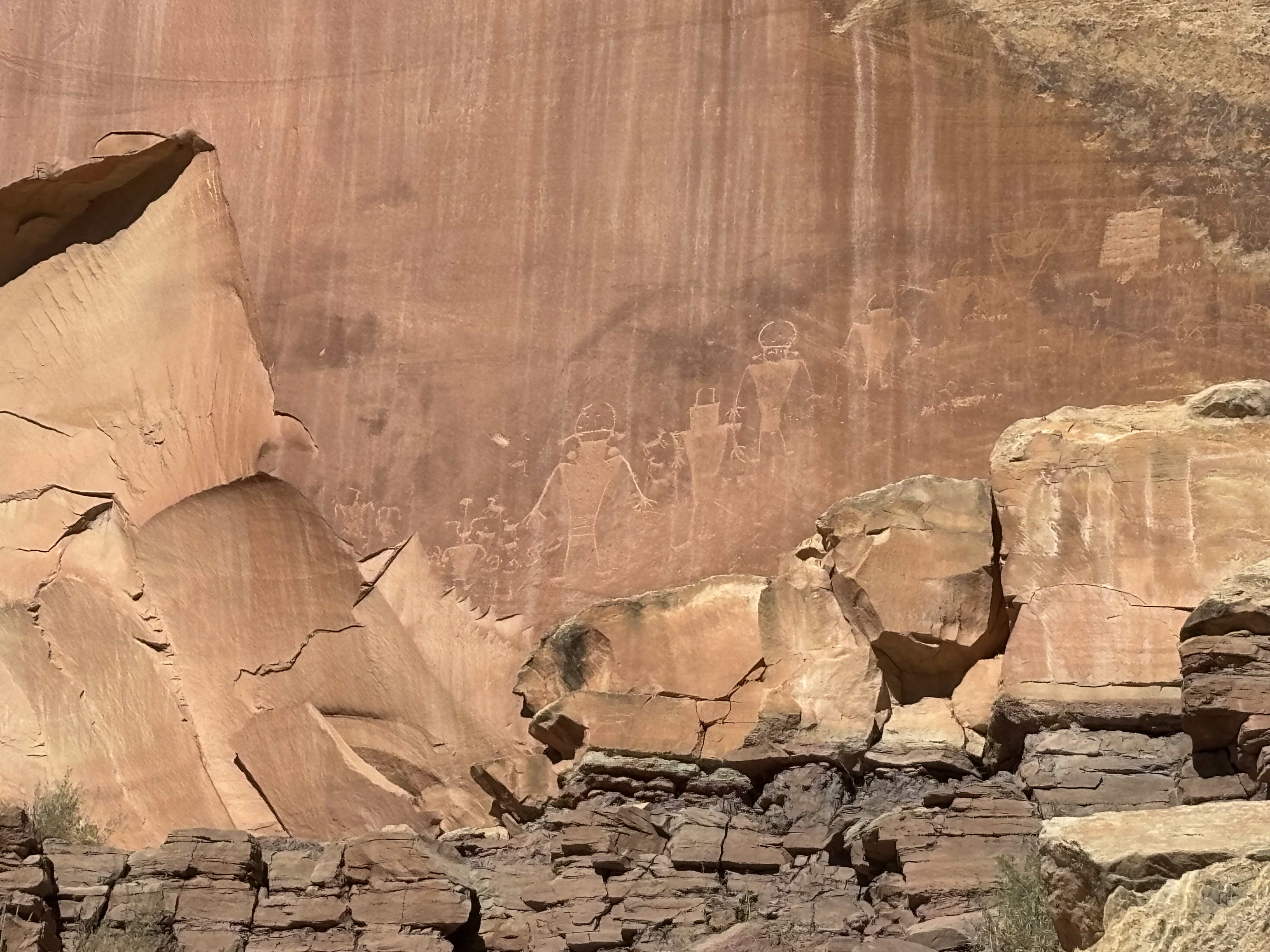
Scratches on the wall. Petroglyphs, the only evidence that remains of a people who once lived in these canyons, who lived by the river we’ve named Fremont. We do not know if they had a name for the river. We do not know if they had a name for themselves. We call them the Fremont, after the river. A location name.

The Fremont River is named for an American explorer, John Charles Fremont, so the people who scratched pictures into the rock over 1,000 years ago also carry his name. As is the nature of history, we locate them from our point of view. We build an identity-structure and civilization-story about them based upon our story of them. We’ve placed them in our narrative timeline, 1 – 1300 CE. We have no idea how they thought of or marked their time.

We have no idea what became of them. They disappeared into time. We have no idea what the petroglyphs mean or why they scratched them into the canyon walls. We wonder at the semiotics, the inner symbolic life that produced such strange (to us) images that remain on the red rock walls.

This morning, through my COVID aches and chills, I watched the news. I would like to say that I am mystified by the civilization-story currently being spun and supported by half of my nation but I am not. I would like to say that the hatred and fear-mongering of the red hat tribe is as much a mystery to me as the way of the Fremont, but it is not. The concurrent xenophobia and wild-eyed-creation of an internal enemy (anyone not in a red hat) has roots that are all too easy to see. It’s a fascist popcorn trail, a page from Hitler’s handbook. The language is identical. The images, scratched into the red-fox-walls of our time are all too easy to interpret. A frightened and misinformed populace is easily manipulated. Fooled.

What is a mystery to me is the inner symbolic life of my nation’s conservatives that seem so ready to trade our sacred democracy for a populist authoritarian. What scratches on the walls of their minds are so easily storied into hatred. What has so hardened their hearts that they embrace with cheers the repulsive bile spewed by their candidate? It is as incomprehensible to me as the petroglyphs of the Fremont.

All societies disappear into time. Ours, relative to the Fremont, is still in its infancy. We can only hope that an explorer in some distant future finds our petroglyphs – and although a mystery to them, we will have known that we transcended the authoritarian threat and overcame the fox-fear-fantasy, manufactured hatred and dark lies. And, over the next thousand years, our scratches on the wall tell the tale of how we matured to fulfill the promise of our sacred ideals. Out of many, one.

read Kerri’s blogpost about PETROGLYPHS

like. share. support. comment. subscribe…thank you.

Not Bad [David’s blog on Merely A Thought Monday]

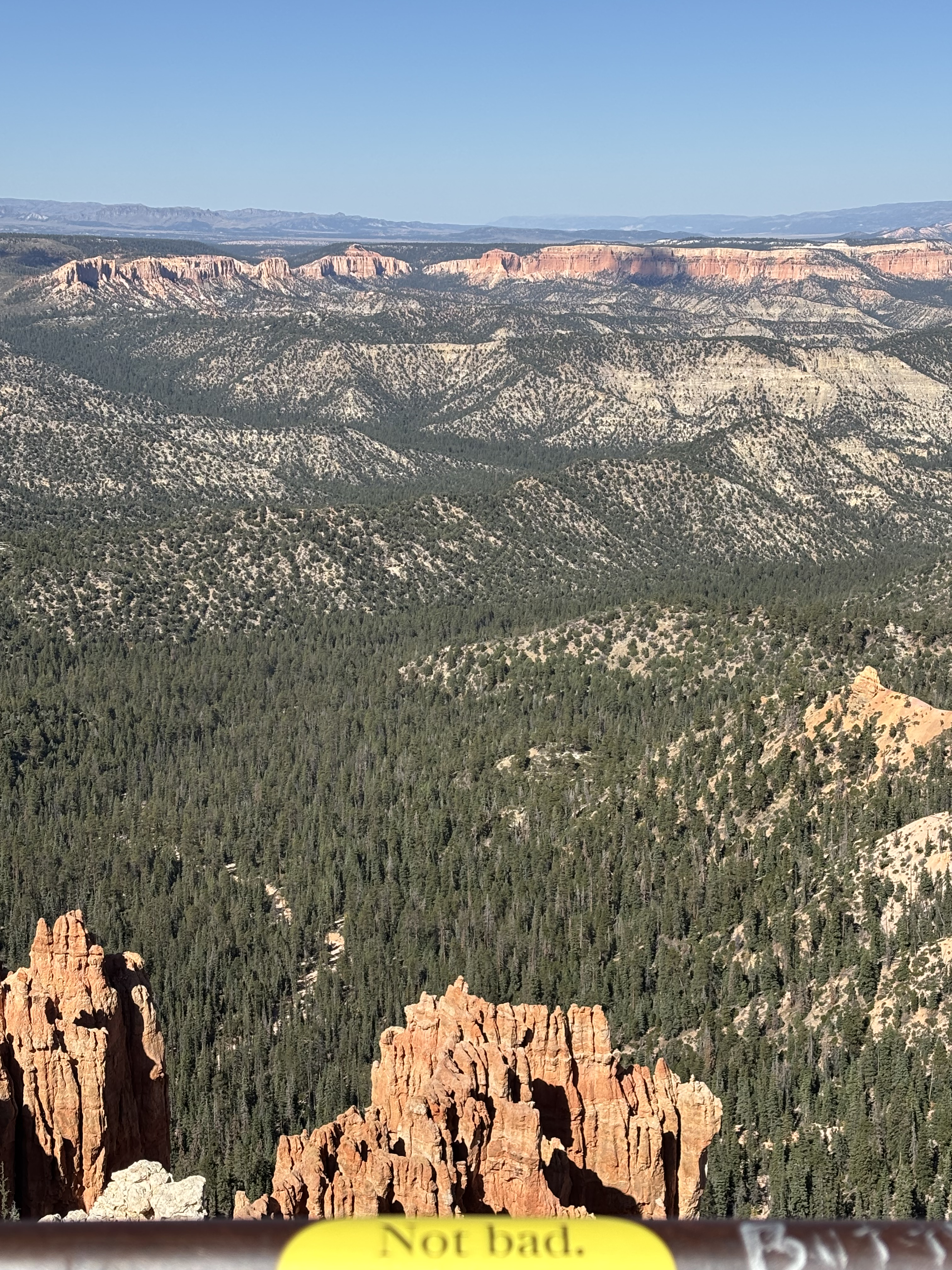
In a fit of understatement, someone placed a yellow sticker on the railing overlooking the sweeping view of Bryce Canyon. It read, “Not bad”. The awe is visceral, “I feel it in the pit of my stomach,” Kerri said. Standing at the edge, as is often the case, words fall short. “Not bad” is as good a phrase of wonderment as any other.

For a moment Gay was overwhelmed. With tears in her eyes she said, “And I get to be here to see it.” There were moments in the past few years that she had every reason to believe that she would not be here.

I was struck by her acknowledgement. It is something that I hope to express every day for the rest of my life. Deep appreciation. “And I get to be here to see it.” Like most people, I let far too many days of this life slip by without realizing or recognizing the astonishing gift of being here to see it.

Every day is as awesome as a peek into Bryce Canyon. Not Bad.

read Kerri’s blogpost about NOT BAD

like. share. subscribe. support. comment…thank you.

Look Around [David’s blog on Merely A Thought Monday]

Strolling on the path through the park, we followed the shoreline. Just at the spot where the path meets the marina, we found an appeal chalked on the walkway: be good people. As Kerri snapped a photo, I wondered who wrote it. Who felt compelled to bring their chalk to the park and petition goodness from passers-by? I wondered if they’d had their fill of bad examples of humanity, snapped-up their chalk, and headed to the original location of social media, the public square.

Or, perhaps it was not a plea but was their wish for us. “My wish for you is to be good people.” Why, on this day, did they feel compelled to make their wish visible?

There are many ideas, definitions and word associations of goodness yet they are bound together by a single notion-thread: consider first the needs of others. Brothers/Sisters keeper. “Good people” reach their hand to assist others.

I gathered a few words used to characterize “good people”: Empathy. Consideration. Accountability. Compassion. Kindness. Each word, each characteristic, is other-people-focused. “How can I help?” Share, because there is plenty-enough for all.

As Kerri took a picture of the message I jumped into a memory, a time of desperation. Some thought-angel dinged my noggin and sent me out into the city to witness acts of kindness. As I have previously written, I saw generosity everywhere I looked. People being good in small ways and large. Opening doors. Paying for a stranger’s cup of coffee. Holding up traffic so a senior could safely cross the street. Asking the bus driver to “Wait a second!” – someone was racing to catch the bus. A second made all the difference for someone.

Those good people, everyday people doing everyday things, buoyed me, filled me with hope and light. If I’d had chalk in my pocket on that day I might have scribbled on the sidewalk, “Good people are everywhere! Look around!” I saw them because I decided to look for them.

If I’d had chalk in my pocket, after Kerri was finished with her photograph, I’d have written a message for the “Be good people” writer: “Thanks for the reminder. See good people”.

They are everywhere.

read Kerri’s blogpost about BE GOOD PEOPLE

like. support. share. subscribe. comment…thank you.

Check Your Stems [David’s blog on KS Friday]

Wild Carrot. Queen Anne’s Lace. Throughout every season we find ourselves marveling at the aesthetic structure of the plant. The graceful curves and shapes. They inspire movement and floral symbols in my paintings.

Summoning the Oracle, Google, I learned that a common question asked is how to discern Queen Anne’s Lace from poisonous Hemlock. They are surprisingly similar in appearance. “Poison hemlock stems are smooth, while Queen Anne’s Lace stems are covered with tiny hairs…” The moral of the story? Check your stems.

Check your stems.

The verb form of the word ‘stem’ concerns origins. Comes from. Arises from. For instance, the stem of the word ‘democracy’ arises from ancient Greece. The word literally means the people (demos) rule (kratos). “Democratic government is commonly juxtaposed with oligarchic and monarchic systems, which are ruled by a minority and a sole monarch respectively.” Healthy disagreement, opposing points of view expressed without fear en route to compromise, is the beating heart – the stem – of a democracy.

The stem of the word ‘fascism’ comes from Latin and means, “bundle of sticks,” – the visual symbol evolved to include an axe at the center of the bundle, representing “a way of organizing a society in which a government ruled by a dictator controls the lives of the people and in which people are not allowed to disagree with the government.” Elimination of opposing points of view is the stem of fascism.

“Fascism’s origins are…ultimately centered on a mythos of national rebirth from decadence.” You could find no better or clearer tag line for a fascist intention than Make America Great Again. You could not pen a better blueprint for the fascist overthrow of democracy than Project 2025. The forcible suppression of opposition. Political violence as a necessary means of national rejuvenation, the demonization of the “other”.

As demonstrated in their gathering in Milwaukee, the reds are now a perfect expression of their symbol: a bundle of tightly bound sticks in lock-step – with an axe hanging over their heads ready to eliminate any voice of opposition. It turns out, like their sycophantic VP pick, many of these men and women, who once called their supreme red leader “America’s Hitler” and “a wannabe dictator”, were right. Sadly, they lack the courage of their convictions. They fear the axe. They lack a basic grasp of the necessity in a healthy democracy for genuine voices of opposition.

Is it rule by-the-people-and-for-the-people or a fascist autocracy?

How can we discern democracy from poisonous fascism? Check the stems.

Open your eyes and look, really look. The red hats have wrapped themselves in the flag so they might appear like the Grand Old Party. They are not. To anyone undecided or confused or jaded, I can only offer this advice: it’s important to check your stems before you ingest too much fascist hemlock believing you’re dining on democracy.

This Part of the Journey on the album of the same name © 1997, 2000 Kerri Sherwood

Kerri’s albums are available on iTunes and streaming on Pandora and iHeart Radio

read Kerri’s blogpost about WILD CARROT

like. share. support. comment. subscribe…thank you.

Doodlebug It! [David’s blog on Not So Flawed Wednesday]

Some words are just too yummy to ignore. For instance, doodlebugging! Who wouldn’t want to toss that delicious word into almost any conversation-salad or happy poem? “The poor man was doodlebugging to no avail!” I am surprised that doodlebugging escaped the keen word-eye of Dr. Seuss!

Doodlebugging means to dowse or divine for treasure or petroleum. I ask myself, “What would I rather find, petroleum or treasure?” Well, I guess I would need more information. What kind of treasure? I imagine myself diligently doodlebugging in the backyard, my “Y” shaped stick goes wild! I dig a deep hole. Kerri stands on the deck, none-too-pleased with my doodlebugging destruction, until I leap into the hole and pull up a hefty pirate’s treasure, complete with many gold doubloons!

And, if I don’t divine for imagined treasure, I need to know whether or not I own the rights on the land I am doodlebugging. There’s no sense in doodlebugging for oil if someone else gets the profits for my newly dowsed black gold, texas tea.

I’ve decided that our poor sad nation needs a good doodlebugging. Despite the rhetoric, petroleum won’t cure what ails us so I suggest we doodlebug for treasure. Specifically, we seem to have lost our most valuable treasure: our moral compass. It has to be out there in the grass somewhere. Perhaps if neighbors across the land, regardless of political affiliation, met in the front yard or on the street, each with a handy “Y” shaped stick, and began a serious doodlebugging project in search for that pesky compass, together we’d find what we seek. A common cause which, after all, forms the foundation for unity and provides the seeds for ethical decision-making. Ethics are usually surfaced – or resurface – when people decide to serve something larger than their own interests.

We used to have one. I mean a common cause. It was called the Constitution, a document that framed, guided and preserved our democracy. Toward a more perfect union. By the way, union means ‘joining’ or ‘uniting.’ It’s what makes our common cause, in the midst of so much rich diversity, more perfect. The challenge is that the Constitution is lost or in hiding. Parchment is notoriously hard to doodlebug. One person will never find it. So, maybe if we all meet together in the front yard, armed with a harmless stick and a good intention, shake hands, laugh a little, and work with the people we so dearly love to vilify, we just might find the medicine our divided-against-itself nation needs. It’s hard to hate someone once you meet them in person, talk for a spell about family, food and “So, what do you do for work?”

A little friendly neighbor-chat while doodlebugging together will do away with the abstractions, labels, and dial-down the fear-mongering. In our common search for the lost compass, we just might learn that we have more in common than we’ve been led to believe.

read Kerri’s blog about Y

like. share. support. comment. subscribe…or go meet, talk and doodlebug with someone new! thank you.

A Dream Itself [David’s blog on KS Friday]

I awoke this morning with a line from Hamlet running through my mind: “There are more things on heaven and earth, Horatio, than are dreamt of in your philosophy.” What dream, what night-wander was I following that made me bob to the surface with a line from Hamlet as my first thought of the day?

Sometimes I use Google like I use the i-Ching. A divining tool. I called up the phrase from the mighty Google and read two opposing opinions of the meaning of the line. Of course. Divining tools generally cast a broad net. The first writer interpreted the line to mean that the human imagination has limits; there is so much that we don’t know and cannot yet imagined. The second interpretation was stated with absolute authority. This is what Shakespeare meant! “One must believe what he or she sees. Even if they previously did not think so, the real evidence should change their mind.”

Evidence or the limits of imagination? Evidence as the limiter of imagination? I was no closer to answering my dreamtime question but I was affirmed in the dynamic nature of perception and interpretation. What a great play!

Living as we now are, in the advent of A-I, one must not believe what he or she sees. I have no idea what Shakespeare meant – we never discussed it – but I am certain that what one sees is no longer evidence of anything. What one hears requires vetting. There are more things on heaven and earth than Shakespeare could have possibly imagined. Our world is beyond his dreaming or he might have suggested to Horatio that he must question everything he hears and challenge everything he sees.

And, about my dreamtime question? I’ll leave that, too, to Hamlet: “A dream itself is but a shadow.”

Kerri’s albums are available on iTunes and streaming on Pandora and iHeart Radio

read Kerri’s blogpost about THE NIGHT

like. comment. share. subscribe. support. thank you!