Step Out Of Line [on Merely A Thought Monday]

“…the fountain of creative work is an intelligent questioning of the rules.” ~Alan Watts, Tao: The Watercourse Way

“If someone tells you they know, they most certainly do not.” It’s not a direct quote from Quinn but it’s close enough. Art school almost snuffed the art in me; there were so many rules and nary a hint of curiosity allowed in the studio. I fled into the theatre after a single year for fear of losing my heart to a book of rules. My theatre professors were explorers of nature. Their refreshing mantra was, “Well, let’s find out!”

What if…? What happens if…?

Nature is boundless expression. Boundless expression is human nature, too, until it is taught otherwise. Boys don’t cry. Be a good girl. Sit in your desk. Follow the rules. There’s a right way. My way or the highway…So much effort to force nature – your nature, your curiosity, to stand on a line.

Einstein revolutionized our world because he dared to posit that Newton had it upside-down. Thank goodness, as Alan Watts observed, “The scientist and the mystic both make experiments in which what has been written is subordinate to the observation of what is.” In other words, they look beyond established belief, expectation and entrenched norms into what is.

What is? Curiosity. A desire to know what’s over that hill. No child begins their life-walk by desiring to color within the lines. Lines are a learned thing. The word “wild” was invented by people whose ancestors emerged from the woods and who have forgotten that they, too, are part of nature – so have become afraid of stepping into the woods. What might they – we – find there?

“It’s not an idea problem,” David Burkus wrote in the HBR, “It’s a recognition problem.” Stepping beyond the known – a great definition of curiosity – is too often seen as an aberration or an assault upon authority. Nip it in the bud. Forcing flow into a fixed state invariably causes idea-blindness and the imperative to think-outside-of-the-box. Innovations are too often smothered in the crib by “What we know,” or “We don’t do it that way.” Coloring in the lines, once ingrained, is a life-long-book-to-follow.

I wish I had a nickel for every time I’ve been invited into an organization or hired by a client to help them “see what they cannot see,” and then subtly or not-so-subtly, been rebuked for opening their eyes to what is in plain sight…or the availability of alternative paths. “We want a vital arts program but we only want art that entertains,” said the school board after the student play asked a serious question of their audience. “…the scholastic theologians would not look through Galileo’s telescope because they considered that they already knew, from Scripture, the order of the heavens.” (Alan Watts)

Think outside the box – as long as you stay within the model or the expectation or the rules. So many models. So many lines. So in love with the struggle and afraid of the simple, natural joy of curiosity. Bend your will to the line. See what you are supposed to see and look no further. What, exactly, are we trying to control?

read Kerri’s blog post about CURIOSITY
Arrive At The Essence [on Two Artists Tuesday]

This past Saturday we passed a milestone. We began writing our Melange on February 12, 2018, four years ago. We’ve published 5 days a week, every week, no matter what chaos or crazy storm blew through our lives.

Our Melange has moved through many phases. Originally, we wanted to regain some control over the publication of our music, paintings, plays, children’s books and cartoons. In our first post I called it our “pile of creative perseverance.” Also, we wanted to make a living from our mountain of work so we set up Society6 storefronts and spent hours each day developing products based on what we published. It was a blast and a total bust.

Eventually, the stores fell off, the daily themes changed, and we arrived at a pure essence: we love to sit together and write. Each day. There’s always a visual prompt, mostly from photos Kerri’s taken during the week. There’s only one rule: we can’t read or know what the other is writing about until we’ve completed our drafts. And then we read to each other, talk about our posts and clean them up. It’s my favorite thing to do. It feeds our hearts, energizes our artistic souls and that is more than enough.

Somedays I feel as if we are writing ourselves into existence. Our Melange is the story we tell each other – and you – of our life together. It’s a continuation of the Roadtrip, the daily emails we wrote to each other before we met. And, if the Roadtrip was a narrative offering of “this is me,” the Melange is a narrative offering of, “this is us.”

We launched the Melange with this Chicken Nugget (below). I wrote, as an introduction in the inaugural post, that this Nugget – and the Melange – was “a quiet reminder that the universe of feelings was – and is – so much bigger than words can possibly contain.” Ironic, yes? Coming from two people who, each and every day, write words as their way of reaching into this vast universe of feelings.

Thank you for reading what we write. We appreciate every step you take with us on our journey.

read Kerri’s blog post about 4 YEARS

chicken marsala © 2016 kerri sherwood & david robinson

the melange © 2018-22 kerri sherwood & david robinson

Gurgle On! [on DR Thursday]

I’m certain the first time I tried to walk I was not successful. A few stumble-steps and a return to the floor. My first attempts at speaking the English language did not receive a passing grade. As I recall (and I don’t recall), I made some gurgling sounds into which the adults surrounding me projected meaning. I’m certain they cheered and encouraged me to gurgle-on.

Learning is not a terribly difficult thing to do when 1) there’s a reason to do it, and 2) judgment, including words like “success” or “failure” are absent from the experience. Thank goodness my first art teacher treated me like an infant and, rather than critique my mess, she encouraged me to gurgle-on. Consequently, I associate my artistic impulses with fun and exploration instead of the thousand shades of rignt-and-wrong that most people are subjected to.

Recently Skip wrote and asked, “What’s the second rule?” Suspend your judgment and learn.

We just bought a mandoline. It slices and dices and chops and cuts. “The first thing we’re going to make is potato chips!” Kerri proclaimed. And, then, her brow furrowed. “What if we do it wrong?”

“We’ll learn something and make another batch.” Trial and error. Both “trial” and “error” are essential ingredients in the learning process and, since all of life is a learning process, you’d think someday we’d learn to value the “error” portion of the experience. We do ourselves a great disservice placing so much emphasis on passing the test and having the “right” answer. The essential ingredients of trial and error can’t breathe in brains fogged by so much right-and-wrong-ness.

Our first batch, like our first baby step, was a stumble. But more delicious. We stood over the pan eating our result and discussed second steps. What should we do differently next time? Less heat or more? Thinner slices or thicker? This is all I know. I love to learn, especially when food is involved and judgment is not.

read Kerri’s blogpost about POTATO CHIPS!

flawed cartoon © 2016 david robinson

Taste And Adjust [on Merely A Thought Monday]

In our kitchen, I am the sous chef. Second in command. I chop, slice and dice. Then, I place my colorful preparations in glass bowls, carefully arranged relative to the stove so the chef need only reach to add an ingredient to her magic-making. “What’s first?” I ask. “Onions and garlic,” the chef replies, tying on her apron. I know the answer before I ask but it’s our ritual signal, like the kitchen version of “On your mark,” to the runners at the starting line. The onion steps onto the cutting board.

We love to cook together. I have learned through the many phases of my life that my relationship with food mirrors the relationship I have with life. If I attend to the the palette of tastes and textures that I eat, if I take the time to savor and appreciate my food, I carry that attention into every moment of my day. If I rush through and jam any food-like-object into my mouth, I carry that same inattention into my life. Appreciation, savoring, is mindfulness. Slowing down to plan and fully fill the palette of flavor fosters anticipation. Moving through a grocery store or farmer’s market is a wholly different affair when favorite recipes call.

I did not arrive easily at my understanding of food and life. The first recipes I tried were utter disasters. Don’t ask BK about my inaugural batch of lentil soup. It will send him into waves of horror-laughter. I ate it to prove that my cooking was not so bad but could not hide that my soup nearly killed me. And, I remember the moment that I decided to learn to cook. I remember like it was yesterday the understanding that sent me to the stove: I wanted, perhaps for the first time in my life, to take care of myself. More than that, I wanted to fully taste the richness of being alive and to do it, I had first to stop running. One must stand still to fully taste. To savor, one must stand still with others. “What do you think? Kerri asks, “More salt?”

Experimentation, trial and error, are the only way. Taste and adjust. And, isn’t that a terrific life credo?

In the recent past, each week, we try new recipes with 20. We’ve discovered some incredible flavors, our repertoire is expanding. Soups and chilis and stir fry. Mostly, that we intend to make meals together, that we slow down and enjoy each other’s company en route to a new taste, an ingredient that we can’t pronounce, a spice that is unknown. “This might be a disaster,” we say as steaming bowls of deliciousness hit the table. “Well, there’s only one way to find out,” we say as we click together our spoons and dive in.

read Kerri’s blogpost about EATING WELL

a photo from before the pandemic. we can’t wait for this to end so we might create more memories like this one.

Feed It [on KS Friday]

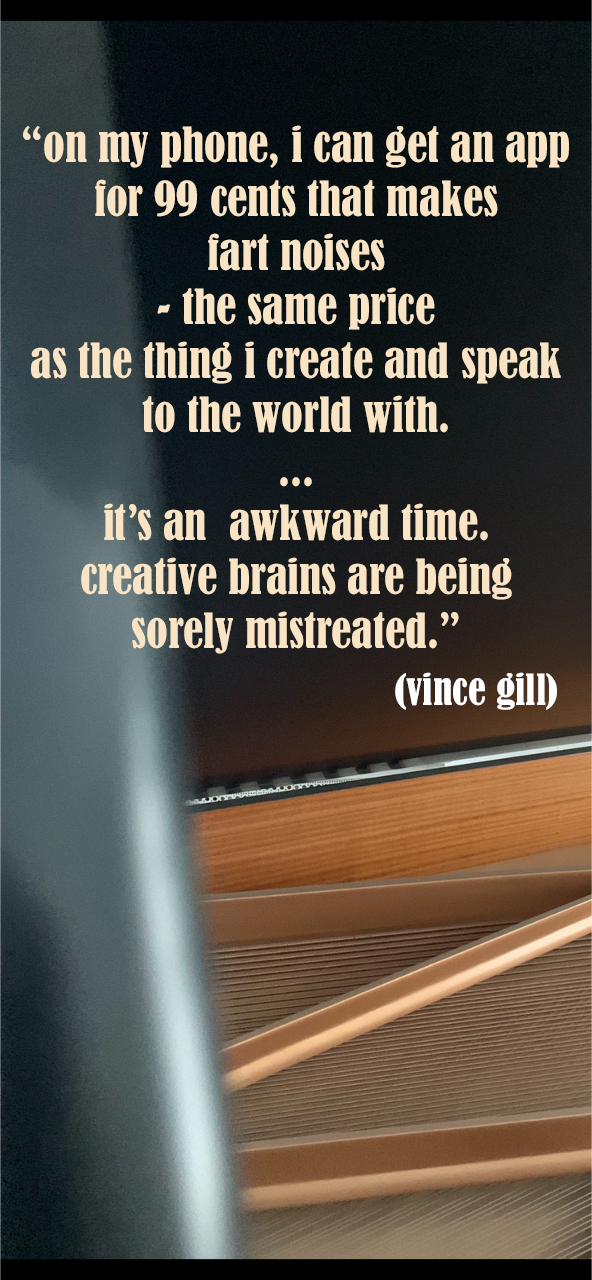
“The devaluation of music and what it’s now deemed to be worth is laughable to me. My single costs 99 cents. That’s what a single cost in 1960. On my phone, I can get an app for 99 cents that makes fart noises – the same price as the thing I create and speak to the world with. Some would say that the fart app is more important. It’s an awkward time. Creative brains are being sorely mistreated.” ~ Vince Gill

I am the first in line to tell you that everyone has a creative mind. Everyone. That river of ridiculousness running between your ears is nothing other than creativity-run-amok. What else? Telling yourself that you are not creative is, in itself, a creative act. Seeds planted early in life grow into mighty obstructions. Creative wastelands are created. If you want to hear a terrific appeal to educators to nurture rather than stifle the creative mind, listen to Sir Ken Robinson’s 2006 Ted Talk. It’s appropriately titled “Do Schools Kill Creativity?”

I’ve listened to numerous school boards tell me how much they truly value the arts – until it’s time to pay for it. Sadly, it’s not a question of whether or not they value the arts; it’s that the arts, the creative minds, do not fit any of the standards of valuation against which all things are measured. They do not know how to value the creative minds that they steward. Arts organizations and artists, mostly, are not money makers. Creative minds, creative acts, do not fit in the boxes and are not measurable on standardized tests. Thinking outside of boxes is, after all, the point of a creative mind. Metrics and goals stop a creative mind and heart in its tracks. The cruelest thing you can ask any artist to do is write a grant.

And yet, an artist has to make a living. Yaki asked me if I had to choose between making a living and making my art, which would I choose? I answered, “Art, of course,” but that it was really a question of Maslow’s hierarchy: it’s hard to make art when you are not surviving. What I didn’t say is that his question perfectly captured the reason schools kill creativity and creative brains are sorely mistreated: it is assumed one must choose between. Making a living and thriving creativity are understood as oppositional.

How many parents have tried to dissuade their children from following their passion for the arts? How many times have I heard Kerri say of the stacks of music on her piano waiting to be recorded, “What’s the use?” How many times have I sat in my basement studio looking at my stacks and rolls of paintings and wondered, “Why bother?” We do it to ourselves, too.

And then, the phony metric falls and we breathe, pick up our brushes and sit at our keyboards. There is a river of riches that runs deeper than money. It is, after all, a creative act to kill a passion. It’s also a creative act to feed and nurture an artistic soul. Both. It’s what the school board doesn’t understand: the choice is not between making a living or living as an artist, the choice is between feeding inspiration, expanding a creative mind, or smothering it.

read Kerri’s blogpost about CREATIVE MINDS

Kerri’s albums are available on iTunes and streaming on Pandora

watershed/as it is © 2004 kerri sherwood

Jump Out Of Your Chair [on KS Friday]

If I want to think clearly – or clear my thinking – I walk. Sitting still has always been and continues to be an invitation for thought-log-jams. It was a problem when I was a student. Classrooms come with desks and an expectation that the learner will sit still. I became a master of the controlled wiggle, not because it broke the logjam but because it helped maintain my sanity. For me, sitting still is like a hair shirt with an itchy tag. Sitting still makes my IQ plummet several points. Sitting still interrupts my synapses.

Tom Mck told me that the alternative schools were populated by artists. I intimately understood his observation. Artists need to move to think. They thrive in an alternative to still-sitting.

I’ve made sure that my work throughout my adulthood included movement. Directing plays. Painting big paintings. Facilitating workshops. Even as a teacher I cleared the room of desks. This morning I saw a headline in Forbes Magazine declaring that children learn more through play than through guided instruction. It was curious to me that this was a headline. Sugata Mitra’s been shouting the news for decades. Neil Postman spent his life reading the research and advocating for what the research implied: turn little people toward a passion and get out of the way. Curiosity and desire are an unbeatable team. They will move faster than you might imagine. Move, move, move. Dance. Paint. Sing. Construct. Act. Play. They will let you know when they need you.

I’m learning the lesson again. My work places me squarely in front of a computer for hours each day. Flow. Eddy. Logjam. Wiggle. Move. Sigh, as the synapses start firing up again. Repeat. At this advanced stage of earth-time, you’d think I’d have grasped the full understanding that, for me to be effective, I have to move around. Each morning I review the previous day’s work and immediately know whether or not I found a movement/sitting-still balance.

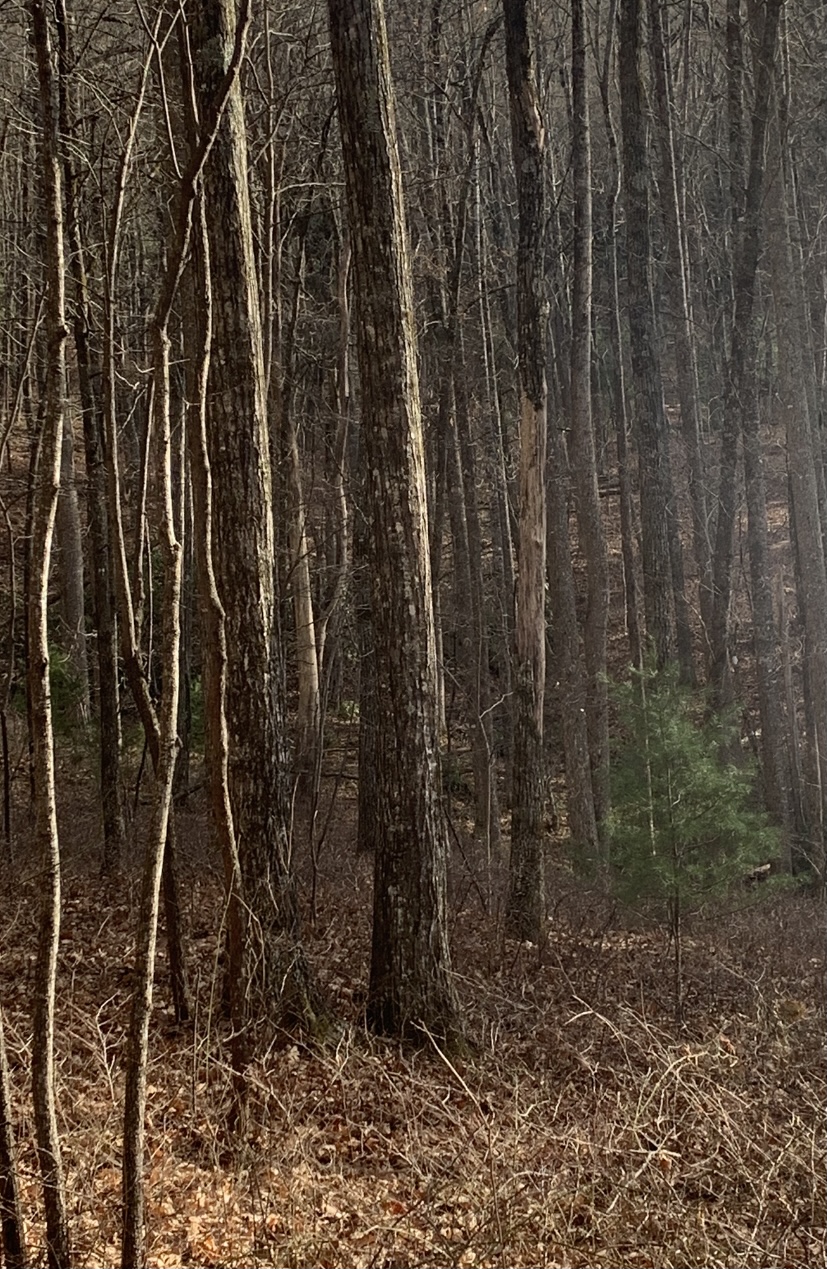
When we stepped on the trail and entered the woods in North Carolina, my mind was chock-full-of-thought-logs. Like everyone else, I stare at the screen and lose track of time. A day can pass me by and I never leave my swivel chair. I swivel for survival. For months, I’d been swiveling and forgetting to stand up and dance my ideas. Fifteen minutes into our hike, the jam broke free. My mind cleared. I could see the subtle landscape inside and outside. I breathed a deep breath. The forest was gorgeous. My mind was spacious and flowing! I resolved, once again, yet again, to attend to the necessity of movement that keeps my mind and heart flowing. Wiggling is maintenance, merely. Swiveling is not a solution. The real game, the full flow, is only available when I jump out of my chair and move-it.

read Kerri’s blog post about THE FOREST

Kerri’s albums are available on iTunes and streaming on Pandora

meander/as it is © 2004 kerri sherwood

Look Down [on DR Thursday]

To all the rugged individualists out there living under the grand illusion that you are blazing a new trail, I have only one thing to say: look down. Someone has been there before you. It’s why there’s a path. And, more to the point, someone – a crew of someones – worked very hard to make and maintain the trail you now tread. It’s true in the forest. It’s true in the big-bad city. Every time we flick a switch and the lights come on it might not be a bad idea to recognize how many people were – and are – involved in the maintenance of our comfort and our self-reliance-fantasies.

On the Pink Bed trail there’s a boardwalk that elevates hikers over the swampy sections. I stopped in utter admiration at the section that took a hard left. Someone – a crew of someones – spent a long time making my corner not only easy to walk but beautiful. Certainly there are more efficient ways to build a turn in a boardwalk and they could have chosen any number of simpler solutions but they didn’t. They took the time to make their work functional, sturdy, AND aesthetic.

Daniel was building a house on the lake. He only builds one a year these days, mostly for fun. He invited us in. Far from being finished, the craftsmanship was exposed. The joints were meticulous. The lumber he chose was solid. The materials mattered. There was beauty in the structure and he was proud to point out the love taken in every step, even the roughest stage of the build. The eventual buyers would never see or know the care alive behind the drywall. They might never fathom the depth of effort and design involved in making their comfort – their triumphant lake home – a possibility.

Horatio and I talk often of the deep philosophical divide in these un-united-united-states. The every-man/woman-for-him/herself camp is at odds with the I-am-my-brother/sisters-keeper folks. I understand the appeal of the self-made-man/woman story but I also recognize it to be mostly a fantasy. Sir Edmund Hillary understood that standing atop Everest, celebrated as the first, was only made possible by the efforts of hundreds of Sherpa, months of expedition planning by John Hunt and team, financing, travel arrangements, government officials, 8 previous unsuccessful expeditions, and the good graces and guidance of Tensing Norgay.

We’d be better off if periodically we stopped and simply looked down.

read Kerri’s blog post about the BOARDWALK

prayer of opposites © 2003-4 david robinson

Sing, “EEE-AAAWWW!” [on Two Artists Tuesday]

Drive across the country with Kerri and one thing is certain to happen: the moment she sees a donkey, she bursts into a rousing chorus of “EEE-AAAWW-EEE-AAAWWW!” She loves donkeys. She wants one. Or two. “They’re like big dogs,” she assures me. I have my doubts but I confess to picking up her quirk. Now, if I spot a donkey before she does, I point and launch a festive “EEE-AAAWW!”

Bill and Linda have two donkeys. We arrived after dark so had to wait until morning to go to the barn for a donkey-confab. She wiggled all night with excitement. “Smack-dab material,” I thought. I’ll be drawing cartoon donkeys soon. I can’t wait to figure out how to make the Kerri-cartoon character wiggle in anticipation.

Linda knows of Kerri’s donkey-love so she had donkey treats ready. I stood back and watched. “This is my future,” I thought. “Can I have another?” Kerri asked and Linda smiled, handing over the plastic container of orange donkey-cookies. Those lucky donkeys hit the cookie lotto.

Donkey cookies. Who knew! There’s more amazing wonders in this world than any of us can comprehend. Stand outside of anyone’s world, peer in at their passions, and you’ll have to try hard not to drop your jaw in fascination. From inside their world, the quirk seems boringly normal. I try to remember that when people stand agog at something in my world that seems normal-to-boring. “What’s the big deal,” I think.

People are great at reducing the magic in their lives to seem insignificant. I’m a “people” so, like all people, am guilty of my own diminishment. Beware of the word, “normal.”

Bill and I bumped fists. We are brothers-in-quirk. While Kerri and Linda stuffed the donkeys with cookies, Bill and I talked about the-things-that-come-out-of-our-mouths that get us into trouble. We think they are obvious. Ordinary. But, the response to our commentary indicates otherwise. He just retired from a board position and, his peers, in their farewell speech, described him in two words, both beginning with the letter “o”: outspoken and opinionated. All laughed. “It’s true!” he said, “And I’m proud of that,” and added, “No one wants to be a rubber stamp.”

What a perfect summation. EEE-AAAWWW-EEE-AAAWWW. Donkey cookies! Magic-in-the-ordinary. No one wants to be a rubber stamp.

read Kerri’s blog post about DONKEYS!

Gain The Force [on KS Friday]

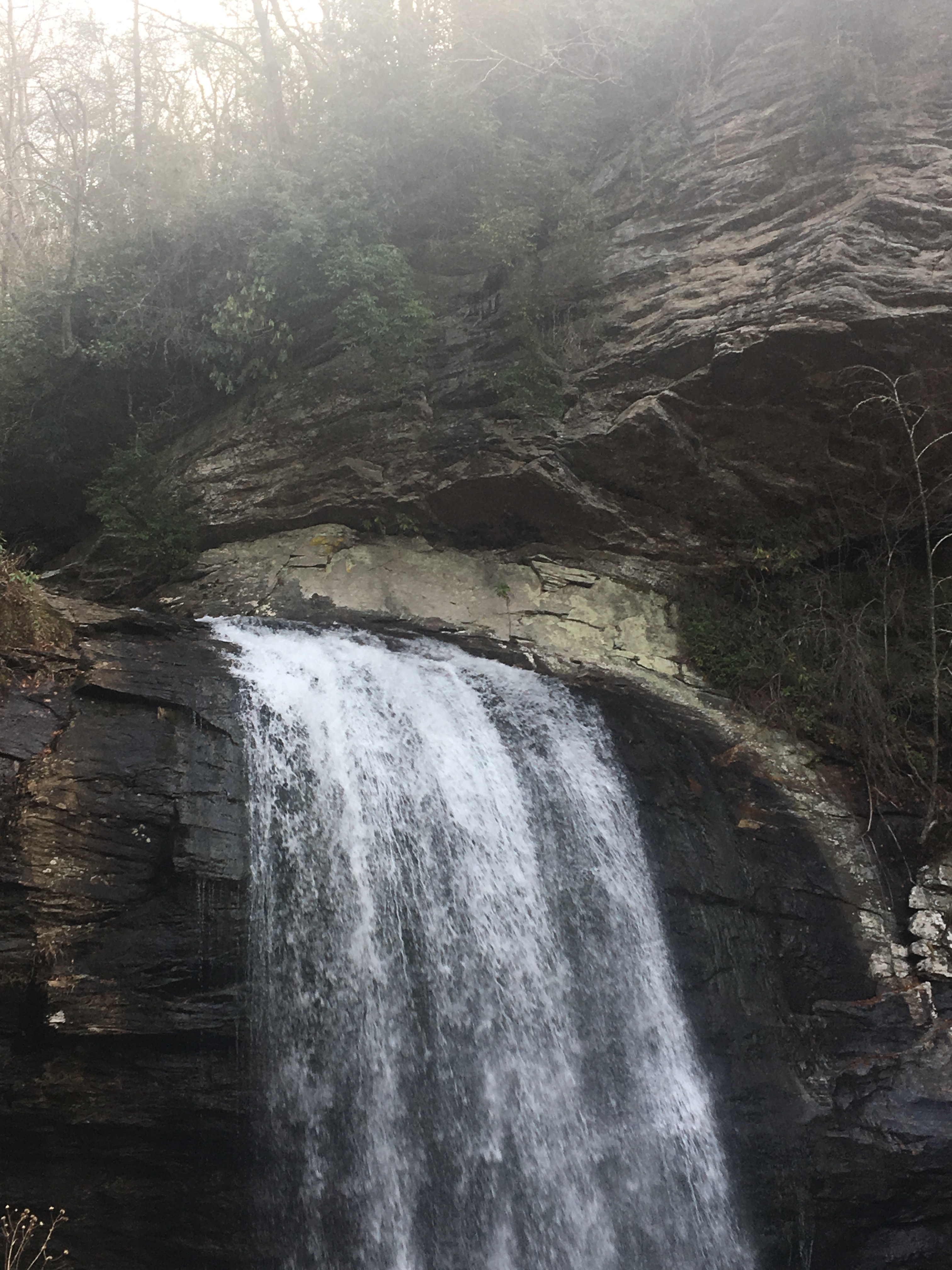
It seemed appropriate, in order to conclude our year of water, that we travel to visit a region of the country with 250 waterfalls. Of course, we didn’t know about the waterfalls until we arrived. Water, water everywhere. I howled with laughter and secretly affirmed that our unintentional pilgrimage to the waterfalls might appease the great WHATEVER and finally release us from water-resistance into the watercourse way.

I will someday look back at our journey to the falls and realize the extent to which we “let go.” It already serves as a marker, a breaking through the resistance and fight of the last chapter and into the next. The new chapter.

Yesterday, at work, I had the opportunity to tease apart a question en route to asking a better question. I am fortunate to have a team of collaborators that, instead of rejecting my alternate perspective outright, even amidst the frustration of my challenge of the norm, ask me to lean into it. My assignment was to return next week with a better question. I am a firm believer that the form of a question – the way that it is asked – determines the answers that are seen or – more importantly – not seen.

Better questions are like the watercourse way. They show up when, instead of swimming against the current, against “what is,” the swimmer/questioner turns and allows the current to carry them. Wu-wei. Natural action. Every creator knows the moment of frustration when trying to force something into being. More force can only produce more frustration. Or, it breaks something. The best thing to do, when force can only produce an eddy, is put down the brushes, step back, and look at what-is. Force never produces a better question. Stepping off the mountain so it becomes visible – or acknowledging the direction of the river’s flow and giving into it, always reveals new possibility.

It is what I remembered for myself at the waterfall. It made me chuckle, then, when my first moment back at work, I was doing for my team what I’ve done all my life: attempting to flip or free a perspective by lobbying for flow; acknowledge what exists-in-the-moment versus what we want to exist. The better question – for me – and others – is always found when we turn and gain the full force of the river.

[I can’t imagine a better piece of music to carry us into 2022. Give yourself a treat – truly – and listen to Riverstone]

read Kerri’s blog post about THE WATERFALL

riverstone/as it is is available on iTunes or streaming on Pandora

riverstone/as it is © 2004 kerri sherwood

Get Lost [on DR Thursday]

“A person who never made a mistake never tried something new.” ~ Albert Einstein

Recently, I revisited Sir Ken Robinson’s TED talk about schools killing creativity. Among his many points, the central idea was simple and clear: we reinforce knowing answers instead of the pursuit of the question. We reinforce “being right” when the beating heart of learning, the vibrant center of creativity, the foundation of scientific process, is to try-and-see-what-happens. To be “prepared to fail,” as he said, is to remove failure from the equation. A curious mind seeks discovery, not “rightness.” An experiment is meant to test a hypothesis not immediately arrive at the answer.

When Kerri and I stepped onto the trail, new to us, the signage was more than confusing. “It’s a loop,” I said, “What’s the worst that could happen?” We chose the orange trail and started walking. We followed the blazes rather than the signs. A storm or drunken ranger must have erected the signs because they were often out of alignment with the blazes. “If we followed that sign, we’d be in the creek,” Kerri said.

Early on in our hike, a man came crashing out of the woods. “Is this the trail?” he asked. “I think I’m bushwhacking,” he said. This man, I suspect, followed the signs. He was having a great time but was somewhat relieved to be back on the beaten path. He was the first of many. A woman stopped us. She and her husband were having a disagreement about which trail they were taking. “Is this the long or short loop?” she asked. We shrugged, a shadow of concern creeping up in the back of our minds.

There was supposed to be a waterfall somewhere on the trail. We asked more than a few people as we passed and received a marvel of contradictory instructions. “There’s a side path on the left.” “Somewhere ahead you’ll see a side trail on the right.” We took option B and had a lovely trek up the mountain but turned back when it became apparent that our choice did not include the waterfall. “Next time,” we said. It was late in the afternoon and we wanted to be back at the car before sunset.

With tired legs and lack of trust in the signage, we came to a trail crossroads. Orange went in three different directions. The sign that pointed the way to the parking lot did not inspire confidence but we followed it anyway. We passed an older couple, local hikers, that assured us we were on the right path. A couple crashed out of the woods, having lost the trail but were equipped with a GPS app: we were definitely headed in the right direction but had more than a mile to go to get back to the car.

“It does not feel good to feel lost,” we agreed. “Especially when the light is waning.”

Arriving back at the car, breathing a sigh of relief. “That was fun!” we laughed. “And stressful at the end.” We were never actually lost but we were successful at filling ourselves with doubt. We were grateful for the older couple that reassured us, the lost couple with the GPS that broke out of the woods exactly when we needed them.

And, we learned a lesson. Next time we’ll take the time to study the map. And, we’ll be equipped with a better app. Our lostness was always in our minds, in our doubt. The next time we lose ourselves in second guessing – and it is certain to happen – we’ll be better equipped to handle our self-imposed-disorientation.

In the meantime, we’re already whipping it up into a great survival story. I didn’t mention the bears or starting fire with flint and steel. Building a survival shelter from twigs. That version, the real story of our heroic adventure, is certain to come soon. Lostness, it seems, stimulates fabulous creativity.

read Kerri’s blog post about THE MOUNTAIN