Melt And Hammer [on Merely A Thought Monday]

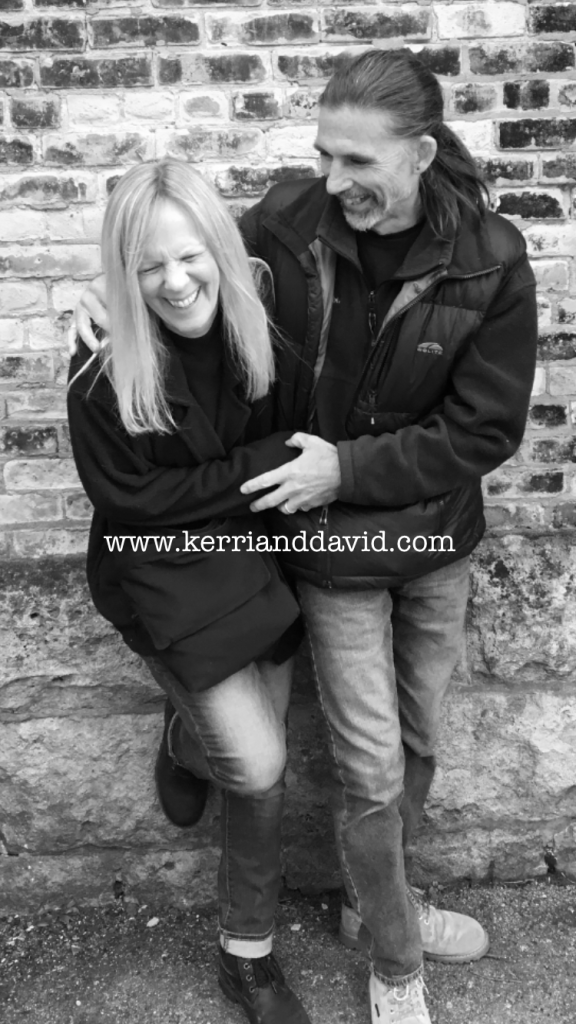
We are easily entertained. Once, we nearly crashed the car laughing-so-hard at the names we gave to our alter-egos. Who drives around naming their alternative selves? We do. Sit us in a corner and we’re pretty good at finding something to do.

Art enables us to find ourselves and lose ourselves at the same time.” ~ Thomas Merton

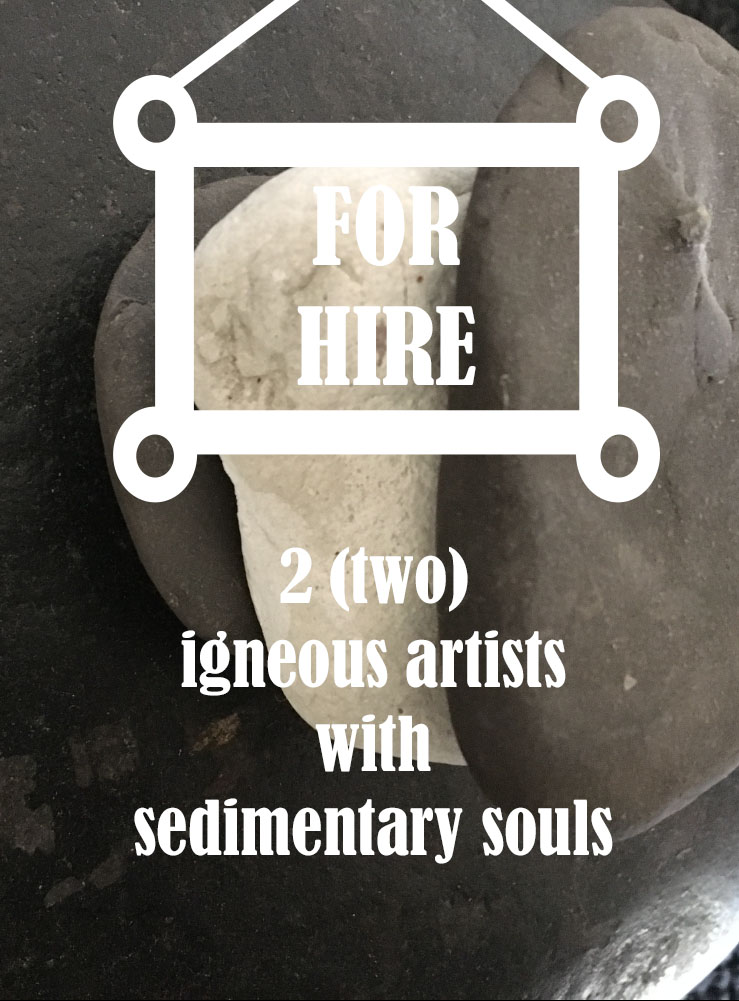
Igneous is volcanic. Fiery. A few weeks ago we painted rocks to put on the trail. Since we’re both cycling through an artistic-growth-crisis, we painted and fantasized about our new career intentions. When Kerri suggested we call ourselves “igneous artists” I howled. The layers of meaning are too vast to count. Plus, I thought it sounded suspiciously close to “ignorant artists” and I liked that, too. “We should hang out a shingle,” she said, “For Hire!”

Igneous artists.

Art is standing with one hand extended into the universe and one hand extended into the world, and letting ourselves be a conduit for passing energy.” ~ Albert Einstein

Because we tend to riff on everything, while painting rocks, we rolled around our new art-moniker until we had an appropriate clever (to us) sub-phrase. “It sounds like a lyric,” I announced, mostly as enticement for my lyricist wife to spin out a theme song. She did not take the bait.

Igneous artists with sedimentary souls.

‘Layers of soul’ is a yummy image. Especially if the layers are born of elements like fire. Like all artists, we’ve been forged, melted in a hot furnace and hammered into shape. The smith hammers out the impurities. “People don’t change,” Kerri often quips, “They become more of who they already are.”

I could stand to lose a few impurities. I look forward to becoming what I am already.

“To draw you must close your eyes and sing.” ~ Pablo Picasso

read Kerri’s blogpost about IGNEOUS ARTISTS

Interpret The Impression [on DR Thursday]

“Art, to me, is the interpretation of the impression which nature makes upon the eye and brain.” ~ Childe Hassam

The eye of the mind. Interpretation of the impression. Imagination. Nature.

This morning Kerri told me that she’s having a stand-off with her piano.

This morning I picked up a box to clear my studio space. I asked myself, “What are you doing?” I set down the box where I found it.

Lately, I’ve been working with an overabundance of business models. Not surprisingly, each addresses the same contemporary challenge: people are having trouble discerning between what is actionable and what is not, what has relevance and what does not. A variation on the theme: focus is hard to come by. Models, I remind myself, are interpretations.

I’ve read that the first evidence of humans making art is found in the funeral rites of our distant ancestors. Decoration? Talisman? Fuel for the trip? An interpretation of life, making peace with the unknowable. Nature makes an impression. Humans respond.

The interpretation-of-the-impression-that-nature-makes points to something essential about art and life: it needs to be shared. It is nothing if not witnessed. We stand in the art gallery and drink it in. We stand at the graveside supplying our fellow traveler for the long journey ahead. We place the crayon drawing on the refrigerator.

Nature makes an impression.We are nature’s impression. Interpreting what that means.

read Kerri’s blog post about IMPRESSIONS

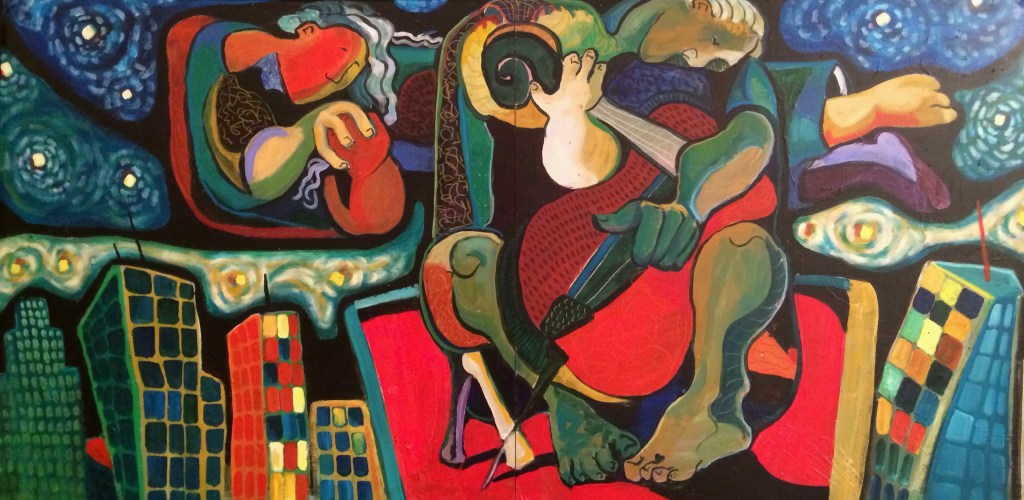
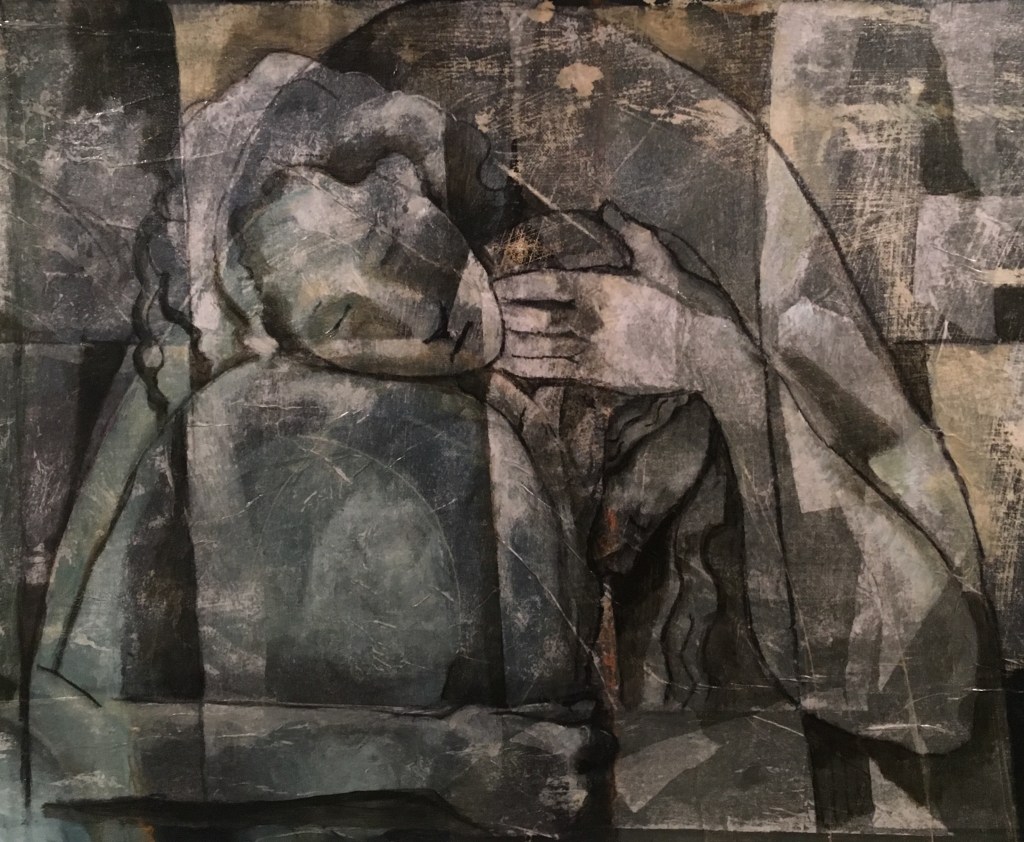
motherdaughter © 2019 david robinson

Lay It To Your Heart [on Two Artists Tuesday]

“This entire week is about noticing,” Kerri said, looking at the week’s photos we’d just uploaded into our site. Sometimes the melange has an intentional theme and sometimes a theme announces itself. Our lives have become about noticing. I suspect all of our writing is, in one way or another, about noticing.

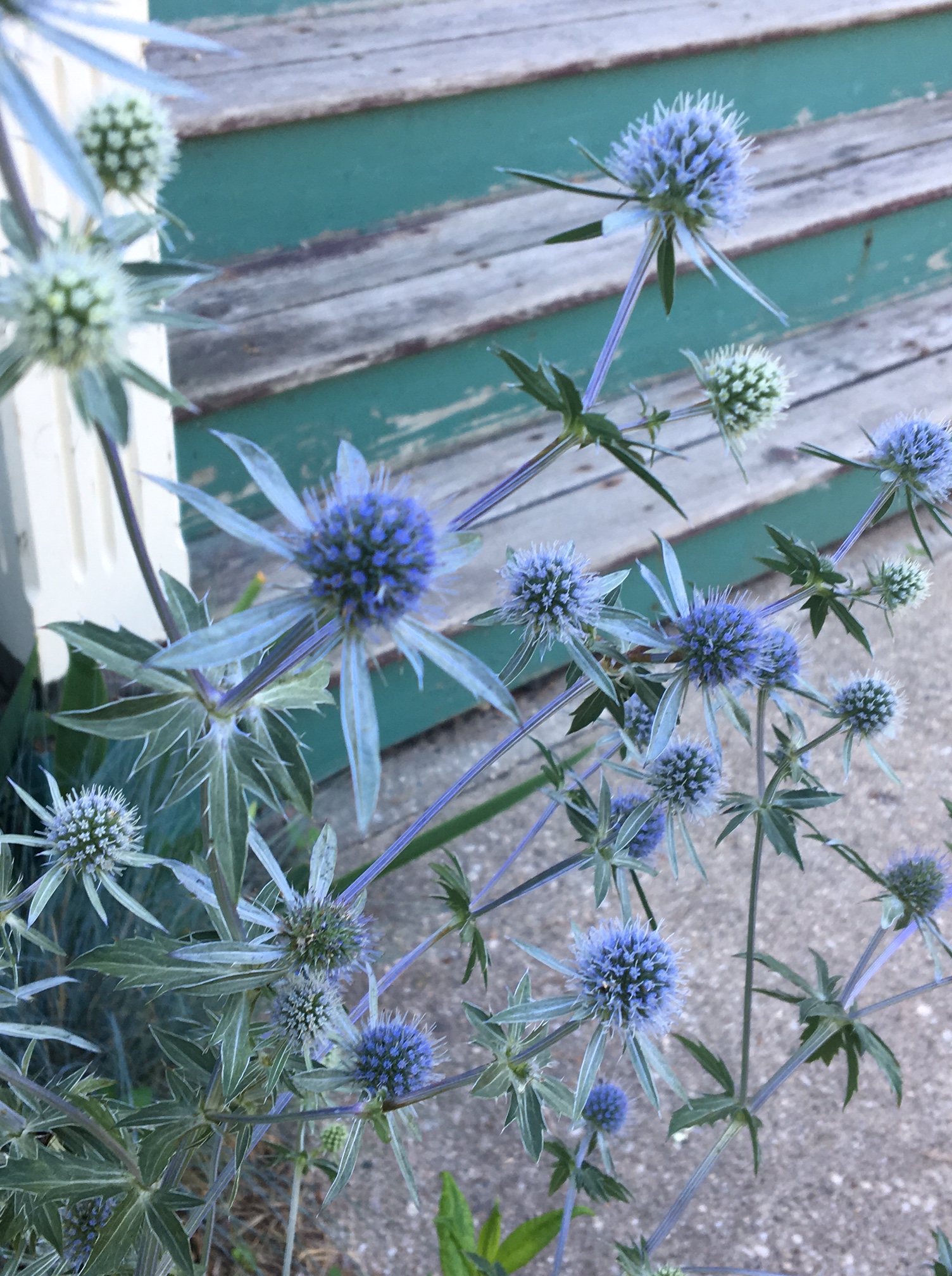
This is Blue eryngo. Flat Sea Holly to the poet. Eryngium planum to those more interested in species categorization. Shakespeare would know it as a thistle, a cure for love sickness. “And lay it to your heart.”

The evening breeze turned our steps toward the marina. It was a brutally humid day and we were restless in the air’s oppression. Arm in arm we talked of how long it had been since we wandered in this direction. It used to be a daily stroll but more recently we’ve sought trails away from people. The forest quiet rather than the crowds at the shore.

The color of the plant stopped us. I felt as if I was looking at a magical universe of purple-blue planets or something more likely found under water. While Kerri snapped photos I marveled at the color. The shape of the leaves reaching from the thistle center. Little blue suns.

Our chance encounter with the Flat Sea Holly blew some nice air into our sails. We walked on talking about the gift of noticing, taking photographs, how to be better artists, amazing sights all around.

Shakespeare’s thistle cures more than lovesickness. We lay it to our hearts and it lifted our humid-heavy- spirits.

read Kerri’s blogpost about FLAT SEA HOLLY

Overflow With Artistry [On Two Artists Tuesday]

Sitting amidst the boxes that currently fill my studio space, I realized that I’m rolling into the third year since I’ve completed a painting. I’ve been staring at the same canvas set on my easel for a very long time. Broken wrists, the pandemic, another broken wrist, lost jobs and economic free fall initiated an era of blank canvases.

I’ve done this almost every day for two years. I stand at the edge of the boxes. I look at the large canvas layered with undertones of red, covered with layers of tissue, preparing the ground for the image. Charcoal sketch marks barely visible, images I drew and wiped away. I suppose it’s not accurate to say the canvas is blank.

My sketchbook is closed. It sits on the table next to the easel. If I opened it, on the last pages, I would find rough sketches for the painting. Ideas in rude pencil scribbles.

Memory is an organizing principle. A story plot line. We make sense of today based on how we organize our memories into a tellable tale. Looking at the canvas is like looking into a mirror and I ask myself what made me pick up a pencil the very first time. The small-boy-me was seeking. “Running or seeking?” I ask. My studio has always served as a sanctuary. A place where I found quiet, made sense of the chaotic world. “Running or seeking?” I ask again.

Staring at the canvas I should feel loss but I don’t. Each morning, Kerri and I sit next to each other and write. This is the 232nd consecutive week that, five days a week, we’ve written together. She edits what I write, makes suggestions, and I do the same for her. We produce a cartoon every week. For my work I’m also drawing a series of cartoons that, after I script and draw final drafts, I hand them off to Kerri. She digitizes them and, quite literally, adds elements that improves them. I’m not empty of artistry but full to overflowing. I no longer need to retreat to enter my sanctuary.

It’s hard to know where my work ends and hers begins. They are ours. A perfect collaboration. Two as one.

Last week we had a fence installed. Invasive neighbors, throwing rocks at Dogga, lobbing toys into our pond, we’d finally had enough. The fence felt like reclamation of space. The impact was immediate. We hadn’t realized how completely the space invaders – like broken wrists and job losses, had interrupted every rhythm and pattern of our life. Basking in our space – our space – Kerri started to laugh and point. Two birds, lawn art purchased in a small town on our long drive from Seattle, always in our yard but always barely seen, we’d hastily placed them next to the new fence. “Two birds, one shadow,” she said, jumping up to snap a photo.

“Two birds. One shadow,” I repeated her words. I’ll take it as an affirmation. A new fence. A new era. All the world is my studio. My sanctuary. It’s what the small-boy-me was seeking all along.

read Kerri’s blogpost about TWO AS ONE

Think About It [on DR Thursday]

Generosity works like blowback: offer support to others and you’ll find yourself supported. Offer kindness to others and you’ll overflow with kindness. Give courtesy, get courtesy. And, it’s not the response or reaction of the recipient that generates the blowback. It’s the act of generosity. The blowback is self-induced.

Of course, meanness works along the same principle. Hate and you fill yourself with hatred.

Often on our trail we find painted rocks. Symbols, messages and whimsy that someone planted for us to find. They make us laugh. They lift our spirits. We generally don’t take them home. We leave them for others to find or, sometimes, we move them to a new location. We re-plant them. Either way, we giggle. It feels like participating in the kindness.

“I want to paint rocks, too!” Kerri’s inner 5-year-old pouted. She went so far as clenching her fist and knitting her brow. Pouty mouth. I fell on the floor in delight after glimpsing the insistent child she was-and-still-is.

We gathered rocks. We bought crappy craft brushes. We brought out the paint. On a gorgeous Saturday evening, sitting outside in the summer breezes, we painted rocks. Compared to the clever rocks we find on trail, our first attempt was crude but inspiring. “We need better tools,” she said, hands-on-hips, admiring our gallery of rocks-ready-to-be-placed-on-trail.

She googled. She asked friends. Armed with information and the desire for better rock art, she’s in hot pursuit of the proper supplies to produce magical rocks that will evoke smiles from people we will never meet.

Someone out there – a person – one day on the trail, giggled and placed a colorful painted stone in the knot of a tree. It set off a ripple of trail giggles in us – and others. How many people, just like Kerri, found their inner 5-year-old, and exclaimed, “I want to do that!”

The, “I want to do that,” isn’t about the rock (though that’s great fun). It’s about the giggle it evokes in strangers. Think about it.

read Kerri’s blogpost about ROCK PAINTING

chasing bubbles © 2019 david robinson

Love What You Bring [on Two Artists Tuesday]

“Only mediocrity is sure of itself…” ~ Paulo Coelho, Aleph

Sometimes I wonder why I spent so much of my life believing I was a fraud. I was provided with great mentors, each relaying the same message: vibrant life is never found in what you know. The point of life is to step toward not-knowing. And, yet, for years, I abused myself with accusations of not-knowing. It was proof that I was a fraud. I was certain everyone else knew.

Quinn pointed to a tall building and told me the people occupying the big office at the top were just making it up, too.

Jim worked hard to help me understand that artistry happens in the release of preparation.

Tom McK tried to help me see that the real riches are found in the very moment that you simply don’t know what to do.

I am fortunate. After so many great mentors speaking a singular message to my titanic fear of not-knowing, the penny dropped. Standing alone in the vast open plain of not-knowing, a two-step mantra flooded my being.

Step #1: Have the experience first. Make meaning second.

A Post-it note pinned near my desk reads, “Competence isn’t in what you know, it’s in your capacity to figure it out.” I have great capacity.

Step #2: Suspend your judgments and learn.

Martha Graham’s “divine dissatisfaction” and “blessed unrest” permeate the vast open plain of not-knowing. “Keep the channel open,” she advised Agnes deMille. “No artist is pleased.”

“Your job is to put it out there,” Dick K., told a younger version of me. “What other people think is none of your business.”

It’s simple. Love what you bring.

read Kerri’s blogpost about YOUR WORK

Sing The Song Of Simple Lessons [on Not So Flawed Wednesday]

This is a song about the simple lessons. The amusing and eye-opening answer to “because we’ve always done it this way.”

As a budding young artist I was frustrated because my charcoal lines were not as alive or fluid as the masters I so admired. I wrestled and strained and struggled to achieve “alive” lines, doubling down on my technique, my personal bridge to nowhere, as if doing more of the same, rife with inner turmoil and tension, might achieve my aim of ease.

Watching me struggle, amused by my absolute dedication to doing the same old thing in the same old way, as if I might accidentally squeeze out a new result, my art teacher, a wisened older woman full to the brim with laughter and humility, came to me, took the charcoal from my hand, and showed me how to hold it, not like a pencil, but like a flower. My lines were instantly alive. My teacher laughed at my amazement.

New ways – better ways – are rarely discovered on a tension path. Why is it that we look in the same drawer multiple times when we’ve lost our keys?

We have, for years, made lunches from yummy food wrapped in a corn tortilla. More often than not, our food falls to our shirt, our plates, the floor, because the tortilla splits. “We have to do something different,” Kerri says each day as her tortilla disintegrates. Dogga delights in the mess and recovers the spoils that hit the floor. Day after day, year after year, the tortilla struggle has been a part of our lives.

During a recent visit, Kirsten, watching our struggles, shook her head, sighed and asked, “Why don’t you use two tortillas?” It was a revelation. A simple change that never occurred to us, babies of depression era parents.

“Two tortillas!” Kerri exclaimed. “Yes!”

I nodded with satisfaction. A better life, a cleaner meal, was in reach! Less mess in our future!

Two tortillas. Hold the charcoal like a flower. Revelations born of ease and the obvious answer.

Someday we will learn (or not): No stress necessary. Relax. Insight sings the song of simple lessons.

read Kerri’s blog post about Two Tortillas

Consider The Brushes [on KS Friday]

As an artist, I have fondness for brushes. I’ve been known to disappear into an art store and lose significant amounts of time in the brush aisle. I rarely buy them – I am notoriously hard on my brushes and wait until they fall apart to replace them – but when I replace them I feel as if I just hit the lotto or found a buried treasure in the art store.

I cut my hair to make my first brush. It was mostly useless and left strands of my hair in the painting. It was the essential need for a brush that clued me in to my life path. I didn’t want it; I needed it.

Lately I found myself wandering through a strange and alien world: the Ulta store, followed by an eye-opening trip into Sephora. Despite the ubiquitous advertising, the fact that I live in this society, how is it possible that I had no idea of the nuance layers of soaps and cremes and removers and buffers and…brushes. Beautiful brushes. As Stephanie once famously exclaimed of me, “You are a man after all!”

Clueless.

I was, of course, fascinated by the brushes. Not just the brushes, but the need to have the right brush. Buffers and liners, fans and foundation and shadow brushes! I am a painter of people, I paint the image of faces, and was fascinated watching the painters of actual faces consider and choose their tools. The right brush. Blush, smooth, hard line.

I cannot count the number of times people have told me that they are not creative, that they do not have a creative bone in their bodies. Standing in the alien land, watching the painters carefully choose their brushes, I wondered how so much creative energy, so much enthusiasm for the right color, the right medium, the best brush, goes unrecognized.

This alien land was pulsing with imagination, desire for the right tool, and the drive to share and help and create. There was a generosity of spirit rarely found on the other side of the doors. Women helping women. Laughter and advice. I liked being in this strange land of strange brushes and kindness – even as an outsider. A stranger. I found a breath of fresh air (perfumed as it was) while following my guides through the brush aisle.

Kerri’s albums are available on iTunes & streaming on Pandora

read Kerri’s blog post about BRUSHES

grateful/as it is © 2004 kerri sherwood

Ask A Peony Question [on KS Friday]

The peony in our yard is sandwiched between tall grasses. We’re careful to cut back the grasses so the peony has space and air to breathe. Kerri watches it. She checks on it daily. She calls me to “Comesee!” when the buds appear. She pulls my arm, “It’s happening!” on the day the buds open into full bloom. In our house peony-bloom is cause for celebration.

The blossoms do not last long, a week, perhaps a few days more if we’re lucky. And then they are gone.

The blooms are passing but the plant is sturdy. Sometimes I feel that the peony is a good artist. It works all year drinking in sun and water and life so it might produce a few moments of lovely. Every single day, through the dog days of August, the harsh cold of winter, the wet and muddy spring, is necessary for the peony to bring its fragile and passing burst of pink beauty – its expression – into plain sight.

Late at night, the tornado sirens sent us to the basement. We sat in rocking chairs and listened to the roar of the storm, the flash and house-rattling thunder. I looked at my easel. Currently, my studio is filled with boxes. Kerri eyes her studio; it’s next up for a good cleaning-out. Revamp and refresh.

In the basement, sirens blaring and storms howling, we talked about whether or not she would ever play again. Whether or not I would ever again pick up a brush. It’s an open question. It’s a deep-in-the-night question.

It’s a peony question. I wonder if, in the dead of winter, roots reaching deeper than the frozen ground, if the peony knows that it will, with certainty, bloom?

In A Split Second from As Sure As The Sun

Kerri’s albums are available on iTunes and streaming on Pandora

read Kerri’s blogpost about THE PEONY

in a split second/as sure as the sun © 2002 kerri sherwood

Embody The Symbol [on DR Thursday]

Everything in the Japanese Garden is symbolic, intentional. Pine trees represent longevity. Rocks, I’ve learned, represent the bones of the earth. They are as necessary in the design as are the “ephemeral blooms of the iris, rhododendron, and plum.” The symbol is not complete without both.

“The ephemeral existence of human life and the timelessness of nature.” Balance.

Entering the small yard of the Shoin House at the Chicago Botanical Garden is instantly calming for me. The small house is designed to “merge the outdoors with the indoors.” It is closed to the public but always beckons. I want to sit in the alcoves and write. Or do nothing at all. In the garden, I am instantly “connected.”

“Connectivity” is a word that has moved to the center of the work that I am currently doing. Amidst our ubiquitous capacity to share (Facebook, Instagram, Tiktok…email, chat, tweet, slack, text…) we are less and less connected. As Neil Postman wrote, we have made the irrelevant relevant and the relevant irrelevant. We share but do not connect. Shared information is not – and never will be – shared meaning.

Symbols empty of meaning when a community ceases to understand, honor, tend or acknowledge the significance of the symbol. And, symbols are the glue of a community. They are the physical, tangible location of an ideal. Disconnect from the symbol and the house falls apart.

I think that is why I am drawn to the Japanese Garden. There, beauty is intentional. The symbols are so well tended, so intentional, that one need not know the specific meanings to enter the symbol.

And, that’s the point. Connectivity happens when people, together, embody their symbols. They enter them. They become embodiments of their symbol(s).

It is the artist’s job to bring people into a shared moment. To give them access to a unified experience. To help them transcend the splinter symbols that divide – and see them for what they are. To help people step back and take a good look at what they, together, are creating. A garden? A desert? Balance? Imbalance?

read Kerri’s blogpost about THE ROCKWAY

prayer of opposites © 2006 david robinson