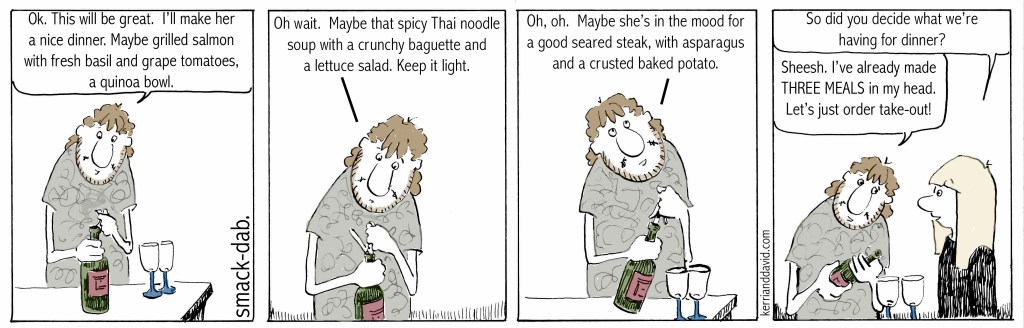
Prepare To Dine! [on saturday morning smack-dab.]

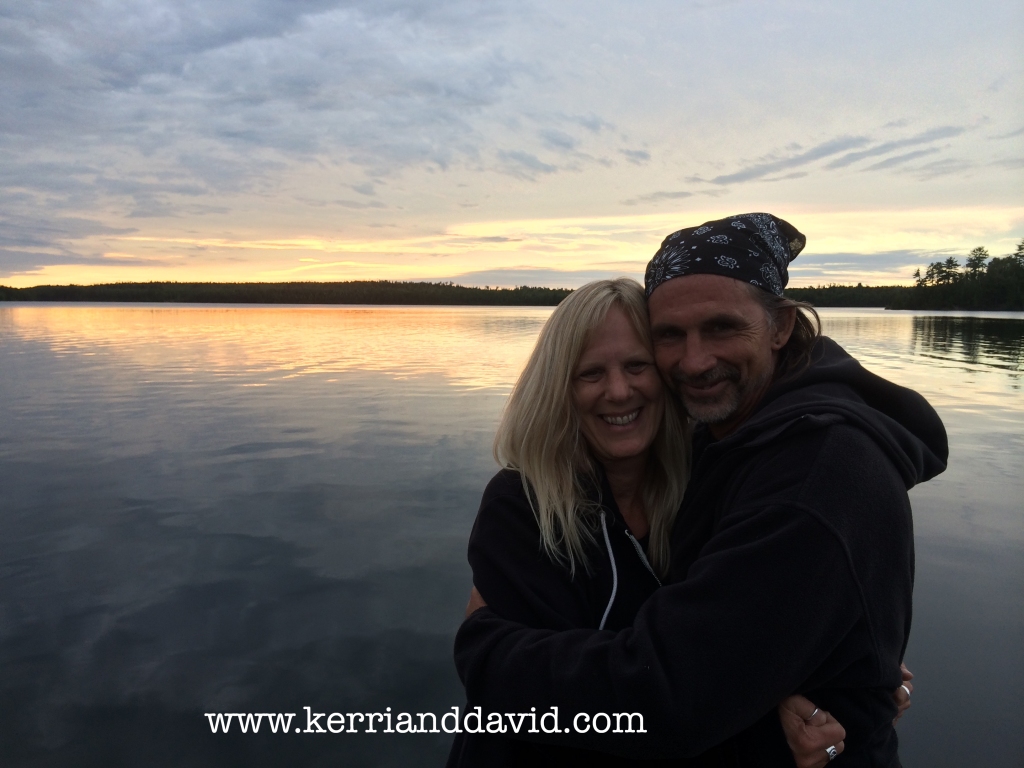
When I first moved to Wisconsin, Kerri barely let me into the kitchen. One night, Craig and I literally had to remove her from the stove so we could make her dinner. The kitchen was her domain. I knew I was “in” when she “let” me make dinner and didn’t pace behind my preparations. The real score came the night 20 and I made her dinner and she sat at the table, ate snacks and sipped wine. Angels sang. Hell froze over. Dinner was delicious.

Let’s just say that it’s been a process. Mostly, we cook together. I am an excellent sous chef. It gives me great pleasure to chop ingredients and put the readied vegetables in little bowls; Kerri imagines she is hostess of a cooking show. One way or another, we’ve always managed to make our meals into fine dining experiences – or just fun experiences.

The bottom line: we are dedicated eaters.

read Kerri’s blog post about DINNER

smack-dab. ©️ 2021 kerrianddavid.com

Pull The Weed [on KS Friday]

One of my favorite simple pleasures each day is watching Kerri go out in the early morning and tend to her tomatoes. The world is quiet. The coffee is brewing. Dogga makes sure the yard is clear of marauding squirrels so the path to tomatoes is safe. An extraordinary ordinary moment. A tender ritual. A wonderful world.

Put down your clever and pick up your ordinary. It is one of my favorite “rules” of improvisational theatre. It is also a good credo to live by. Trying to be clever will take you out of the game every time. It is as true in all aspects of life as it is in art. The beautiful little secret: power, presence, flow…these live in the province of the ordinary.

When I was learning to scuba dive,Terry tried to teach me one central concept: get neutral. After several dives, fighting for control, trying “to do it right,” burning through my oxygen with my dedicated stress, I simply relaxed. I found the neutral that he advised. It was as if I joined the current. The colors sharpened. Time seemed to slow. My breathing definitely slowed. What was a struggle only a few moments before was suddenly easy. I’d picked up my ordinary. I got out of my way.

I delight watching children draw. They are free in their ordinary, not a shred of clever to be found. They lose that. We lose that, trying to be…something other than what we are. How many of us shudder in the notion that we are inauthentic? How many of us invest in the notion of low “self-esteem?” The circle of ordinary comes back around though it is cloaked in words like “self love” or “acceptance” or “wholeness.” Get neutral. Put down your clever.

Ordinary, not clever. It is a discovery that ought to stick early in life but generally lands much later. There’s very little distance between the child that freely colors and the adult that one day remembers that nothing is broken, nothing needs fixing. It is ordinary to color with abandon. The riches are in tending the tomatoes. “Clever” is merely a weed that needs pulling. In the ordinary, a wonderful world is waiting.

PULLING WEEDS on Kerri’s album RIGHT NOW is available on ITunes or streaming on Pandora

read Kerri’s blog post on TOMATOES

pulling weeds/right now ©️ 2010 kerri sherwood

Sit On The Curb [on DR Thursday]

As much as our wily-ole brains would like us to believe otherwise, we can be nowhere else but in the present. Everything else is imagination.

Years ago I belonged to a support group of independent consultants. We met once a month to discuss our business challenges, insights, and to give and receive some advice. One of the members of the group was a Byron Cady coach. I have no memory of the discussion that prompted her to offer this Byron-thought-metaphor: “If your house burns down, rather than race around in panic, the best thing you can do is sit on the curb and appreciate the moment.”

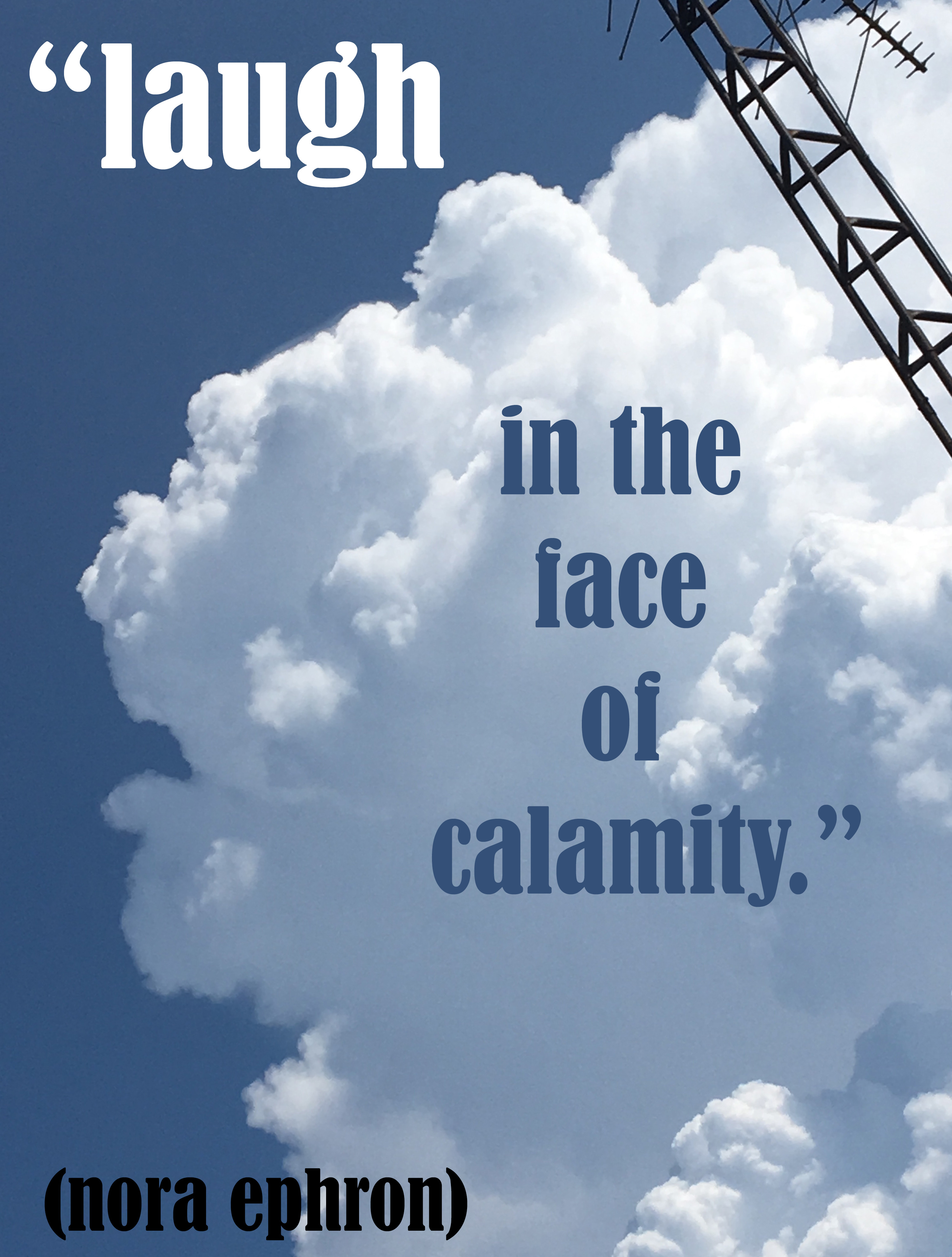
To the consumer-mind, wisdom often sounds like bad advice. That you are alive, that you have this moment, means that no real possession was lost. The question is, in the face of calamity, what will you make of the moment?

Brother Joseph told the story of holding a woman wearing expensive furs, each finger was diamond encrusted, as she died on the street. He was, in the moment, overwhelmed by the worthlessness of her stuff. The illusion of value once life has gone.

Life. This moment. Calamity is certain to come. Sit on the curb and see what is there, beyond what you think is there.

We’ve had our share of adversity these past few years. I would like to report that we laughed heartily in the face of lost jobs and broken wrists and pandemic madness and civil unrest. We did not. We shook our fists at the sky. We made up words and ran loops like Chicken Little. We invested in all manner of fear-of-the-future and ran from monsters-of-the-past. None of our racing around or fist-shaking brought comfort or change.

But, the moments that we took a breath, walked a trail or sat on the back deck and listened to the cardinals and crows, sipped hot coffee on cold mornings, held hands – sat on the curb and appreciated the undeniable truth of our moment: we have everything. We have this moment – the only moment of life that we’ll ever inhabit. We have each other. The rest, the fear of future, demons of the past, are pure imagination. In those moments, wrapped in a circumstance of calamity, we laughed at the beauty of it all.

read Kerri’s blog post about LAUGH IN THE FACE OF CALAMITY

Expect Surprise [on Not So Flawed Wednesday]

Walking through the Lake District in a driving rain, cold and soaked to the skin. Roger had a high fever and was near delirious. The hostel closed. We had to leave. It was miles to the next village. This day was not going according to plan. The trip was not going according to plan. It was the darkest moment in a series of dark moments. “What else could go wrong?” I asked. There was nothing to do but shiver and take another step. And then, unheard of at the time, an RV rounded the bend. The door popped open and a cheery voice asked, “Do you need a ride?”

I often think of that ride. That unlikely RV. Suddenly there were towels to dry ourselves. Aspirin for Roger. The mother of the clan took over and attended to my sick friend. Mugs of hot tea. We were delivered safely to the next village. They did not leave until they knew we had a warm place to stay until the rains passed. Something went right. It was breathtaking.

It was a life lesson for the younger version of me. My very own Aesop’s Fable. What looks like tragedy is often an opportunity, and vice versa. When it appears that things cannot get worse, they often do get worse en route to something better. The real lesson was to be in it, rain or shine. Joyful participation. I didn’t get the lesson right away. It took a few laps before it stuck.

That trip was decades ago and, to me, seemed ill-fated from the outset. But, when I think back on it, I remember the kind family in the RV, the man standing in line behind me who secured a ticket for me when I didn’t have enough money. The kindnesses too many to count. The utter shock of serendipity. What we needed always appeared somehow, in unexpected ways.

Quinn used to say, “Cultivate your serendipity.” Open yourself to chance, to the unexpected. Expect surprise.

read Kerri’s blog post about THINGS GOING RIGHT

Choose [on Two Artists Tuesday]

“It’s a serious thing just to be alive on this fresh morning in this broken world.” ~ Mary Oliver

Were I to have been born in an earlier century I would not be alive today. Twice on my life-path doctors have declared that, “You are now a miracle of modern medicine.” Leeches and blood-letting would not have cured what ailed me.

This thing called ‘science’ is what gave me more days of life. It is the same science that developed vaccines for a pandemic but also made possible the technology that makes mass-media-misinformation possible. Here is the medicine. Here is the disease. It is exactly as Sophocles wrote: Nothing vast enters the life of mortals without a curse.

One morning, deeply tired, I arose to go do a job that I did not like. It was a means to an end and I dreaded the day ahead of me. Stepping out the door, the cold morning air stopped me in my tracks. It slapped me awake. The air was crisp and clean, the neighborhood was quiet. The light in the sky was brilliant. I drank it in. I vowed never again to dread a day of my life. In truth, I had no idea what the day held for me. Why then, would I story my day with a frame of dread? Why tell myself a tale of just-getting-through-it? Why not open to the possibilities of surprise and miracle? Why not embrace the already-stated-obvious-thing: I had no idea what the day held. That simple fact would be true every single day of my life. Dread was a choice, not an inevitability.

To be alive on this fresh morning. It is a serious thing. In this world, broken by the little story of us-and-them, the tiny tale of power-over. Choices. The miracle of the new day is present whether it is seen or not. We can cloak it in dread or gratitude, in support or division. It doesn’t care either way. The miracle of the new day, the gift of being alive on this fresh morning in a world that is broken or healed, whole or fragmented – it all depends upon the story-frame we wrap around it. The story we tell is a choice, not an inevitability.

read Kerri’s blog post about JUST TO BE ALIVE

Climb The Ladder [on Merely A Thought Monday]

Very few images are as potent as Tom Mck’s story of finding his 90 year old aunt Bunty on the roof of the farmhouse. There had been a storm. She’d hooked her cane on a rung and climbed the rickety ladder to make sure the shingles were intact, “Papa put a fine roof on this house,” she said, staring down at her alarmed nephew. Bunty was a farm woman. She saw no reason why she should not be on the roof. As the elder of the family, she was the keeper of the legacy. The house and ranch were the tangible creations of her ancestors and she was the steward.

Years later, when Bunty was gone and Tom was the ancestral steward, his task was untenable. The city was spreading like a fire, gobbling up farm land. He knew it was only a matter of time before the ranch was consumed. A Walmart was being built and he could almost see it from the porch. “What am I going to do?” he asked, knowing that he was the end of the line. His question was rhetorical. Sometimes the steward’s job is to close the door on an era. He knew what he had to do.

After Tom passed and the ranch was sold, I imagined him, like Bunty, standing on the roof of the farmhouse. He made sure that, as the land was lost, the legacy remained intact. He was strong, like Bunty. His ladder was rickety but he climbed it none-the-less. He made sure the shingles were intact. He met his task without self-pity.

I learned from him that life can forge you into strong metal or, if you choose, if you feel sorry for yourself, it can break you into tiny pieces. Jonathan told me that a tree must split its bark to grow and I understood that as a metaphor for aging. The bark splits because the spirit outgrows the body’s capacity to contain it. Beaky was like that. And, Dorothy. Mike. Grandma Sue. H. I admire them. Bodies break down. Aging hurts. Spirits, on the other hand, need not wither.

I’m told that, in her elderhood, Margaret stopped what she was doing each day to go out back and watch the sun set over the desert. She was made hardy by a hard life. She was made kind by how she chose to live within her hard life. Drying her hands, stepping out on the back porch, the sky electric with peach and pink, she met each sunset with gratitude. Intentional thankfulness for the day.

Gratitude is not a soft thing. It is an attribute of the strong. Hard won from a long life of choices. Bitterness is easy, a lazy thing. Climbing the ladder, standing on the roof, feeling the aches and the loses, facing the running sands with a smile and admiring the day’s end, celebrating the shingles that held fast through the storm and those who placed them, that takes grit. Courage. And, an understanding of the connected power and responsibility of standing in the long line of ancestry.

read Kerri’s blog post about STRONG WINGS