Run Through Norway [on Not So Flawed Wednesday]

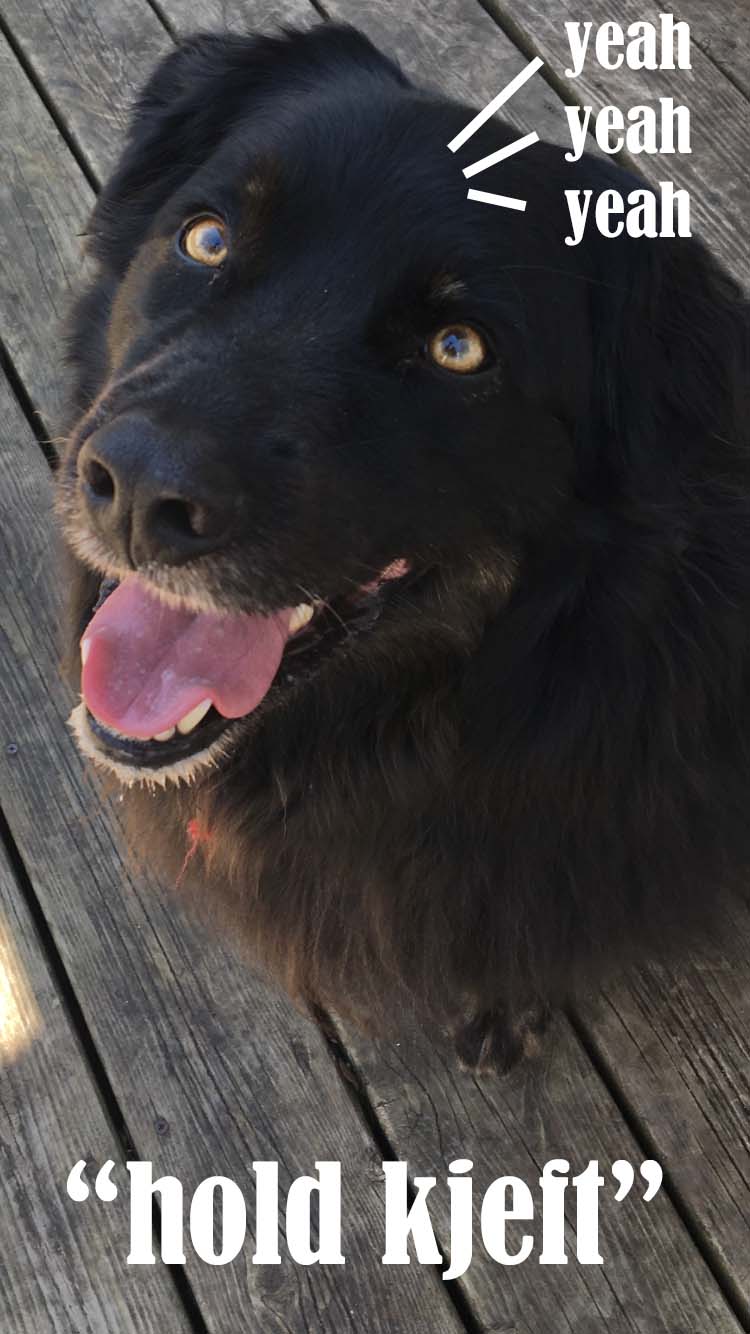
DogDog is a very vocal pooch. He sings his body electric, he gives full voice to his soul. There are times that I, with great delight, watch him run fence to fence, barking for the simple pleasure of making sound. He is a vocal hedonist.

Sometimes he barks and listens. He wants some dog out there to bark back, a pooch call-and-response. There is no better gift for DogDog than when one of his neighborhood pals barks in response. Pure pleasure, he runs circles around the yard. When his call does not evoke a response, he waits a few minutes and tries again. He is an eternal optimist.

DogDog knows when he’s NOT supposed to bark. Inside the house is a no-bark-zone. When Tim, the neighbor gets in and out of his car. When Lucky, the dog that recently showed up in the yard behind ours, comes to the fence. When we are in the car, going on errands, and he sees another dog; his body quakes with full-bark-desire but he knows better. Kerri taught DogDog a bit of Norwegian. “Hold Kjeft,” she says, when we he winds up for a good bark-in-the-car. DogDog hears Hold Kjeft and he moans and whines and complains. He performs a melodramatic Medea until something else captures his attention.

Initially, she didn’t use the phrase in any other situation. Norwegian was reserved for the car. Hold kjeft, in translation, means shut-up but for us it has become a preemptive command, “no bark.” Norwegian was so successful in the car that it has now spilled out into all other situations. She never has to raise her voice. She simply opens the back door, says, “Hold Kjeft,” and all barking turns to enthusiastic circle-running. It’s magic. It’s Norwegian.

It doesn’t work when I use it. For some reason that I can’t explain, my “Hold Kjeft” elicits howls of laughter from DogDog. He looks at me and, as if to make a point, “Your Norwegian is no good!” he barks in reply. And then, to sear in his criticism, he barks again. I revert to my Frankenstein English “No Bark!” DogDog immediately complies. “That’s more like it,” he wags and runs for the back door.

Language is a mysterious and magic beast. Lately, I’ve noticed, that when I am whining and complaining and feeling like performing my version of melodramatic Medea, a tiny voice in the back of my mind whispers, “Hold Kjeft!” So taken aback by the sudden whoosh of Norwegian, my performance is short-circuited. My mind shuts up.

I look to Kerri to suss out whether that tiny voice is hers or coming from some other mysterious source. She always appears to be innocent and asks, “What?” to my inquisitive stare. “Nothing,” I reply and look to DogDog, who wags and rolls for a belly-belly.

I suspect that, rather than DogDog, it is I who am being trained. Belly-belly. Hold Kjeft. I am suddenly suspicious about my overwhelming desire to wash the dishes. What is going on here?

There is only one thing of which I am certain: my path to inner quiet runs through Norway. Hold Kjeft! On me, Norwegian works.

read Kerri’s blog post about HOLD KJEFT!

Live A Sockdolager [on Two Artists Tuesday]

Word genius sends me a word everyday. Some I know. Most I do not. Yesterday, my word-of-the-day was sockdolager. Sockdolager is a word that, when typed, is unrecognizable to the vocabulary in my spellcheck and is adorned with a screaming-dotted-red-line meant to notify me that either I spelled the word incorrectly or it’s not a word at all. Language is a fickle companion.

In Seattle, when the rains clear, people are fond of saying, “The mountain is out.” Mount Rainier, hidden in the clouds, makes a grand – almost impossible – appearance when the weather clears. Where there was no mountain, suddenly a Titan appears. It is a sockdolager, an exceptional occurrence. A forceful blow. The first time I saw it I almost crashed my car.

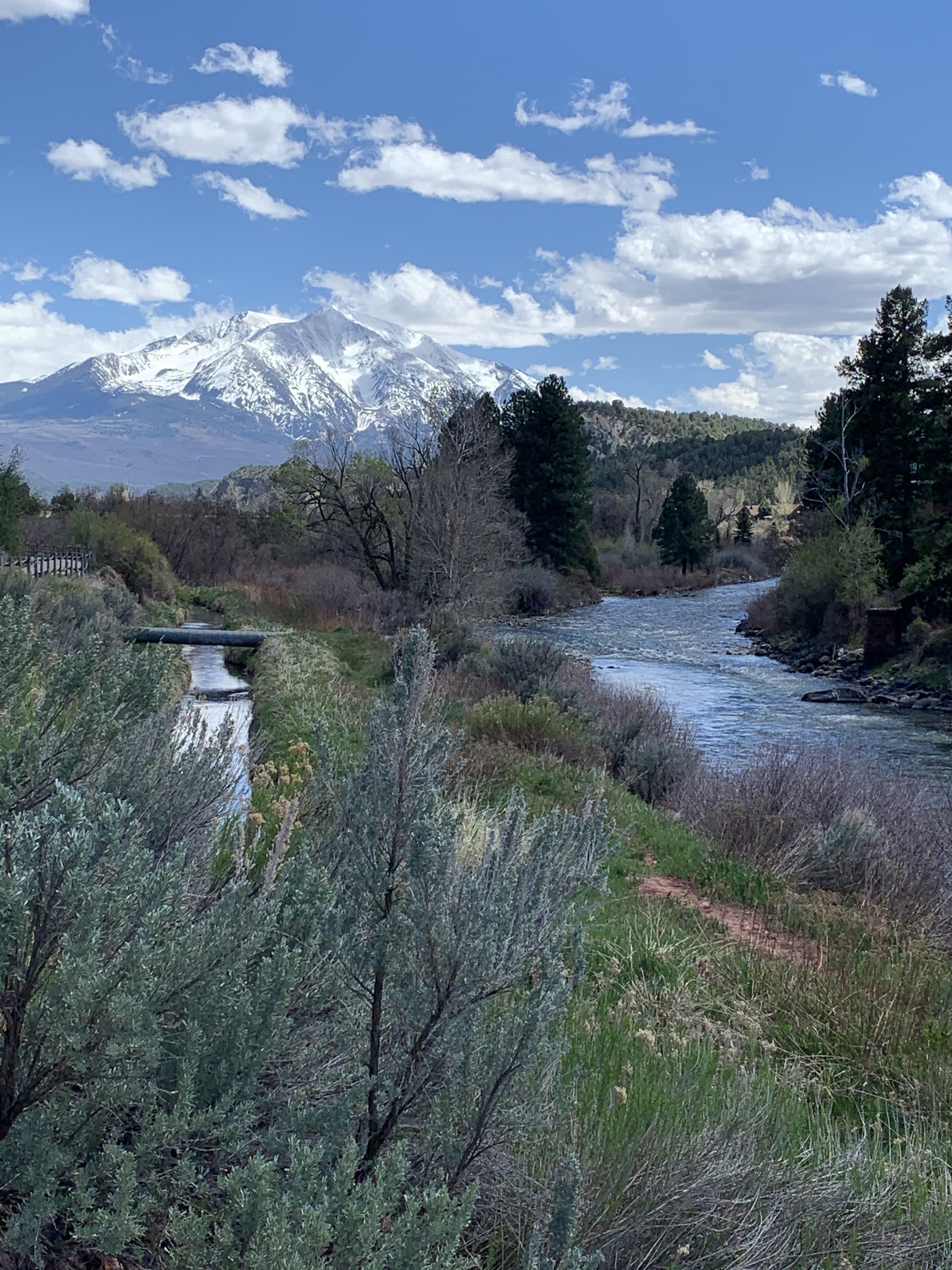
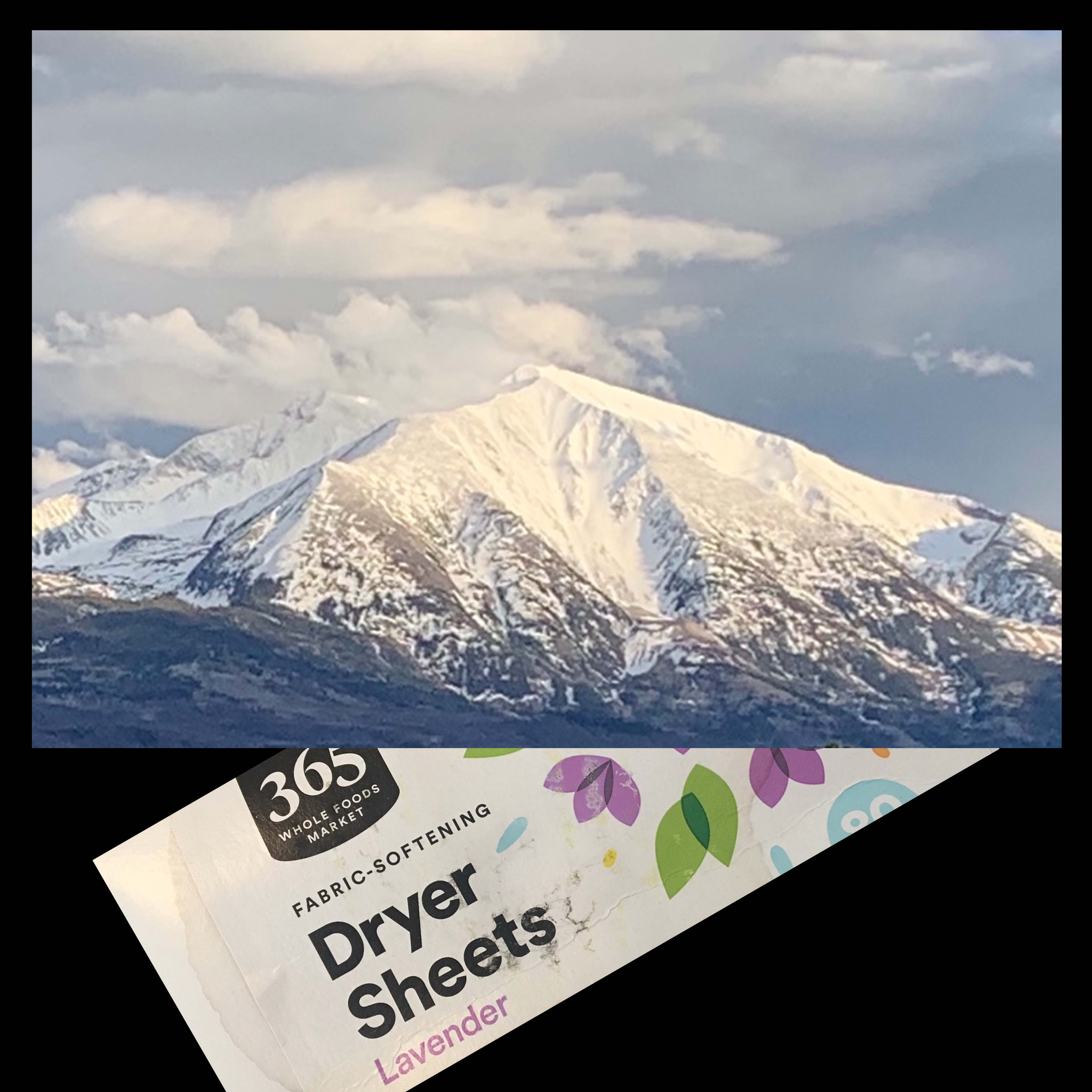
Mount Sopris hit us with a similar wallop. We arrived in Carbondale “in weather.” A day later, making a run to Main Street to meet Kirsten, we rounded a corner and nearly crashed the truck. There was a mountain towering over us where, previously, there was none. Clouds swirled around the summit. The late afternoon light made it glow. Sockdolager! Sockdolager!

I very much appreciate that my snotty spellcheck does not recognize or appreciate my use of sockdolager. No word can adequately capture the experience of being hit by a mountain. “Awe” is a word. So is “amazement.” They fall short, too. Language can reach toward but never quite touch that which it hopes to describe.

The day after the wallop we took a stroll on the Rio Grande Trail. We intentionally walked away from Mount Sopris, knowing that, at some point, to get back to our airbnb, we’d need to turn around and walk toward it. Like Orpheus leading Eurydice, we tried not to turn and peek but the majesty was too much. We’d giggle and turn and gasp. “My god!” we whispered.

We go to the mountains to remind us, to refresh our eyes and hearts and minds. This life. An exceptional event. A forceful blow. Grander than words can describe. Sometimes the mountain is hidden. Sometimes it shows its face. Either way, it never ceases to surprise you, to take your breath away. Sockdolager.

read Kerri’s blog post about THE MOUNTAIN

Consider The Intention [on Merely A Thought Monday]

My least favorite character in Romeo and Juliet is Capulet, Juliet’s father. A few years back I thought it would be a good exercise to tell the story from his point of view. In his world of privilege and order, he has an out of control daughter, a teenager no less, ignoring the rules of the house and society, having sex with the son of a sworn enemy. He imagines a better future for her (and himself) and has worked hard to protect her and match her with royalty. Like every parent I know, he just wants his daughter to behave and thrive.

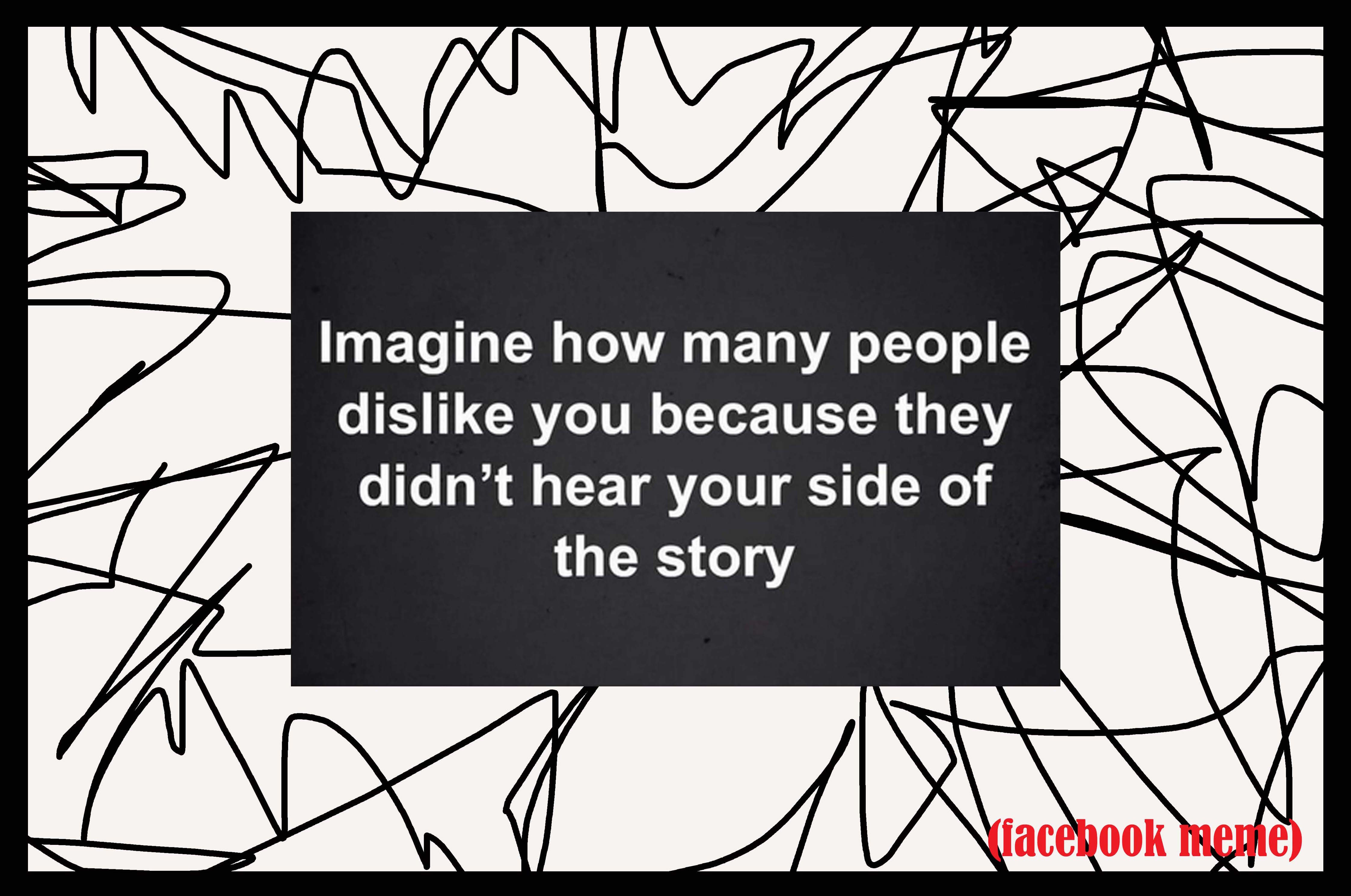
Every story has an agenda. That’s true of the stories we tell of ourselves at parties, it’s true of the stories we shout at each other when we are having fights, it’s true of the stories we tell when we are falling in love, it’s true of the stories we tell when breaking up. Every story has at least two sides and each side has an intention.

Stories are never neutral or passive. It’s precisely why Blind Justice is so important to the health and well being of a society: between two opposing/competing stories there is a point of equilibrium that we call “fact” or “truth.” Blind Justice carries a scale to symbolize that place of story-equilibrium, ideally free of status, privilege, sway…weighing the stories to arrive at fairness and equity.

Health is the capacity to consider the other side of the story.

It is the truly despicable character that steps with intention into the gap between competing narratives solely to create discord. To lie for gain. Iago is just such a character. He creates an illusion with no greater intention than to hurt, to destroy. Desdemona dies. Othello murders because he cannot see through the lie Iago is telling. Othello’s love turns to hate. He cannot or will not hear the other side, the love story, the truth of Desdemona.

Hatred is a territorial flag planted in a one-sided story.

The modern GOP is Iago. Othello is a cautionary tale relevant in our times. What or who will be murdered before the lie is laid bare?

I have always been a lover of myth and parable, stories that reach with intention to deeper truths. It is why I stepped into the theatre in the first place. Art, like Blind Justice, uses story to reach deeper truths, truths that can rarely be captured in words. It’s the paradox of art and truth is always found there.

No story has a single point of view. No truth is singular – that is the hallmark of the truly important challenges that every society faces. It is why successful governments tell their story with truth as their intention. It is why successful relationships sail through stormy seas. The intention is pure. The desire to stand in the shoes of the other-side-of-the-story is genuine and necessary in order for the relationship, the community, the country to thrive.

Capulet is not a bad man. He has good intention. The play ends when he becomes capable of standing in and considering the other side of the story. Hope and equity is the promise rising from the pain.

Iago, on the other hand, is a wholly different story. His play ends in a cage with a nasty celebration of the pain, death and havoc he’s wreaked, gloating about his capacity to snare others in his big lie. All are made fools.

read Kerri’s blog post about THE OTHER SIDE OF THE STORY

Seek The Old Gods [on KS Friday]

I’m thinking a lot about gods and goddesses these day. No, it’s not a weird fixation. It’s a project, a story that involves the old gods and the new. The elemental and the angry. The unified and the divided. We make ourselves in the images of the god[s] we embrace. It’s a story about reaching back to the old gods, to a time before the worship of the great divide.

We took a walk along a trail just behind our airbnb. We were only in the mountains for a short time, long enough to have dinner and a day with our daughter and her beau. On the trail we turned and gasped. The mountain towered above all things. It reached to the sky. So majestic in its presence, it did not look real. “Now, there’s an old god,” I whispered to no one. It challenges one to know it, to climb it and participate in the beauty and the ascent – with no opinion at all about who might deem themselves chosen or not. It does not discern nor divide. It reminds. You are this. Climb and breathe the fresh air.

Kerri saw hypericum berries [“You say hypernicum, I say hypericum, let’s call the whole thing off…”] in the grocery store. “These would look lovely on our table!” she exclaimed. They came back to the airbnb with us and found themselves placed in a fine Ball jar sitting in a prime spot on the table. She was right. Lovely. We did a bit of research and discovered that 1) no one can agree on the spelling of the berry [or they’re two different things but we could not discern the difference], and 2) it is often used as a winter wedding flower. Winter’s daisy. Red on green giving its color and presence at unions. “Another old god!” I declared to no one. Elemental. Till death do us part where we will once again unite.

She wrote a note of gratitude and placed the corner beneath the Ball jar that held the hypericum. “Our host will love these!” she said. Gratitude adorned with beauty. We hated to leave but had run out of time. We had to hit the road. We stood at the door and breathed deeply of the mountain air. More gratitude. The blue sky ringing against the red rock of the western slope. Old gods everywhere.

“We’ll be back soon,” I said.

“Maybe we shouldn’t leave,” she whispered.

“But oh if we call the whole thing off then we must part,
And oh, if we ever part, then that might break my heart.”

You say hypernicum. I say hypericum. Winter wedding. Both/And. Gratitude and mountains. Old gods. Old gods everywhere.

read Kerri’s blog post about HYPERICUM

kerri’s albums are available on iTunes

Appreciate The Marks [on DR Thursday]

Life leaves marks. When I look in the mirror these days, I see my grandfather staring back at me. Or, to be more accurate, I see aspects of both of them, all akimbo in a variation that I now recognize as “me.” The topography of DNA, crafted by my unique life, now sketched into my mask.

Quinn left marks in me. So did Tom. And Doug. And Kathy. I could go on. The list of amazing humans who had a hand in shaping my perception, molding my thinking, in informing my walk through this world, is lengthy. They are my fortune, the gold in my pocket. Their marks serve as my credo, define my intentions. Their marks have become the scale upon which I weigh value and importance. Laughter, according to their marks, carries enormous weight.

As we carried boxes out of the house, I couldn’t help but notice marks on the walls, scuffs on the floor. Each marked a memory. When the movers lifted the couch, its impression in the carpet was deep. It had sat in the same spot for years. In its absence, the entire space reeled. Soon it would find a new equilibrium as another family sculpted the now empty space. They will, no doubt, remove the carpet. The impression is too deep, the placement and accompanying memories are not theirs. Erasure is the necessary first act of new inhabitants. Eliminate the marks. Paint. Sand. Demo. And freshen. Clean the palette.

Leigh is an authority on rock art. Cave painting. The marks left by humans. Prophesy and map. Ritual and graffiti. Not all cultures are obsessed with leaving marks. Many try not to. My relationship to my marks, my paintings, changed the day I helped carry Duke’s brilliant paintings out of his basement. He’d passed and now the question was, “What do we do with all of his paintings?” I knew, someday, someone would ask the same question of my paintings. Carrying his paintings up the stairs and stacking them in the truck, I became less invested in the notion that my paintings, my marks, need matter. They no longer need to transcend me. They are immediate, fulfilling for me and perhaps me alone. That is enough. Bits of ego easily fall off when the perspective of age comes calling, when the marks are undeniable.

Marks fade. Life is what is happening now. A cliche’ that could not be more relevant. The couch, seemingly so permanent, will someday be hauled out. The marks will remain for a while. Only a while. And new life will move in and fill the old space, as it should.

read Kerri’s beautiful blog post on IMPRESSIONS

Exercise Choice [on Not So Flawed Wednesday]

I know what it is to be kind. I see acts of kindness everyday. Humans helping humans. Humans helping animals. Humans mindful of and taking care of their planet. Synonyms include friendly, generous, considerate. All of these are other-focused. To be kind is to consider the needs and lives of others. Beaky used to say in parting, “Be kind to each other.” Kindness was her wish for this world.

I’m not sure that I know with the same clarity what it is to be human. Philosophers have answers that generally trace back to our capacity to reason, to make meaning from our senses. To think consciously. To question. To be aware.

My quick pass through the news of the day betrays how non-human we humans can be. What is the sense of perpetuating a lie? What is gained by lobbing bombs at neighbors? Cyber attacks? We read that there were, from sea to shining sea, 9 mass shootings over the weekend. I’m having a hard time making meaning of it all. I can rationalize it, explain it away, assign blame…but, at the end of the day, I know my rationalizations are nonsensical. Non-sense. No sense. Which, according to the battalion of philosophers scribbling across the ages, attempting to define what it is to be human, we are, because of our non-sense, not human.

There are so many questions and thoughts bursting from this simple bumper sticker!

Arriving home at 10pm, after two consecutive days of 13 hour drives, 20 had a hot meal waiting for us. I called for help and my neighbor John came running. Jen prepared a travel bag of snacks for us and left it on our doorstep. The family that lived next door to my parents made sure, after every snowfall, that the walks and driveways of their elder neighbors were shoveled and safe. Kind.

Somewhere in Kansas it occurred to me that to be human was a choice. Kindness is a choice. Yes, we make meaning from our senses and experiences and the line that defines us as human is our capacity to choose the sense, the meaning that we make. We witness and then we choose. The choice makes all the difference.

The angry man weaving in and out of traffic in his truck, flying the confederate flag, was making a choice. The man who shoveled my parent’s driveway, never having met them, was making a choice. To focus on division is a choice. To reach across the aisle is a choice. To wear a mask to protect others is a choice. To point a gun is a choice. To lie is a choice. To stand firm in your conviction is a choice. To open a door for others is a choice.

To be human is not just to exercise choice but to choose actions that support others. And, among the greatest available choices, the choice that most advances humankind, as Beaky knew, is kindness. To think of others, choose, and act accordingly.

read Kerri’s blog post about HUMANKIND

Turn Out The Lights [on Two Artists Tuesday]

There are first-times and there are last-times. I occurred to me, as we sat on the back porch of the house where I grew up, watching the sun go down, that this night would be a last-time. In the morning we would drive away and never again come back to this place.

We’d driven to Colorado to move my mom into an independent living community. The move was complete. The house nearly empty. My sister was coming to finish the clean-out and clean-up and then the house would be sold.

Kerri is much more “thready” than I am. She leads with her heart and feels deeply the story-threads that extend back through time. With the sun beneath the horizon, the light of the house beckoning, we talked of what it must feel like for my mom to leave this house after 54 years. We talked of the turtle that buried itself in the window well each fall and would claw its way back into the sunlight each spring. Climbing the crab apple tree when it, too, was young. Camping in the back yard in a musty green canvas tent. Riding bikes around the driveway in mock stock car race fashion. The Irish mail. Volleyball, basketball, and cranking ice cream on hot summer days. The small rituals that largely go unnoticed until the last-times, the experiences that fill life full-to-bursting.

These rich, amazing moments that we call ordinary, that happen with ease every single day, that pass unnoticed or unappreciated until the-last-time.

She asked me what I felt and my answer surprised me. “Relieved,” I said. “Just relieved.”

Tired, we went into the house, closed the back door, and turned out the lights. Last time.

read Kerri’s blog post about THE LAST TIME

Care Enough To Question [on Merely A Thought Monday]

“Have you noticed that people all over the world are divided into groups, calling themselves Hindus, Muslims, Buddhists, Christians, and so on? What divides them? Not the investigations of science, not the knowledge of agriculture, of how to build bridges or fly jet planes. What divides people is tradition, beliefs which condition the mind in a certain way.” ~Krishnamurti, Think On These Things

John helped me carry a treadmill downstairs into the basement. It was a beast, a one-step-at-a-time affair. After the job was done we fell into a conversation about how baffling we find our divided nation. He confided that, of late, he’s completely unplugged from the news. “I’m happier, less anxious,” he said, though somewhat conflicted about his decision.

I told John about my dear friend whose strategy for navigating the division and the noise was to read only The Wall Street Journal. It aligns with his conservative values and provides the business and financial news that he enjoys. For his mental health and well being, he’s eschewed all other sources.

On our drive from Wisconsin to Colorado and back again, Kerri and I were amazed by the rabid roadside proclamations of belief. A bumper sticker trumpeting Extreme Right Wing, a pick up truck, weaving through traffic, flying a Confederate flag. We stopped to get gas and went into the convenience store to use the restroom. We were wearing masks which apparently was an affront to the other patrons; I literally locked myself in a stall to avoid being assaulted.

I thought all night about my conversation with John. What are our strategies for surviving the toxic noise? Note the word, “survive.” John suggested (and I agree) that the division is intentional, a strategy. “They’ve learned to monetize hate,” he said, “Both sides.” Our strategies of survival are indications of the problem. Like my dear friend, we seek a source of information – a single source – based on our belief, what we align and are comfortable with, and not based on any measure or expectation of truth.

This is not a new revelation. We’ve been talking about the problem with info-bubbles for years. John’s question, “Why don’t people care enough to ask questions of what they are being told?” is, I think, exposes the root of the challenge. People have to want the truth, expect the truth, before they care enough seek it.

Questioning is the basis of education. Curiosity is what drives progress. Belief asks adherents to stop questioning. We are, apparently – at least 50% – a nation of believers. Not a question in sight. Witness the circus in Arizona, the implosion of the GOP, the restrictive voting laws sweeping our nation, the undying support of a lie that undermines the pillars of our democracy. Belief without question is a toxic soup.

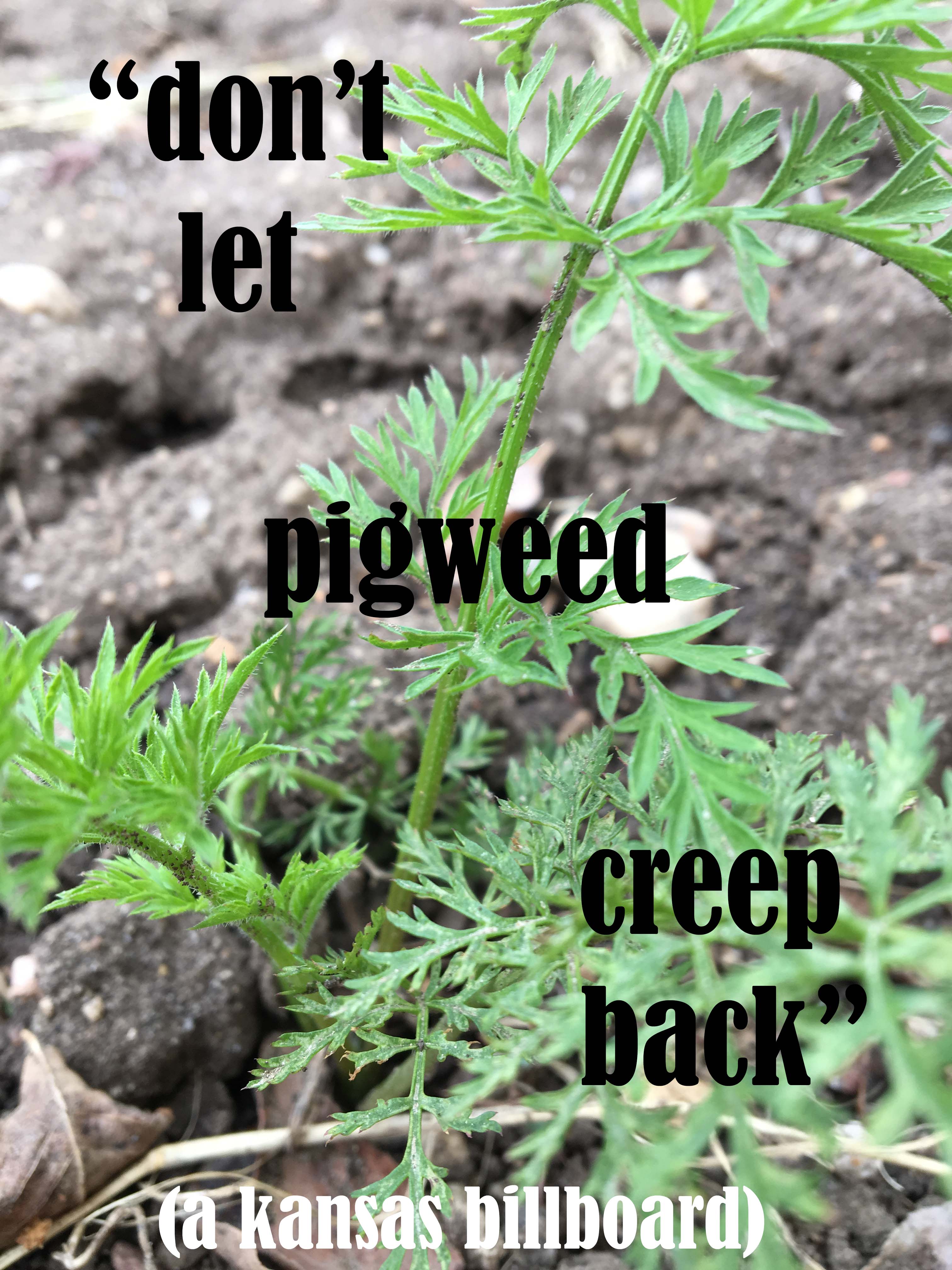
It’s become a metaphor that is easy to grasp: the Kansas billboard read, “Don’t Let Pigweed Creep Back.” A warning to vigilant farmers, pigweed strangles crops. It is toxic to farm animals. To keep the fields and the farm prosperous, a farmer must wage a consistent and conscious battle to keep the invasive weed from overrunning their fields. Our nation is no different than the farmer’s field. We are overrun with pigweed. It seems our information sorting mechanisms are out of whack. We no longer know – or care – to sort out what is edible and what is toxic.

We eat the weed and ignore the vegetable. John’s question is more and more relevant, “Why don’t people care enough to ask questions about what they are being fed?”

Belief without question. Conditioned minds. Mental farms overrun by pigweed.

read Kerri’s blog post about PIGWEED

Take It Home [on KS Friday]

A Double Haiku

“It smells like mountains,”

she said, nose deep in blankets.

“Can we take it home?”

Mount Sopris’ towers

above nose, bed, and blanket.

A coyote howls.

read Kerri’s KS FRIDAY HAIKU

Touch The Walls [on DR Thursday]

A Haiku

I wander the house

touching boyhood memories.

Stories pour from walls.

read Kerri’s DR Thursday Haiku