Teach The Moment [David’s blog on DR Thursday]

As I watched the curtain of grasses sway I thought they’d make an excellent set piece for a production of The Tempest. Their movement was hypnotic. I had the good fortune to design a minimal-budget-production of The Tempest several years ago and used huge pieces of driftwood and a bamboo curtain. I loved it.

The Tempest was on my mind because earlier in the day while doing some research I bumbled across the question, “Why is The Tempest a banned book?” The answer is a very sad statement about our times, the reason our nation cannot seem to mature: “The Tempest,” one of the playwright’s classics, is among the books removed, as teachers were urged to stay away from any works where “race, ethnicity and oppression are central themes,” the website Salon reported.

In our nation race, ethnicity and oppression are the central themes of our history: “246 years of brutal enslavement; the rape of black women for the pleasure of white men and to produce more enslaved workers; the selling off of black children; the attempted genocide of Indigenous people, Indian removal acts, and reservations; indentured servitude, lynching and mob violence; sharecropping; Chinese exclusion laws; Japanese American internment; Jim Crow laws and mandatory segregation…” (Robin Diangelo, White Fragility)

You’d think we might want to encourage teaching The Tempest and other great works so we might consider and discuss the full scope of our history. So that we might learn about ourselves. So that we might become capable of addressing and putting to rest the ugly fear – rooted in race, ethnicity and oppression – exploited for gain by the Republican party, that gave birth to the MAGA movement. It’s the Confederacy by another name.

In a nation of immigrants, you’d think it might be a first principle to teach our children about race, ethnicity, and oppression so we might learn how to reach across – and put to rest – division rather than perpetually recreate it.

The AI overview provided another related and currently more salient reason to teach The Tempest: “The main message of Shakespeare’s The Tempest is that forgiveness and reconciliation are preferable to revenge and punishment, especially when it comes to the restoration of social order and personal peace.

If social order and personal peace are the goals, our current path of revenge and punishment will not take us there. In the play, Prospero chooses release from his island prison through the power of forgiveness and redemption rather than perpetuating his imprisonment by seeking revenge.

In this teachable moment Prospero’s choice is an analogy worth teaching: a path provided to us by a play written in 1610 by one of the greatest poets of the English language; a way out of our national-soul-imprisonment.

I suspect that is why The Tempest and other great works of literature dealing with themes-that-matter are being banned. In the minds of this administration, continued imprisonment, revenge and punishment seem to be the goals.

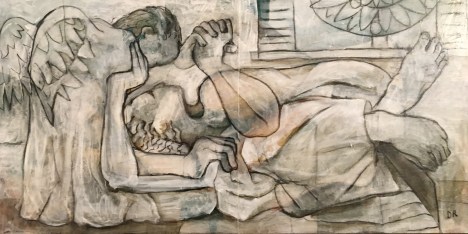
Angels At Our Side, 24″x48″, mixed media on board

read Kerri’s blogpost about THE GRASSES

likesharesupportsubscribecomment…thankyou.

It Is All [David’s blog on Merely A Thought Monday]

“The ordinary days have a way of lulling us into believing there isn’t any urgency to them…” ~ John Pavlovitz

These days I am more likely to appreciate my moment. I’m no longer trying to get somewhere or be someone that I am not. I have finally traded the harried drive for self-improvement, the fool’s errand to save the world, the not-so-healthy-desire-to-be-other-than-I-am, for the warm embrace of self-acceptance. I’m now less interested in attempting to hide my brokenness than I am in fully valuing the life I have been fortunate enough to live – with all of its foibles and folly.

It’s the word “urgency” that caught me in the quote. It’s an interesting choice in a thought about presence to use a word that implies “hurry” or “haste”. The imperative in each moment to fully appreciate the gift of life. Now. Not tomorrow. Not when the race is won or the bank account is full. Now. Right now. Doing the dishes. Making the bed. The haste of slowing down.

The Buddhists call this “chop wood, carry water”. The awareness of the extraordinary in the ordinary, everyday tasks.

Dogga groans at night. His muzzle grows more grey with each passing month. Sometimes at night he struggles to stand. And, because we know beyond doubt that our time with him is limited, we linger with him. We fawn on him. We want to heap all the love in our hearts on him. There are no ordinary days. There are no throw-away moments.

Limits inspire appreciation. Rolling into sight of my looming limit is doing exactly what it is supposed to do. “Listen to the birds,” she just said. We stopped writing and drank in the birdsong.

The birdsong brought to mind a favorite quote from Shakespeare:

“There’s a special providence in the fall of a sparrow. If it be now, ’tis not to come; if it be not to come, it will be now; if it be not now, yet it will come. The readiness is all.” [Hamlet, Act 5, scene 2]

A quote about fate. Acceptance. And what is the gift of readiness? It is to be wide awake. It is all.

read Kerri’s blogpost about URGENCY

likesharesupportcommentsubscribe…thankyou

Two Moons [David’s blog on DR Thursday]

“Those who dream by day are cognizant of many things which escape those who dream only by night.” ~ Edgar Allan Poe, Eleonora

Looking back it makes me laugh. I advocated – more than once – with skeptical school board members that daydreaming was not only useful but a necessary activity. The inception of every worthwhile invention, every startling work of art, every passionate pursuit, begins with a daydream. An idea somewhere out-there. A student staring out the window is rarely wasting time. I wonder how much life Shakespeare or Einstein or Marie Curie spent gazing into imagination-space?

And what about the light of the moon? More than once we’ve chased the moon and stood at the shore in awe. Moonlight evokes a silent reflection. It pulls me into a different kind of imagination-space: not “out-there” but inside. “When to the sessions of sweet silent thought I summon up remembrance of things past…” (Sonnet 30, William Shakespeare) Things past. Memories.

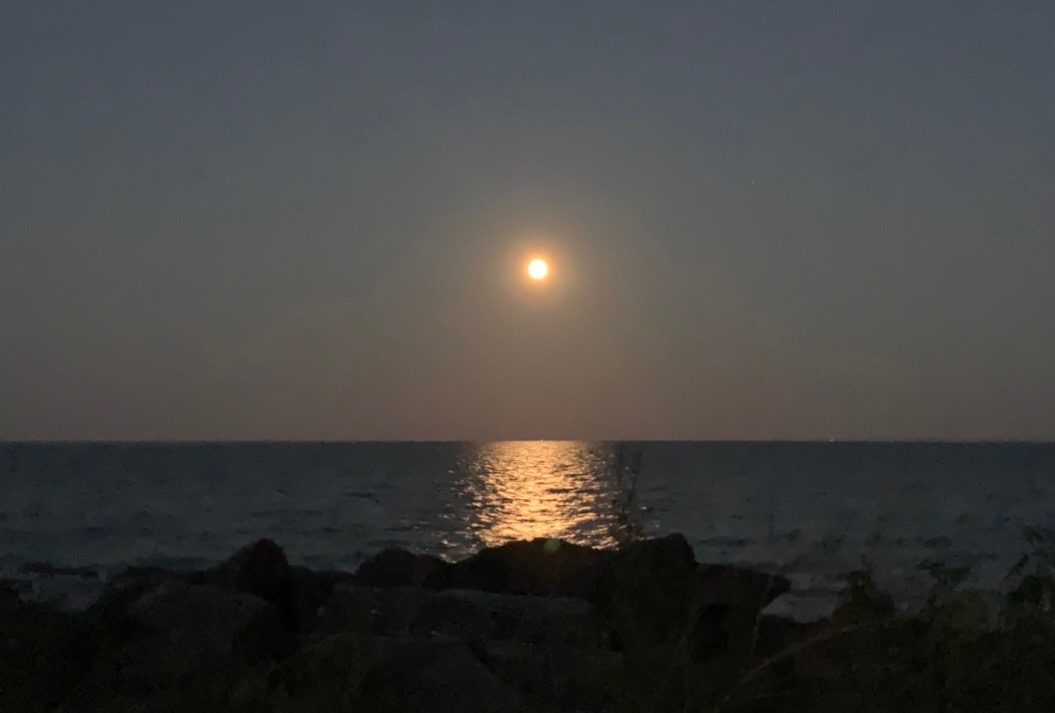
Many years ago, deep into the night, I stood beside a backyard pool and gazed at the full moon. I knew my life was about to change radically. A leap. I was scared. I whispered, “I don’t know where you will lead me but I will follow you.” Recently, standing on the shore of Lake Michigan, watching Kerri snap photos of the brilliant full moon, for some reason I vividly remembered that long ago poolside moment. I smiled and whispered, “So this is where you led me!”

I couldn’t be more grateful.

Tango With Me, 36″x48″ mixed media

read Kerri’s blogpost about THE MOON

like. share. support. subscribe. comment…thank you!

A Dream Itself [David’s blog on KS Friday]

I awoke this morning with a line from Hamlet running through my mind: “There are more things on heaven and earth, Horatio, than are dreamt of in your philosophy.” What dream, what night-wander was I following that made me bob to the surface with a line from Hamlet as my first thought of the day?

Sometimes I use Google like I use the i-Ching. A divining tool. I called up the phrase from the mighty Google and read two opposing opinions of the meaning of the line. Of course. Divining tools generally cast a broad net. The first writer interpreted the line to mean that the human imagination has limits; there is so much that we don’t know and cannot yet imagined. The second interpretation was stated with absolute authority. This is what Shakespeare meant! “One must believe what he or she sees. Even if they previously did not think so, the real evidence should change their mind.”

Evidence or the limits of imagination? Evidence as the limiter of imagination? I was no closer to answering my dreamtime question but I was affirmed in the dynamic nature of perception and interpretation. What a great play!

Living as we now are, in the advent of A-I, one must not believe what he or she sees. I have no idea what Shakespeare meant – we never discussed it – but I am certain that what one sees is no longer evidence of anything. What one hears requires vetting. There are more things on heaven and earth than Shakespeare could have possibly imagined. Our world is beyond his dreaming or he might have suggested to Horatio that he must question everything he hears and challenge everything he sees.

And, about my dreamtime question? I’ll leave that, too, to Hamlet: “A dream itself is but a shadow.”

Kerri’s albums are available on iTunes and streaming on Pandora and iHeart Radio

read Kerri’s blogpost about THE NIGHT

like. comment. share. subscribe. support. thank you!

Fill Your Paintbox [David’s blog on DR Thursday]

I know a bank where the wild thyme blows,
Where oxlips and the nodding violet grows,
Quite over-canopied with luscious woodbine,
With sweet musk-roses and with eglantine:
There sleeps Titania sometime of the night…

[A Midsummer NIght’s Dream by William Shakespeare. Act 2, scene 1]

I played Oberon for the Walden Theatre Company at the Kentucky Center for the Performing Arts when I was way too young to play the role. I said the words and, although I did my research, I only had an abstract grasp of wild thyme and luscious woodbine. I had no depth of understanding of relationship and the mischief it invokes.

Now, those things are visceral. I know them to my core.

Luscious woodbine climbs and covers the fence beside our driveway. The leaves turn to fire in the fall, and when they drop, they reveal the blue berries, toxic to humans but delicious to birds. In a few days, the berries disappear. Woodbine symbolizes the bond of love since it entwines and embraces trees and other plants. And fences. The locals call it Virginia Creeper.

I was witness to the great actor, Jim Edmondson, play Lear for the first time. He was astonishing. After the performance, he said, “I don’t have enough colors in my paint box yet to play this role.” I sometimes wonder, as he aged, if he found the colors he felt he lacked. The intimate depth of understanding of growing old, of losing power, of being shelved. Loss upon loss. Leaves turn to fire and fall. All that remains is the vine.

I’m growing to understand the paradox of life: none of us has enough colors in our paint box when we are young and moving through the complexity. The colors are cumulative. How many times have I said, “Man, if I only knew then what I know now.”

“I know a bank where the wild thyme blows…” Yes. I do. At last.

read Kerri’s blogpost about WOODBINE

like. share. comment. support. smell the sweet musk-roses. we do.

buymeacoffee is a place where nodding violets grow and artists find a way to live another day.

See Green [David’s blog on Not So Flawed Wednesday]

If we call someone “green”, we mean that they are inexperienced. Innocent or new. The term “green-on-green” implies a team that has little experience. Young pilots. Mixed doubles swatting at tennis balls. Newly minted detectives. New growth. Immature. Seedlings.

A green issue is environmental. Renewable energy. Wind power. Green is the color of nature.

In street slang, green has two possible meanings. Money. Green is the color of currency. Or, weed. Green is the color of marijuana. A surprising twist on green-on-green!

I can be green with envy. Or green with jealousy. Green is the color of illness. Apparently coveting makes us sick. “Do you feel okay? You’re looking green.” The Romans thought so. Shakespeare, too.

Google the meaning of green and you’ll find it symbolizes peace, hope, and harmony. Optimism.

In spiritual circles, green refers to fruitfulness and fertility. New leaves. New growth. And so, a full-circle return to the first meaning of green, only “new” need not imply ineptitude as much as promise. Hope. A weave of the many meanings of green!

I’m left pondering why I rarely use green in my paintings. Van Gogh did not shy away from green. He was bold enough to smear his green adjacent to vibrant reds and orange. Opposites on the color wheel. A bang to the eyes. Perhaps there is some green in my future.

On our hike today I can say with all honesty that I was completely taken with the many shades of green.

read Kerri’s blogpost about GREEN

like. support. share. comment. many thanks!

buy-me-a-coffee is a donation “tip jar” where you can support the work of the artists you value.

Act For The Benefit [on KS Friday]

We are hunkering down today. The smoke from the Canadian fires has arrived and the air-quality-index reads “Poor” to “Dangerous.” My head hurts. I feel as if I can’t catch my breath. A glaring example of interconnectivity. Airspace knows no nation. Not really. All for one and one for all.

I Googled the phrase “All for one and one for all” wondering if it was yet another clever Shakespearean quote. It is but the good poet didn’t originate it. He borrowed it from the Latin or from Aesop. I read that now-a-days it is the unofficial motto of Switzerland. “Each individual should act for the benefit of the group, and the group should act for the benefit of the individual.”

Aesop was born circa 620 BCE so the idea that we should – and could – act for the benefit of all is not a new idea. It may be the most basic of human survival necessities. Aesop popped it into a fable since storytelling is the original-and-best form of adult learning theory. On a side note, someone who composes and/or tells fables is called a “fabulist.” Had I known sooner I’d have spattered that on every business card, used it at every social gathering: “What do you do for a living, Mr. Robinson?”

(humble chuckle) “Oh, you know, I’m a fabulist. Here’s my card…”

Kerri snapped this photo of Meadow Hawkweed. It’s important to our story of Canadian smoke in American airspace because its healing properties include the treatment of asthma and other respiratory ailments. All for one and one for all includes the world of flora and fauna, too. The whole knows no parts just as the airspace knows no nation.

In my dystopian fantasy, when we warm the globe sufficiently enough that systems collapse and smoky air is the new norm, I’ll corner the market on Hawkweed. Just-kidding. I’ll share what I know with whomever needs help breathing. And, while waiting for the healing to kick-in, I’ll tell some stories of people helping people. Like Aesop, I’ll try and plant the seed for a better world. Once a fabulist, always a fabulist.

in a split second/as sure as the sun © 2002 kerri sherwood

Kerri’s albums are available on iTunes and streaming on Pandora and iHeart Radio

read Kerri’s blogpost on HAWKWEED

Like it? Like it. Or share it. Or comment. Or buyusacoffee. All are greatly appreciated.

Name It [on Merely A Thought Monday]

The artist, Joe, had us write our names again and again until the lines lost their meaning, until we realized the lines were…lines. And shapes. Until we realized that our names were drawings. Unique and easy. His message? Everyone draws. And, more importantly though less obvious, the lines do not carry the meaning, the person infuses the line with meaning.

Visiting a pal in the hospital, I watched a heart monitor. More lines. Pattern. Waves. Visual indications of the drumbeat of the body. The drumbeat of the body propels the rhythm of the poet’s pen. Iambic pentameter. Short, loooong. Short, loooong. The poet’s lines reach through time and space, heart-meaning yearning to pulse through another person, to perhaps synchronize with their heart-wave pattern. Centuries may have passed between the inky scribbles from the poet’s pen to the person absorbing the meaning into their beating heart. Time travel. Ancient heart touches the living. “When to the sessions of sweet silent thought/ I summon up remembrance of things past…”

Watch a child learning to “write” their alphabet. Assigning meaning to shape. Crayon fist making lines. The refined adults see the shaky line as crude. Cute. Titanic imagination squeezes itself into alphabetic parameter. The little hand becomes a giver of meaning to shape and line. Expression. Learning to combine the limited shapes for greater and greater complexity. The conundrum: among the first lines we learn to scrawl are our names yet these few lines carry a question that can never be answered. Who am I?

The artist, Joe, had us dash off our names again and again until the lines seemed nothing more than a doodle. The meaning is not found in the lines; the lines and shapes merely point the way to the question.

read Kerri’s blogpost about THE CONTRAIL LINE

share or like or buyusacoffee.com. better than all, let us know you are out there.

Remember This Vivid Moment [on Merely A Thought Monday]

When we first met, we sat on the living room carpet staring into the fire, and talked the night away. The sound of the birds at dawn surprised us. I remember the coming light and sweet birdsong like it was yesterday.

A few days ago we sat on the living room carpet in the sun, and talked the afternoon away. Our quiet conversation reminded me of that very first night. Our topic in the winter sun: letting go of too-tightly-held-ideals. “Truth will out,” wrote Master Shakespeare in his Merchant of Venice. Our truth was out in quiet voices that brought affirmations of better days.

A story I once loved to tell was The Crescent Moon Bear. The heroine, a young wife, must go on a journey. She must leave all that she knows in pursuit of her purpose. Leaving all that you know is easier said than done. It doesn’t happen in a moment; it requires some sweet visitation of the past. “What was” as launching pad to “What will be.”

Before I left my studio in Seattle, I had to touch the walls, run my fingers along the sill. I knew I would never be back. Even in that moment, all I could remember was the goodness I experienced in that space. The refuge. The sanctuary. The creative fulfillment. The hard times I’d known there dissipated like mist.

What was. Krishnamurti wrote, “You can only be afraid of what you think you know.” I marvel that the hardships of my past soften into pastel remembrance, translated into useful lessons, while my future fears are as sharp as broken glass, monsters around the corner. Acute imagination.

I marvel that the generosities heaped upon my life are vivid and bring tears to my eyes just as they did the day that I first experienced them. Keen remembrances.

Sitting on the carpet, the low afternoon sun warming us, I realize that I will always remember this vivid moment. The day we opened our hands and let fly illusions. We both took a deep breath. New air rushed into the open space, Not knowing where we might now go or what we might now do, we sat in the waning light, surprised that the sun was setting so soon.

read Kerri’s blogpost about REMEMBERING

Reach Through The Trees [on DR Thursday]

When my time on the planet could be counted in single digits, I drew the same picture over and over and over again. A cabin in the forest. A tree in the foreground. Among my first oil paintings was the cabin-in-my-mind.

For years, my cabin hung on my grandfather’s wall. When we traveled to Iowa for a visit, I was pleased to see it nested in a modest frame in his home office. It may be my first painting to make an appearance beyond the walls of my boyhood home. When he passed, my parents claimed the painting and it circled back to their house, where I painted it.

Last year, with my dad in assisted living, while moving my mom into her new apartment, I brought the painting back with me to Wisconsin. Full circle. We put it in a new frame. It rests in my office, sitting on the floor against the file cabinet because we can’t decide where we want to hang it. Each day, standing at my desk, I am, for a moment, pulled back in time to the boy who had to draw this cabin again and again.

Why? I certainly didn’t feel as if I was inventing it as a drawing exercise. From this vantage point I remember it as a recall, the invocation of a memory. My child-brain never questioned it. My cabin, as if I lived in a world before photographs and was trying to record what once was, trying to reach through the trees to what could no longer be touched. I had to draw it so I might remember it.

Now, with hundreds of paintings between me and my cabin in the woods, I wonder if every painting I’ve ever painted comes from the same impulse, reaching through the trees to what cannot be touched. Canvas on the easel has always pulled me into it, like a good story pulls a reader into a book.

It’s also a great definition of art and artistry. Just try and wrap your fingers around King Lear or grasp the deep well of Martha Graham. Kerri’s piano bounces when she plays it; she is little and her piano is grand. The force that comes through is beyond comprehension.

I laughed when my doctor told me that we rationalize things because we want to control them and, sometimes there is no rational explanation. No way to control it. Art regularly blows through the question “Why?”.

read Kerri’s blogpost about REACHING THROUGH THE TREES