See The Third [David’s blog on DR Thursday]

Rules of composition are really a study of human perception. It’s not the work of art that’s being examined, it’s the human being. Why do we consistently – universally – respond positively to visual compositions that follow the rule of thirds? Divide a composition into thirds, either vertically or horizontally, and then place focal areas of the “scene” at the meeting points of the lines. A professor in art and design school teaches the rule as a basic tenet, not because it was a concept that was invented but because someone, somewhere in time, noticed that people generally like their paintings, photographs, murals, quilts, architecture… when the focal point lands on one of the thirds. It was a discovery about the nature of people. Human nature.

Even the most abstract painters adhere to the rule of thirds. There is structure beneath seeming chaos.

There is something about humans and the number 3. The structure of a joke has three parts – the set-up, the detail, and the punchline. Most religions sport a trinity: father, son, and holy ghost. Brahma, Vishnu and Shiva. Buckminster Fuller’s Geodesic Dome is a festival of three. Pay attention and the rule of thirds pops up in everything from brain science to marketing messages. Triangulate and even the most lost hiker will be found.

When I first met Kerri I was disconcerted. Her compositional eye is infinitely better than mine. How could this musician come into my studio, snap a photo of my work-in-progress, and show me that her cropped version of my composition was infinitely better? What the heck? Her crops were never radical; simple adjustments merely. After I recognized how natural yet specific her eye sees the thirds – while I am clumsy in my seeing – in a fit of re-composing, I almost took a saw and scissors to my paintings. It was so obvious. Now, I ask her early and often to come into the studio and tell me what she sees (Imagine my horror when she stands silently for several moments and finally utters, “Well…”).

On the trail she stops often to “take a picture.” I play a game with myself. I look at where she aims her camera and then I predict where the focal point will land. Which third will claim the prize? I am almost never right but always delighted by what she shows me. “Lookit!” she says, smiling. A perfect third. Naturally.

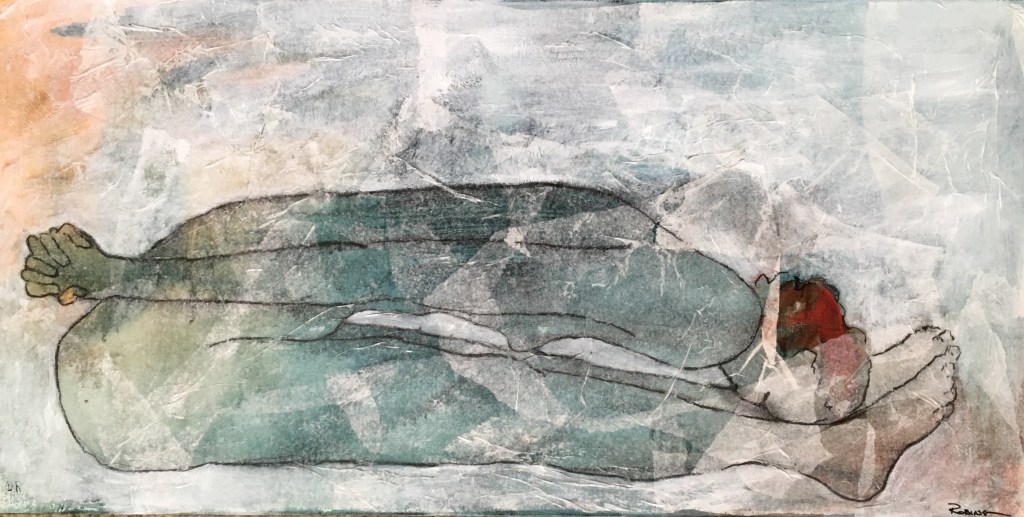
prayer, 9″ x 24″ acrylic on hardboard

read Kerri’s blogpost about LACE AND SNOW

like. support. share. comment. many thanks

buymeacoffee is not a third. It is something else.

Work Forward And Back [David’s blog on DR Thursday]

Writing the first draft of a play, I’ve just entered the “swimming upstream” step in the process. I’m working my way from back-to-front to make sure all the story dots connect. It’s detail work. It requires looking close-in. I used to hate this part of the process because I’d get lost. I’d forget what I was doing and prematurely rework sections. Painters ruin paintings when working too small too soon. Writers are subject to the same peril. Now, I adore this step. Life is funny.

A few years ago I realized that my change in process-love, my capacity to work in detail without getting lost, came when I stopped trying to race to the end. Now, I am in no hurry to finish. I want a full relationship with my story as it reveals itself to me. It is a child, holding my hand, guiding me to the wonders of the playground.

Working forward. Working backward. Stepping in and then stepping away, like the tides. Big brush washes first, attending to the overall composition. Structure. And then detail. It’s much like building a house. Foundations and then finishes.

I have learned from watching Kerri to use my camera to see detail. To step in and look. Seeing-as-a-relationship. To pay attention to the dew on the small pine, the reason it glistens. And then to step in further. The platitude: a single drop of dew contains an entire world. Beyond the platitude: step in and it’s possible to fall into another world. To experience the surprise available in the enormity of the minute. And bring back to the big, big world of hurry-here-hurry-there the astonishment that is found there.

Forward Back, 18 x 36IN, mixed media on canvas

read Kerri’s blogpost about DEW

like. share. support. comment. thank you.

buymeacoffee is a dew drop in a sea of possibilities, a tiny window into the realities of another reality.

Dream [on Not So Flawed Wednesday]

When does a dream turn into a goal?

Lately, I’m having conversations that confuse me. Business thinking, engineer minds, make models for creation. Creativity plans as action templates and guides.

Screen writers make plans, too. Step outlines. The difference is in the process. A creative mind makes models and plans with full intent to throw them away. To discover the best story, their plan involves making space for the better idea. Open up by tossing the model. Clear the deck by shuffling the plan. Sketches and rough drafts. It’s a conversation with the muse. Muses are notoriously structure resistant until the story makes an audience sit forward. Movement first. Then, the structure begins.

The engineer mind works in the opposite direction. The dream must wear the mask of a goal or it is considered invalid. Too squishy. Construction begins immediately with targets and tasks. Order. It is, in fact, the same process as the creative mind, only it is less forgiving of space. It forces the muse to move. Time is of the essence. Structure first. Then movement. Efficiency is a tree with shallow roots.

It confuses me. Dreams do not wear ties or leather shoes, yet, scrape the blueprint and you’ll find a dream every time. Perspective requires stepping away from the canvas. Standing too close for too long and loss of vision is the result. Every time. It’s not a mystery or voodoo. It’s physics. Great ideas and idea-break-throughs happen in the shower or walking on the trail. A clear mind. A different focus creates space. Too tight thinking, too close in for too long, sucks energy.

Once upon a time I worked with organizations and educators. They also confused me. Squeezing the air out of their space they’d gasp, “We can’t breathe.” A little bit of space, some play, a refocus on the relationships was good medicine. Fresh air. Step back and see the painting. The point of perspective is to see. The secret: permission to remove the status games and need to be an authority and, for a moment, reconnect the players to their dream.

At the nucleus of every goal beats the wild heart of a dream.

read Kerri’s blog post about DREAM

Use Your Chalk [on Two Artists Tuesday]

There are two words floating around in my universe these days: structured and unstructured. Structured data. Unstructured data. Structured time. Unstructured time.

The world as seen through the Puritan lens gives great preference to structure. Unstructured anything is suspect. “Idle hands,” we are taught, “are the devil’s workshop.” Yikes. Apparently it’s dangerous to take a stroll, to sit and ponder, to clear the day and do nothing.

I suspect it explains why our notion of business is hyper-focused on the bottom line and often misses the value of relationships. Bottom lines are easy structure. Relationships, not so much. It is the same with test scores in education. Easy structure. However, stepping into the unknown – the very definition of learning – is largely eschewed because it begins in an unstructured pursuit. Creating the structure, making the meaning, discovering the connectivity is what our hearts and brains like to do. When learning isn’t merely a factory, when business is more than a bottom line, people prosper. They come alive.

Unstructured time. There was a time when time had no structure. Monks attempted to “keep” time by monitoring water through a bucket or sift sand through an “hour” glass. Sometimes the water froze in the bucket so the structure of evening prayer was disrupted. The sand clumped in the hour glass and the measure of time clumped with it.

There are moment on the stage when the actor forgets their lines. It’s called “going up” or “drying.” It is always, in the re-telling, the moment when everything becomes real, alive. It is the moment when the structure becomes unstructured. Hearts race. Eyes widen. The stakes are suddenly palpable. The actor breathes, stands in the vast unstructured universe, and the words return like a swinging bar to a high-flying aerialist. The play is infused with aliveness. Presence is mostly unstructured.

As is common in the structured and unstructured use of the English language, oppositions are easily constructed. Unstructured simply means the meaning has yet to be made. Structured data, structured time, are the tip of a largely unknown iceberg. Love, joy, despair, awe…the full spectrum of experiences, bubble in the unstructured spaces. Numbers can describe a moment in time, can orient for a moment, but will never “explain” yearning or desire or our fundamental need to tell stories (put structure on unfathomable experiences). Structure & Unstructure: they are dancing partners, not combatants.

Where do we come from? What are we here to do? I am going to die, what then? It takes a good deal of unstructured time to sit in these unanswerable questions. There are, of course, plenty of people who will gladly provide structure to your unanswerable – and therefore uncomfortable – questions. Perhaps that is why we adore our structure and demonize the empty spaces? Comfort. Ease.

Kerri cannot pass a hopscotch template chalked on the street. It’s almost automatic. Step, hop, hop, step, hop. The little girl in her connects to the child who chalked the squares on the sidewalk. A simple game. Play. It’s one of the things people do with unstructured time. Set challenges. Make up obstacles. Seek puzzles. Invent. Dream. Connect to the deeper places. Where’s the structured bottom line watching the little-girl-in-my-wife hop and skip and turn in the game-chalked-on-the-sidewalk? The laughter of remembering? The giggle and freedom of the woman hopping the scotch, just because she can?

read Kerri’s blog post about HOPSCOTCH

Lose The Justification

783. Join me in inspiring truly powerful people. Each day I will add a new thought, story or idea to support your quest and mine.

I’m reviewing some material for a project and pulled up a chapter from the rough draft of my unpublished ebook, The Open Story. I liked this section and although I know it was expanded from a past post, after 782 posts I’m pretending that you will read this with fresh eyes as I did today:

It is my habit to look beneath behavior to the underlying “structures of the land” (from Robert Fritz, behavior like water follows the path of least resistance – behavior will change when you change the structure of the land). I’ve coached hundreds of people: the process of fulfilling potential or expanding thinking almost always entails reaching beyond the realms of visible behavior into the underlying structures.

The other day Ana Noriega, coach extraordinaire, dropped a thought-bomb on me (she always does) that went something like this: if you want to change your belief, change your justification of the belief. It had never occurred to me to think of belief in the same way I’ve come to think of behavior.

I was about to say, “What!?” but she was already filling in the idea – Ana is usually 3 steps ahead of me and said, “Think about it. If you believe you are not worthy or something like that, there is always a justification beneath the belief. You justify the belief. I’m not worthy because….” Beneath every belief there is a justification: there is a reason you hold onto the belief.”

Justification is a form of story. Most of us are attached to our stories – why we can or cannot do something; why the world is this way or that way. Usually our justifications have to do with maintaining comfort – making sure we don’t stray into lands that challenge our beliefs – and that would require a peak into our justifications – it’s a loop.

Take a look at the things you want to change or manifest in your life. What are your beliefs about it? What are you justifying?