With Fresh Eyes, See [on Merely A Thought Monday]

In retrospect, many of the experiences I used to facilitate were meant to pop people – even for a moment – out of the fog of their life story. It’s a curious intention for a guy whose career was/is centered around the telling of stories.

I loved working with masks, especially with people in corporate settings or lofty educational towers. They feared the exposure that a mask might bring so they approached it with eye rolling and whatever-ego resistance. Yet, in every case, they put the mask on with reverence. There is a sequence, after donning the mask, that the wearer “wakes up” and looks at the world for the first time through fresh eyes. Everything is new. Everything. Their hands. The movement of their arms. The color and feel of the carpet. Jaded people, blunted with puffy assumption, through the eyes of the mask, are astonished by the miracle of their fingers. And then, imagine the moment that they discover each other. Their discussion during the debrief would make you weep. It was quiet. Respectful to the point of sacred. In every case the people, newly out of the mask, had to tell of their astonishment and discovery. Their eyes wide with the utter beauty of the world in and around them. And, their new eyes never carried further than the next day. The old mask, the one worn daily, the one full of fear and inflated self-importance, is powerful, too. As they say, masks reveal and masks conceal.

Masks reveal and masks conceal. The phrase refers to the wearer but it also applies to the world seen or not seen through the mask. New eyes are astonished with the ubiquitous beauty of the world newly revealed. Eyes fogged through been-there-done-that stories are dulled to the point of inattention. The magical world is concealed from their sight.

I am working on a script for a piece that I’ll perform in the fall. I realized in my latest draft that it is really about masks. The astonishment of seeing – and seeing is nothing more than or less than the revelation of connectivity. Paying attention is a step toward the eyes that see crackling vibrant color, ears that hear the birdsong. When the dull eyes open, even for a moment, the next impulse is to reach, to “call attention” to the connectivity. “Do you see that?” “Listen, isn’t it gorgeous!”

read Kerri’s blog post about PAYING ATTENTION

Pay Attention [on Merely A Thought Monday]

I read this morning in my brainpickings, “We have to try and cure our faults by attention and not by will.” Simone Weil.

Kerri and I walk almost everyday. We head for our known, usual trails, and only occasionally go in search of something new. Even though we walk a well-known path, it never fails to seem entirely new. Kerri attends to the details, taking photographs of unusual pine cones, a downy feather on a limb, the sun streaming through the trees. She pays attention. My awareness is more global, the movement of forest, the orchestra and dance of trees and wind. I pay attention.

Our walks bring us perspective when all else seems dark and disorderly. Our walks refill our well of hope when our circumstance seems bleak. Mostly, our walks “cure our faults,” they bring us into a present moment where all of life’s judgments and fears fall away as the illusions that they are. Our walks, if only for a few hours, wipe clean our canvas and return us to a childlike curiosity.

Sometimes, after a snowfall, we arrive at our trail and it is untouched. It never fails that we stand at the trailhead and marvel at the unblemished snow. Sometimes we hold hands and jump in with both feet and laugh. Sometimes we step carefully, quietly. Reverently. Either way, it seems a special gift. First steps are to be noted. Last steps are to be noted.

This morning I read an article about How Aging Shapes Narrative Identity. How the story-we-tell-ourselves-about-ourselves changes as we age. Our investments change. We become less interested in pursuits and achievements, in willful purpose. We become more interested in appreciation of our precious, limited moments. And, so, we begin to tell a different story. New snow on an old path.

The article was timely. Kerri and I lay awake most of the night. Among other things we pondered my dad’s dementia, the stories that he weaves and realities he inhabits. He is obsessed with going home.

Deep in the night, we talked about the stories that we currently weave together as we grow older. It seems that this time in our lives is a blank canvas, a path of new and untouched snow. Standing at the trailhead of our next chapter, no steps to follow or map, neither of us has any desire to reinvent or become different than what we are. Certainly, the circumstances of our lives are changing, but more and more we merely want to pay attention. To hold hands and jump into the unbroken snow. To laugh. To note the downy feather in the tree. The wind song, the deer that surprise us, leaping through tall grasses. “Did you see them?” I whisper. Kerri nods and smiles. Reverence. Nothing in the world, at that moment, is more important.

read Kerri’s blog post about UNBROKEN SNOW

Add A Stone [on Not So Flawed Wednesday]

southport cairn copy

I am fond of a labyrinth tucked into the woods at The Whidbey Institute. I’ve spent many a sunrise and sunset walking the meditation path to its center and back again. After each trip into the labyrinth, I’d add a small stone to the cairn that stood adjacent to the entry point. A ritual to mark my passage. A location stone.

I hadn’t thought of the labyrinth for years.

Last week, on a stormy day, we took a long walk through our neighborhood and emerged on to the beach at Southport.  We were stopped in our tracks by what we found there. A field of cairns. Someone – or many someones – had created dozens of stacked stones. Each unique. Some playful. Some sorrowful giants. Markers of the way home? Funeral stones? Sculpture merely? The intention didn’t really matter. They brought us peace.

We approached silently just as I used to approach the labyrinth at Whidbey. We entered the field with a reverence that surprised me. We wandered through them, spent time with them. Some were massive, towering over us. Some very small, a few stones stacked at our feet.

Pebble and red brick trails ran like crazy lines connecting the cairns, a mixed up maze that begged us to follow, to make sense of the impossible. This labyrinth had no center. This meditation maze led nowhere specific, looping back, a dead end here, a path to the water, and over there, a line that stopped at a heart made of rock, a spiral. A wish. A message. An inspiration.

I could imagine no better monument to this pandemic. A shattered labyrinth. Burial monuments. A field of markers standing ready for the day when we might find our way out. A quiet reverent place where we are called to add a stone, a simple gesture to remember our passage through.


read Kerri’s blog post about CAIRNS


cairns website box copy


Turn And Open [on Two Artists Tuesday]

canoe and dock copy

Real education is understanding the significance of life, not just cramming to pass examinations. ~ Krishnamurti

Tom used to call it The Little Green Bottle theory. The illusion of learning at the expense of real learning. It is the worst fate for a curious mind to confuse active pursuit with passing the test.

The worst fate for an artist is to be revered. Artists who are revered regardless of what they do, stop growing – or worse – they twist. They confuse themselves with their art. And, because they are lauded for any and everything thing they do, they lose their muse. They no longer need to listen or seek or try.  They insulate and turn in on themselves. Knowing that their feedback loop – called an audience – will give them a perfect score no matter what they do, oddly makes their work not matter at all. They – and their work – and their audience – become an energy eddy, an empty bottle with no substance. The circle closes.

Long ago, I guest-directed a play at a college. There was a student, an extraordinarily talented young man, who was coddled by his professor. She heaped praise on him. He was cast as the lead in all productions. In fact, I was (hush-hush-nod-nod) required to cast him. He was protected from the rules and rigors his peers were required to follow. He simply needed to show up.  I crossed his path again a few years later and he was a very sad and empty young man. He left his small pond and didn’t have the skills or work ethic to swim in the ocean. He wondered why no casting director would work with him, why no masters program would admit him. He expected reverence. His talent collapsed on itself. Many of his peers, those who had to work, to grapple, to reach, to struggle, had solid and thriving careers. Rather than helping him grow, his professor, his college community, stunted his artistry. His circle closed.

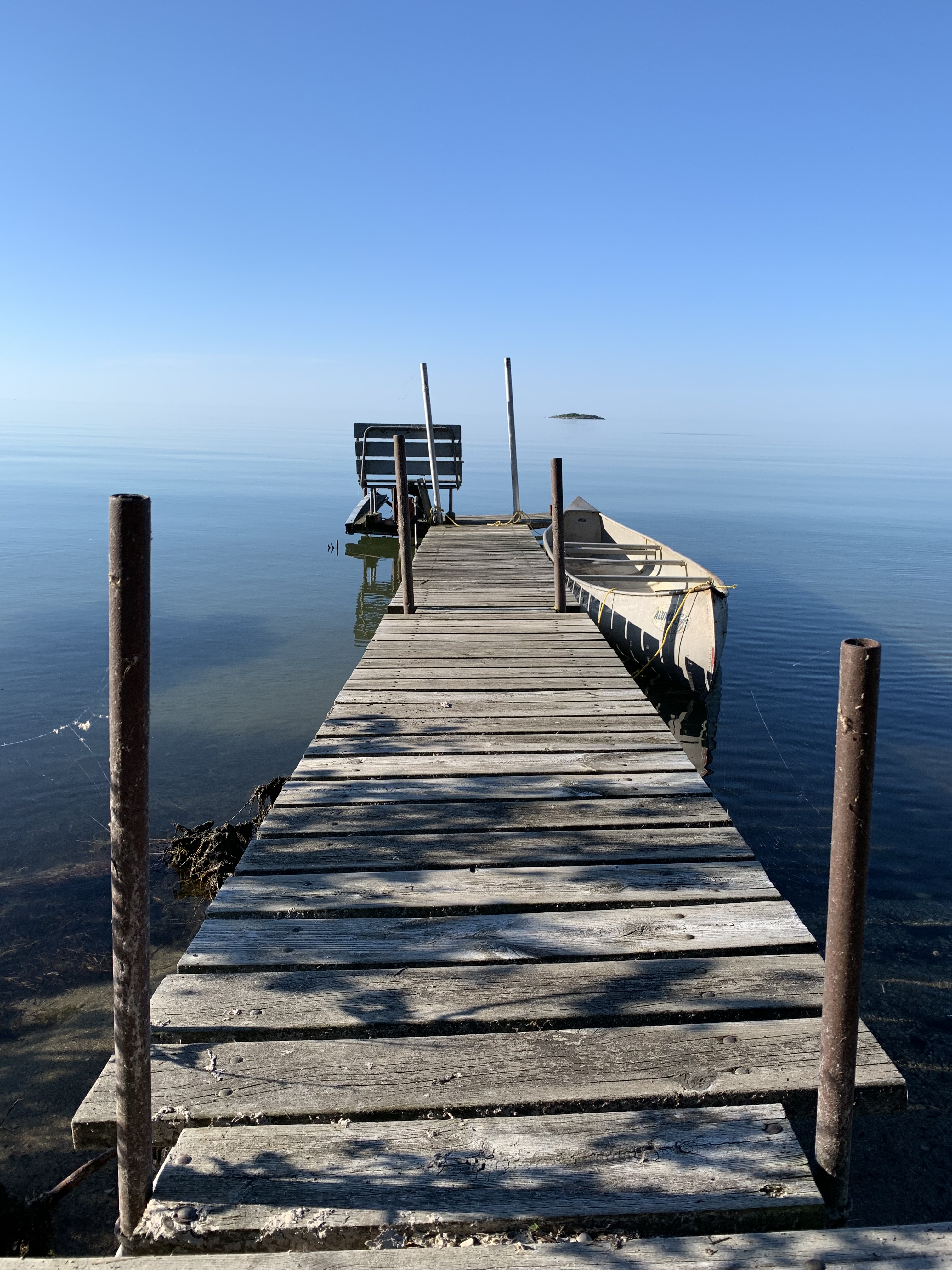
The waters are so calm this morning. Hog Island seems to float in the air. Sitting on the dock, I feel perplexed. Lately, the world so often feels upside-down, in service to the opposite of what it professes. Islands feigning connection. Closed circles working hard to stay closed even awash in the knowing that they can only breathe when opened. They can only grow when challenged, when they open the gates. They can only thrive when they turn, open the circle, paddle toward the limitless horizon and face the unknown.

The muse is out there, waiting.


read Kerri’s blog post about THE DOCK


sunrisewebsite copy


photograph: on the dock of the bay ©️ 2019 kerri sherwood