An Unearthing [David’s blog on KS Friday]

“We shall not cease from exploration, and the end of all our exploring will be to arrive where we started and know the place for the first time.” ~ T.S. Elliot, Little Gidding

It is not so simple to Be You.

I’ve yet to meet a person who knows without question, without doubt, who they are.

That is not a flaw. It is a given since we are not a piece of furniture, not a thing or an end result. We are so much more. An unearthing. A discovery.

We are human beings. Questioners. Questions.

We are both seeker and sought. We are both archeologist and vast hidden city.

Of course, that is not the meaning behind the message stitched on the rainbow hat. Be You is an affirmation of inner truth in the face of social pressure to Be Other than You.

There are other seekers – other people – who, in their fear of the unknown, attempt to define you. Confine you. They make rules, absolutes. They wish to stop the seeking.

Your difference is a disturbance in their rigid field of sameness.

They desire limited commerce and will only travel well-worn paths. They worship control – so controlling you, they believe, will keep them safe in their comfortable known. They would have you walk on their paved path. Color within the lines. Worship as they do.

Your difference shakes their cage. Your difference is a siren’s call to the scary edge of the unknown, to growth since growth is always in the direction of the unknown.

They quake. They fear your difference because they fear that they will disappear if they step toward the rim of learning: they fear what they will find in themselves – or have to admit to themselves – so they sail far away from the edges.

Be You? Just as others propel you forward in your discovery, just as resistance helps you discover the parameters and depths of your belief, your difference serves as a harbinger for others, a message in a bottle, calling them to the precipice of their greater archaeology.

What is over there? In there? Under there? Beyond? Me?

Is it an end? A beginning? And who will walk with me? Why?

As always, rather than a book of rules, a fistful of pat answers, is it not more useful – more honest – to ask and ask and ask a better question?

[Quinn called these The Big 3: Who am I? Where do I come from? What is mine to do? We never arrive at an absolute answer since we are a moving target, always growing in a relationship with the unknown. The point is not to nail down a forever-answer; the point is to be brave enough and open enough to continually ask the questions.]

GRACE on the album RIGHT NOW © 2010 Kerri Sherwood

Kerri’s albums are available on iTunes and streaming on Pandora

read Kerri’s blogpost about BE YOU

likesharecommentsupportsubscribe…thankyou!

Love The Question [David’s blog on Two Artists Tuesday]

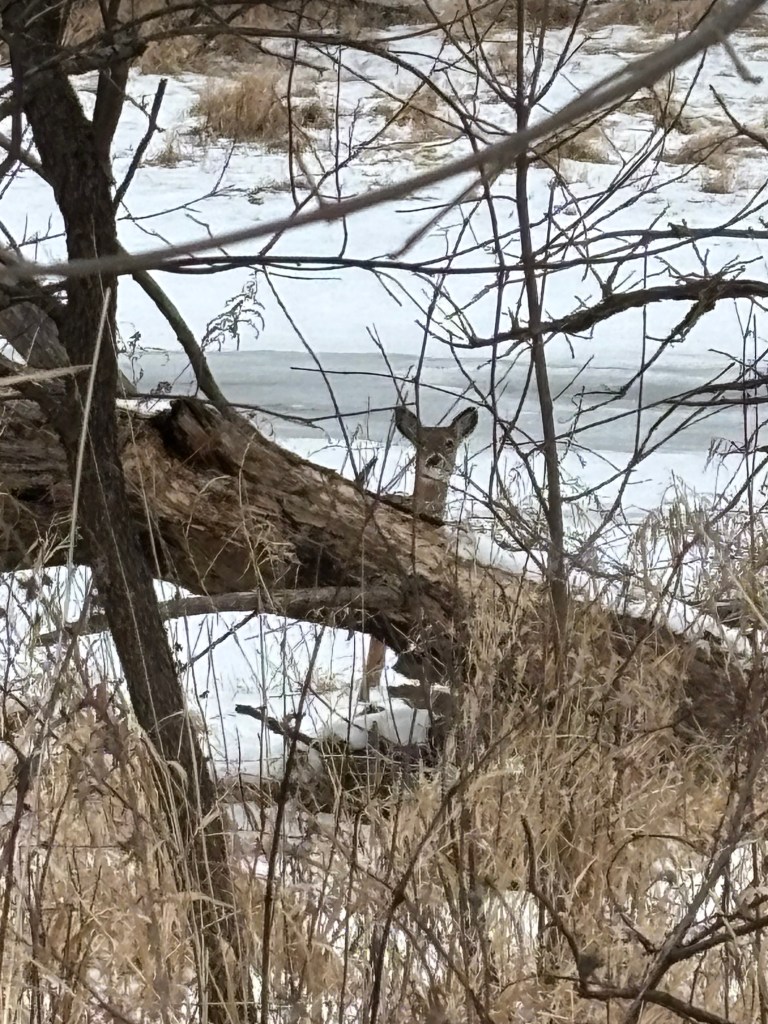
After an interminable stretch of frigid days the temperatures finally rose enough to venture out. Grateful, we bundled up and headed to a trail. In the five miles we walked, on a path that is in no way remote, we saw at least 10 deer. At one point two of the herd stepped onto the path and scrutinized us. We stared at them and they stared at us.

It’s been true all my life that when animals cross my path or show up in unusual ways I take note and later research their symbolism. I like the idea that nature is communicating with me. I like the feeling that nature is sending me messages, reinforcement, guidance. Is it a game I play with myself or a core belief? I have arrived at a moment in my life-walk that I no longer need an answer to the question. I simply love the question.

We have an old wooden glider in our living room. Somehow, outdoor furniture made its way inside. We sit on it every afternoon. It’s become the place where we debrief life, where we have deep-diving conversations. Lately on the glider we’ve been unpacking the past five years. Our previous half-decade has been fraught. It has been akin to the interminable polar freeze. Sitting on the glider, wine in hand, we appreciated that the deer symbolize, among other things, new beginnings. “If one deer represents regeneration and rebirth, what might it mean that we saw so many?”

It’s an excellent question to hold in our hearts. It’s a question filled with hope in a time rife with national unrest, fear and contention. We don’t need an answer. For now – and always – it’s enough to love the question, to live into the surprise, to welcome the possibility.

read Kerri’s blogpost about THE DEER

l

ikesharesupportcommentsubscribe….thankyou.

The Way Home [David’s blog on Two Artists Tuesday]

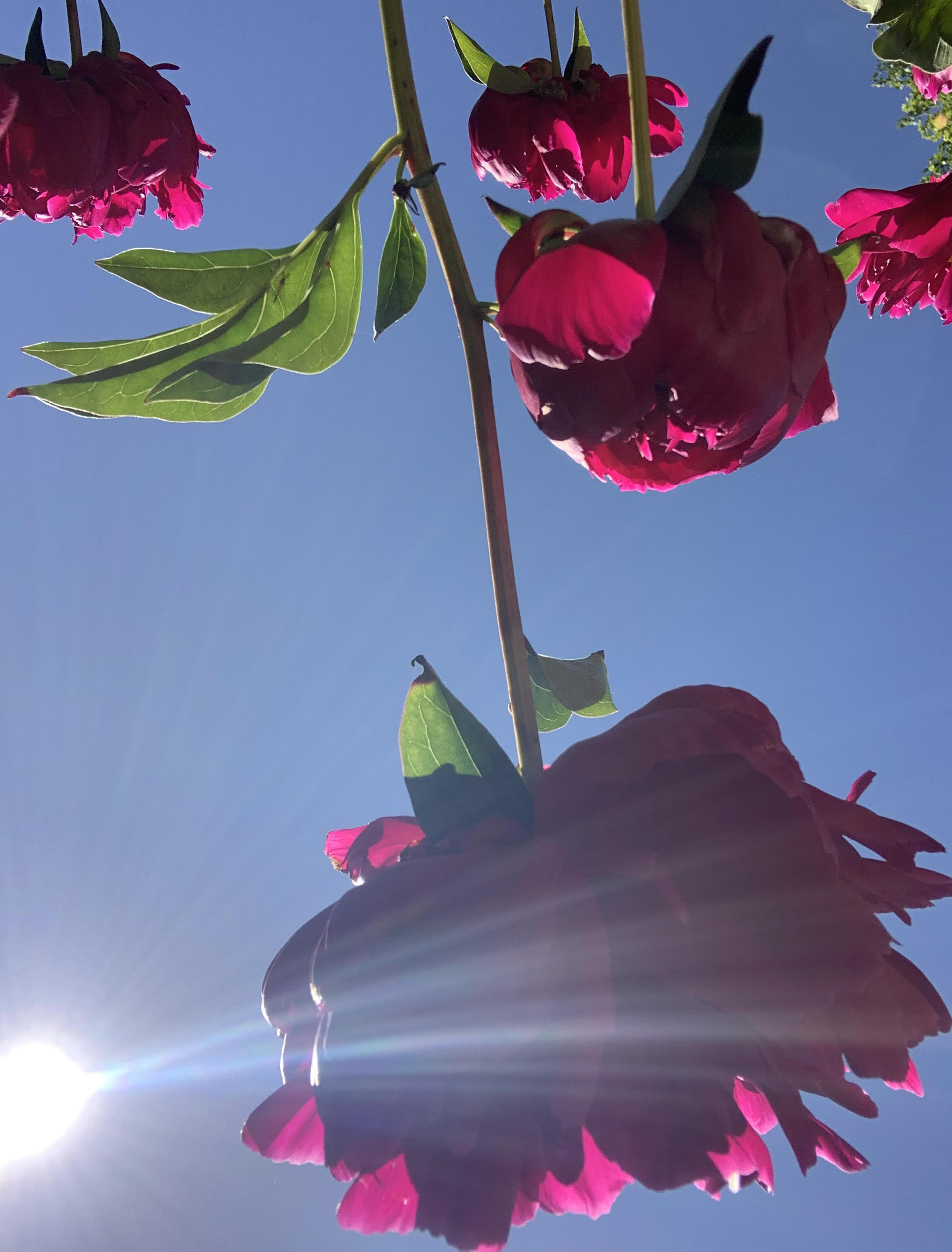
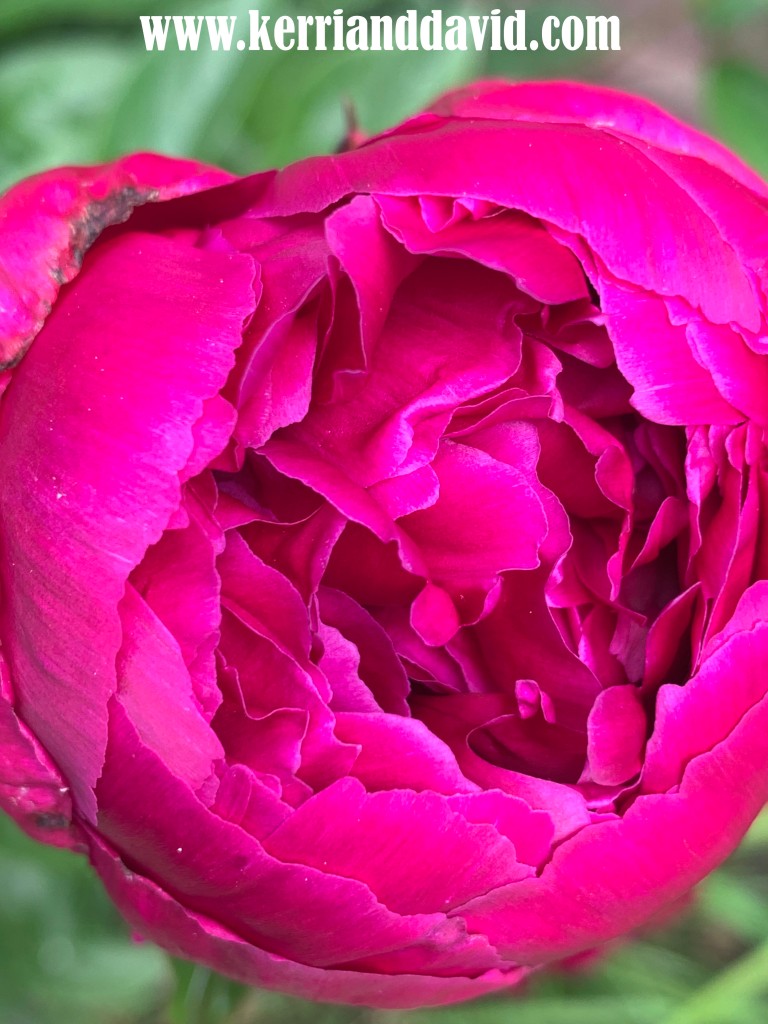
This peony-perspective begs to be the inciting image of a children’s book. I imagine the main character comes from a world where people are smaller than flowers. Where bumblebees are happy Ubers delivering their small human riders to distant neighborhoods when they need a lift. Where nature is magical, playful and esteemed.

Not all ideas make it to the final draft so it’s important to stack up the ideas and have fun with the images. The main character sleeps inside the peony. The Uber bees are chaotic fliers and one never knows where they land; in this world, destination is always a surprise. Spontaneity is the norm.

In this world where people look up to flowers, “Home” is everywhere for everyone – so people, unacquainted with ownership or territory, have evolved as intrinsically helpful. Generosity of spirit is a highly prized character trait. Survival is not of the fittest but of the kindest.

Hummingbirds know the secret of finding sweet treats, caterpillars know the secret of patience.

Since this storybook is evolving as a sweet utopia, it begs the question, “What’s the conflict?” Stories do not work without obstacles. The bigger the better. What is the lesson our main character must learn? What gets lost that must be found? Maybe our little person, like Adam and Eve, falls out of their garden? Perhaps an Uber bee unwittingly flies our hero/heroine through a magic portal, to a place where people are bigger than flowers? In a world that seems sad and upside-down, the question becomes, how does our little person, lost in the land of big, find their way home?

read Kerri’s blogpost about PEONY PERSPECTIVE

Bonus! Perhaps this amazing composition will be the theme for the animated version of the story book once it garners a world-wide audience!

The Way Home/This Part of the Journey © 1997/2000 Kerri Sherwood

like. support. share. comment. subscribe. many thanks!

Ramble [on DR Thursday]

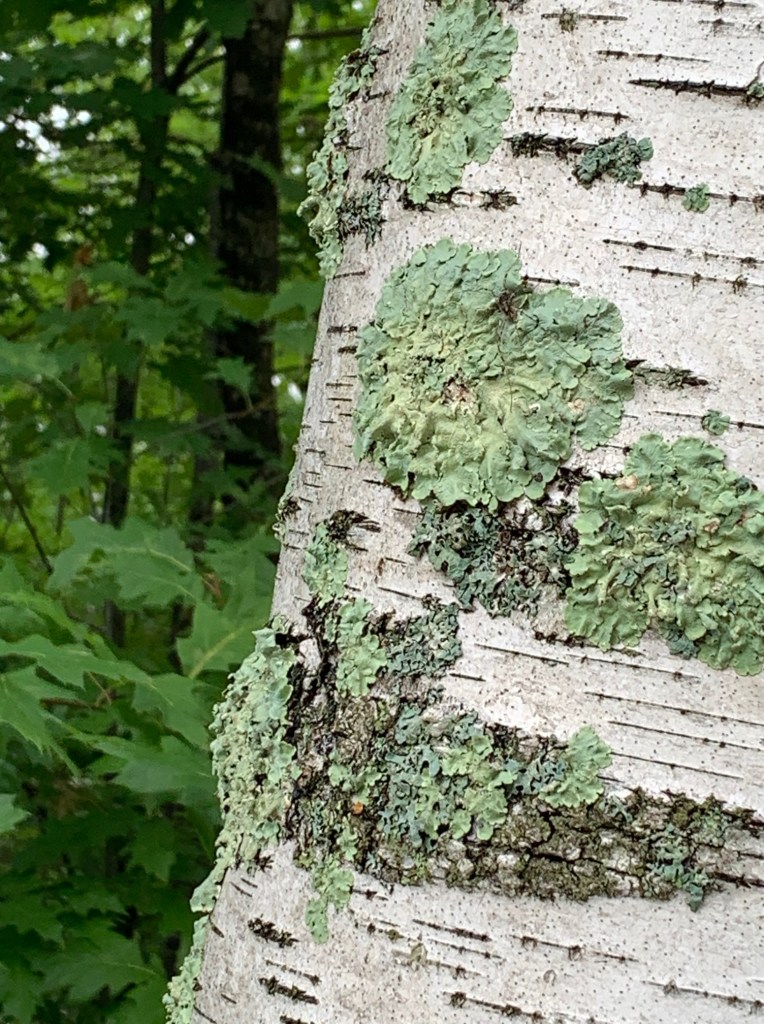
I’m like a two-year old: I want to know “Why?” For instance, the lichen growing on the birch tree is Hypogymnia physodes, but it’s also known as “Monk’s Hood.” Why?

There’s a wildflower also known as Monk’s Hood. I read that the flower gets its name because its petals resemble the cowls once worn by monks. However, the flower is also known as “Wolfsbane.” Why? What does the bane of a wolf have to do with the hood of a monk? I’m capable of inventing a slew of possible connections but they will be just that: inventions.

In an attempt to bore you beyond rescue, I’ve lately been fascinated by how much of our world is a blizzard of unhinged information in search of a context. For instance, conceptual art needs an explanation. Without a curator, it’s nothing more than a banana taped to a wall. Twine with a dirty sponge. Oddity seeking to be taken seriously.

In the 21st century, we measure relevance by the number of followers, not by the substance-of-the-matter-being-followed. It’s a popularity contest. Lots and lots of flowing information, most of it useless. Without use. Without substance. And, scarily for us: without being questioned.

What is empty content pushed through a fabricated context? “Breaking” news. MAGA. Q.

It occurs to me that society needs more two year olds! A healthy practice of asking “Why” would spare us from certain death-by-bloviation.

A cowl, by the way, is both a monk’s hood AND a loose neckline in contemporary women’s clothing. Wouldn’t the monks be surprised if they’d confused their cowls!

Now, get out there and find context for this bit of useless information.

read Kerri’s blogpost about LICHEN

pieta with paparazzi © 2010 david robinson

Delight In The Question

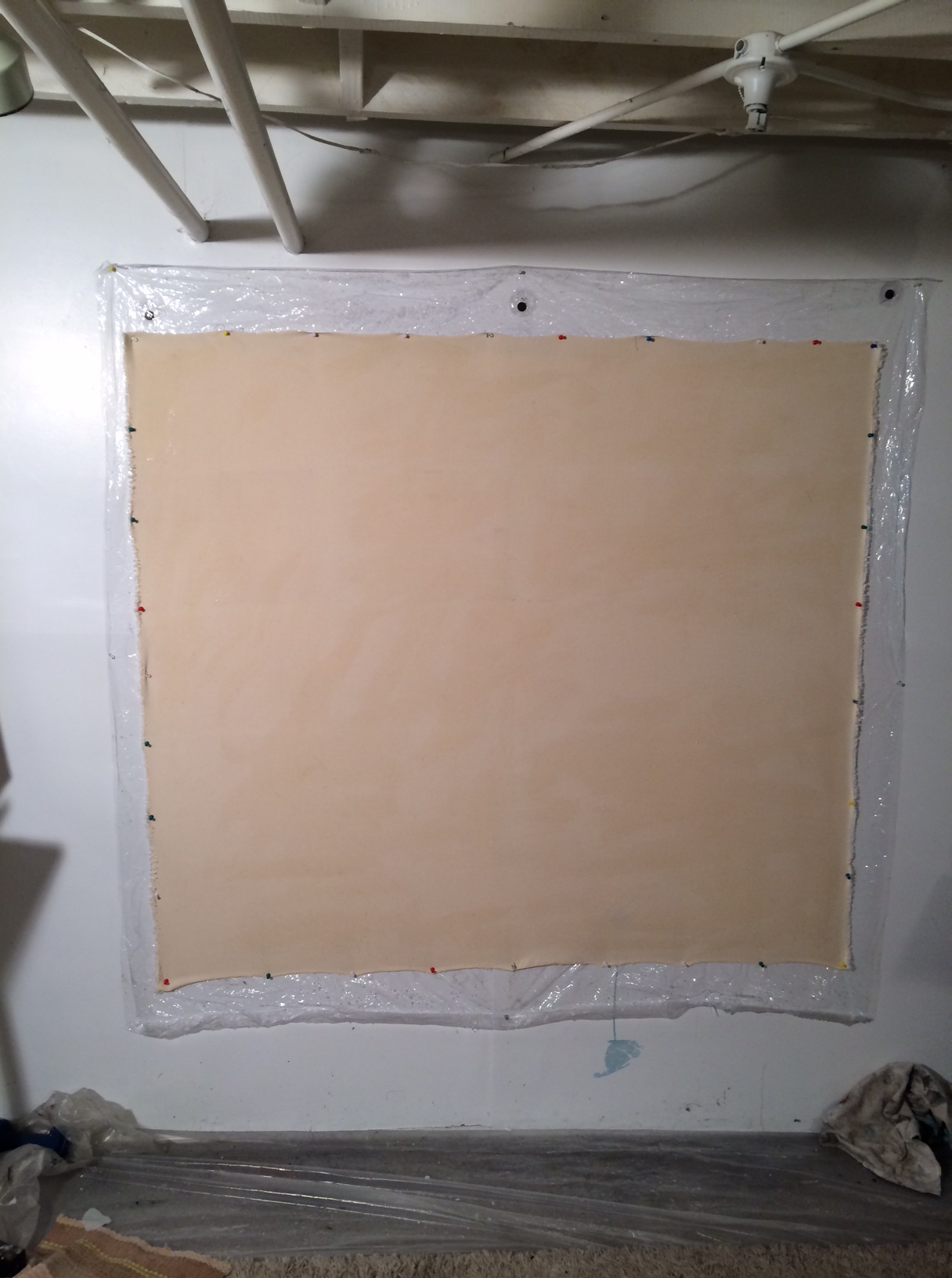
a new canvas, stretched and ready for gesso.

a new canvas, stretched and ready for gesso.

So what is next?

There is a sweet void that follows in the wake of every project and this particular void is vaster than most (don’t you love the phrase, “particular void?”). This project, The Lost Boy, was and continues to be more layered than any other. It pulls on emotional and spiritual roots that have not been available in other performances and so the post-show disorientation is mighty.

I’ve come to appreciate my time in the void. It is the time of reflection. It is the time of rest. It is the time of long walks. It is the time of questions finally answered that invite bigger questions. I’ve learned that disorientation is necessary for reorientation and reorientation never comes as an answer but always comes in the form of a question: so, what’s next?

Yesterday I tacked a large canvas to the wall. It is now covered with layers of Gesso and is ready for paint. I delight in this phase of preparation. It is akin to the anticipation of meeting with an old friend; the conversation will be rich and far reaching. I also bought a new sketchbook and have set myself the task of filling it within the month. Many years ago, while sitting in another void, I was staying with my pals Duncan and Liz while directing a play. Liz, familiar with voids, insisted that, after rehearsals, I do a hundred paintings before I sleep. Each night, tired from a long day of rehearsal, Liz sat with me as I did one hundred paintings, quick gestures with brush and ink, paper fluttering to the floor. We laughed and I felt renewed. After ten paintings en route to a hundred, the notion of judgment and too-much-thinking goes out the window. The joy of the action takes precedence over the illusion of a finished product.

I’ve written often of the lessons Saul-the-tai-chi master taught me. Focus on the field of possibility and not on the opponent. In other words, offer no resistance to those things that appear as obstacles. Sit with gratitude in the void. Paint a hundred paintings before you sleep. Delight in the question.

Choose Your Experience

767. Join me in inspiring truly powerful people. Each day I will add a new thought, story or idea to support your quest and mine.

It’s after 7:00pm and I just realized that it was Sunday. One of the privileges of wandering is that days of the week blend and become one. There are relatively few patterns so markers like workday and non-workday do not exist. This has been somewhat true most of my life. The line between work and play is indistinct. My play and my work have mostly been the same thing.

This afternoon Skip and I did a test run of experiences for our new start-up business. The audience is entrepreneurs. Some members of our team are young entrepreneurs so we gathered and talked through the content with them and then threw them into some experiences. Having been a data-basher most of my life it’s an interesting flip to do things to gather data and adjust my work based on audience responses. I learned a lot today!

What came clear to me was something that I’ve known for a while but did not fully grasp the magnitude until today. Human beings come into the world oriented to the unknown and strive to pretend that we are oriented to the known. We make meaning of chaos. And, what is chaos really? It’s a made up concept. It means, “I don’t know!” It has no use outside of the human need to make story and project order onto the world. It’s like the word, “wild.” Wild is only useful when there is an expectation of tame. Chaos is only meaningful relative to an expectation of order. Both are categories. One is generally comfortable because it provides the illusion of control and the other is uncomfortable because the illusion is of no control. Tame and wild follow the same general principle. I was in the Northridge earthquake in Los Angeles and as the earth threw my house off of it’s foundation and hurtled me through the air, I learned that control was not mine to assign. I learned that wild is tame and tame is wild and chaos drives order and order collapses into chaos. It’s a dance.

It’s not the nouns that matter. It’s the verbs. It is the movement. Nothing is static. Nothing is fixed. The answers are not important. The questions matter, it is the conversation and the relationship that hold the real stuff of life. Questions and relationships are fluid. They move. Orient to the unknown and you orient to the questions. The questions will open you to discovery. Orient to the known and you orient to the answers. The answers will close you to rules and righteousness. This would seem obvious but it is not. The most potent revelation of all: how you orient is a choice. Choose to open or choose to close. Orient to the unknown or orient to the known. Orient to the infinite game or to the finite. Choose your experience.

What Circle Are You On?

755.Join me in inspiring truly powerful people. Each day I will add a new thought, story or idea to support your quest and mine.

There are lots of Venn diagrams showing up in my life. Today, Beth offered another that applies to education. The three circles of her diagram are Pattern, Metaphor, and Questions. Master these circles and you are a critical thinker. She brought to mind those other circles from my past, The Vicious and Virtuous Circles (I am now thinking of them as a Venn diagram – more on that in another post). I dug around and found these notes that I wrote almost seven years ago. Think about the notes as they might relate to education reform (or life change):

A Vicious Cycle has the following characteristics:
• There are winners and losers (a finite game)
• The direction of movement is “away from” something (a negative action)
• The actions are reactions.
• It is reductionary in every way (“tames” or over simplifies problems, reduces others, reduces self)
• Circumstance/Fear driven

The Virtuous Cycle has the following characteristics:
• The game is played for mastery (an infinite game)
• The direction of movement is “toward” something (a positive action)
• The actions are generative or creative.
• It is expansive in every way (allows for complex problems and identities)
• Values/Love driven

Both the Vicious and the Virtuous cycles are patterns. Just as water always follows the structure of the land, behavior always follows the underlying structural pattern. In other words, the pattern represents a way of being. The Vicious Cycle is a default pattern, an unconscious way of being. The Virtuous is an intentional pattern, a conscious and therefore, a creative way of being. The goal is to replace the default pattern with the intentional pattern.

To move from the Vicious to the Virtuous cycle, you first have to Identify & Clarify:
Identify your Vicious Cycle. Name it.

After you identify your Vicious Cycle, answer these questions:
Why move off the circle? What do you gain by staying in your default mode? In other words, what does the Vicious circle buy you (you only stay in dysfunction if you are getting something from it)?

Identify/Clarify your Intention
What do you want?
Identify/Clarify your Circumstance
What’s in the way? Name your obstacles.
Identify/Clarify your Values
What drives you? Name your yearning.

The required Movement/Action is to build a new pattern. Since the Vicious and Virtuous Cycles are patterns (structure of the land). Talk about the competencies in terms of building a new pattern. These are:

Pattern to catch your 1st thought, and then work on your second.
How: witness your thoughts; challenge your assumptions.
Pattern to suspend judgments
How: put down your need to be right, assume that you “don’t know”
Pattern to grant specificity.
How: Look beyond the superficial, own your fear,
Pattern to slow down
How: Breath, Be seen
Pattern to say yes and….
How: open your fist; entertain other perspectives
Pattern to step toward….
How: own your edges; make them horizons

Initially, the competencies may look too simplistic, however changing the behavioral structure of a human being begins with changing the patterning; also, systems never change through complexities, rather, they change through leveraging the local simplicity. It’s the pattern that reveals the local simplicity….

Thank you, Beth. Pattern. Metaphor. Question. What we do is really a matter of the direction of intention.