My Fleeting Moment [David’s blog on Merely A Thought Monday]

Alone on the trail we heard a loud pop and then a crack – and then the tree fell. We felt the thud through the soles of our feet.

There was no wind. There was no apparent cause for it to fall. We were, somehow, witness to its final moment as “tree”.

If a tree falls in the woods and someone is around to hear it, it definitely makes a sound. If not? For some reason, in that majestic moment, the quotidian philosophical question popped into my mind and it bothered me. Is human observation really the only validation for existence? Philosopher George Berkeley wrote, “To be is to be perceived.” George didn’t mean perceived by squirrels or hawks or any other critter in the woods at that moment who also heard the sound and felt the fall of the old tree. For humans, philosophers, preachers and politicians alike, human perception is the requirement granting something so grand, something so profound, as existence. How many birds nested in this grand old tree during the course of its life span? How many plants will feed on its fibers now that it has joined the earth?

Hubris is our Achilles Heel.

On our drive to the trail we were rerouted. The road was shutdown in both directions. There was a terrible crash. A car was cleaved, barely recognizable. Certainly there were witnesses to this loud final moment of a human-being pass into non-being. I’m grateful I was not one of them. I do not need to have seen or heard the crash to know that it happened.

Perhaps that is why the question bothered me: “If a tree falls in the woods and no one is around to hear it, does it make a sound?” In a single day, in the space of an hour, I was witness to a tree falling in the woods and aware of a human life ending. I heard the tree so I have no need to imagine what happened. I saw the car, the evidence of the end of human life. I can only imagine.

Horatio wrote a beautiful poem about the death of a salmon after its struggle to return to its place of origin. It’s a poem about the impossibility of life and the cycle of constant renewal. The poem offers we-the-perceivers some rare perspective on the end of life.

I wondered how I could read the days news about starvation in Gaza, brutal raids and deportations without due process…and simply turn the page. That, too, must be uniquely human. To perceive and then tune out. To look the other way, to pretend not to perceive when human beings enact horror upon other human beings. It requires a dedicated lack of imagination.

We are not above it all.

“To be is to be perceived.” Perhaps. It begs an all important follow-up question: In my fleeting moment of human perception, who – or how – do I choose to be?

read Kerri’s blogpost about TINY NAILS

likesharecommentsubscribesupport…thankyou.

Witness The Impossible [David’s blog on DR Thursday]

We heard, in some locations this summer, people experienced a veritable plague of cicadas. They shoveled them off of their driveways like so much snow. Not here. We finally heard their song late in the season. We found a few empty shells floating in the pond or attached to fence, evidence that they’d emerged and transformed. They were present in vibrational rhythmic sound. They remained invisible to our eyes.

Sitting quietly on the deck one evening in August, enjoying the cicada symphony, Kerri said, “It’s not summer until I hear the cicadas.” Markers of our passage around the sun. Symbols of the cycle. The first color on the leaves. First snow. The first dandelion of spring. The first turtle emerging from the muddy river. Cicada song.

Last week we talked about stew and soups rather than watermelon and burgers on the grill. In this way, in old and new recipes, we chase the coming season. Anticipation and imagination.

We found the cicada on the driveway. It was in its last minutes of life. Crawling like a drunken sailor, it could no longer fly; one wing undamaged but seemingly useless. “It’s so sad,” she said as she knelt to take a photo.

Reverence overcame the sadness. “Look at the color! How beautiful!” she whispered, showing me the photo. We knelt again to witness the dying cicada.

Appreciation. Sometimes I think our only purpose on this earth is to cherish its treasures, to recognize something so small and impossibly grand as the movement of life.

read Kerri’s blogpost about THE CICADA

like. share. support. subscribe. comment…thank you.

Gaze Inside [David’s blog on Two Artists Tuesday]

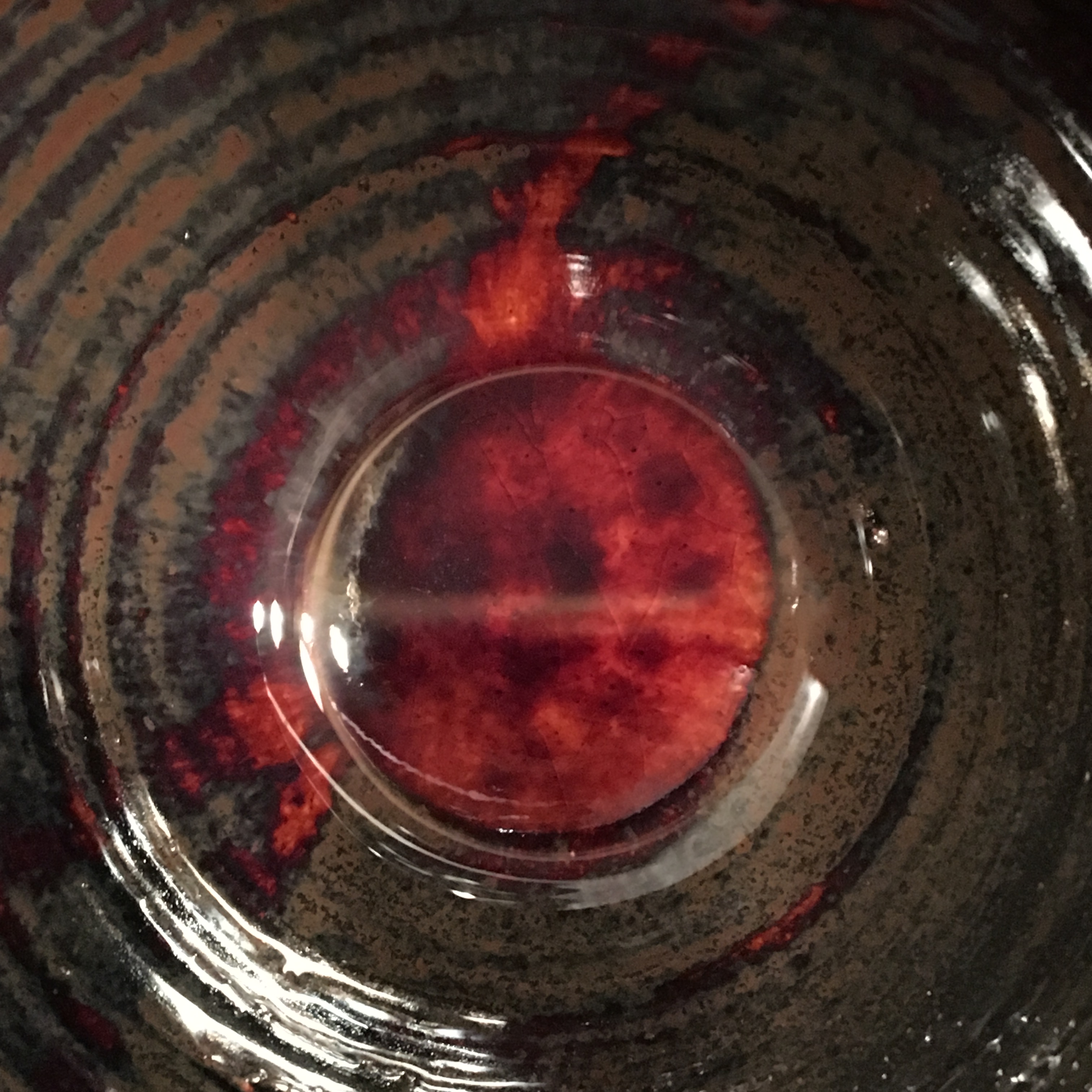
I suppose most people would first notice the beautiful glaze and transfer pattern on the outside of the cups. We were caught by the beautiful color, the glaze on the inside at the very bottom. Gorgeous. Simple.

The cups were a wedding present from Kerri’s good friend and long-time collaborator, Heidi. Together, they toured the country. Heidi telling the story of her breast cancer journey. Kerri performing her compositions written for the cause of cancer research and celebration of life. I was not in the picture when they were doing their good work but I can hear in their stories the potency, the absolute epicenter of the power of art, their art: inspiring, encouraging, healing, up-lifting spirits.

It is the same spirit that Rachel Stevens, the potter of the cups, imbued in her work. It’s why we were immediately captivated. The free flow of her artistry lifted our spirits. A perfect talisman for our union, a reminder of my favorite day of life – our wedding.

We brought out the cups for our wine. I love the delicate weight and textures, the feel when I hold them in my hand. Before pouring, I gazed again at the inside color and had a minor revelation, the kind that will simmer over the next few months:

I’m sitting in a quiet space with my artistry. The imperative to create remains as strong as it has ever been, but it is the time to journey into the root. Early in my life I created for myself, for the pure pleasure of the presence it provided. The gift of solitude. Another kind of union. Later, the root required a reaching out, a branching relationship with others, to light the dark path, ask the unanswered question, explore the uncharted territory. Yet another kind of union. The cycle is coming back around; I am returning to the pure pleasure of creating. The root. Now, there can be – there is – no other reason.

Simple. Gorgeous.

read Kerri’s blogpost about THE CUPS

like. share. comment. support. thank you.

buymeacoffee is a beautiful glaze at the bottom of a delicate pottery cup that, when you hold it, makes you feel good to be alive.

Let It Run [David’s blog on DR Thursday]

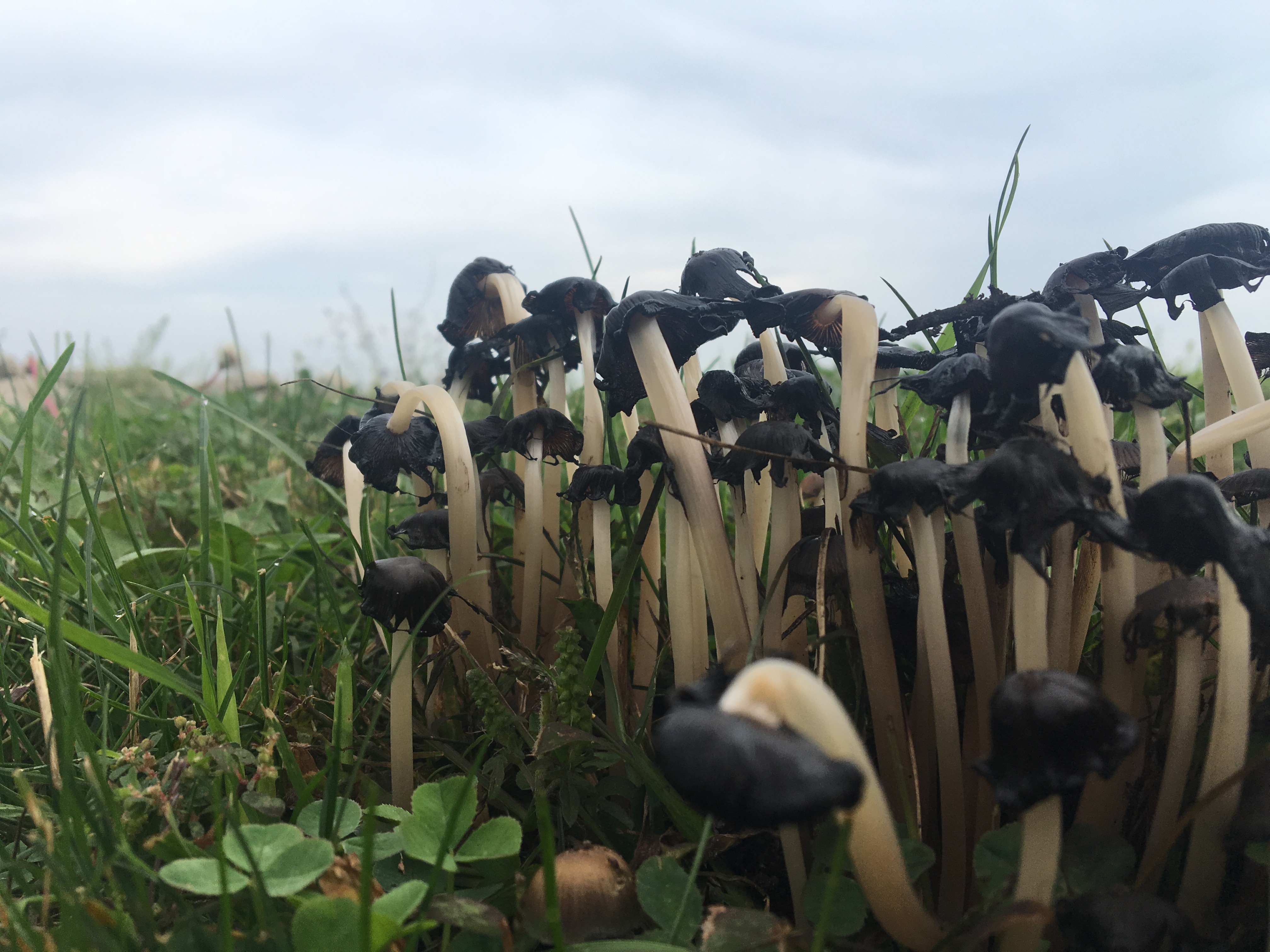
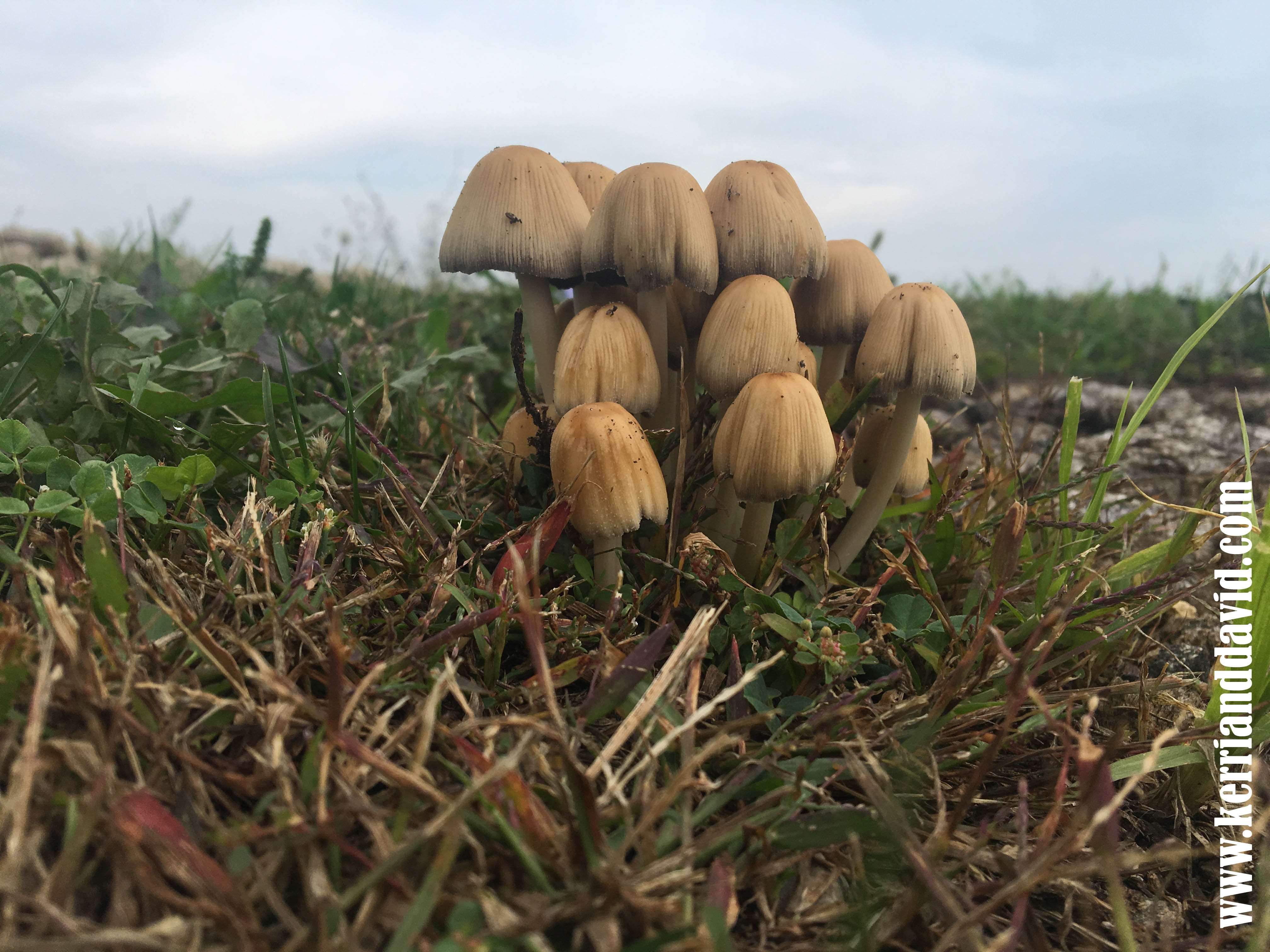
Following the heavy rains, the mushrooms appeared. They came in all shapes and sizes with colors ranging across the spectrum, yellows and reds, taupe and black.

There’s something other-worldly about the mushrooms. They seem like alien creatures. Like cicadas, living deep in the soil until one auspicious day, when the conditions are just right or their inner imperative whispers, “Now,” they step into the moist air, appearing as if from nowhere.

Some look like a colony of creatures on the march. Some look like gnome condos. Some take impossible architectural shapes, sound receivers listening to the pulse of deep space. Some form a perfect circle, a commons of strange beings.

Mysterious and intelligent, ancient and earthy, they appear magically and disappear just as mysteriously. Fungi,”…genetically more closely related to animals than plants.”

“What is that?” she exclaimed, pointing at the huge orb reaching above the grasses. “It’s a mushroom,” she gasped. “Can you believe it?”

Imagination runs wild.

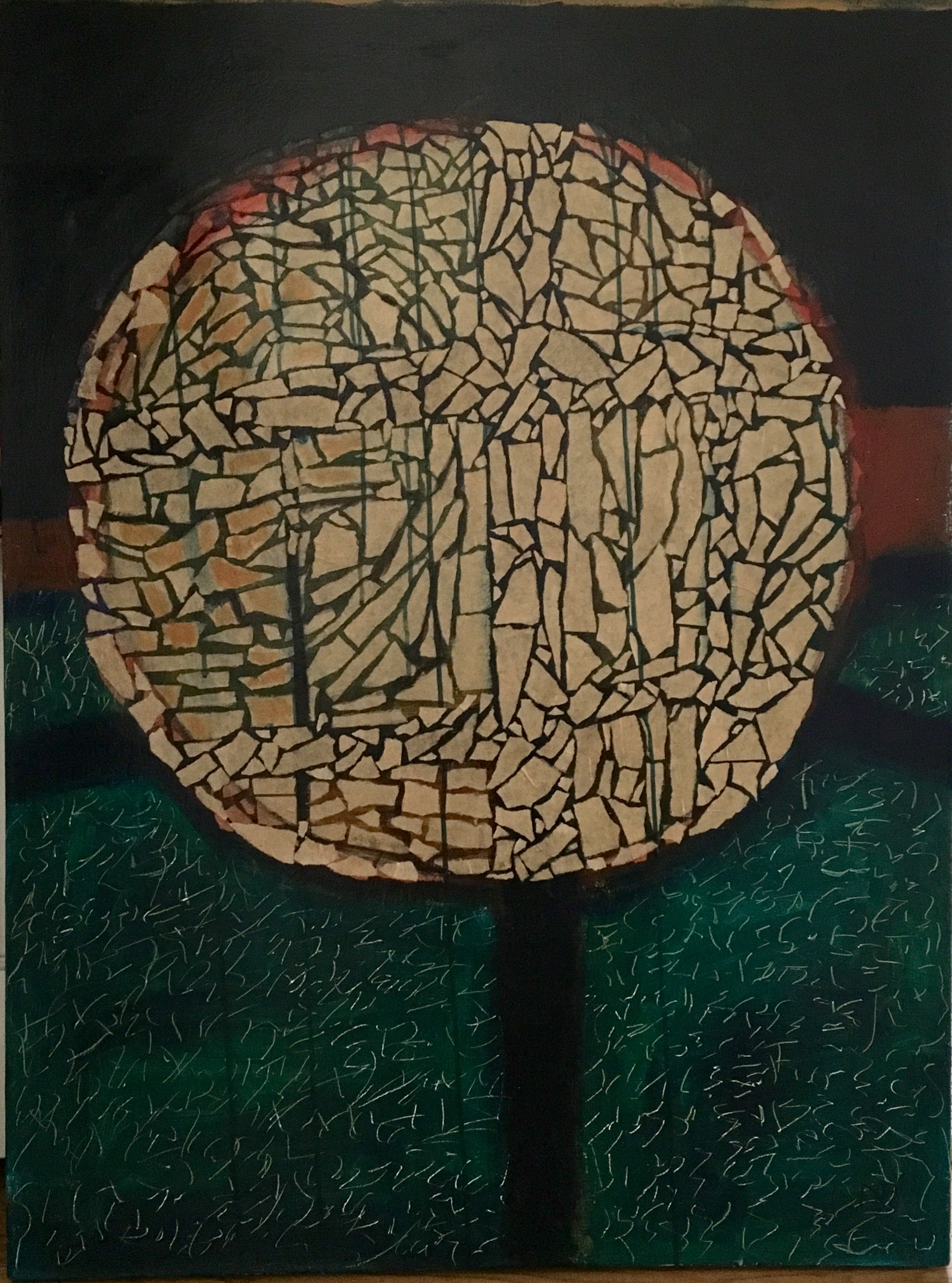
Earth Interrupted III, 48x36IN, mixed media

read Kerri’s blogpost about MUSHROOMS

like. share. support. comment. thank you!

buymeacoffee = and online “tip jar” where you can support the continued work of artists you appreciate.

See The Bounty [David’s blog on Not So Flawed Wednesday]

I doubt that our bird feeder experience is different than most people. The chipmunks and the squirrels get most of the bounty and the birds play clean-up.

In another life, were I to aspire to be an acrobat or gymnast, I’d study the amazing antics of chippies and squirrels. They scale the impossible pole. They leap the impossible leap. And then they fill their cheeks to bursting, kick gobs of seed to the ground, and fling themselves – fully loaded – into space and somehow catch a limb or bit of fence and escape into the great unknown. They are fearless.

The birds alight on the feeder, too, but mostly they find their fortune on the ground.

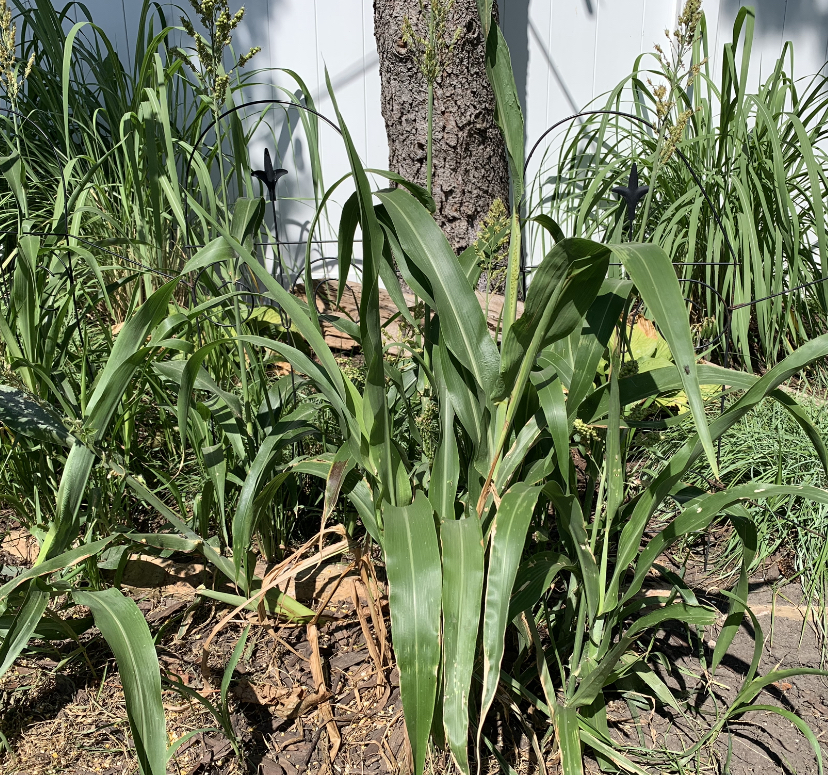
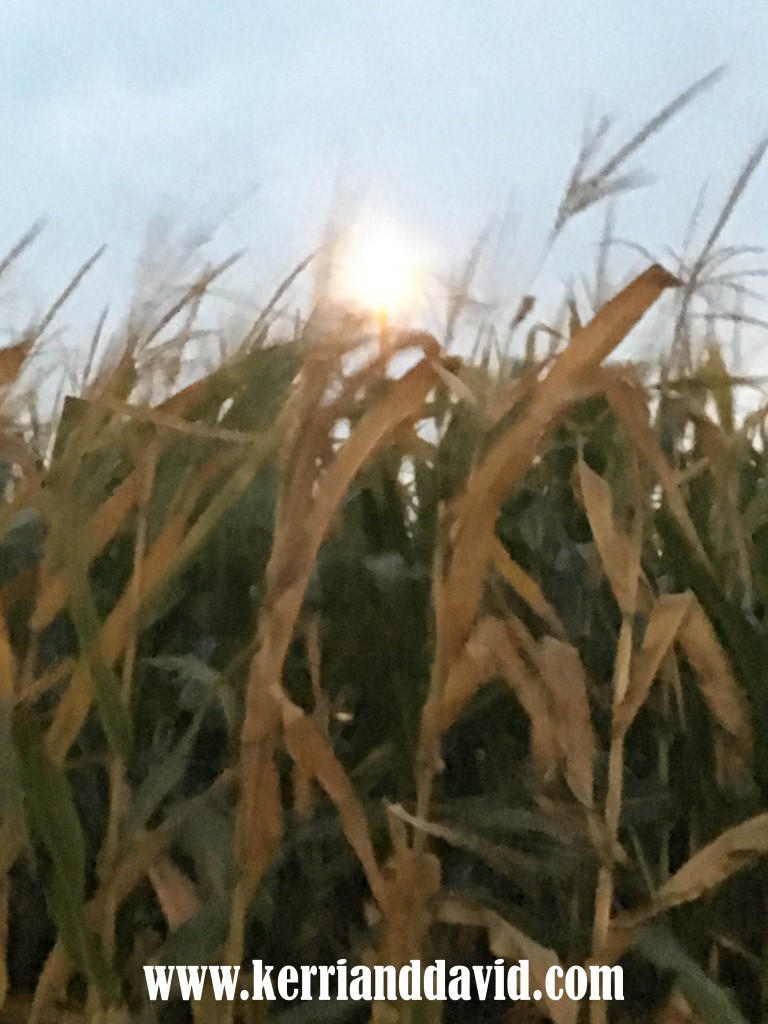
Over the summer, directly beneath the feeder, corn plants appeared. We let them grow for a while. I confess, the corn made us smile. “We have corn!” we’d giggle at the absurdity even though the origin was obvious. Apparently we are easily amused.

And then the corn plants sprouted across the yard. A stalk grew right next to Breck-the-Aspen-Tree. And then we found a few lively plants pressing through the tall grasses in the front yard. We’d unintentionally set into motion a small-sample-experiment of corn migration as carried by birds and mini-beasts.

Across many cultures, corn has long been a symbol of prosperity and representative of the cycle of life. It’s easy to understand why. The fields are magical places. In our film mythos, baseball teams of yore emerged from the corn, bringing good fortune to the family that built a field on their farm. Giver of dreams. Fulfiller of hope. Ancestors return to the corn.

In addition to the summer of the bunny and the surprise frog-named-Hope, this is the summer of corn-on-the-move. As the leaves begin to turn, as the harvest comes in, we take comfort knowing that we are surrounded by so many symbols of plenty.

read Kerri’s blogpost about CORN

like. comment. share. support. many thanks!

buymeacoffee is an online “tip jar” where you can support the continued work of the artists you value.

Split and Emerge [on Two Artists Tuesday]

Although butterflies get all the headlines, the transformation of a cicada is equally astonishing. The cicada doesn’t emerge from a cocoon. It emerges from its own body. The outer shell, a crawling insect, splits and the new form, a miracle with wings, a flying insect, crawls out of its former self to greet the world.

It actually has two emergences. For most of its life it lives underground, feeding on the sap in tree roots. And then, one day, on a cue no scientist has yet discovered, all of the cicadas in the neighborhood crawl to the surface, climb into the air and light, ascend toward the sky, and attach to a tree or some other vertical surface. Once they are firmly attached, the second emergence begins. Like a snake shedding its skin, the cicada sheds its former…form, and enters the last chapter of life completely changed. Air-born.

I’ve never wondered if a butterfly turns and ponders the cocoon. A cocoon seems generic. An envelope. But each time I see the shell of a cicada I can’t help but wonder, as its new wings dry, before it is capable of flight, what it might think, perched atop the old form, staring at what it used to be. Did it know that wings were growing inside all along or is it a complete surprise? A reverse mummy, opening the lid of a body-shaped sarcophagus to venture into the upper regions.

I wonder if it knows the transformation to flight signals the end, only a few more weeks of life. The males begin to sing. The females click their wings. Partnering through an ancient call-and-response. The end of life. The fulfillment of purpose. The beginning of a new cycle of life.

It’s full, full, full of useful metaphors. The old shell appears as if it is hanging on for dear life when dear life was about to burst forth, unrecognizable. Transfigured. And, isn’t that usually the way of the scary new? The old, well-worn shape wants nothing more than to hang on for dear life to what it knows, what it has always been. It’s necessary for the new energy, the new form, to split the frightened shell, wrestle with itself to emerge, and discover life anew. Finally ready to fulfill its purpose, its reason for being.

read Kerri’s blogpost about CICADAS

like it. share it. support it. comment on it. we appreciate it.

Return To The Nest [on DR Thursday]

In a few weeks we will travel to a small town in Iowa for my dad’s inurnment. It is the town of his birth. Although he never lived there during his adult life, it is the place he called home. It is somehow appropriate that we will take him home in spring.

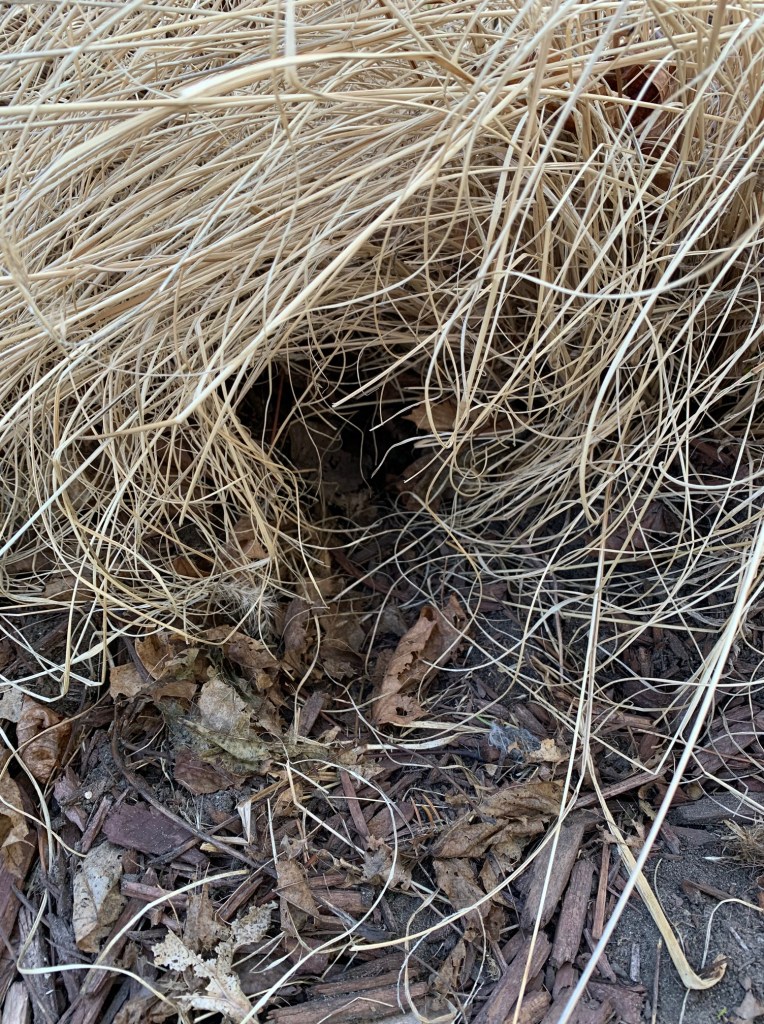
I’ve had plenty of time to think about the coming ritual. It’s now associated for me with the birth of the bunnies in our backyard. We watched the momma-rabbit dig the nest but thought she’d rejected the spot once she’d experienced our enthusiastic dog who regularly terrorizes critters in the backyard. She knew what she was doing. We discovered the truth the day we caught Dogga proudly carrying a baby bunny around in his mouth. He dropped the bunny, unharmed. We went on a 24/7 backyard bunny watch.

Once, sitting on the deck watching the terrorist Dogga run circles, I decided to check out the nest. I stopped in my tracks when I realized two babies were gnawing on grass just inches from my feet. They hopped back to their nest. I watched as they disappeared into the safety of the dark void.

The dark void. The safety of the nest.

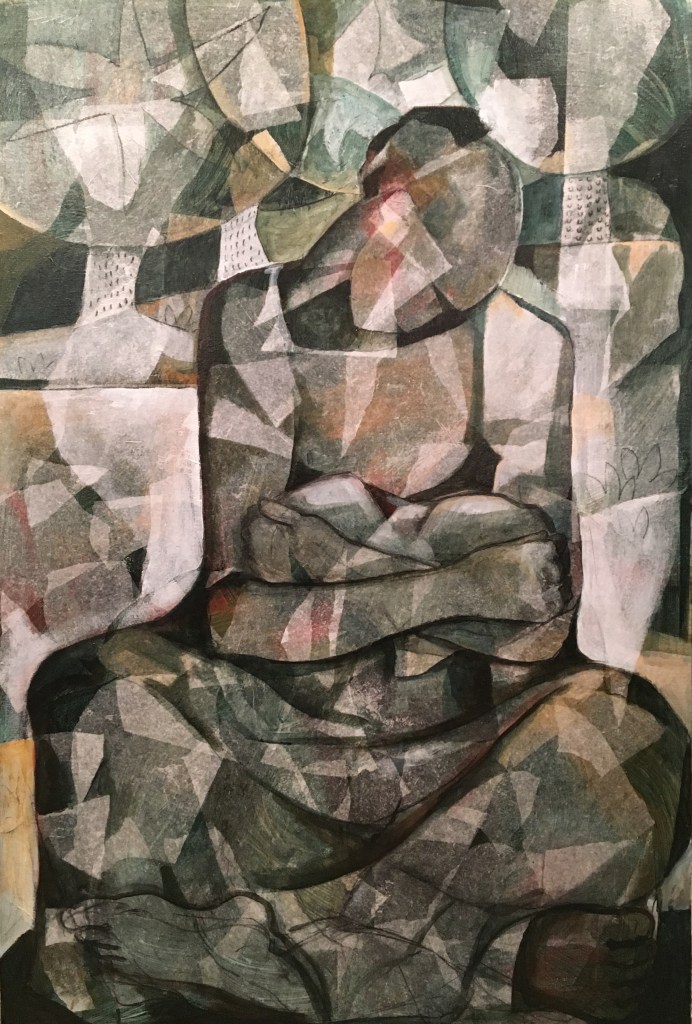
Years ago I started a painting. My dad emerging from a field of corn. Or returning to the field of corn. I’m not sure why I painted it. He often talked of his desire to return to his hometown but he could never find a way to make a living there. His yearning seemed profound. I suppose my painting was an attempt to understand the anchor of “home”; I have been a wanderer so his longing seemed incomprehensible.

Watching the bunnies race for their nest and disappear into the comfort of darkness sent a shock of recognition through me. It helped me understand. Away from his nest, he felt like an alien in a confusing frenetic world. In that place, he felt safe. Known. He understood the rules. He knew the stories. He was attuned to the pace.

It is somehow appropriate. We will take him home, return him to his nest, in spring.

I’m still working on my site...go here to see my continued indecision

read Kerri’s blogpost about BUNNIES

If you appreciate this post, like it or share it. Or, buymeacoffee.com. Or, let us know your thoughts. All are appreciated. Thank you.

Listen To The River [on Merely A Thought Monday]

“Have you learned that secret from the river; that there is no such thing as time?” Hermann Hesse, Siddhartha

I’m not sure why I didn’t recognize it before now but Siddhartha and the Parcival grail epic are the same story. A ferryman. A hermit in the woods. A second teacher that appears and teaches presence – by example.

“The river knows everything; one can learn everything from it. You have already learned from the river that it is good to strive downwards, to sink, to seek the depths. The rich and distinguished Siddhartha will become a rower…” Parcival removes his armor. The great and powerful knight loses himself; he chops wood and carries water.

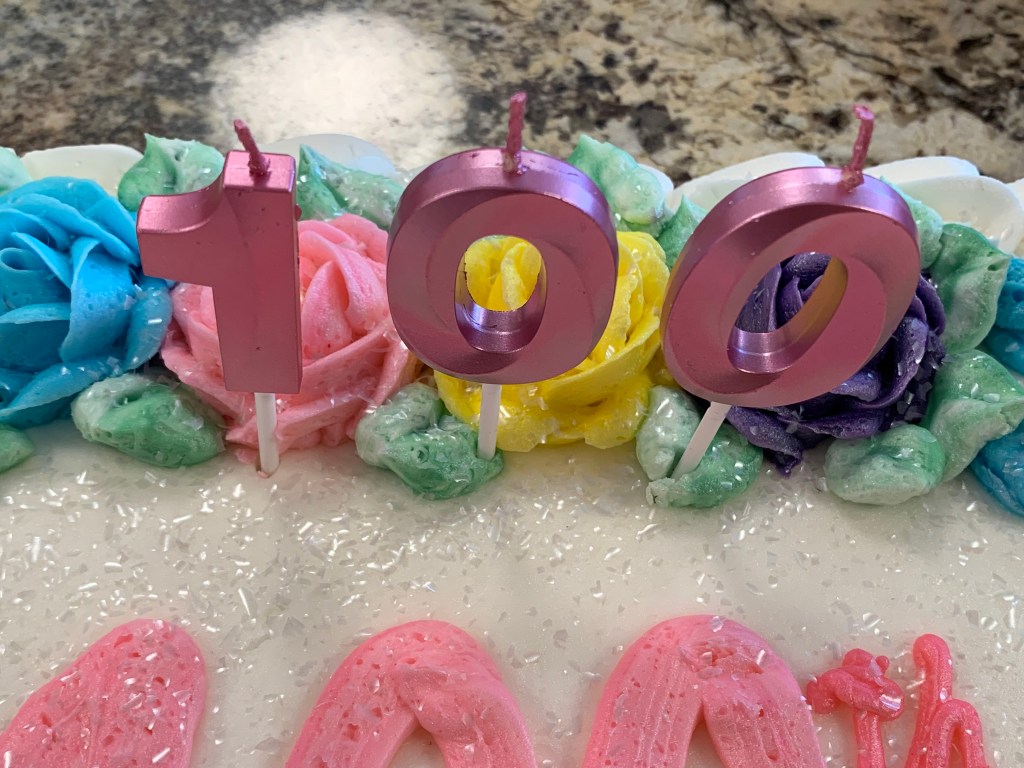
Eileen, 20’s mom, turns 100 today. Her party was last week. 20 made a beautiful photo board of her long life. The child. The sassy teenager. A vibrant young woman. A mother. A keeper-of-the-books. A grandmother. An aged woman. The full cycle of life. Her granddaughters attended the party. Her great-granddaughters, too.

“Age-and-stage,” 20 often says. Age and stage.

“Is this what you mean? That the river is everywhere at the same time, at the source and at the mouth, at the waterfall, at the ferry, at the current, in the ocean, and in the mountains, everywhere, and that the present only exists for it, not the shadow of the past, nor the shadow of the future?”

That is it,” said Siddhartha, “and when I learned that, I reviewed my life and it was also a river…”

Parcival turned and was shocked to see the grail castle standing in the meadow behind him. The hermit smiled and said, “Boy, it’s been there all along.”

Happy Birthday, Eileen. 100 years. A moment.

read Kerri’s blogpost about 100 YEARS

Release The Seeds [on KS Friday]

“Creative people are driven to periodic symbolic self-annihilation and rebirth, much like the mythic phoenix.” ~ Alex Grey, The Mission of Art

I loaded my truck with my paintings. I drove to the beach where there were large fire-pits. I burned the paintings, bonfire style. I had so many paintings that it took three days, three truckloads, three successive nights. People helped, strangers who held vigil for me. Only one tried to talk me out of it.

Those nights on the beach were over 20 years ago. All along I’ve understood the conflagration. What I only now understand is the necessity of fire to release the seeds. Not just one seed, but hundreds. Thousands. And not all the seeds found rich soil. Only a few. And, once rooted, most of the seedlings were trampled, overshadowed or eaten. They never made it to the sun.

But the one seed, the single seed, released in fire, without will, intention or knowledge; the fortunate seed, flung into the air by heat and flame, caught the wind at just the right moment and fell to the earth haphazardly in an opportune spot. It took root. It drank in the sun. It survived the hungry deer nibbling close-by. And over decades, through harsh winter and sunny drought, it slowly, ever-so-slowly, grew.

A thousand seeds. One strong tree. New cones, loaded with millions of seeds. Ideas ripe for the wind.

A cycle that cannot be rushed. Each loop, lovingly and faith-full, takes time.

Kerri’s albums are available on iTunes and streaming on Pandora

read Kerri’s blogpost about SEEDS

part of the wind/blueprint for my soul © 1997 kerri sherwood

Shape The Vessel [on Two Artists Tuesday]

George Ohr was one of the great ceramic artists of the late 19th and early 20th century. Like Van Gogh, he died unknown, never experiencing the success of his work. Robert reminded me of George Ohr’s story and I reminded Robert that Ohr would be a terrific story for him to tell through a one-man play.

What is it to follow your art-call with heart and dedication with nary a hint of financial reward or success on the horizon? Vincent Van Gogh would have been called an amateur during his life since the making-of-money is the flag we plant in the sand marking the line between being a professional and a dilettante. Those lines do not exist for artists with a deeper call. The money does not the artist make.

The Ohr-O’Keefe Museum of Art was designed by renowned architect Frank Gehry, quite a journey for the unseen work of George Ohr’s life to find so much vibrant admiration after his passing. Had he known it would have changed nothing. He’d have spent his days at the potter’s wheel either way.

“Shape clay into a vessel; It is the space within that makes it useful. Cut out doors and windows from a room; It is the holes that make it useful. Therefore, profit comes from what is there; Usefulness from what is not there.” ~Lao-tzu

Profit and usefulness. Shape and space. Mary Oliver asked the question: What will you do with your one wild and precious life? It hits the nail squarely on the head. It was not the pots that George Ohr made or the paintings that Van Gogh painted, it was the space they entered while throwing pots and painting paintings. It was the world they entered through their artistry, more expansive than financial success, more necessary than renown. A wild and precious life lived wildly and with avid appreciation.

Standing amidst the brilliant orchids, some of the flowers were in their last days. Their beauty fading, they cared not a wit. It is not in their nature to stretch their faces and pretend that the cycle of life is more valuable in the early bloom than it is in the late retreat. All is treasured, beguiling. Every last moment, not to be stalled or held onto. The root as necessary as the bloom, the winter as indispensable as the spring.

read Kerri’s blogpost about FIREWORKS