Posted on August 26, 2021 by davidrobinsoncreative
I’m not sure when I started using floral shapes and imagery in my paintings. There was Sam The Poet and Eve, trees as symbol.
Sam The Poet, acrylic, 48 x 48IN
Eve, acrylic on hardboard, 48 x 48IN
I know my sketchbooks began filling up with flower shapes and symbolic landscapes. Petals appeared throughout my Yoga Series. Leaf and flower shapes found their way into the bodies as well as the surrounding spaces.
Joy, mixed media, 50 x 56IN
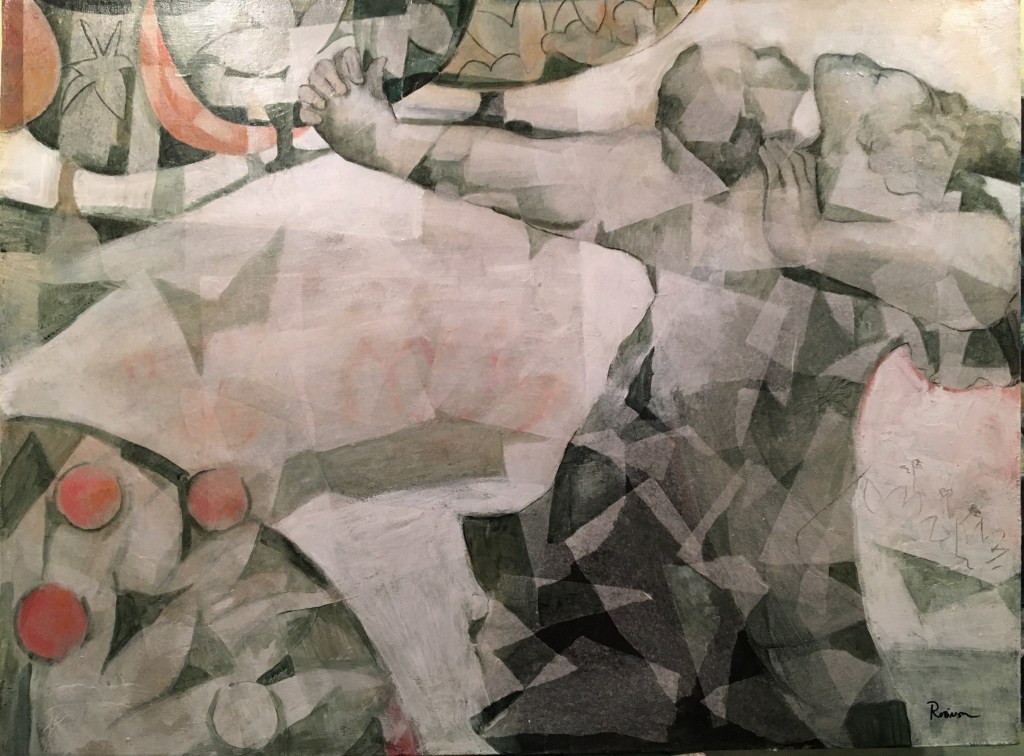
I played with tissue paper over color as a ground for the images. When Tony recently visited my studio, he said my paintings were sculptural, visually commanding. I wrote his words on a scrap of paper since artists are mostly terrible at describing their work. He is an artist so he knows that the proper answer to the question, “Tell me about your work?” is “Go look at it and then you tell me about my work.” He didn’t ask the question; he went straight to the looking.
Tango With Me, mixed media, 39 x 52IN
We walked down a path at sunset. Kerri saw the sunflowers and I knew a photo op had arrived. “You should use this as your Thursday post,” she said, showing me her photo, “because your paintings always have flowers in them.”
Well, good enough, then. Sunflowers, shape and symbol, will find their way into the next painting, I’m sure of it.
Posted on August 25, 2021 by davidrobinsoncreative
“Innumerable confusions and a feeling of despair invariably emerge in periods of great technological and cultural transition.” ~ Marshall McLuhan
At the first theatre company I artistic directed, we cut silk screens and pulled ink to make our posters. They were crude but we didn’t know it at the time because that was the most advanced process available. At the time they looked cool and we were proud of them. They took some effort.
I remember the day a student came into my office and showed me how we could design our posters on the computer. His designs were gorgeous, easily adjusted, took almost no time, and came back from the printer quicker than I could cut a good screen. We felt like our status bumped up a notch. We looked professional, and, what we’d been so proud of only a year before, now looked primitive.
My first website cost an extraordinary amount of money. It took weeks of working with a designer. Changes were costly so were made rarely. Now, Kerri and I design, redesign and make changes to our site every week. A few years ago we set up a site for a theatre company, complete with ticket service, database and newsletter capacity all in one easy-to-use app. It cost them almost nothing and any fool could adjust and make changes to it.
People who only a few short years ago considered themselves voiceless can now say any old thing they want to an audience no less than world-wide. Patti once asked a conference attendee, “If you had a voice, what would you say?” If I could go back in time I’d beg her to retract that question.
We live in a time of high anxiety. There are few substantial anchors to moor our reality. I’m about to make the ultimate old guy statement: I remember when…a few limited news channels actually attempted to broadcast the news. They had a limited window of time to tell the news so they made their information count. We now have hundreds of information and misinformation sources that can rattle at us 24/7 and from multiple devices. The challenge is not editing-down-to what-matters, it is filling too much time with loads of spin that mostly has limited substance.
Information spreading – for me, too – has become easy-peasy. I can lob an opinion as easily and as readily as the next person. But, as Marshall McLuhan said – and I whole-heartily concur, “I don’t necessarily agree with everything I say.” In other words, (don’t tell Kerri) I am sometime reactive. Sometimes, I think I know more than I do. Sometimes, I make mistakes. Slowing down seems to be the only cure. Thinking things through. Researching before spouting. Breathe and breathe again. Consider what matters. Really matters.
I’ve walked a complete circle in my life. Now, in all it’s shiny capacity, within the amazing miracles of technology, I find much of what people say and do and assert with this glorious ability – to be crude. Without thought. It’s too easy so it doesn’t much matter. The stream will quickly carry away even the most offensive opinions and endlessly wash in some more. I wonder how considerate people might become if their easy voices were less easily shared? If saying something actually took some time and effort – let’s say, as much time as it took to design, transfer and cut a silkscreen – what might they say? If it was less easy to “like” or “dislike.” If one slip would send the thought back to the arduous start? Maybe we’d be more considerate because we’d take the time to consider what we were expressing – to think about what we were saying and why we were saying it.
I suspect most of our “whys” would get our knuckles rapped by grandmothers who held decorum and polite communication as a high virtue. Saying stuff so-as-to-belong-or-pile-on…or to hear ourselves talk, certainly wouldn’t spare the rod.
That whole thought stream came from taking a walk, looking down, and finding a rock smiling back at me. Someone took some time. Chose a rock. They chose what to paint and had a grandma-approved-reason-why. And, they did a good job of it. “Ahhhhh,” Kerri said, smiling back at the rock. “How considerate,” I added to her awe.
Posted on August 24, 2021 by davidrobinsoncreative
Through the good graces of our tomato plants, I’ve learned a few new concepts this summer. Determinate and indeterminate. Bush and vine. Determinate tomato plants (bushes) are bred to stop growing. Indeterminate tomato plants (vines) will grow indefinitely or until the weather conditions “are no longer favorable.”
Our plants are indeterminate. Each morning, Kerri visits our planting bench and checks her tomatoes. 20 taught her a few simple tending-rules and now, each morning, there are more and more little indeterminate miracles moving backward along the color spectrum, finally arriving at a brilliant red.
Life is indeterminate.
My new tomato-terms come just in time. My current project has me revisiting my past life as a teacher and facilitator. If I apply my new terminology to people I can’t help but think it is the lucky few who survive so much dedicated energy to stop the learning-mind in the name of education. The natural output of a system designed on manufacturing principles is to truncate the questioning mind by patterning the notion that there is a predetermined answer. It becomes a game of finding the answer that teacher wants – a closed loop – instead of an incitement of curiosity. Children are excellent game players and translate the gaming pattern into their now-dulled-adulthood.
There is a cycle apparent in all genuine learning processes. It begins with discontent. Curiosity is a movement born from some form of discontent. It leads to questioning. Questioning always leads to disturbance (the interruption of the known). And, just like that, out of the disturbance something new is seen, call it a breakthrough, call it an insight, call it new learning…Many classrooms – certainly the systems – are designed and organized to keep disturbances to a minimum. The mantra is ‘control’ rather than ‘inspire curiosity.’ Business has the same dedication.
We’re taught that disturbance is the sign of something wrong rather than the crusty earth breaking to reveal new verdant life.
Discontent leads to questioning, leads to disturbance, which leads to breakthrough. And, an insight will always lead to discontent. It’s a story cycle, where yearning meets obstacle. Learning is by definition uncomfortable and at its best when it is uncontrollable.
Last week I attended a meeting. My two companions and I brought our homework back to the team. One was content. The other two of us were filled with discontent. The leader of the session, at first, was angry. He did not get the result he’d anticipated from his exercise. “So, you two are telling me this process was worthless!” he raged. We’d spent our week questioning instead of answering. Discontent. Questioning.
“No! It was great!” we chimed in chorus. “Look at all the good information we uncovered!” It was a mess. Big disturbance. We cycled through our misalignment a few times, wrangling over perception and usefulness. More rage. And then…an insight. The breakthrough. All of the rage, all of the appeasing, began to flow in a single direction. A possibility took shape. A target materialized that was much better than the prescribed pursuit. Energy filled our zoom-osphere. Laughter. Excitement.
Learning. Indeterminate. Open questions. Hot pursuits.
I am drawn to and surrounded by the dedicated indeterminates; those who refuse to stop learning: David, Mike, Horatio, MM, Bruce, 20, Judy, and yes, Kerri…I am a very fortunate man to be surrounded by so many tomatoes moving their way backward along the color spectrum, not afraid to walk through their discontent toward bigger and bigger questions.
Posted on August 23, 2021 by davidrobinsoncreative
Lately, the universe has pitched me headlong into a master class on efficiency. Maximum productivity with minimum wasted effort. A useful concept in certain arenas and an intensely destructive concept in others. For a person who’s spent his life in a study of curiosity, art, and the creative, it’s an unexpected study at this stage of the game. It is sometimes uncomfortable but I consider it an opportunity for balance. Artists rarely meditate on efficiencies. We’re more of a discovery clan and efficiency is generally the enemy of discovery. No one ever sailed to the edge of the world with efficiency-on-their-lips.
Once, I made the argument to a school board that daydreaming was highly productive. It seems a no-brainer to me that exercising the imagination should be highly valued in a learning environment. Einstein’s Theory of Relativity came to him in a dream about cows. It is not an accident that many insights and revelations come in the shower or while driving or peeling a carrot. Newton’s apple did not fall on his head while he was exercising maximum productivity. The mind, to be efficient, needs space to breathe, fields to roam. It is the most elegant of paradoxes but mostly lost on worshipers at the altar of efficiency. In the modern business world, efficiency is all about time since time is billable. You know the mantra: time is money. Do more with less. Somehow, we’ve turned that nonsense into a virtue, a thing to be desired. A reason to squeeze.
There’s another, more admirable side to efficiency-seekers. How to make work less arduous. Grease the wheels and remove the friction. Relieve the burden. Not faster but easier. Ann used to say, “Find a need and fill it.” She’d look at people toiling and ask, “How can I ease their struggle?” Beaky was that way, too.
Near our home there is a stretch of shoreline with an ineffective seawall. It was built with stones and debris that become projectiles when hit by forceful waves. The locals know to avoid that stretch during a storm. It’s deadly. After the storm, it has become our ritual to walk the path to see the destruction. It’s always impressive. How far can a wave throw a heavy stone? The answer: farther than you think. Mother Nature yawns when we think we can control her. The seawall has become my metaphor for human hubris but also masterful inefficiency. It would cost money to build a proper wall. So, instead, after each storm, crews collect the rocks and pile them back on the shore, readying them to be hurled by the next storm.
We saw a double-rainbow and turned toward the shore. Kerri never misses an opportunity to capture a little miracle or a slice of beauty. We parked in front of the seawall-of-inefficiency and I laughed out loud. A budding Banksy sprayed a message on the rubble: love. The secret message-maker could not have found a more appropriate word: Love. Can you imagine anything more inefficient and, at the same time, more potent? Love moves mountains but is not billable. It transcends time. What better reason to do anything? Well, perhaps reason has nothing to do with it and never has. Reason has the worshipers-of-the-efficient perpetually re-stacking stones.
It’s easy to be seduced but let’s face it, life reduced to billable hours is not life at all. On the other hand, there is nothing more inspiring, nothing more curiosity-invoking than asking, “How can I make life better for everyone?”
Love on a rubble pile. What could be better? On second thought, what could possibly be more efficient?
Posted on August 21, 2021 by davidrobinsoncreative
There is no greater torture for Kerri than having to pack for a trip. Her packing-panic begins weeks before we leave. The stress of trying to plan for and cover multiple clothing scenarios – infinite possibilities given weather, unknown and unplanned formal affairs, nail polish color and shoe requirements… all to fit within the limited space of a suitcase (or the back of the car) is unbearable. The torture lasts long after the trip begins, long after the trip actually ends. “I should have thought to bring…” is a common refrain, sometimes weeks after we’ve come home.
On the other hand I pack in a few minutes with almost no thought. My formal clothes and my ratty clothes are often one-and-the-same. My unintentional packing strategy has been to reduce my choices to one: black on blue jeans. As 20 says, “Easy Peasy.”
I have learned that it is sometimes helpful to pretend that my packing is more difficult than it actually is. I fret over my choice of t-shirts. Do I bring both pairs of boots or just one? Sometimes help looks like indecision. After all, no one likes to suffer alone.
Posted on August 20, 2021 by davidrobinsoncreative
Simple elegance. Courteous goodwill. Thoughtfulness. Consideration. Do honor. Ennoble. Look up the word “grace” and these are the phrases and synonyms that you will find.
John Updike wrote that “Rain is grace; rain is the sky descending to the earth; without rain, there would be no life.” California is on fire. So is Greece and Turkey. Siberia. Reservoirs are shrinking. So many are looking to the sky awaiting its descent to the earth. Awaiting simple grace.
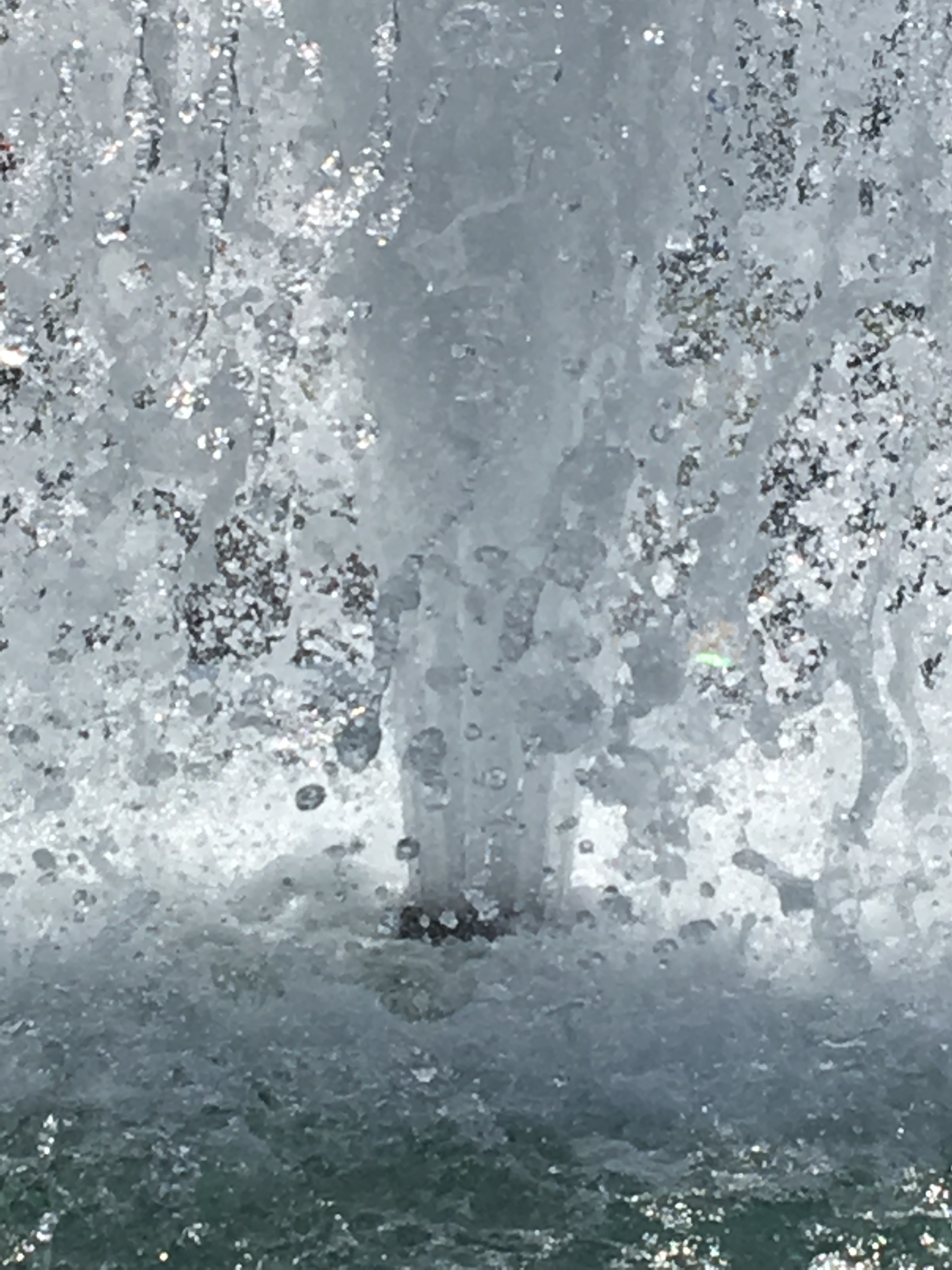
When I lived in Seattle I delighted on a hot summer day of running through the International Fountain. I was not alone. Children and adults alike squealed as they played in the dancing jets of water. It was a joy to go to the fountain, sit in the spray and watch people play, rest, and rejuvenate with and in the water.
We are following couples as they through-hike the Pacific Crest Trail and the Continental Divide Trail. They plan their days according to their water sources. There are water-less stretches that are made do-able only because a trail-angel maintains a cache of water for the hikers.
Trail-angels, people who, for no other reason than having the satisfaction of helping ease the journey of others, give me hope. They bring respite, perhaps because someone in their past did it for them and it mattered. They make difficult passages do-able. Sometimes they provide a ride into town. They look for opportunities to help. They are the rain when rain is nowhere to be found.
Isn’t that grace? Rain meeting earth? Angel meeting a need, providing water so a thirsty traveler might drink and continue walking?
Grace on the album Right Now
Kerri’s albums are available on iTunes and streaming on Pandora
Posted on August 19, 2021 by davidrobinsoncreative
strange sky
“Can a shallow mind appreciate beauty?…When the mind is merely concerned with itself and its own activities, it is not beautiful; whatever it does, it remains ugly, limited, therefore it is incapable of knowing what beauty is.” ~Krishnamurti,Think On These Things
What accounts for the strange color of the sky? Smoke from the fires? A coming storm?
The quote above is only half of the thought. It is the set up for the real point to be made. A shallow mind is concerned only for itself. And, while consumed with the lesser, it misses the greater. It is the unintentional theme that emerged for me this week: losing the greater for the lesser. The baby goes out with the bathwater.
It is a matter of perception, of focus placement.
Yesterday I wrote about the judge questioning the potential juror about his capacity to experience hardship in order to keep the system going and growing. The juror entered the exchange with a self-focus and exited, admonished, with perhaps the possibility of seeing something beyond his own agenda. Perhaps.
I read that Rome fell when the luxuries became more important than the essentials. Societies fall when they can no longer discern between what is important and what is not, when the lesser is protected at the expense of the greater.
Years ago, during a facilitation, a young woman pulled herself from and exercise. She sat on the sidelines and brooded. After the exercise, during the debrief, she claimed that she was discriminated against because her team did not listen to her ideas. Initially, her team scrambled to apologize – one does not want to be accused of discrimination. We asked the team to explore the situation a bit further. Because the young woman’s idea was rejected, was she truly a victim of discrimination? It was an illuminating conversation. The problem – the real problem – arises when we can no longer discern between what is discrimination and what is not? There is terrible discrimination in our world and needs to be addressed. It can’t be seriously confronted if we are incapable of distinguishing between the rejection of an idea and laws that prevent citizens of color from voting.
In a pandemic, a mask is not a breach of personal freedom. It is not the state ripping away control of your body. It is a minor inconvenience to ensure the mitigation of a virus that is killing scores of fellow citizens. Despite the rhetoric otherwise, the fearmongering and tribe-building, wearing a mask is something done for the health of the whole. It is not unlike jury duty.
It is a matter of perception. Of focus placement. Self or other? Lesser or greater?
The rest of the quote: “Whereas, a mind that is not concerned with itself, that is free of ambition, a mind that is not caught up in its own desires or driven by pursuit of its own success – such a mind is not shallow, and it flowers in goodness. Do you understand? It is this inward goodness that gives beauty, even to a so-called ugly face.”
Pay attention to the verb. Beauty is given. Concern for the well-being of the other is a sentiment expressed and championed in every corner of the world, by all the figures we quote, elevate, and sometimes emulate. Martin Luther King, Ghandi, Abraham Lincoln, Mother Teresa,…it’s a very, very long list.
Communities thrive when they are capable of enduring hardship for each other, for the benefit of the whole. They also thrive when they hold boundaries and protect the rights of the individuals. Those two seemingly different actions are, in fact, one and the same.
Societies fall when shallow minds prevail, when they can no longer discern between essentials and luxuries, privileges and responsibilities. When personal comfort takes precedence over enduring ideals.
It’s a matter of perception. Of focus placement, and make no mistake, focus is easily led. Just like a package of pastrami mistaken for a strange colored sky.
Posted on August 18, 2021 by davidrobinsoncreative
It was a national campaign of the US Department of Homeland Security. If you see something, say something. The enemy is here. It is us. We pulled it from an episode of Grace & Frankie. Old folks have hair that grows in places it ought naught. Frankie plucks a hair from Grace’s chin. “How long has that been there?” Grace exclaims. “Frankie, if you see something, say something!”
Yesterday, I had a collision of experiences at the courthouse during my jury pool swim. First, I read an article in The Atlantic, by Tom Nichols, Afghanistan Is Your Fault. He wrote, “The soldiers who served overseas in those first years of major operations soon felt forgotten. ‘“America’s not at war” was a common refrain among the troops. “We’re at war. America’s at the mall.”’
He continued, “A serious people—the kind of people we once were—would have made serious choices, long before this current debacle was upon them. They would today be trying to learn something from nearly 2,500 dead service members and many more wounded. They would be grimly assessing risk and preparing both overseas and at home for the reality of a terrorist nation making its way back onto the international map.
Instead, we’re bickering about masks. We’re holding super-spreader events. We’re complaining and finger-pointing about who ruined our fall plans.”
Next, I was among the many chosen for voir dire (the jury selection process). I was in the last group selected so the odds of my serving on the jury were slim. I sat in the courtroom and watched an amazing moment unfold. The judge said something that all Americans should hear. It aligned perfectly with Tom Nichols’ thoughts. A potential juror, a young man, claimed serving on a one-day trial would create hardship. He’d miss a day of work. The judge questioned him to get more context and then sat back, considered for a moment, and said this:
“Democracy is hard work. When I was young, there were three things that we had to do: pay taxes, honor the draft if called, and serve on a jury if called. All of those things create hardship. Taxes aren’t easy. The draft changed the lives of thousands of young people. Serving on a jury interrupts life. It creates hardship. Giving of yourself to the common good means serving something greater than yourself. It is an interruption. Today, there are only two of those things because there is no draft. My point is, giving of yourself to make this gorgeous system work is not easy. It is hard work. It creates hardship to ensure that our system, the oldest democracy in the world, thrives and survives for the next generation.”
America is at the mall. Meanwhile, democracy is hard work.
For a serious people, there is a center to our commons and, keeping it alive, takes a bit of self-reflection and sacrifice. Giving of yourself to the common good means serving something greater than yourself.
Divided we fall. It is a cliche’ but could not be more relevant.
The enemy is here. It is us. Bickering about the lesser while the greater slips from our fingers. “If you see something, say something” is predicated on an assumption: we are in service to something greater than ourselves. We are on the same team with a common, shared interest.
The judge sat back in his chair after his lecture and asked the young man, “Are you less capable of handling hardship than anyone else in this room?”
“No, sir,” the young man sat back in his chair, resigned.
“Good!” the judge exclaimed. “Now, let’s get on with it.”
Posted on August 17, 2021 by davidrobinsoncreative
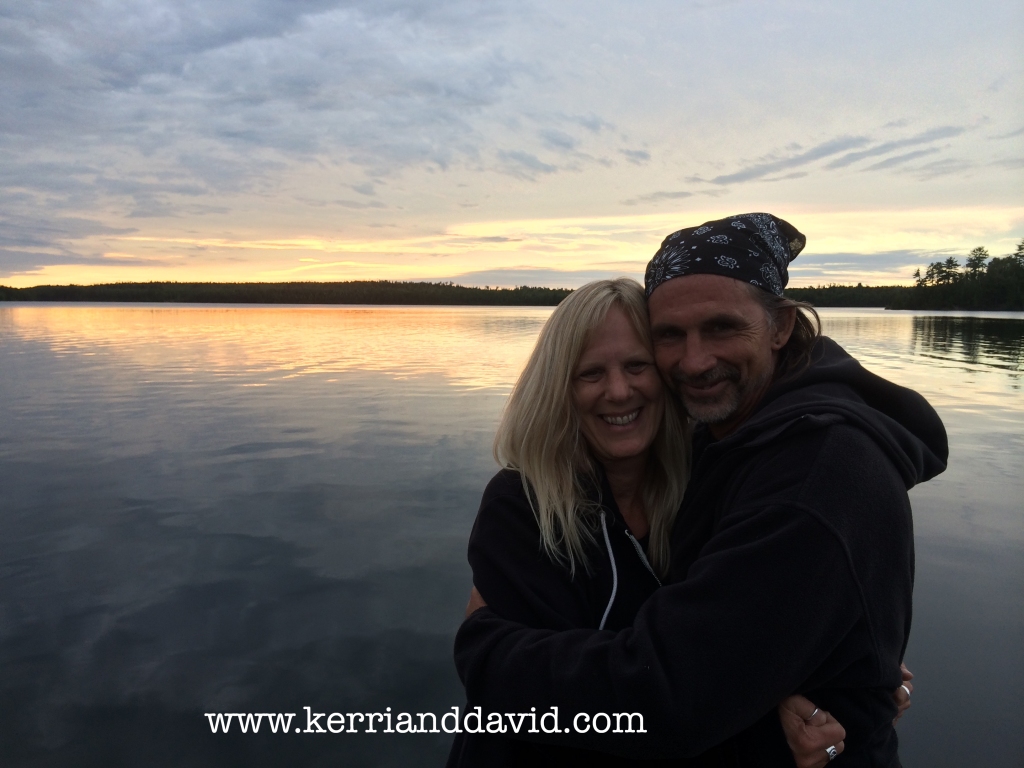
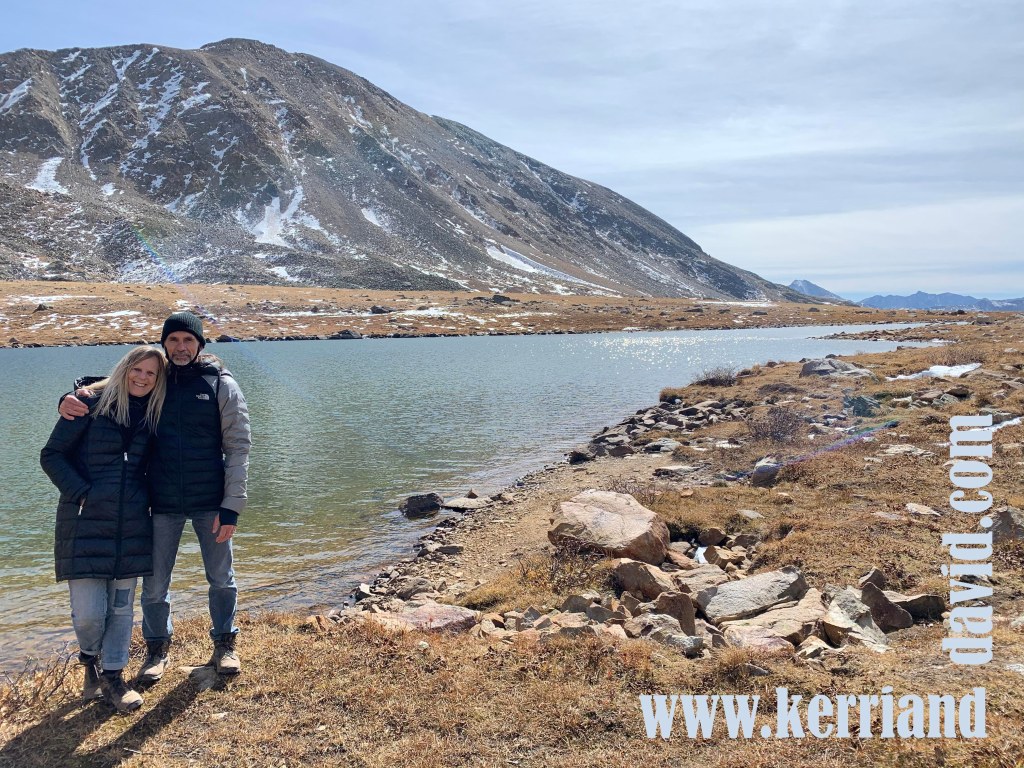
It’s been true since we met. People stop us in airports and on the street, they give us thumbs up or take a faux paparazzi-photograph. They tell us that we are cute or “lookin’ good!” Once, a shopkeeper came out of his store to tell us that we made him smile. When we walk the neighborhood, we are often met with people who tell us that we make their day. It always takes us by surprise and it always makes us smile.
What are people seeing? We are older and link arms when we walk. We hold hands. Our clothes are unintentionally the same. Black on blue jeans. We walk slowly. We talk to each other. We stroll; a walk without a destination. We don’t know what inspires the comments but always appreciate them.
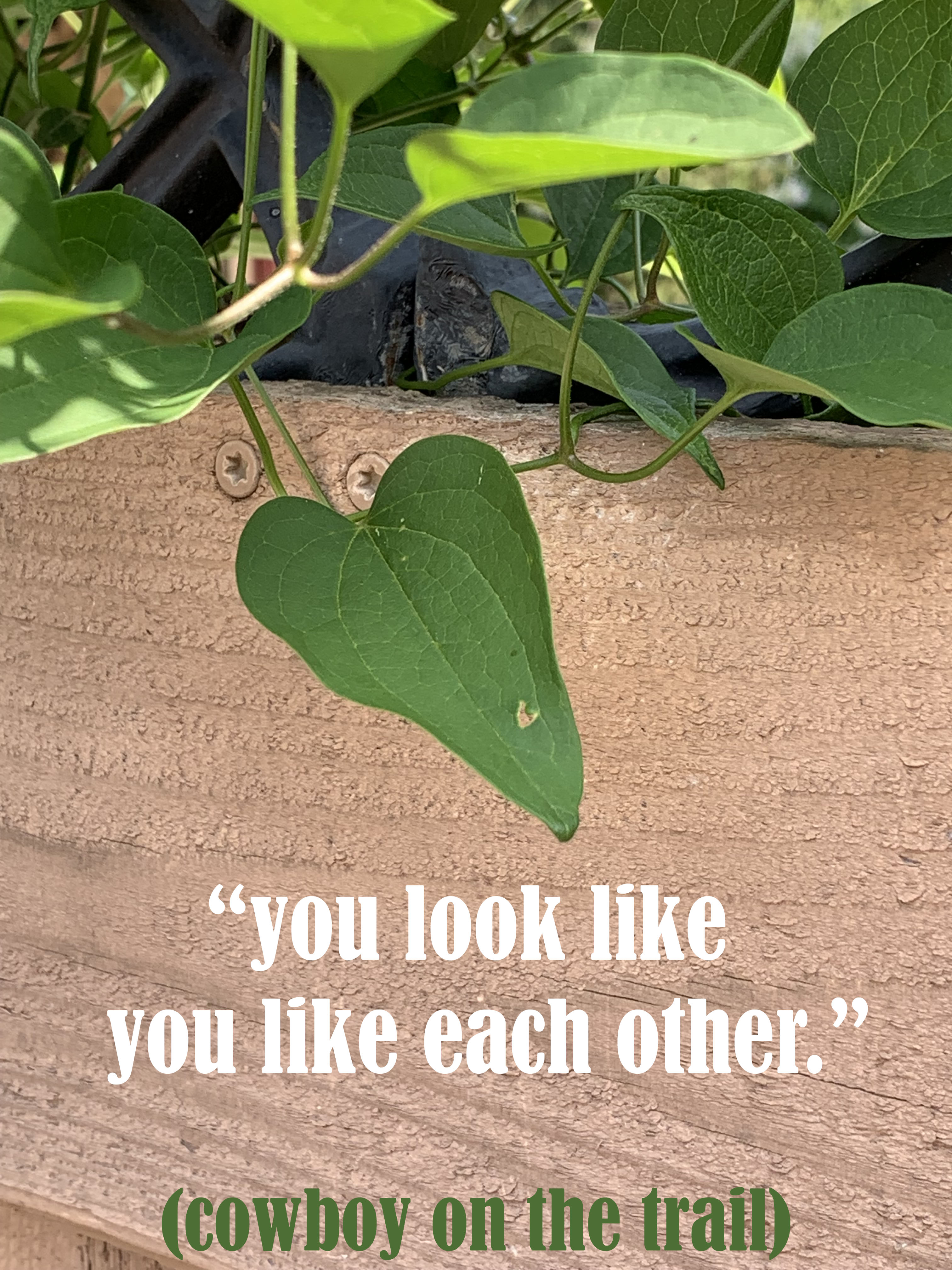
Kerri always coos when she sees a horse. In our imaginary life, she has horses, a donkey, and an old truck. We were walking on the trail in our flip flops (that always gets a raised eyebrow or two) when the cowboy came around the bend. “A horse!” Kerri whispered, and squeezed my arm. The cowboy sat up in his saddle, nodded as he rode passed, then said, “You look like you like each other.”
“We do.” I replied.
Perhaps it is that simple. We like each other.
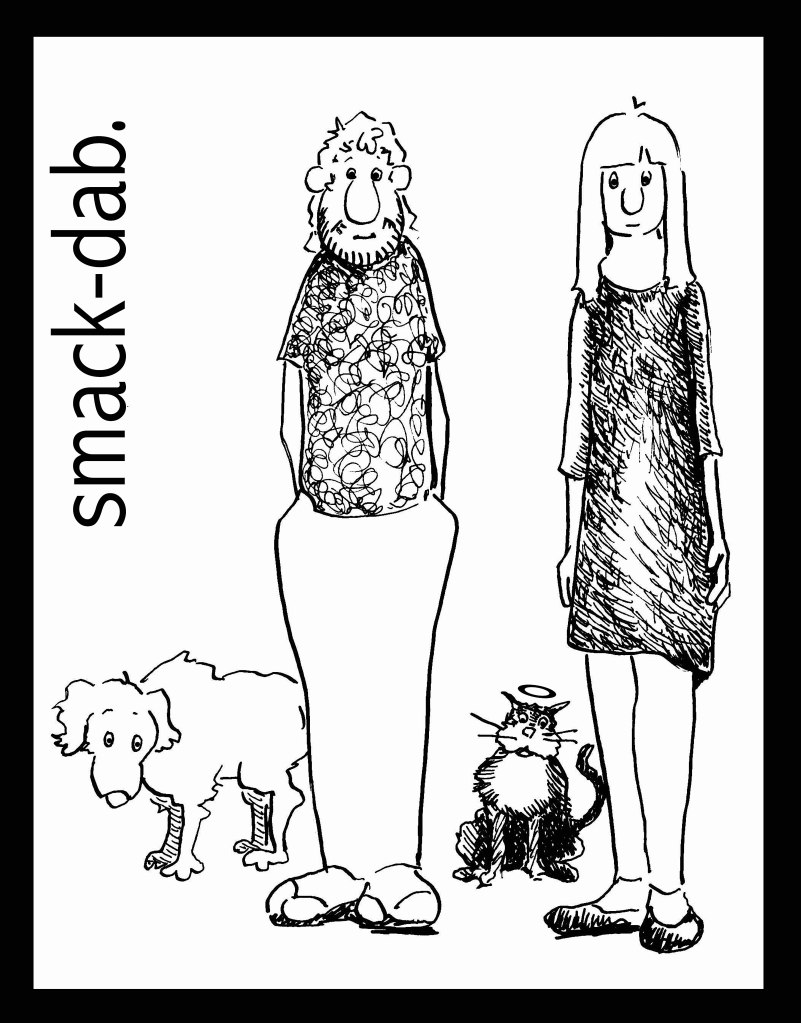
We’re fortunate. Our work allows us to be together all day. Every day. That would, I’m sure, be the end of most relationships. We like it. When I need feedback on a painting, she is my best wise-eyes. “What do you see?” I ask. We read our posts to each other before we publish. We edit together. We cook together. We create together. Our list of joint projects is growing. Lately, our once-weekly-cartoon about…well…us, Smack-dab., is giving us tremendous energy. It is fun. We poke fun at ourselves. We capture the ridiculous and the poignant. We pay attention to the marvels of simple relationship.
Picasso said that, “Love is the greatest refreshment in life.” He also said that, “Art is the elimination of the unnecessary.” Those thoughts, placed side-by-side, I believe, holds the reason a cowboy sat up in his saddle and a shopkeeper ran into the street. We are refreshed. We practice the elimination of the unnecessary – on canvas, at the piano, and in life.
We didn’t try to make 24/7 togetherness. There was no rule or expectation. It’s what we wanted. It’s what we want.
I am on jury duty this week and was at the courthouse most of the day. When she came to fetch me I got in the car and we said at the same time, “That was weird!”
“Tell me everything!” she said.
“No. You first! What did you and Dogga do?” Our conversation took us deep into the night. There’s so much life and so little time. Perhaps that’s it. We know this day is precious and fleeting and act accordingly. It must show.
I’ve been told again and again that, at the heart of every complexity, there is a simplicity. And, of course, at the heart of every simplicity, there is a complexity. So, either way you go, there you are.
I find that I am yearning for greater and greater simplicity. I appreciate quiet. I avoid crowds, not “like the plague” but because of it. I’d rather be in my studio or on a trail than almost anywhere else. I wish I could go sit in a museum all by myself, in the quiet for an hour or two, with a Chagall or Picasso. Intentional beauty. I feel like the world is so full of extraneous noise and dedicated bloviating that I’m having trouble hearing the simple essentials.
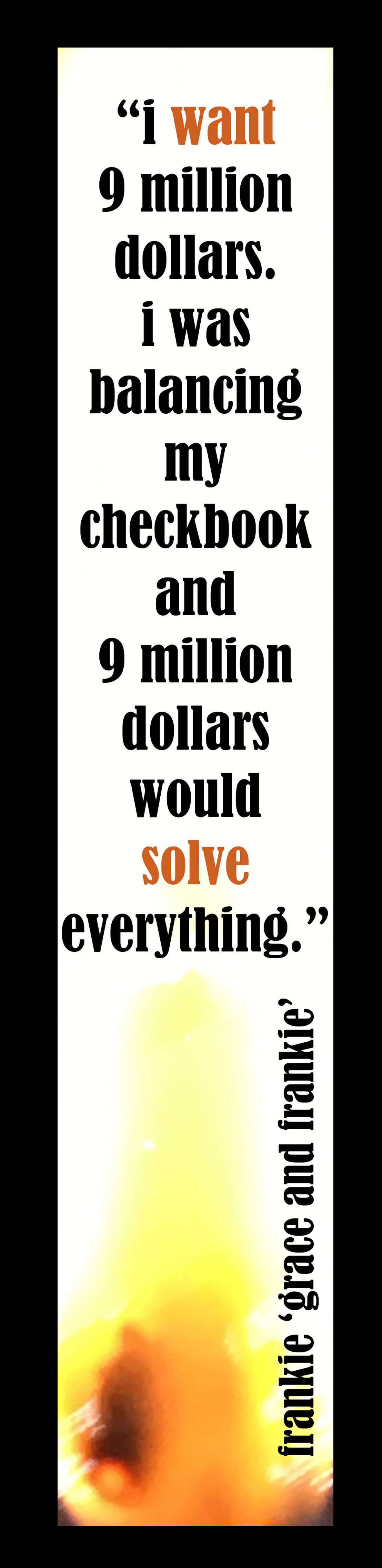
And, perhaps because my desire is for simplicity, I find that I am, like Frankie, projecting simple solutions on to everything. Yes, 9 million dollars in my bank account would solve everything!
Almost.
Do you remember Rodney King? I was in Los Angeles when he was beaten, when the city was aflame after the acquittal of the officers who beat him. Do you remember what he asked? It was the ultimate simplicity: “Why can’t we all just get along?”
I think it would take something more than 9 million dollars to solve the complexity to which Rodney King spoke. There probably isn’t enough money in the world. But, here in my dedicated simplicity, I think the opposite should be true. Rather than cost anything, getting along would probably save all of us a lot of money, and time, and heart ache. Getting along would profit all of us.
It costs nothing to open a door for someone. Put a price on gratitude. I can’t. How much does it cost to tell the truth? What about making sure everyone is safe and well fed, that everyone can walk safely down the street, that people are paid fairly, that the rules apply equally to all, that, if you’re injured or become sick, you will be treated and not lose your house in the process?
It doesn’t seem like that should be so far out of reach.
There I go again. At the heart of every simplicity…













 The Direction of Intention