Unfurl [David’s blog on Two Artists Tuesday]

I’m proud of her. Twice this week Kerri has fact-checked friends on FB who posted articles riddled with misinformation meant to rile. It took her less than a minute each time. In posting a link to the fact-check, she wrote, “Please check your information before you pass it on. xo”

It seems like such a small thing but it’s lately apparent that it’s becoming everything:

We forget that democracy is not a thing. It is an idea. It is an action rather than a noun. We forget that our democracy is young. Very, very young.

It worries me when I hear politicians making laws placing limits on the discussion of ideas at school. It worries me when I read that parents want teachers to teach “only the facts”. In today’s bubble-discourse it is a valid question to ask, “Whose facts?” Discerning between fact and fiction requires minds and hearts capable of questioning, capable of challenging the “facts” they are being fed. The notion of the purpose of education as a feeder-of-facts is nothing less than a sign of moral and mental decay. This is especially true in our great age of information with its ever-present shadow of rampant misinformation.

Democracies collapse when ideas and ideals are no longer debated, when winning-at-any-cost overshadows compromise, when respect for divergent points of view is overrun by intolerance. Healthy democracies are an ongoing tug-of-war; creative tension generated by a lively and respectful exchange of perspectives. This requires a system of education that nurtures these qualities and capacities.

Democracies collapse when they aim for an end result rather than steward a living process.

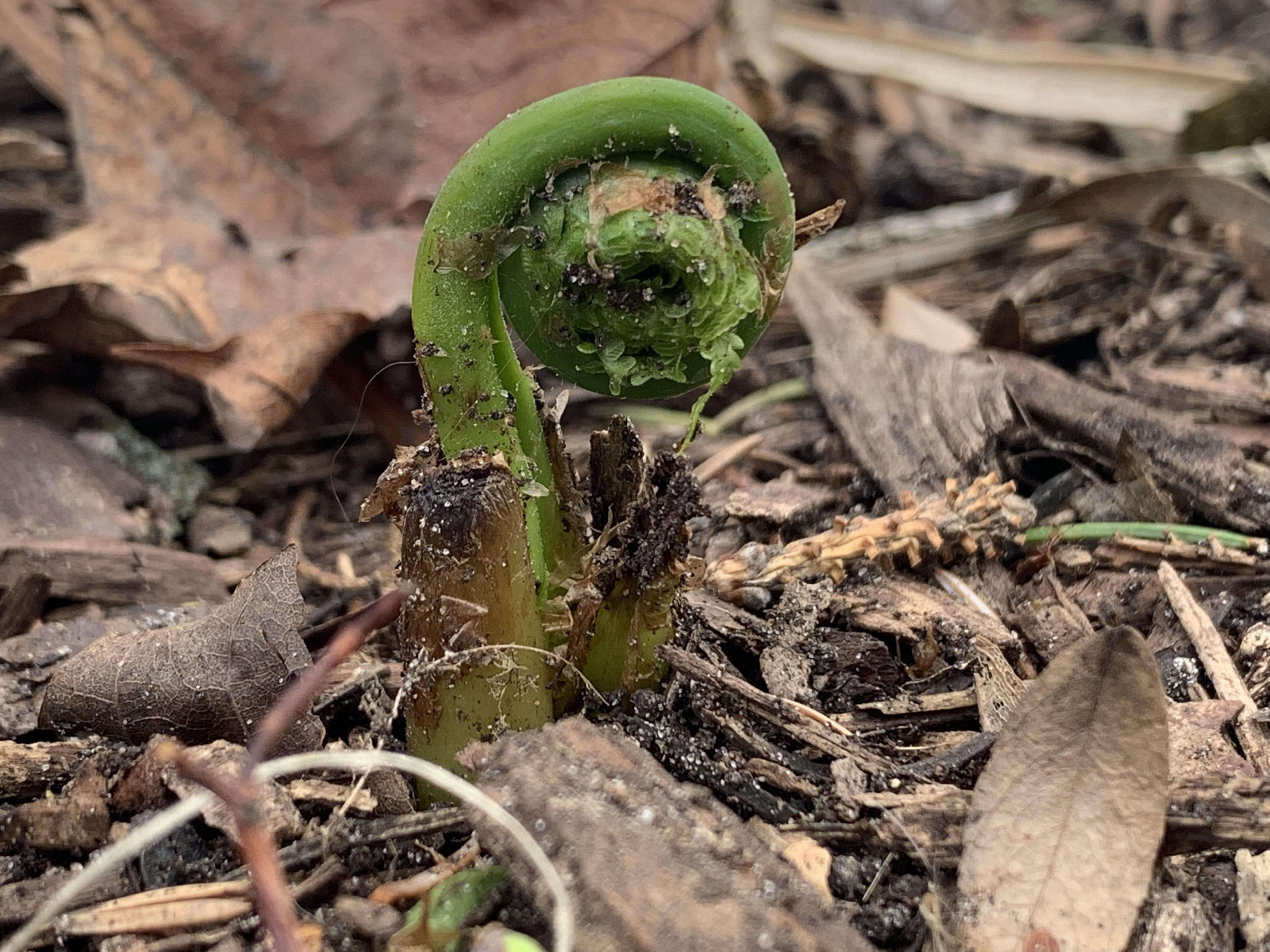
The point of education in a democracy is to consciously and carefully unfurl young minds so they might become active questioners, expansive thinkers, participating citizens in an ongoing experiment in a complex system called democracy, capable of stewarding their communities forward through an ever-changing world toward the promises inherent in the IDEA: equality, inclusion, governance by the people, for the people.

I would hope that we become capable of grokking governance-by-the-people which necessitates a people educated in ideas, reinforced in their curiosity and capacity to question, to converse and debate complex issues, capable of discerning ruinous power-over-agendas from the central idea enlivening their budding democracy: power with.

read Kerri’s blogpost about FERNS
like. share. support. subscribe. comment. many thanks.

Gain Some Perspective [David’s blog on Not So Flawed Wednesday]

If you’ve not yet bumped into Piet Mondrian’s paintings of trees, this is your chance. Not only are the paintings beautiful but if you’ve ever scratched your head at his more famous abstract/geometric paintings, you will find the forest through his trees. Things are not always what they seem and, in the era of contemporary art, it is necessary to grok the context in order to fully appreciate the content. Of course, that rule also applies in this age of info-tsunami: content rushing across the screen is regularly embraced whole-cloth – sans context – so truth and lie have equal standing.

In the art world, placing content (an individual painting) into context (the historic era, the long-body-exploration of the artist’s work, the source of the exploration) is called “gaining perspective”. Because things are not always what they seem, it is drilled into every artist to regularly stand back, to clear their eyes, to get perspective on their work-in-progress. It is also (or used to be) drilled-in to offer the same courtesy to the work of other artists. Stand back from snap judgments. Check the sources. Understand the exploration. Grasp the historical context. It is never as simple as “liking” or “not liking”; appreciation opens a vast color palette beyond the numbing mindset of thumbs-up or down.

Gaining perspective and learning are the same thing. The most well-educated people I know are not lawyers or doctors. They are actors, directors, dancers, and painters. Gaining perspective takes a lifelong dedication to questioning and researching and double-checking. It is to peek behind the curtain of popular and not get caught in the current reality spin. It is to know that things are not what they seem. It is to know that reactions are easy answers; questions take time. Gaining perspective takes time.

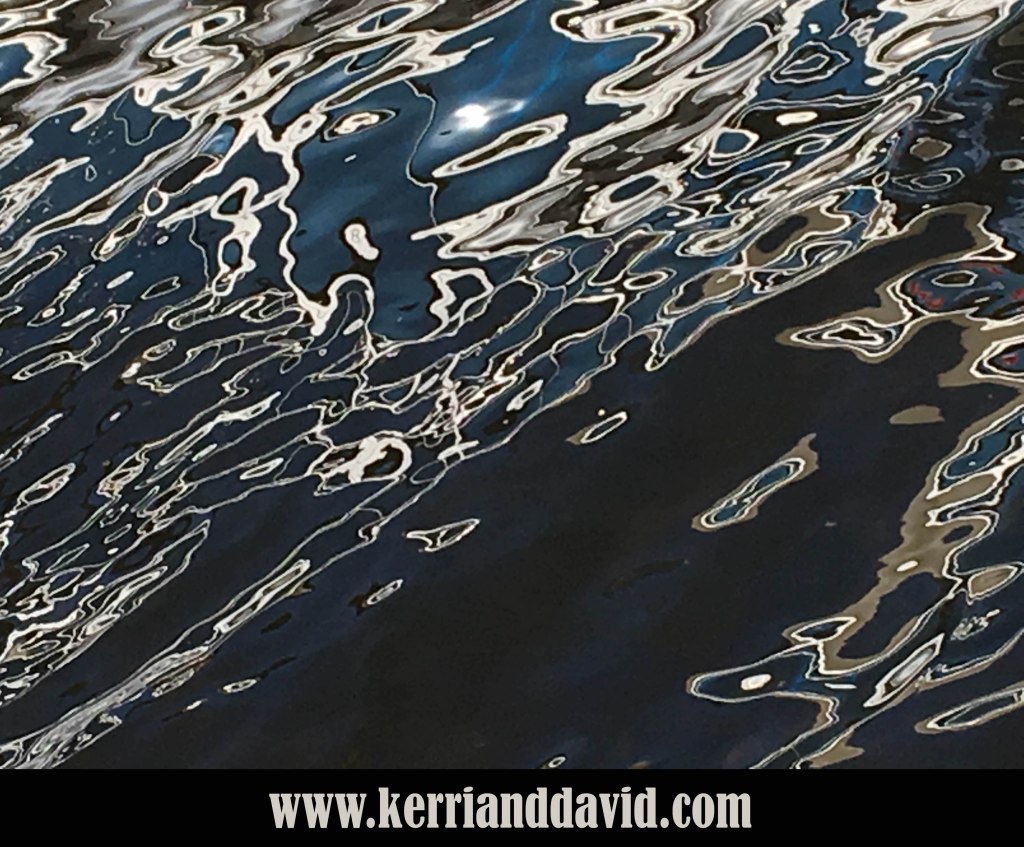
Sometimes she stops so quickly that it propels me forward a few stumbling steps. While I tumbled forward she knelt at a puddle and aimed her camera at a leaf. Or so I thought. I have learned (daily) that she sees things that I do not. I have learned that my assumptions are almost always wrong. She smiled when she stood up. “Look,” she said.

I gasped. I was terrifically wrong. The leaf was nowhere in sight. The reflection of trees in a puddle on the asphalt trail. A festival of texture. A masterpiece of illusion. Piet Mondrian must have knelt at a puddle reflection just like this! “Trees through an icy window,” I said.

Things are rarely – if ever – what they seem.

read Kerri’s blogpost about THE TREES

share it. like it. support it. comment on it. research it. question it. doubt it. grok it.

buymeacoffee is exactly what you make of it.

Savor The Words [David’s blog on Merely A Thought Monday]

Her delight in finding the stack of Nancy Drew novels, her girlhood favorites, sparked a question. She asked, “What did you read as a kid?” Instantly, I was a deer in the headlights. I muttered something incomprehensible and changed the subject in order to dodge the question.

It’s not that I didn’t remember. The truth is that I wasn’t a reader until I was in my mid 20’s. It’s as if someone threw a switch and I was instantly transformed from dullard to a voracious reader. I generally have two or three books going at the same time, making up for lost reading time.

A few years ago it occurred to me that I was reading like a starving man at a smorgasbord. I was gobbling words without breathing or tasting. So I decided to try an experiment. Read books like they are poetry. Savor a few pages at a time. Consider for a full day what I have read in my few pages. Re-read it if I am unclear. Re-read it if it is gorgeously written.

My experiment is going well. I’m living in the books rather than blowing through them. I delight in the phrases, the way words are put together to invoke images and sounds and tastes. Sometimes a phrase is so beautifully written it makes my eyes water. I feel as if I’ve pulled off the freeway, stepped out of the car, and am walking through a meadow. I see more. I appreciate more.

I credit the age of information with my new reading practice. I’ve been studying how people engage with their screens, how I have been engaging with my screen. We skim. We jump. We tab hop. There’s so much information demanding our attention, stuffing the nooks and crannies of our minds. Emails, texts, slacks, social streams…

I’m finding my peace, out of the stream and off the info-super-highway, turning paper pages with intention, paying full attention to what is written there, no more than a few pages at a time.

read Kerri’s blog about NANCY DREW

like. share. support. comment. savor. sample. contemplate. replicate. all things we appreciate.

buymeacoffee is an online fictional book repository where you can lose your ever-loving-mind and fall into strange lands where you find yourself supporting the work of artists you appreciate. Ridiculous!

Join The Kerfuffle [on Two Artists Tuesday]

Rob and I have been having a text conversation about AI. For him, an Orwellian curtain is descending. For me it’s a pattern: progress that pushes people into the unknown always ignites a kerfuffle.

Months ago Skip suggested that I jump into the dialogue raging around phrase engineering for AI. Basically, people learning better ways to ask the technology for more efficient and effective results. As a visual artist and a writer, he believed I might be able to stand with a foot in both evolving camps. Cross disciplines. I thought about it. Read everything I could find. I decided against. As an artist, someone who’s taken his artistry into the wilds of organizations, education, change initiatives, DEI, intercultural communication, coaching, software start-ups…a cross-pollinator – I’ve shouted my perceptions at the top of my lungs but rarely found ears that would or could listen. Why should an engineer listen to an artist? Why should a CEO give credence to a theatre artist? There are many many reasons. The notion of doing the same old thing in the same old way in a new context made me…tired.

What is a new way?

I’ve read that the mission of the industrial age was to create technology capable of sparing or lessening human physical labor. The mission of the information age is to create technology capable of sparing us from the rigors of thought. All in service of making life easier.

My last exchange with Rob led me back to Neil Postman’s short forward to his book Amusing Ourselves To Death. “Huxley feared we’d become a trivial culture…” Rereading the forward I thought, “Spot on”. Among the many upsides, having something or someone else think for you definitely has a downside.

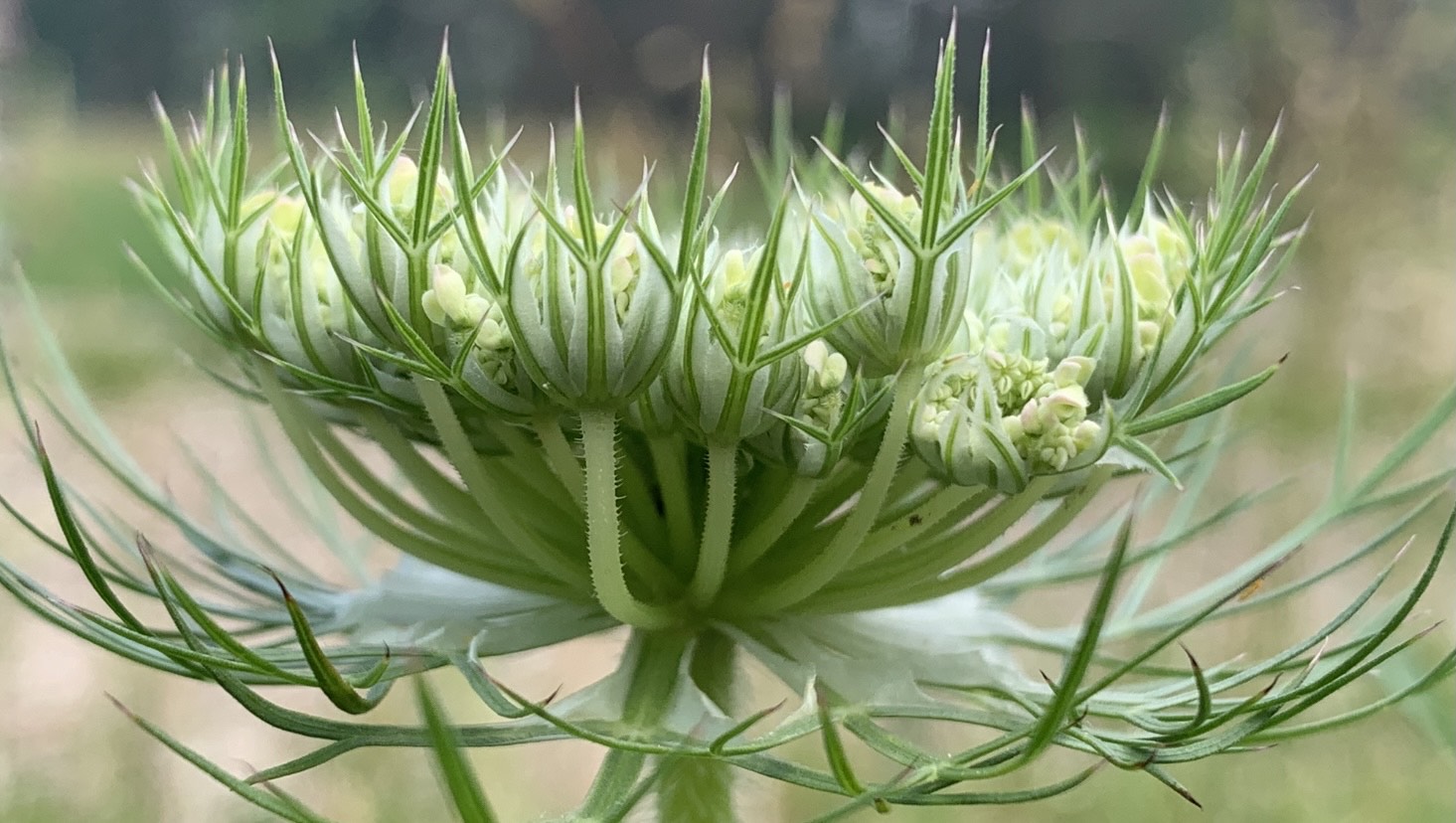
Perhaps our AI era will hold up a mirror so we might better see ourselves as part-of rather than separate-from. Perhaps all the space we gain in our brainpans, as we are spared the rigors of thought, will open new frontiers. It always has in the past. In a miracle of biomimicry, one of Skip’s creations in our start-up was a social network view: a visual of personal connectivity, an active map of all the people a user communicates with. The lines of connectivity were profoundly meaningful to me. The ability to see the thriving network active in my working life was a revelation. A pulsing flower, a wild carrot of interconnectivity. I appreciated my peers – my support system – in new ways because I could see them. My social network view made it undeniable: nothing I do, nothing I think, is independent of my community. We create.

Growth and learning is always in the direction of the unknown. Whether we realize it or not, even amidst the greatest kerfuffle, we take these bold steps together.

read Kerri’s blogpost about WILD CARROT

like it. share it. support it. comment on it. we appreciate it.

Breathe At Human Pace [on KS Friday]

We live in a time in which cars are capable of parking and braking themselves. I am able to type a message into a little box that I carry in my pocket and my message, through space and time to anywhere in the world, is delivered immediately. I write my thoughts in this device and then publish all over the world. I’ve learned of a software that is able to write my thoughts without me – faster and with fewer grammatical errors at the outset. I think and write in a pattern capable of being recognized. I am, therefore, capable of being approximated. What is amazing today is common tomorrow. So it goes with the pace of change.

I read in The Dream Society, written two decades ago, that the aim of the industrial era was to spare humanity physical toil and the aim of the information age is to relieve us from the exertion of thought. We’re producing data at a staggering rate and, ironically, the explosion is both serving the intention and overwhelming our capacity to keep up. We can’t possibly process the tsunami of information that washes over us everyday. We are human. We have a tough time sussing out truth from belief-fantasy even when not washed down the roaring information streams.

It is why I hang out with Desi. Desi is the little tree sprout that we rescued from the Des Plaines river trail over two years ago. When Desi came home with us, her tiny trunk was needle thin. She is thriving in her pot and has more than doubled in size, yet, by the standards of data, her growth is glacial. And that is precisely why I visit her each day. She is in no rush. Efficiency for Desi has nothing to do with speed. Health is about good soil and light. Like all plants, she could be pushed artificially, but why? Pushing might get her to adulthood faster but would also damage her systems. Efficiency and health, for Desi, are all about natural pace. Slow, slow, slow to human eyes.

Desi reminds me that the pace of my life is artificial. A choice. The pace, the incessant noise vying for my attention, are human-made, unnatural. Don’t get me wrong. I delight that Google maps gets me where I want to go. I appreciate having a phone available while walking a backwoods trail. One of the great joys of my life is watching Kerri photograph – with her phone – the world she sees. I love to write and push a button to share. I am, despite my advertising, not a luddite. I’m also aware that the media – the medium – is the message. We are – we become – what we consume and how we consume it. It is a necessity in our age of rolling miracles to keep both eyes open.

I think it is healthy (although virtually impossible) to occasionally crawl out of the stream and breathe at human pace. To think without the expectation of assistance. Each day, for a few minutes, I hang out with Desi, a reminder that an inch of growth every year is sometimes fast enough.

Kerri’s albums are available on iTunes and streaming on Pandora

read Kerri’s blogpost about DESI

taking stock/right now © 2010 kerri sherwood

Share Appreciation [on Not So Flawed Wednesday]

“I’ve got an old mule and her name is Sal
Fifteen miles on the Erie Canal”

~Low Bridge, Everybody Down, music and lyrics by Thomas Allen, 1913

She’s a donkey, not a mule, yet I couldn’t help but appreciate the collision of power sources present in this photograph. From donkey to solar.

I’ve read that the innovations of the industrial age were meant to spare humans of muscle-toil. If an engine could power it, a human didn’t have to. The innovations of the information age are meant to spare us mental and sense toil: why stress to parallel park your car if the car can do it all by itself? Why add the numbers if the spreadsheet does it for you? Why look up information if Siri or Alexa can bring it to you? What does it now mean to stay in touch? Text and facebook and tweet and email and zoom and facetime and slack and chat and…call.

Oil, coal and gas are the energy systems of the past. They are donkeys and mules standing next to renewable energy sources like wind and power. It takes time for an infrastructure to be built. It takes time for people to wrap their imaginations around a different way. Do you remember the loud resistance in the early days of the credit card proclaiming that plastic would never replace paper money? That was not so long ago. There were similar angry voices declaring the auto-mobile was a flash-in-the-pan. “Nothing will replace the horse!” Our local supermarket just installed banks of electric car charging stations. Energy systems are slowly moving away from grids: the power source and the property will (mostly) be one and the same.

Industries, like people, either adapt or die. Most retail chains that came late to online shopping are going or already gone. Many have said that they didn’t see the change coming. Or that they couldn’t imagine a world in which people bought stuff without first touching it. Cars are in vending machines. Isaac Asimov would have loved it!

Did I mention that the solar panel in the photograph senses and moves with the sun? As it turns out, the donkey does, too. Much for the same reason. Only, for the donkey, the heat of the sun feels good and I doubt the solar panel cares or feels anything. Sensing and feeling are still on opposite sides of the change-line. At least so far. There may come a day in the not-so-distant-future that the donkey and the solar panel share appreciation for the heat of the sun. The donkey will wag its tail. The solar panel will stretch and sigh. The stuff of children’s books or sci-fi. At least for now.

read Kerri’s blog post about DONKEY & SOLAR PANEL