Change Your Focus

a watercolor from 2003, House On Fire

a watercolor from 2003, House On Fire

Life can change in an instant. There are collective moments. There are personal moments. For years, my dad kept articles about the conspiracy theories swirling around the Kennedy assassination. It was the moment that marked the end of things as he knew it. Life would never be the same. For many years I shared his fascination because my first memory is an image from John F. Kennedy’s funeral which we watched on black and white television: a soldier leading a horse with empty boots reversed in the stirrups. I suspect that the image was potent for me because it was potent for the adults caring for me as they watched the funeral of the president.

Many years later, on a beautiful September morning in 2001, I sat in front of another television set and watched the Twin Towers fall. I thought, “Life will never be the same.”

With the recent anniversary of that day, on another beautiful September morning, Kerri and I read aloud to each other a book, 102 MINUTES: The Untold Story of the Fight To Survive Inside the Twin Towers. I was surprised by my reaction to the book. It felt a return to the place where we got lost. Like my dad, I missed the innocence that vanished in a single day (doesn’t each generation experience this loss? I imagine my grandfather yearned for a world before the atom bomb).

Throughout the reading, two potent and related metaphors would not let me go. First, a two-part metaphor for what I believe ails our nation. With a hyper focus on profitability, many long standing high rise safety precautions were minimized in the Towers. Less escape stairs meant more rentable space. Structural fire prevention measures are costly so they were either written out of the code or ignored. No one believed these twin Titanics could fail and when they did, the greatly reduced escape routes were either severed by the planes that hit them or were inadequate to accommodate the evacuation of the buildings. Additionally, communication between the police and fire departments was broken – they had the capacity but lacked the will. They did not use their updated systems because they were fighting over who would be in control. Their polarization crippled them on the day that they most needed to communicate.

So, the metaphor. One of the themes of my life (and, therefore, this blog) is the importance and necessity of a conscious placement of focus. Where you focus matters. Focus is a creative act. Our hyper focus on profitability took down the world’s economy in 2008. We’ve deregulated our financial institutions, removing all the safety precautions so that we might, as my pals in the financials services once told me, “Print money from nothing.” And the structure weakens. The wealth of the nation is in the hands of a shrinking few even though, as I learned in Economics 101, a healthy capitalist system is built upon a healthy middle class. No one believes this Titanic can sink. Communication between those who are supposed to be looking out for our safety, The House, The Congress, etc., are famously polarized. They have the capacity but lack the will and do not exercise their communication in the fight over who will be in control. In the meantime, we need them to communicate; waiting until the Tower falls will be too late to start. Our focus is on the wrong stuff.

 A sketch working out some details for House On Fire

A sketch working out some details for House On Fire

Which, brings me to metaphor number 2. This is the metaphor that cures us. The other story of those 102 Minutes is a story of kindness. People reaching for other people. When the disaster struck, the gap between custodian and CEO disappeared. The social divisions were irrelevant. People helped people simply because they needed it. They recognized that they were living a common story, a shared story, not the story of division that predominated a single moment before the planes struck the buildings. Everything changed in a moment. Or, perhaps everything became clear. People died to help other people. Their focus changed.


Unroll The Generosity Perspective

from the archives: EmbraceI’m eavesdropping. Kerri and Pastor Tom are in the next room having a planning session. I just heard P-Tom say, “The generosity perspective fell down. Woody rolled it up and put it under the table.” I laughed out loud. They are talking about a banner but, taken out of context, it is a terrific and ominous phrase!

If you take a gander at the daily news, follow the political circus, count the people trampled in the crush to buy stuff the day after Thanksgiving, you would be hard-pressed to find a better phrase for our times. The generosity perspective fell down. And, to add icing on the metaphoric cake: Woody easily rolled it up. He put under a table.

This land is your land. This land is my land. This land was made for you and me.

I’m convinced that there is another side of the coin. There is no denying that meanness exists in our world. Humiliation is a game played everyday through social media and beyond. Yet, I still believe that there is a disconnection between the rhetoric and the lived experience. I see and experience terrific acts of generosity every day. Some are small acts, some are vast – unfathomable, some are spontaneous, some are planned but all are generous. In fact, when I really pay attention, I find that the incidences of generosity far outpace the acts of cruelty.

Cruelty makes for good gossip and good gossip is cruel. And so, meanness sells. It is good for advertisers so those are the stories we broadcast. Generosity, on the other hand, erases victim stories and so is rarely yummy-fun to talk about. Acts of generosity are less potent as a selling tool.

Cruelty is easy to see. Generosity requires an intentional focus.

This morning I bumbled into a TED talk by Patti Dobrowolski. I learned that the odds are 9-to-1 against making change even if the change needed is life saving. Her message is great: draw the story you want to tell. Literally, draw it. And then tell it. If we want a different story we have to imagine a different story. If we want a different story we need to tell a different story. If we want a different story we need to act a different story.

If Woody easily rolled up and stashed the generosity perspective under the table it should be equally as easy for Woody to reach under the table, unroll the generosity perspective and hang it for all to see.


Train Your Eyes To See

an illustration from my unpublished children's book, Play 2 Play

an illustration from my unpublished children’s book, Play 2 Play

Laundromats are liminal places. Enter a laundromat and you leave behind the known world. You step into the great  “in-between,” the land of “not here, not there.” I am in the land of “not here, not there” because Tripper Dog-Dog-Dog came in from the yard with muddy paws and blew past our usual clean up stop. As Tripper was coming in, our neighbor let out his dogs and, apparently, the perimeter needed immediate protection, which required a Dog-Dog mad dash through the house, a leap onto the bed, and loud, raucous barking. So, muddy paws met white bedspread and although the paw prints were beautifully applied, smeared, and reprinted (a perfect composition), the bedspread needed washing.

As I wait for the cycle to finish I’ve been watching people. The proprietor is wearing a Santa cap and sits at the counter scoping the patrons; he is looking for anyone who might need assistance. He jumps at every opportunity to help patrons having problems with a machine. This is his kingdom and I have the illusion that he’s created it so that he might help others. He laughs a lot. He likes his kingdom.

A young man, clearly a regular patron, is quick to help the older clients lift heavy loads (the proprietor is at the ready but recognizes this unique circumstance). They are all regulars and lifting laundry is the organizing principle of their relationship. They ask the young man how he is doing. He is humble yet delights in their attention as they delight in his assistance.

This liminal space is filled with generosity and acts of kindness. It reminds me of the game I played not so long ago during my walk about. Each day, as I walked, I counted the obvious acts of kindness. There were always more than I could count. Always. The game was not so much about tallying goodness as it was about training my eyes to see what was right in front of me. It is too easy to see the road rage, the aggression, and the selfishness. It is too easy to believe in the monsters. That stuff is there. But, when you take the time to see it all –really see it – the generosity always far outweighs the miserliness.

title_pageGo here to buy hard copies (and Kindle) of my latest book: The Seer: The Mind of the Entrepreneur, Artist, Visionary, Innovator, Seeker, Learner, Leader, Creator,…You.

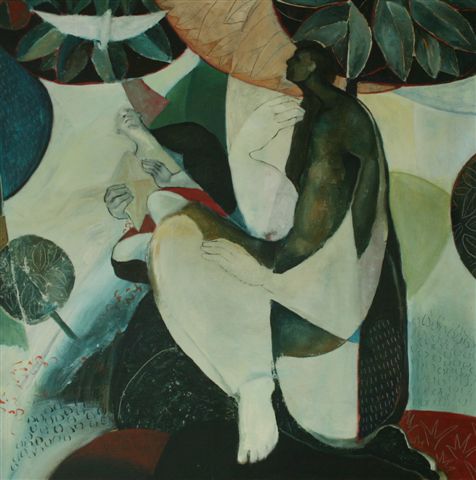
Canopy by David Robinson

Canopy by David Robinson

Go here for fine art prints of my paintings.


Recognize The Gift

Kerri with her mom, Beaky

Kerri with her mom, Beaky

Late night thoughts from the ER.

Earlier in the day Beaky told me that she had no special talents and I protested! She is one of the best storytellers I’ve ever known. She’s a natural. She can’t help herself. Sit with Beaky and you’ll hear some great stories. Beaky is like the rest of us: she doesn’t recognize her greatest gift because she thinks it is ordinary. She overlooks her gift because she thinks everyone can do what she does easily. That is the way with gifts: it is in the ordinary that we ultimately recognize our extraordinary-ness.

Beaky fell and we spent the night with her in the emergency room. As we sat by her bed, waiting for the pain medication to kick in, she said, “Did I ever tell you about the time…?” We heard stories about stags leaping over the car and the late-in-life marriage of her brother.

Another gift, related to her gift of story or, perhaps, an extension of her story-gift: people smile when they hang out with Beaky, even under extreme circumstances. For instance, writhing in pain, she looked into the eyes of a nurse and said, “I wish I had some of what you have! You have such a lovely smile.” And a new story begins; the nurse moved into the hall to tell the night staff about the kind woman in room 28.

After a sleepless night, Kerri and I sat in the hospital café and talked about the lessons of life, the lessons in generosity of spirit, the instruction in Grace and the rich stories we are receiving. From this seat, not much else seems important.

title_pageGo here to buy hard copies (and Kindle) of my latest book: The Seer: The Mind of the Entrepreneur, Artist, Visionary, Innovator, Seeker, Learner, Leader, Creator,…You.

Johnny crop copySupport the Kickstarter campaign for my play, The Lost Boy

See It. Feel It.

I call this painting "Sleepers"

I call this painting “Sleepers”

Tom spoke of small actions, the gift of peanut butter to a food kitchen for the poor. He asked, “Will it change the world?” and answered his own question, “I don’t know. In some small way, bringing a bit of hope to anther person, or providing food for a day, maybe it will.” Tom has been meditating on the many ways we enact love but perhaps do not see. He has been wondering if small acts of generosity serve as small acts love. Are not these small acts of generosity capable of changing the world.

For the past year, since moving from Seattle and leaving my work with entrepreneurs, I’ve been pondering this impulse toward change and the ubiquitous desire to change the world. I learned last year that, in business start-ups, the intention to change people is the great sign of folly. Changing people is impossible. If the central intention of the new business is to change people, don’t invest. It’s good rule of thumb.

People pray for a world without violence, a world free of disease and poverty. People read the paper and wonder what has become of the world. Someone recently said to me, “It’s overwhelming. What can I do?”

Tom’s meditation has brought him to this: it is not the doing that ultimately matters. It is quality of the being that matters. If your doing changes your being, you have changed the world. If some small act of generosity or compassion opens you, it changes the world. In the year prior to my move, I walked across the city of Seattle twice each day. I made it a game to count the small acts of kindness I saw each day during my crossing. There were always too many to count. People opening doors for others, making space in line, helping someone who dropped their packages, blocking traffic for an elderly person to cross the street. My walks were steeped in otherwise small invisible generosities.

The mistake we make when desiring change in the world is to think of change as a bottom line, change as an outcome or end result. Change as a forced march or dose of castor oil. Changing the world is not an arrival platform. It is within every act of kindness. It is every generous thought. It is fluid, on going, never ending.

One thing I learned from my walk with entrepreneurs is that every single start-up came about because someone saw a way to make life easier for others. What makes an idea good is how effectively it helps others. And so, in pursuing their idea, in every small action, they change themselves. They play in the field of possibilities. In changing themselves, they cannot help but change the world.

Will a donation of a jar of peanut butter to a food bank change the world? Perhaps. If it feels good. If it changes you. Small acts do not exist in isolation. To change the world you need only change yourself. People do not exist in isolation. The river flows. Each act impacts others in small ways and large.

title_pageGo here for my latest book, The Seer

Go here for fine art prints of my paintingsYoga.ForwardFold

Make It Ordinary

700. Join me in inspiring truly powerful people. Each day I will add a new thought, story or idea to support your quest and mine.

A midnight train, an early morning taxi, and a day at the Denver airport. Trains, planes and automobiles followed by a light rail into downtown Seattle and then a ferry to Bainbridge Island. I think in a single 24-hour period I will have only skipped submarine and hot air balloon as viable transportation options, though Judy reminded me that I had not yet traveled by camel. And, the day is not over yet so I knock on wood. These days I can make no assumptions about what the next moment will bring.

The benefit of riding on the rails, in the cab and on the concourse is that I’m very productive in transit. I’m a bit shocked at how focused I can be when rocking across Colorado in the dead of night or in the midst of thousands of noisy airport travelers by day. I finished the first true draft of the book. I caught up on emails (mostly). I untangled a banking knot, I made lists and all the while I watched the amazing dramas that unfold in an airport. I talked with Horatio and Diane and Megan. I had a text fest and toasted k.erle with a great cup of java. Judy played her harp for me just before midnight and it was among my favorite experiences all day.

I’m aware of the varied and glorious textures of this day. The amazing palettes of colors of this life are available if we only choose to see them. I saw the sunrise over the plains. I watched hundreds of small kindnesses and acts of generosity. Many were unknown to the recipient. A man pulled luggage off the train for an elderly couple. A woman quietly helped a young mother herd her children through security, doors were opened for baggage laden travelers, bus drivers waited for tardy riders, a barista left her post to give directions to a lost man and all the people queued for coffee stepped out of line to help.

And think about it – it was just a day like any other day. And, no day will ever be like this one. Little generosities swirl around us. The sunrise will never be the same as it was today; it was not like any other and the same will be true tomorrow. We have the capacity to see. We have the capacity to place our focus wherever we choose. The life we experience is a direct result of what we choose to see, where we choose to stand, how we choose to interpret and what we choose to celebrate. The day can be ordinary or extraordinary and the only difference is what we decide to perceive. Why not make the extraordinary ordinary?

Stand In Happiness

655. Join me in inspiring truly powerful people. Each day I will add a new thought, story or idea to support your quest and mine.

I drive to Capitol Hill early every Saturday morning to take Tai-Chi class. I go early to get some coffee and a scone and have started a special ritual of sending photos of my incredible morning bounty to torture Megan-the-brilliant who responds in kind, sending me photos of her bagel and jet fuel coffee from The Blue Moon café. Soon I plan on recording my scone enjoyment moans and sending the sound effects along with the photos. Torture is torture and I can’t wait to see how Megan-the-brilliant responds; she has a competitive nature and will one-up me somehow. Video maybe, or her food enjoyment sounds will come with a Hollywood soundtrack. She’s young and has the technological advantage in our torture game.

Although there are several coffee houses within walking distance of my class I now go almost exclusively to the Starbucks – not because the coffee is better or because the scone is world class, I go there because of the way I’m greeted by my barista. As I come through the door he shouts, “Hey! You’re back!” He’s often singing a song or bantering with his co-workers. His joy and enthusiasm is infectious. And, although I am only there one early morning a week, he no longer asks what I want; my coffee and scone just show up. We laugh at something, I pay and move on, and then he brightens the day of the next person in line. He has unwittingly made my Saturday morning ritual, previously a time of quiet reflection, a solitary act, into a homecoming. A simple thing, a greeting, a decision to stand in happiness, has deeply impacted my life to the point that I build my week around walking through a door into a welcome that warms me.

It is a season of giving (and, really, why do we need to define a season when this life could be a generosity fest) and when I think of all the amazing people in my life, the people who nourish and enrich me, my mind does not go to the big events, it goes to a video chat, the pizza that showed up at my door, a barista, a note from a top secret person, a tai chi teacher who has no idea of the impact his quirky sense of humor has on my life. My barista hasn’t a clue that he is my barista and has no idea that he enriches my life. My top secret person knows but has no idea of the profound impact she’s having on my life. At the center of each of them is a pattern, a ritual of generosity, an intentional sharing of heart that these amazing people bring to each day of their lives. From their point of view, their generosity is ordinary; they do not see it as special. They greet. They act. They support. Today, I count myself the most fortunate man on the planet to walk in their circles.

Take A Peak Beyond Appearances

483. Join me in inspiring truly powerful people. Each day I will add a new thought, story or idea to support your quest and mine.

Pal is a taxi driver. He was the driver at the head of the cue so he gave Lora and me a lift from the airport to our apartment. It’s a twenty-minute ride, no time at all yet enough for the story of a life. In 20 minutes we learned that Pal is from the Pujab region in India. He has lived and worked in the US for 25 years. With the exception of his father, his family now lives in the United States. He was mugged during one of his graveyard shifts at the 7-Eleven because he would not buy stolen property from a man who wandered in one night. He is a Sikh though he no longer wears his turban; he’s cut his hair and his beard. To a Sikh, cutting the hair and the beard are not done without good reason. Pal’s reason is safety. In the United States he has been beaten for his appearance. It’s better to fit in than to be beaten.

Central to the Sikh’s belief are radical notions like the equality of humankind and universal brotherhood. In my twenty minutes with Pal I learned that he was generous, gentle, bright, present, and open-hearted. He was not in a hurry. He loved his family. He worked hard. We unloaded our bags from the taxi and stood with Pal to continue our conversation. He showed us a picture of what he looked like before he went into hiding by cutting his hair and beard.

When Pal drove away I was awash with conflicting feelings. I was so grateful for our magic taxi conversation and his generosity – and equally saddened that in a country that prides itself on individualism, this man, this good man, does not feel safe being an individual. He was not beaten for his actions; he was beaten for his looks.

Once, someone I love but do not understand told me that, “not all Americans want this diversity thing;” an odd sentiment in a country comprised of immigrants. Evidently the diversity in his neighborhood made him uncomfortable and rather than walk toward it and meet his neighbors he chose to close his front door and fear. I wonder if he would have recognized Pal’s kindness or held him suspect because he looked different.

Of this I am certain: those who do not want this “diversity thing” are missing out. This “diversity thing” is a human thing and there are extraordinary treasures (human beings who do not look like you) all around. It only takes a moment to peak beyond the appearance, ask a question, and find the riches.