Be Held In Grace

Grace (noun): 1. Simple elegance or refinement of movement. 2. Unmerited divine assistance given humans for their regeneration or sanctification.

The first time it happened Kathleen, my landlady, stepped between me and the canvas shouting, “You can’t do it!” I was about to wipe off the image and start anew. “I love this one!” she said. “I love it.” Baffled by Kathleen’s wild-eyed heroics I granted the painting a stay of execution. I let it live. I faced the canvas to the wall so I couldn’t see it. After a few days I put it back on the easel. I saw it anew. I saw what Kathleen saw. It was a good painting and ultimately birthed an entire series of paintings.

One of the great paradoxes of being a visual artist is to lose sight en route to seeing. Becoming mired in the thoughts of the painting blinds an artist to the painting. Stare at anything long enough and you will stop seeing it (you will only see what you think about it). The only antidote is to turn it around. Forget about it so you can see it anew.

A few weeks ago it happened again. Kerri was coming down the stairs to the studio just as I was about the wipe an image off the canvas. It wasn’t working for me. Like Kathleen a decade earlier, Kerri threw herself over the painting and pleaded for its life. This time I asked her to tell me what she saw that I clearly was not seeing. I asked her to make a case for clemency. She saw something new. She saw Grace. And, she convinced me that I was blind to the painting. I took it off the easel and turned it to face the wall.

I’m learning again lessons that were pounded into me when I was younger but am now finding deeper levels. Step away. Forget. Clear your vision by looking away. Tom called this “closing the building for a spell.” Understand that seeing and thinking are intertwined. It is a sword with two edges that can illuminate or limit. The skill is never found in the thinking, the interpretation. The great skill is to see beyond the thinking. To see. Artistry happens when thought serves sight and not the other way around. The mastery of art and the mastery of life are, after all, one and the same thing.

When I turned the painting around I saw it anew. And, like the reprieved painting of a decade ago, this one, too, is inspiring a series. In a fit of intentional spontaneity (one of my new favorite descriptions of artistry), the second in the series jumped off my brush. I’m preparing surfaces for the third, fourth, and fifth. They are asking me to follow them – no thought required. They are asking me to take a walk with Grace.


Create A Purpose

photo-2In the sixteenth hour of our drive to the mountains, to keep us awake, Kerri and I began a rousing game of This-or-That. “Frosted Flakes or Lucky Charms?” Frosted Flakes all the way; those little marshmallow things get wonky in the milk. It’s amazing what you learn about yourself and others when the world of infinite possibilities is reduced to two choices. The game soon escalated to the impossible with pairings like “Coffee or Chocolate?” Real life penetrates the game when the only possible answers are, “It depends!” or “Both!”

Since our drive to the mountains I’ve been paying attention to how often people unwittingly play the This-or-That game, pretending that there are only two choices and, further, pretending that the choices are distinct and knowable. Democrat or Republican? Communities collapse when they forget that the important stuff is unanswerable. The important stuff is a moving target and requires conversation, debate, and comes along with multiple points of view. Two sizes do not fit all bodies.

I’ve also been playing my own inner game of This-or-That, purposefully choosing impossible pairings. Order or Chaos? It seems like a no-brainer until you dive in a bit deeper.

My favorite version so far is the Purpose-of-Life category. I picked a most lofty purpose: Illumination – and matched it with the utter absence of purpose. And, of course, I came to, “It depends!” or “Both!” I sprang my line of reasoning on Kerri (she thought we were going to talk about what to make for breakfast. She’s grown quite used to my surprise topics so she rolled her eyes, sipped coffee, and listened, knowing that no breakfast choice would be possible until after I unpacked my game).

No matter which spiritual tradition I read, the final point seems to be presence (living fully – aware of your moments). And in practice, presence becomes possible when thought is either transcended (meditation) or focused (prayer). Meditation and prayer are both purpose-full. Thought needs transcending and/or focus because it is mostly a babbling brook of nonsense or, better, a brook of babbling nonsense. It’s a lot of made up stuff that often takes the form of a game called This-or-That (I win/I lose, I’m right/I’m wrong, Us/Them). The game, as is true of all forms of interpretation, gets in the way of direct experience. It interrupts presence.

Detach from the babble. Meditate. Or recognize that it’s all made up and focus what’s made up. Pray. In either case presence comes through the recognition that it is all made up. The hitch: every notion of purpose, then, is also made up. There isn’t one. But, having a purpose is required to come to the recognition that there is no purpose. It’s a loop. It’s all creativity. It’s all imagination.

Spectrums and polarities are often cycles in disguise. They are both/and. They are yin and yang (not Yin or Yang). Illumination or Purposelessness? It depends. Both. Order needs chaos just as much as chaos needs order. The question is, what do we want to create? Why, a purpose, of course! So, let’s see what’s needed and decide to address it.

“My imagined purpose is breakfast,” Kerri sighed at the end of my rambling dissertation. “Pancakes or an egg scramble?”


Make Art So.

at one time even this was considered a new technology

at one time even this was considered new technology. numbers, too!

Chet said, “But where’s the human in all of it?” His question took me by surprise. It is a question that often puzzles me. I was telling him about my recent inner earthquake, the moment that the train of technology jumped the tracks and collided with my art engine. Both exploded.

For weeks I’d been looking forward to a full day of exploration at the Chicago Art Expo. Hundreds of contemporary galleries from around the world assembled in one place, each showing their premiere work. As an artist these events have always fed my soul. This time, with the exception of a few older masters (a Chagall, a Picasso), a Hockney that made me smile, and few pieces from The San Francisco Figurative painters, I was unmoved. Worse, I was uninterested. As I wandered through the exhibits I listened to curators over and over again working hard to give context to the art. The viewers had no immediate access to it. They (like me) needed an explanation to access its relevance. I felt as if I was watching art-priests interpreting god for parishioners who had no expectation of direct access to the divine. The art needed a middleman. It required an explanation.

Just before going to the Expo, Skip shared a link with me. It was a video of animator Glen Keane drawing in virtual space. He was literally drawing from within the image. It took my breath away. Glen Keane called the technology a new tool but, like many new tools – so many new technologies, this one has the capacity to change our relationship with life and, therefore, with art because it could change our relationship with time and space. At one point in time, electric light was a new technology. The automobile, the airplane, the telephone, the camera and the phonograph were once new technologies. Each changed our relationship with sound, light, distance, the planet…each other. They changed how we see and experience possibilities. And, at the time of their invention, the community, at first, did not understand the power being introduced into their lives. They, like we, were stepping into the future with their eyes in the rearview mirror. What we know as art changed with the introduction of each of these technologies.

I couldn’t help but see the work at the Expo through the lens of this most contemporary tool. My eyes, for a moment, were wrenched from the rearview mirror and forced to look straight ahead through the windshield. Relative to the tool, the work at the Expo seemed abstract to the point of inaccessibility. It felt academic and I felt distant from it (lots of head, little heart). The tool although incomprehensible, was exhilarating, approachable, and inspiring. It made me want to play. It made me want to create. With this tool, Jackson Pollock would have danced and splashed in 3-D space. Picasso would have explored Cubism from within the cube. And, with this tool, I could see them doing it; I could sit in the same space and get paint on my face. In the video, Glen Keane says, “When an artist makes a line, it is a seismograph to their soul.” This tool, this technology, is a 4 dimensional seismograph.

Eve Ensler wrote, “Art has the power to explode the heart and open up other energetic capacities to re-perceive it. It defies boundaries and leaps tall buildings. It transports, it translates, it transcends. Transcendence is so important right now because our lives are so mechanized, controlled, and commodified; art has the capacity to open our souls and could be our revolutionary, evolutionary salvation.”

Yes. And, yes again. I can draw in the dirt with a stick. I can draw in virtual space. The verb remains the same. The access to others – the reach of the art – changes.

To Chet I wanted to say that humans create technology. And, in turn, technology informs humans and, therefore, art. Our very short attention spans are the result of our relationship with technology –  800 word blog posts are now too long, and 140 character tweets are desirable. Much of the Expo was digital photography or digitally altered images. It was mental and cold and abstract – certainly expressions of our time – expediency allows for little depth of experience. The technology did not make it cold; the way it is wielded by human beings makes it so.

Meditate On Mistakes

taking advantage of my mistakes: a detail of my latest painting in progress called Weeping Man

taking advantage of my mistakes: a detail of my latest painting in progress called Weeping Man

A meditation on mistakes:

Actors know. In performance, when they forget their line, they come alive. The exhilaration of forgetting shocks them into presence. The mistake achieves the essential thing: presence. The audience may not be aware of the lost line but they cannot help but come into presence when the actor does. That’s how it works. Presence begets presence. Actors also know that, in such a moment, tension is their enemy. Panic is counterproductive. Relaxation is the only path back to their play.

Mistakes wake us up.

Many years ago, I produced a summer theatre company. In the middle of a performance, a storm blew out the power to the theatre. The performance stopped. The emergency lights came on. The actors looked at the audience and the audience looked at the actors. And then, in the ghostly blue-white light, the actors continued their play. It was the one and only time that the play was riveting. Actors and audience alike became invested. They were together in an experience that was unique. It was, as are all true mistakes, unrepeatable.

the under painting and sketch.

the under painting and sketch.

The playwright John Guare wrote that a writer must write ten bad pages to arrive at the one good page. The writer must value the ten bad pages for the single good page to be possible. The ten bad pages, what educators, locked into testing regimens, might call mistakes, are necessary. Up front expectations of perfection are guarantees of mediocrity. No process is perfect – and that’s the point. Perfection, like happiness, comes after the fact. It is the blossom of a rich process. It ensues and only becomes available when mistakes are valued, when exploration is encouraged. A rich process is alive with trial and error, with strong offers that may or may not work. The strength of the offer, the capacity to make a grand mistake, learn, adjust and boldly offer again – is a great definition of freedom. It is otherwise known as vitality.

It’s what artists understand. When nothing seems to be working, when the most powerful offers fall flat, when paintings turn to mud, relaxation is the only path forward. There is comfort in knowing that the single good page is out there somewhere if only you keep making grand, luscious, brilliant mistakes.

Open Your Eyes

a detail from the painting on the chopping block. It's called "The Stillness Must Be Immense."

a detail from the painting on the chopping block. It’s called “The Stillness Must Be Immense.”

There is a debate raging in my house. Yesterday I was about to wipe a painting off my canvas and begin anew when Kerri intervened. “I love it!” she declared. “I hate it,” I replied. “Truly,” she said, “I love it.” When I wrinkled my brow she restated, “I love it.”

Many years ago I was stepping toward a canvas to wipe it clean. The painting wasn’t working for me and I’d given up. I wanted to start anew. My landlady, Kathleen, came into the studio at just that moment and hurled herself in front of the canvas. “You can’t erase it!” she declared! “This is one of my favorites!” She had the look of a desperate woman begging for the life of her child. I relented. I couldn’t wipe it clean. She confessed to coming into the studio the previous evening and admiring the painting. “I spent a long time with it!” I made a deal with her. I promised to show the painting – to include it in one show – and let the public decide. If it was roundly reviled, as I KNEW it would be (as I was actively roundly reviling it), I’d paint over it without drama or interference. If it was appreciated by anyone, by a single person, Kathleen could say, “I told you so,” and I’d never paint over it.

the painting Kathleen saved

the painting Kathleen saved.

A few months later I hung the painting in my solo show at Rock/Dement studio gallery in

Seattle. At the opening a woman came into the gallery, stood before the painting, and burst into tears. She looked at me with tears rolling down her face and said, “I love it.” Kathleen waited a few days before allowing words to break through her smug smile, “Well,” she sighed, “I told you so.”

That painting is the reason I made the same deal with Kerri yesterday. I will let it remain long enough to show one time. If it is roundly reviled and ignored, then I will paint over the canvas without protest. If a single person likes it or expresses appreciation for it, she can bury me in a mountain of, “I told you so,” and the painting will live on long after I’m gone.

The Stillness Must Be Immense.

The Stillness Must Be Immense.

This morning I posted an image, a print that reads, “CROSS THE BOUNDARY OF ELEMENTS.” In the short blurb associated with the image I wrote that sometimes we have to stand in other people’s shoes. We have to see what they see. I am an artist and am convinced that artistry is all about opening new visions for others. It is about helping people see what is there, not what they think is there – and I’m certain that I fall into a thought eddy while painting. It is, perhaps impossible for me to see what others see in my paintings. What I judge to be worthless has often proven to be magnetic to others. And so, I am willing to make this bet, I delight in the moments when my understanding of life turns back on me, flings itself in front of me and screams, “Open your eyes!”

another detail of the painting.

another detail of the painting.

Embrace The Bump

photoArt stores are dangerous places. We entered the store with a short list: vine charcoal and titanium white paint. We left with a suspiciously large bag – Kerri found the pen and pencil aisle and got “that look” in her eyes. I found her sitting amidst a vast circle of pen possibilities making marks on a pad of paper. “Ooooooooooo,” she cooed, feeling the latest pen for weight and suitability for her hand. “I looooooove this one,” she said to herself. Her pile of “I love this one” selections was formidable. Art stores are like opium dens.

20 (aka John) was with us. He regularly incites us to riot and misbehavior. He was little help extracting Kerri from her pen-nest. 20 impacts us like a snout-full of laughing gas. He has a way of making the darkest day bright. 20 is, in fact, a bringer of light; he has developed this capacity because, like all bringers of light, he knows well the other side. One day in early summer, we sat on the deck drinking coffee and made our belly buttons talk, giving voice to the things we think but cannot say in polite society. We laughed so hard that I had to run inside the house; I couldn’t breathe. Twenty’s belly button had a lot to say.

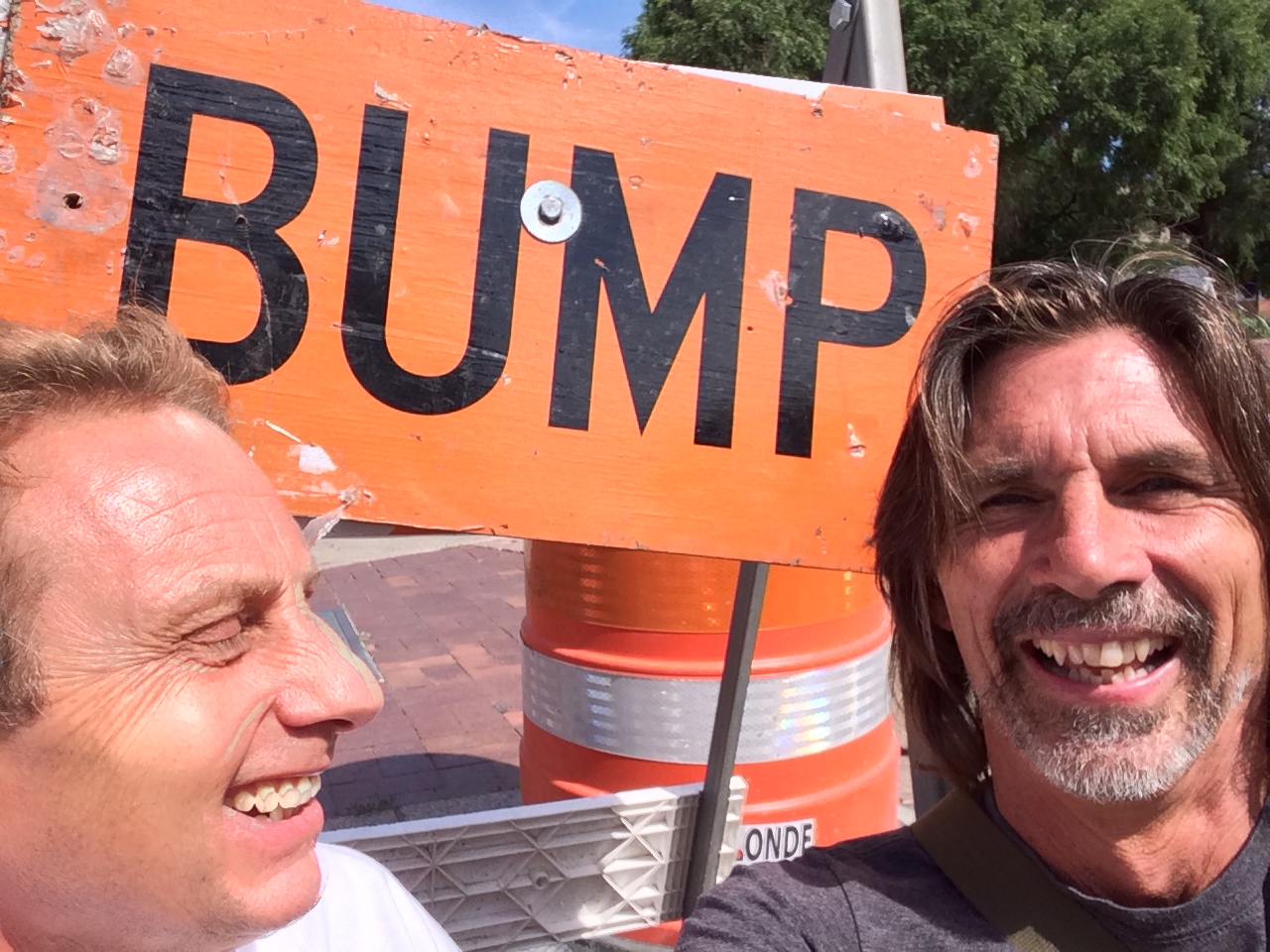
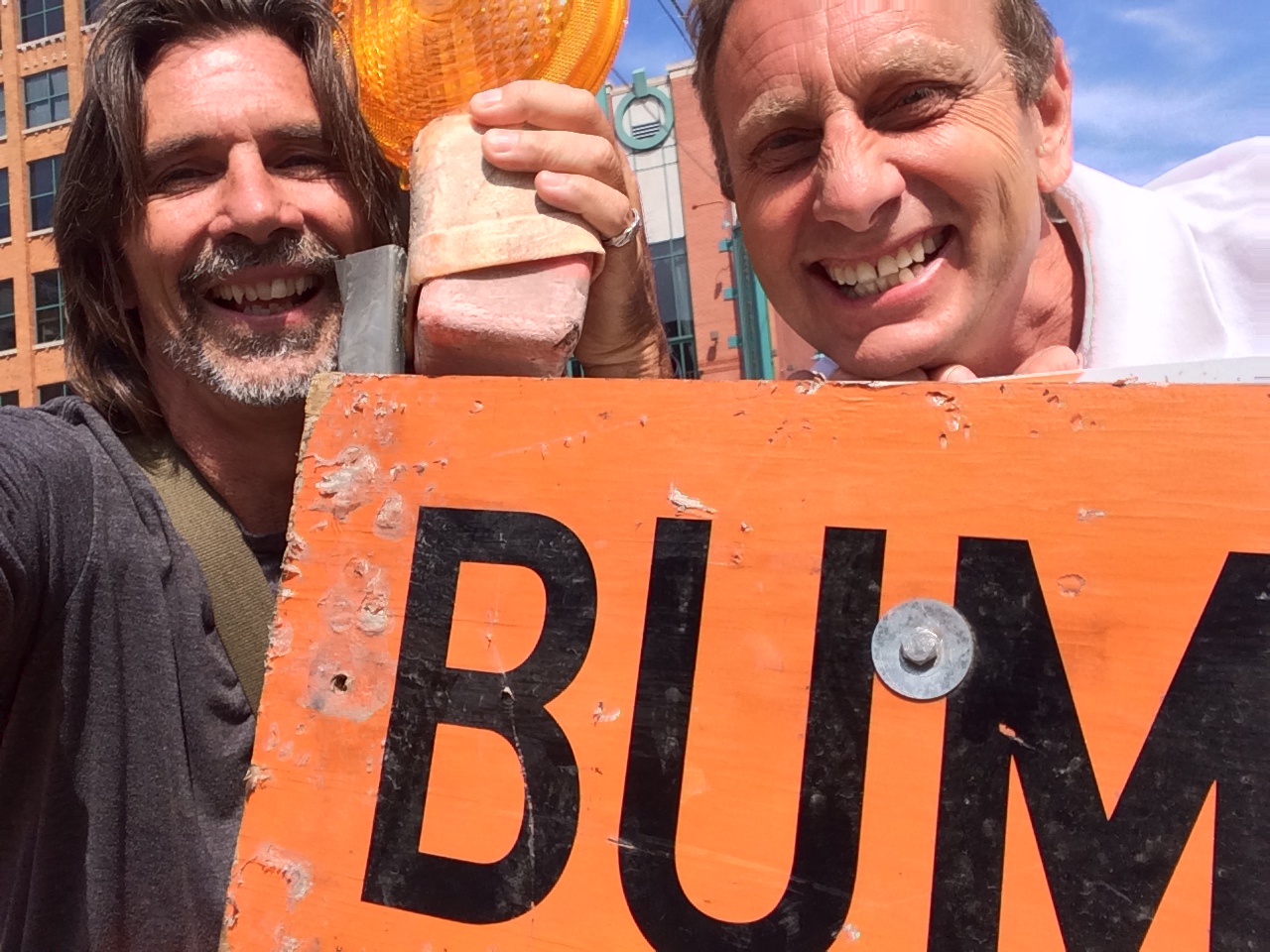
After escaping the art store, Kerri hefted her bag of supplies to the car while 20 and I waited on the corner. That’s when we saw the sign. It was something Sartre might have provided had he been a traffic engineer. It was existential. 20 and I jumped at the chance to make a selfie with the sign-philosophical. It simply read, BUMP.

photo-1As we snapped our selfies, laughing all the way, I couldn’t help but recognize that life – a good life – is riddled with bumps. In my consulting days I used to work with people to embrace the bumps rather than try to remove them. There is a pervasive notion that smooth sailing makes a good life. A bump-free life is a recipe for disaster. All of life’s lessons are found within the bumps. A life without bumps is a life without challenges is a life that is boring. And, in truth, people create bumps if they don’t already exist. They’re called a hobby or gossip or a complaint or drama. In story language, bumps (called ‘conflict’) drive the story; without bumps there is no movement. Yearning is a bump. So is desire. Unrequited love is a bump. Loss is a bump. Wondering what is beyond the horizon is a great bump.

20 is a great teacher of how to address bumps: Laugh. Make a selfie. Alter the word to something even more outrageously appropriate. Look for the next opportunity. Let your belly button talk.

photo-2

Reach To The Light

TODAY’S FEATURED IDEA FOR HUMANS

Reach To The Light

FOR TODAY’S FEATURED PRINT FOR HUMANS, GO HERE.

Fall Into It

lingering

lingering

Scott said, “In today’s world, if you can’t say it succinctly, you might as well not say it.”

Guitar Jim teases me each Sunday, saying, “Hey, I read the first 80 words of your blog!” I always laugh and he adds, “No, seriously. I didn’t have time to read the rest of it.”

I am like everyone else. I give only 3-to-5 seconds to any website that I visit. If it doesn’t capture me in that vast span of time, I move on to the next and the next and the next….

Click. Click. Click.

We are slaves to brevity.

In The Art of Living, Wilferd Peterson wrote: Travel with curiosity. It is not how far you go, but how deeply you go that mines the gold of experience. Thoreau wrote a big book about a tiny Walden Pond.

Going deeply takes time. My grandfather lived his entire life within a 10-mile patch of earth. He could smell a storm on the wind when all I – a visitor – could see was blue sky.

When I go to a museum, when I need to recharge my artist battery, I find the paintings that demand my attention, the pieces that want a relationship with me. Relationship takes time, too. Like Thoreau, I need to stare into the pond deeply, to spend time with it, to know it beyond mere thinking. Then I can breathe it in, feel the impact that only comes available with an engagement beyond the cursory. When I fall into it, it falls into me.

This is the challenge of our time, the artistic challenge of our time, the expectation that depth can be found by skipping a stone across the surface.

A good poem will not fully open without lingering in it.


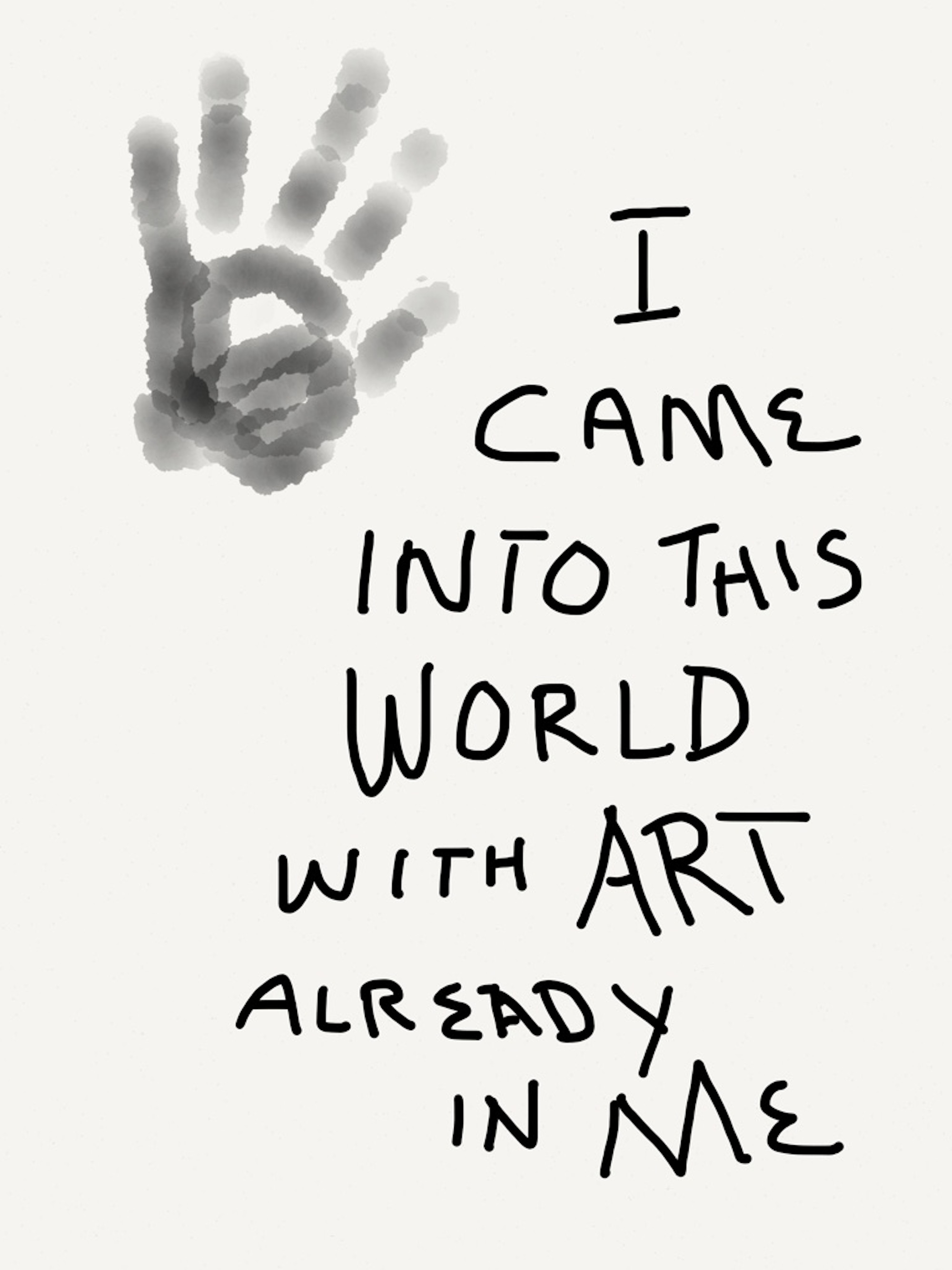
Art Already In Me

TODAY’S FEATURED PRINT FOR HUMANS

Art In Me

FOR TODAY’S FEATURED PRINT FOR HUMANS, GO HERE.

Walk With Your Ally

another painting in the Yoga series

the latest painting in the Yoga series

David is among my chief muses. He was the first person I met in my spontaneous-no-plan-move-to-Seattle over 15 years ago. We sat next to each other at a conference and he asked me if I wanted to be in a play. When I said yes he said, “Great. Can you be at rehearsal tonight?” Like me, he is a painter as well as a theatre artist. He steps through life with his eyes firmly focused on the possibilities. He reminds me that obstacles are nothing more than interesting process steps. When I wander through museums or galleries David goes with me whether he is there or not. When I see a play that inspires me, I wish that he might see it, too, so we might talk about it.

Recently, he sent this quote: “My intention has been, often, to say what I had to say in a way that would exemplify it; that would, conceivably, permit the listener to experience what I had to say rather than just hear about it.” – John Cage, Where the Heart Beats: John Cage, Zen Buddhism, and the Inner Life of Artists.

When I was in college studying acting I had a professor who would say, “You will always know a good play from a bad play because a bad play wants to tell you what happens. A good play wants to include you in what happens.” He also used this rule to define good acting from bad acting. His shorthand phrase was, “Show me, don’t tell me.” It is the artistic equivalent of, “Give a man a fish and he will have a meal; teach a man to fish and he will eat forever.” Art, regardless of the form it takes, is meant to teach people to fish.

Art is not a “thing,” it is a relationship. It is a dynamic orientation to life. It is an experience (not a possession). My interpretation of my professor’s rule goes something like this: a good play/performance/painting includes; a bad play/performance/painting excludes. Vital art reaches for others. Empty art rejects or attempts to elevate itself above others.

The best artists I know have learned to get out of their own way. They have essentially, let go of all investment in self-importance. They serve the art and, so, are not terribly invested in whether a critic or a friend likes or dislikes their work. They have grown beyond attempting to control the perceptions of others (control is an act of exclusion); they are attempting to reach the soul of the matter, touch the soul of the other.

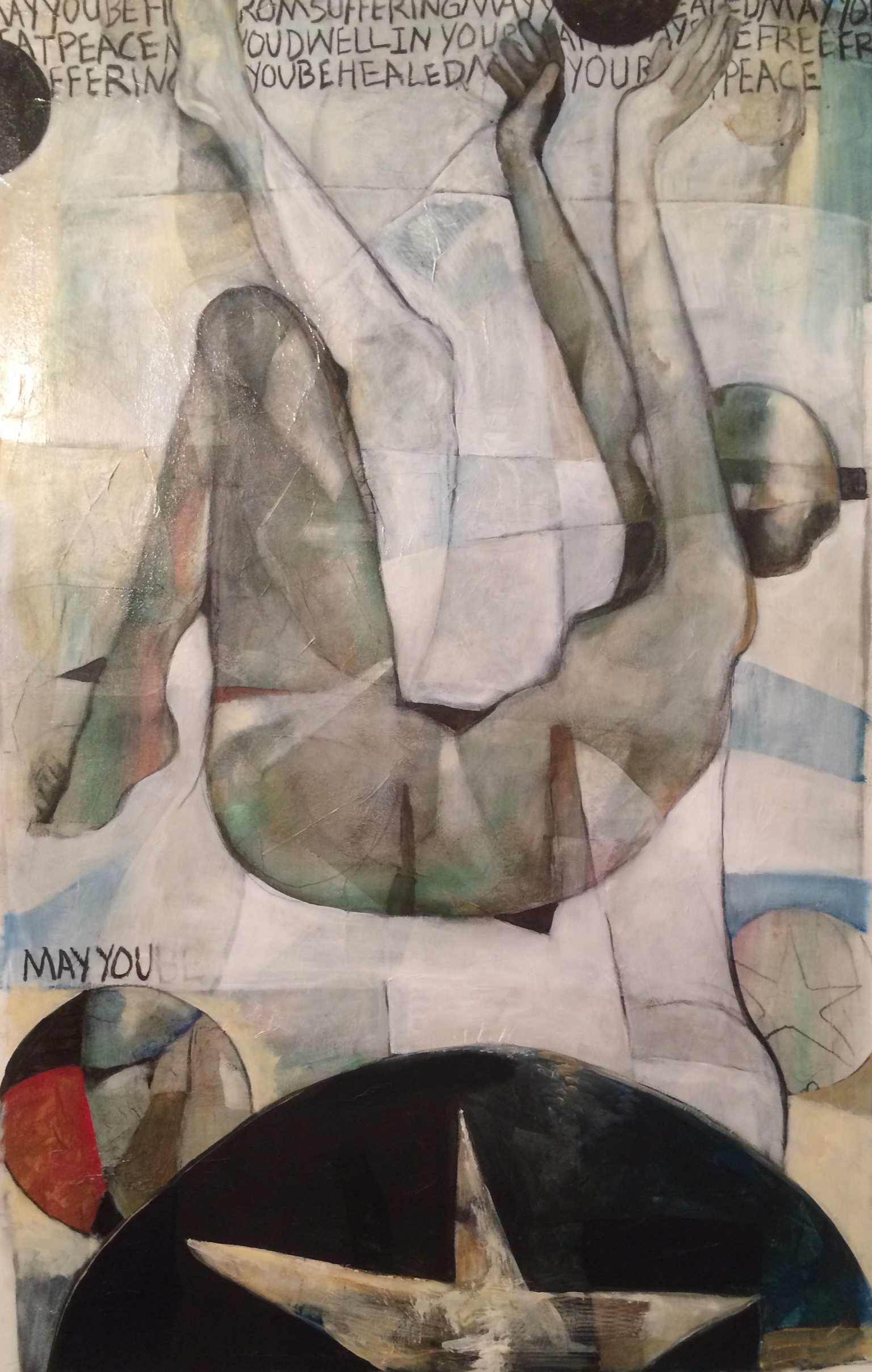
finally finished: May You Be

finally finished: May You Be

It is also true that great artists are constantly learning. And, since growth is always in the direction of the unknown, it is terribly important to have allies to walk with you. Stepping into the unknown is best done in the company of others, those special few wanderers who you can turn to and say, “Whoa! Did you just see that?” David, who is always there with me, laughs in response to my awe, and says, “Tell me! What did you see?”