Open Your Eyes

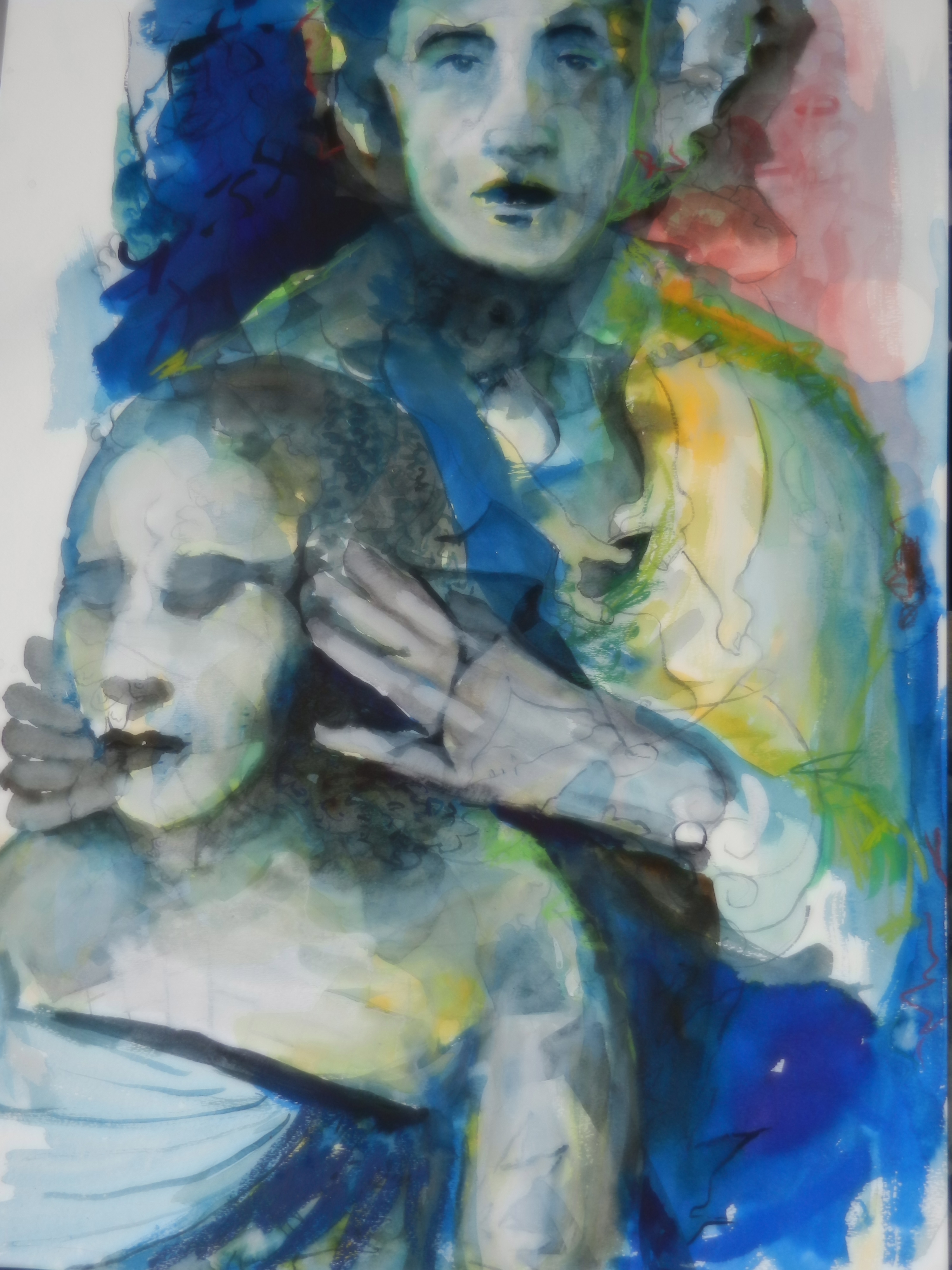
a detail from the painting on the chopping block. It's called "The Stillness Must Be Immense."

a detail from the painting on the chopping block. It’s called “The Stillness Must Be Immense.”

There is a debate raging in my house. Yesterday I was about to wipe a painting off my canvas and begin anew when Kerri intervened. “I love it!” she declared. “I hate it,” I replied. “Truly,” she said, “I love it.” When I wrinkled my brow she restated, “I love it.”

Many years ago I was stepping toward a canvas to wipe it clean. The painting wasn’t working for me and I’d given up. I wanted to start anew. My landlady, Kathleen, came into the studio at just that moment and hurled herself in front of the canvas. “You can’t erase it!” she declared! “This is one of my favorites!” She had the look of a desperate woman begging for the life of her child. I relented. I couldn’t wipe it clean. She confessed to coming into the studio the previous evening and admiring the painting. “I spent a long time with it!” I made a deal with her. I promised to show the painting – to include it in one show – and let the public decide. If it was roundly reviled, as I KNEW it would be (as I was actively roundly reviling it), I’d paint over it without drama or interference. If it was appreciated by anyone, by a single person, Kathleen could say, “I told you so,” and I’d never paint over it.

the painting Kathleen saved

the painting Kathleen saved.

A few months later I hung the painting in my solo show at Rock/Dement studio gallery in

Seattle. At the opening a woman came into the gallery, stood before the painting, and burst into tears. She looked at me with tears rolling down her face and said, “I love it.” Kathleen waited a few days before allowing words to break through her smug smile, “Well,” she sighed, “I told you so.”

That painting is the reason I made the same deal with Kerri yesterday. I will let it remain long enough to show one time. If it is roundly reviled and ignored, then I will paint over the canvas without protest. If a single person likes it or expresses appreciation for it, she can bury me in a mountain of, “I told you so,” and the painting will live on long after I’m gone.

The Stillness Must Be Immense.

The Stillness Must Be Immense.

This morning I posted an image, a print that reads, “CROSS THE BOUNDARY OF ELEMENTS.” In the short blurb associated with the image I wrote that sometimes we have to stand in other people’s shoes. We have to see what they see. I am an artist and am convinced that artistry is all about opening new visions for others. It is about helping people see what is there, not what they think is there – and I’m certain that I fall into a thought eddy while painting. It is, perhaps impossible for me to see what others see in my paintings. What I judge to be worthless has often proven to be magnetic to others. And so, I am willing to make this bet, I delight in the moments when my understanding of life turns back on me, flings itself in front of me and screams, “Open your eyes!”

another detail of the painting.

another detail of the painting.

Reach To The Light

TODAY’S FEATURED IDEA FOR HUMANS

Reach To The Light

FOR TODAY’S FEATURED PRINT FOR HUMANS, GO HERE.

Make Your Own Adventure

TODAY’S FEATURED PRINT FOR HUMANS

make your own adventure

FOR TODAY’S FEATURED PRINT FOR HUMANS, GO HERE.

Make It So

Pasta. Meat sauce. Warm Bread. Wine.

Pasta. Arugula salad. Wine.

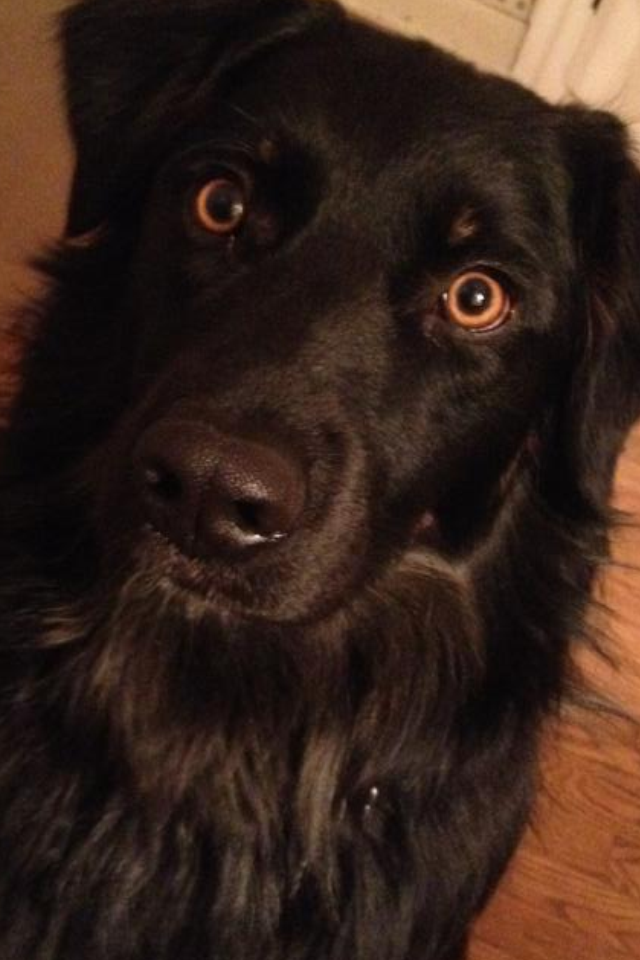
Tripper Dog-Dog-Dog knows the world through his nose. He sniffs everything. It is not uncommon after we finish a meal to come face-to-muzzle with a scent-curious Dog-Dog. Lately, as the objects of his sniffer, we’re given to staring into his amber eyes and offering the menu, saying something like, “Pasta. Arugula salad. Red wine,” or “English muffin. Peanut butter with black cherry jam. Banana. Coffee.” Satisfied with our description, he moves on to the next smell-enticing investigation.

I delight in our Dog-Dog food reports. They’ve become commonplace and matter of fact; “Chocolate chip cookie. Espresso.” Our reports never contain qualifiers, so, for instance, we never say, “A great chocolate chip cookie. Delicious espresso.” We provide the minimum, the noun.

Our Dog-Dog reports have rekindled an age-old fascination of mine: the power of words, specifically, the enormous power of the labels we attach to our experiences.

Language is a sword that cuts both ways. It can liberate and it can imprison. The difference is in how it is used. Language is the primary tool we use to make meaning. Big magic happens the day a person realizes that meaning is not something that is found, rather, it is something that is given and it is given the moment we apply a word-label to an experience. Nothing is good/bad, hard/easy until our label makes it so.

Applying a label to an experience is an act of creation. It is not passive. Take note of the word-judgments you apply to yourself or to others. For a week make a game of flipping them over and applying the label “beautiful” to where you usually apply a judgment. So, for instance, instead of, “I am fat,” why not say to your self, “I am beautiful.” Both are labels. One imprisons while the other liberates. The difference is a single word.

The label determines the possibilities we see (or don’t see). In a past life I used to facilitate organizational change and I came understand that my role was to help my clients ask better questions (use different language). They always came to the table with a “how” question: how do we change without feeling any discomfort? Response: what might you see if you stopped pre-labeling what you might feel as “discomfort?”

The mantra: have the experience first, make meaning second. And then, recognize the great capacity and opportunity you have to make meaning. Why not make a better meaning? Why not take a step and let it be a step merely?

Try this: do the Dog-Dog and, for one week, eliminate the qualifiers so that nothing is good or bad or right or wrong. It just is because you choose to make it so.

What’s The Story

This is a very old watercolor that I called The Inner Monologue

This is a very old watercolor that I called The Inner Monologue

All the ladies were talking about how their bodies have changed with age. My body has changed, too! You’d never know it now but I used to be less than two feet tall with really pudgy knees. Kerri punched me when I offered my perspective on my body change. Apparently there is a statute of limitation for how far back in time you can go on the my-body-has-changed conversation.

When I was studying acting we were taught to write backstories for our characters. The play script was filled with clues but we learned that a character is not 3 dimensional until it has an articulated history. This was always problematic for me. I had no problem creating a backstory – that was easy – and I could justify my imagined story happenings in the script – but I couldn’t see how my imagined story led to more specific actions in the performance. If anything, the backstory got in my way. Like all young actors I got lost in the backstory, trying to “tell” it rather than pursue my clear action. Acting, like life, is about the pursuit of desire. My backstory muddied my ability to act. Acting is an art form of the present moment.

When I was teaching acting I came across the same problem. The young actors would spend hours telling me the details of their backstory which only served to diffuse their present action. They’d try to perform their history instead of pursue their current target.

The backstory was interesting but functionally useless in the present moment.

I’m finding the same challenge off the stage as I found on it. In one form or another I’ve coached a lot of people. I hear a lot of backstories. Our backstories are interesting. They do what they are meant to do: they give us identity. We spend hours and hours telling each other about our past adventures and abuses. People are storytellers, telling the story of their lives all day, everyday. Most of the storytelling concerns the past. What we did or did not do, what was done to us or justifying what we did to others. Most backstories are about limitation. Most backstories have a root in fear that show up as “reasons why I can’t” stories. Do you remember the famous Richard Bach quote? Argue for your limitations and sure enough they are yours. As interesting and informing as it is, very little of the backstory is functionally useful in the present moment. I don’t want the person I was a decade ago defining the choices I make today.

It’s become something of a mantra for me, something I find myself writing or saying a lot: The actions we need to take are usually very simple. The story we wrap around them make them difficult. What’s the story?

title_pageGo here to buy hard copies (and Kindle) of my latest book: The Seer: The Mind of the Entrepreneur, Artist, Visionary, Innovator, Seeker, Learner, Leader, Creator,…You.

Go here for fine art prints of my paintings:

This painting is called Icarus.

This painting is called Icarus.

Intend And Forget

I have many titles for this painting and have used it a few times for posts. It is ultimately about intention and inner guidance.

I have many titles for this painting and have used it more than a few times for posts. It popped up for me again today. It is ultimately about intention and inner guidance.

I just finished writing this post and realized that, in many ways, this is the continuation of yesterday’s thought: clear the mental static and the channel to full expression opens. So, here is part two of my meditation on inner static:

John and I were having a conversation about the passage of time. He told me that he’d recently found some old lists that he’d written of life goals and intentions. The interesting thing about discovering the lists was 1) that he’d forgotten writing them and, 2) that he’d achieved most of what he’d written. He said, “The form of what I created was different than what I’d originally imagined but I was surprised to see that I’d actually created what I intended.” It was as if he had to write the intention in order to activate it. Forgetting the intention was necessary to give it space to manifest and grow. Write and forget.

When I was first training as an actor, late in every rehearsal process, my teachers consistently advised that we let go of everything we’d rehearsed and just show up. “You’ve done your work,” they’d say. “Now, let it go and trust.” Many years later when I was directing plays and teaching actors I gave the same advice. “Let go and trust. You’ve done your work. All that remains is to be present.” From the teacher/director seat, the moment of letting go is palpable; you can literally see and feel the phase in the process when an actor needs to let go of their work to come alive. They need to get out of their own way. They need to get out of their head and give all of their focus to the relationships on the stage. The work moves from the head to the body. It is this last step that transforms their study to a living pursuit. Forgetting the work creates spaciousness and allows the art to happen. Art is always about relationship and great art happens when the relationship is clear and expansive enough for all comers.

One of the most profound lessons I gained from my time in Bali concerned this dynamic connection between setting an intention and letting it go. While I was on the island my internal monologue disappeared; one day I realized that I was completely quiet. Thought was a choice and not a plague or chattering background noise. Silence was simple when no story was necessary, when no interpretation was needed. In the middle of that silence I could set an intention (“This is what I want to do/find today”) and then forget it. Before the day was over I would have found what I intended. The steps came to me; I did not have to seek the steps. Sometimes the intention was simple and sometimes seemed complex but that didn’t matter. If I clearly stated what I wanted and returned to silence the necessary coincidence always found me. I felt as if I could see the pieces on the game board moving on my behalf. There was no internal noise to compromise my intention so there was no external discord confusing my choices. I was conscious of my connection.

Alan calls this co-creating. Work with the energy and cease trying to force things to happen. John told me of his lists and I wondered how many people have had the same experience. We make lists, we try to make the list happen, life gets in the way and we forget. And, in the moment of forgetting, we relax our grip on how we think things need to happen. We forget the form and inadvertently open to possibility. In the forgetting we create the steps necessary for fulfillment: spaciousness, trust, and quiet participation.

Go here to get my latest book, The Seer: The Mind of the Entrepreneur, Artist, Visionary, title_pageSeeker, Learner, Leader, Creator…You.

Go here for hard copies.

Give Yourself Some Advice (3)

A younger version of myself rehearsing for The Creatures of Prometheus. The tats are fake!

A younger version of me rehearsing for The Creatures of Prometheus with The Portland Chamber Orchestra. The tattoos are fake!

[continued from GIVE YOURSELF SOME ADVICE (2)]

Here’s the third and final section of Horatio’s Advice To Myself. He sent it to me in an email last week. Horatio is one of my dear companions in art and artistry and I was so moved by his words that I asked him if I might post his thoughts. Were I still teaching young artists, this would be required reading:

Do not make work that attempts to control others. That is only advertising or propaganda and sustains no one. Make work that connects to others. That is sustaining. 

Do not make work that exalts yourself alone. That separates you from others.

Walking is good for you. Eating and sleeping are good for you. Loving is good for you. All those things sustain and heal you. Make your work like those other things. That kind of work is good for you, and for everyone.

Bragging is not good for you, or for anyone.

Never work in order to be famous or get rich. Never confuse your work with either one of those false goals, even though either or both may come your way.

Fame and riches are burdens and require a whole set of tools and abilities not at all related to the work that may have brought you fame and riches. No one but a very small minority of the rich and famous and a few visionary souls who are not rich or famous understand this. It may be the greatest false idol of human self-fulfillment of all time.

Time is the only asset that really matters. Value and prioritize it. You also need enough food and shelter, which usually means money. But enough is enough. That’s all that matters.

Having enough money for food and shelter is a necessity of doing good work. You have no choice but to figure something out. There are many paths. 

You will make bad choices. Learn from them. Forgive yourself so you can make other choices. Keep pursuing the real work.

You will waste effort and time. You will do work you don’t like. Everyone does. Try again.

All good work contains a discovery, something necessary for human life, even if it’s only that you need to drink water. 

All good work shows how we are all human, both you and your audience, that you connect, that you are the same.

All good work shows that it matters that we are all the same.

[to learn more about Horatio’s films or to read the complete Advice, visit www.Fidalgofilms.com]

Go here to get my latest book, The Seer: The Mind of the Entrepreneur, Artist, Visionary, title_pageSeeker, Learner, Leader, Creator…You.

Go here for hard copies.


Embrace The Paradox

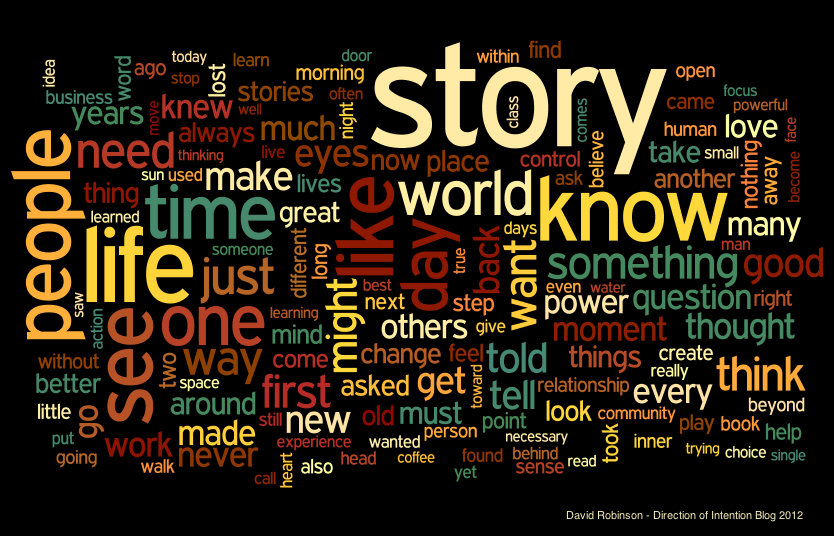
Mark Seely's gift to me: A Wordle of my blog

Mark Seely’s gift to me: A Wordle of my blog!

This is a landmark post: number 1000. When I started blogging I told Horatio that I feared I only had enough thought for 10 posts. He said, “If you can write 10, you can write 1000.” I wrinkled my brow in disbelief but it turns out that Horatio was right. With every step comes a new perspective. Kerri has a phrase I love: take down one tree at a time. In other words, if you can’t see where you are going, take the step that you can see; many single steps translate into miles of walking just as one post at a time can become 3 years of small thought-shares all in a row. What is a lifetime but a long series of days?

I’m writing this from a dining room table. All around me, covering the walls, are long strips of newsprint with a gathering storm of many colored post-it notes. The notes contain phrases, actions, like “Burn Your Trash,” or “Both Feet In, “ or “ Leave the Yuck Behind,” or, as you’ve already guessed, “Take Down One Tree At A Time.” They are story prompts. They are insight and idea prompts. Each prompt is associated with one of Kerri’s music compositions (she has 15 albums to date, with material enough for 3 more). They are building blocks for concert/storytelling evenings or keynote speech/performances. From the more than 60 post-it note prompts (and growing) we can combine any 9 to configure an audience-specific performance. The possibilities are endless. The viable themes are both unique and universal. Our umbrella title is Back To Center. We have a series of workshops to compliment the performances. The workshops illuminate the extraordinary moments and liberate the boundless capabilities of we mortals, we ordinary human beings. The big box is appropriately a prompt: Be A Ray!

Kerri and I are bringing our work together in a new form: Be A Ray!

Kerri and I are bringing our work together in a new form: Be A Ray!

As it turns out, I am a man of my time after all. The notion of a series of discreet component thoughts assembled to create a universal conception is taking over all of my processes – writing, painting, coaching, facilitating. It is the “many small steps making one large journey” philosophy of creation. It has taken over our world. It is contemporary: note the thought behind an App store or an Army of One. It is natural; cells do it. In the blog world it goes by the name of a “plug-in.” Build your own burger: design your car from the available components. It is the illusion of individuality in the midst of a constraint of choices. There is no arrival, just continuing process of expansive and interchanging capability. It is the Kahn Academy. Work at the pace that is appropriate to you. It is yoga: begin where you are, not where others are. It is what the old world of government process (ridiculously obscure tax codes), health care, education…the usual bureaucratic suspects and old school businesses do not understand. The world of rolling process has ascended; products and outcomes are obsolete before they hit the shelves. Story is more accurate than data (data is, after all, a type of story).

Nimble thinking requires nimble processes. Expansive living requires expansive thinking. Cathedrals are built one block at a time but the secret story of a cathedral is that it is never finished. It is always under construction, always changing, updating, repairing and modernizing. That’s the point of a sacred path. Stability, your sacred home, in this modern age is now found in motion, in a pure engagement with a moment. This is what we mean when we say, Be A Ray! Get into motion and focus your intention. Safety is never found in stasis.

Yesterday I wrote that a good life is marked by the capacity to stand solidly in the constancy of discovery. It is a paradox. Another prompt on the wall, one of my favorites, reads, “Embrace The Paradox.” Yes.

Go here to get my latest book, The Seer: The Mind of the Entrepreneur, Artist, Visionary, title_pageSeeker, Learner, Leader, Creator…You.

Or, go here for hard copies.


Share A Meal With Jakorda

803. Join me in inspiring truly powerful people. Each day I will add a new thought, story or idea to support your quest and mine.

Jakorda Rai sat behind me. His hands on either side of my head, he read my energy just as he’d read the other students who previously sat before him. Unlike the other students he did not progress to the second phase of diagnosis. Instead, he simply tapped me on my right shoulder and through a translator told me that nothing physically ailed me. My challenge was to open my story. As if to emphasize his diagnosis he tapped me again on the right shoulder and repeated his instruction. Open your story.

Later I would return to his house compound and participate in a ritual. He initiated me into his family temple. I became one of his family line. Only now am I understanding the import of that gesture, the gift that he gave me. The high priests brought me in to his temple and then Jakorda Rai sent me back into the world to open my story. Before I left his house compound he invited me to come back back. Through the translator he said, “Someday come back and share a meal with me.” I thought I’d be back within a few years. More than a decade has passed.

What does it mean to have an open story?

Artists – and by artists I mean all people who are conscious of their actions and choices – flourish when the emphasis in life is moved from “answer seeking” and placed on “question engagement” – the capacity to explore and engage, to sit solidly in uncertainty: that is the environment (and I think it is an internal environment) necessary for humans to flourish and fulfill their creative impulse.

I’ve posted these words before and decided to post them again. My dear friend Sam asked me to describe under what conditions an artist flourishes and this is what I wrote in response:

It is perhaps too simple but this is what I know and experience: the artist in me becomes present (it is all about presence; artistry is not something you do as much as something you are) – there is no past or future, just what is before me (and in me) in that moment and we are not separate: the poem or the painting or the story and I are one fluid thing. The world (my seeing) moves from nouns to verbs, from object focused to process focused. When I am present the environment, my seeing of my environment, comes “alive;” the colors are more intense, the sounds and textures of my space richer and clearer. I guess, in my artist self, there ceases to be a separation between me and my environment, I am not moving through a day, I am in the day. All concepts of “time” disappear. I am the creator, the creating, and the created.

This is what it means to have an open story. And now that I know, now that I am an open story, I remember that I am long over due to share a meal with Jakorda Rai.