Name It Or Not [on DR Thursday]

David Robinson 4by4 copy 2

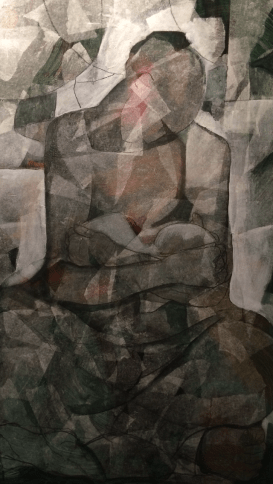
I sold this painting a long time ago. It’s a big piece, four feet by four feet. George Broderick sold it through his gallery in Portland, Oregon. The day we hung it in his space, he asked me what it was called. He was making a label for the painting with the title and price. I didn’t have an answer and said the first thing that came to me. “It’s called Four by Four,” I said. George wrinkled his brow.

True confessions: I’ve never been good at naming paintings. In fact, I used to resist it. I think a viewer should name the painting. I think a viewer does name the painting in the first moment they see it but then they dump their response when they read the label. But, reality has a way of setting in. As you might imagine, it nearly impossible to keep track of multiple paintings when they are all called Untitled.

For a while – a short while – I tried giving each untitled piece a number. Untitled 624. Untitled 29. “Cop out!” was the cry from friends and gallery staff. “What’s it called?” There was no mercy.

I was much more snarky then than I am now, I so I responded to the requirement of proper names by keeping a notebook of words and phrases that I liked. When a painting was being readied for a show I’d randomly pull a notation from the notebook and tack it to a painting. “There! A name!” That, too, was a ridiculous strategy. It confused everyone, including me. When it comes to tracking things, random associations are not very memorable and I’d inevitably lose the notation. I was constantly opening my notebook and renaming paintings. Plus, at openings, artists are always asked about the names they give to paintings and people were forever asking about a name/painting and I couldn’t remember which painting carried which random tag. More than once I stared blankly and stuttered until the uncomfortable patron moved on.

It has come as a great relief to me that Kerri actually likes to put names on my paintings. Nowadays, my foolproof naming strategy goes like this: “K.Dot, what would you call this painting?” And, without fail, she  always has a response.

“Why did you call this 4 x 4?” she just asked, hoping that the name would spark something to write about on her blog.

“I can’t remember,” I replied, lying outrageously. “What would you call it?” I asked.

She squinched up her face and studied it for a moment. “Slumber,” she said.


read Kerri’s blog post on 4 x 4


drc website header copy


snapchat website box copy


4 x 4/Slumber ©️ some date in the past and really who knows and who really cares?

Pace And Shed [on DR Thursday]

underpainting copy

underpainting

Like all artists I pass through periods of discontent with my paintings. They become like ill-fitting clothes. I want to shed them. I’m embarrassed to claim them. I start poking around for something new. Something that fits.

It took me more than a few cycles of discomfort to realize that discontent was actually a gift. It is the leading edge of curiosity, the fire storm that makes way for rejuvenation. Artists are not immune to holding on tightly to the safety and comfort of what they know and need a good dose of discontent to loosen their grip. At least I do.

Discontent makes me range around. Try stuff. Tear things up. Scribble furiously. Wonder if my muse has abandoned me (feel sorry for myself). Make really bad art (not on purpose). Make really bad art (on purpose). Take walks.

Discontent allows my empty well to refill. It pops any illusion I might carry of perfection. It turns my ship and hoists full-sail toward the edge of the world. And, it is always when I sail into uncharted waters that I find my muse waiting. She drums her fingers and says, “I thought you’d never get here.”

Ten years ago, when becalmed in the middle of my artistic ocean, I saw a pile of tissue paper in the corner of my studio. In a fit of why-not-nothing-else-is-working, I tore pieces of tissue and slapped them onto the painting-of-my-discontent. There sat my long missing muse, fingers drumming. “Texture,” she yawned. “You might want to see where this takes you.”

It’s taken me a long way. And, to my surprise, just a few weeks ago, I woke up and my paintings, like ill-fitting clothes, no longer fit me. I look at them as if someone else painted them. “Yikes,” I thought, “I hope no one saw these…” My muse packed her bags. She is nowhere in sight. I paced a little. Discontent like fog descended.


read Kerri’s blog post about UNDERPAINTING


buffalo adirondack chair website box copy

mother&childprocessshot copy

sometimes the underpainting becomes the painting…this is a slice of Newborn


newborn ©️ 2019 david robinson


Drink It In [on DR Thursday]

I wrote to Master Miller. He is one of my favorite artist confidantes. I told him that I was in a dry spell and so I was taking advantage of my artistic empty well by playing with sketches and revisiting old themes. Drawing memories.

He was (as always) enthusiastic. He regularly bubbles with love of art and artists. He often sends me photos of his young son painting. They have become a source of great joy and inspiration for me. Curiosity and freedom. A father and son, both artists, at play.

I remember a spring day in Colorado. A mountain trail. It was hot and then the afternoon rains came. A short burst, a downpour. There was nothing to be done but turn and face it, open and drink it in.

facetherain morsel

a close up


read Kerri’s blog post about FACE THE RAIN


vailKdotDdot website box copy


face the rain ©️ 2019 david robinson


Be A Part Of The Wind [on KS Friday]

part of the wind songbox copy

I am a sturdy proponent of The Paris Theory. I made it up so it only follows that I am a stalwart adherent. The Paris Theory goes like this: if you try to get to Paris you will end up in Kansas City every time; the fastest way to Paris is to shoot for Kansas City.

A quick read of The Paris Theory implies that Kansas City is a lesser destination but that’s to miss the point entirely. The point? Adventure, rich vibrant experience, is available everywhere. And, most often, the richest experiences come along because “the plan” collapsed, the plane was diverted, the seat reassigned. In The Paris Theory, Paris is not a place. It is an orientation to experience. The quickest way to Paris is to recognize that there is no greater or lesser place – especially when you are standing in it. Open. Look around. Art and life and love and danger and interesting people, food…vital experiences are everywhere.

Artists steal ideas and I must now confess that The Paris Theory is ancient. I slapped some shiny new lipstick on it to make it my own.

We are here for such a short time. The winds blow us here and there. Sometimes it feels like we are in control, bobbing along, but then strong winds come and push us in new directions. How much time do we spend wishing we were some other place and miss where we are? How much time do we delude ourselves into thinking there will be a firm and lasting resolution? An arrival? The winds never stop blowing. As Kerri said [and so beautifully composed], “We are part of the wind.”


PART OF THE WIND on the album BLUEPRINT FOR MY SOUL is available on iTunes & CDBaby


read Kerri’s blog post about PART OF THE WIND


ChasingBubbles (full) copy

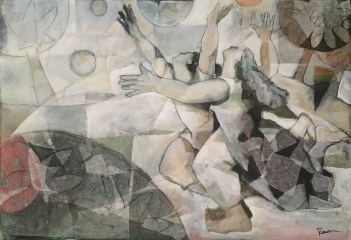
The Paris Theory = Chasing Bubbles


gate f8 website box copy

part of the wind/blueprint for my soul ©️ 1996 kerri sherwood

chasing bubbles ©️ 2019 david robinson

Listen To Them [on Merely A Thought Monday]

cleared the path bridge copy

Saul taught me to look beyond anything I understood as an obstacle and, instead,  place my focus on the field of all possibilities. “Place your focus on the obstacle and you will deal with the obstacle. Place your focus on the possibilities and you will deal with possibilities.”

Tom taught me to choose my battles and to fight only those worth fighting. “You don’t want to die on every hill,” he said. “In life there are really only one or two hills worth dying on.”

Ironically, Quinn, one the best storytellers I’ve ever known, taught me not to make up stories. Pointing to the big tall bank building he said, “See those people up there on the top floor? They don’t know what they are doing, either. They’re just making it up, too.” Or, maybe, he was attempting to teach me to tell a better story about myself.

It is not an understatement to say that I am rich in guides, teachers and mentors.

Doug, a Vietnam vet and one of the best teachers I’ve known, one day called me into his office and showed me a tattered, ruined book of poetry. “I bought it in the airport on the way to the war,” he said. “It saved my life.” He told me the story and it made me weep. Doug taught me the power of art. So did Paul and Roger. My two MM’s (Master Marsh and Master Miller) continue to teach me this lesson. Dawson, too.

Kerri and I are in a period of change that is simmering with unknowns. It is not the first time in my life that the dense fog has come in. She asked, “What do you think will happen?” I said, “Well, ultimately we’ll die.” She punched me. “That’s not what I mean!” she groused, adding a second punch. “Geez.”

Later, after the double punch, we took a walk on the Des Plaines river trail. An elderly man came around the bend and said with great jest and enthusiasm, “I cleared the path for you! It’s all clear.”

“Clear.”  It’s a poetic term. It means ‘possibility.’ And I heard them, my chorus of teachers and guides. All of them. Loud and clear.


read Kerri’s blog post about CLEAR PATH


muddy boots blue website box copy


Mix It [on DR Thursday]

palette copy

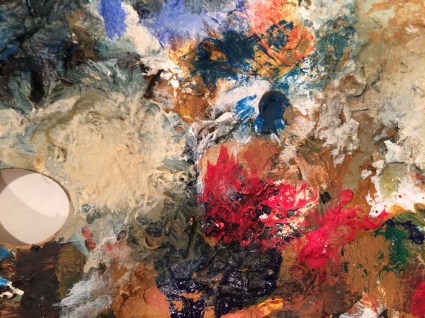
True confessions: I never clean my palette. I like the messy build up of color. I like the chunky texture. It serves as a gunky history of my work, a genealogy of paintings past. And then, over time, it becomes a tactile work of art in its own right. Unfettered by any of the mental gymnastics or over-ponderous considerations that plague my “real” work, it is the closest to child-mind that I will achieve. It is accidental. It is free.

This might be a stretch but it is, for me, nevertheless true. I love my palette because it is the place of alchemy in my artist process. It is the true liminal space. I begin with pure color. I smashed the pure color together with another color and transform it into a third color, the hue I intend. On a palette, color becomes intention. And then, once transformed, with a brush or knife I lift the color-intention from my palette and in an action that is often more responsive than creative, I place it onto a canvas. It transforms yet again relative to all the color it touches. An image emerges. More color is called for.

And, somewhere in this call and response of color, I become like the palette. The pass-through of alchemy, the door that color passes through en route to something beautiful. And, in the process, perhaps I, too, in my messy build up of life/color, grow closer to that child mind. Unfettered. Accidentally interesting. Free.

“You never know what is enough until you know what is more than enough” ~ William Blake


read Kerri’s blog post about my PALETTE


roadtrip reading website box copy


Horses FullSize copy

untitled, mixed media 48 x 48IN


Paint The Can [on Not So Flawed Wednesday]

duke's painting copy

I imagine this still life is a painting that Duke merely tossed off. It was an exercise, something he painted because, well, he wanted to paint but wasn’t awash in inspiration. He looked around for a subject, any subject, and laughed when it occurred to him that the coffee can stuffed with brushes and tubes of paint lying willy-nilly on his table would make a sufficient study. When it was complete, he liked it enough to hang in the hallway of his house. It hung there for years. I imagine he and his wife, Eileen, looked at it everyday – to the point that they probably stopped seeing it. It was the norm. Part of the hallway.

It remained in the hallway after his death.

A few weeks ago Kerri and I helped Duke’s son, 20, move his mom into a nice assisted living apartment. After the furniture was moved in and the dishes and lamps, the final piece was Duke’s painting of brushes in a coffee can. It is the piece that made Eileen’s new apartment feel like home. Before we hung it on the wall we took some time and studied the painting. Duke was great painter!  I imagine that he had no idea on the long-ago-day that he decided old brushes in a coffee can would make a nice study, that his coffee can, like the Velveteen Rabbit of paintings, would come to mean so much. That it would carry associations like “home” and “Duke.”

It’s probably good that an artist cannot know the destiny of their work.

I imagine he put on the final touches of paint, the highlights, stood back and thought, “It’s good. I like this one.” He dropped his brush in some turpentine and made his way upstairs the get another cup of coffee.


read Kerri’s blog post about DUKE’S PAINTING


k&dbw backs website box_ copy

Ask, “Why?” [on Merely A Thought Monday]

guidance framed copy

I’m told that every evening of her life, Margaret would stop what she was doing, and go outside to watch the sun set. If she was on the phone she would hang up. If she was doing dishes she’d turn off the water. She’d step into her back yard and attend the setting of the sun. It was her ritual.

Last year, Kerri, my mom, and I took my dad back to visit the small town where he grew up. He wanted to live his life there but that was not to be. Now, he is sliding into dementia. Before his sun set he wanted to make at least one last pilgrimage to the place he’s always considered home.

I draw and paint. Not because I want to but because I have to. As far back as I can remember that has been true. The rest of this world seems like Alice’s trip down the rabbit hole. Mad. Illusory. Missing the point. I know what is solid and true when I step in front of a canvas. It’s a paradox, yes?

Why do people make paintings? Why do they compose music? Why are we tellers of story? Inventors of story? Poets? Budget makers and parents alike caution that there is no real value in the arts. They rarely make money. Money making as the ultimate arbiter of value makes for an empty world, indeed.

Why do people climb mountains, jump out of airplanes, or kayak over waterfalls?

“Why does she say, ‘guidance is eternal?'” Kerri asked. We were streaming an episode of Life Below Zero on the National Geographic site and the Boeing commercial came up for the umpteenth time. Amid images of advanced technology and machines that fly, the narrator begins a countdown, 10, 9, 8, guidance is internal, 6, 5,… “I think she’s saying that guidance is internal, not eternal.” We looked at each other. Either way, what a great phrase! Guidance is internal. Guidance is eternal.

Why do people step outside each evening of their lives to watch the setting sun? Return like salmon to their birthplace? Listen to the wind and run to their piano?


read Kerri’s blog post about GUIDANCE


slow dance party cropped website box copy


Make The Climb [on Not So Flawed Wednesday]

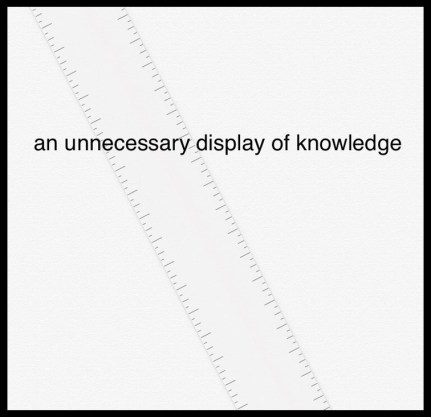
display of knowledge in frame copy

Roger and I used to talk about art in terms of levels of sophistication. For instance, no one masters an instrument the first time they pick one up. There are layers of learning necessary before the musician “knows” how to play. The “knowing” has little to do with the accumulation of information and everything to do with giving over to what the body learns. Finally, it is a letting go (of the mind) into an undefended sharing. Flow. It has nothing to do with knowing and everything to do with availability. This ‘availability to experience’ is what we called sophistication.

Both the artist and the audience pass through layers of greater sophistication. The artist wants greater and greater challenges. The audience wants greater and greater challenges, that is, they want to participate in something that demands more from them. It requires that both artist and audience show up, open, give over. Union is the ultimate purpose of art. Participation in something greater than your self. That is how art informs and transforms.

And then, there is the flip side, the anti-art. You can feel it. The absence of the genuine experience. The demonstration of accumulated knowledge. I cringe when a curator launches a three-masted-ship-of-study that tells me what the art is about, what the artist felt, and what I should see and feel. When the actor attempts to control what I see, when the art is so conceptual that it precludes me or anyone save the artist from entering the conversation, when the  knowledge priest stands between me and my god…you’ll know the levels of sophistication have left the building when the conversation is one way, judged, controlled.

Kerri calls this the blah-blah. When a real moment is disrupted by an agenda, when the flow is dammed by an unnecessary display of knowledge. And, the kicker is, we are all guilty of it. I am. It is a necessary step in climbing the ladder of sophistication, slipping back down the ladder of sophistication. To confuse technique with art. To garble the necessity of the open heart with  the realm of the intellectually abstract.  To give a standing ovation to something that put you to sleep. To try to control what the other person sees or thinks or feels; a fool’s errand. The great artist trap. The great life trap.

And, the best you can do (truly, the best thing), is to catch yourself in the moment of blah-blah, laugh at yourself lost in the trap, pull out the ladder, and begin again to climb toward simplicity.


read Kerri’s blog post about AN UNNECESSARY DISPLAY OF KNOWLEDGE


cropped head kiss website copy


Ask The Question [on DR Thursday]

palm tree copy

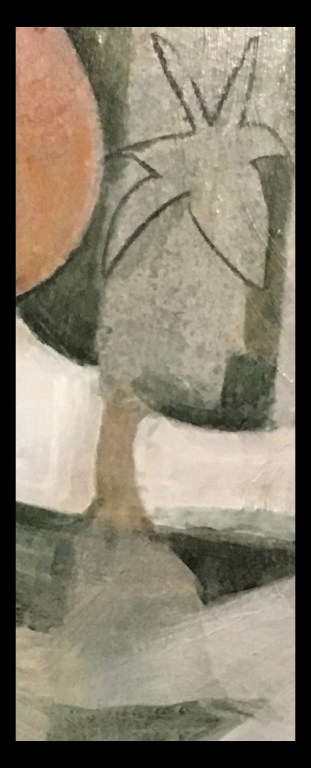
a morsel of Tango With Me. Kerri calls this one ‘Palm Trees.’

I’m proud of Skip. He decided that learning to paint with a palette knife was the best way this year to work on his soul. In my eyes, it is a sure path. He sent photos of his first efforts. Luscious in color and texture, they are abstracts. He showed his efforts to his wife and received the single question that no artist can answer yet it is the first question that every viewer-of-art asks: what is it?

It is the assumption of representation. The need for location. The desire to be told what “it” means. No one wants to be wrong or offend so they ask the artist to provide the interpretation – which will rob the viewer of their own experience. It will short-circuit the relationship between viewer and painting. As Joseph Campbell quipped, ” If the artist doesn’t like you, he (or she) will tell you what it means.”

Color, form, composition, and movement. Art. Abstraction. In a world of individualism, abstractions are capable of telling a different story unique to each individual. They refuse to locate you and, instead, ask you to participate. Make meaning. Don’t seek what is expected, bring to the painting what is evoked.

It creates a tension. It calls us to sit in the paradox of our times. Is there one meaning or many? How is it that people so devoted to self-expression believe they can best express their individualism by shopping together at The Gap?

At the center of potent art, at the bottom of great learning, is the same question: what is it to you?


TangoWithMe-Final copy

Tango With Me, mixed media, 39 x 52IN


read Kerri’s blog post about PALM TREES


cheers! shopping in chicago website box copy

tango with me/palm tree ©️ 2018 david robinson & kerri sherwood