Wink With Piet [on Not So Flawed Wednesday]

My first thought was of Piet Mondrian. Not the colorful compositions but a never-before-seen shadow side. Abstract reduction into simple geometry. An artistic vocabulary concerned with spirituality and universal values. I used to ponder how a utopian pursuit of the spiritual landed on clean hard geometry; bold primary colors set inside hard black lines. I’m certain that, given a similar pursuit, my visual vocabulary would have been softer. Ethereal.

It was the first snow. I looked down at the aging planks of the bench. A criss-cross-apple-sauce of workmanship dusted with white. We’ve never painted the loveseat. After so many years, so many winters and summers, rain and snow and sun, the grain of the wood is alive with texture. An aged face.

One of my favorite rituals of spring is the first sitting. After another freezing winter, another year of age, will the wood continue to hold my weight, our weight? We hold hands and sit slowly, gingerly. Our knees creak before our weight finds the planks. Like a baton pass, the wood takes on the groaning as our knees pass our load to the seat. We sit for a moment with eyes open wide. And then, after a slight bounce-test, we relax. The wood will hold. Our loveseat is like a faithful friend.

The snow melted as fast as it arrived. That is the way of first snow. Blink and you’ll miss it. Except for the love seat and matching chair, we hauled all the other summer furniture into the garage. The table and umbrella. The small ladders that serve as end tables. The fire pit. The first dusting of snow is the cue. The pond freezes so we pull the pump and fountain. Soon, we’ll stack the plastic Adirondack chairs and they’ll take the last available spot in our tiny garage. We push the loveseat to the wall beneath the kitchen window.

We stand on the deck and sigh, feeling the weight of coming winter. The dark days. For a moment, the yard seems bleak. But then, the birds land on the wire. The squirrel highway is open for business. We hear the ancient croak of the cranes in the distance. A cold gust brings a blizzard of falling leaves. A wholly different kind of abundance. The energy moves underground. A time for sleeping and quiet rejuvenation.

Simple geometry. Reduction to cold days and hard lines. Brilliant blue sky. A wink from Piet Mondrian.

read Kerri’s blogpost about THE DECK

Call Attention [on Two Artists Tuesday]

I spent the past two years working with engineers. I was constantly amazed at what they could not see and what I could not see. They were blind to what was apparent to me and I was equally blind to what was obvious to them. It’s what made us a good team. Once, Scott sent a spreadsheet and I stared at it like it was an alien. And it was. Numbers in columns and rows become visual statements for me. I lose the data in the pattern. The information melts into a design on the page. It was beautiful and incomprehensible to me. I had to ask, “What does this mean?”

Yesterday, Kerri and I took a long hike on a trail that we hadn’t walked for a few years. It was a beautiful day. I was overcome with appreciation. I recognized that we do not walk like other people. We stop often to look. Kerri takes photographs of detail. She sees the smallest of miracles and, rather than walk-on-by, she stops. She engages. She calls my attention to it. While she snaps pictures, I close my eyes. I feel the air. I hear the cranes and geese flying overhead. I call her attention to it.

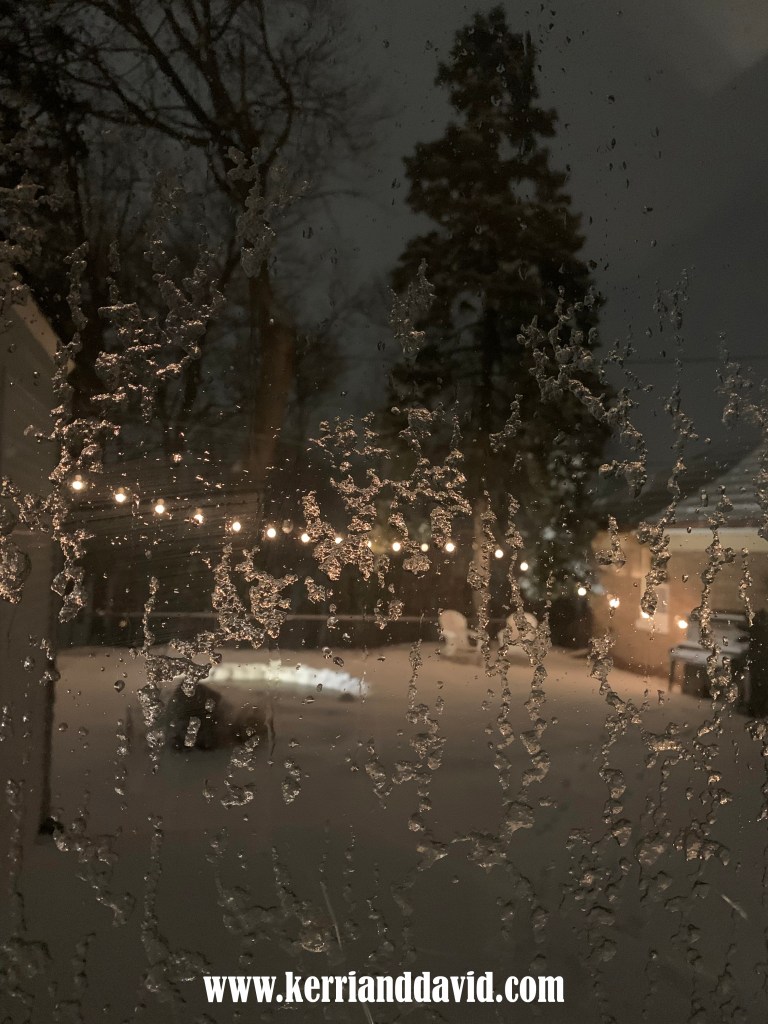
The crystals on the window stopped me in my tracks. Standing in the door of my office, I looked across the hall through a room and to the window. The ice-branches sparkled in the morning light. They were like a magic kelp forest frozen in time. I called to Kerri and she came running, camera in hand.

I cherished the moment, not because it was unusual, but because it is our ordinary. What happens on the trail also happens in our home. We are not in a rush to get “there.” We stop often to look. We call attention to what we see.

read Kerri’s blogpost about CRYSTALS

See Your Choices [on Merely A Thought Monday]

He began with silence. He looked them all over, one fox at a time, and his eyes looked deep into theirs. Lucy wanted to hide when his eyes came to her but instead she fell into his gaze. He seemed to be listening. Then, he made up his mind, and in a voice that was both powerful and quiet, he said, “Words are strong magic, misused they are tragic, but handled with care they bring insight and good cheer. So listen, dear friends, listen with care.” ~ Lucy & The Waterfox

“Choice” is a very powerful word. Perhaps one of the most powerful.

Lucy was a story I told many years ago at a conference of healthcare workers. Actually, it wasn’t the primary story; it was an addition. The organizers asked if I had a second story in my bag o’ tricks and I’d just written Lucy.

After the conference I illustrated and self-published it. It was the early days of self-publishing so the layout is wonky. I’ve never really liked how the book looks. I’d turn Kerri loose on it if we were bored and didn’t have other things to do. We’re not bored.

Lucy makes two choices in the story. The first is to hide her special talent. To conform. The second is to own her special talent. To take flight.

She achieves both choices through the intervention of others. The first choice was made with the help of social pressure; who doesn’t want to belong, to fit in! To conform. This choice nearly kills her. The second is made with the help of a storyteller, a role model. Who doesn’t want to fulfill their passion! Follow their bliss? This choice fills her with life.

I’d write a sequel but it’s already imbedded in the first book. What happens to Lucy when she chooses the left hand path? She becomes, as all artists do, the carrier of the story, the mythologist and mythology of the pack.

Sometimes it doesn’t feel like a choice. To hide your fire. Bend to pressure. To burn brightly. Follow an inner imperative. Yet they are choices, both.

“Lucy was a red fox who lived as other red foxes do, playing in the fields and forests. But Lucy had a secret. She could fly. Not a run-and-jump-to-this-rock kind of fly. No! She could fly like a bird…”

read Kerri’s blogpost about CHOICE

Lucy & The Waterfox © 2004 david robinson

See Beyond [on DR Thursday]

I am amazed by nature. We learned in our visit to the botanical gardens that plants in tropical climates are a study in waterproofing. Waxy leaves prevent excess water from accumulating. Holes allow water and sunlight to pass through. It’s a masterclass in protection from algae. Adaptation, not resistance. Working with rather than fighting against.

My adult life has been a meditation on whole systems – which is quite simply a study of perception. It takes a human mind to separate the leaf from the branch from the trunk from the root. Separation and categorization is how we make sense of things. Analysis requires breaking-it-down. It’s easy to forget that those distinctions are in our minds and not in the world we observe. There is no separation of leaf from rain, not really. There is movement. Concert. Equilibrium.

Understanding requires reassembly.

To live creatively is to discover rather than invent. Thank goodness for the scientists teasing apart, deconstructing, uncovering, analyzing. I would not be alive today without their passionate pursuit.

And, while the scientist dissects, the artist reassembles. The reach for wholeness, the pull toward universal experience that cuts across division…I thank goodness each day for eyes that see beyond the separations, the capacity for utter delight and awe – standing in a garden – staring at a leaf made colander over eons of time.

read Kerri’s blogpost about HOLES IN LEAVES

eve © 2006 david robinson

Imagine The Shadow [on KS Friday]

“I look out the window sometimes to seek the color of the shadows and the different greens in the trees, but when I get ready to paint I just close my eyes and imagine a scene.” ~ Grandma Moses

Among the many reasons I love autumn is the color of the light. Looking out of the kitchen window this morning I was bowled over by plants resplendent in orange and pink. I was so taken by the color that I forgot I was cooking and nearly burned breakfast.

We hiked yesterday. The trail was steep and rocky but, thankfully, the trail wound under the canopy of the forest. It was a hot day and the shade made our path bearable. We stopped often to breathe and enjoy the remarkable shadows cast by the trees. The leaves glowed and waved, backlit by the sun.

Imagination. The capacity to make images in the mind. It is the most basic of human capacities. We spend our lives imaging ourselves in tragedy and in triumph. Yearning and fear are both shades of imagination. “What if…?” is a question borne of imagination.

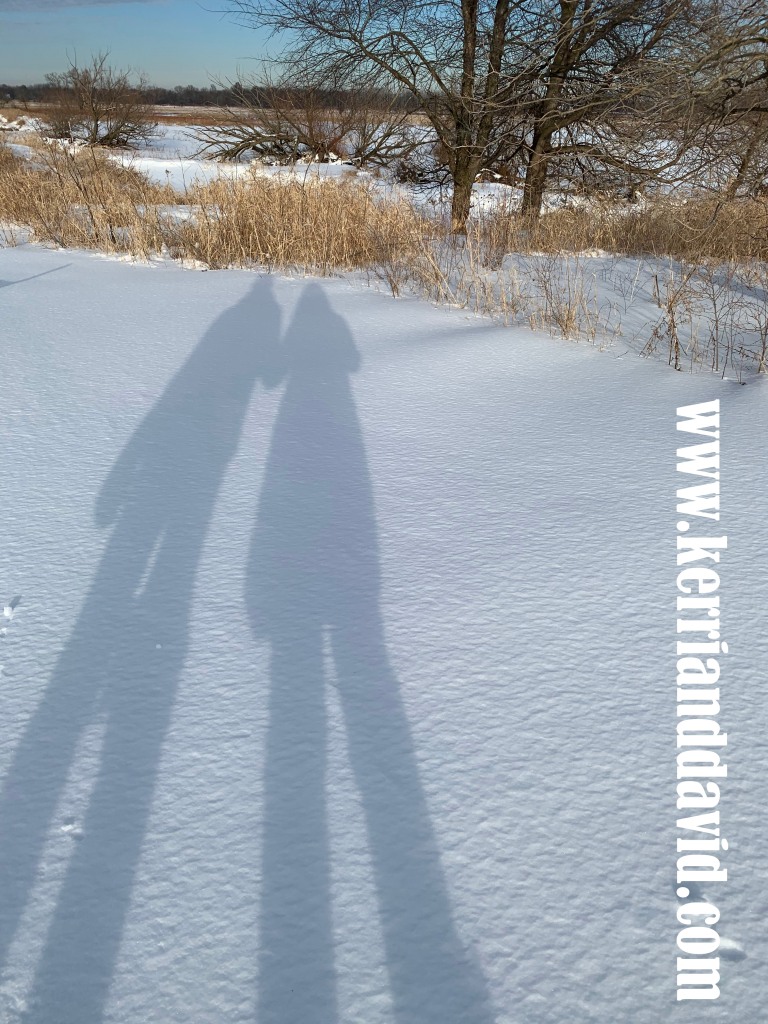
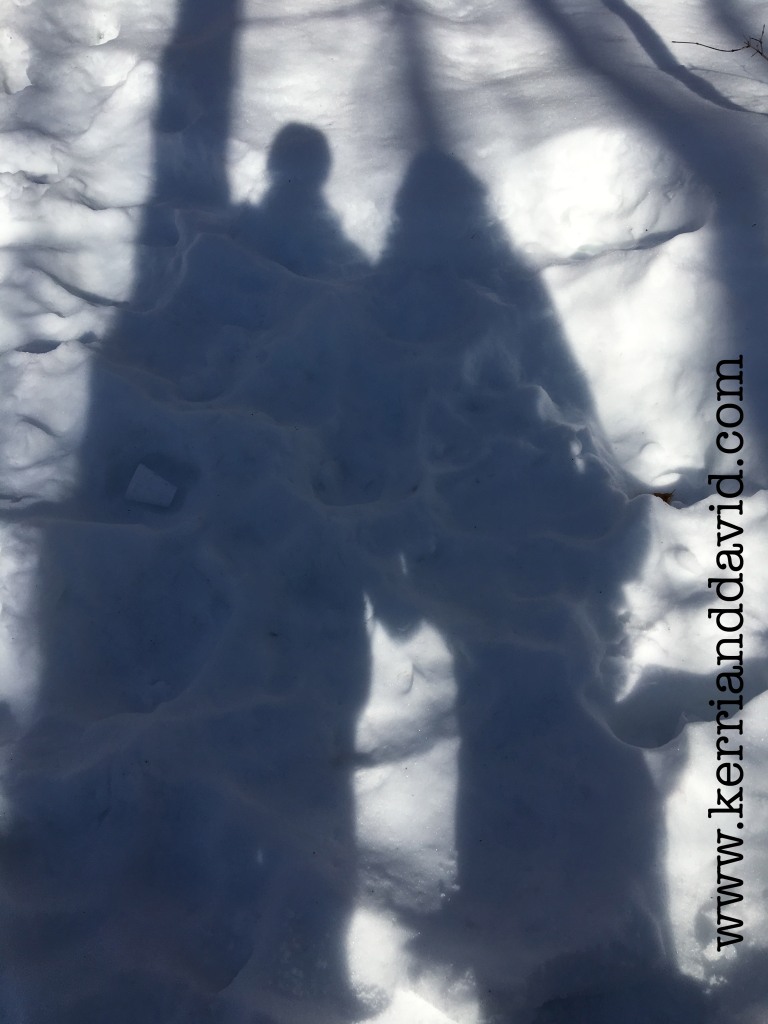
“Wait!” Kerri suddenly instructs, stopping me in my tracks. When the sun is low in the sky and our shadows make us skinny giants, she likes to capture our distortion. Shadows do not resist the curvature of the earth. They do not try-to-be. They simply conform to the circumstance and, inevitably, moving through a festival of color changes, blend into the purple dusk.

While she focuses her camera on our shadow, I appreciate the glow of the negative spaces, the yellow-autumn warmth heightened by our grey-blue silhouette. I giggle imagining we are as skinny-tall as the shadows we cast. “Hold still,” she whispers, not realizing my giggle is making the shot impossible. While stilling my shadow, in my mind, we reach and pluck the reddest of leaves from the tippy top of the maple tree.

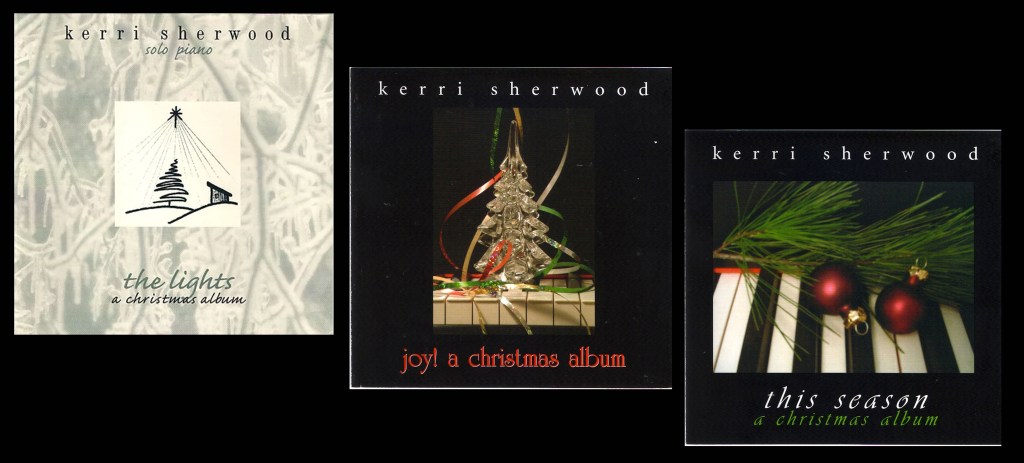
Waiting (from Joy)

Kerri’s albums are available on iTunes or streaming on Pandora

read Kerri’s blogpost about SHADOWS


waiting/joy © 1998 kerri sherwood

Find Your Flower [on Two Artists Tuesday]

“A good traveler has no fixed plans and is not intent on arriving.” ~ Lao Tzu

Lately I am learning that I don’t need to immediately accomplish every task. Our house has been an excellent teacher and I have gained the useful phrase, “delayed maintenance.”

Kerri and I have two different operating styles. Mine is a straight line and hers is a circle. She can start a project and leave it and think nothing about it. On the other hand, if I start a project, I can’t stop thinking about it until it is complete. I am only now learning that I tend toward the obsessive. I have a gift for the myopic.

I thought I was kind of a zen guy, easy going, and am shocked to discover that I can be a hot mess of fixation. Thus is the nature of self-discovery. Life is helping me loosen up.

We sat on the deck last night and talked of our childhood homes. The games we played. I drew pictures on typing paper with a #2 pencil for hours and hours. The world disappeared. I’d wait until the rest of my family was asleep and then I ‘d get up and paint on my wall. I thrived in the quiet of the night. I suppose myopic comes naturally to me. Single focus. Disappearing into my work.

I marvel that butterflies seem like drunken sailors, careening this way and that, yet they always clear the fence. They always alight on the flower of their intention. My career has been like the flight of a butterfly. I dare anyone to make linear sense of my resume. Drunken sailor. Yet, somehow, I clear the fence. I find my flower.

People ask me if I like my job and I tell them I love it. They, of course, want to know why I love it and I tell them that I never know in the morning what I am going to do that day. Each day the work is good. I fall into my myopic ways, sail into my conceptual universe, but have no expectation of completion. It’s like wrestling with a shape-shifter. And, so, to keep in the match, I, too, must shift my shape. I’m honing my inner chameleon.

There is a post-it note on the wall next to my desk. It reads, “Live as if the universe was tipped in your favor.”

Fly like a drunken sailor. Like Dogga, run in circles of delight. Learn to love your myopic ways, yet do as the Balinese taught: know that “it’ll happen when it happens.” What else? Sight – seeing the flower (myopic and otherwise) – is fully available when practiced without expectation.

read Kerri’s blogpost about WHITE MOTHS

See The Pattern [on Two Artists Tuesday]

“To live on a day-to-day basis is insufficient for human beings; we need to transcend, transport, escape; we need meaning, understanding, and explanation; we need to see over-all patterns in our lives.” ~ Oliver Sacks

Entrepreneur Ash Bhoopathy said, “The more you see, the more you see patterns.” It’s true. Take some time and sit on a busy street corner and watch. If your eyes are open, you’ll notice that you are surrounded by patterns. Not only the bricks in the buildings but the patterns of travel. The space between a red light and green light. The beeping of the crosswalk. The suits and ties. The paths walked by busy commuters.

“Comfort” and “home” are defined by patterns. What do you do to get comfortable? How do you signal the end your busy workday? Is it the same as you did yesterday?

Expectations are patterns, too.

Study “story” long enough and you’ll discover, as Kurt Vonnegut did, that there are patterns beneath every plot. We tell ourselves the same storyline over and over. Hallmark has its story pattern defined to the minute. It’s the secret to their appeal: the comfort of knowing the pattern. The comfort of asking, not “What” will happen, but “How” will it happen.

It’s a great paradox. The more you see, the more you see pattern. Yes. Yet, in order to see, often it’s necessary to disturb your patterns. That’s the beauty of patterns. When you are inside them, living a day of your life, you rarely see your patterns. It’s the reason Julia Cameron built artists dates into her Artist’s Way. Do something different. Break your routine. Challenge your expectation. Get out of your pattern rut. Only then will you be capable of seeing the pattern.

If you desire to change anything about your world, about this world, the change you seek will ultimately be a change in pattern. It’s a good practice to begin seeing them.

read Kerri’s blogpost about PATTERN

[the pattern image is the mat at our backdoor]

Protect The Heartwood [on DR Thursday]

Conk!

No, that is not cartoon-speak for being hit on the noggin. It’s a formal name, the body-shape of the shelf-fungi that grows on local trees. Not having grown up here, the first time I saw them, I thought they were aliens. Trees with tongues. A Little Shop of Horrors; Audrey II. Get too close and tree-Audrey would feed on me. Conk! Chomp! (burp).

Polypores. Now, there’s a word that rolls trippingly off the tongue – and is made more fun because polypores actually look like a tongue. Shelf-fungi (a polypore) is not a good thing if you are a tree. In fact, it has no interest in feeding on me but consumes the heartwood of its host.

Heartwood.

I’m not kidding when I admit that, in passing this shelf-fungi, I imagined the conks to be visible stories. Each conk represented a story of insecurity or fear. The stories that feed on our heartwood. What would we look like if our conk-stories where visible on our trunks?

If the rot-story was visible, what might we do to tell a self-tale intended to protect our heartwood and eliminate the conks? How might we help our children tell life stories of self-love, knowing they’d wear their conk-stories? How might we address our neighbors? What would we do to protect the heartwood of the forest from wearing rot-stories?

I think I’ll stop there. Conk!

read Kerri’s blogpost about SHELF FUNGI

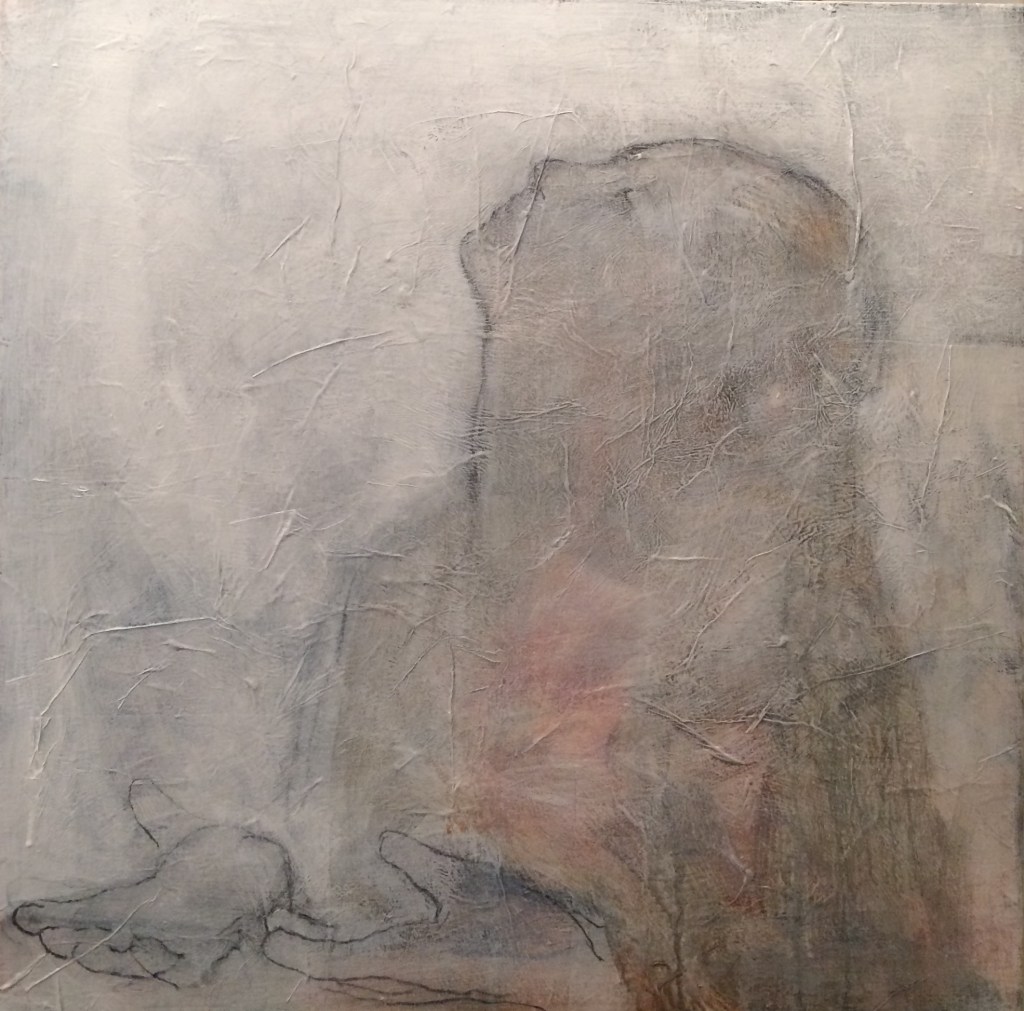
shared fatherhood © 2018 david robinson

Discern [on Not So Flawed Wednesday]

It’s a little over two miles to Steve’s garage. When we drop the car for a repair, especially in the early morning, we like to walk home. The route takes us by the lake. We take our time, more stroll than stride, and breathe in the early morning quiet.

We are dedicated walkers. We’ve become dedicated seekers and creators of quiet. It’s as if we are counterbalancing the crazy-noise-of-the-news with a stalwart sanctuary that we take with us wherever we go. We walk slow enough to notice. We walk slow enough to appreciate.

There is, of course, a direct correlation between pace-of-movement and paying attention. It’s hard to smell the roses when racing through the day. Lately, much of my work-in-the-world involves addressing information overload. The pace-of-movement need not be physical, it also applies to the river of information rushing across our screens. It’s no wonder we’re angry and anxious and aggressive. I’ve adopted a phrase from my colleague, Greg; he calls the info-torrent More/Faster. We live in the age of info-gluttony and have difficulty discerning between what has nutritional value and what is dross.

Until we slow down. There is a correlation between the pace of movement and peace-of-mind. There is a correlation between pace and the capacity to determine relevance.

It’s why we walk to or from Steve’s Garage. It’s why we end the work day holding hands and walking the neighborhood. It’s why we begin each day sitting side-by-side writing. To slow it down. To discern relevance in a fast moving info-river of dedicated draff. To see what matters in a More/Faster world racing too fast to see anything at all.

We smell flowers. Feel the dew on leaves. Turn our faces to the sun as it reaches through the morning clouds. Real stuff. Stuff of the moment. The small discoveries available when racing to the next thing is the last thing you want to do.

read Kerri’s blogpost about MORNING SKY

Make [on Two Artists Tuesday]

“The origami crane has become a symbol of peace.”

Fold 1,000 cranes and your heart’s desire will come true. Legend will have it so. In Japan, the crane is a symbol of good luck and long life.

Making something into something else. Folding paper into cranes. It is, perhaps, the quality that defines us, makes us human. We turn the flow of water into the force driving the mill. We study patterns in stars and translate it into navigation. We smelt ore and hammer the elements again at the forge to make iron. We use the iron to make trains.

We make.

We look at flowers and see cranes. We look at clouds and see wild horses. We look at blank canvas and see possibility.

We make stories.

Our storymaking cuts both ways. We look at others and see friends; we look at others and see enemies. Either way, our looking is not passive. We make stories. We make connections. We make divisions.

We make wishes. Fold 1,000 cranes and your heart’s desire will come true.

Reach your hand to help. Slap a hand away. Either way, it depends on what story you see. What you want to make.

The story we create.

Folded paper. A symbol of peace.

read Kerri’s blogpost about CRANES