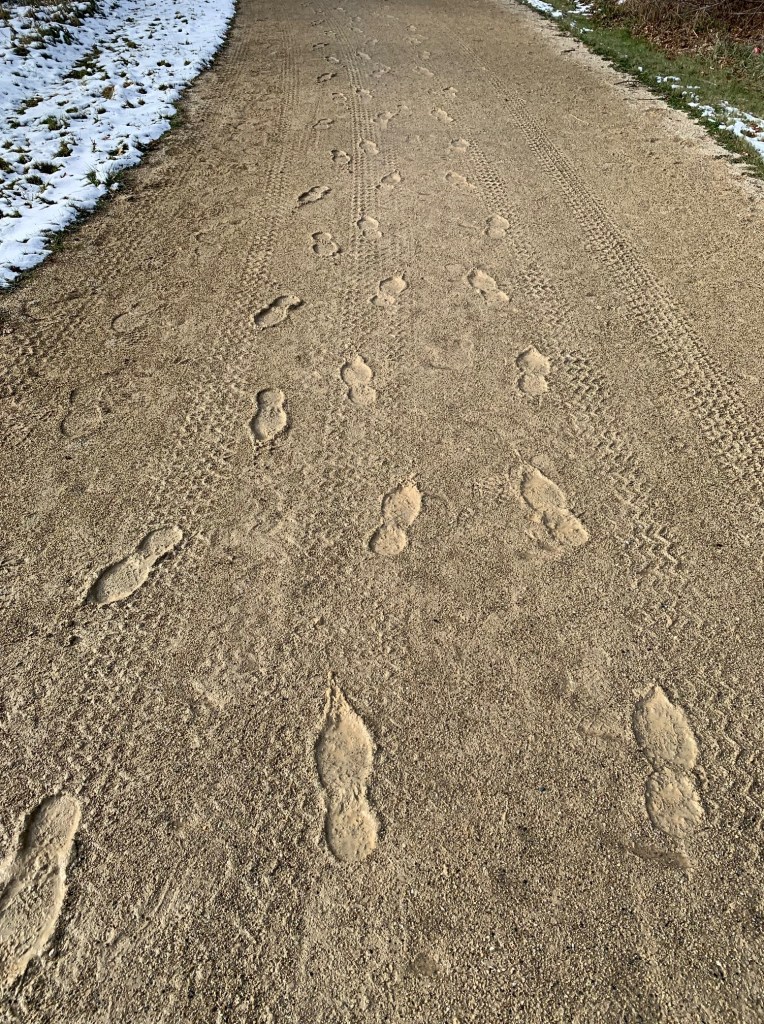
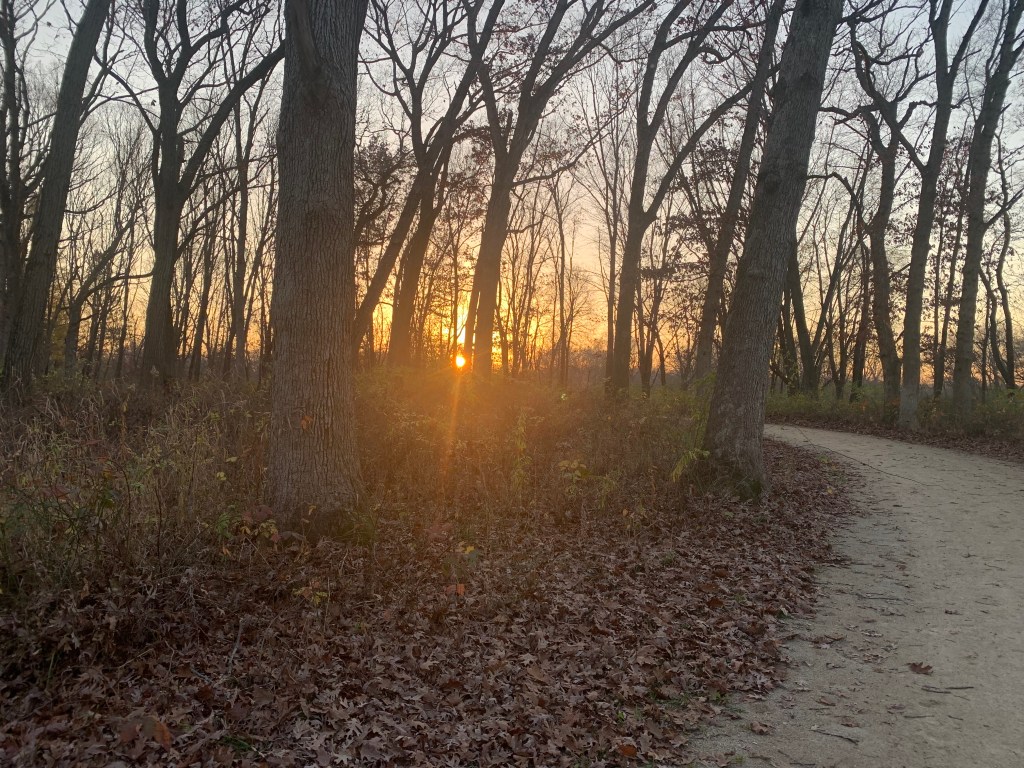
Take The First Step [on Two Artists Tuesday]

“That is what marks out the warrior: the knowledge that willpower and courage are not the same thing. Courage can attract fear and adulation, but willpower requires patience and commitment.” ~ Paulo Coelho, Aleph

And so begins my tale of two quotes.

It’s true, I have not been very courageous in this lifetime. I’ve run from most of my demons until circumstance or readiness required me to turn and face them. Left to my own devices I’d be running still.

“I learned long ago that in order to heal my wounds I must have the courage to face up to them.” ~ Paulo Coehlo, Aleph

Luckily, life ran me into a dead-end. It was not courage but conditions that stopped the run and necessitated the turn. Demons are never as big as fear makes them out to be. In fact, turn and face them, and they will often shrink to nothingness. Their job is to make you run.

The real work happens after the demons shrink. Standing in your dead-end, the race from your life now complete, an obvious and disconcerting question arises: now what? Actually, there’s a deeper question implied: in the absence of running away, what will you choose to walk toward?

The deeper question is one of willpower. The deeper question cannot be answered by anyone else and can only be found in the space once occupied by the demon. Facing the demon was merely a prerequisite. Standing still in your dead-end, reaction transforms to intention.

Breathless and vulnerable, it is willpower (perhaps a kind of courage?) that is needed to take that first timid step toward…

read Kerri’s blogpost about THE CANOPY

Live The Words [on Merely A Thought Monday]

We awake each morning to birdsong. I imagine the birds’ song raises the spirit of the sun. Or, the birds sing because the sun raises their spirits. Both are good stories.

When I was in college I had a professor who seemed a bit radical. Now I recognize that he was not radical. He was a scientist and his data was prophetic. He was sounding an alarm for his students, knowing that his students could not yet hear him. He was the first person to introduce me to the notion of climate change. At the time, the world was still smarting from the oil crisis of the 1970’s. One day in class he said, ‘If you think the oil wars are bad, just wait until the water wars.” I heard his voice this morning while looking at photographs of Lake Mead and the river Po. Dwindling water meets rising population. Panic is in the air. In the meantime, Australia is drowning. Desperation is on the rise.

I like to imagine the birds raising the sun while the sun raises the song in the birds. It’s a story of interconnectivity. It’s to understand the question, ‘what causes what?’ – as a two way street. You impact your environment and your environment impacts you. Or, better stated, you and your environment are not separate events. (“The love you take is equal to the love you make.” ~ The Beatles)

Though he never used the word, “interconnectivity” was the construct my seeming-radical professor was asking us to consider. He understood that his students were products of a long tradition of disconnection. A dedicated delusion of dominance over nature ruled our construct and he was attempting to puncture that absurdity bubble. Pour toxins into your river and your water will poison you. Pour carbon into your air and your air will eventually pour carbon into you.

The same applies to governance and society in general. What we pour into it is what we will experience as it. H wrote that, “Politics is simply the exercise of being a good neighbor for the sake of the neighborhood.” Interconnectivity. For the sake of the neighborhood. Demonize your neighbor and they will, in turn, demonize you. Refuse to listen to your neighbors and they will refuse to listen to you. Pour guns into your community and your community will inevitably aim its guns at you. Lie to gain power and the lie will gain power over you.

Pour support, service, acceptance, consideration…into your community and it will respond in kind. “Do unto others as you would have them do unto you,” is not so complicated a concept when seen through the lens of interconnectivity. Kindness begets kindness. Acceptance begets acceptance. Honesty begets honesty. Intend it. Practice it.

These are easy words to say. Living the words is quite another story. Unless you happen to be a bird, singing the sun awake as the sun pours its rejuvenating warmth over your song.

read Kerri’s blogpost about THIS DAY AND AGE

Be A Zebra [on KS Friday]

The Post-It note beside my desk reads “Zebra.” It is a reminder to be more like the zebra. After a near miss with a lion, the zebra does not return to the herd and perpetuate their stress by recounting the story over and over to any other zebra that will listen. The zebra shakes off the adrenaline rush and moves on. No extra stress necessary.

For many years I’ve known that most actions are relatively easy to perform, the stress we experience comes from the story we wrap around the action. There’s a full range of stress stories, from “I can’t do it” to “I have to be…” The it-has-to-be-done-now story is pervasive. At some point in my youth I got it into my human head that faster was better. It’s not a good story since it requires the lion to be on your heels all the time. Watch people sitting in a traffic jam: the story of stuckness has otherwise rational people red-faced and pounding on their steering wheels. The I-have-to-be-there-now story is a recipe for never being present. Running, running, running. Lion on your tail.

Zebra.

When I moved in Kerri cautioned me that the to-do list would never be done. We live in an old house and, like an old body, extra care and patience is required. It’s been quite a transition. This house has become my teacher. It’s in my nature to get-things-done. True confession: If I start a project, I become myopic until it’s finished. All my life, after starting a painting, I lay awake at night rolling the possibilities over and over in my mind until the final brush stroke hits the canvas.

This old house has taught me to let go of my story of need-to-finish. It’s softened the edges of my Puritan work ethic. I’ve grown to appreciate having to tighten the handle on the backdoor once a week. Some day we’ll get to putting knobs on the kitchen cabinets. I’ve come to appreciate jiggling the burner to make the stove work. Our monthly puddle-prevention-thaw of the freezer is part of the rhythm of our lives.

Zebra. No resistance. It’ll get done when it gets done.

Life is infinitely better without an imaginary lion on my heels. It makes me wonder why I spent so much of my life creating stress for myself. I’ll save my stress for the real lions and you can bet when one of those appear, I’ll tell you about it. Again and again. I’m a human after all. Half the fun of being human is telling the tale so I want to make certain my tale, if I’m going to perpetuate my stress, has bonafide lions snapping at my hooves.

Kerri’s albums are available on iTunes & streaming on Pandora

read Kerri’s blogpost about THE REFRIGERATOR

i didn’t know/this part of the journey © 1998 kerri sherwood

Consider The Symbol [on DR Thursday]

Because it is outside, she grabs her camera. Were it inside, I’d hear the special scream saved for spiders and I’d come running. The power of a screen, flipping fear to fascination. “It’s amazing,” she said and cringed.

Spider symbolism – like all vital symbols – carries the power of a complex split-metaphor. On one side of the screen they are toxic, malicious, potential bringers of slow venomous death. On the other side of the symbol, they are world creators, weavers of life and interconnectivity. Certainly, they are central characters in this world-wide-web that we enjoy.

In this era, we attempt to restrict our symbols, preferring them to be absolute, one-sided, either this or that. Symbols never work that way. They lose their power when cut in half. To be potent, a symbol must embody both sides of the moon. Limiting a symbol to only one side flattens it, robs it of dimension, renders it useless. The real power of the symbol ignites when both aspects are understood and embraced. Symbols are polarities.

We would be wise, in our nation, to look at both sides of our symbols. Our history, embodied in our symbols, is both shining and dark. Vapid fear-stories like “replacement theory” fester in a flattened symbol culture, a half-told history. Ugly nationalism grows in the spaces left empty by a cleaved symbolism, a highly-edited narrative.

Gaze through the screen at both sides of the symbol, and a fuller, richer, more color-full story emerges. An honest narrative.

Nations, like people, become healthy when they embrace all sides of their story, the dark side and the light, when they acknowledge both aspects of their symbol, when they take responsibility for their actions, the venomous and the virtuous alike.

read Kerri’s blogpost about THE SPIDER.

Prometheus Resurrection © 2008 David Robinson

Sing The Song Of Simple Lessons [on Not So Flawed Wednesday]

This is a song about the simple lessons. The amusing and eye-opening answer to “because we’ve always done it this way.”

As a budding young artist I was frustrated because my charcoal lines were not as alive or fluid as the masters I so admired. I wrestled and strained and struggled to achieve “alive” lines, doubling down on my technique, my personal bridge to nowhere, as if doing more of the same, rife with inner turmoil and tension, might achieve my aim of ease.

Watching me struggle, amused by my absolute dedication to doing the same old thing in the same old way, as if I might accidentally squeeze out a new result, my art teacher, a wisened older woman full to the brim with laughter and humility, came to me, took the charcoal from my hand, and showed me how to hold it, not like a pencil, but like a flower. My lines were instantly alive. My teacher laughed at my amazement.

New ways – better ways – are rarely discovered on a tension path. Why is it that we look in the same drawer multiple times when we’ve lost our keys?

We have, for years, made lunches from yummy food wrapped in a corn tortilla. More often than not, our food falls to our shirt, our plates, the floor, because the tortilla splits. “We have to do something different,” Kerri says each day as her tortilla disintegrates. Dogga delights in the mess and recovers the spoils that hit the floor. Day after day, year after year, the tortilla struggle has been a part of our lives.

During a recent visit, Kirsten, watching our struggles, shook her head, sighed and asked, “Why don’t you use two tortillas?” It was a revelation. A simple change that never occurred to us, babies of depression era parents.

“Two tortillas!” Kerri exclaimed. “Yes!”

I nodded with satisfaction. A better life, a cleaner meal, was in reach! Less mess in our future!

Two tortillas. Hold the charcoal like a flower. Revelations born of ease and the obvious answer.

Someday we will learn (or not): No stress necessary. Relax. Insight sings the song of simple lessons.

read Kerri’s blog post about Two Tortillas

Pull In [on DR Thursday]

I suspect the turtle understood the giant blonde woman with the camera aimed at this face as a threat. He did what turtles do when stressed: retreated into his shell. “I’m not going to hurt you little guy!” Kerri said, on her knees, snapping pictures. The turtle was, at best, dubious of her reassurances.

We were considering going to an outdoor concert until we saw photos of large crowds of people packed together. Covid has made us crowd averse. “I’m not sure I’m ready for that,” we chirped together and laughed at our stereo response. “I wonder if I will ever be ready for that,” Kerri mused.

At this moment I know more people with Covid than I have personally known throughout the entire span of the pandemic. I suppose this virus that rolls on and on, shapeshifting as it goes, would exhaust our guard sooner or later. I am guilty of thinking, “What’s the point?” as I don my mask to enter a store. Yet, every day this week, a new name or group of names has joined my roster of friends-with-Covid. So, I put on my mask. I pull my head into my protective shell.

There are real threats and there are nice ladies with cameras that only seem dangerous. “May you live in interesting times.” We do. A pandemic. Global warming has arrived. Nationalist madness on the rise. We cannot send our children safely to school – or shop at the grocery store – or attend a concert – without the thought of gun violence. We are awash in real threats and, like countless societies before us, we seem dedicated to our own demise. Madmen and women are at the wheel and we are in the backseat whispering, “Slow down,” looking at each other with, “Do Something!” in our eyes.

When Kerri showed me the photo of the turtle I was struck by the calm on its face. I recognize that turtles probably don’t have the facial muscles to fully express their fear but nevertheless I was delighted by the notion that the turtle-in-retreat was calm. Nothing to be done but pull into the shell and wait it out. No reason to panic.

We’ve discussed being more turtle-like in our lives. We live in Interesting times and there’s not a thing to do about it, other than perhaps write. Make art. Change a few behaviors. We need not wrinkle our brows or cry out in fear while pulling our heads into our shells. The sunrise is still as beautiful, we hold hands when we walk, make dinner together, love on Dogga at night. There’s lots of love inside our shell, no matter the surrounding madness, a quiet center in the storm.

read Kerri’s blogpost about THE TURTLE

shared fatherhood © 2018 david robinson

Add To The Story [on Not So Flawed Wednesday]

Our water theme continues though, instead of pipes breaking, surprise waterfalls in the basement, or spontaneous fountains in the front yard, we’re dancing on the other side of the theme. What was broken or compromised is slowly, as we can afford it, being fixed or replaced. And, as metaphors go, I welcome what this implies.

It is our very own kintsugi. Golden repair – or in our case – copper repair.

“…treating breakage and repair as part of the history…rather than something to disguise.” We’ve consciously created our home to be a keeper of stories: the driftwood that adorns our mantel, the rock cairns stacked by the plants, the chairs in our sunroom… all tell a story. A walk on a special beach. A mountain top. The day the car broke down in Minnesota. Adventure. Routine. Accident. Surprise.

We have a series of old suitcases stacked in our dining room. They are our “special boxes.” Each is filled with momentos of our life together. Concert ticket stubs, birthday cards, notes, old calendars, the bits chain from Pa’s workbench that we once wore as bracelets… Our story fodder. Connective tissue to our shared history.

The copper that Mike-the-plumber has installed in key locations around the house serve as connective tissue to the era of water. Our house is a special box, too. It’s nearly 100 years old so we are a chapter in its story, stewards merely. The copper repair is a visual keepsake, a golden repair from a time when the old pipes and fittings, having done good work, let us know with no uncertainty that they were retiring.

We love this house. We love being stewards to its story. We love that it is the keeper of our story. And, lately, we especially love being on this side of the water era, putting all the pieces back together again, adding to our entwined history, with undisguised copper-gold.

read Kerri’s blogpost about COPPER PIPES

Look Up. Look Higher. [on Merely A Thought Monday]

“And men are so poor in intellect that a few cold chills down their spine will be enough to keep them from ever finding out the truth about anything.” ~ Thomas Merton, The Seven Storey Mountain

This will read like a blazing generality and I do not intend it to be so. Some of the best people I have known are readers of the book(s). They learned along the line to read their book(s) as metaphor instead of literally, as a history. There are, after all, many paths up the same mountain.

As for me, I was cured of religion when I was a boy but it’s taken a lifetime to understand what and why – and to find language to express what should (to me) be obvious to all.

It only takes a moment to lift your eyes from the book and look up – all the way up to the sky. The book is a human invention, as are the gods and the stories of the gods told in them. The sky, on the other hand, complete with stars and suns and universes beyond imagining, are not human inventions. The book lives in the human mind. That which the book is meant to illuminate is…wholeness…all around us. We are part of, not separate from. That’s it. It’s that simple. The game of separation and unity.

We are part of, not separate from. This word “Love” is unity, the absence of made-up-separations.

The book will have you believing that your body and its myriad of impulses are, like nature, in need of taming. Separation from yourself. The book will promote the notion of a chosen few, the singular path, a destiny that is manifest. Separation from other. Elevation for team-white. Moral authority for team-straight. It’s probably good to feel above others and certainly feels powerful to believe yourself keeper of the book’s rules. Isn’t it blatantly obvious that the rules were/are made by men to justify, as-the-voice-of-god, all manner of privilege and cruelty? Separation, separation, separation.

Here’s what I understood as a boy: any god that promotes separation in any form is very small, indeed, and probably not worth worshipping. At the very least it is a man-made god meant to make folks feel better about their obvious impermanence in an infinite universe.

There’s so much in this life worthy of our worship.

Whether or not we walk as one or decide to beat the hell out of each other for the color of our skin or the natural orientation of our sexuality has nothing to do with the vast universe outside of the book. We create the separations to justify our fear or to protect our property.

We are completely capable of love. We are completely capable of reaching across the unknown and living our short time on this earth in full support of the rich myriad of wonder and diversity expressed through us in this infinite possibility called life.

The book is an abstraction. The person standing before you is not.

Love is love. Love is not separation or division or privilege or a skin color or gender or sexual orientation. Love has nothing to do with how much money you have or do not have. Separations are the province of small people inventing small gods for very small reasons – so they can feel good about being separate and small.

Love is love.

read Kerri’s blogpost about PRIDE

Ask A Peony Question [on KS Friday]

The peony in our yard is sandwiched between tall grasses. We’re careful to cut back the grasses so the peony has space and air to breathe. Kerri watches it. She checks on it daily. She calls me to “Comesee!” when the buds appear. She pulls my arm, “It’s happening!” on the day the buds open into full bloom. In our house peony-bloom is cause for celebration.

The blossoms do not last long, a week, perhaps a few days more if we’re lucky. And then they are gone.

The blooms are passing but the plant is sturdy. Sometimes I feel that the peony is a good artist. It works all year drinking in sun and water and life so it might produce a few moments of lovely. Every single day, through the dog days of August, the harsh cold of winter, the wet and muddy spring, is necessary for the peony to bring its fragile and passing burst of pink beauty – its expression – into plain sight.

Late at night, the tornado sirens sent us to the basement. We sat in rocking chairs and listened to the roar of the storm, the flash and house-rattling thunder. I looked at my easel. Currently, my studio is filled with boxes. Kerri eyes her studio; it’s next up for a good cleaning-out. Revamp and refresh.

In the basement, sirens blaring and storms howling, we talked about whether or not she would ever play again. Whether or not I would ever again pick up a brush. It’s an open question. It’s a deep-in-the-night question.

It’s a peony question. I wonder if, in the dead of winter, roots reaching deeper than the frozen ground, if the peony knows that it will, with certainty, bloom?

In A Split Second from As Sure As The Sun

Kerri’s albums are available on iTunes and streaming on Pandora

read Kerri’s blogpost about THE PEONY

in a split second/as sure as the sun © 2002 kerri sherwood

Embody The Symbol [on DR Thursday]

Everything in the Japanese Garden is symbolic, intentional. Pine trees represent longevity. Rocks, I’ve learned, represent the bones of the earth. They are as necessary in the design as are the “ephemeral blooms of the iris, rhododendron, and plum.” The symbol is not complete without both.

“The ephemeral existence of human life and the timelessness of nature.” Balance.

Entering the small yard of the Shoin House at the Chicago Botanical Garden is instantly calming for me. The small house is designed to “merge the outdoors with the indoors.” It is closed to the public but always beckons. I want to sit in the alcoves and write. Or do nothing at all. In the garden, I am instantly “connected.”

“Connectivity” is a word that has moved to the center of the work that I am currently doing. Amidst our ubiquitous capacity to share (Facebook, Instagram, Tiktok…email, chat, tweet, slack, text…) we are less and less connected. As Neil Postman wrote, we have made the irrelevant relevant and the relevant irrelevant. We share but do not connect. Shared information is not – and never will be – shared meaning.

Symbols empty of meaning when a community ceases to understand, honor, tend or acknowledge the significance of the symbol. And, symbols are the glue of a community. They are the physical, tangible location of an ideal. Disconnect from the symbol and the house falls apart.

I think that is why I am drawn to the Japanese Garden. There, beauty is intentional. The symbols are so well tended, so intentional, that one need not know the specific meanings to enter the symbol.

And, that’s the point. Connectivity happens when people, together, embody their symbols. They enter them. They become embodiments of their symbol(s).

It is the artist’s job to bring people into a shared moment. To give them access to a unified experience. To help them transcend the splinter symbols that divide – and see them for what they are. To help people step back and take a good look at what they, together, are creating. A garden? A desert? Balance? Imbalance?

read Kerri’s blogpost about THE ROCKWAY

prayer of opposites © 2006 david robinson