Move Your Words

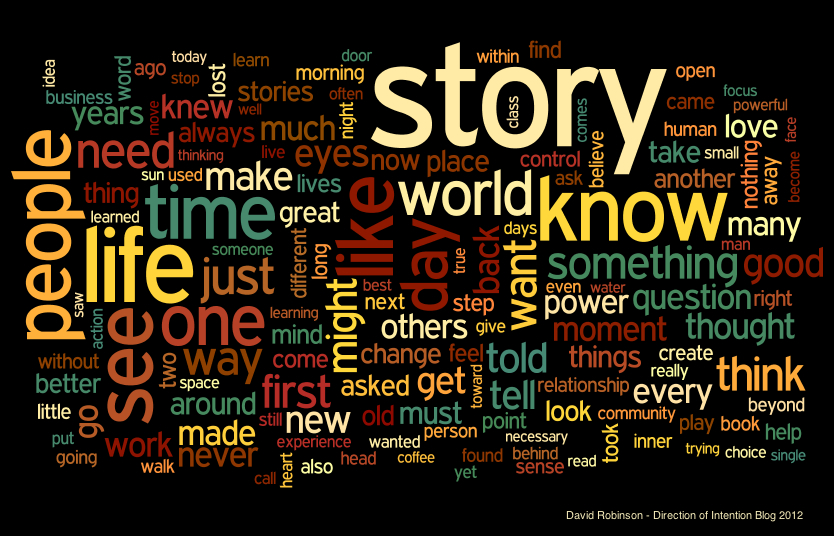
My friend, Mark, made this Wordle of my blog

My friend, Mark, made this Wordle of my blog

I am working with words again today but in another aspect entirely. Now that The Lost Boy has the minimum funding necessary for a production I am working on the play in earnest. Tripper Dog-Dog-Dog cocks his head and wrinkles his brow in wonderment as I talk to myself or dance the words. Sometimes he confuses my work method as an invitation to play and he leaps, catching the cuff of my shirt and pulls me to the ground. “Not now!” I cry out as Dog-Dog stretches my sleeve so that it might fit a giant (a side note: Dog-Dog has altered all of my shirts – he regularly mistakes my work for play. If I do not roll them, my shirt sleeves look as if I am small child wearing an adult extra-large).

I am a kinesthetic learner and realized years ago that working on a script was easier and more productive if I moved or danced the words as I worked with them. To borrow a phrase from a lost friend, my years at school were “fresh hell” because sitting in a desk was painful, it hampered my learning. If I want to have an insight or gain an understanding of something, the best thing for me to do is take a walk. If I move it, I can break down a script in no time. I can memorize anything if I can physicalize the intentions. For me, language, word use, and sense-making are a physical affair.

It is a physical affair for everyone. Try to speak without breathing (an impossibility); breath is movement. Speech is physical. For a real laugh, try to communicate without gesturing. Limit your movements and you will inhibit your capacity to communicate. For more fun, Google the latest statistic about how much of our communication is really non-verbal (we primarily read body language; listening to what is being said is a distant second). The deep mastery of a storyteller is found, not in the words, but the punctuation of a moment: the turn of the head, the intake of breath, the smallest of gesture, the connection made through the eyes; the fire of imagination is fanned when the storyteller, no matter how subtle, dances the story.

Last night I was reminded again of the power of language – the real kinesthetic of it. B is disturbed by the violence and darkness she sees in the world and asked, “How do we push back on it.” I challenged her verb. When we choose our language we also choose a “metaphor path”. Language choices come with images and images are not passive. They define what we see. They define the available options. They are a root for movement. To push back is a verb of resistance. It is counter force, a choice of aggression. “Why push against what you don’t want?” I asked. “Why not put your energy, effort, and imagination into creating what you actually want?”

To push. To create. Which verb will move you?

title_pageGo here to buy hard copies (and Kindle) of my latest book: The Seer: The Mind of the Entrepreneur, Artist, Visionary, Innovator, Seeker, Learner, Leader, Creator,…You.

The PoetFor fine art prints of my paintings, go here.

Follow The Thread

My work in progress.

My work in progress.

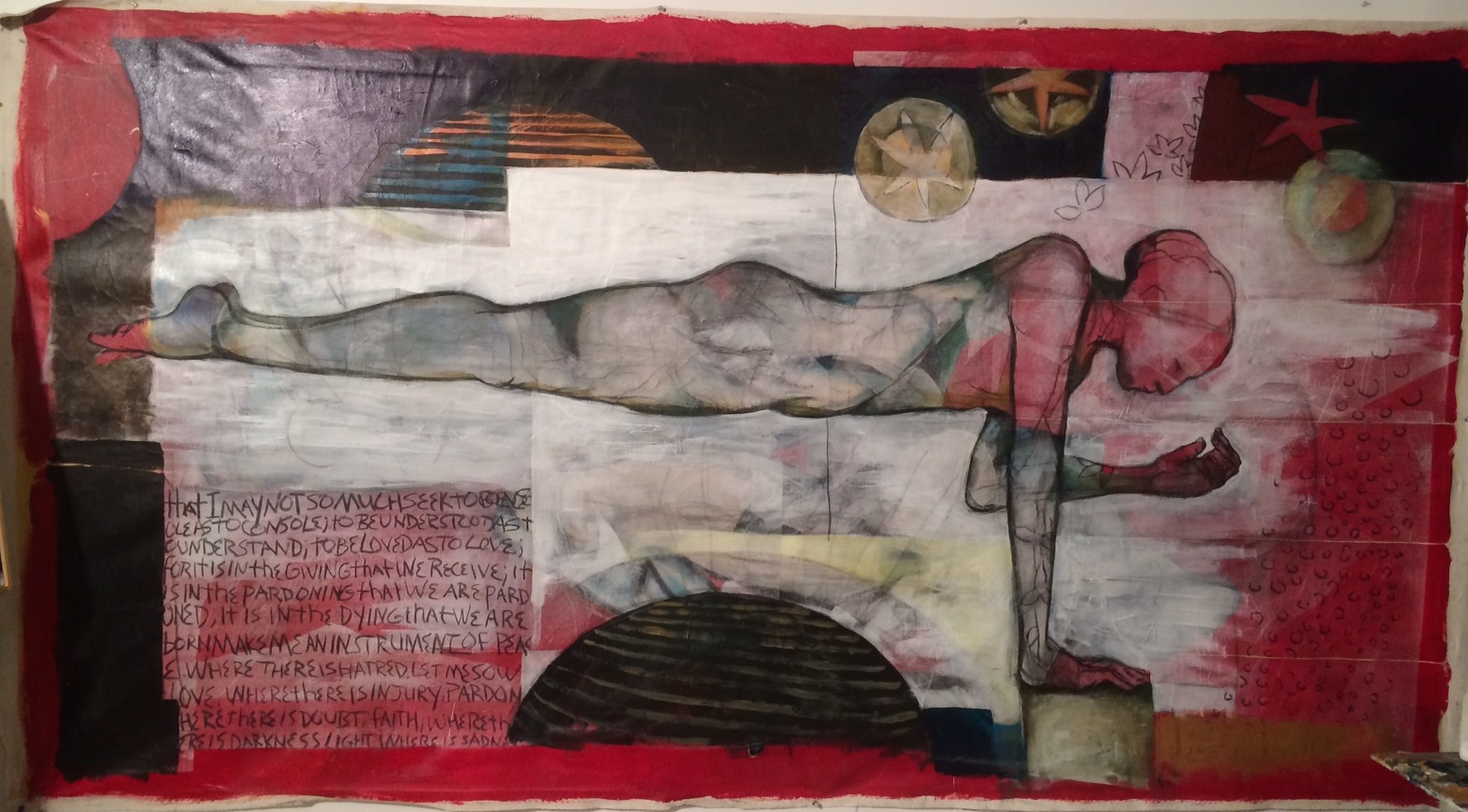
I spent the morning in the studio fanning the flame of a painting I started weeks ago. It’s hard for me to leave a painting once I start it. Once started, there is a thread that I must follow through the maze of developing imagery that will eventually bring me to completion. If I drop the thread, I lose my way. When I find myself thinking too much I know I’ve lost the thread and it is best to do nothing. It is best to sit in the maze and be lost. Moving from the intellect alone will always create mud or worse, it will kill the painting. The thread, to be useful, is intuitive, a guide of feeling. I’ve learned that sitting still is a necessary and useful skill.

To return to the painting requires finding a wholly new thread. It requires sitting with the existing image until the new thread appears. Sometimes the new thread presents itself when I stare at the painting. Sometimes the new thread jumps me in an alley or while having coffee with a friend. That’s what happened with this painting.

The new thread mugged me. I was miles from the studio and heard someone recite a portion of The Prayer of Saint Francis; the painting was suddenly smacking my inner eye. I knew exactly what I needed to do. It felt right. It felt vital. It would not leave me alone – and that’s how I know I’ve found the thread again. The prayer wanted to be in the painting. This thread would not lead to the same outcome. This thread would lead to a completely different painting.

More and more, words are showing up in my paintings. As I walk deeper into specific symbolism, I’m discovering the word as image. Using words as design elements, shaping a word as I shape a drawing, letters as visual symbol (they are symbols referential to sound). These words that do so much to shape our perception and either put locks on our experiences or set us free – they are calling to me as pure visual forms. Letters are simple lines and shapes sequenced and given meaning as words. Just so, words are lovely shapes sequenced and given meaning as sentences. The meaning is not carried in the words (the symbols) but in the reader. The shapes are visual statements before they are infused with symbolic meaning. Open a book written in a language that you do not read and you’ll see what I mean. You can’t make meaning of the symbols but you can appreciate the visual – in fact, once your brain ceases attempting to assign meaning to the symbols you can actually see the pure form (this is a good rule of thumb for cultivating presence, too).

Here’s the prayer in its symbol form for you to interpret and an image of how it currently exists in the painting:

Lord, make me an instrument of Your peace. Where there is hatred, let me sow love; where there is injury, pardon; where there is doubt, faith; where there is despair, hope; where there is darkness, light; where there is sadness, joy.

A detail of the prayer.

A detail of the prayer.

O’ Divine Master, grant that I may not so much seek to be consoled as to console; to be understood as to understand; to be loved as to love. For it is in giving that we receive; it is in pardoning that we are pardoned; it is in dying that we are born again to eternal life.


title_pageGo here to buy hard copies (and Kindle) of my latest book: The Seer: The Mind of the Entrepreneur, Artist, Visionary, Innovator, Seeker, Learner, Leader, Creator,…You.


Possess It

An untitled  watercolor I did years ago

An untitled watercolor I did years ago

Last night P-Tom said, “This is the time of year that everyone is telling us what we need and where we can go to buy it.”

Yesterday I worked on website language. After a year-long hiatus I’m re-visioning what was once a coaching practice. All day I was aware that words like “potential” and “purpose” are abstractions; they are marketing terms. Many years ago, when I was first establishing a coaching practice, I read articles and listened to recordings full of advice about “how to start a coaching business;” the recommendation was unanimous: host free calls, help people see their problem, and end the call. Leave them standing in the mud so they will need you. Create lack (isn’t that a great definition for marketing?).

What does it really mean to fulfill your potential? What does it mean to “find your purpose?” Look to the layer beneath. To fulfill, to find…, these are terms from the canon of outcome and result. No one willingly seeks his or her endpoint. If there is a universal problem it is that we see our existence as something with a bottom line and hire coaches and therapists to help us do the accounting.

(Insert mantra: nothing is broken. You do not need to be fixed).

Good coaches, teachers, mentors, and therapists get you out of the spreadsheet and into the moment. Looking for the fullness of life is usually a process that requires the cessation of looking so we might see what is right in front of us. Stop the search and you will be found. As the old saying goes, life is the thing that is happening while you are running around looking for it.

I’m a world-class note taker and always take notes when I work with people. For me it’s like mapping verbal terrain, capturing inner geography. Lately I’ve been reviewing the maps before I destroy them and I find not seekers of potential and purpose, but people overwhelmed by the experience of 1) feeling lost, 2) feeling that something is missing or they are missing something, 3) feeling that they are pushing on a door that won’t open, or 4) a yearning for a different way of being. These are questions of feeling. These are questions of orientation to life (experiences of life). “Potential” and “purpose” are words of doing. These are questions of being.

What if meaning, value, purpose,… in life was not something found or bought but something that is already possessed?

Go here to buy hard copies (and Kindle) of my latest book: The Seer: The Mind of the Entrepreneur, Artist, Visionary, Innovator, Seeker, Learner, Leader, Creator,…You.


Step Into Your Sanctuary

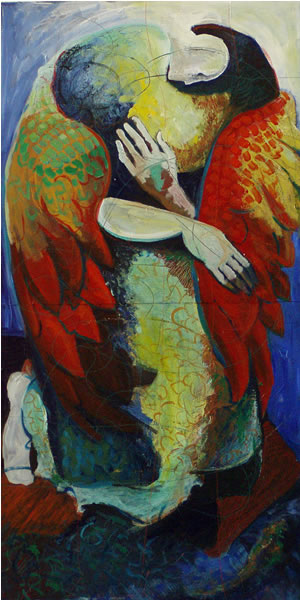
An oldie simply called ANGEL

An oldie simply called ANGEL

It is night and I am hanging out in the sanctuary while Kerri attends a meeting. I never in my life thought I’d hang out in a sanctuary but I quite like it. It is quiet and I am by myself. It is a good place to meditate or just get still. I am sitting with my stain glass window wondering if there is a conversation in the offing. I’ve spent many nights in my life sitting alone in dark empty theatres and always felt the same sense of peace that I feel at this moment.

I like the word “sanctuary.” It implies a safe place, a resting place. If all the world is my studio then it is also my aspiration to live as if all the world is my sanctuary. I’ve always understood my studio to be a holy place, a place of creation and presence. Going to my studio has always been a step into a safe space. It is where I rejuvenate. Tonight, sitting here, it occurs to me that “studio” and “sanctuary” are very similar words. They are very similar places just as “theatre” and “church” have, for me, been mostly interchangeable: where we go to affirm the stories that identify and transform us; where we go to find our community. My sister finds her community in a church. I have, until lately, found mine in the theatre.

This rambling path begs the question, “What is sacred and what is not?” Yesterday Diane told me that she is a spiritual teacher and I believe that is true. This morning while walking I remembered her words and wondered if we are all spiritual teachers to each other. Some of my greatest teachers had no idea that they were teaching me.They had no intention of teaching me. One great teacher was sweeping a floor and had no idea that I was watching him. He was one of the happiest people I have ever seen. He was shining. He was doing a job that most people would deplore. Everyone who saw him smiled, myself included. He was not his job. He was not his body. He was…connected and alive in his moment. He was living in his sanctuary and helped me know that all the world can be a holy place. He helped crack my understanding of what is possible.

These lines we draw between the sacred and profane are mostly imagined. They are convenient and sometimes useful but they are illusions that I am beginning to understand as destructive. Us and them. A divided house begins in a belief of divisions – a need for division. I’ve often told the story of the executive, red in the face, pounding the table with his fist, shouting, “I know how to compartmentalize my reason from my emotions!” I remember thinking, why would any one want to cut off their emotions from their reason? A better question might have been, who, in their right mind, willingly cleaves themselves into pieces? What delusion is necessary to entertain the notion that reason and emotions are distinct and separate? Separations are generally an indication of not-right-mindedness and a dedication to controlling the uncontrollable.

The angry executive was also a great spiritual teacher for me, too. He taught me to check my assumptions and step over the lines of false distinction that I draw. I can connect the dots directly from his table pounding exclamation to my desire to define my studio as all the world; to live consciously in my sanctuary all of my days.

title_pageGo here to buy hard copies (and Kindle) of my latest book: The Seer: The Mind of the Entrepreneur, Artist, Visionary, Innovator, Seeker, Learner, Leader, Creator,…You.

Or, go here for all digital forms of The Seer.

Go here for fine art prints of my paintingsEmbrace

Choose Your Label

title_pageThe second recognition in The Seer is that your language matters. It is a curiosity to me that of the nine recognitions in the book, this recognition is the one that causes the most conversation and generates the most questions. My latest theory is the notion that the moment we tack a word onto an experience we are defining the experience; we are making a choice. Owning that we have the power to define our experiences through the way we think and talk about them means taking responsibility for our lives. Ownership of your happiness and power and thought might seem overwhelming or, as someone once said to me, “That’s pie in the sky!”

As the storyteller of your life, the language you use to tell your story matters. Try this exercise for a single day: express gratitude for everything – even if you don’t feel gratitude. Tell yourself in the middle of the traffic jam that you are grateful for the jam. And, if you are really bold and brave, take the next step and assign a reason for your gratitude: the traffic is slowing you down so you can breathe a bit amidst an otherwise hectic day. Express gratitude for everything: the meeting you will attend, waiting in the doctors office, the dishes you wash. By the end of the day, if you have been diligent in telling the story of gratitude, you might just feel it. You will certainly have no more doubt that you live life labeling your experiences. It is only a short hop from knowing you have the power to label your life to choosing the label.

Go here to buy hard copies (and Kindle) of my latest book: The Seer: The Mind of the Entrepreneur, Artist, Visionary, Innovator, Seeker, Learner, Leader, Creator,…You.

Go here for all digital forms of The Seer.

And, for fine art prints of my paintings, go hereYoga.Meditation

Speak Your Truth

old photo of an old watercolor. I did this painting sometime in the 1980's

old photo of an old watercolor. I did this painting sometime in the 1980’s

Words hook me and lately I’ve been paying attention to the difference in the phrases:

  • Speak the truth, and
  • Speak your truth

One word makes a world of difference! Literally, an entire world of differentiation is made in one little word. “The” truth or “your” truth?

Outside of every courthouse in America is Lady Truth wearing a blindfold and holding a tipping scale. The idea is that truth is objective and fact based. Truth, so the symbol implies, is blind to any personal consideration and justice is equal to all who enter the marble courthouse. It’s a concept that was firmly ensconced in the age of reason with roots running back to the Greeks: truth is something neutral, measurable, concrete, fixed, and external. In such a construct, inner truth is suspect because it is subjective and, at best, fluid.

I’ve sat on a few juries and was reinforced in the notion that the lawyer who told the better story always wins. Truth in the courthouse was as malleable as truth outside the courthouse. The point of the whole exercise, a prosecution and a defense telling opposing stories to a captive group of citizens, is an exercise in subjectivity. Whose version of truth do the captive citizens embrace? Truth, in the courthouse, is an agreement.

Also, there are a myriad of forces at play in the epicenter of the symbol and few are fixed, blind, or measurable. For instance, a public defender with a mountain of cases does not stand a good chance against a modestly prepared prosecution. The story is already tipped when the circumstance of the play is “someone stands accused….” If truth were fixed and measurable, millions of Americans would not be glued to their televisions each night watching Law & Order. Truth makes for good drama because it is a matter of perception. Truth is perception.

We live in the age of news as entertainment (I’d make an argument that we’ve digressed into the age of news as marketing ideology – but that is a post for another day). For instance, listen to the news as told by MSNBC and then flip your dial to FOX NEWS and you’ll see what I mean. Then, for grins, listen to the same series of stories as reported by the BBC. We regularly apply two words when debating our news-of-the-day that make me shake my head with despair: slant and spin. Truth is what we want to believe – or, more to the point, what others want us to believe.

And therein lies the hook. Because we hold dear the notion that truth is neutral, external, and objective, despite overwhelming evidence to the contrary, we are willing to abdicate personal truth. We blunt the inner guides for what we are told to think, feel, and believe. We become passive. If truth is fixed and external then the inner voice is all but meaningless. Self-doubt is the blossom. The symbol of blindfolded Truth is accurate but it is a different kind of blindness. Seeing is as much internal as external. Experiences are interpreted; there will always be conflicting points of view. That means there will be multiple truths. Always. Isn’t that the definition of subjective?

The only real measure that matters is inner truth. At the end of the day, in the dark of your private space, there is no one other than yourself to ask (and answer) the question, “Did I speak truth or did I spin things.” Words matter. Words create. Truth is the name we give things.

title_pageGo here to buy hard copies (and Kindle) of my latest book: The Seer: The Mind of the Entrepreneur, Artist, Visionary, Innovator, Seeker, Learner, Leader, Creator,…You.

Go here for all forms of digital copies

Go here for fine art prints of my paintings

Eve, by David Robinson

Eve, by David Robinson

Know Your Meditation

photo-1Some random thoughts on consciousness:

Last night I read that, according to some traditions, all forms of separation are an illusion. Only the whole is real but to experience the whole, one must experience him or her self as separate from it. What a conundrum!

Or, is it a gift? Tonight we witnessed the most extraordinary sunset. It’s been stormy these past few days and this evening the storms finally broke. The colors of the sunset were subtle, muted, otherworldly. Breathtaking.

We witness all of creation. All of it. And, as witnesses, we experience ourselves as separate from it. A sunset stops us in our tracks because we glimpse the glory of it all. Once, I stood on top of a mountain at sunrise and cried for the sheer beauty of what I was witnessing. Or, perhaps I cried for the feeling; I was, for a brief moment, not separate.

Consciousness is like a flashlight. We point its beam. We see what we illuminate. And, we illuminate what we see. We assign meaning and value where we point our beam. Some experiences – like sunsets – we define as glorious. Some, we define as lacking. Both are forms of meditation. Every choice to aim the beam is a meditation. All assignment of what is found in the light of the beam is a meditation.

What is your meditation?

As Joe said, the entire universe tends toward wholeness. Every time I recall his words I realize a deeper truth in what he said. We tend toward wholeness because we are already whole; the illusion of separation makes us think otherwise. In fact, thinking makes us think otherwise.

The Balinese have an art form, the shadow puppet, called Wayan Kulit. The audience sees the story as shadows cast on a screen. The performance is meant to remind the community that what they see is illusion. It is meant to remind them that they (we) are all casters of shadows. Our minds are screens upon which we play our dramas. Behind the screen, when all the characters are put away, when all the conflict is resolved, when all the separate pieces unified, there is only one artist, and we are….all.

title_pageGo here for my latest book, The Seer

For hard copies, go here.

The latest in the series. This piece is almost 5ft x 5ft

For fine art prints of my paintings, go here.

Give Joy

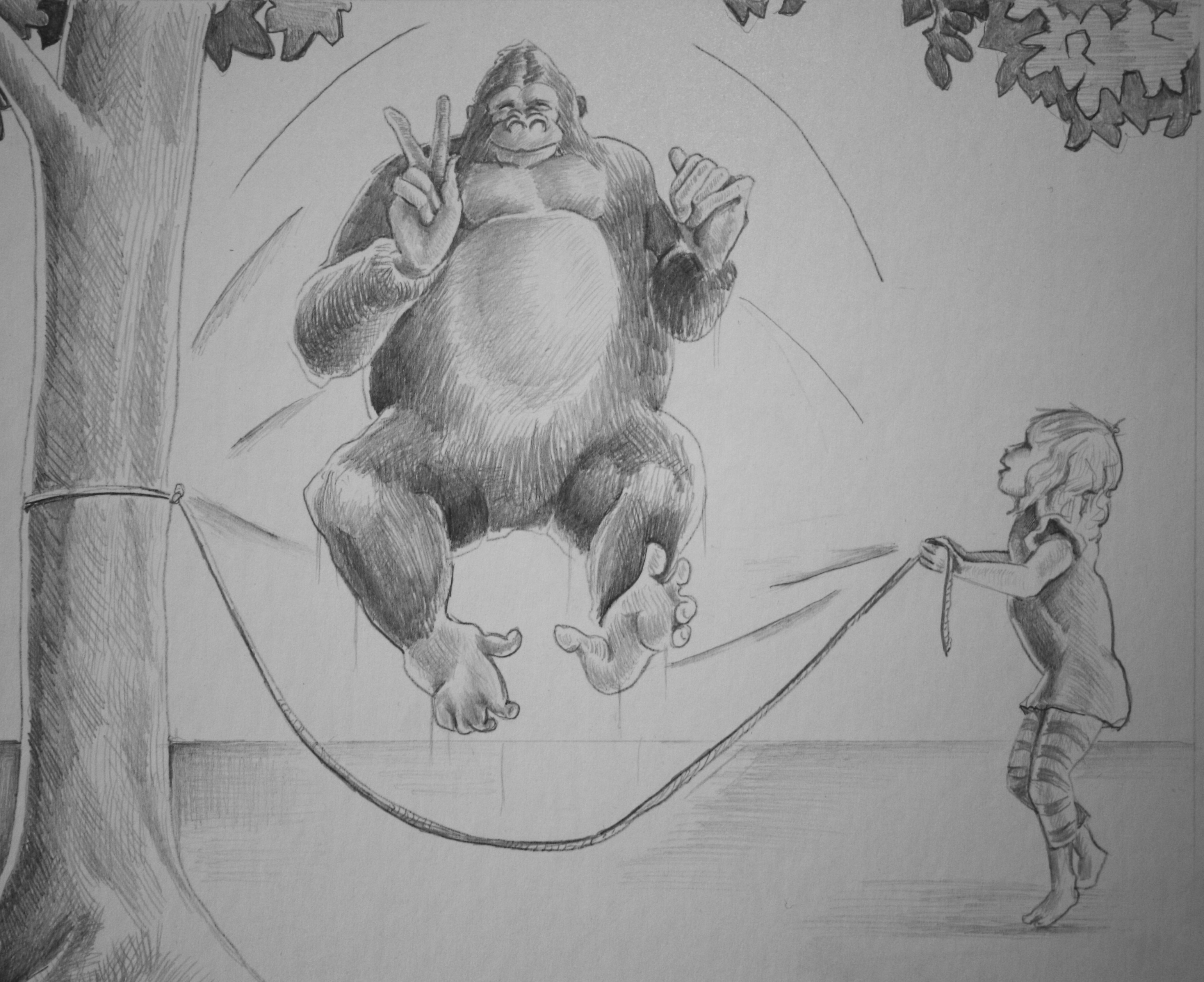
This is an illustration from my as yet unpublished children's book, Play To Play.

This is an illustration from my as yet unpublished children’s book, Play To Play.

The question was, “What gives you joy?” People responded with things like, “family,” “the sunrise,” and “community.” Someone offered, “Other people’s laughter gives me joy.” There were nods of agreement all around.

It is hard for me to hear a question like, “What gives you joy?” and not think of Viktor Frankel. As a young Jewish man in Nazi Germany, he somehow survived years in a concentration camp. He emerged believing that, other than sheer chance, the line that divided the survivors from those who perished was a capacity to give meaning to life – as opposed to seeking meaning from life. He noted that the prisoners who sought meaning from the experience perished. Those who made meaning from the experience were more apt to live another day; they storied hope instead of looked for it.

Viktor Frankel famously wrote that, “Happiness ensues.” Happiness follows. It is not something sought. It is not found on the outside. Happiness is a response. It comes from within. We bring happiness to a moment. We do not get happiness from the moment.

Joy is like happiness. As I listened to the responses to the question about joy, I thought about the language of “seeking” and “ensuing.” In the English language it is hard not to create a paradigm of separation. We rely heavily on our nouns. Things are distinct. Dissimilar. “It” is found outside; “it” is located inside. “I give meaning” versus “I get meaning.” Give. Get. Either way, within or without, there is a line of division; “it” cannot be in both places. I wondered if the experience of joy and happiness (or sadness and grief, for that matter) are co-creations. I wondered if the language of us/them, within/without actually obscured the other option: we seek it and it ensues because we engage life. We open and life opens. Joy, like happiness, is generated in the relationship space, the space between, and in the relationship space there is no separation. Your actions and my responses are intimately connected. Where is the line between my action and the impact it creates?

After the conversation about joy, Kristi talked about being empathic. She said, “I can feel other people’s pain and then I carry it.” Earlier in the week, Kerri and I had the same conversation. She told me that she wanted to learn how not to take on other people’s stuff. I told her about the time I sought a teacher named Anna Christensen who showed me how to feel but not take on other people’s pain. “We are all empathic to various degrees,” Anna said. “Most people, to survive, need to numb their capacity for feeling. It’s necessary for most people because they need to know where they end and other people begin. They need the illusion of the individual. But, that comes with a cost; it creates the terrible experience of aloneness,” she added.

If other people’s laughter gives joy, and we can universally agree that is true, then my laughter and your laughter give joy to others. Isn’t it really just that simple?

Go here to get my latest book, The Seer: The Mind of the Entrepreneur, Artist, Visionary, title_pageSeeker, Learner, Leader, Creator…You.

Go here for hard copies.

Walk As One

From my archives. I call this painting, "Alki."

From my archives. I call this painting, “Alki.”

Alan and I talked today. We are planning our upcoming Summit in Holland in June. Our conversations are always as wide-ranging as they are deep dives into sense making and soul. There seems to be no horizon that we won’t step towards, no secret passage that we won’t explore. This has been true since the moment we met. We’ve always been verdant collaborators. We joked that someday clients will hire us just to listen to how our minds spark each other. And, given our conversation today, we’d be worth every penny. We are both in the business of facilitating perceptual shifts and transformation so we do it for each other. Our planning sessions are a festival of insight upon insight, shift within shift. Together, we are innovation squared.

Recently, I shared a short TED talk by neurologist V.S. Ramachandran about mirror neurons and how deeply and concretely we are connected despite our belief/experience that we are separate. It came up again for me because during our call Alan and I discussed the waves of far-reaching impact that any simple action or word generates. Paul Barnes used to say to young actors, “Never underestimate the power you have to influence another person’s life.” Most of us are unaware of the impact that we have on lives that we never directly touch. For instance, I have had great teachers in my life and I carry their work forward in every word I write and every group I facilitate. My teachers will never know the many lives they touched and continue to touch. And, neither will I. And, neither will you. The best we can do is know that our actions matter, our thoughts matter, our intentions matter. We are more powerful than we understand.

No one lives in a vacuum. No one creates without influences. No one has a purely original thought. In fact, if you grasp what V.S. Ramachandran is addressing, no one thinks or feels independently of others. We are not as isolated or as separate as we believe ourselves to be. We have to work at separation. We are, each of us, continually co-creating (to use Alan’s term) our world in every moment of every day. What might you see if you stopped and pondered the implications of co-creation, if you took a moment and considered that you are not merely a bobber in an ocean but, in fact, are the ocean? How might you read the news of the day or address your dreams if you understood that you were a participant, a dynamic part, a burning point for the ancestors, a sender of ripples through space and time, and not simply walking this path all alone?

Go here to get my latest book, The Seer: The Mind of the Entrepreneur, Artist, Visionary, title_pageSeeker, Learner, Leader, Creator…You.

Or, go here for a hard copy.

Say “I Can.”

My latest addition to the Yoga series.

My latest addition to the Yoga series.

This is a bit of a confluence of thought-rivers. Two comments came across my virtual desk on the same day and collided.

1) Master Marsh sent me some wise words about a recent post concerning “can” and “can’t.” He wrote:

“There have always been plenty who will say: ‘It can’t be done.’ Ignore those. Surround yourself only with those who say: ‘It can.’ I’ve come to believe this is less about can and can’t than about the challenge of doing. And not doing is always easier.”

2) Another of my favorite readers sent this comment about a post on boundaries and choices:

I’m thinking making own-able choices is so freakin’ difficult for so many us because we were never taught/allowed to make them as children, nor are we often encouraged/allowed to do so as adults. Most of us learned at a very young age that to do as instructed – without complaint or question – meant that you were “good.” Being “good” was all tied up in stuff like being seen and not heard; accepting “Because I said so” as an explanation; being expected to abide by dictated boundaries and beliefs because of tradition or what “Other people will think.”  Operate by the rules and you are “good.” Buck that system by challenging the status quo and you are “bad.”

At first glance these might seem like two entirely different subjects. Though, as luck would have it I read them one-after-the other and I started pondering why, “not doing is always easier” and if that might not have something to do with identifying “good” with compliance and “bad” with non-compliance.

It’s a fascination of mine that in a nation that prides itself on a spirit of independence we place so much emphasis on obedience, control, and compliance. Nike sells us shoes by plucking the chord, “Just Do It!” Yet, we all know that the cowboy spirit is not welcome in grades K – 12. It’s a mixed message at best.

In the world of work, in environments heavy on control and compliance, workers can be counted on to do the minimum. Why would they show up ready to give their best when their best requires a mind-of-their-own. They, in essence, become resistant to take initiative and necessarily refuse any ownership of actions. To take ownership requires being seen and compliance is a game of invisibility. I remember a very frustrated artistic director asking me why her creative people never initiated action. She was dumbfounded when I helped her see that she was the problem. She made it a habit of negating every idea that she didn’t originate. Her staff did what all people do when punished for making offers; they stop making offers. Her “creative” team became adherents of “It can’t be done.”

No child comes to the planet with an internal line dividing “can do” and “can’t do.” Imagination makes all things possible. “Can do” and “can’t do” is learned; it marks the boundary between safe and not safe (or unseen and shamed). There is a price for domestication. “It can’t be done” is often a statement of fear and refusal to cross the line into disobedience (independence by another name). I would add a thought to Master Marsh’s comment, “not doing is always easier;” it is also true that not being seen is always easier, too. Showing up is hard. Doing is always a challenge because doing is often unpopular.

Tom used to say: “You know the value of your work by the size of the tide that rises against you.” In other words, it takes a special kind of courage to say, “this is mine to do and it matters not a whit what others think or feel about it.” It takes a special courage to say to yourself, “I’ll never know if it is possible or not until I try.”

Go here to get my latest book, The Seer: The Mind of the Entrepreneur, Artist, Visionary, title_pageSeeker, Learner, Leader, Creator…You.

Or, go here for hard copies.