Give Yourself Some Advice (2)

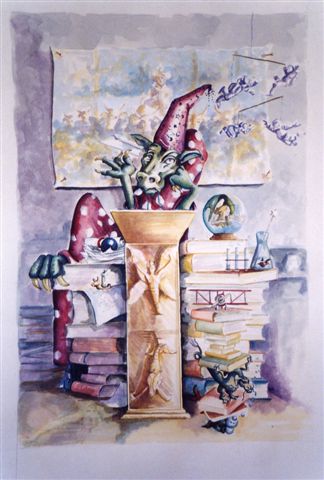
Finishing a painting is really about having a conversation with yourself. This one is talking!

Finishing a painting is really about having a conversation with yourself. This one is talking!

[continued from Give Yourself Some Advice]

Here’s the next bit of an email Horatio sent to me with his Advice To Myself. He wrote it following a question from a reporter about advice he’d give to emerging filmmakers. I am particularly fond of this section as many of my teachers, mentors, and guides are now passing away and I am revisiting what is mine to add to this “ancient conversation.” Here is the next section of Horatio’s advice to himself (for the full text, visit his blog at www.fidalgofilms.com):

Respect the boundaries of others; do not seek to control anyone else. You can only control your own choices.

Learn and honor with absolute integrity your own boundaries so that others may not try to control you or your work. Unfortunately, this is usually only learned through a certain amount of trial and error. 

Learning to trust is an art, and absolutely necessary. Learn to trust yourself first. Learn to trust others.

Always respect the tradition of your work, its ancient human conversation.

Connect to tradition, to all your teachers and your teachers’ teachers. Give yourself to it so that it can give to you and to your work. Honor it with rigor and doubt, with hours and hours of study and practice.

Then let your teachers go, follow the path that you understand as truth. You will know it when you see it. It will be your part of the ancient conversation. Likely, you will find that parts of one or two of your teachers have become part of you.

If you do not let your teachers go, your part of the ancient conversation will not be yours, but rather what you think other people want you to add to the conversation. That is not from you and only clogs up the conversation.

[to be continued]

Horatio asks great questions: What is the tradition that you carry forward? I follow the line of Tom and Marcia McKenzie, who learned from DeMarcus Brown, who learned from Eva Le Gallienne, who learned from…. What teachers/teaching do you need to let go?

Go here to get my latest book, The Seer: The Mind of the Entrepreneur, Artist, Visionary, title_pageSeeker, Learner, Leader, Creator…You.

Or, go here for hard copies (Amazon)


Love Yourself Better

this one is from the archives. I painted this 10 years ago.

this one is from the archives. I painted this 10 years ago.

He said, “The current goal is to love myself better.” And then he added, “Not so much a goal but something that needs teaching from our own mind.” His statement begs a great question, an ages old question: Can the mind teach itself? Really, the question is can the mind see itself clearly enough to teach itself?  Or, the question within the question: Can the mind teach itself to love itself? I scribbled the questions in my notebook and beneath them I wrote, “Is love teachable? Is love reachable through the mind, especially self-love?

We’d been chatting for a while and had covered a lot of territory, from Monte Blanc pens to typewriters to soap use around the world, clean water, the difference between good and bad scotch, the shapes of the 50 states and how they might influence personal identity and we’d somehow wandered into the epicenter: self-love.

His statement nailed the universal dilemma perfectly. It was a declaration of separation. The self watching and wanting more for the self. The separation is in the language: to love myself better. I don’t know anyone who hasn’t made this statement. Which part of the self will better love the other part of the self? Which part of the mind will teach the other to love?

It is where myth meets the everyday. Every human being who has walked the earth has wrangled with separation and the yearning for self-love (re-connection to self, unity). The human journey is a walk from separation (birth, if you want to take it literally) to reunification (death). The story lives in mythologies the world round. If we were still willing to read our mythologies (religions) metaphorically, we’d see it. For instance, being expelled from the Garden of Eden for eating from the tree of knowledge is the story the ancients told of the experience of separation. The inevitable bite of apple from the tree of knowledge brought duality consciousness: male/female, us/them, mine/yours, haves/have-nots, me/you. Separation. The rest of the story, not often told, is how, through out the rest of our lives, we seek the Garden where there lives a second tree: the tree of everlasting life (unity). We journey from knowledge (separation) to everlasting life (reconnection). The death need not be literal. To die to the self is necessary to experience the SELF.

Here’s the great paradox: loving another person is an act of self-love. The path to self-love is found when we serve something bigger than our selves. Think about it: the movement is always from separation to joining, from isolation to connectivity. The obvious question is, “Connectivity to what?”

Self-love is not found when the mind teaches the mind but when the mind gets out of the way of the heart. The love is always there. Love is never missing. Self-love reveals itself when the definition of self grows beyond our own skin. According to our latest neurological science, we experience ourselves as separate because we dull ourselves to our fundamental connectedness to others. In other words, we cultivate a story of isolation and then set about the real work of our lives: to see beyond what we think.

And then he said, “You know what else I just realized?”

“What’s that?” I asked.

“I just landed myself in a blog post.”

Yep.

Go here to get my latest book, The Seer: The Mind of the Entrepreneur, Artist, Visionary, title_pageSeeker, Learner, Leader, Creator…You.

Or, go here for hard copies.

Sizzle!

an illustration from a book I never published: A Dragon's Tale

an illustration from a book I never published: A Dragon’s Tale

I’m breaking my book down into component actions almost as if I was dissecting a play script. It’s an interesting exercise because I’m experiencing a measure of creator’s blowback: I’m having the distinct impression that someone else wrote this book knowing that I’d read it someday. The author formerly known as “me” knew that I’d need to know what it contains. It is often true that we teach what we most need to know.

I started my component part breakdown because I’ll soon be throwing people into an exploration of the book’s 9 Recognitions. I wanted to chart the actions of the story and the learning embedded within the narrative. I say, “throw people into an exploration,” because I eschew the word “teaching.” My life has taught me that good teaching is about creating a container for exploration. Good teaching involves no teaching. Good teaching is watching and waiting for the right moment to ask a single simple question: what did you discover? The response will always be personal and relevant to the learner. No amount of control or planning can match the power of relevant personal discovery.

A side note: good teaching and a good life share a common center: the capacity to stand solidly in the constancy of discovery.

The primary thought-river that carries the raft of my book is “to have the experience first and make meaning second.” Making meaning second is what we do even when we think we know where we are going. Life is mundane only when “mundane” is the meaning we assign to it. Life goes bland and gray when we make meaning prior to having experiences.

The word “presence” is shorthand for having experiences before assigning meaning to the experience. If you strive to be more present simply cease thinking that you know what’s coming. You don’t.

And so, this is what my component part breakdown/book blowback looks like:

“Throw them into an exploration.” This is a remarkably different action than, “teach them.” (Another Recognition from my book: the language we use to assign meaning matters more than we know).

“Ask a single simple question” This is also a remarkably different action than, “teach them.” Live in the question and not the need for an answer.

When I was an aspiring actor deep in my acting school studies I learned that the verbs that I choose matter. The actions that I assign to my pursuit can ignite me up or block my path. The same is true on my discovery path: when I am making meaning, use really good verbs. There’s no need to minimize the sizzle of this extraordinary life.

Go here to get my latest book, The Seer: The Mind of the Entrepreneur, Artist, Visionary, title_pageSeeker, Learner, Leader, Creator…You.

Or, go here for hard copies (Amazon)

Hear Your Words

[continued from EAT WELL]

Craig originally wrote a post about the boxes people construct around themselves and the alternative choice of creating a stage.  After his post he challenge me to enter the fray and muck about with boxes and stage and I’ve been pleasantly surprised at how much I have to say – I’ve followed the thread for a few days and will probably keep following it for a few more. It’s a rich exploration!

Yesterday I mentioned that I had the opportunity to work with Skip’s Human Centered Design class at the Illinois Institute of Technology in Chicago. I tossed the group into several exercises and experiences designed to help them understand how people story themselves. Specifically, we took a look at language as the building block of perception. We captured on video portions of my time with the students so rather than write about it, here’s clip from the day. [Note: the real riches start about 2:30 minutes in but I thought the students questions might be of use to set the stage so I left it in the cut. They’d just completed an exercise of misnaming things]. Let me know if you find some juicy bits about the boxes we build around ourselves and our attempts to “step outside of the box.”

[to be continued]

Go here to get my latest book, The Seer: The Mind of the Entrepreneur, Artist, Visionary, title_pageSeeker, Learner, Leader, Creator…You.

Go here for hard copies (it’s Amazon…)

Update Your Model

InfinityI laughed when I read this phrase on Skip’s Power Point presentation:

“All models are false. However, some are useful.” Alan Kay

I spent years of my life reading books built upon the thought models of thinkers, consultants, physicists, mathematicians, artists, business people and spiritual thinkers. None of the models was true. Many contradicted other models. Models are only useful if they help us make sense of our days on this planet.

Culture is a thought model. Travel to another culture and you’ll spend some time being disoriented because you will have entered a different model for sense making. For instance, some cultures/models place the accent on the individual and others place it on the group. I come from a culture that celebrates the individual and my world was rocked in a culture that celebrates the group; the model was so different that I could not sense make anything and fell head long into “not knowing.” While stumbling about unable to make sense of the world, I saw my own cultural model for what it is: a useful model – not truth.

Art, in most of Western culture, is considered important if it breaks or disturbs the model. In most Eastern cultures art is considered important if it supports the model.  Neither is truth. Neither is right. Both are useful for sense making if you understand the model.

Language is a model. It is very useful model, wouldn’t you agree? Wade Davis is sounding an important alarm that is going mostly unnoticed: we are losing languages faster than species are going extinct. Each language lost is more than a lost collection of words; a language lost is an entire world lost. It is a mythology lost. A language lost is a way of seeing and engaging with the mystery that is lost. What is useful and unknowable (un-see-able) to other languages/models is lost forever.

Religion is a model. Science creates and constantly revises its models. Religion could learn a thing or two from science (and vice versa). Maps are models. For a terrific book on mind models, get Charles Hampden-Turner’s, Maps Of The Mind.

A study of history is a study of models that served as sense makers for a time but collapsed under the weight of updates. For instance, no explorer ever sailed off the edge of the world despite the unassailable model of the day. It turns out that the sun does not rotate around the earth though many people were hushed and crushed for going against the model of their day. Newton showed us that space and time were fixed and Einstein showed us that space and time are not only fluid but connected.

We get into trouble when we confuse our models with truth. No model is true. No model is right. This applies especially to the models that we carry within us: the mind models that lead us to believe that, “I can’t do it…” are false. My favorite model that is mistaken for truth shows up like this: “I’m not creative.” That is a model that is both false and not very useful. What might you need to do to reconsider your model and accept an update?

Go here to get my latest book, The Seer: The Mind of the Entrepreneur, Artist, Visionary, title_pageSeeker, Learner, Leader, Creator…You.

Go here for hard copies

Let’s Play

It is Monday morning and I am sitting in the lobby of a Lutheran church. How I got here is a very long story and isn’t that true of any moment of your life? Recently I spent a night in Helen, Georgia. Earlier that day I’d never even heard of Helen, Georgia and Helen, Georgia was not on the way to any place I was intending to go. As I drifted off to sleep that night in a motel in Helen, I asked myself, “What had to happen in the universe to get me to this place at this time?”

Play the game of tracking backwards and you’ll find that, “How did I get here?” is not an easy question to answer. The choice–dots on the map of life connect back before the moment that you started making choices. You might as well ask, “Why did I incarnate at this time in human history?” When I attempt to track backwards I find some choice points that are more relevant than others. I also see how much of my story is a happy accident, a collision with other people’s choices, almost all of it out of my control. Years ago I knew a woman who slept in and missed her flight. Had she used a more reliable alarm clock she would have died that day in a plane crash.

This has been the year that I learned about and let go my illusion of control. The words, ”control” and “choice” mean something vastly different to me now than they did this time last year. Last year I understood them as orientations to the world. I might have asked, “Are you trying to control your circumstance?” “Are you in choice?” It’s almost as if I understood “choice” as yet another form of “control.” They are Puritan words; both are vested with end-result expectations. Today I understand them as orientations to my Self. They are words of relationship. I understand “choice” as being conscious so that when I ask myself, “What are you choosing?” what I’m really asking myself is, “Are you present? Are you conscious of your actions and what you are engaging?”

When I ask myself, “What can I control?” my new answer is “nothing.” There are too many forces in play for me to believe that I have control over anything. I think the notion of control is a form of insanity. Go outside tonight and look into the night sky and see the vastness of this universe. Then ask yourself, “What do I control?” Instead of control, I can exercise presence. I can participate. Presence is a word of joining. Presence leads me to the center of the room. It pulls me with gentle hands from the safety of my witness perch and says, “Let’s play.”

[905. Join me in inspiring truly powerful people. Each day I will add a new thought, story or idea to support your quest and mine].

For a humorous look at the wonderful world of innovation and new ventures, check out my new comic strip Fl!p and the gang at Fl!p Comics.

What Are You Saying?

877. Join me in inspiring truly powerful people. Each day I will add a new thought, story or idea to support your quest and mine.

Here’s a funny collection of phrases from my box of funny collections. This set is about the word, “say.” Three little letters comprise a surprisingly powerful word. I imagine that we’ve each had these phrases used on us at least once. If you doubt the power of the word, “say,” sample the phrases below and remember the moment it was used with you:

If you don’t have anything to say, say nothing.

What do you have to say for yourself?

If you had a voice, what would you say?

Say what you think!

What do you want to say?

I wouldn’t say it if I were you.

Enough said! (past tense;-)

That goes without saying.

Say when!

Say It! Just say it!

What are you not saying?

Just for grins, look up the word “say” in the dictionary. To speak. To reveal. To express an opinion. To give voice. To influence. According to the data, most people would rather die than stand before a group of people and say what they think. How many times a day do you ask someone, “What are you thinking?” How often do you get a response other than, “Nothing.”

This year, each morning, I have asked myself a series of questions: What do you need to say? What are you not saying? What are your actions saying? What are you saying with your life? Do you need your life to say anything at all?

See The Color

857. Join me in inspiring truly powerful people. Each day I will add a new thought, story or idea to support your quest and mine.

Occasionally, for reasons I can’t explain, I become fixated on the words people use to describe their experiences. Language is powerful and we are rarely aware that in using specific language to describe particular experiences we are, in fact, defining ourselves.

Today I was struck by the predominance of phrase polarity I heard in my conversations and travels. People were “effective” or “ineffective.” Experiences were “good” or “bad.” We “liked” or “didn’t like” an idea. I heard, “Are you in or out?” A frustrated pedestrian shouted at a young woman who’d stopped to adjust her ear buds, “Walk or Don’t Walk!”
This or that. Up or Down. Black or white. More or less. Main Street or Wall Street.

It is comfortable to pretend that things are simple and easily defined. It is probably efficient to pretend that there are only two available options. We are, after all, a society of laws and in a legal preset there must always exist a clear line though we learn again and again that the line is never clear. Who honestly believes that Justice is blind? Context complicates even the smallest decision.

Dogma is not spirituality. Data is not knowledge and is miles from approaching wisdom. Wisdom is complex. Data sorts to the simple. There are an infinite number of points between those two poles. The question remains: how is your language defining you. Do you define yourself as data with two points or do you allow for more complexity? Listen to how you story yourself and your world.

The challenge with phrase polarity is that the points are often pitted against each other. It’s as if data and wisdom are two distinct paths so you can have one or the other but not both. The phrase “effective or ineffective” recognizes no middle ground. It eliminates any common ground. The same holds true if you define yourself as either good or bad. Do you have worth or are you worthless? Are you identified with a red state or a blue state? Can business have heart? Can data support wisdom? Can wisdom translate data?

Isn’t life sweet with only two choices! In such a paradigm it is easy to be the good guy and so by default the “others” are bad. In such a paradigm, when rushing to your very important meeting, all the “others” are in your way. My way or the highway is a bleak and immature paradigm.

The important questions do not live at the poles but are in constant movement in search of a balance point. Balance is available in the center and the center moves all of the time. Do you love your children? Do you want to make a better world? Do you want your life to have meaning? Is it possible that people in the other color states also want the same things?

Coloring outside of the lines requires crossing lines. It requires a desire to work with color, lots and lots of color, which opens the capacity to see a multitude of options. Everyday I work with people searching for the greater meaning in their lives. The first thing they come to realize is that they have choices. Not one or two but many, many choices. They have a full palette of choices. And they can only see the multitude of choices when they stop telling themselves that the world is black or white. They can only see the rainbow of possibilities when they get off the pole of rightness or wrongness and step toward the middle. Living a rich and varied story begins when you start telling a rich and varied story. Language is the building block of story. It matters.

Root And Reach

822. Join me in inspiring truly powerful people. Each day I will add a new thought, story or idea to support your quest and mine.

Here’s a simple image that came to me from Megan-the-brilliant. She and I have been having an extended conversation about roots and hope. She told me that roots are filled with hope. The green plant that grows from the hope-root is an expression of faith. Hope reaches into the earth providing a sturdy basis for faith to reach into the sky.

Both are nourished in their reaching. Hope is fed from reaching deep into the warm, fecund earth. Faith is fed bountifully by opening its green leaves to the sun and drinking deep draughts of light. The earth nourishment is released into the sky while the sunlight is pulled into the earth via the hope-root.

One cannot live without the other. They are, in fact, not separate even though it would seem that they reach in opposite directions and are nourished from seemingly different sources. The separations do not exist. The root-hope and plant-faith are in fact a single organism – as are the earth and sky. The separation lives only in our language and necessity to distinguish the parts.

It Matters

808. Join me in inspiring truly powerful people. Each day I will add a new thought, story or idea to support your quest and mine.

From the department of subtlety in language comes a submission from Skip. During lunch today (His email said, “Meet me for a black and tan. We’ll call it late lunch or early dinner.”) During “lunch” he told me about a speaker who made the distinction between a student and a learner – to make the point that our systems of education (higher and lower) are not about learning. To be a student and to be a learner are not the same thing at all.

The distinction is in the assumptions beneath the words. The word “student” implies the need for teachers, curricula, etc. The deeper implication is in the necessary action: it is ‘other-directed.” The word learner, on the other hand, requires no teacher, no agenda, nor a curriculum. The necessary action is self-directed. The action can be facilitated, it can be mentored, it can be shared, but the imperative is within.

Why, you ask, does this matter? Isn’t this just splitting hairs?

Last year Skip and I met at a conference for educators on reinventing learning but in Skip’s words, it was not about learning at all. It was about reinventing teaching. The organizers were educators so their assumption set necessitated students and teachers in an expert driven relationship. The teachers know. The students receive the knowing. No learning required. There were incredible conversations that day and few had to do with learning.

Learning is a pursuit. It is a discovery path. There is nothing passively receptive about learning (note: the moment you separate content from method you end all learning and enter the realm of student/teacher).

It matters. The way we ask the question determines the possibilities we see or don’t see. None of our current questions in the field of education have much to do with learning. I walk in many worlds and in the business realm I regularly hear these phrases: “Why don’t my employees take any initiative?” “They expect to be rewarded for everything?” “It’s impossible to critique anything because they take it so personally.” “Everything needs to be an ‘atta-boy!” “They might do just what you ask but never go beyond the prescription.” Frustration abounds.

Well. We get what we create. Students look for permission, color inside the lines, need approval and fixate on their grade. Learners embrace challenges, step across lines, and know intrinsically whether or not their work is good. It matters.