Find The Riches

an illustration from Beaky's book, SHAYNE.

one of my illustrations from Beaky’s book, SHAYNE.

During my call with Jim I told him that my projects this year have been the most satisfying of my life. Certainly they have been the most important. And, they have also been, as I laughingly used the term, “negatively lucrative.” He didn’t yet know of Beaky’s books, of her website, of her book signing, so I sent him a few of my favorite photos from the event. Later, he sent me this text:

It is wonderful to be able to eat and pay the bills but there are for a fact things money can never buy. That famous authors obvious joy being one.

Isn’t that the truth? What price could we possibly place on joy? What price would we pay for true love? What price do we place on personal truth? What is the price tag on fulfillment?

I suspect that the great disease of our time – something future history professors and archaeologists will investigate – is that we’ve managed to place a value on our values; morality has somehow enmeshed with money, the purpose of education has somehow become the achievement of a bigger paycheck. In this never-ending political season, count the number of times and ways our candidates tell us that we must weigh our interests against our values.

What is the price of a value? What is the purpose of a value if it has a price?

All my life I’ve been told by people who love me, that, as an artist, I need to make a distinction between the work I do for food and the work I do for love. Most artists, myself included, feel their work is a kind of call. It is an imperative, a necessity. It is food. It is love. Most artists, myself included, do their work-for-love whether they are paid for it or not. They have to. I have to. It is a call. It is nourishment. There is no way in a culture that has placed a value on its values to recognize the real value of food-for-the-soul and food-from-the soul (the purpose of artists in a culture); a market cannot make sense of soul nourishment. This line of distinction, work-for-food or work-for-love, is at best a wonky value statement. It is a line that only makes sense to a people versed and rehearsed in trading their soul-requirements for a better retirement.

what is the price of joy?

what is the price of joy?

Last night I finished reading aloud to Kerri Tuesdays With Morrie. Jim’s text and Morrie’s messages are in beautiful alignment: there are, for a fact, things that money can never buy. And, those things are where the riches of this life can be found.

Step Toward Faith

My latest. An unusually small canvas.

My latest. An unusually small canvas: Will Is Belief.

I began writing this post a few weeks ago, just before the run to Florida and the launch of Beaky’s book. It was a very busy week and I’d forgotten that I started but did not finish the thought. This morning, wanting to get back into the rhythm of writing, I opened my iPad and found these words already written and awaiting my return:

I’m sitting in the choir loft watching the evening sun illuminate the stained glass window. I’m tired tonight and listening to Kerri, preparing for the Maundy evening service, rehearsing Nancy’s solo. Nancy’s voice is like a warm cello, deep and rich, and is working like a sound-massage on my tired bones. I’m giving over to it.

This cycle of services on Easter week is relatively new to me so I’m paying attention to all of the symbols and rituals of this story of rebirth. As is true of every great story cycle, the night is darkest before the dawn (thus, the cliché). This night, called Maundy Thursday in the cycle – I’m told that Maundy means mandate – is the night of the last supper and all the betrayals that followed. It is the segment of the story that is chocked full of crises of faith. If, like me, you are a lover of story you will recognize that some form of betrayal usually precedes a crisis of faith and, in turn, a crisis of faith always leads to growth and new direction; it always leads to sunrise.

Others betray us. We betray ourselves. Betrayal happens on the edges of the dark forest and forces a step into the unknown. Betrayal happens when we fall asleep (that is most often how we betray ourselves – sitting in front of the television to numb us to the richness of our lives). Things crumble: the relationship that we believed was secure, the truth into which we rooted our belief, the career that we thought would carry us to retirement. Security dissolves, identity dissipates, and then what? All the fears bob to the surface. All the dragons come out of the closet.

This was the unfinished thought I found this morning. I have no recollection of where I was going with it. Now, two weeks and a lot of life later, I read it as if someone else wrote it. However, there was one other sentence, detached from the others. It now reads like a mystery to me. When writing, I routinely float a sentence at the bottom of the page because it is the point of what I’m trying to reach. My floating sentence read:

A crisis of faith often has very little to do with faith.

And, as I try to resurrect my thought of a few weeks ago, I can only smile and write the first thing that occurred to me when I scrolled down and found the floater: Faith, like love or truth or time or anything else, is not something fixed. It moves and grows as we move and grow. A crisis of faith is really a step toward faith renewed. It enlivens. It helps us retire old dragons or let go of empty promises. It gets us out of our easy chair and helps us fully feel the day.


Make It So

Pasta. Meat sauce. Warm Bread. Wine.

Pasta. Arugula salad. Wine.

Tripper Dog-Dog-Dog knows the world through his nose. He sniffs everything. It is not uncommon after we finish a meal to come face-to-muzzle with a scent-curious Dog-Dog. Lately, as the objects of his sniffer, we’re given to staring into his amber eyes and offering the menu, saying something like, “Pasta. Arugula salad. Red wine,” or “English muffin. Peanut butter with black cherry jam. Banana. Coffee.” Satisfied with our description, he moves on to the next smell-enticing investigation.

I delight in our Dog-Dog food reports. They’ve become commonplace and matter of fact; “Chocolate chip cookie. Espresso.” Our reports never contain qualifiers, so, for instance, we never say, “A great chocolate chip cookie. Delicious espresso.” We provide the minimum, the noun.

Our Dog-Dog reports have rekindled an age-old fascination of mine: the power of words, specifically, the enormous power of the labels we attach to our experiences.

Language is a sword that cuts both ways. It can liberate and it can imprison. The difference is in how it is used. Language is the primary tool we use to make meaning. Big magic happens the day a person realizes that meaning is not something that is found, rather, it is something that is given and it is given the moment we apply a word-label to an experience. Nothing is good/bad, hard/easy until our label makes it so.

Applying a label to an experience is an act of creation. It is not passive. Take note of the word-judgments you apply to yourself or to others. For a week make a game of flipping them over and applying the label “beautiful” to where you usually apply a judgment. So, for instance, instead of, “I am fat,” why not say to your self, “I am beautiful.” Both are labels. One imprisons while the other liberates. The difference is a single word.

The label determines the possibilities we see (or don’t see). In a past life I used to facilitate organizational change and I came understand that my role was to help my clients ask better questions (use different language). They always came to the table with a “how” question: how do we change without feeling any discomfort? Response: what might you see if you stopped pre-labeling what you might feel as “discomfort?”

The mantra: have the experience first, make meaning second. And then, recognize the great capacity and opportunity you have to make meaning. Why not make a better meaning? Why not take a step and let it be a step merely?

Try this: do the Dog-Dog and, for one week, eliminate the qualifiers so that nothing is good or bad or right or wrong. It just is because you choose to make it so.

Dance With The Fire

Screen Shot 2015-03-29 at 5.21.46 PMLast night was Duke’s (Richard Kruse’s) memorial art show. There was an abundance of food, wine, laughter and stories. The gallery was literally filled with his paintings, prints, and sculpture. He was prolific. His paint encrusted chair, draped with his paint spattered coat, sat empty before his easel; on the easel was a large sketch pad, a place for notes for Duke and his family. I watched people approach the chair, catching their breath before sitting to compose their thoughts in the very chair he’d occupied for decades to compose the paintings that lined the walls. The chair became sacred space, a bridge between worlds.

I did not know him but I felt an immediate kinship with his work. He was a figurative painter – as am I – and given to the mystic – as am I: he worked the figure to find the soul shining inside – as do I. It was a great treat to thumb through his sketchbook. The energy and freedom of his drawings took my breath away; this was a man who needed to make art. It was an imperative made visible. I found an even deeper kinship in his imperative.

It’s hard to explain to someone who is not filled with the fire, the inner necessity to draw, dance, make music,…. It is more than a want or desire. It can be ignored but withering is the price. If it is not honored it will consume. To someone who does not know this fire the making of art appears as an indulgence. To someone who burns with the fire, anything else is a distraction; they will construct their life patterns according to the necessity of the fire.

The myth of the suffering artist is perpetuated by non-artists. The only artists that suffer are those who ignore their gift. Most people, despite their rhetoric, fear the kind of freedom and energy evident in Duke’s sketchbook. Artists run at the unknown. They develop craft so they might relinquish control in order to dance with the fire. Too much investment in control (of self, of other, of circumstance) smothers the flame. By the stories I heard, by the power of his sketches, by the laughter his life evoked, I can only assume that Duke must have been a master of this fire-dance.


Make Quiet

A sanctuary

A sanctuary

It is Thursday night. Kerri is attending a meeting at the church and I have tagged along so I might sit alone in the sanctuary. I’ve always loved entering the quiet spaces. Once, a lifetime ago in Sedona, John called me “guru dude” because I sat for hours nestled in the quiet of a vortex. It felt like minutes to me. I think it unsettled him that I was so completely settled. I know it unsettled him that I would rather seek quiet than make noise.

Sanctuaries, I’ve learned, are everywhere.

My task, my mantra, and my delight of a few years ago was to realize that all the world is my studio. I had some amazing help and more than one universal dope slap before that realization sank in. I used to believe that in order to create I had to escape the world to find the refuge and quiet of my studio. I felt like I had to go to my studio to find my creative place just like I felt like I needed to go to a vortex to experience deep quiet. I had it upside-down. A studio, like a meditation practice, is meant to bring us into communion-with, not reinforce our isolation-from. It is not a place of escape. It is a place of joining. Quiet is not something we find as much as something we allow.

To me, the word “studio” and the word “sanctuary” are now equivalents. They are the places that creating happens and creation is a quiet process: the inner chatter stops, channels open, and something comes through. A few weeks ago, in the second performance of The Lost Boy, we stepped onto the stage and everything was quiet inside. There was no past and no future; there was only the moment – and it joined us, audience and performers, in a single, shared story. Something came through us; together we created. There was no effort, there was no striving; there was, as Jim Edmondson used to say, “a dance of giving and receiving.”

This “joining” is the dirty little secret and great power of the arts. It is something that school boards will never understand but something that dictators across the ages have feared. Artists are the vortex of joining, of shared identity, of explosive quiet, of laughter that crosses lifetimes. The arts do not separate; when at their most potent they unite. They clarify. They delineate substance from chatter en route to a powerful common center that is as holy, as quiet, as it is creative.

Light The Way

A detail from my painting, An Instrument of Peace

A detail from my painting, An Instrument of Peace

Yesterday was Ann’s funeral. She died too young but by all accounts lived out loud – she packed a lot of life into her short time. One of the speakers said that she was neither a glass-half-empty nor a glass-half-full kind of person; her glass was always overflowing. I sat in the choir loft and listened to the stories, the grief and the laughter, the music that a community makes when it says good-bye. I only know her through their stories, through their eyes, and I was overwhelmed with the beauty that they saw in her. She was rooted in a community and the community was rooted in her. I was moved by the story she inspired.

Just before the service I was working on my play, The Lost Boy. We open in a few short weeks. I was memorizing the last two pages. The language of the play, the moment in the script that I worked, is about Tom’s ancestors answering his call. He worried about what to do with the ranch and the legacy that he guarded. He didn’t know what to do. There was no one to receive what he had to tell. He summoned the ancestors and, when he needed them most, they came. They didn’t answer his question. Instead, they took his hand and helped him join the story.

Jean Houston called us – the living – the burning point of the ancestral ship. Each of us carry forward the story, we add a chapter to a longer epic whether we realize it or not. Once, many years ago, John was directing one of Shakespeare’s plays for my company. While talking with the young actors about the play, he was moved to tears telling them how he realized that he was a link in a long chain that led all the way back to a first production in the 17th century. This play did not exist isolated in time. It was a burning point. Their work mattered because they were the guardians of a tradition. They were the burning point. The play was remarkable because the actors understood their root; even the smallest action mattered because if fed something bigger.

A few weeks ago we watched the film, The Descendants, with Brad and Jen’s movie group. It is a story of legacy and mattering – a story of what happens to descendants when everything looks like a commodity. The root withers. The story dissipates. As Yeats wrote, “The center cannot hold.” Joseph Campbell said that our mythology was dead and all the proof we needed was in the news. It took me years to fully understand his statement. And, the question he asked was this: once lost can a community revive its mythology? Can it reconnect with the root? Can it look beyond the immediate and see the rich soil of the greater story? As the burning point, can we light the way forward or is our dilemma the same as Tom’s: what do you do when you carry a root-story and no one is interested or capable of hearing it?

title_pageGo here to buy hard copies (and Kindle) of my latest book: The Seer: The Mind of the Entrepreneur, Artist, Visionary, Innovator, Seeker, Learner, Leader, Creator,…You.

from my Yoga series

from my Yoga series

Go here to buy art prints, posters and such – of my paintings


Begin Here

photo-6

Begin Anywhere

In our house, hanging on the wall like a painting, is an old window frame. In the top pane is a card that reads, “Begin Anywhere.”

Earlier this week I had a great conversation with Diane. She laughed and said, “In my meditations I was whining to God because I wanted to see the plan of my life. I got the clear message that I was never going to see the plan but I could always see the next step. The next step is always right in front of me.” Dancing with what’s right in front of you is sometimes called faith. Sometimes it is called play. Sometimes it is called art.

Diane and I are good reflectors for each other; we are usually on parallel paths. For both of us, the past year or two has been a process of letting things go and stripping things back: paths, patterns, and presuppositions. It has been the mother of all house-cleanings (she had a literal flood!) and, like all good house cleaning it took some elbow grease and few hard decisions about what to keep and what to throw. After the job is done, nothing feels better than a clean house and along with the good feeling, new space, and wide-open possibilities, comes the question, “What’s next?”

Diane told me her story because my next step is so clear that I can focus on nothing else. With such a myopic focus I can see nothing else and that’s why I called her. I must do this play. I must. I cannot see beyond this dance. It is my first thought in the morning. It is my last thought falling into sleep. This step, my dance with The Lost Boy, makes no sense and Diane’s point was well taken: the next step rarely makes sense. Sense-making requires context. Sense-making is a skill of relativity – and since we can never know the plan (if, indeed, there is one), we can only make sense based on old information. That is good news for plumbers but is dubious at best for leaders, explorers, seekers, and artists.

After our call I realized that dancing with what’s right in front of me is how I paint. It’s also the key to a good conversation – and painting, for me, is a good conversation. After my good conversation with Diane, she sent me an email of affirmation and concluded her thoughts with this: “Stay focused on what is before you now and let the creations show you how and when they are ready to play.”

title_pageGo here to buy hard copies (and Kindle) of my latest book: The Seer: The Mind of the Entrepreneur, Artist, Visionary, Innovator, Seeker, Learner, Leader, Creator,…You.

For all digital forms of The Seer, go here

Yoga.ForwardFoldFor posters and prints of my paintings, go here


Hear The Voices

photo-2This is the most unusual rehearsal process I’ve ever navigated.

First, I wrote the play and in preparing to perform it, I’m discovering it anew as if someone else wrote it. There have been brilliant and funny moments when I ask myself, I wonder why he wrote that? The good news is that I remember whom to ask.

Second, the play was originally meant for Tom to perform and since the story is Tom’s family narrative, I wanted the language and syntax to be Tom’s. In development, I recorded hours of conversation with him. Much of the first draft was a transcription so that I might capture word-for-word his language choices and speech patterns. Those structures survived the several rewrites that happened after Tom’s death. In preparing to perform the play I’m wrestling with the language. I’m wrestling with his language. It is almost as if I am discovering my own speech patterns and syntax – in telling Tom’s story I’m finding it necessary to tell it my way, not his. Essentially, as is true in all good storytelling, I am finding myself, my voice, through his story.

Tom and me a long time ago.

Tom and me a long time ago.

Finally, the music is a character in the play and the musicians, Mom’s Chili Boys, are madly rehearsing in California while the actors (Kerri and I) are rehearsing in Wisconsin. The internet is a beautiful thing as, each day, we pass notes, record voices, email questions; we will only be together in the same room 3 days before the first performance. We’re essentially workshopping the play from two locations. It is akin to rehearsing a symphony in parts and the parts only come together in the final day. They get to experience the whole symphony, the fullness of their music as played through all of the voices, only in the final hour. And that will be true of this play.

Each day I rehearse and I hear Tom’s voice in my head, telling me the stories that comprise the play. I am reminded that, whether artist or audience, art is a living thing. It is a relationship and ultimately that relationship is with your self.

title_pageGo here to buy hard copies (and Kindle) of my latest book: The Seer: The Mind of the Entrepreneur, Artist, Visionary, Innovator, Seeker, Learner, Leader, Creator,…You.

For all digital versions, go here (Leanpub)

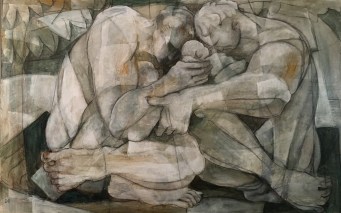
Untitled by David Robinson

Untitled by David Robinson

Go here for fine art prints of my paintings.

Look Up

Eve, by David Robinson

Eve, by David Robinson

The nights have been bitter cold and clear. The cold always seems to make the stars sharp like crystals. Standing on the back deck, looking at the stars, I remembered a conversation I had years ago. I was working with students and we strayed into a discussion of human beings connection to the stars. It was cosmology in a nutshell.

Here was the gist of the conversation: something happened to human consciousness when they (we) understood that our patterns of life on earth were (are) oriented to happenings in the sky. For instance, our impulse to worship is intimately connected to the solstice and equinox: the disappearance and return of the light. Our migration habits, planting habits, daily rising-and-shining habits are relative to the movement of the sun. The tides in the ocean and the waters in our body are responsive to the pull of the moon. With the awareness, we crossed a line from chaos to order, from unconsciousness to consciousness. There was a relationship, a pattern, a belonging, a participation. There was something bigger.

During that same period in my life I also worked with a group of inner city students who had never seen the stars. It was a revelation for me. For them, there was no sense of relationship, there was no “something bigger.” There was a load of anger and existential separation.

This holiday season, I was struck by two things: 1) how many times I had conversations with people, glued to their televisions, who are frightened and feeling helpless by the happenings in the world, and 2) how many casual family photos crossed my path featuring a gathering of individuals, alone together, faces to smart phones. Everyone was looking down.

Standing on the back deck on a dark and starry night, wrapped against the cold, I wonder what some distant teacher in the future will tell his or her students about what happened to human consciousness when they (we) ceased looking up.

title_pageGo here to buy hard copies (and Kindle) of my latest book: The Seer: The Mind of the Entrepreneur, Artist, Visionary, Innovator, Seeker, Learner, Leader, Creator,…You.

Yoga Series 7Go here for prints of my paintings

Visit With Your Guardian

My Threshold Guardian at the Jelly Belly store.

My Threshold Guardian at the Jelly Belly store.

In addition to being a dear friend, Arnie is my personal threshold guardian. His appearances in my life always signal that change is a’comin’. The last time that I saw Arnie I left behind everything that I knew (literally and metaphorically). I began a long pilgrimage to the church of my self. It felt as if I stepped into my big wooden sailing ship and set a course for the edge of the known world and then, with great intention, sailed over the edge.

Two years have passed since our last meeting. In the interim, I have experienced Sirens and Cyclops, I lost my metaphoric ship and crew to the great whirling Charybdis, I was held captive on an island, I paid an extraordinary visit to the underworld and, at last, returned to the light with new knowledge. And, this week, as is his custom when I am ready to pass through the next portal, Arnie came to visit.

Saul’s voice roared in my head as Arnie and I debriefed my two-year journey: address your self to the field of possibility, not to the opponent. Possibility, I learned, becomes visible when we are vulnerable and available to it. It appears when we place our focus on it, when we seek it. Pushing and protecting and fighting and resisting obscures the field of possibility because our focus is on the opponent, not on the possibility.

And, of course, the greatest opponent is our self.

In the language of story, for great personal transformation to occur, we must leave behind everything we know and go on a journey into the unknown. That includes leaving behind who we know ourselves to be. In other words, we are required to let go of all the things we believe that we can control – but in truth cannot; we are required to release our insistence on keeping things “as they are.” In the end, we are required to face and then release the things that we are trying “to make work” but cannot – and let go of all the things we want to force into existence but cannot. That is the moment the opponent in our self disappears and we are at last able to turn our eyes outward and see the field of possibility that has been available for us all along.

title_pageGo here to buy hard copies (and Kindle) of my latest book: The Seer: The Mind of the Entrepreneur, Artist, Visionary, Innovator, Seeker, Learner, Leader, Creator,…You.

Eve, by David Robinson

Eve, by David Robinson

Go here to buy fine art prints of my paintings.