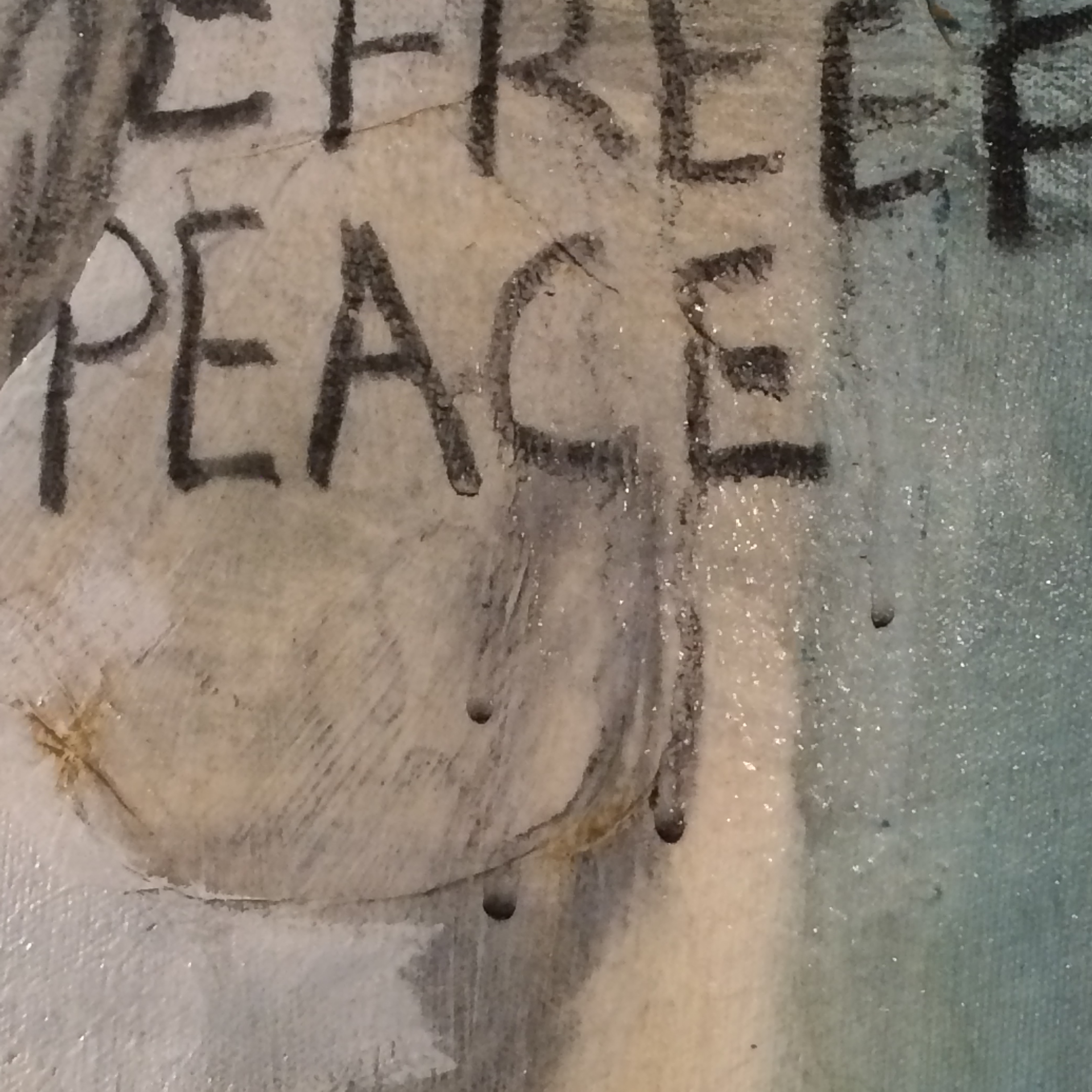
Doubt

Pidgeon Pier - acrylic on canvas

Pigeon Pier – acrylic on canvas

It’s been months since I had a good chat with the stained glass window. I hadn’t realized that the conversations had stopped. The summer was a blur of unplanned travel and I suspect during the chaos of coming and going that I simply stopped asking questions.

This morning we awoke to snow, the first of the season. Snow arrives silently and inspires inner silence. Steeped in the snow’s quiet I heard the window’s greeting. “Ah, Welcome back.” And so began our conversation about doubt.

Doubt is a double-edged sword, it has two distinct faces. The first face, unlike the snow, is noisy. Doubt does not arrive in silence. It demands to be heard. In the middle of my conversation with the window I heard P-Tom say, “Fear makes us doubt our belief and believe our doubts.” This face of doubt is a crazy maker. It makes muddy the inner waters. It makes all fears come true.

There is another face of doubt, not born of fear but arising from love. The 5th Agreement of Don Miguel Ruiz is this: doubt everything that you think. To doubt what you think makes little sense without the preceding agreements, the most powerful (to me) is this – Be impeccable to your word: speak your truth and nothing else; do not blame or accuse or make others responsible for your pain (your thoughts and actions); own your thoughts; own your actions. Or, better said, love yourself enough to express your love and nothing else. Don Miguel writes that impeccability to your word requires self-love. In this context, this other face of doubt is a step forward. Coming from love, to doubt what you think is akin to cleaning up the dirty dishes. It is to not take anything too seriously. Thought is nothing more than storytelling and to doubt the story births detachment from investment in the story. Detaching from the story-investment brings quiet, like the snow.

title_pageGo here to buy hard copies (and Kindle) of my latest book: The Seer: The Mind of the Entrepreneur, Artist, Visionary, Innovator, Seeker, Learner, Leader, Creator,…You.

Yoga Series 7Go here for fine art prints of my paintings

Tell A Good Story

The Storyteller emerges from the forest. Lucy & The Waterfox

The Storyteller emerges from the forest. Lucy & The Waterfox

Over the years I’ve tried countless marginally successful ways to define for others what I do. It would seem obvious: I am a painter. I am a writer. Oh, and a theatre artist. And a consultant. And I’ve maintained a coaching practice. I’ve worked in education, the corporate world, with non-profits, and with entrepreneurs. So, in conclusion, I do too many things.

Well, that’s not exactly true. I do one thing. I deal in story.

I speak the language of story and that is confusing in any arena. What does it mean? Such a simple word, story, and yet it can mean so many different things. For instance, a truism in effective, transformational coaching is that the story doesn’t matter. By story, coaches mean the circumstance; in transformation, in the fulfillment of potential, the details of what happened – the story – are not useful. The circumstance story usually equates to blaming or endless attempts at self-fixing. The circumstance story gets in the way of growth. It is an anchor in the sea of dysfunction.

I don’t work with circumstance stories.

By story, I mean inner monologue, the-story-you-tell-yourself-about-yourself. By story, I mean the language that we use within ourselves to articulate belief. I work with the orientation story, the personal and communal mythology. Rather than get in the way, the orientation story defines the way. It defines what we see. It defines our relationship with time, with nature, with god, with community: it is the lens through which we make meaning. I help people change their lenses. Try explaining that to a CEO!

Last year, when Skip and I shuttered our business, I also shuttered my coaching practice. I ended my corporate work. Much of it came to feel like wearing an ill-fitting shirt –or a host of ill-fitting shirts – so I decided to clean out the closet. I wanted to drop all the definitions, the old forms, to make space for the new.

Last week I decided it was time to peek into the empty closet. And, as serendipity would dictate, I happened to be reading Frank Delaney’s engaging book, The Last Storyteller. On page 99 of this fictional tale, this is what I read:

“…every legend and all mythologies exist to teach us how to run our days. In kind fashion. A loving way. But there’s no story, no matter how ancient, as important as one’s own. So if we’re to live good lives, we have to tell our own story. In a good way. A way that’s decent to ourselves.”

I threw my head back and laughed. There is no story as important as one’s own. To live a good life we have to tell our own story in a good way. And then, there was this:

“…I don’t give anybody advice. All I do is release the good thinking that’s already inside of you. You’re the one who acts on your own advice, and I have the pleasure of helping you reach those thoughts about yourself. So it’s not me helping you. It’s you helping you.”

Ask me today what I do and I will say, I write. I paint. Ask me for more detail and I’ll open the book to page 99.

[to be continued]

title_pageGo here to buy hard copies (and Kindle) of my latest book: The Seer: The Mind of the Entrepreneur, Artist, Visionary, Innovator, Seeker, Learner, Leader, Creator,…You.

All digital forms of The Seer can be found here

Learn To Swim

from my children's book on how to play, PLAY 2 PLAY

from my children’s book on how to play, PLAY 2 PLAY

Hoodie tells me that he is sarcastic by nature but I don’t believe it. I’ve spent a lot of time in nature and I find no sarcasm there. I also understand much about human nature and know that sarcasm is not a native plant; it is invasive. It is introduced into fertile, unknowing soil.

Sarcasm is the tool of the drowning man. It is an act of desperation to push others under the water in order to elevate the self. I’ve walked many paths and worked with many powerful and not-so-powerful people. There is a rule on the stage that applies: the king never needs to act powerful because the king is powerful. Those who need to demonstrate power have none. As Quinn used to tell me, if someone has to tell you that they’re important, they really aren’t. Sarcasm is a form of importance-telling. Powerful people create power with others. Power is a creative act. It is a communal act. They have no need to diminish or reduce others because they recognize that reduction also reduces. People who must reduce others are not powerful; they’ve confused control with power. They want to be king. They want to be seen as king. But, they do not believe they are king. Sarcasm is a form of perception control.

No one is by nature sarcastic. Sarcasm is learned in batting cages, at dinner tables, and on the field of play. Sarcasm is a mask. It is a place to hide smallness. It is passed down generationally. Masks both conceal and reveal and while it might feel good to pull others under the waves, it also reveals a non-swimmer. It is habit. It is learned.

Hoodie is not by nature sarcastic. Hoodie is a swimmer. He has the stuff of kings. He also tells me that his nature is to give comfort, to help others. He will one day realize, after he transcends his habit of drowning, that his nature to lift others is the center of his power place. Sarcasm separates him, reduces him, as do all forms of self-diminishment/control. Sarcasm is a lonely planet. Power is always a movement toward others. It is generative, as is all of nature.

title_pageGo here to buy hard copies (and Kindle) of my latest book: The Seer: The Mind of the Entrepreneur, Artist, Visionary, Innovator, Seeker, Learner, Leader, Creator,…You.

Go here to support my kickstarter campaign for The Lost BoyDSC_1196 copy


Simply Listen

Pieta with Paparazzi

I call this one Pieta with Paparazzi

I am standing in a lobby listening to people compare their tragedies. It is more than comparison; it is a festival of one-ups-manship. “If you think that’s bad, my niece was just diagnosed with a terrible cancer….” The first speaker, now crestfallen, reaches into her story-bag of pain as another member of the group competes, “That happened to my brother just after his daughter was hit broadside by an enormous truck!” The group coos in sympathy, each in a hurry to make their personal story of hurt the center of the conversation. I wonder at their need to outdo each other in tragedy.

I suppose it is human, this feeding frenzy of drama. I want to reject my supposition outright. Suppose it is not human? I wonder if this dis-ease is cultural, an expression of the fragmentation that comes from the too-busy, the clan that avoids internal quiet at all costs, filling every moment with television, gaming, texting, emailing, gossip-news. As Anne Morrow Lindbergh wrote in Gifts From The Sea, it is impossible to know who you are without dedicated inner spaciousness and quiet. To listen to your self is the only way to really know your self. Filling the quiet space with incessant noise withers the root.

Maybe.

All stories require conflict to move forward but it is also true that the point of all storytelling is transformation. Through the conflict we are transformed. Perhaps that is what bothers me as I listen to this pain frenzy: the emphasis is on the suffering. The investment, the identity, is in the wound, not the transformation.

There is a simple Buddhist prayer that I like:

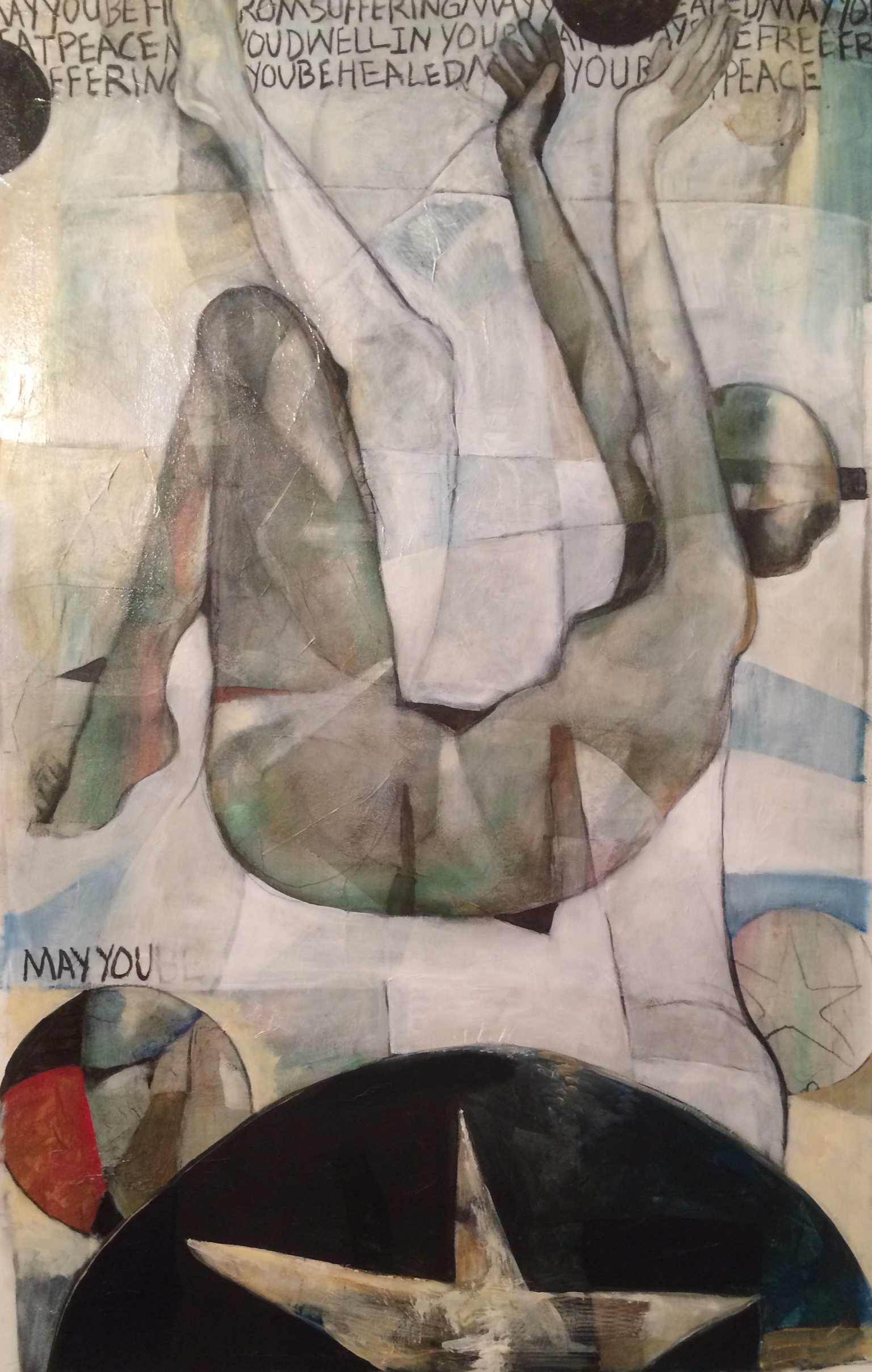
May I dwell in my heart. May I be free from suffering. May I be healed. May I be at peace.

The prayer is like a musical round that progresses from the “I” to the “You” to the “We.” The emphasis is on the transformation. It begins with dwelling in the heart.

Maybe.

What bothers me most is the absence of the capacity to listen. The first speaker needed to be heard, not outdone. I wonder what might have happened if the group had simply said, “Tell us.” I wonder what might have happened if they had been able to be present with another’s pain. To listen, simply to listen, must be a route to free each other from suffering, to heal, to create peace.

title_pageGo here to buy hard copies (and Kindle) of my latest book: The Seer: The Mind of the Entrepreneur, Artist, Visionary, Innovator, Seeker, Learner, Leader, Creator,…You.

Or, you can go here for all forms of digital options


And, you can go here for fine art prints of my paintingsYoga.Meditation


Leave Your Ghost

from the archives. I call this painting "Demeter."

from the archives. I call this painting “Demeter.”

As Alan said, this year for me is a year of departures. First Tom, then Kathy, Bob, and Doug passed; mentors all. Earlier this month Casey, who lived a long season and once told me that heaven didn’t want him and hell wouldn’t have him, finally found his way out of this life and into his proper place in the mystery.

When I was a boy my favorite book was an old college text of my father’s on comparative religions. It was moldering on a shelf in the basement with other long forgotten books. Finding it was like uncovering buried treasure. I fell into it, reading and rereading it. Among other things, it helped me understand that religion was not fact but a cultural expression of universal experiences. Human beings have to deal with the enormity of existence (who am I?), birth (where do I come from), death (where am I going?), and everything in between (what’s my purpose?). Human beings deal with the enormity of existence like they deal with everything in life: they story it.

Since there has been so many significant departures this year I’ve been doing some reading about death and dying. Lately, I’m reading Deepak Chopra’s book, Life After Death. He weaves the book around a parable of a young woman who must confront Death. The woman seeks the help of rishi, a wise contemplative who lives in the forest. In one of my favorite sections of the parable, the rishi introduces the young woman to ghosts. The first is a toddler; the second is young girl. The woman soon recognizes that the ghosts are her past; they are the phantoms of various stages of her own life. The rishi tells her, “Every former self you have left behind is a ghost. Your body is no longer the body of a child. Your thoughts, desires, fears, and hopes have changed. It would be terrible to walk around with all your dead selves holding on.”

He teaches her that death has been with her every moment of her life. “You have survived thousands of deaths every day as your old thoughts, your old cells, your old emotions, and even your old identity passed away. Everyone is living in the afterlife right now. What is there to fear and doubt?”

title_pageGo here for my latest book

Go here for fine art prints of my paintings.

Return To Your Self

DSC_1914

The 2014 Transformational Presence Global Summit in Vught, Holland

While in Holland I led a group through a segment of an exercise called The Dream Police. I created the exercise years ago with John Langs and Lisa Paulson – two master teachers and performing artists – while doing some work with young actors at PCPA Theatrefest. The original exercise is deeply rooted in ritual and communal transformation. The group in Holland was engaged in a more personal exploration so I only led them through the first part of the exercise.

It is surprisingly potent and I’ve learned to use it carefully. The first part of the exercise sounds simple but can be explosive: Write for 5 minutes as if, in 5 minutes, your memory will be wiped clean. All that you will know of your life, of your values, your relationships, your dreams, your identity… will be what you capture in those few moments of writing. After the writing, in a ritual act, the scribbles on the paper are left behind. Most often, people destroy the paper. They shred it. The writing is lost. The question becomes, “Who are you without your story?” It is intended to disorient so the participants might reorient to the essentials of their lives; it is a great exercise for cleaning the gunk. It can be freeing. It can be terrifying. It is always illuminating.

The reorientation process is impossible to do alone. Reorientation is communal. Until Holland I’d never left a group midway, I’d never let the exercise stop in the middle of the disorientation and had always before made sure the reorientation process was at least initiated. IN Holland, the exercise was interrupted. The disoriented community fragmented. Some left the exercise feeling liberated. Others were angry. Some were confused or frightened. All left by themselves. Disorientation makes lonely introverts of us all. Disorientation is an individual sport.

The ritual of coming back to yourself is always a ritual of returning to the community. Clarity is a boon that requires sharing with others. To come back to yourself is to come back to relationship. No one walks this earth alone. No one is capable of saying “This is me,” without the presence and assistance of others. The process can be volcanic. It can be quiet and intense. It always requires another question: “Will you tell me what you see?”

24 hours later we completed the exercise. The individuals returned. They gathered, reoriented and a new form of the community was born. I knew all was well when the newly reformed community asked, “What do we do now?” and the only available answer was, “We don’t know – but let’s find out together.”

Go here to get my latest book, The Seer: The Mind of the Entrepreneur, Artist, Visionary, title_pageSeeker, Learner, Leader, Creator…You.

Or, go here for hard copies.

Pick Up Your Ordinary

From Kerri and my travels: a photo essay about what our feet have seen

From Kerri and my travels: a photo essay about what our feet have seen

I continue to process all of the amazing events and experiences from the past few weeks working abroad. They have jiggled loose an old thought-bubble and I’ve been pondering it since it bobbed to the surface.

The old thought-bubble is a tenet that comes from improvisational theatre: put down your clever and pick up your ordinary. I’ve used this tenet in any number of facilitations and coaching relationships. The basic idea is this: any attempt at being clever actually diminishes personal power and inhibits the capacity to be present. Trying to be clever focuses the eye inside and robs a performer or presenter of the only thing that really matters: relationship in the moment.

Dig a bit deeper and the real wealth of the tenet shows itself. We rarely recognize our true gift because we think everyone possesses it. We miss our unique gift because we think it’s ordinary. We mistake our gift for something common and therefore not of great value. In truth, what we brand as ordinary (how we see the world) is our most unique, most potent and powerful gift. So, to put down your clever and pick up your ordinary is to value your unique point of view. It is to honor yourself and how you see the world and also affords you the capacity to be seen as you are, not as you think you need to be seen. To pick up your ordinary is to become accessible.

Trying to be clever is actually an attempt at trying to be something we are not – or someone we are not. It is to hide, put on a mask, or pretend.

Ordinary reveals; clever obscures. Ordinary facilitates flow. Clever needs to control. Attempts at being clever are manufactured moments. Experts need to be clever, they need to whip up a straw man and call it substance. Clever is always an ego need – in fact, clever is nothing more than a plea for approval. It is a thirst for adulation. Clever needs center stage. Ordinary shares the stage. Clever needs to claim territory. Ordinary expands horizons. Ordinary is accessible. Clever is protected, aloof, and closed.

All of this is old news. It was in the old thought-bubble. Just behind it came a few new little trailer bubbles. Clever is oriented on what it gets (adoration, attention, acclamation). Ordinary is oriented according to what it brings: a unique point of view in service to a relationship. Ordinary is a form of potlatch: give what you have; give away your wealth as the road to increase. Clever comes from a universe of lack. Ordinary comes from an abundant life. It is a paradox. Unique is found in the ordinary. New vision comes when we cease trying to say something new and simply offer our unique, one-of-a-kind perspective. The beauty is in what we see.

title_pageGo here to get my latest book, The Seer: The Mind of the Entrepreneur, Artist, Visionary, Seeker, Learner, Leader, Creator…You.

Or, go here for hard copies and Kindle.

Locate Your Self

title_pageHere’s a short excerpt from my book, The Seer, dealing with the dance between investments, limitations, and the roles we play in life. This conversation is a kind of coaching session and is happening via online chat:

Me:…All week I’ve asked myself, “why?” Why the dramatic shift in experience from role to role? I’m a bit shocked to realize that I play many, many roles each day. In each role I want something and what I want is different depending upon the people I am with. I realized that my roles are not about me in isolation – and what do I mean by that? I mean that I define my role by how I define the relationship I am in at the moment. For instance, in my workshop, I assumed the role of “guide” and I wanted to lead the young people to some new insights that might help them create their businesses. In my conversation with my parents, in the role of “son,” I wanted them to be pleased with my work. I wanted to share and I wanted their approval. So, my role is defined by relationship and in each different relationship I tell a specific story based on what I want or need. I’ve “cast” myself in these little mini-stories. Or to use your term, “role” is the way I “locate” myself in the story.

Virgil: And how does this knowledge help you with your questions about business?

Me: The first thing that occurs to me is that I have the capacity to locate myself in a different way if I don’t like the role I’m playing. I can change how I locate myself. Also, there is a dance with the words “limitation” and “investment.” I took notes all week and realized that I was using the verb “to invest” over and over again to describe my experience of different roles. So, for instance, during my dinner with my friend Bruce I invested in helping him. I wanted Bruce to know that I cared about his challenges. Then, I watched Bruce invest in being the wine expert. It was his way of caring for me and demonstrating his expertise. I began to see my investments as keys to discerning my limitations. In some roles I’ve invested in the idea that I can’t do something or that I’m not good at something. In some roles I diminish myself; my limitations are investments in being small.

Virgil: Just a caution: as you explore further the dance between investment and limitation, remember to practice suspending your judgment. Remember: you are having experiences first so you can see how you make meaning and begin to choose how you make meaning.

Me: Thank you. It’s a good reminder. I was beating myself up every time I     realized I was investing in being small.

Virgil: We tell ourselves stories. We locate ourselves within the stories. In fact, that is the next recognition: you locate yourself within your story. We do it physically (like your description of choosing the table in the restaurant); we do it through the roles we assume – specifically our assumptions of how we need to play our roles, what is ours to do, etc. Locating is simply a way of establishing comfort. We sort to the known. If you judge how you locate yourself, you miss the opportunity to change how you locate yourself.

Me: Right. Judgment blinds me to the choices I am making.

Virgil: Judgment is always a version of the “things are happening to me” story. In fact, judgment is a way of locating: it is the warning signal when we step too close to discomfort. When I judge myself and say, “I’m an idiot,” I’m actually locating myself, pulling myself back into my comfort zone. When I judge others, “They are idiots,” I’m locating myself in a higher status position. The action of diminishing “them” elevates me back into a comfortable status position. Thus, suspending your judgments removes the easy step back to comfort and allows you to stand in “not knowing” and see what is there beyond what you think is there.

Go here to get my latest book, The Seer: The Mind of the Entrepreneur, Artist, Visionary, Seeker, Learner, Leader, Creator…You.

Or, go here for hard copies.

Stand Rooted

I awoke this morning with this phrase hanging in my dream space: you can’t control your circumstance but you have infinite control over who you are within your circumstance. It is a well-worn phrase for me, like an old sweater, relevant to much of the teaching, coaching and facilitation I’ve done. It is useful to remember when the hurricane hits or the job disappears or life seems to be a festival of obstacles. The ability to discern between circumstance and personal center is of great value. It is a skill that lives atop of Maslow’s hierarchy.

A work in progress: K.Dot & D.Dot See An Owl

A work in progress: K.Dot & D.Dot See An Owl

We have these words in our canon of health: centered, grounded, rooted, conscious, present…. They are all terrific metaphors, earthy with eyes wide open. Flip them over and you get a good sense of what happens when you confuse your self with your circumstance: off center, uprooted, ungrounded, unconscious, not here; up in the air with eyes squeezed shut.

There is a Buddhist phrase that I appreciate: joyful participation in the sorrows of the world. It is necessary to know the difference between self and circumstance to really grasp the meaning of this phrase. Life is going to bring you trials, tribulations, and lessons. You can never know what is just around the corner. As Kerri often reminds me, it is what you don’t know that makes you grow. So, when the storm comes, participate. Stand in it. Love life in all of its forms and textures.

So many times when working with business clients I’ve had to say, “Don’t eliminate the wolf from your story.” In the story of Little Red Riding Hood, the wolf moves the story forward. In fact, without the wolf, there is no story. In business as in life we attempt to protect ourselves from the wolf. We resist the very thing that can bring growth and renewal. Circumstance is often the wolf. The storm comes. The relationship suffocates. The wolf always creates movement where the energy is stuck. It is uncomfortable. It hurts. It is scary. Yes. So, participate. Engage. Be-with-it. Within the circumstance, within the storm, learn to stand rooted, centered: earthy with eyes wide open.

The circumstance will pass and you will remain. You will know more. You will have grown. This simple understanding, that you are separate from your circumstance, allows for the joyful part of participation. Joy lives at the choice point. The world is and always will have plenty of sorrows to help you grow. Things happen. The question is, “How do you choose to participate?”

Go here to get my latest book, The Seer: The Mind of the Entrepreneur, Artist, Visionary, title_pageSeeker, Learner, Leader, Creator…You.

Or, go here for hard copies.


Trespass And Forgive

from my Yoga series of paintings.

from my Yoga series of paintings.

I’m back in the choir loft staring at the stained glass window. We’re having a conversation about the word ‘trespass;” it has lately been central to my meditation.

When I was a kid my cousin, Randal, and I used to trespass a lot. There was an old abandoned house built on a hillside. It had a big fence around it to keep us out. It also had the best tree swing in the world so it was worth the breach. Using the back porch as a launch pad, we could swing out over the hillside and let go, falling into a pile of mattresses and foam rubber stacked by all the trespassers. Many times we ran or hid when the police came to shoo us away, always returning when the coast was clear for another swing. It was thrilling.

I’ve trespassed a lot this past year, not into abandoned properties but into places within myself that I had erected fences, places I was not supposed to go. That is the necessity of growth. Transformation always requires a trespass. In stories it is the equivalent of leaving home and going where you are never supposed to go, the place where the monsters live, the place where the entire society (your psyche) tells you never to go. And, so, it becomes the one place that you must go to grow. It is usually ugly and messy and filled with betrayal – and that is the point: all the order dissolves into chaos so that a new order might emerge.

And, in the trespassing within, we trespass against others, especially against people we cherish. They are part of the old order. When the internal order dissolves, the outer order dissolves, too. That is also ugly and messy and filled with betrayal. There is loss of friendship. Love is tested.

My stained glass window tells me that forgiveness – of self and other – is a necessary step on the path to the new order. Trespass is a wrecking ball. Trespass is thrilling. The cops in the head (to borrow a phrase from Augusto Boal) will drive by to run you off or make you hide. The cops in the head will tell you that you are not safe or that you are doing damage that cannot be repaired. Fear wears a badge of authority. Fear wags a finger and calls you traitor, liar, or coward.

Trespass makes all things true and nothing true; that is the point of chaos. All location points disappear. My stained glass window tells me that forgiveness is new location point. It is an anchor. It is a sign that the new order, the butterfly, is emerging from the mush of chaos. Just as trespass is an essential movement away from the known, forgiveness is essential to return home. And, in story terms as in life, when you come home, finally and at last, after all of the trials and all of the betrayals, after all the mess and ugliness, you are new, so home is new, too. When you trespass, leave, and return, you find that there are no more fences and no more badges keeping you out. You find that the swing is available anytime. Love is reformed and everything becomes possible.

Go here to get my latest book, The Seer: The Mind of the Entrepreneur, Artist, Visionary, title_pageSeeker, Learner, Leader, Creator…You.

Or, go here for hard copies.