Laugh More

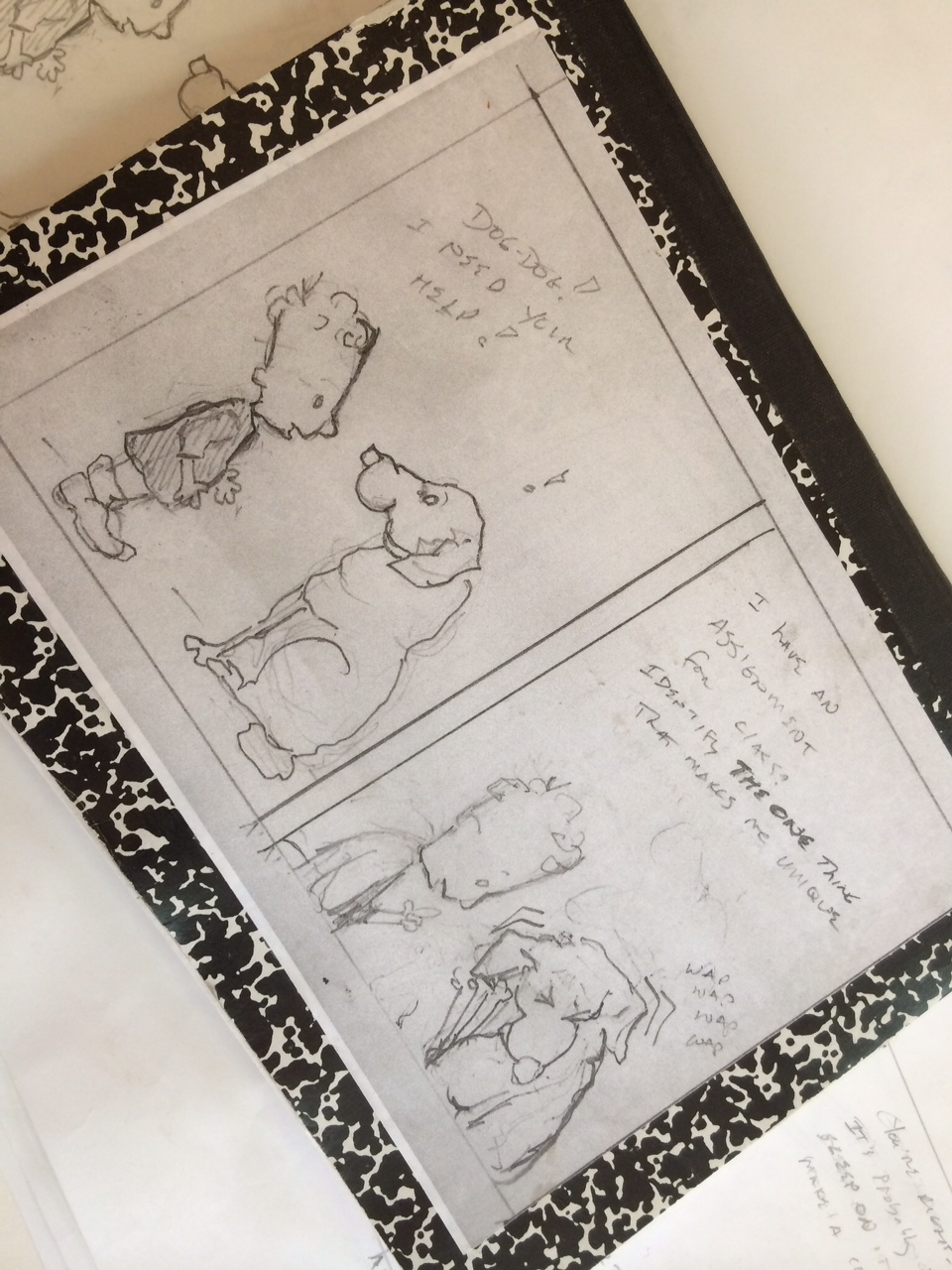
my idea book for our coming-soon cartoon, Chicken Marsala

my idea book for our coming-soon cartoon, Chicken Marsala

There is laughter coming from the next room. Across the way, a woman bursts into tears and a man with a ponytail leads her away from a group. They whisper. He tries to calm her. He makes her laugh. She wipes her eyes and they walk back to the group and all act as if nothing had happened. And, maybe nothing did happen. I am too far away to know the circumstances of her tears. I know the circumstances of her laughter.

Today it rained. I sat at my drafting table and worked on a cartoon strip. Tripper Dog-Dog-Dog sat at my feet. For the first time in over two years I streamed NPR and listened to the day’s news and some other stories. There was a story of a hunger strike in Chicago over the closure of a school. There was a story on public figures and apologies. There was an age-old story of the division in congress. I felt the same way listening to the news as I just felt watching the woman in tears. I am too far away to know the circumstances. I am too far away to know with certainty the truth of any of it. I’ve developed a healthy distrust of news reports. All I know with certainty is that truth is relative, truth is a point of view. I inked my drawings and listened as I might listen to a book-on-tape.

There is more laughter. It is coming from a meeting. I find comfort knowing that a committee in charge of anything can laugh. I hope that they are laughing at themselves.

Ann once told me that they key to success was to find a need and fill it. This world seems to have no shortage of needs. It does seem to have a shortage of laughter.

Recently, David shared with me his thoughts of Plato’s analogy of the cave. Perception as projection. It’s all shadows. Once I watched a Balinese shadow puppet master perform. The performances always take place in the outer ring of the temple and are meant to remind people that what they see in this life is a shadow, a projection merely. One of the messages: we are too far away to know Truth. Another message: our projections are worthy of our laughter and not much else. The puppet master had us rolling on the ground. His characters were mostly tricksters, stooges, and in their over-serious pursuits they were hysterical in their folly. Another message, perhaps the most important: the quickest route to the divine, to the connective tissue, is through laughter.


Wait For The Flow

The Weeping Man

The Weeping Man

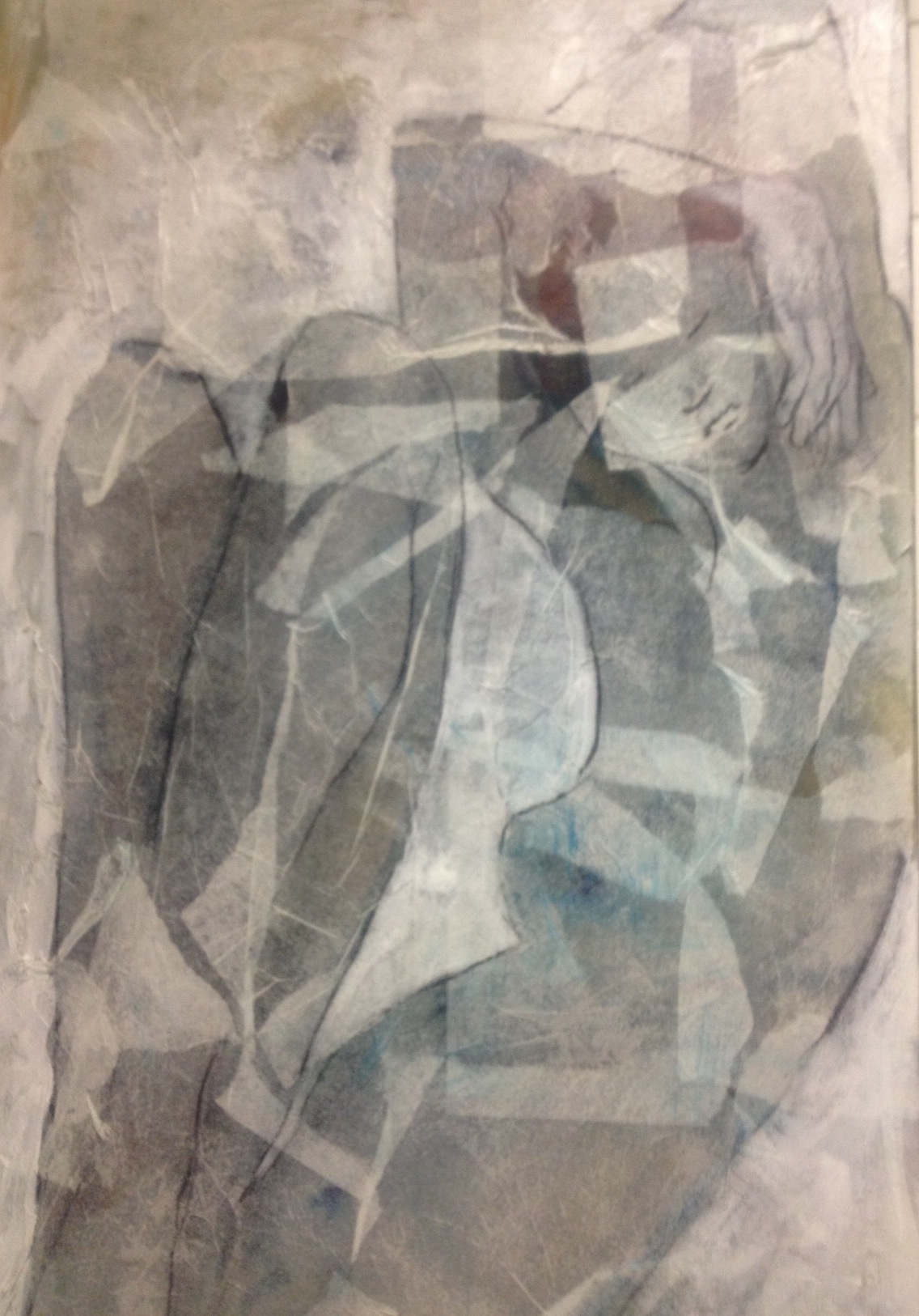
The Weeping Man is finished.

Sometimes the process of painting feels like wrestling with an angel: It will not release me. I will not let it go. We wrangle and discover the truth in each other. It is, as Quinn used to say of all relationships: “corrections as refinements”.

Sometimes a painting follows you for years and chooses its day. It chooses its time and simply steps into the light. It announces itself: “I am here now.” The Weeping Man was like that.

In my life I have painted hundreds of paintings and I can count a handful that are like The Weeping Man. Pure. In laying it out, I corrected one line. I added another. There are relatively few unnecessary brush strokes.

Flow is like that.

Answer The Question With A Question

carrying on the tradition (and my heroes): mike and sabrina bartram

carrying on the tradition (and my heroes): mike and sabrina bartram at Changing Faces Theatre Company

Many years ago at the start of my career I bumbled into running a summer theatre company. It would become one of the great gifts of my life. At the time I decided that it would be my laboratory. I’d be able to experiment with directing processes and actor training techniques. What I didn’t realize until much later was that I would also be running an experiment in business and, more importantly, how to create a community mindset of support and empowerment (and, therefore, achievement). I was free to succeed because I gave myself permission to focus on the quality of the process instead of worrying about hard and abstract words like ‘achievement.’ My bottom line was the inner growth of everyone in the company, the inner growth of the community that we served.

When the company was up and running, when it was mature, company members swept the parking lot because they knew it would make the play better (improving the audience experience always impacts the performance). The people running the box office prided themselves on their kind service and efficiency because they knew that it would make the play better. The actors understood that they were in service to the play and not themselves. In fact, everyone in the company was in service to something bigger than themselves. That was the culture of the company. When pushed to articulate the success of what we created together, I’d say, “We’re focusing on the important stuff.”

Yesterday with great intention I sent that phrase (focus on the important stuff) out into the e-stratosphere. I lobbed it in association with the company that Kerri and I are in the process of creating to see what would come back at me. Like the summer theatre company, this new venture is our laboratory. What came back was the question, “What’s the important stuff?”

Sometimes the only way to answer a question is with another question. Take a look around your world. Take a moment to look at the difference between what you say and what you do. What do you see? What do you want to see? Big power comes to people when, like my company members (students) of so long ago, they realize that their “seeing” isn’t passive. The greatest single power any human being has is to choose where they place their focus. The greatest single revelation any human being has is to recognize that what they see impacts everyone around them. No one does this walk alone.

the very first painting in the Yoga series. It was an experiment, a walk of discovery. It's also about being alone

the very first painting in the Yoga series. It was an experiment, a walk of discovery. It’s also about being alone.

It’s easy to place a focus on an obstacle. It’s very easy to fix a gaze on the problems. It’s easy because, left alone, believing we are alone, that’s where most people default. Place yourself in a community that knows there is something bigger, something more important to see and serve, and the field of possibilities becomes easy. My company members of so long ago didn’t know what they couldn’t do so they did everything they imagined. That was only possible because they imagined it together. So, answering a question with a question, to you, what’s the important stuff?


Focus On The Important Stuff

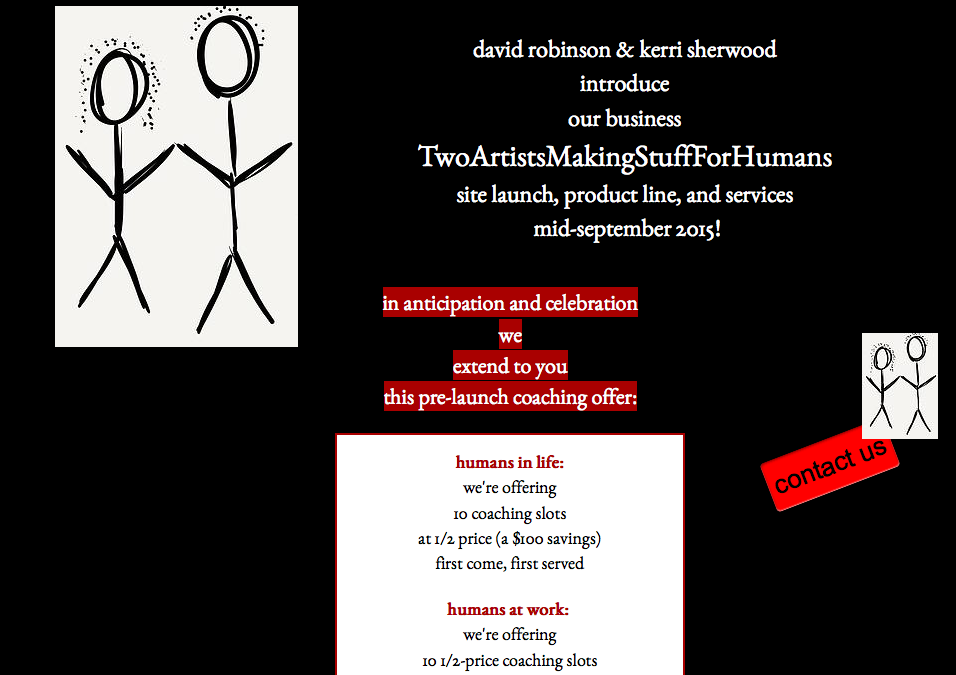
an offer from TwoArtistMakingStuffForHumans

an offer from TwoArtistMakingStuffForHumans

A note from the temporary site of TwoArtistsMakingStuffForHumans:

The waxing moon was muted with fog. It made the air shimmer. Avalon was near. Although it seemed too soon, there was a hint of autumn in the air. We sat next to a chiminea talking to friends. Monica told us of her daughter working in villages in South America. She told Monica that, by our standards, the people there have nothing. They are possession poor. But, they were happy, genuinely happy. They didn’t have much money or stuff but they had the essential thing that many of us lack: peace of mind. They focus on different, more important stuff.

It brought to mind my experiences in Bali. When I arrived all I could see was the poverty. By the time I left several weeks later, I’d have given everything I own or will ever own to have what they have: presence. Ease of mind. They weren’t looking for fulfillment, status, or living for retirement. They were living. Life was fulfillment. In a world where all things are sacred, status is gained by the quality of your giving and not by the size of your piece of the limited pie. It is a different focus.

There is a hidden cost to what dominates our focus, the things that take our attention…as opposed to the things we pay attention to.

As artists, both Kerri and I believe the work of our lives has been, one way or another, to help people focus on the important stuff, to see the extraordinary in the ordinary moment, to find inside what people seek outside. We’ve both worked across the boundaries of business, art, and the fine art of living everyday, there is no lack of necessity to refocus the eye, mind, and heart.

In a few weeks we will be launching our business (details to follow). All the many aspects of our work – if you can call art a product and performing a service – are intended to support, exercise and pay forward a focus on the important stuff, the important moments…sometimes the teeniest things that in the chaos pass unnoticed.

We want to do for others what we do for each other. Check out our pre-launch coaching offer. Take us up on it! Or, if you know someone who might benefit from working with us, pass it on, pay it forward.

Change They to We

photo-2

the next step in my painting, The Weeping Man. He’s nearly complete

The word that’s captured my recent attention is the word “they.” I’m captivated by language choices that might at first seem insignificant but, once unpacked, are profound. “They” is one of those words.

“They” caught my attention when 20 was making us dinner. His recipe included fennel and, until we googled it, we thought anise and fennel were the same thing. While we Googled for truth, Kerri asked, “Why would they name something twice?”

“Good question!” I replied and then asked, “Who are ‘they?'”

“Good question!” she echoed as the Google oracle brought us clarity about our fennel/anise confusion (as it turns out they are two different plants). Google was not very useful in clarifying who “they” were.

So, this week I listened for samples. Some of what I heard: “Why would they do that?” (a conversation about women in another culture). “They don’t care about us.” (what else, politics). “Don’t you think they cause their own problems?” (referring to a situation in a local minority community).

“They” can be a word of distancing, a word of exclusion. If you want to mess with the meaning, simply change the pronoun. For instance: why would we do that? We don’t we care about us. Don’t you thing we cause our own problems? “We” is inclusive. “We” makes us participants. “We” makes us culpable.

a detail of Weeping Man.

a detail of Weeping Man.

What if, in our current state of mis-education for instance, we stopped asking about our policy makers, “What are they doing?” And, instead, asked, “What are we doing?” What kind of action or meaningful discussion might ensue if we simply refused to use the word “they?” What if, as artists, we stopped asking, “Why don’t they get it?” and instead asked, “What don’t we get?” Artists do not create in a vacuum. Our expression might be individual and unique but without a community to receive, debate, appreciate, revile and otherwise engage it, has little purpose. After all, “they” are “we” if our language will allow us to see it.

the previous photo/stage I posted

the previous photo/stage I posted

Meditate On Mistakes

taking advantage of my mistakes: a detail of my latest painting in progress called Weeping Man

taking advantage of my mistakes: a detail of my latest painting in progress called Weeping Man

A meditation on mistakes:

Actors know. In performance, when they forget their line, they come alive. The exhilaration of forgetting shocks them into presence. The mistake achieves the essential thing: presence. The audience may not be aware of the lost line but they cannot help but come into presence when the actor does. That’s how it works. Presence begets presence. Actors also know that, in such a moment, tension is their enemy. Panic is counterproductive. Relaxation is the only path back to their play.

Mistakes wake us up.

Many years ago, I produced a summer theatre company. In the middle of a performance, a storm blew out the power to the theatre. The performance stopped. The emergency lights came on. The actors looked at the audience and the audience looked at the actors. And then, in the ghostly blue-white light, the actors continued their play. It was the one and only time that the play was riveting. Actors and audience alike became invested. They were together in an experience that was unique. It was, as are all true mistakes, unrepeatable.

the under painting and sketch.

the under painting and sketch.

The playwright John Guare wrote that a writer must write ten bad pages to arrive at the one good page. The writer must value the ten bad pages for the single good page to be possible. The ten bad pages, what educators, locked into testing regimens, might call mistakes, are necessary. Up front expectations of perfection are guarantees of mediocrity. No process is perfect – and that’s the point. Perfection, like happiness, comes after the fact. It is the blossom of a rich process. It ensues and only becomes available when mistakes are valued, when exploration is encouraged. A rich process is alive with trial and error, with strong offers that may or may not work. The strength of the offer, the capacity to make a grand mistake, learn, adjust and boldly offer again – is a great definition of freedom. It is otherwise known as vitality.

It’s what artists understand. When nothing seems to be working, when the most powerful offers fall flat, when paintings turn to mud, relaxation is the only path forward. There is comfort in knowing that the single good page is out there somewhere if only you keep making grand, luscious, brilliant mistakes.

Be An Avid Catcher Of Your Thoughts

TODAY’S FEATURED IDEA FOR HUMANS

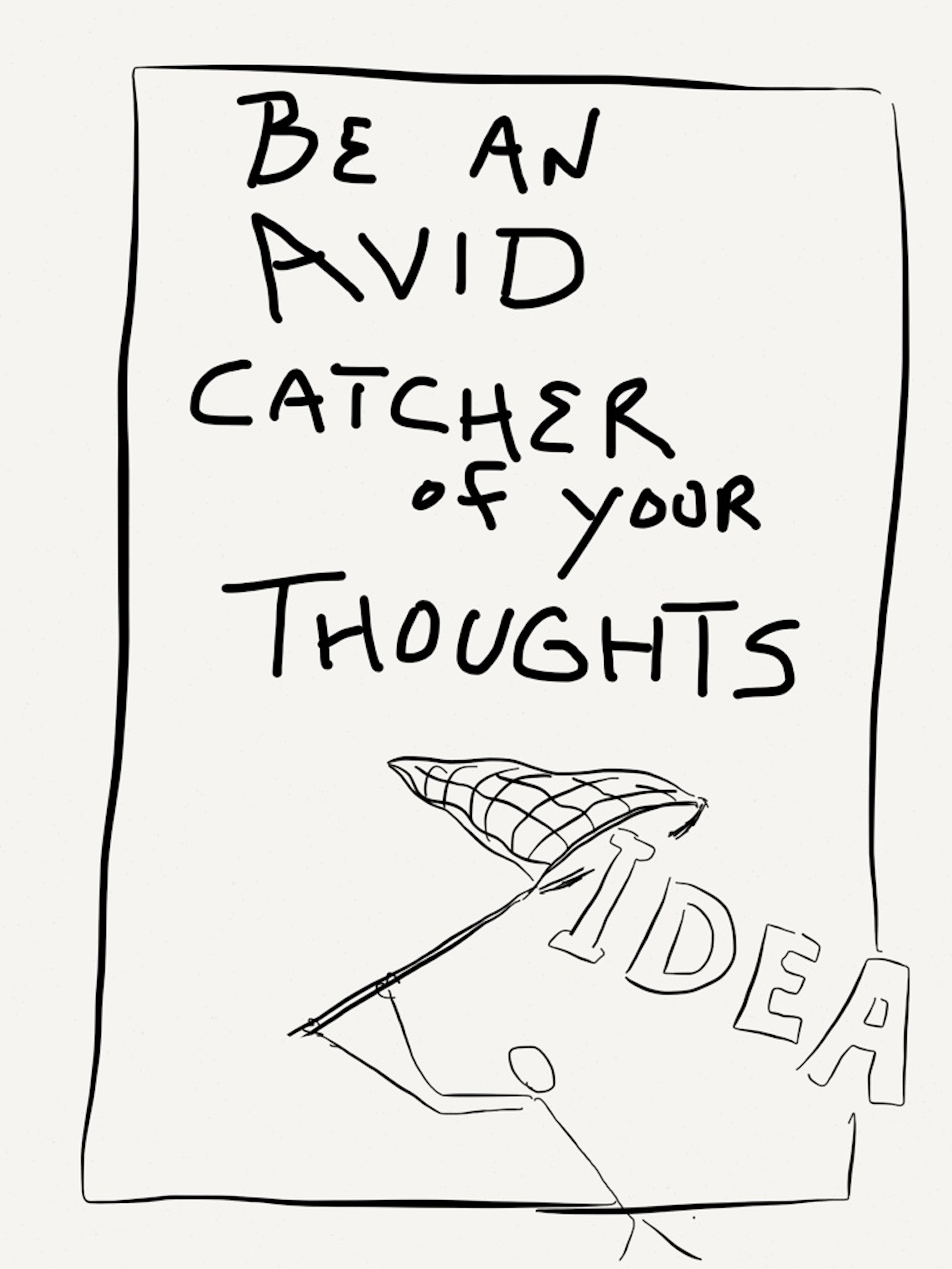
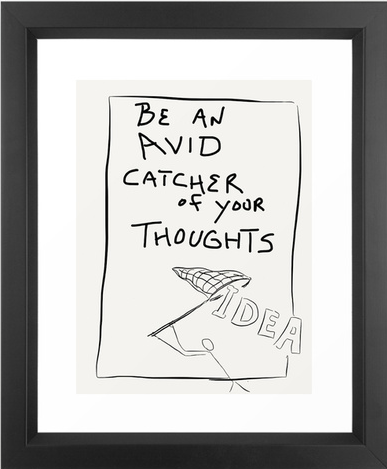
Be an avid catcher of your thoughts

This notion is the heart of change. It is the practice of self-awareness. Listen to the story you tell yourself about your self.  It is ripe with ideas, dreams, and yearnings. It is also ripe with fears, doubts, and comparisons. Capture the ideas. Listen to the dreams. Follow the yearnings. It’s a muscle. Develop a focus for the creative. Capture what’s useful and let the other jabber go.

Screen Shot Avid Catcher

TO GET TODAY’S FEATURED IDEA FOR HUMANS, GO HERE

Say More With Less

TODAY’S FEATURED THOUGHT FOR HUMANS

say more with less

One of my favorite humans is Master Jim Marsh. He told me a story of a dilemma. Something in his world was bugging him. He complained about it a lot. One day he realized that complaining was not helping. He said, “I decided I had 3 choices: to stop complaining, to move, or to do something about it.” He stopped complaining and began acting to change on what was bugging him. Sometimes talking about something makes us feel like we’re doing something. It’s a deflection. Actions, as we are told, speak louder than words. 

TO GET TODAY’S FEATURED THOUGHT FOR HUMANS, GO HERE.

Screen Shot Say More

There Is Wisdom In Dancing

TODAY’S FEATURED THOUGHT FOR HUMANS

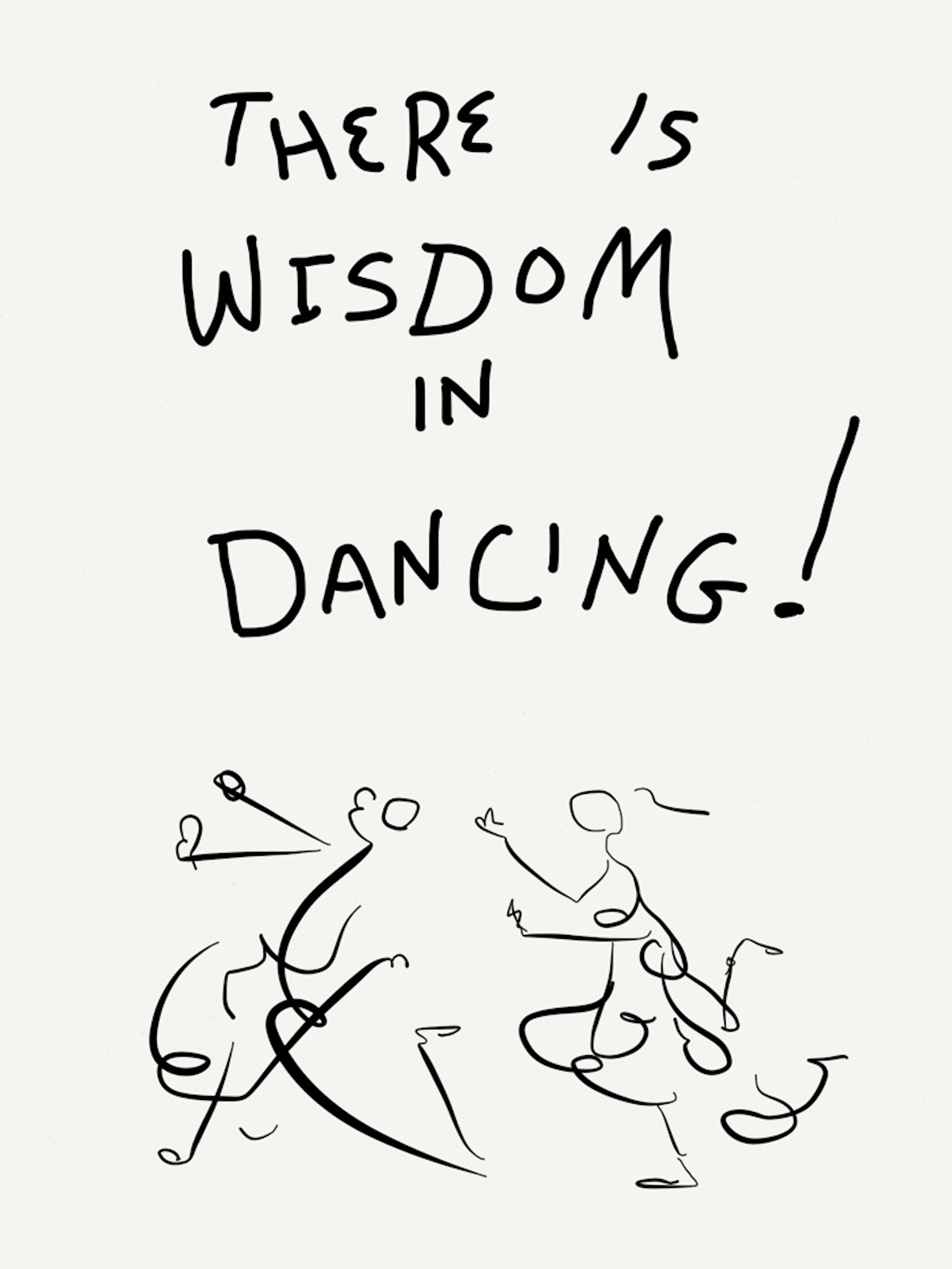
There is wisdom in dancing

To restate an old notion: knowledge is not wisdom. And, often times, our reliance on knowledge blinds us to wisdom (for instance, passing a test has little or nothing to do with learning). My mentors taught me that the toughest thing in life to master is relationship. The reason: relationship is at the heart of everything we do whether we acknowledge it or not. Life IS a relationship. Education, business, art, spirituality, leadership, management, self love, economics, agriculture, kindness, gratitude… are all relationship skills. Wisdom is found in the fields beyond your thinking. Get onto the floor of life and dance.

TO GET TODAY’S FEATURED THOUGHT FOR HUMANS, GO HERE.

Walk The Line Where Sky Meets Earth

TODAY’S FEATURED THOUGHT FOR HUMANS

Walk the line where earth meets sky

There is a concept that shows up in one form or another in all spiritual traditions: find the middle way. Finding the middle way is simply another way of saying ‘presence.’ Be present. Be where you are, not in the past, not in the future, here, in the middle place. Move out of the distant poles of right and wrong, us and them, red and blue, and walk in the actual, the present, instead of the conceptual. Deal with what’s in front of you instead of what you think is there. It’s a sound business practice, too. Guiding people to the middle way, to the line where sky meets earth, IS the artist’s job.

FOR TODAY’S FEATURED PRINT FOR HUMANS, GO HERE.