Ask The Gorilla [on DR Thursday]

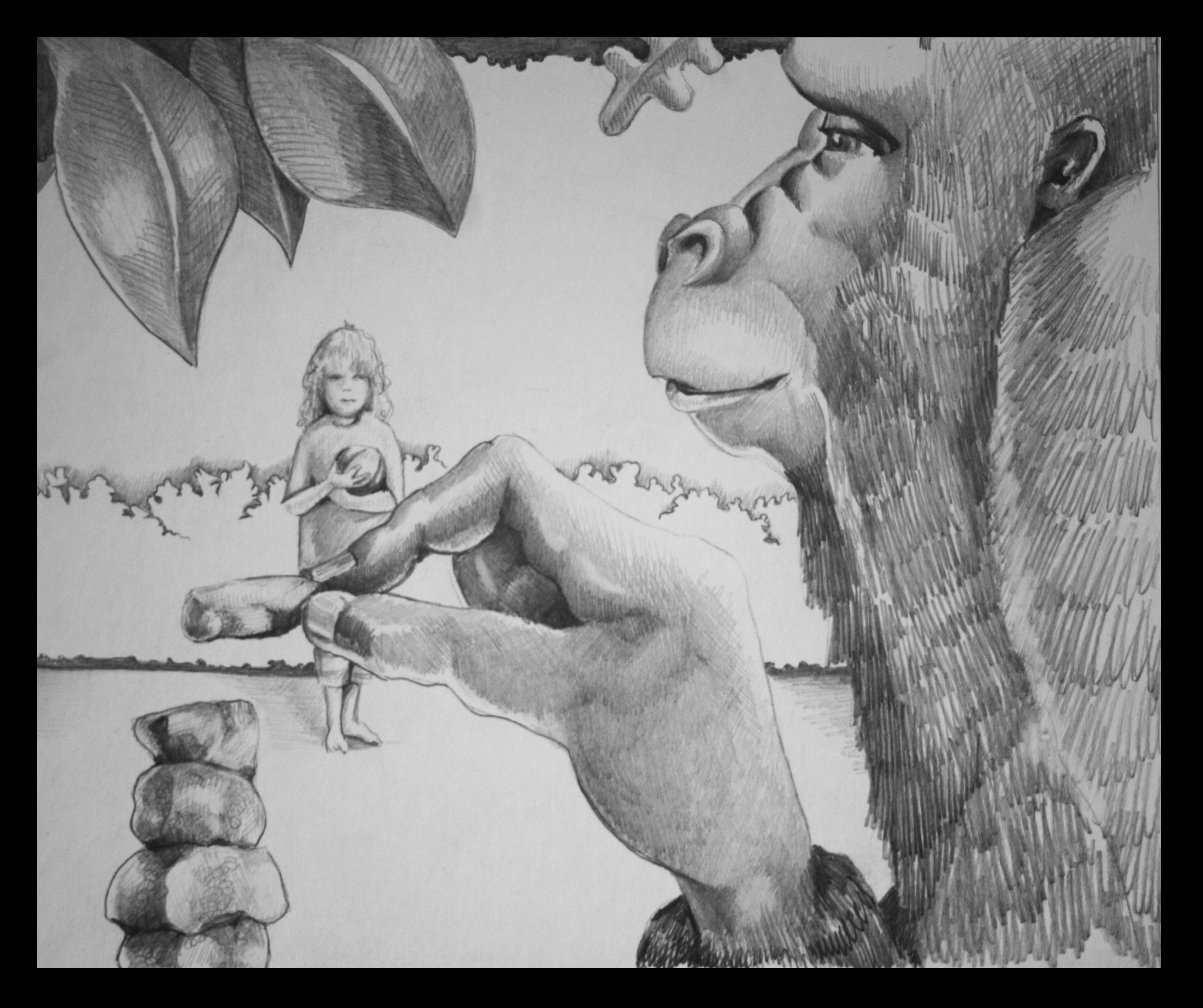
I’m not the first person to use a gorilla as the teacher in a story. This gorilla, in this story, is teaching the little girl the difference between playing-to-win and playing-to-become-a-better-player. The story begins when the girl asks the gorilla, “Do you want to play?” and the gorilla responds, “Well, it depends. What do you mean by ‘play’?”

It’s not a flippant question. It speaks directly to the “why” of what you do. The reason. Simon Sinek put this question at the center of his golden circle. James Carse wrote his philosophical masterpiece, Finite and Infinite Games, about this simple distinction.

Yesterday I had a conversation about success. A conversation about the difference between internal and external motivation. External motivators, like winning-as-your-why, are necessarily grounded in fear. What if you lose? Who are you if you fail? Winning at all cost will eventually lead to quagmires not unlike where the Republican party now finds itself. Obstruct. Lie. Gerrymander. Fix the vote. Fix the game. Any and all deeper value or ethic is sacrificed. There is always a cost when the “why” is as superficial as “to win.” The body seizes-up, loses its freedom of movement when fear of losing is the central driver of action. The nation-body, too.

The path to mastery cannot run through a win-lose “why.” Failure is an essential on a master’s path. Throw many pots, the metaphor from Art & Fear, is a mantra not only for artistic freedom, but for honing skills. Getting better and better at playing. See what happens. Playing to play, to become a better player, transcends and finally removes the word ‘failure.’ The body gains more and more freedom of movement when every action is a learning experience.

I wrote and illustrated this book back in my dark ages when I was facilitating diversity and inclusion trainings. Some companies hired us because they feared being sued. They feared losing money and had no real interest in diversity, inclusion, equality, fair play, betterment for their employees. They feared losing their privilege. Diversity initiatives ask that we stop rigging the game.

Other companies hired us because they truly desired to address the inequities in their organization. They wanted to step into their blind spots and see. They wanted to become better and better players in their communities. Early on we learned to distinguish between the fear-clients and those that were sincere. We became better players by choosing to work with organizations that were honest and sincere about their “why.” Players of infinite games.

I never attempted to publish Play-to-Play, my little illustrated meditation. Over the years I’ve given away some of the illustrations. It is one of the many stones I’ve stacked, pots I’ve thrown, the many projects and paintings that are literally stacked in my studio. It seems more relevant now than ever before. Yesterday, looking again at the illustrations, I told Kerri, “I should draw this again. I’m better now.”

She asked, “Why?”

I said, “Exactly.”

read Kerri’s blog post about STACKING STONES

play to play ©️ 2005 david robinson

Root Into The Worth [on KS Friday]

As Tom Mck used to say, “There are only three people in the United States qualified to review plays and none of them live in Stockton, CA.” His point: it’s best not to read your reviews but, if you must, don’t invest in what you find there. Good or bad, the review has little to say about the work of the artist and everything to say about the mind of the reviewer.

To be an artist is to be vulnerable. Vulnerability is an especially complex skill to master when the work of an artist is an open invitation for commentary.

The worst play I’ve ever seen got a standing ovation the night I saw it. Some of the best work I’ve ever done drew little or no audience. I directed a play that regularly had half the audience storm out of the theatre in anger while the other half was on its feet cheering; which half should I believe?

Many years ago I directed a play. One of my leading ladies had a family friend who was the theatre reviewer for the local paper. After opening night, my actress’ fine performance started to twist and sour. It was a mystery to me how her good work could go so bad. Later I learned that she was taking notes from the family friend. She lost herself in the cloudy opinion of an other and her performance suffered for it. She suffered for it.

Artists – not unlike everyone else – like to be liked. Most wait tables or teach lessons so they can pursue the thing they love. I use the word “love” purposefully. Most are regularly asked to give away their love/work for free on the empty promise of “exposure.” As Kerri says, “It’s hard to pay your rent with exposure.” It’s very, very easy for an artist to feel undervalued in a world where money defines value – while constantly being asked to perform for free. It makes being-liked an especially dangerous value-default.

Some of the greatest artists I’ve known lived marginal financial lives; financial success evaded them – but they knew without doubt the single secret that kept their work vital all of their lives: they alone were the judge of whether or not their work was good. They alone knew the pure driver of their pursuit. They knew the real danger of an artist’s life is to lose the purity of their artistic driver in the swamps of “being liked” or getting good reviews. They worked hard to stay centered and avoid becoming dancing bears at the circus.

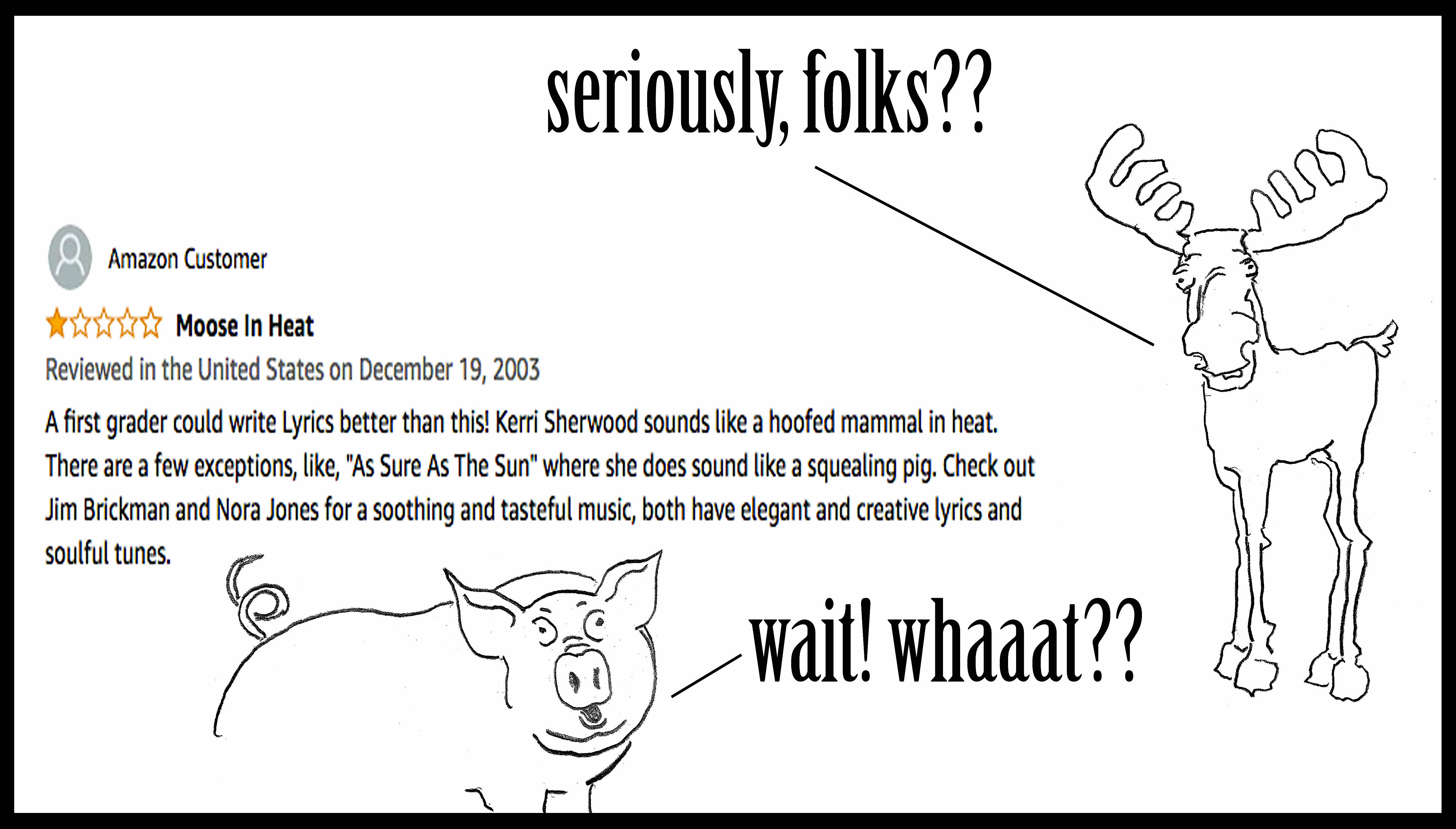
It was Tom’s greater point: only you – the artist -will know if your work is good or not, if you’ve truly found and pushed your edge or discovered new territory. You will know when your work is shallow. No accolade can change that. You will also know when your work is exceptional. No criticism can change that. Its best to root into the worth of your pursuit, to grow and learn, rather than gorge on the ever-abundant-opinions of others. Good or bad. Moose or pig.

read Kerri’s blog post on MOOSE IN HEAT

all of kerri’s albums are available on iTunes & on Pandora

Set It Free [on DR Thursday]

Horatio told me that, according to the happiness index, the good folks in Iceland sit atop the happiness-mountain. One reason, he explained, is that they’ve removed failure from their national equation. They cheer the effort, not the outcome.

Removing failure from the equation is the main ingredient for fun and success in all arenas, especially the arts. It is impossible to learn color theory without making some extraordinary messes. Ask a dancer how many times they tried and fell before they made that astounding leap look easy. Throw many pots and, over time, mastery will come – and mastery is nothing more than the understanding that there is no such thing as failure. It is the feel and touch of a long relationship with clay that can only come from not being afraid to throw it, to see what happens if…

Sometimes, no matter how hard I struggle with it or adjust it, a painting just isn’t working. Usually it doesn’t work because I’ve forgotten the rule about failure-removal. My brush is too timid. My brain is in the way. And yet, sometimes, in the middle of a painting that isn’t working, there is a small piece, the actual inspiration for the painting, that isn’t stilted, that remains alive and free of my fear. It’s easy to see. It captivates my eye, a warm island in the middle of a frozen sea. Every so often, rather than paint over the whole thing, I’ll lift the island, cut it out, set it free from it’s too-labored surroundings.

“Brutal,” Kerri said. “I liked that painting.”

“I’ll do another,” I replied. And maybe, I thought, another and another and another. Who knows, learning to cheer the effort takes some not-so-serious practice. It’s the only road back to the freedom of finger painting and the joy of playing in the sand.

Beautiful K.Dot, 12 x 9IN, mixed media

read Kerri’s blog post about CUT OUT

beautiful k.dot ©️ 2021 david robinson

Laugh At Yourself [on DR Thursday]

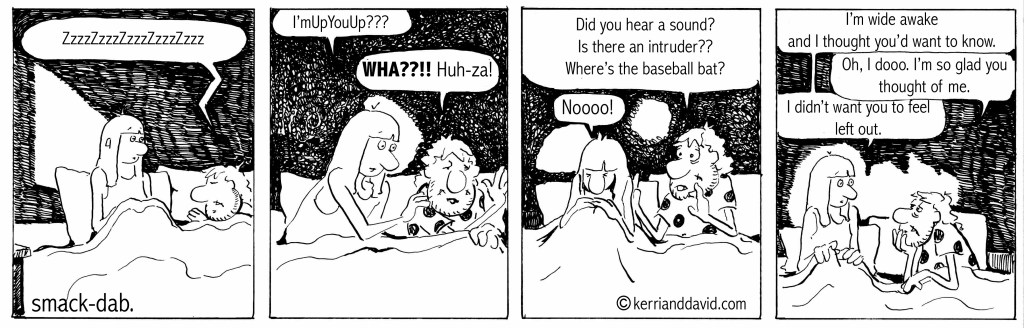
Had you come across our website during the era of The Roadtrip, a play that Kerri and I wrote from the several-months-email-conversation we had before we first met face-to-face, you’d have read this phrase: smack-dab in the middle of middle age…a true story of quiet hope and the arrival of life’s second chances.

Smack-dab. In the middle of middle age. We met. We married. We walk the neighborhood arm-in-arm. We write these blog posts each day. She brings her wise-eyes into my studio and I tell her what her music makes me feel and think.

For an intense year or so, we tried-like-crazy to syndicate a cartoon strip called Chicken Marsala, the imaginary child of two people who met smack-dab in the middle of middle age. In the course of writing and drawing Chicken, we also pitched a single-panel cartoon, Flawed, and another called At The Door. Chicken Marsala had several iterations because the syndicate liked it…almost. They asked for improvements though never specified what those improvements might be – in the writing? The art work? In this age of too much information, no answer ever came back to us.

In the face of unspecified and uncertain improvements, this ONE thing is certain: we generated a mountain of material in the hunt for the elusive improvement. Oh, and this, too: we laughed heartily at ourselves. The mountain of material was about us. We were poking fun at the things we do and say each day.

This morning I found Kerri furiously working at her computer guffawing. She’d pulled up the old Chicken file. There was an iteration of the strip that was pre-Chicken, the middle-aged couple prior to the appearance of their imaginary son. We sat this morning and laughed again at ourselves. These things actually happen and how joyful is it to chronicle yourself in-and-as a cartoon?

I suspect we are going back to the drawing board. This time, we’ll not hide behind our imaginary son. This time, we’ll pull the blankets on the source. Smack-dab. In the middle of middle age. Two artists met and got married. What could be a better set-up for ridiculousness?

read Kerri’s blog post introducing SMACK-DAB

*don’t believe a word she writes, she guffaws all of the time.

smack-dab ©️ 2021 david robinson & kerri sherwood

Come Look! [on Two Artists Tuesday]

“The artist finds, rather than creates and controls.” ~ Declan Donnellan

I’m not sure when I began including floral shapes in my paintings. I’ve always appreciated the shape of symbols and shapes as symbols. One day in my Seattle studio, I lined the walls with my most recent paintings and was surprised to discover leaves and plants and stems etched into figures and the spaces. My charcoal and paint flora was generic; they were not studies of plants nor in any way representational. They were shapes. They were accidental.

Even when my plant-shapes became intentional they remained generic, improvisational. I didn’t go outside and study the shapes of leaves. It never occurred to me to step into the field next to my studio and look at the plant life. I’m slow that way.

And then I met Kerri. We walk almost every day. While my mind wanders into the ethers and gets lost in the sky, she is busy looking at life’s minutiae. She stops often and takes photographs, usually of a tiny treasure. A forest flower. The bud about to burst on a limb. A butterfly nestled into the leaves. “Look!” she exclaims and kneels on the path, camera in hand. She navigates thorns, wades into tall grasses, climbs over rocks, all to get close enough to see, really see the miniature miracle.

Because she sees, I see. She is single-handedly responsible for my ongoing Georgia O’Keeffe revival. And what I’ve re-learned as Kerri beckons me to, “Come Look!” is that my vast imagination is not capable of creating the amazing shapes and colors and delights that surround me. I’ve been walking through this intense world of marvels my whole life and noticed only the smallest slice. The best I can do is pay attention and dance with what I find.

It’s humbling – as it should be. I’ll never be a better creator than nature because I am a creation of nature. In fact, I realize again and again that my job as an artist is not to create, it is to discover what is already right in front of my face. To open eyes – my eyes and others’ eyes – to the enormity of what already exists. The wild shapes, the dancing colors, the glow of life that I’ll never be able to capture, no matter how great my technique or pure my intention. The best I can do is point to the mystery, with symbol, shape and color, and say, as Kerri does for me each and every day, “Look! Come Look!”

read Kerri’s blog post about SUCCULENTS

Add Another Layer [on DR Thursday]

Were you to meet my easel in a dark alley it would, no doubt, frighten you. It’s big. Substantial. Rough. Weathered from hard life. Knobby, bent and encrusted.

I see it with different eyes. It is one of my most sacred possessions. It was given to me, a gift of celebration, following the opening of my very first solo show. Prior to its arrival in my life I propped my canvas on chairs or tables, I leaned them against walls, kneeling to paint. My easel allowed me to stand.

Caked in charcoal and layer upon layer of paint, artifacts of the hundreds of paintings that it has held for me, I find it beautiful. It has traveled with me through many states and life stages. Its main support is bent. It creaks when I adjust the angle or drop the arm. It occurred to me this morning, as I rebuild my studio following the great flood, that I also creak when my angles adjust, when my arms drop. We’ve aged together.

In a life with very few constants, my easel has served as my single steadfast companion through every move, every triumph, every tragedy. It has stood with me when I was artistically productive and a barren wasteland. It’s listened to me rant, ramble, and recite. It’s been witness to my laughter and my fears. It has been the silent sentinel during my mini-deaths and slow rebirths.

This morning, as I carried my easel back into the studio, I realized how out-of-order my world has felt. If my studio is in disarray, as it has been since the flood, I am also in disarray. Returning my easel to its proper spot in the studio I felt a flood of relief. All of my pieces are nearly put back together again. My trusty companion, my reliable easel and I will soon stand together, paint will spatter, charcoal and matte medium will crust another coating onto our already layered archaeology.

Art hollers. Possibility beckons.

read Kerri’s blog post about the EASEL

Complete The Ritual [on KS Friday]

One of the strangest rituals in directing plays comes in the closing hours of tech rehearsal. It is the final button, the cherry on the sundae; the last detail before the addition of the audience: choreographing the bow. The mechanics of gratitude. The curtain falls. The audience claps. The actors return to the stage to accept the appreciation. It’s important, in that moment, to know what to do and where to go. It’s important to know when to bow and when to vacate the stage.

It’s a mechanical moment made generous – made real – when the audience arrives. After having been led through a story or gifted with a performance, the curtain falls, the audience claps in appreciation. The actors, relieved and filled with gratitude, return to the stage and bow in thanks. Appreciation meets appreciation. The strange ritual of the previous day becomes the point of the whole exercise. Without the other, audience and performer, the storytelling is empty. We complete each other. We acknowledge in appreciation this absolute truth. My story is nothing without your witness. Your story is incomplete without my story. You applaud for me. I bow to you.

A major purpose of the artist is to remind the community of this truth. We are nothing without each other. We are capable of walking into impossible questions, when, together, we gather to share and complete a story.

Artistry is a service industry. It is humbling. It is meant to be humbling.

I sit staring at the screen. I am rewriting a script, a piece I performed with a symphony in 2008. I was terrified until the conductor lifted his baton. I remember very little after the first note was played. I came back into my body the moment the music concluded, my story told. The applause. I’ve never felt so small. I’ve never felt so full. Both.

The conductor wants to perform the piece again in 2022, only he asked that I revise the story, something that will speak directly to the issues of our times. The mechanics of writing. A strange ritual, this staring at the screen. I know the story I want to write. I wonder if I am up to this task. And then, I remind myself that this question, “Am I up for it?,” is the wrong question. It leads me to believe that I am alone in this creation. Of course I am not up for it! But, together, with the musicians, the conductor, the audience… Someday, after the mechanics, the rehearsal, the revision, the final button of preparation, we will gather and together, we will walk into impossible places, ask questions too big to be answered. Together, we will join hands and share the experience of a story. The curtain will fall. The audience will clap. The performers will bow. We will remind ourselves, as this strange ritual completes itself, that we are nothing without each other.

[I love this sculpture. Kerri keeps it close by her piano. The Bow by Duke Kruse.]

kerri’s albums are available on iTunes

See The Invisible [on Merely A Thought Monday]

“Oh my gosh!” She whispered. “These remind me of my mother!” She quickly pulled her camera from her purse and, to the amazement and amused curiosity of our fellow grocery shoppers, we had a straw-plate-holder photo shoot at the end cap of aisle 9.

It is, of course, among my favorite aspects of going through life with an artist wife. Everything is a story-thread. Everything is a possible composition, an opportunity for beauty. Everything is immediate. It is utterly unpredictable when the muse will strike. And, the immediacy of capturing the moment usually draws a crowd and she is blissfully unaware of the ruckus her immediate-story-composition creates. She is a rolling storm of performance art. I am the lucky one who gets to watch both the artist and the audience.

Augusto Boal, one of the developers of the Invisible Theatre, would be most proud of the unintentional performances Kerri creates. In an everyday setting, everyday life, a performance snaps an audience into awareness, shocks them out of their dulled sensibility, an audience that has no idea that it is functioning as an audience. Many stop to watch the crazed lady snap photos of straw-plate-holders as she tells sweet stories of her mother. Many scurry for the safety of anonymity. Either way, either response, a pure theatrical event takes place.

The performer scrutinizes her many photos, completely unaware of her performance. As she places her camera back in her purse, the audience immediately disperses, hopeful not to catch the attention of the performer and somehow be called into the play. They fold themselves back into the normalcy of their day.

But, something has changed. They have a story to tell, an unusual event happened in their day. The performer has touched back to her deep story and through her photographs, plucked her heart-threads.

And I have been the happy witness to art and artistry. All are fed by these lovely, oh so common, straw plate holders displayed at the end cap of aisle 9.

read Kerri’s blog post about STRAW PLATE HOLDERS

Prepare For The Jump [on DR Thursday]

On the upside, an in-studio-waterfall, after the shop-vac-a-go-go, the sodden-carpet-padding-removal, the baking-soda-ballet, amidst the-we-are-still-hunting-for-the-proper-gasket-to-stop-all-leaks-quest, an opportunity arises. It’s been awhile since I sat with my life’s work. It’s been awhile since I made time to stare at my paintings, each and every single one.

I confess that this year has been rife with artistic mourning. I have barely picked up a brush. I have sat in my studio like a visitor at a wake. I feel the emptiness as a loss and have asked myself the fear-question again and again, “Where did it go?”

One of my favorite books is Art & Fear. Recently, I flipped it open and read, “Your reach as a viewer is vastly greater than your reach as a maker. The art you experience may have originated a thousand miles away or a thousand years ago, but the art you can make is irrevocably bound to the times and places of your life. Limited by the very ground on which you stand.”

A second flip brought me to this passage about change: “Yet it’s demonstrably true that all of us do (from time to time) experience such conceptual jumps, and while ours may not affect the orbits of the planets, they markedly affect the way we engage with the world around us.”

The times of our life. The world, for us, stopped when Kerri broke her wrists. She was in casts when the pandemic washed over all of us. Our jobs disappeared. Our community fragmented. Our city burned with civil unrest, a young militia-boy murdered two people a few blocks from our home. My father took rapid steps toward the abyss. Kerri took a second fall, tore ligaments in an already injured wrist. Our BabyCat left us. We talk about 2019 as if it was decades ago. “Doesn’t it seem like years since we…”

I know this death I feel will find its springtime. There was a “me” before this time. There will be another “me” after. Sitting on the stairs, looking at my paintings, I know for the first time in a-year-that-feels-like-a-century, that a conceptual jump is bubbling. I remember the man who painted these paintings. I look forward to meeting the man who will one day pick up his brushes and dance with the muse again.

In the meantime, I sit with my paintings. I stand in the ground of my times. I will find the right gasket so water no longer rains into my studio. I will prepare for my jump by putting all of my pieces back together again.

read Kerri’s blog post about THE WATER STUDIO REVIEW

Really Look [on KS Friday]

20 watches the house, the dog and our very large cat when we are away. To keep us in touch with what’s going on at home, he sends us mystery photos: common things around our house made mysterious through an extreme close up or unusual angle. Our job is to solve the photo-riddle. I love the game because, no matter where we are, it instantly makes me look at the world in a different way. Or, better said, it makes me look. Really look.

I also appreciate the game because, upon returning home, I run around the house looking at the objects he transformed into enigmas. All that I have grown dull to seeing re-emerges as rich in color and shape and texture and story.

Kerri has the visual sensibility of a contemporary artist. She went down a path of music but might just as well aimed her artistry at the visual. Hers is a natural sense of design. Her camera might as well be an accessory or visual-opportunity-attachment since she moves through the day capturing photographs of passing detail. I’ve known her to be paying bills and jump up suddenly to catch the light on the wall or the texture of the door. Her eye is never passive. She and 20 are alike in that. They are visual twins with unique sensibilities and both serve to keep my eyes open and looking-beyond-what-I-think.

Yesterday, in mid-sentence, she stopped and said, “Oh! I want to show you something!” turned and ran down the hall. When I started to follow she said over her shoulder, “You can’t look! Stay there!” A minute later she returned, sheepish, and showed me the photo she’d just taken. “Do you know what this is?” she beamed. Too excited to wait for my answer she announced, “It’s the laundry chute! Isn’t it cool!” She walked away studying her photograph, muttering, “It’s so coooool.” I ran to the laundry chute to have a look. To really look as if for the very first time.

read Kerri’s blog post about THE CHUTE

find Kerri’s albums on iTunes