Posted on February 12, 2021 by davidrobinsoncreative
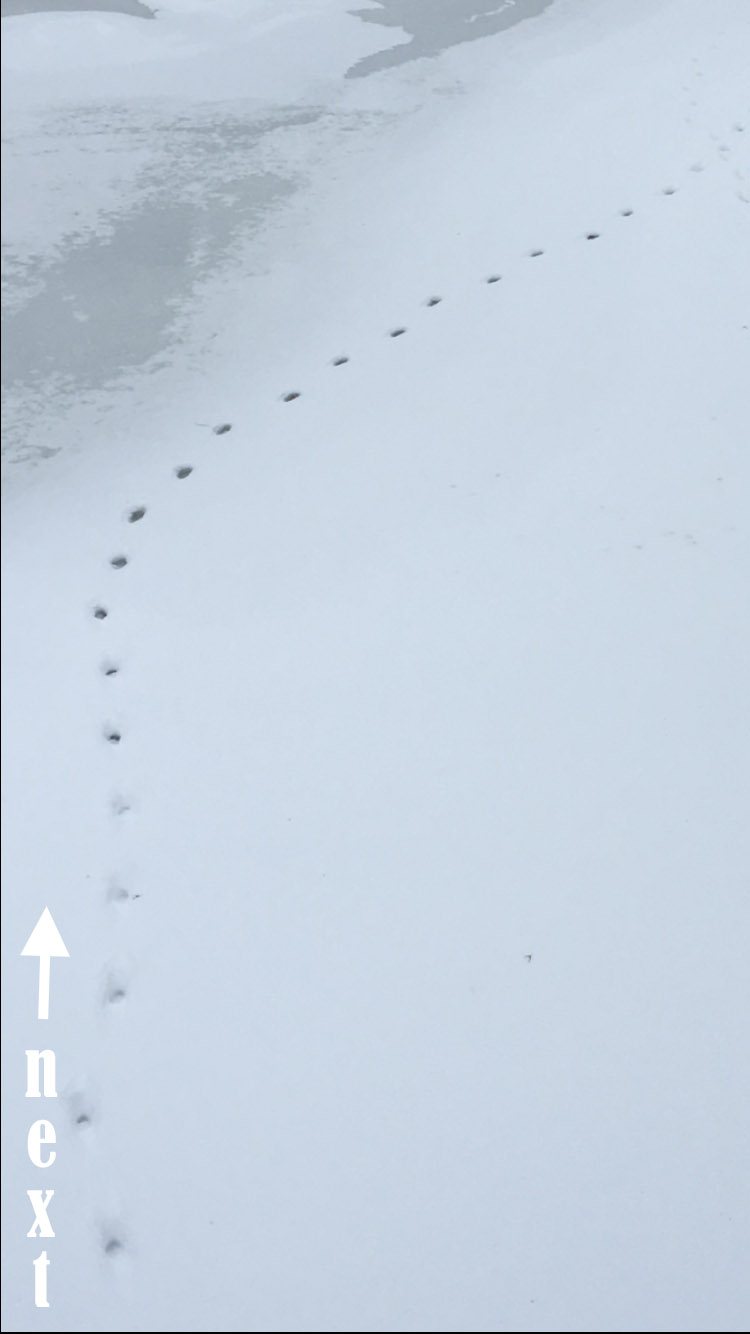
“Whenever the question comes up,/ the poets all say the same thing:/ the only poem we are interested in is in the next room,/ the one not written, the poem of tomorrow.” ~ Billy Collins, The Next Poem
I am trying not to focus on the next. The next chapter. The next day. This is a day of my life even if it is unfolding in a time of pandemic, of jobs lost, careers collapsed, broken-wrists-not-healing and my father’s slow disappearance.
Yesterday was hard. I made it so. Even before noon I was wishing the day away. I was anxious to get to the next. To stick a fork in it. Then, when the truck wouldn’t start, it was all too much. I could have shaken my fist at the sky but instead I decided to stop trying to be someplace else. I decided to feel the hurt. Be in the day.
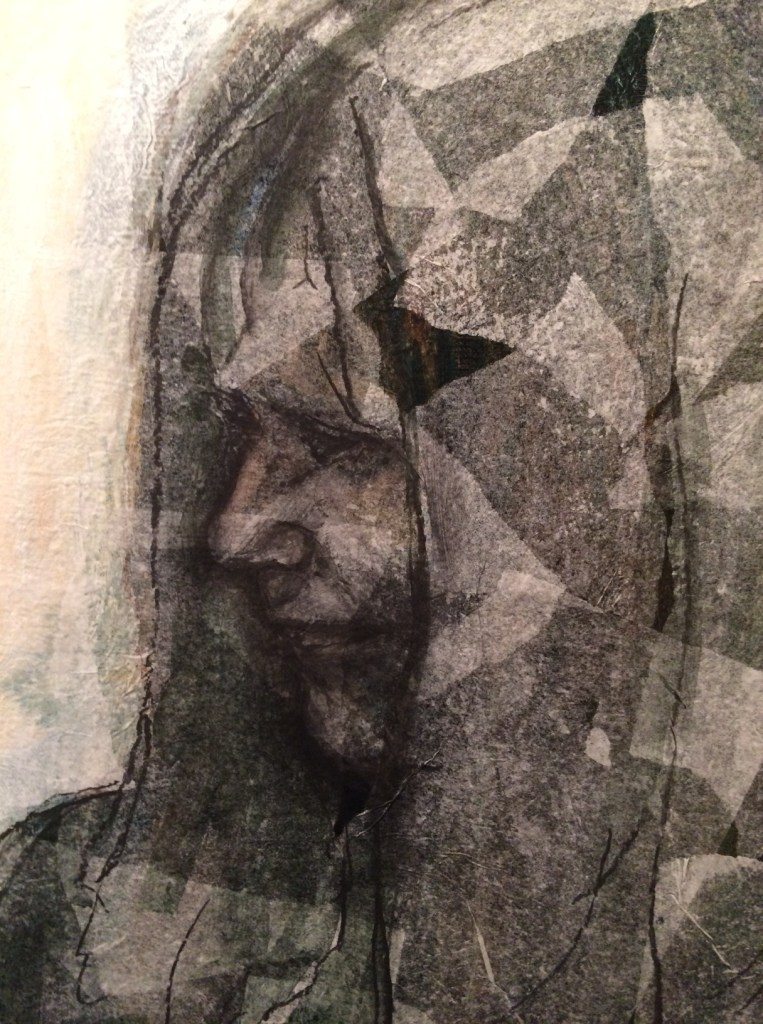
I miss my studio. That’s not quite right. I miss myself in my studio. I miss how I feel when I am working in it. Timeless. In that place, there is no next. In that place, I feel good, all things become possible. It is a staircase away. These days, it might as well be on the moon.
Mary Oliver wrote, “Next time what I’d do is look at/ the earth before saying anything.” This seems to me, as I approach a birthday, an age marker, a sunrise unlike any other, to be sage advice. See the miracle before I diminish it with my thinking, before I jam it into sackcloth with my opinions.
Once, on a bitter cold day, feeling blue, I leaned back against a red brick wall and closed my eyes. I felt the sun warm my bones and, in a snap, wanted to be no where else on earth. Try as you might, you cannot take that from me, the sun. The warmth against that wall. The absence of next. The boundless power of the snap.
Posted on February 11, 2021 by davidrobinsoncreative
I’m concerned. This is the 4th week in a row that Kerri has penned a new AT THE DOOR for use in our Melange. “This would be good for DR Thursday,” she says, showing me the latest draft. Originally, this cartoon was about the differences between DogDog and BabyCat; what they might think when staring out-into-the-world from the same door. Now, I fear Kerri’s new AT THE DOOR revival is about us. I am the dog. She is the cat. I am easily amused and too often state the obvious. She is more discerning and precise. I am, I confess, remedial. She can’t help but roll her eyes.
It’s not that I mind the cartoon comparison to DogDog. There are definite similarities. The circles I run are also counterclockwise. I am food driven. I want to run at every horizon simply to see what’s there. She is given to sitting in the sun, content in the bounds of the known, the delights of home.
Other comparisons of note: when BabyCat is hungry, he tortures the Dog. When Kerri is hungry, well, let’s just say that I spring into food-prep-mode for self-preservation. I can feel BabyCat’s stare boring a hole in the back of my head. Kerri’s stare has the same power. No. Words. Necessary. When DogDog is upset, he disappears into his safe spot. For him, it’s the bathroom. For me, it’s the studio.
Saturday – the day we choose our images for the upcoming week of the Melange – is fast approaching. I lay awake last night wondering what message or observation will come my way via AT THE DOOR. Last Saturday, before she showed me the cat’s commentary on the dog, dog = remedial, she was literally cackling. Looking at me and snickering. So was BabyCat!
Of course, it’s possible that AT THE DOOR has always been about us. It’s possible. DogDog and BabyCat, despite their vast differences, are constant companions and champions for the other. Just like us. I suspect that, if DogDog and BabyCat were to collaborate and pen a cartoon about us sitting at the door, staring into this vast wide-open universe, they’d snicker with love at our character collisions, a study in oppositions, and adore us and celebrate us, as we do them, weird quirks and all.
Posted on February 10, 2021 by davidrobinsoncreative
The snow was too dry. My snowman fell apart when I put the head on. “It doesn’t have to look like a snowman to be a snowman,” Kerri said to cheer me up.
“Maybe it’s modern art!” I quipped, using my if-it’s-a-mess-call-it-art default statement. As I walked down the trail, away from my unsuccessful snowman, I wondered when incoherence had become included in my definition of art.
I am and have been these many months doing some soul searching and life review. Walking down our snowy trail I remembered working with a dying theatre company. The first step in restoring their health and vitality was to help them face a simple truth: that they made the “art” did not necessarily make the “art” good. In fact, the “art” could not be good until their criteria for “good” wasn’t about them.
The challenge with “art” in the modern era is that it is nearly impossible to define. For purely masochistic reasons I looked up the word ‘art’ in the dictionary and nearly fell asleep before I finished reading the definition. “A diverse range of human activities involving the creation of visual, auditory, or performing artifacts…” Artifacts? The last lap of the definition reads, “…intended to be appreciated primarily for their beauty or emotional power.”
Beauty. Emotional power.
Of course, the contemporary world is awash in conceptual art and I read in my dictionary that this form of art, dating back to Duchamp in 1917, “…abandoned beauty, rarity and skill as measures.” Bananas taped to the wall. Statements.
Beauty abandoned. No emotional power necessary. But still “art.”
Art is, I’m told by historians and other scholars, a mirror of society. It is reflective of the era in which the artist lived. What a society values is made apparent in their art. It’s true.
Art, I believe, has a power and purpose far beyond mere appreciation. It is more than a mirror. It generates identity. It pulls disparate individuals to a common center. It affirms connectivity. It awakens us – and provides access to – that which is greater than any single individual. It bonds. It affirms. It transforms.
I wonder if our art, often so unrecognizable, sometimes incomprehensible, dependent upon curatorial interpretation, not concerned with beauty or rarity or skill or any other discernible measure, is not the perfect reflection of us. Narcissistic. Statements. Each day I am, like you, met by a tsunami of stories in the daily news revealing our collective confusion, our collapse of values, a commons at war with itself fueled by leaders stoking division for personal gain. Bananas taped to the wall. It is – we are – in our daily tales – so conceptual – so void of beauty or rarity or recognizable skill or measure – that it requires an anchor/curator to tell us why it – or we – might have meaning.
And then, just when I wonder if we are hopelessly lost, Amanda Gorman stepped up to the mic. The one true test of artistry is that we know it when we see it. No curator necessary. We are, we were, for a moment, bonded together in a way that no politician, no historian, no concept will ever understand or achieve.
I see it alive in Mike, and David, and Mark, and Chris. It glistens every time Kerri sits at the piano or composes a poem. It is not a mess though sometimes skill meets a happy-accident and, like penicillin, something healing emerges.
When we are washed away into the annals of time, what will be our art-love-letter to the future? What legacy – and art is a legacy – will we leave behind? What will I leave behind?
Posted on February 9, 2021 by davidrobinsoncreative
It lifted my spirits. David sent a short video, a snippet of a play. He called it “Sofa Shakespeare.” Using small toys from his son’s collection, he performed – and filmed – a puppet version – of Act 5, Scene 2 of Hamlet. “…we defy augury. There is special providence in the fall of a sparrow….” He’s a professor of theatre, a director and playwright, a major member of my inspiration-tribe. He is a bubbling wellspring of the creative.
We have a periodic-ongoing-for-years-conversation about Hamlet. The play is special to both of us. I’ve had two runs at Hamlet. Both were significant. Both productions popped open new doors of understanding for me. Both productions also came to me just before the floor-of-my-life collapsed. I’ve come to think of Hamlet as an omen. If today I was approached to direct it, I’d say “Yes,” but, inwardly, I’d think, “Uh-oh.” I would defy augury. Like Hamlet, I’ve come to realize that I have little or no control over my fate.
Later in the day, after Sofa Shakespeare, Kerri and I hit the trail. The sky stopped me in my tracks. It was winter-radiant. I felt as if I was standing between heaven and earth. Staring at this magical sky, Kerri asked, “What do you think is going to happen?” Our lives, like so many others during this pandemic, have been blasted into utter uncertainty. We ask this question daily, “What do you think will happen?”
“I don’t know. Something will happen. That’s for certain,” I respond. She punches my arm.
“Not helpful!” she grimaces.
Making choices. Making peace with your choices and your fate. Chasing ghosts. Asking the ethers for more information. “What does it mean?” Trying to decipher whether the ghost you chase is “a spirit of health or goblin damned.” Whether your ghost brings “airs from Heaven or blasts from hell…” What will happen?
Continuing down our snowy trail, more words from Hamlet rolled to the front of my brain. These words come at the beginning of the play: “There are more things in heaven and Earth, Horatio/Than are dreamt of in your philosophy.” At the end, “We defy augury.” This great magical world is beyond our capacity to grasp. Still, we must try. And, like Hamlet, the best we can do is arrive at peace with our uncertain fate.
“If it be now, ’tis not to come; if it be not to come, it will be now; if it be not now, yet it will come – the readiness is all.” Hamlet. Act V, ii
Posted on February 8, 2021 by davidrobinsoncreative
I read this morning in my brainpickings, “We have to try and cure our faults by attention and not by will.” Simone Weil.
Kerri and I walk almost everyday. We head for our known, usual trails, and only occasionally go in search of something new. Even though we walk a well-known path, it never fails to seem entirely new. Kerri attends to the details, taking photographs of unusual pine cones, a downy feather on a limb, the sun streaming through the trees. She pays attention. My awareness is more global, the movement of forest, the orchestra and dance of trees and wind. I pay attention.
Our walks bring us perspective when all else seems dark and disorderly. Our walks refill our well of hope when our circumstance seems bleak. Mostly, our walks “cure our faults,” they bring us into a present moment where all of life’s judgments and fears fall away as the illusions that they are. Our walks, if only for a few hours, wipe clean our canvas and return us to a childlike curiosity.
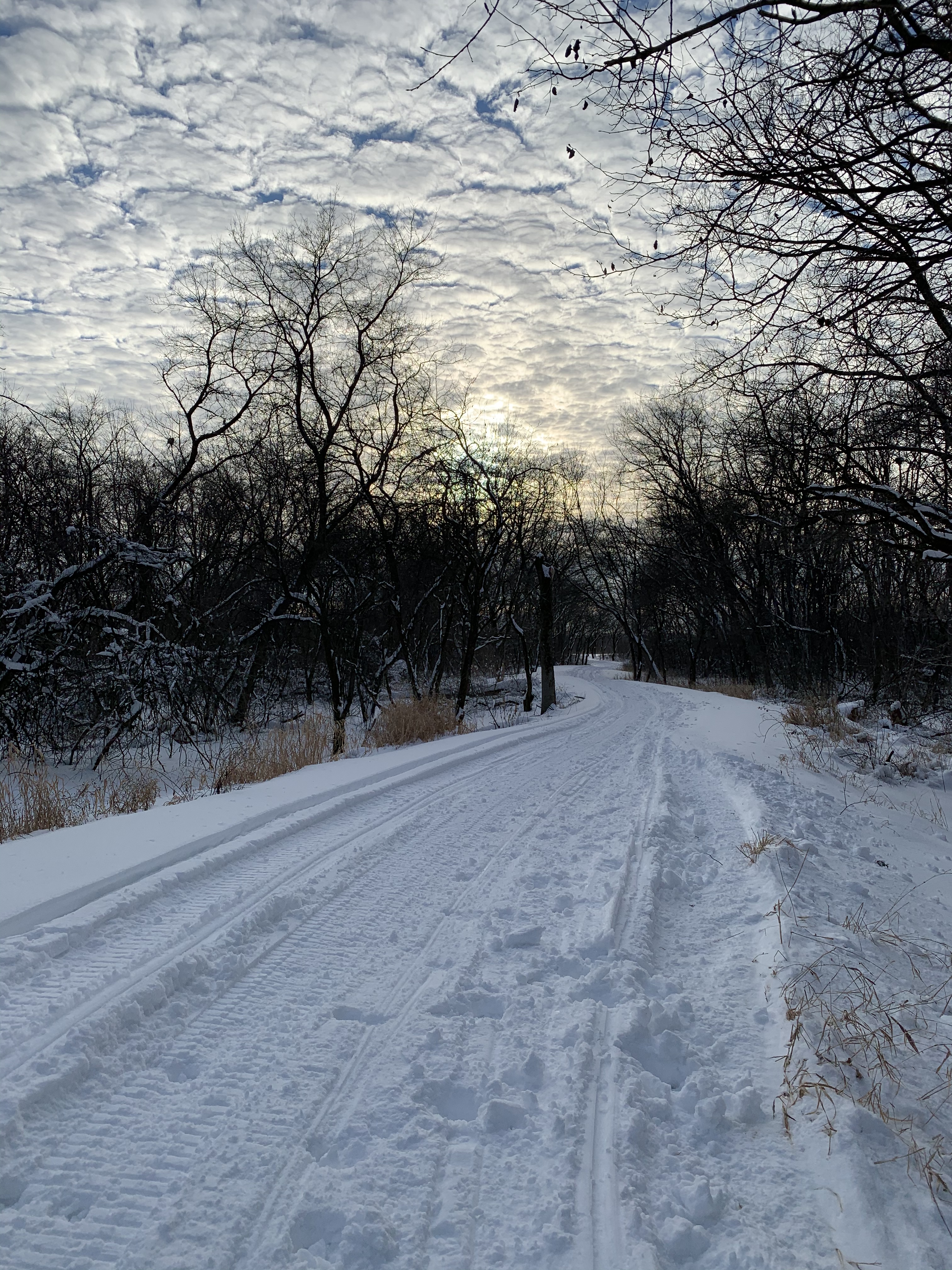
Sometimes, after a snowfall, we arrive at our trail and it is untouched. It never fails that we stand at the trailhead and marvel at the unblemished snow. Sometimes we hold hands and jump in with both feet and laugh. Sometimes we step carefully, quietly. Reverently. Either way, it seems a special gift. First steps are to be noted. Last steps are to be noted.
This morning I read an article about How Aging Shapes Narrative Identity. How the story-we-tell-ourselves-about-ourselves changes as we age. Our investments change. We become less interested in pursuits and achievements, in willful purpose. We become more interested in appreciation of our precious, limited moments. And, so, we begin to tell a different story. New snow on an old path.
The article was timely. Kerri and I lay awake most of the night. Among other things we pondered my dad’s dementia, the stories that he weaves and realities he inhabits. He is obsessed with going home.
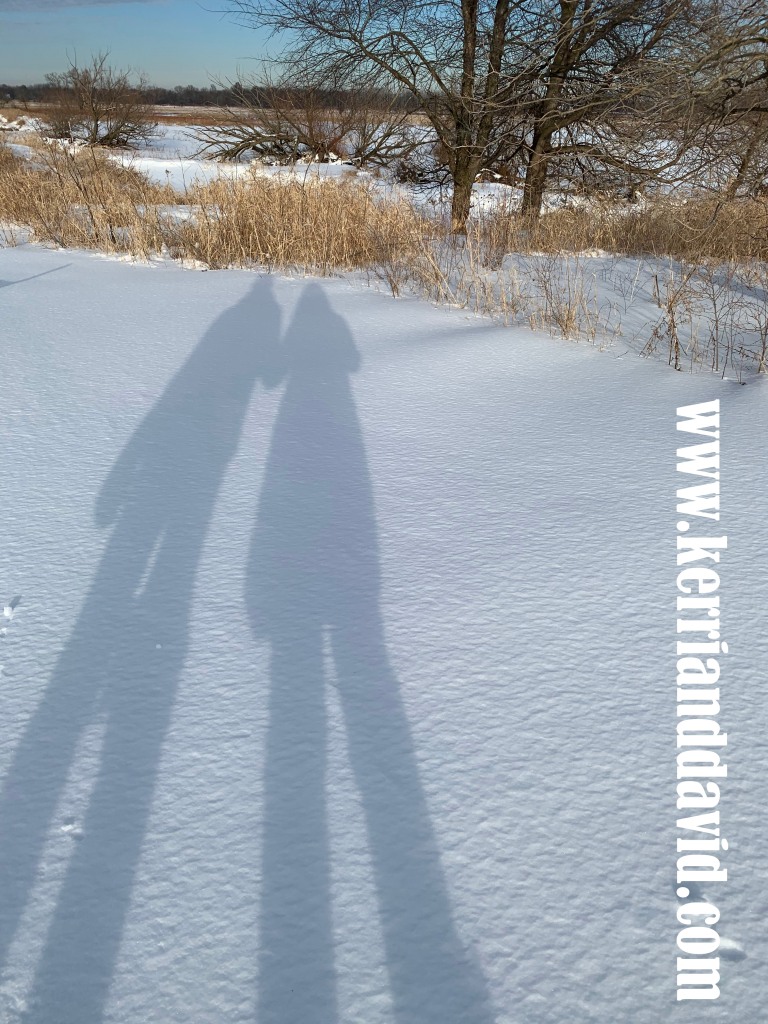
Deep in the night, we talked about the stories that we currently weave together as we grow older. It seems that this time in our lives is a blank canvas, a path of new and untouched snow. Standing at the trailhead of our next chapter, no steps to follow or map, neither of us has any desire to reinvent or become different than what we are. Certainly, the circumstances of our lives are changing, but more and more we merely want to pay attention. To hold hands and jump into the unbroken snow. To laugh. To note the downy feather in the tree. The wind song, the deer that surprise us, leaping through tall grasses. “Did you see them?” I whisper. Kerri nods and smiles. Reverence. Nothing in the world, at that moment, is more important.
Posted on February 5, 2021 by davidrobinsoncreative
When we were at the other end of life, Roger and I often discussed the “bodies” of artists’ work. The overview of their lifetime of work and what it revealed. We speculated about what our bodies of work might someday reveal. He is, and always has been, singular, a director of plays, certain of his path. His body of work would be – and has become – the plays he’s directed and the actors that he’s instructed. It’s an impressive body of work. I am, as Horatio calls me, a polymath. My body of work has never been certain. As Roger knew with clarity the destination of his path, I knew with curiosity that I would be a wanderer. The path was and continues to be my destination.
In other words, I’m all over the map. It’s visible in my paintings. I dare anyone to make linear sense of my resume.
Tom Mck hired me because, in his words, I was a “Johnny Appleseed.” When he was old, he told me that he turned me loose in the schools to see what I’d stir up and also what I’d plant. It was one of my favorite “jobs” because it came without a description. I followed the fires. I found the need. I brought art and stories to hearts and minds grown arid from the pursuit of dusty answers.
Tom was a brilliant theatre artist and teacher. His body of work was immense. I was surprised, at the end of his life, when he told me that he rarely thought of the plays he’d directed. He believed his best work, the work that he most loved and defined him – his real body of work – was at the very beginning of his teaching career. He was assigned a 2nd grade class and had no idea what to do with them. So, his curriculum was to invent stories with them. They traveled the world as pirates, went on safari, designed and priced supply lists and mapped routes. Math and history and geography. For weeks they prepared for a day of being blind. What would they need to do to spend an entire day safely learning what it was to be without sight? Curiosity and discovery. Empathy. Inner and outer worlds. He ignited and followed their imaginations. Tom was a polymath, too. He was a Johnny Appleseed.
Today marks Kerri and my 156th week of consecutive posts. 3 years, 5 days a week. My wife is a poet and composer and pianist and teacher and singer/songwriter and recording artist and business owner and photographer and designer. A polymath. After breakfast each morning, we write. It occurred to me recently that my body of work, when all is said and done, will be my posts. I’ve directed many plays, performed many plays, written some really bad plays and a few good ones, consulted with corporations, performed stories at conferences and with symphonies, painted and shown paintings, written children’s books, taught and facilitated workshops and dug ditches and delivered warm bread to grocery stores. I started an experiential learning school, a diversity and inclusion training company, and coached people from all over the world. All of my wandering has provided a rich field of experiences to pull from, to ponder and reflect.
Sometimes (more times than I care to count) I ask myself, “How did I get here?” These days, in the pandemic era, I have plenty of time to look back on my road, on my body of work. “How” is a question that can only be answered after the fact. ‘How do we do it?” tops my list of most useless questions. How did I get here? What is my body of work? I turn around and look where I’ve traveled, where I’m from, and write myself into coherence.
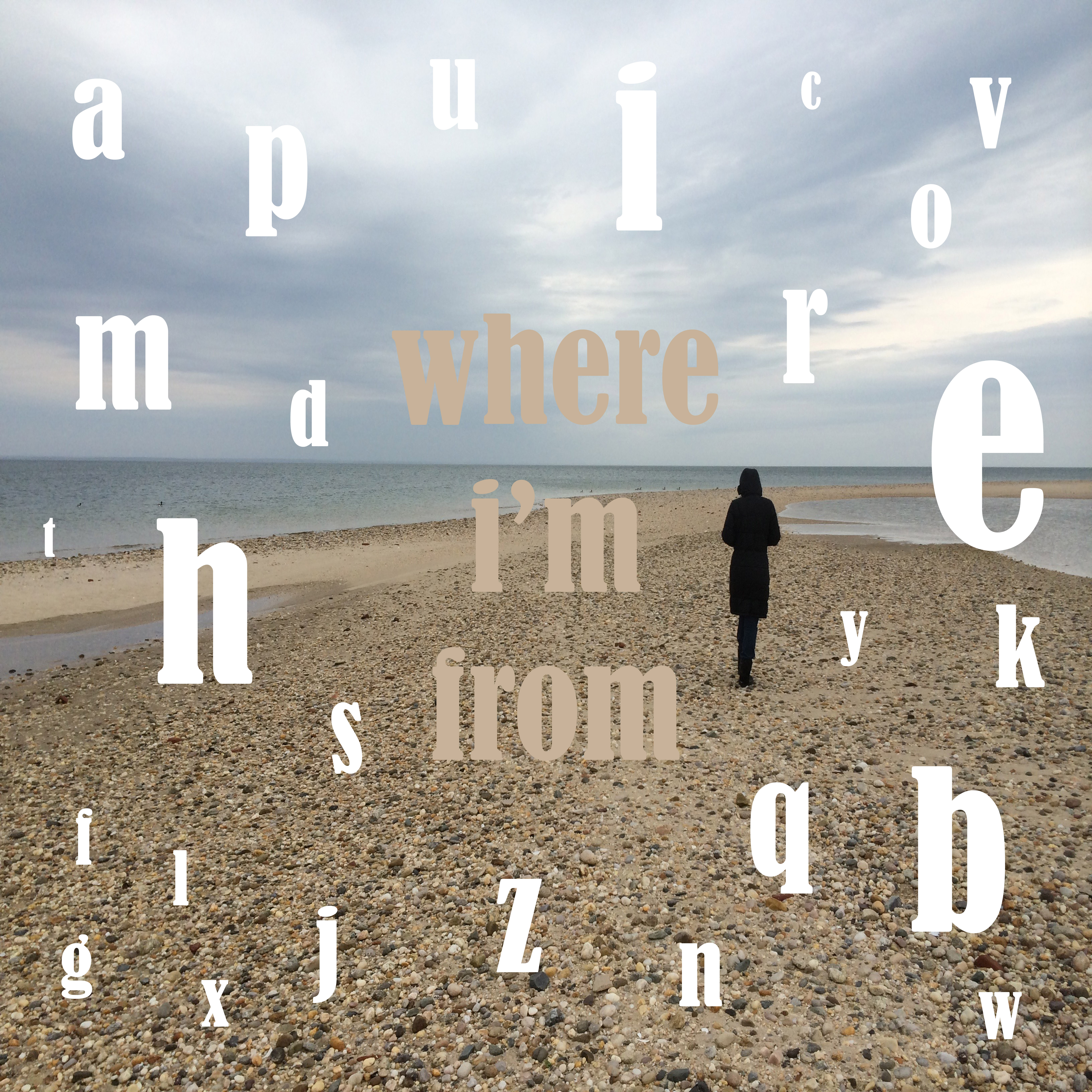
where i’m from/blueprint for my soul is available on iTunes
Posted on February 4, 2021 by davidrobinsoncreative
“As Huxley remarked in Brave New World Revisited, the civil libertarians and rationalists, who are ever on the alert to oppose tyranny, ‘failed to take into account man’s almost infinite appetite for distractions.”‘ ~ Neil Postman, Amusing Ourselves To Death
Any day now I’m going to watch the 1976 movie, Network. It’s the film equivalent of a crystal ball to our current predicament. A veteran news anchorman loses it on air, threatens to kill himself, but instead goes on a full-blown rant. The network’s ratings skyrocket. An ambitious producer recognizes and exploits the opportunity by creating more and more outrageous programming. Fact falls prey to profitable fiction sold as truth. Ratings imperatives eclipse the north star of accuracy-in-reporting. Roger Ailes created his Fox News Network on the same premise; no veracity necessary. People like a good train wreck, just ask Jerry Springer. It is why the nation is so divided. The blues use news to sort out the lies; the reds use lies to siphon off the truth.
“Contrary to common belief even among the educated, Huxley [Brave New World] and Orwell [1984] did not prophesy the same thing. Orwell warns that we will be overcome by an externally imposed oppression. But in Huxley‘s vision, no Big Brother is required to deprive people of their autonomy, maturity and history. As he saw it, people will come to love their oppression, to adore the technologies that undo their capacities to think.” ~Neil Postman, Amusing Ourselves To Death
Neil Postman wrote Amusing Ourselves To Death before Facebook and Twitter were glimmers in their inventors’ eyes, before the internet hit the personal computer, before multiple channels on cable networks. We have, as Postman wrote, an infinite appetite for distraction with nary a need for honesty. And, as we are witnessing, distraction has arrived in the halls of Congress. We’ve now a party in government that actively shuns verity and raises funds on peddling fallacy.
“When a population becomes distracted by trivia, when cultural life is redefined as a perpetual round of entertainments, when serious public conversation becomes a form of baby-talk, when, in short, a people become an audience, and their public business a vaudeville act, then a nation finds itself at risk; culture-death is a clear possibility.” Neil Postman, Amusing Ourselves To Death.
We are a nation that finds itself at risk. In my post yesterday I wrote that I no longer wonder how a society can willingly and knowingly take itself down. We have front row seats. And yet, the road to our recovery is as simple (and as difficult) as a collective valuing of the truth over ratings or poll numbers or bubbles. We worship at the wrong altar. We are inundated with info-dross. We would be better off if ratings plummeted every time a pundit ranted, a politician bullied, or a commentator lied. We’d be better off if thinking, if fact-checking, was a prerequisite to posting or tweeting or speaking. We’d find ourselves in a shared center, a place of possibility built on a generous commitment to probity.
“For in the end, he [Huxley] was trying to tell us what afflicted the people in ‘Brave New World’ was not that they were laughing instead of thinking, but that they did not know what they were laughing about and why they had stopped thinking.” ~ Neil Postman, Amusing Ourselves To Death
Posted on February 3, 2021 by davidrobinsoncreative
Last night it snowed. I had to pry open the back door and shovel so I could let Dogga out. It is snowing now. We are lying low, appreciating the quiet that comes with winter.
Societies have seasons, too, though their winters look more like forest fires than bears sleeping.
I remember standing atop a Mayan pyramid in Belize, having just read Jared Diamond’s book, Collapse, and wondering how it was possible that such an advanced society didn’t see their demise coming. As NASA Science aptly wrote, “They Did It To Themselves.” It’s hard to see the mountain when you are sitting on it, I suppose.
I no longer wonder how societies do-it-to-themselves as I feel I have a historical front row seat of our unwavering commitment to collapse. We are following a well-known pattern, a rat trail of self-destruction. We are not the first society to impact our temperatures, to influence our rainfall. We are, however, the first to do it on a global scale.
There are so many people ringing the alarm of climate change, the science is incontrovertible, yet overpowering evidence is no match for dedicated human denial. Ignorance is, in this case, to ignore. Action will hurt the markets. Non-action, of course, could destroy life as we know it. We will not be the first society to sacrifice the greater for the lesser, to throw away the essential by protecting the luxury. We will not be the first to ask, “How did that happen?”
The Maya did not cope well when their problems emerged. They doubled down in hearty denial until all resources were exhausted. They waited until their crisis was full blown before attempting to deal with it. The survival odds are better by planning for the hurricane before it hits.
And us? We are on the Mayan path. It seems that we are, like they were, penny wise and pound foolish.
Despite evidence to the contrary, I am not nihilistic or hopeless. In fact, quite the opposite. As Rich used to say, when the pain of change is greater than the pain of staying the same, people get moving. The levels of pain are rising on all fronts. The problems are more than perceptible and it’s debatable about whether or not the crisis has fully arrived. What we’re experiencing could be the very beginning of movement, the willingness to face ourselves and take a good hard look at what we value. It might be the leading edge of courage.
Posted on February 1, 2021 by davidrobinsoncreative
“Look” is the new “um.” It now lives among the tribe of words used as placeholders, thought-launching-pads, or mental-composition-vocables.
I had a professor that cleared his throat when composing his thoughts. That semester nearly killed me. I lost all contact with the content of his lectures in the cacophony of throat-clearing. I spent entire lectures either writhing in my seat or wondering what happened in his life to develop such an odd vocal tick. I’m certain Sarah Jessica Parker based her throat-clearing-character in The Family Stone on my professor. Each week I sat in the lecture hall and wondered if he was terrified when speaking in public or perhaps he was fearful of not expressing thoughts clearly. That odd-socks-thought-train sent me down a rabbit hole of pondering weird karma. It’s a wonder I passed his class (or any class, for that matter).
“Look” is significantly different than “um” or throat clearing. There’s a very important nuance to note: it assumes authority. It’s a directive. “Take note!” “Consider this!” It’s a placeholder with a purpose. It’s as if everyone on the public stage secretly doubts their credibility or must demonstrate their sway.
Perhaps it’s the cabin fever that comes with believing in the pandemic, perhaps it is the state of politics and pundits in these media-cleaved-united-states, but we’ve become fascinated by the ubiquitous “Look.” It regularly launches politician replies and reporters’ reports. At first we merely glanced at each other, “Did you hear it, too?” Then we counted. We passed through the cheering phase. We even considered making it a drinking game – take a sip every time we hear “Look” – but decided against it for obvious reasons.
Instead of a drinking game we’ve lapsed into mimicry. “What do you want for dinner?” Kerri might ask. My reply, “Look, I’ve surveyed my belly and 85% of tummy-grumbling prefers pasta over all other candidates.”
Without missing a beat, she counters, “Look, your data is clearly partisan since the people are voting for chicken soup.”
“Look,” I say, gathering my thought for a response, “I’m willing to work with you here. My caucus will support your chicken soup if you’ll guarantee chocolate sometime before bedtime.”
She stares her best stare of thoughtful consideration. “Well, look,” she replies, extending her pause, “I think we can make that happen.”














 The Direction of Intention