Seed The Pocket [on Flawed Wednesday]

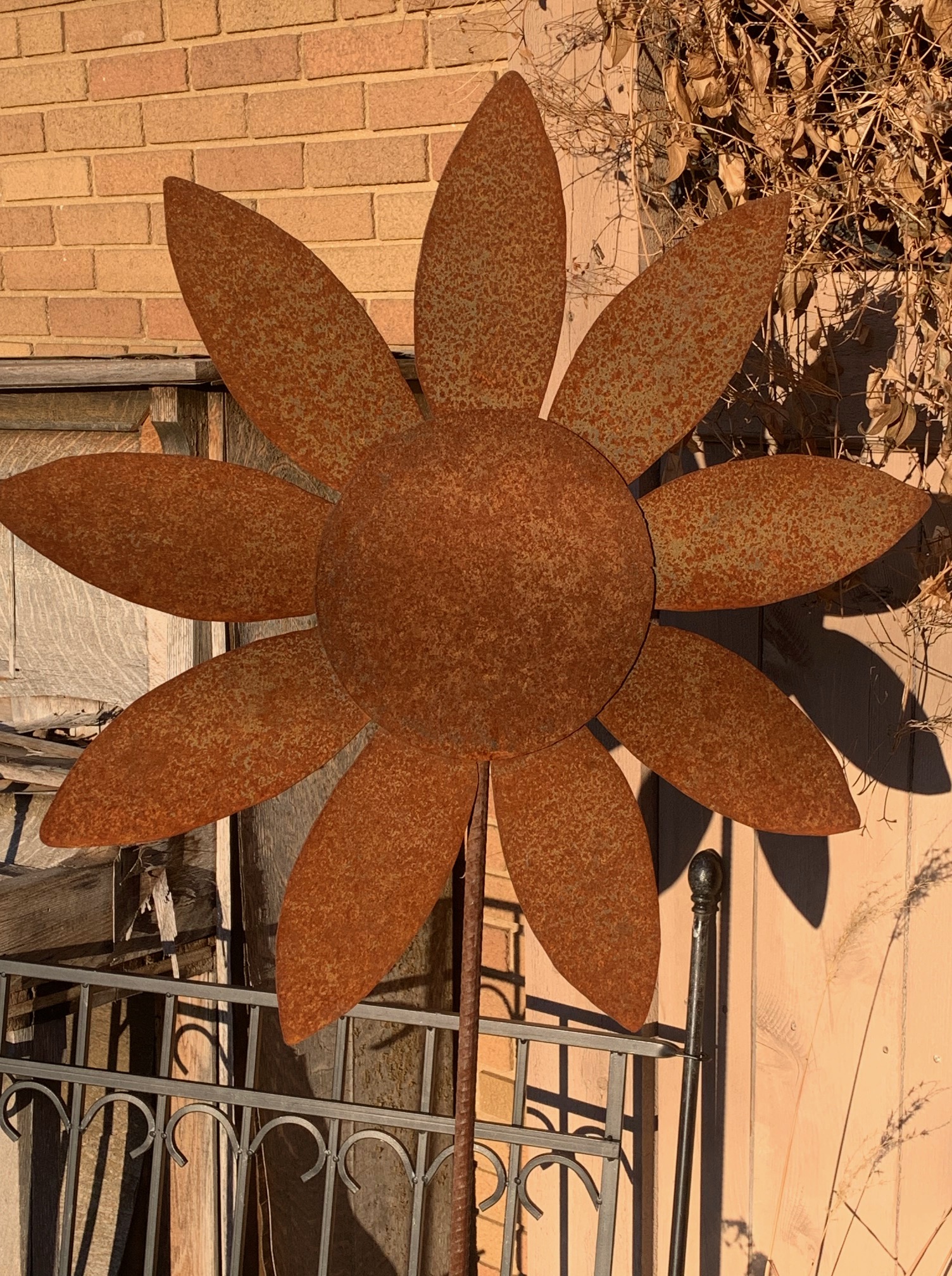
I’ve appreciated this sunflower for many years and until a month ago it never made me think of Ukraine. Now, that’s all I see. Thus, the power of a symbol. Sunflower seeds placed into the pockets of Russian soldiers by brave Ukrainian elders. “So, some good may come from your death.”

Walking through the antique mall, Brad spotted an ugly homemade sculpture. Golf balls with multiple screws protruding, spray painted and supported by wire rods. “Look, the coronavirus!” he exclaimed. Three years ago spheres with spiky knobs would have made me wrinkle my brow but never associate the shape with a virus. Now?

And masks? Will we ever see a surgical mask without feeling the divide in our nation? A confederate flag paraded through the Capitol? Members of the Capitol Police beaten with the stars and stripes; symbols matter.

Every year more and more our written communication is reimagined with emojis. Visual symbols. The new Ideogram. A thumbs up. A heart. Laughing face. Saying more with less or at the very least opening up our communication to broader interpretation. I find that I’m symbolically rolling my eyes more and more. Exclamation point. HAHA! Know what I mean? Winky face.

Leonard Shlain wrote some remarkable books about how our brains are wired by how we communicate; he posits that linear language, the introduction of writing drove us into our left brains and away from our holistic right. Perhaps in our movement back toward the ideogram we are rebalancing? A course correction or returning to center? It takes more than a few years for brains to rewire. Our descendants will, no doubt, either write books about it or communicate their thoughts through a combo platter of alphabet and pictograph.

Either way, we can only hope they grasp the meaning of the peace symbol. Or, at the very least, learn how to give it more preference than the dollar sign. Or, better yet, figure out how to make peace profitable. Can you imagine? Certainly there will be a symbol for that.

Until then, sunflowers in the killing fields. Sad face. Broken heart.

read Kerri’s blog post about THE SUNFLOWER

Turn Toward It [on KS Friday]

This is what he wrote. “The irony I feel is that the world is lost on the artistic temperament of these students.  They don’t seem awake to all that’s going on.” He’s directing teenage students in a play. He was my student thirty five years ago and reached out to me. We compared notes of the production I directed when he was a teenager, and the production he’s directing now. The world has changed mightily. His production will be viewed through a wholly different lens.

I flipped his phrase over in my mind. Artistry is to be awake to all that’s going on. And, awake is not a steady state. It’s not an arrival platform. It’s a relationship between the inner and the outer. What I know about that relationship is that sometimes you need to look away. His students have drilled for active shooters in the hall since they were in kindergarten. Mine couldn’t have imagined it. His students are navigating a pandemic, they’ve never known a world pre 9/11, they live in a country that is eating itself alive. My actors had easier access to what was going on. What was going on was closer in, more immediate and less abstract. They were not looking at a world-wide horror story or lost in the morass of social media. Cell phones were science fiction to my cast. My actors looked at each other and not at their screens.

Stories are about something. We just watched Erin Burnett’s interview with a Ukrainian husband who lost his wife and children to a Russian mortar attack. A month ago, violent death was nowhere on their radar. They were making dinner, going to school, doing homework, late for work. Erin Burnett began to cry and thank goodness. Humanity breaks through and we awake to what’s going on – really going on. We should all be weeping with Erin Burnett and this man.

Sometimes I feel as if I am looking for the small beautiful moments. I am trying to root my day in the explosion of color, the pastel sky, Dogga in the sun. Holding hands. Cooking dinner together. I am trying to be awake to what is going on, the anger and division and warmongering and carelessness as we soil our nest – without it frying my insides. Holding hands is just as real. Reaching toward our neighbors is also what’s going on.

Stories have to be about something and most often stories are about transcendence. Waking up to what is going on is less about waking up – we already know – and more about fully acknowledging it, facing the full picture and turning toward it rather than running away. But, before that final act, that moment of deciding enough-is-enough, before we are willing to blink open our eyes, we pretend the problem is non-existent or small. We ignore the obvious. 500 year storms every year. A family killed by a mortar shell. We bury our faces in our phones, we ban critical race theory, and toss our attention in a Twitter reality or a Tik-Tok diversion.

I wanted to write back and suggest that the world is not lost on the artistic temperament of his students, it’s simply too hard to look at the world so they are choosing to look away. That’s what their play will ultimately be about.

read Kerri’s blogpost about COLOR!!

Kerri’s albums are available on iTunes & streaming on Pandora

the way home/this part of the journey © 1998 kerri sherwood

Listen To The Memento [on DR Thursday]

Stop for moment and look around your house. How many of the objects that populate your shelves and walls are mementos? Keepsakes from travels or special events? I’m always struck, after a devastating fire or tornado, how often I watch people sifting through the rubble of their home to find a photograph or a special ring. There is the shock of losing the home, but the stories! What will happen with the loss of the reminder, the things that carry the story?

Last week, after the night we thought there was a fire in our walls, we talked about our race to get out of the house, and the question of “What do we grab and take?” The dog. The special papers. The computers. A few clothes. Those “items” fall into two categories: what you love (the dog. each other) and what we need to start again (special papers, the computers, a change of clothes). Although losing the passports and birth certificates would be difficult to replace, the first category is really all you need.

I’m certain, because our experience was so recent, I want to sob watching the news footage of families fleeing their homes in Ukraine. What do you grab and take when yesterday you went to work and today you are fleeing bombs and war? Where do you go? We have friends a few minutes away who would have taken us in and helped us back on our feet. When fleeing is the destination…where do you go?

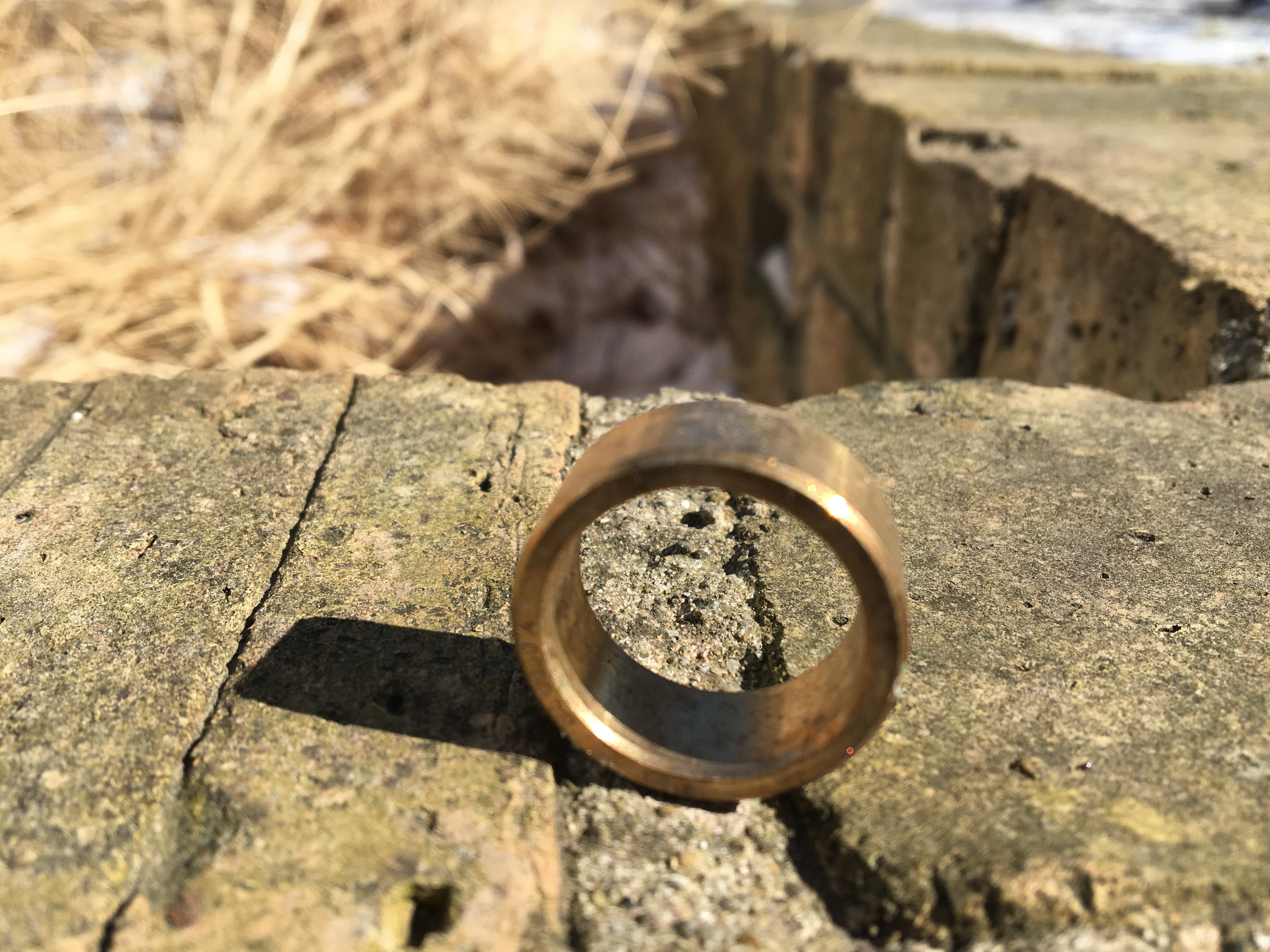
The sun was bright through the cold on the day we pushed LittleBabyScion down the driveway so we could get Big Red out and onto the street. At first, she thought she found a wedding ring poking out of the snow. One of the men who worked so hard to replace our water line must have lost it. But then, we realized it was a brass fitting. We brought it in house. Someday, when the trench has settled, the front yard has grass again, when we feel comfortable leaving the television plugged in, and the house is restored to order, the ring will serve as a memento to remind us of the upheaval.

Yesterday I held the ring for a moment and I wondered why we – humans – build memorials to war that carry messages chiseled in stone, “Never again…” or “Remember…”, sentiments that are meant to remind us that murdering each other for resource or political gain actually achieves nothing but pain and the erection of yet another stone and steel memento – it’s a flip of priority – as if the special papers and computers have more importance than the people. The people become expendable. Where do you flee in the face of such madness?

read Kerri’s blog post about THE RING