Chicken Marsala Monday

thismomentunique WITH EYES jpeg copy 2“What do I see?” It is, perhaps, the most important and fundamental question any person can ask. Seeing is never passive. It is never pure. Interpretation begins the moment you open your eyes. The ‘see-er’ stories – gives meaning to – what is seen. It is a simple truth: the very act of opening your eyes is a creative act.

Every moment of our lives is new. What else? You have never lived this moment before. You will never live it again. We blunt ourselves when we tell ourselves the story of ‘same-old-same-old.’ We dull ourselves when we weave the belief that this day is routine, that this moment of life is nothing new.

We blur our seeing and muddle our moments by asking the wrong question(s): how do they see me? what do they think of me? These are impossible crazy-making questions to answer. They generate a directional challenge. It is not your superpower to determine what the world sees when IT looks at YOU – mostly because you can’t. The world is not looking at you. You are seeing it.  IT is not giving meaning to you. You are giving meaning to IT. That is your genuine superpower.

The thought for today from the melange: open your eyes. See the new-ness. Create this moment as unique in every way.

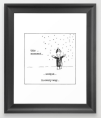
THIS MOMENT UNIQUE IN EVERY WAY merchandise

ThisMomentUnique mug  ThisMomentUnique framed print ThisMomentUnique clock ThisMomentUnique pillow

read Kerri’s thoughts about this Chicken Marsala Monday

melange button jpeg copy

kerrianddavid.com

this moment unique in every way ©️ 2016 kerri sherwood & david robinson

See It Blaze

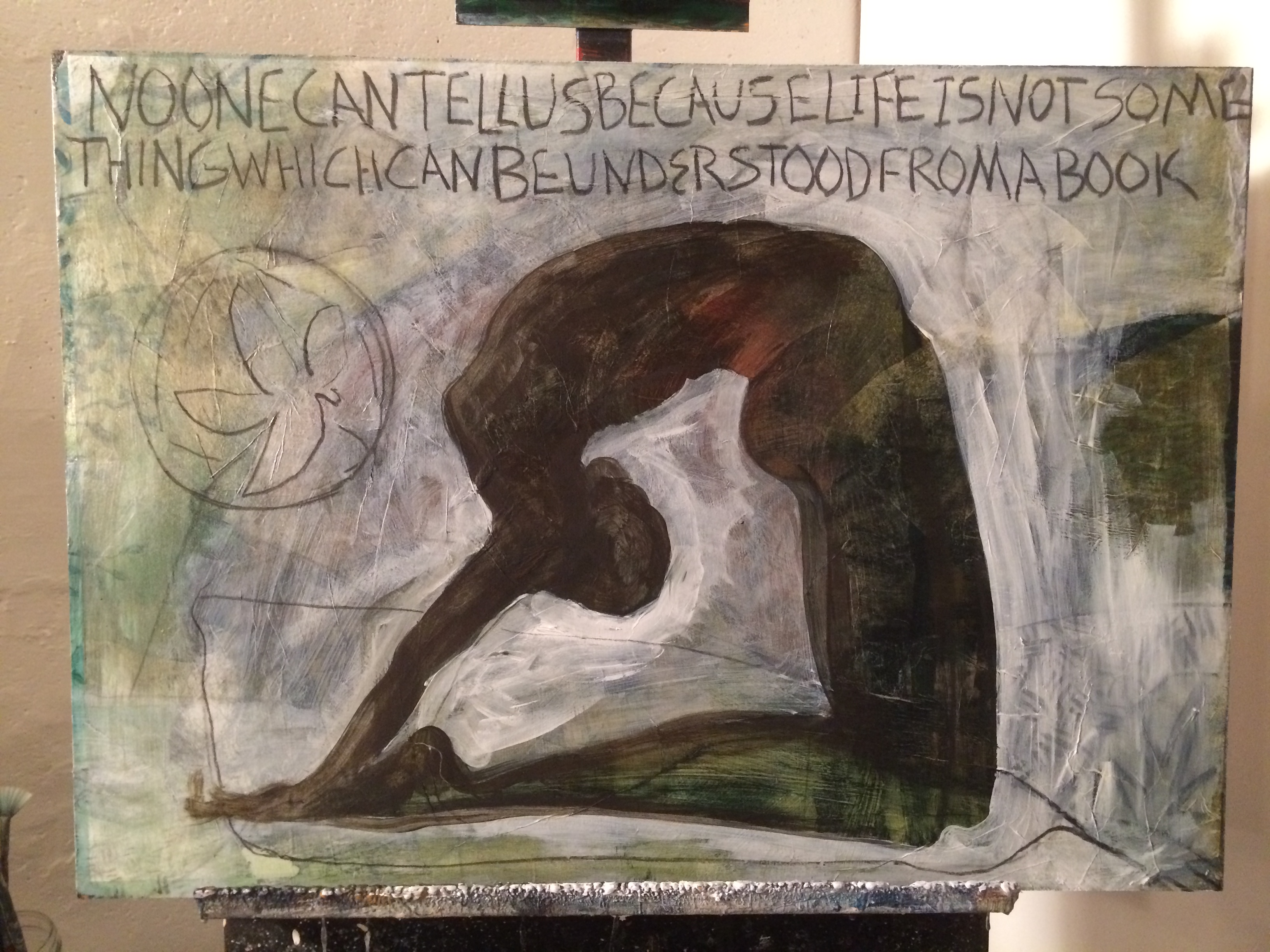
text from Krishnamurti as it appears in my painting

text from Krishnamurti as it appears in my painting

Every once in a while the things I read, the experiences of my life, seem to coordinate. Like a thought-confluence, the books, the poems, the errands, the conversations, run into a single thought-stream. It’s as if they called each other last week and asked, “So what are you going to wear?” Often, this is how the universe places its hammer on my head.

A few stanzas from a Mary Oliver poem, Morning Poem (read the whole poem sometime. It’s breathtaking):

each pond with its blazing lilies
is a prayer heard and answered
lavishly,
each morning

 whether or not
you have ever dared to be happy,
whether or not
you have ever dared to pray

Did you catch the word, ‘lavishly?’

Here’s a bit from Carlos Castaneda, A Separate Reality:

What makes us unhappy is to want. Yet if we would learn to cut our wants to nothing, the smallest thing would be a true gift…. A warrior knows that he is waiting and what he is waiting for; and while he waits he wants nothing and thus whatever little thing he gets is more than he can take.

Prayers answered lavishly. Whatever little thing he gets is more than he can take.

For me, there are a few important words that have, from over-use, fallen into the bin of meaninglessness:

presence, transformation

Actually, they are in the bin because we’ve managed to make them (like the word, ‘art’) commodities, marketing terms, something owned or purchased with coin or wile or reason. Something possessed or not possessed. Something available to a few but not all.

Sometimes the words open again, the experience opens again, when said another way. For instance, the phrase, “cutting our wants to nothing,” is another way of saying ‘presence.’ Don Juan would have made a good Buddhist! When present, the ordinary pond blazes, it teems with life and isn’t the experience of teeming life at the heart of any good prayer? The last time you caught your breath, a sunset or watching your child sleep, you were present, you wanted for nothing,  your prayers were lavishly answered.

my latest work-in-progress

not yet finished – maybe never will be – an, perhaps, that is the point.

The message of the hammer on my head: The pond is always blazing. The transformation is not in the pond but in our ability to see it.


Visit With Your Guardian

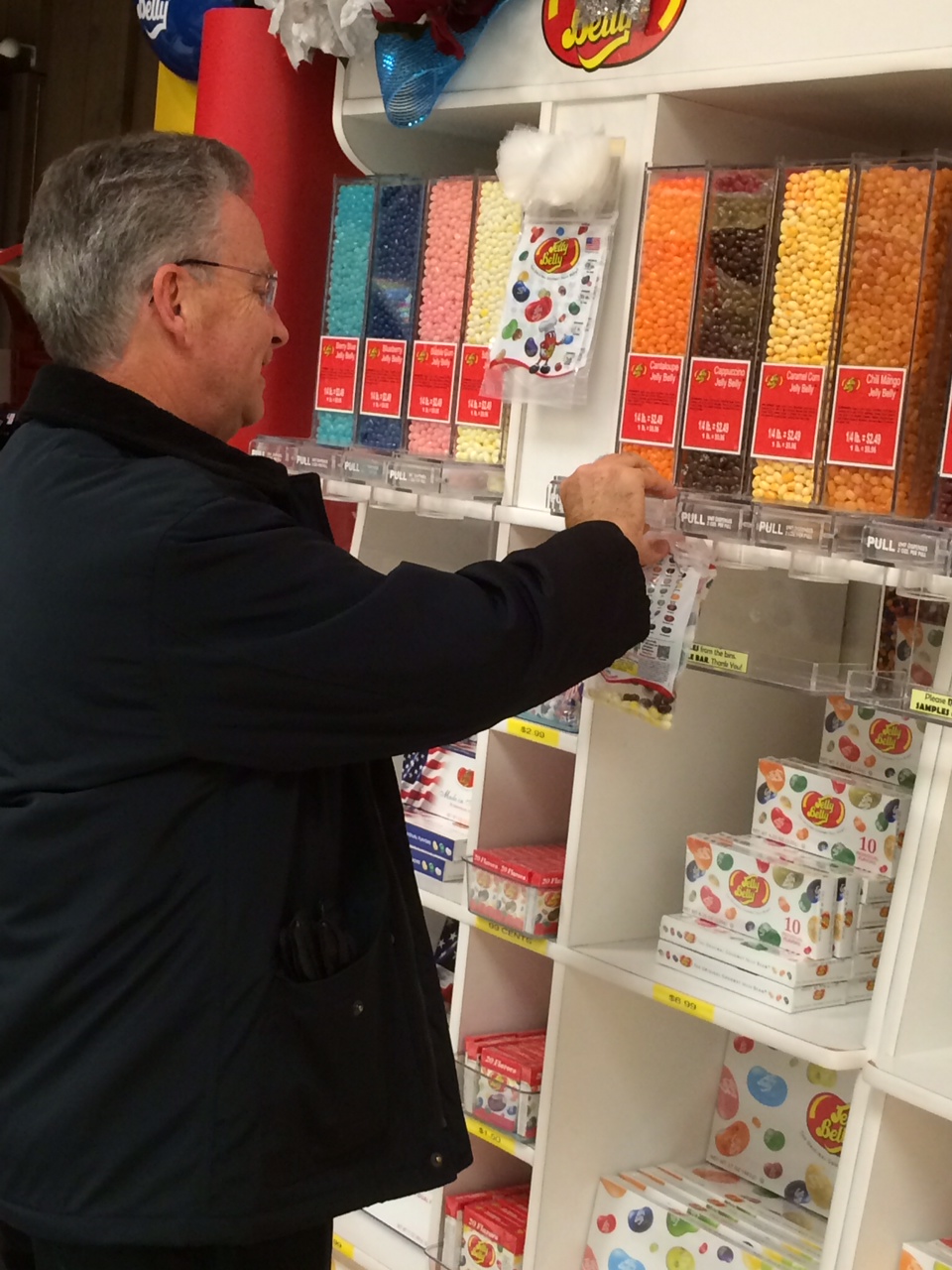
My Threshold Guardian at the Jelly Belly store.

My Threshold Guardian at the Jelly Belly store.

In addition to being a dear friend, Arnie is my personal threshold guardian. His appearances in my life always signal that change is a’comin’. The last time that I saw Arnie I left behind everything that I knew (literally and metaphorically). I began a long pilgrimage to the church of my self. It felt as if I stepped into my big wooden sailing ship and set a course for the edge of the known world and then, with great intention, sailed over the edge.

Two years have passed since our last meeting. In the interim, I have experienced Sirens and Cyclops, I lost my metaphoric ship and crew to the great whirling Charybdis, I was held captive on an island, I paid an extraordinary visit to the underworld and, at last, returned to the light with new knowledge. And, this week, as is his custom when I am ready to pass through the next portal, Arnie came to visit.

Saul’s voice roared in my head as Arnie and I debriefed my two-year journey: address your self to the field of possibility, not to the opponent. Possibility, I learned, becomes visible when we are vulnerable and available to it. It appears when we place our focus on it, when we seek it. Pushing and protecting and fighting and resisting obscures the field of possibility because our focus is on the opponent, not on the possibility.

And, of course, the greatest opponent is our self.

In the language of story, for great personal transformation to occur, we must leave behind everything we know and go on a journey into the unknown. That includes leaving behind who we know ourselves to be. In other words, we are required to let go of all the things we believe that we can control – but in truth cannot; we are required to release our insistence on keeping things “as they are.” In the end, we are required to face and then release the things that we are trying “to make work” but cannot – and let go of all the things we want to force into existence but cannot. That is the moment the opponent in our self disappears and we are at last able to turn our eyes outward and see the field of possibility that has been available for us all along.

title_pageGo here to buy hard copies (and Kindle) of my latest book: The Seer: The Mind of the Entrepreneur, Artist, Visionary, Innovator, Seeker, Learner, Leader, Creator,…You.

Eve, by David Robinson

Eve, by David Robinson

Go here to buy fine art prints of my paintings.


Locate Your Self

title_pageHere’s a short excerpt from my book, The Seer, dealing with the dance between investments, limitations, and the roles we play in life. This conversation is a kind of coaching session and is happening via online chat:

Me:…All week I’ve asked myself, “why?” Why the dramatic shift in experience from role to role? I’m a bit shocked to realize that I play many, many roles each day. In each role I want something and what I want is different depending upon the people I am with. I realized that my roles are not about me in isolation – and what do I mean by that? I mean that I define my role by how I define the relationship I am in at the moment. For instance, in my workshop, I assumed the role of “guide” and I wanted to lead the young people to some new insights that might help them create their businesses. In my conversation with my parents, in the role of “son,” I wanted them to be pleased with my work. I wanted to share and I wanted their approval. So, my role is defined by relationship and in each different relationship I tell a specific story based on what I want or need. I’ve “cast” myself in these little mini-stories. Or to use your term, “role” is the way I “locate” myself in the story.

Virgil: And how does this knowledge help you with your questions about business?

Me: The first thing that occurs to me is that I have the capacity to locate myself in a different way if I don’t like the role I’m playing. I can change how I locate myself. Also, there is a dance with the words “limitation” and “investment.” I took notes all week and realized that I was using the verb “to invest” over and over again to describe my experience of different roles. So, for instance, during my dinner with my friend Bruce I invested in helping him. I wanted Bruce to know that I cared about his challenges. Then, I watched Bruce invest in being the wine expert. It was his way of caring for me and demonstrating his expertise. I began to see my investments as keys to discerning my limitations. In some roles I’ve invested in the idea that I can’t do something or that I’m not good at something. In some roles I diminish myself; my limitations are investments in being small.

Virgil: Just a caution: as you explore further the dance between investment and limitation, remember to practice suspending your judgment. Remember: you are having experiences first so you can see how you make meaning and begin to choose how you make meaning.

Me: Thank you. It’s a good reminder. I was beating myself up every time I     realized I was investing in being small.

Virgil: We tell ourselves stories. We locate ourselves within the stories. In fact, that is the next recognition: you locate yourself within your story. We do it physically (like your description of choosing the table in the restaurant); we do it through the roles we assume – specifically our assumptions of how we need to play our roles, what is ours to do, etc. Locating is simply a way of establishing comfort. We sort to the known. If you judge how you locate yourself, you miss the opportunity to change how you locate yourself.

Me: Right. Judgment blinds me to the choices I am making.

Virgil: Judgment is always a version of the “things are happening to me” story. In fact, judgment is a way of locating: it is the warning signal when we step too close to discomfort. When I judge myself and say, “I’m an idiot,” I’m actually locating myself, pulling myself back into my comfort zone. When I judge others, “They are idiots,” I’m locating myself in a higher status position. The action of diminishing “them” elevates me back into a comfortable status position. Thus, suspending your judgments removes the easy step back to comfort and allows you to stand in “not knowing” and see what is there beyond what you think is there.

Go here to get my latest book, The Seer: The Mind of the Entrepreneur, Artist, Visionary, Seeker, Learner, Leader, Creator…You.

Or, go here for hard copies.

Join A Group!

title_page“This book invites conversation,” Mary said. “I’m enjoying that others feel the same way and want to talk about it.”

I was enjoying it, too because it was my book, The Seer, that they were meeting to discuss. It was the first time since publishing The Seer that I’d participated in a conversation about it. There have been other group conversations and I’ve received some very useful emails and insightful notes, but this was the first time that I was able to attend. Since I’ve been approached to coach people using The Seer process, I was delighted with the opportunity to hear their discussion. It was the first of several calls with a people from many countries who are working their way through the 9 Recognitions (the chapters are a progressive series of recognitions).

During the call I thought about my very first art exhibit. I was young, shy and unknown so I was able to follow people through the gallery and listen to what they saw in my paintings. It was a revelation. There were as many different interpretations of my paintings as there were people in the gallery. Each person interpreted the paintings through their unique lens; they did not see what I painted, they made sense of the image through their life-narrative. They recreated the images. I loved it. It was a lesson in the power of art, seeing and was a seed for my fascination in communal narrative: where do our stories become transcendent and singular? Where does identity become cultural?

During the call I listened to what was important about the First Recognition to each caller. They had unique experiences with the concept. The First Recognition sounds simple but is capable of reorienting what you see if you take it seriously. It goes like this: you don’t have a problem, you have a pattern. “Problem-seeing” is a lens and defines a path of available actions. It defines a worldview is rooted in the notion of separation. “Pattern-seeing” is also a lens and defines a path of available action. It, too, defines a worldview but the rooting is in connectivity. The callers discussed their experiences of shifting their seeing from problem to pattern.

Mostly, I appreciated Mary’s comment because she echoed two concepts layered into the book: 1) No one creates alone. Creating, whether it is a painting or a life story, is a team sport. We need each other to make sense of this life. 2) Working with my book is like riding a bike or throwing a pot: you can’t make the shift unless you do it. To read it alone is useful and perhaps illuminating, but the real worth becomes available when you step into the actions, when you get on the metaphoric bike and fall down a few times. And, looping back to the first point, it is easier to fall with others stumbling along with you. Creating is a team sport because life is a team sport. This group inspired me and how lovely for the potency of the First Recognition to come back at me through the eyes of my readers.

Go here to get my latest book, The Seer: The Mind of the Entrepreneur, Artist, Visionary, Seeker, Learner, Leader, Creator…You.

Go here for hard copies.

Stalk The Story

title_pageLast year I wrote a book and only recently got around to publishing it. One of the many benefits of waiting several months to publish is that I forgot what I wrote so, in preparing to publish, I got to read my book as if someone else wrote it. I got to discover my own book!

Now that the book is out in the world I’m receiving lots of requests to talk about it or coach to it. The requests are driving me to read it again and again – only through a different set of eyes each time. The question I’m asking myself is this: What is teachable beyond the obvious? I end each chapter with exercises and ideas but the real teachable moments happen within the story (just like life!). Here’s a “for instance” tidbit from the book:

When a story stalks you through your lifetime you inevitably learn some things about stories; you unwittingly stalk them, too. One of the first things I learned was that the word “beginning” is arbitrary. An end is always a beginning. A beginning is always an end. What we call a beginning or the middle or an end is really a simple matter of our point of view. It depends on what we see.

We rarely recognize the teachable moments in our lives. They seem so distant or have become so wrapped in justification that we don’t recognize them as opportunities for learning. A teachable moment is often embedded in the story that stalks you. In the book I weave the story of Parcival through the main narrative because Parcival gives his voice away. The main character of my book gives his voice away. He invests in the idea of what he should be and, so, loses sight of who he really is. He betrays himself. I’ve yet to meet a person who hasn’t given their voice away or lived from an image (a “should-do”) instead of honoring their “I-want-to-do.”  A moment of self-betrayal is a story that will stalk you all of your life. It will follow you until you reclaim your voice. And, the capacity to reclaim voice comes from a lifetime spent stalking the moment of self-betrayal. It’s a life story loop.

What are the stories that stalk you? The answer to this might not seem immediately apparent but if you take a moment and reflect you’ll likely come up with a moment (or several) that has shaped or continues to shape your life.

A moment of betrayal and a moment of reclamation might make a tight little beginning-middle-end story or might represent two beginnings or two ends, depending on how you decide to see it. Wounds are often opportunities for growth. Triumphs are often the beginning of a new chapter. We grow. We learn. We story and re-story ourselves. We give pieces away and reclaim them later. What’s important is that we learn to see our dance, capture the moment, and grow.

Go here to get my latest book, The Seer: The Mind of the Entrepreneur, Artist, Visionary, title_pageSeeker, Learner, Leader, Creator…You.

Go here to get hard copies


Make Sense

title_pageThe Seer is built upon 9 Recognitions. Much of the book is an email conversation between the protagonist and his mysterious guide, named Virgil. Virgil coaches the protagonist through his discovery and encounters with the 9 Recognitions. Here is a small excerpt from an email exchange between the protagonist and Virgil:

Me: I realized that I think in patterns. I think the same stuff over and over. This is a puzzle: the act of looking for patterns opened my eyes. So, patterns reveal. And yet, later, when I became aware of the patterns of my thinking, I recognized that those patterns were like ruts or grooves. It’s as if I am playing the same song over and over again so no other music can come in. My thinking pattern, my rut, prevents me from seeing. So patterns also obscure. Make sense?

Virgil: Yes. It must seem like a paradox to you. Think of the song or rut as a story that you tell yourself. Your thoughts, literally, are a story that you tell yourself about yourself and the world; the more you tell this story the deeper the rut you create. So, a good question to ask is: what is the story that you want to tell? Are you creating the pattern that you desire to create? We will return to this many times. This is important: the story is not happening to you; you are telling it. The story can only control you if you are not aware that you are telling it.

Me: Can you say more?

 Virgil: We literally ‘story’ ourselves. We are hard-wired for story. What we think is a narrative; this pattern (song) that rolls through your mind everyday is a story that you tell. You tell it. It defines what you see and what you do not see. What you think is literally what you see.

There was a pause. That was a lot for me to take in. When I didn’t respond, he continued:

Virgil: So, what you think is nothing more than a story; it’s an interpretation. You move through your day seeing what you think – instead of what is there. You are not seeing the world you are seeing your interpretation of the world. You are seeing from your rut and your rut is a pattern. So, your patterns of thinking, your rut, can obscure what you see. Make sense?

Go here to get my latest book, The Seer: The Mind of the Entrepreneur, Artist, Visionary, Seeker, Learner, Leader, Creator…You.