Learn A New Word [on Merely A Thought Monday]

I learned a new word today. Actually given the divisive climate in our current epoch, I’m surprised that I did not come across it sooner.

The word: Agnotology: the study of deliberate culturally induced ignorance or doubt, typically to sell a product, influence an opinion, or win favor, particularly through the publication of inaccurate or misleading scientific data.

Speak these words slowly so you might taste the sounds: deliberate culturally induced ignorance…Once you’ve tasted the sounds, think about the ramifications. Deliberate ignorance. Head in the sand. Deliberate ignorance is, of course, a necessity on the road to hate. And, not just any form of hate. Hate as a product. Hate meant to influence opinions. Hate that thrives on misleading information.

Deliberate ignorance eschews knowledge and refuses to ask questions. Non-curious, hard-edged-belief that refuses to check reality. Hard-edged-belief borne of purposeful misinformation. Hate is learned. Acquired.

My new word came across my path when a stream of transgender hate crossed my screen. A post on Facebook.

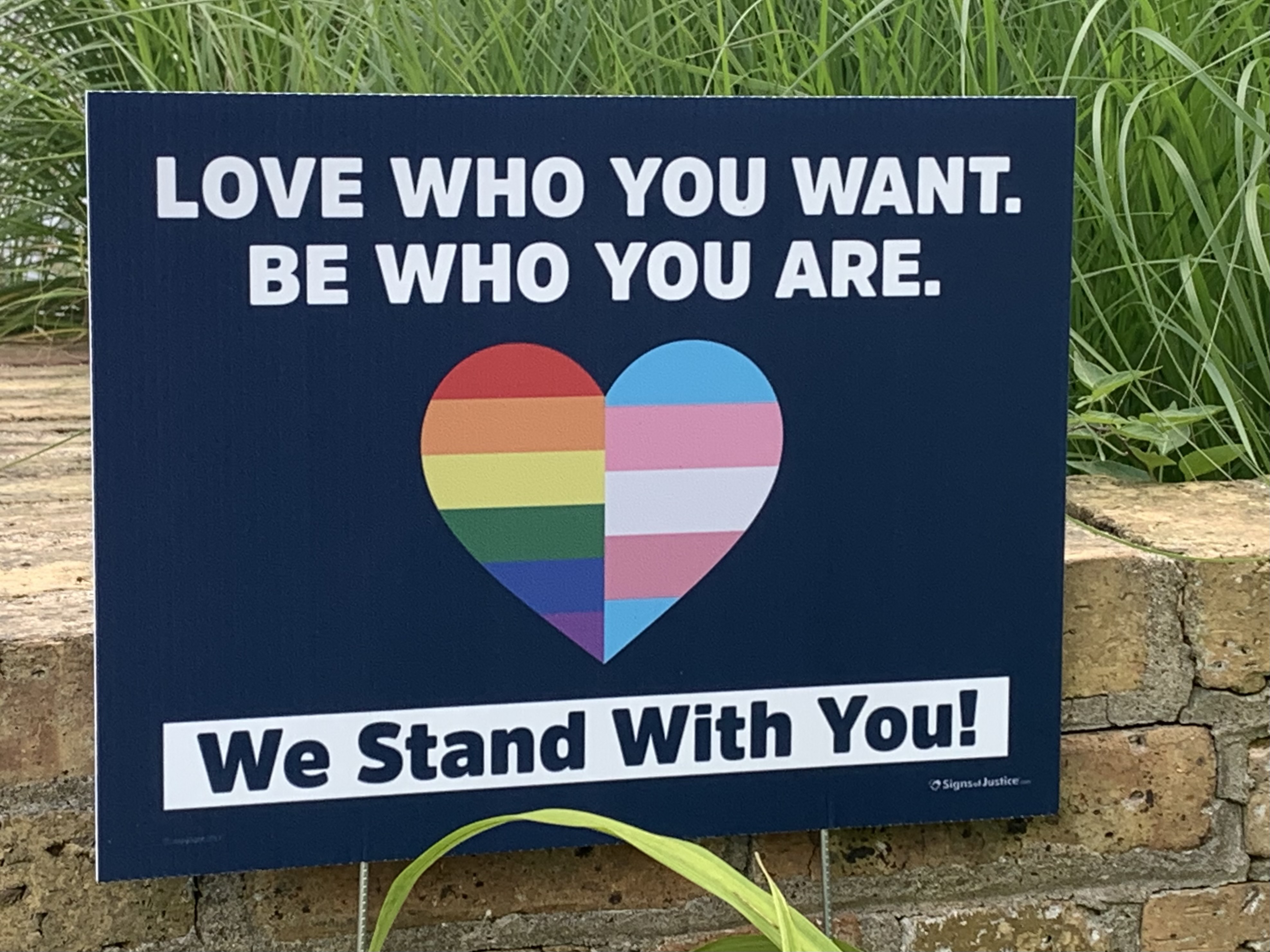
I’ll call them Sam. Sam was my student when I taught at an independent learning center. My appointments with Sam were scheduled after hours. Sam fled the main campus. Sam was transgender and Sam’s parents feared for their child’s life. Sam feared for their life, too.

Transgender (adjective): a person whose gender identity does not correspond to the sex registered to them at birth.

Start with the word “person”. A person. Now, roll around your mouth and mind the word “identity”. Speak the words slowly so you might taste the sounds.

I remember being a teenager. Do you? It was mostly a festival of confusion and an intense desire to fit in. To be accepted. About 5% of young adults are transgender. Sam, like all teenagers, was awash in a festival of confusion and wanted what every other student wanted: to fit in. To be accepted. And, the acceptance Sam sought most was… from Sam. Just like you and me.

Sam’s mountain-to-climb was significantly steeper than most. Sam’s walk toward wholeness demanded deep questioning, knowledge seeking, personal reflection, assumption challenges, fact checking, and a dedication of self-love that most of the populace, approximately 95%, can’t begin to imagine. I taught Sam geometry and world lit but I learned from Sam the great expanse of the human soul.

We vilify what we don’t understand, or more accurately, what we refuse to understand. Lemmings learn to hate en route to the ledge.

Lemming (noun): a person who follows the will of others, especially in a mass movement, and heads straight into a situation or circumstance that is dangerous, stupid, or destructive.

Lemming. Speak the word slowly so you can taste it…Now, think of the ramifications.

The path to love and understanding always begins with a step toward: Asking a question. Challenging a belief. Bursting the misinformation bubble. Fact-checking the information and especially checking the agenda of the source.

Love is a very old word yet it’s never too late to learn it anew.

read Kerri’s blogpost about LOVE

share. like. comment. support. many thanks!

Embrace The Nincompoop [on Merely A Thought Monday]

I always appreciate when life lessons come in different forms and from multiple directions. The first time I remember hearing this lesson was standing on a street corner in San Francisco with Quinn. He pointed to the tippy top of the TransAmerica building and told me that the person sitting in the big office up there was making it up, too. Just like me. No one really knows what they are doing.

It was a message that actually scared me to death. At the time I thought everyone knew what they were doing except me. I was, in my mind, the only nincompoop in the herd. To entertain the idea that the entire herd was comprised of nincompoops… I wish I’d asked Quinn the obvious next question: If we’re all stumbling in the dark, whose driving this car, anyway?

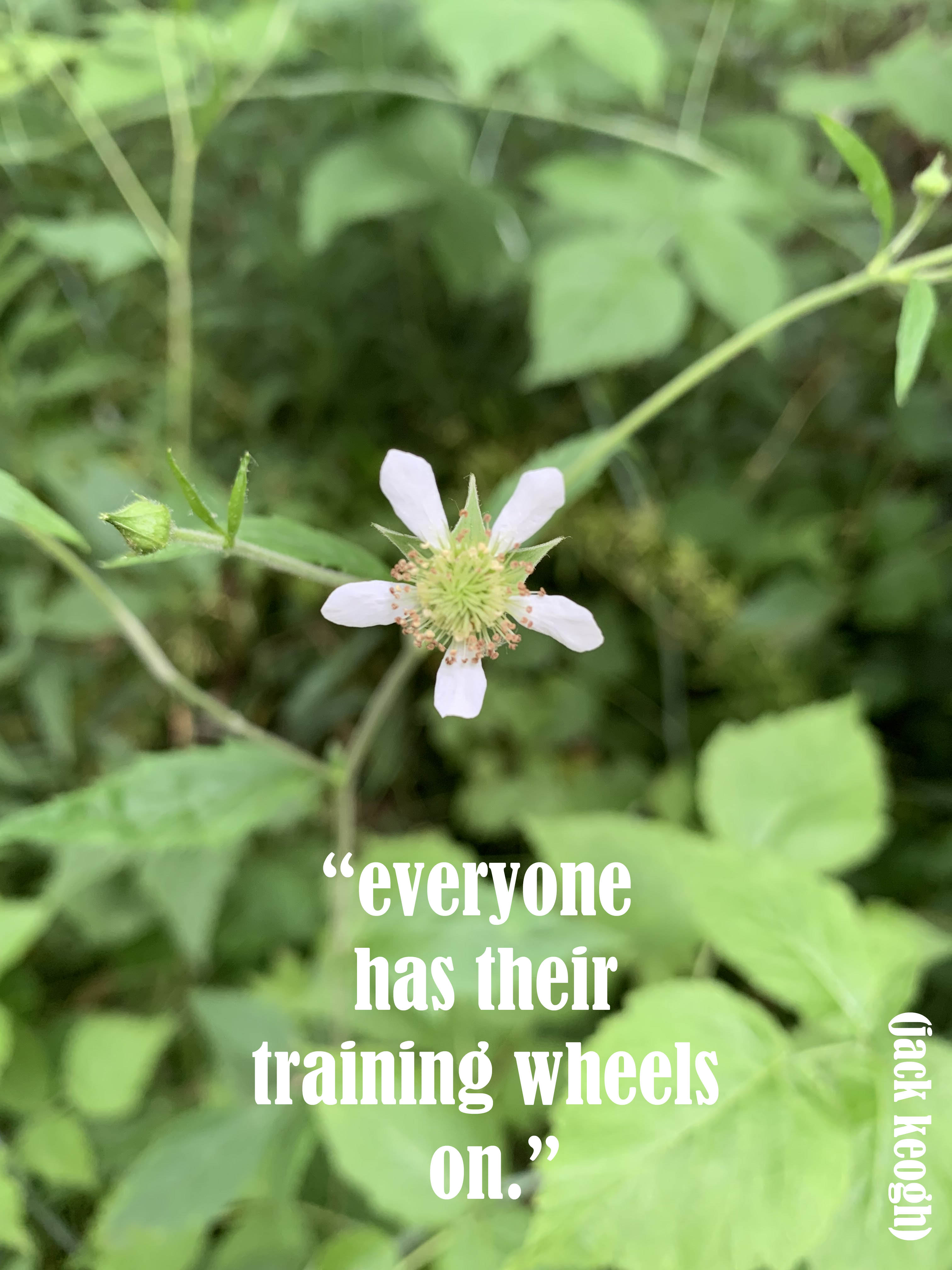
The lesson came around again, this time while indulging in one of our favorite quirks. Before sleep, we watch hiking videos on YouTube. A recent favorite is Jack Keogh’s, Walking on A Dream. Early in his PCT through-hike, he comments that, without exception, everyone is new to the experience and just trying to figure stuff out. “Everyone has their training wheels on.” Kerri whispered, “That’s true in all of life.” As she sat up to write the phrase, I heard Quinn chuckling. He had a great chuckle.

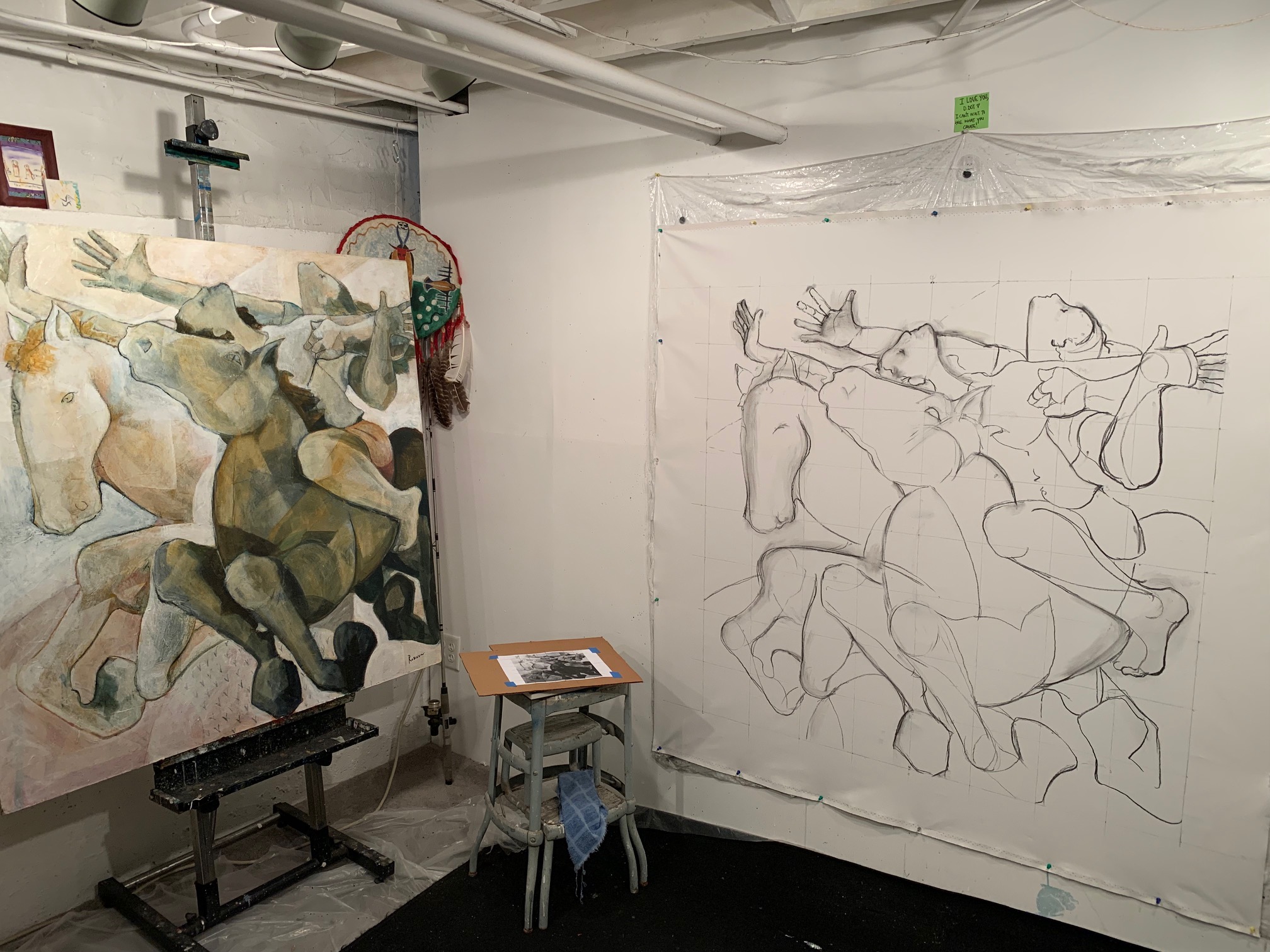
I’m working on a special project. I’ve volunteered to copy one of my paintings. yes, it’s true, I’m copying myself. Now, isn’t that a scary thought! Every few days 20 comes down into my studio to check my progress. He scrutinizes the original and then squints at the copy and asks a variation of this question: How did you know how to…? My answer is always the same: I don’t know. I’m making it up as I go.

What’s remarkable to me is the ease of my answer. I have no idea. The younger version of me, the one Quinn took to the city to administer a lesson, thought he needed to know. The younger version of me thought that to be competent meant “to know.” The younger version of me, when asked, “How did you know how to…?” made up some profoundly stupid answers. And, to my great relief, usually the questioner would nod their head as if what I said was actually plausible. “What a nincompoop,” I’d think, meaning both me and the questioner.

I am, at long last, able to fully grasp the lesson. Competency has nothing to do with knowing. It has everything to do with being able to “figure it out.” Shorthand: questions are much more valuable than answers since an answer is merely a single step on the path of a life filled with questions. Questions, like life, keep rolling along. I now know that had I asked the obvious next question, “Whose driving this car, anyway?” Quinn would have answered without hesitation, “No one and everyone.”

There I go again, thinking that life is about getting somewhere. It is, after all, the common mistake that defines the nincompoop herd: we consistently miss the point. No one knows what tomorrow will bring. No one controls their moment, spinning on this little orb as it hurtles through infinite space. It’s best to hold the hand of the one you love, enjoy the moment, make it up together, and embrace life as a bona fide nincompoop.

read Kerri’s blogpost about TRAINING WHEELS

Like it? Like it. Or share it. Or comment. Or buyusacoffee.com. Or all of the above. Why hold back?;-)

Dine With Jonathan [on Not So Flawed Wednesday]

I lost my copy of On Reflection by Jonathan Miller in one of my moves. He gave it to me. I treasured it both for the generosity of his gift but also a reminder of a night I had a casual dinner with an artistic giant. He was kind. And funny. And shared his ideas, thoughts and new work like an enthusiastic child. He listened intently to my ideas and thoughts like a fascinated friend. It is the mark of a great artist: humility. Healthy doubt. He loved his work and loved to share the exploration. He was brimming with questions.

I left that evening thinking, “I want that!”

That. Secure in my work. The playfulness of a child. The love of the exploration. The fearlessness to my bones knowing that each painting and every play is not an end in itself – not an achievement – but part of the dance of life on the playground called artist. Dedicated to asking questions. Dedicated to surfacing shared truth.

To Mary Oliver’s question, “What will you do with your one wild and precious life?” I say, I want that. Wild and precious.

That. It’s not an achievement; rather, it is a way of being. A practice. It alters Mary Oliver’s question: How will you be within your one wild and precious life?

Safe. Steady. Unshakable through dedicated practice. Arrived at through a lifetime of grace and humility. Or, perhaps, grace and humility arrived at through a lifetime of questioning. The certainty of doubt. That’s what I saw in Jonathan Miller that night. The paradox of the artist: security in vulnerability. To feel so safe as to play without inhibition. To express sans trepidation. To share and receive with equal enthusiasm.

It is a practice available when the artistry is no longer about the “I” but about the “we”. The bigger energy, call it what you will. It’s humbling. That.

read Kerri’s blogpost about REFLECTION

like it. share it. comment on it. buyusacoffee. thank you for reading what we write.

Ramble [on DR Thursday]

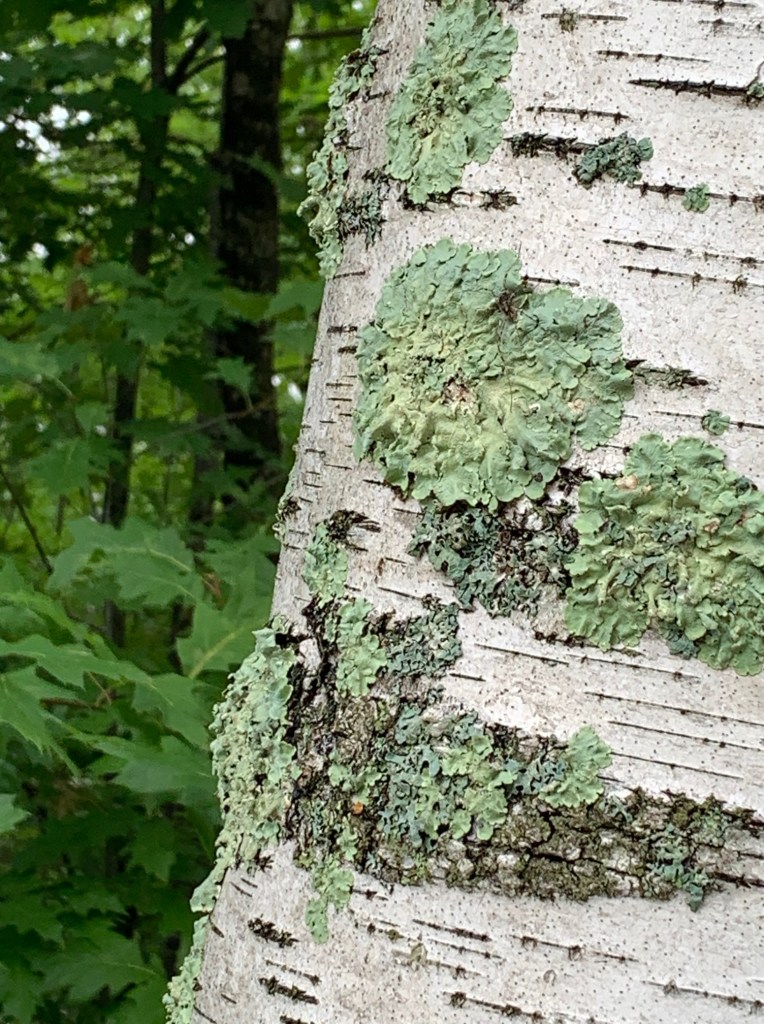
I’m like a two-year old: I want to know “Why?” For instance, the lichen growing on the birch tree is Hypogymnia physodes, but it’s also known as “Monk’s Hood.” Why?

There’s a wildflower also known as Monk’s Hood. I read that the flower gets its name because its petals resemble the cowls once worn by monks. However, the flower is also known as “Wolfsbane.” Why? What does the bane of a wolf have to do with the hood of a monk? I’m capable of inventing a slew of possible connections but they will be just that: inventions.

In an attempt to bore you beyond rescue, I’ve lately been fascinated by how much of our world is a blizzard of unhinged information in search of a context. For instance, conceptual art needs an explanation. Without a curator, it’s nothing more than a banana taped to a wall. Twine with a dirty sponge. Oddity seeking to be taken seriously.

In the 21st century, we measure relevance by the number of followers, not by the substance-of-the-matter-being-followed. It’s a popularity contest. Lots and lots of flowing information, most of it useless. Without use. Without substance. And, scarily for us: without being questioned.

What is empty content pushed through a fabricated context? “Breaking” news. MAGA. Q.

It occurs to me that society needs more two year olds! A healthy practice of asking “Why” would spare us from certain death-by-bloviation.

A cowl, by the way, is both a monk’s hood AND a loose neckline in contemporary women’s clothing. Wouldn’t the monks be surprised if they’d confused their cowls!

Now, get out there and find context for this bit of useless information.

read Kerri’s blogpost about LICHEN

pieta with paparazzi © 2010 david robinson

Be Indeterminate [on Two Artists Tuesday]

Through the good graces of our tomato plants, I’ve learned a few new concepts this summer. Determinate and indeterminate. Bush and vine. Determinate tomato plants (bushes) are bred to stop growing. Indeterminate tomato plants (vines) will grow indefinitely or until the weather conditions “are no longer favorable.”

Our plants are indeterminate. Each morning, Kerri visits our planting bench and checks her tomatoes. 20 taught her a few simple tending-rules and now, each morning, there are more and more little indeterminate miracles moving backward along the color spectrum, finally arriving at a brilliant red.

Life is indeterminate.

My new tomato-terms come just in time. My current project has me revisiting my past life as a teacher and facilitator. If I apply my new terminology to people I can’t help but think it is the lucky few who survive so much dedicated energy to stop the learning-mind in the name of education. The natural output of a system designed on manufacturing principles is to truncate the questioning mind by patterning the notion that there is a predetermined answer. It becomes a game of finding the answer that teacher wants – a closed loop – instead of an incitement of curiosity. Children are excellent game players and translate the gaming pattern into their now-dulled-adulthood.

There is a cycle apparent in all genuine learning processes. It begins with discontent. Curiosity is a movement born from some form of discontent. It leads to questioning. Questioning always leads to disturbance (the interruption of the known). And, just like that, out of the disturbance something new is seen, call it a breakthrough, call it an insight, call it new learning…Many classrooms – certainly the systems – are designed and organized to keep disturbances to a minimum. The mantra is ‘control’ rather than ‘inspire curiosity.’ Business has the same dedication.

We’re taught that disturbance is the sign of something wrong rather than the crusty earth breaking to reveal new verdant life.

Discontent leads to questioning, leads to disturbance, which leads to breakthrough. And, an insight will always lead to discontent. It’s a story cycle, where yearning meets obstacle. Learning is by definition uncomfortable and at its best when it is uncontrollable.

Last week I attended a meeting. My two companions and I brought our homework back to the team. One was content. The other two of us were filled with discontent. The leader of the session, at first, was angry. He did not get the result he’d anticipated from his exercise. “So, you two are telling me this process was worthless!” he raged. We’d spent our week questioning instead of answering. Discontent. Questioning.

“No! It was great!” we chimed in chorus. “Look at all the good information we uncovered!” It was a mess. Big disturbance. We cycled through our misalignment a few times, wrangling over perception and usefulness. More rage. And then…an insight. The breakthrough. All of the rage, all of the appeasing, began to flow in a single direction. A possibility took shape. A target materialized that was much better than the prescribed pursuit. Energy filled our zoom-osphere. Laughter. Excitement.

Learning. Indeterminate. Open questions. Hot pursuits.

I am drawn to and surrounded by the dedicated indeterminates; those who refuse to stop learning: David, Mike, Horatio, MM, Bruce, 20, Judy, and yes, Kerri…I am a very fortunate man to be surrounded by so many tomatoes moving their way backward along the color spectrum, not afraid to walk through their discontent toward bigger and bigger questions.

read Kerri’s blog post about TOMATOES

Prove It [on Merely A Thought Monday]

I am about to prove that I am guilty of everything I accuse others of being. I am just as capable of surrounding myself with like-minded people as the next person. Let me explain:

I cheered when I read Marc’s response in the conversation chain. It was an appeal, an attempt to puncture a dedicated delusion, an untethered ideology. But, as is always the case when fantasy is met with fact, the holder of the fantasy vehemently defended and further retreated into their illusion. Confirmation bias.

Among my favorite phrases this week comes from a New Yorker article, Why Facts Don’t Change Our Minds. The phrase: the illusion of explanatory depth. Here are two quotes from the article:

“People believe that they know more than they actually do. What allows us to persist in this belief is other people.” In other words, we ally with people who hold a similar belief rooted in the same lack-of-knowledge. Apparently, as a species, we’d rather be reinforced in our ignorance than consider the possibility that we don’t know what we are talking about. Purple Kool-Aid is easier to drink than wondering if what we’re being told may or may not be truth. It explains the current GOP, Fox News, OAN, Ron Johnson, and the rest of the dangerous-national-clown-car.

Quote number 2: “As a rule, strong feelings about issues do not emerge from deep understanding.”

Strong feelings. Deep understanding.

In the canon of human self-aggrandizement, we delight in the narrative that we are primarily rational, that our reason, like a good border collie, has driven our emotions into safe containment. The opposite seems to be the case. Or, at best, we are a mass of contradictions.

There is a flip-side, a necessity woven into our contradiction that gives me hope. Strong feelings and deep understanding are not natural enemies and need not be pitted against each other. Think of it this way, no firefighter, in his or her right mind, would run into a burning building to save a life, if we were as rational and reasonable as we like to believe. They do, however, study fires beforehand to know how to run in, how to reach. They study the science. For every exploiter there is a matching story of a giver, someone whose strong feelings combines with their deep understanding in an effort to better the world, save a life, make things easier.

That which makes us crazy also makes us compassionate. How’s that for a statement of contradiction? Families fight each other until the forest fire threatens their house. Common cause and education are a great poppers of confirmation bias.

Some fires are manufactured with the sole purpose of exploiting confirmation bias. This kind of exploitation is dependent upon – and feeds upon – strong feelings with shallow roots in understanding. Ignorance. The big lie. Vaccine misinformation. Divide and conquer is always reliant on strong feelings intended to create blindness.

Some fires are real. And, the test of a real fire: divisions fall, eyes open, and people run toward the flames to help other people. It remains to be seen how hot and close the flames need to come before the confirmation bias burns off and we realize that we’re in real trouble, that science is real, and that the big trough of purple (red) kool-aid being proffered is doing the opposite of what it professes to do.

It may be in our nature to believe that we know more than we do, but, it is also in our nature, without concern or thought for our own safety, to reach for the drowning person. Deep understanding allies with strong feelings when people cared enough to learn how to reach, how not to become the person drowned by the drowning person.

Do you see it? I am an idealist. I want to believe in the goodness of humanity and the necessity of shared truth. Yet, despite powerful evidence to the contrary, I hold fast to my dedicated belief that we are capable of tipping toward love rather than falling toward hate, that, when faced with undeniable data, that we are capable of questioning our strong feelings en route to a deeper, shared understanding. We are capable of recognizing that the science that brought us the cell phone, satellites, allergy medicine, and electric light is the same science that brings us the data of climate change, and the best way to beat this pandemic. Cherry picking belief in science is…absurd and currently dangerous. Cherry picking news is equally as absurd and currently dangerous. From my idealistic mind, it is a necessity to ask questions, check sources, doubt belief.

We are certainly capable of knowing the real fires from the those fanned by the thought-arsonists. We are capable of questioning, of suspending our delusions. At least, I like to believe that we are. I, like you, surround myself with like-minded believers.

We’ve proven it again and again and again. When we recognize that the fire is real, our dedicated illusions burn the filters from our eyes, we transcend our little stories, and reach our hands with no thought of political alliance or other exploitative non-sense, to help dig our neighbors from the rubble.

read Kerri’s blog post about BASIC LOGICAL REASONING

Enter The Sanctuary [on Not So Flawed Wednesday]

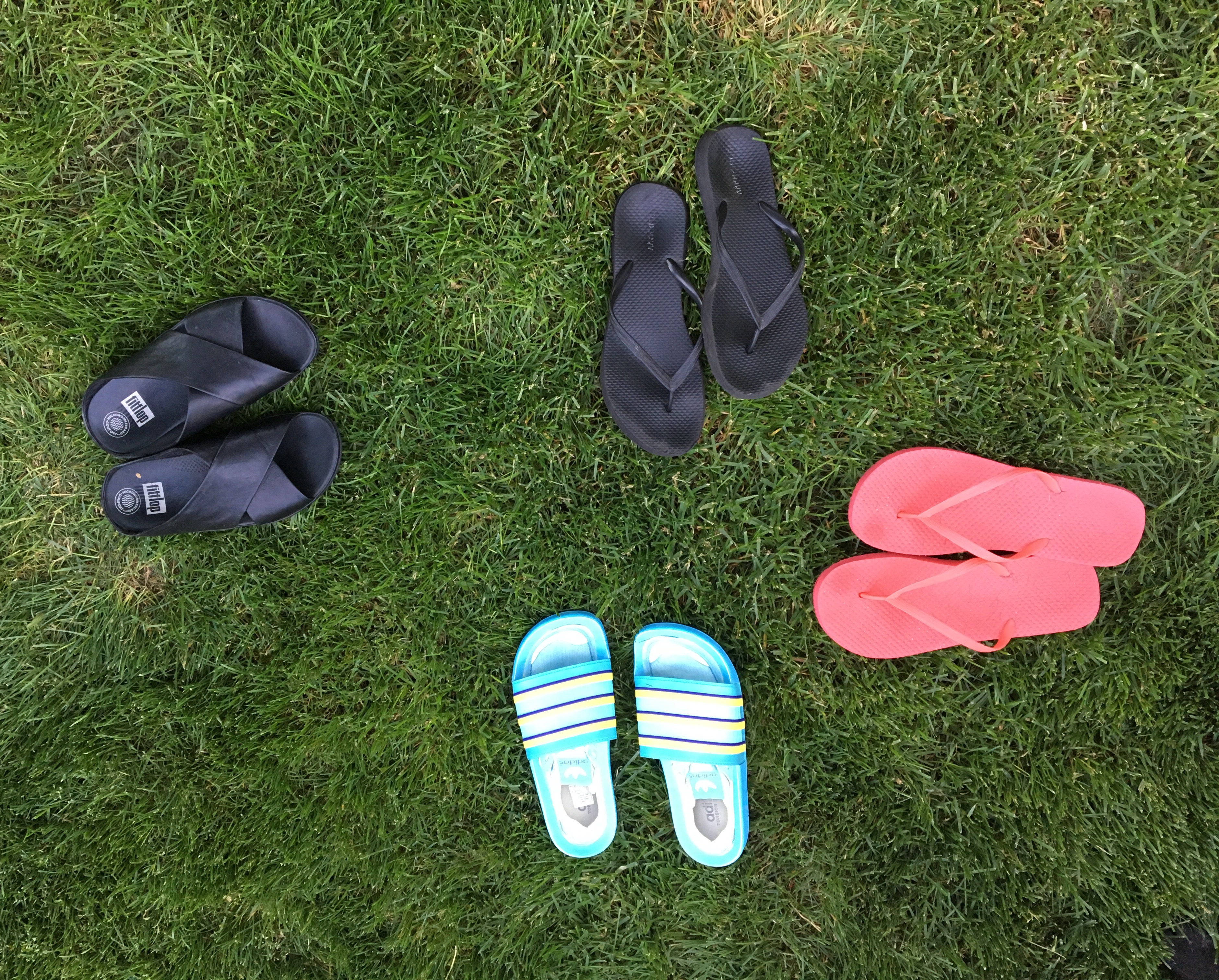
This is an image of sanctuary. The back yard of dear friends, time spent together, taking precautions to be safe in a time of pandemic.

There’s more than one compromised immune system represented in this photograph. It is why we continue to meet outdoors. It is why, until we were vaccinated, we were careful to keep distance between us. How odd to honor the love of dear friends by inserting space between us. Our flip flops and sandals are stand-ins for a group selfie.

When our postal carrier came to the door to deliver a certified letter, she groused about the process for capturing the required signature, “We have to do this because of COVID,” she sneered, “even though there is no COVID.” We’ve learned not to push back on ignore-ance. I was reading about Brazil eclipsing the the over 500,000 deaths-mark when the doorbell rang. Kerri signed for the letter. She closed the door and we simply stared at each other. No words.

I delight in this photograph because, to me, it is slightly disorienting. If you had to guess which direction the photo was taken, you’d most likely guess blue. You’d be wrong. Perspective is just that – perspective. From my perspective, the photograph is upside-down. The photographer wears black flip flops.

We constantly locate ourselves in our stories. The location we choose is not passive or general. It is unique, dynamic. It gives us a point of view but does not afford us a lock on truth. Learning to question your unique perspective, to challenge your story-as-central, is an important growth step. It is maturation. Learning to question what you are told is an invaluable skill to develop.

As a lover of story, as a student of perspective, I am fascinated by the story-war raging in my nation. Politicians drape themselves in the flag, defending a violent insurrection on democracy, while demonizing and fearmongering BLM. Propaganda, hate-mongering and conspiracy theory is run amok and fueled by entertainment posing as news. Voter suppression laws, gerrymandering, stuffing the courts, all in the name of…what? The story of division. The dedicated maintenance of a half-story. A national story increasingly exposed as redacted. Why should a democracy work so hard to prevent a portion of its population from voting? To prevent its full history from being told? As we ask in the coaching world, “What’s underneath?”

Nations, like people, cannot grow until they look at the whole of their story, until all perspectives are voiced.

I’ve wandered back into the world of entrepreneurs and business. Each day I read or am shown the data on teamwork or the power of collaboration. The software-as-a-service world is dedicated to facilitating better communication, efficiency in sharing and collaborating, crossing disjointed platforms, and reaching into clouds where all are stronger as one than when in silos. I’m finding it intensely hopeful. Progress is calling us together. The economy is global as is the pandemic. We are in this together.

No one is healthy if all are not healthy. It’s the rule of the backyard, the honoring of dedicated friendship. My job is to protect you and yours is to protect me. It’s the story of the sandals and flip flops, the image of sanctuary, and, if not the yearning of this nation, it is the reality of this interconnected world.

read Kerri’s blog post about SANDALS

Choose Your Way [on DR Thursday]

“Everything can be taken from a man but one thing: the last of human freedoms – to choose one’s attitude in any given set of circumstances, to choose one’s own way.” ~ Viktor Frankel

I always feel a bit disappointed in myself after writing a post like the post I wrote yesterday. It was a near-rant, an ugly system becoming more ugly as it fights to protect its ugliness.

It’s been a battle all of my life, wrestling with what to do or say when my desire to focus on the life-giving runs headlong into the harsh realities of the life-denying. To shine a light on the life-denying is sometimes the most life affirming thing to do, it just doesn’t feel very good. “Look at the ugly. No, really look.” Last night, I listened to a conversation – in all seriousness – about the collapse of our democracy. It’s been a minor fascination of mine to witness how self-destructive people and organizations – and nations – will become before they admit that they need to change. Before they turn and say, “I’ve been lying to myself and to you.” Sometimes they destroy themselves rather than turn and face their truth. That was the crux of the conversation. It seems more and more likely that we’ll set ourselves on fire before we embrace the truth of our dysfunction.

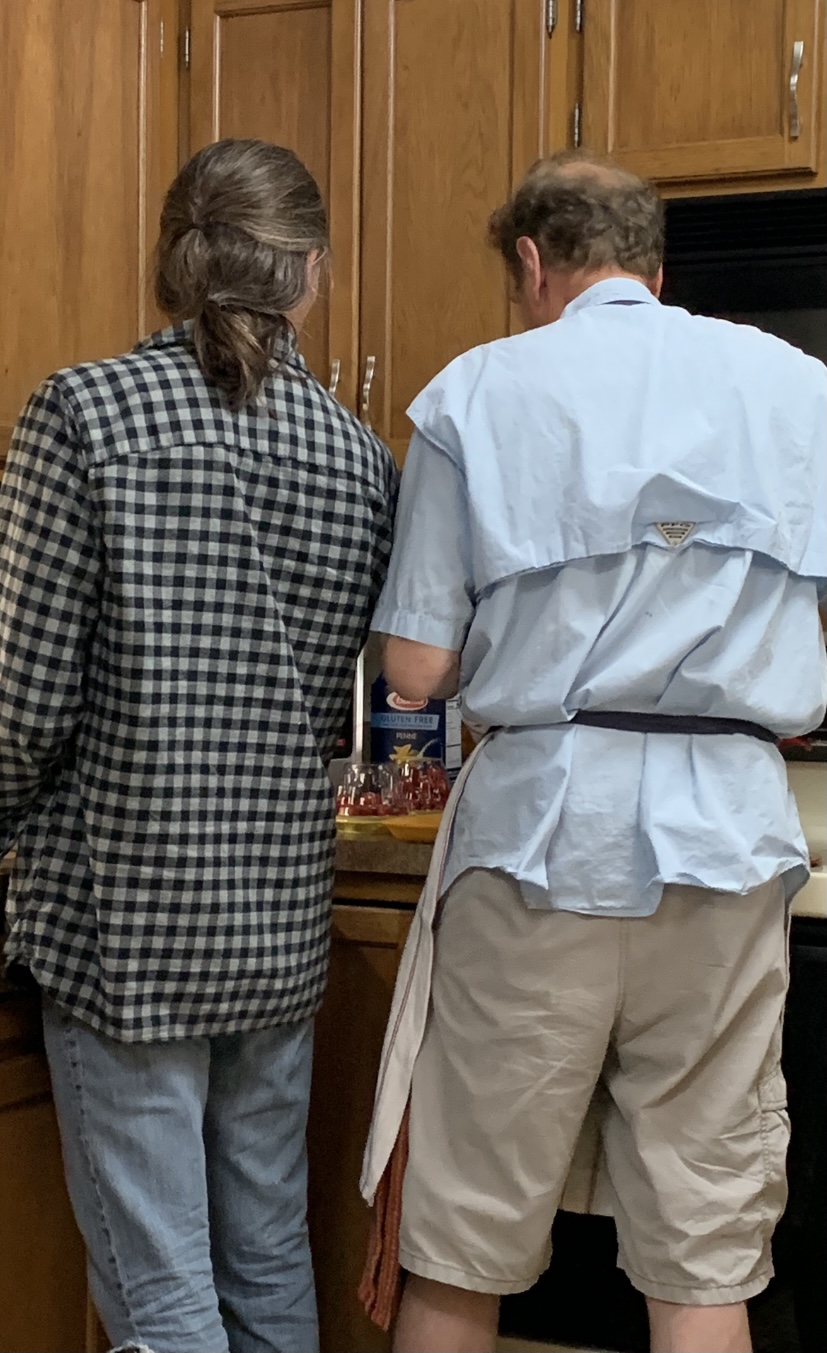
One of Kerri and my greatest losses during the time of pandemic was our weekly ritual dinners with 20. Thursday night we’d cook at his condo. Sunday night we’d cook at our house. We’d cook for each other. Sometimes we’d cook with each other. Always we’d drink wine, laugh, and reaffirm what is most important about life. Each other.

Post-vaccination, after a long year of isolation, we recently, gratefully, returned to our ritual. We cook. We talk about our days. We laugh. 20 and I tease Kerri. She feigns indignance and loves every moment. We talk about art. We share the curiosities that have crossed our paths and screens. Sometimes we talk about the nation’s self-immolation but only briefly as we very quickly realize that it pulls us from what is really important. Each other.

Tonight is dinner with 20. We can’t wait and are making our menu, designing our day around what will be the most important thing to happen all day. Time with each other.

As a nation, “We have the wolf by the ears, and we can neither hold him, nor safely let him go. Justice is in one scale, and self-preservation in the other.” ~Thomas Jefferson, in a letter discussing slavery.

How a question is framed determines the answers/paths-forward one sees or does not see. It could be said of our national trauma that we’ve framed our dilemma with justice pitted squarely against self-preservation, or, to be clear, self-preservation will be at the cost of justice-for-all. It’s too bad. As the bottom of Maslow’s hierarchy, self-preservation will always negate a reach toward justice. You’d think that we’d someday recognize that the wolf we have by the ears is of our own creation and that justice-for-all is the only path to self-preservation, national self-actualization. You’d think that it might occur to us, rather than do the same old thing in the same old way, to ask a different question.

If I had a magic wand I’d ding the noggin of this nation with the one strength we share, the one thing that 20 and Kerri and I know without doubt, the only real path to laughter and support and all the other good things we can offer: time with each other. A good meal made with heaps of love. A ritual born of a simple desire to each week make the world a bit better for each other.

read kerri’s blog post about DINNER WITH 20

Care Enough To Question [on Merely A Thought Monday]

“Have you noticed that people all over the world are divided into groups, calling themselves Hindus, Muslims, Buddhists, Christians, and so on? What divides them? Not the investigations of science, not the knowledge of agriculture, of how to build bridges or fly jet planes. What divides people is tradition, beliefs which condition the mind in a certain way.” ~Krishnamurti, Think On These Things

John helped me carry a treadmill downstairs into the basement. It was a beast, a one-step-at-a-time affair. After the job was done we fell into a conversation about how baffling we find our divided nation. He confided that, of late, he’s completely unplugged from the news. “I’m happier, less anxious,” he said, though somewhat conflicted about his decision.

I told John about my dear friend whose strategy for navigating the division and the noise was to read only The Wall Street Journal. It aligns with his conservative values and provides the business and financial news that he enjoys. For his mental health and well being, he’s eschewed all other sources.

On our drive from Wisconsin to Colorado and back again, Kerri and I were amazed by the rabid roadside proclamations of belief. A bumper sticker trumpeting Extreme Right Wing, a pick up truck, weaving through traffic, flying a Confederate flag. We stopped to get gas and went into the convenience store to use the restroom. We were wearing masks which apparently was an affront to the other patrons; I literally locked myself in a stall to avoid being assaulted.

I thought all night about my conversation with John. What are our strategies for surviving the toxic noise? Note the word, “survive.” John suggested (and I agree) that the division is intentional, a strategy. “They’ve learned to monetize hate,” he said, “Both sides.” Our strategies of survival are indications of the problem. Like my dear friend, we seek a source of information – a single source – based on our belief, what we align and are comfortable with, and not based on any measure or expectation of truth.

This is not a new revelation. We’ve been talking about the problem with info-bubbles for years. John’s question, “Why don’t people care enough to ask questions of what they are being told?” is, I think, exposes the root of the challenge. People have to want the truth, expect the truth, before they care enough seek it.

Questioning is the basis of education. Curiosity is what drives progress. Belief asks adherents to stop questioning. We are, apparently – at least 50% – a nation of believers. Not a question in sight. Witness the circus in Arizona, the implosion of the GOP, the restrictive voting laws sweeping our nation, the undying support of a lie that undermines the pillars of our democracy. Belief without question is a toxic soup.

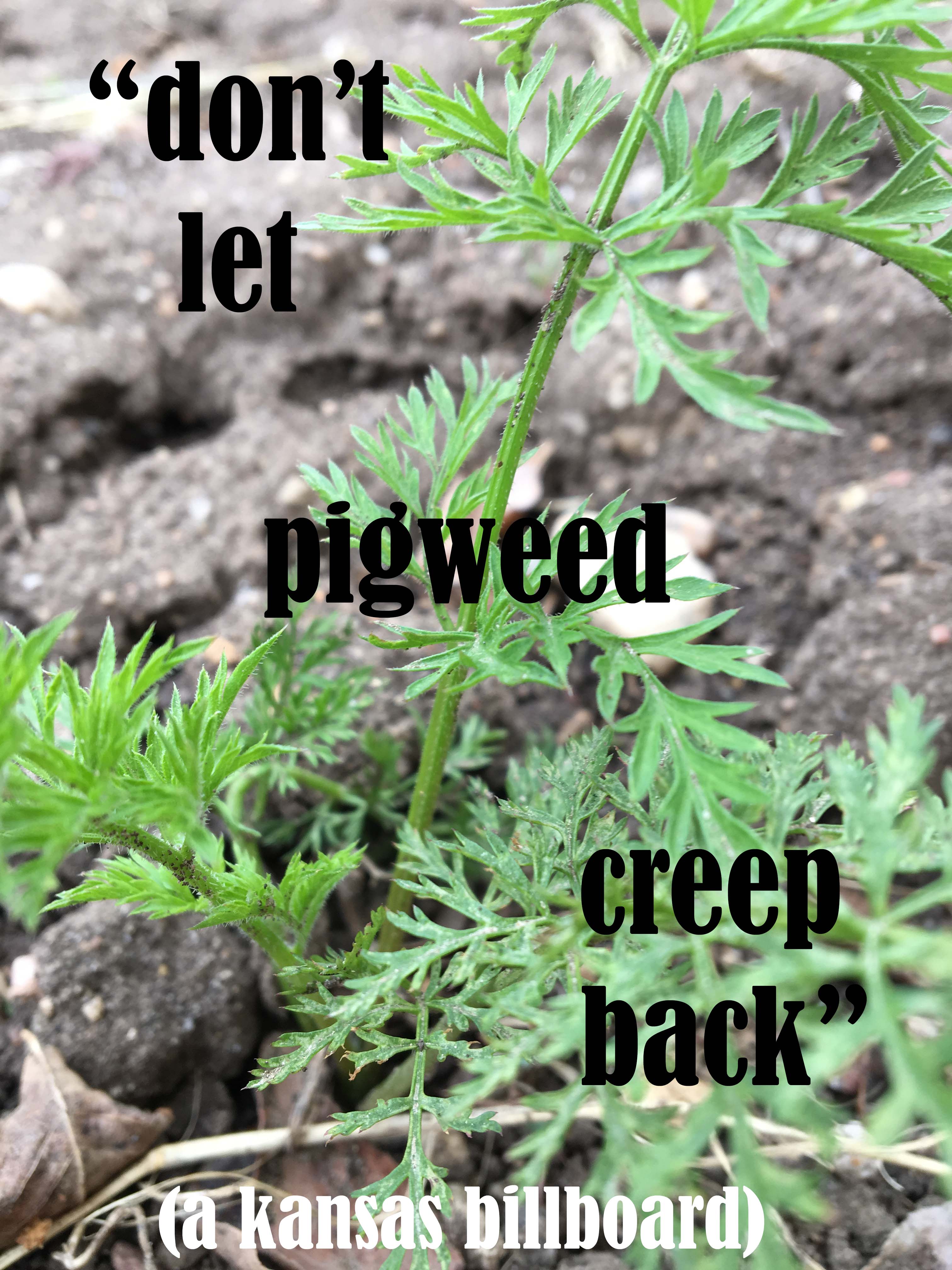
It’s become a metaphor that is easy to grasp: the Kansas billboard read, “Don’t Let Pigweed Creep Back.” A warning to vigilant farmers, pigweed strangles crops. It is toxic to farm animals. To keep the fields and the farm prosperous, a farmer must wage a consistent and conscious battle to keep the invasive weed from overrunning their fields. Our nation is no different than the farmer’s field. We are overrun with pigweed. It seems our information sorting mechanisms are out of whack. We no longer know – or care – to sort out what is edible and what is toxic.

We eat the weed and ignore the vegetable. John’s question is more and more relevant, “Why don’t people care enough to ask questions about what they are being fed?”

Belief without question. Conditioned minds. Mental farms overrun by pigweed.

read Kerri’s blog post about PIGWEED

Give Light [on Two Artists Tuesday]

“What is to give light must endure burning.” ~ Viktor Frankel

We walked downtown a few days after the fires. We decided it was time to go see for ourselves what had happened in our town only a few blocks from our home. In truth, the sound of speeches ringing through the neighborhood drew us. We were already walking when we first heard them. We couldn’t understand what they were saying or where exactly they were coming from so we followed the sound. The amplified voices and cheering bounced off the buildings and sometimes seemed to be coming from all directions.

We followed the echo to the street that runs by the civic center. From a distance we could see the crowd. ACLU observers wearing blue vests roamed the area. There was a first aid center. Tables were manned to distribute water to the crowd. When we saw the burned out car lot Kerri took out her camera and began taking pictures. “Why did they burn this?” she asked. Yes. Why?

It is uniquely human to ask why. To need an explanation. We attempt to record and document. To gather evidence. All in the pursuit of sense-making. To find meaning. And, if no meaning is easily found, no readily graspable answer to “Why?” is available, it is among our greatest human powers to make it.

To make meaning. To find meaning.

Viktor Frankel, a survivor of Nazi concentration camps, asked “Why did some people survive and some not? He looked for an attribute that favored survival in such extreme, random and deadly conditions. He concluded that, after sheer luck, survival in the camps favored people who made meaning from their circumstance. The people who sought meaning from their circumstance soon lost hope. He wrote, “Everything can be taken from a man but one thing: the last of the human freedoms—to choose one’s attitude in any given set of circumstances, to choose one’s own way.”

On the hood of one of the burned out cars someone had stenciled this appeal: Let’s Be Better Humans. What might it take for us to be better humans?

When I was in elementary school great pains were taken to teach me how to be a good human and function in a civilized society. Wait for my turn. Open the door for someone with their hands full. Help where you can. Listen to others. Raise my hand before speaking. All of these simple lessons shared one thing in common, a specific organizing principle: consider others. Be considerate to others. Good humans are mindful and cooperative.

All of these simple lessons ran contrary to the rules I was taught about succeeding in the world: it’s dog-eat-dog. It’s a fierce competition. Do whatever it takes. In other words, it’s every man and woman for themselves. It’s just business.

So, like all of us, I’ve wrestled with the national schizophrenia: I can either be a good human and consider others or I can succeed. Not both. Said another way: in order to succeed I have to abandon my goodness.

As is the case with most either/or framing, it is a false choice. Money need not be absent of morality. Success can be the blossom of compassion.

It is important as we stand at this national crossroad, this opportunity for reckoning with our past, that we look at this polarity, that we step into the gaps between all of the false choices, black and white. Our troubles will not go away until we attempt to live our rhetoric, until we unpin white success from black subjugation. Equality of opportunity, equal justice, equal (fill in the blank) has not been afforded all members of our community. To be better humans we need to challenge our either/or false choices and instead walk toward a center that includes a full spectrum of color, choices and opportunities for all.

If we can find our center, if we can challenge our rhetoric, we just might find our path to being better humans living in healthy inclusive society. In the end, we may even come to the same conclusion as did Viktor Frankel: “I grasped the meaning of the greatest secret that human poetry and human thought and belief have to impart: The salvation of man is through love and in love.”

read Kerri’s blog post about BE BETTER HUMANS