Shared [David’s blog on DR Thursday]

The waning sunflower stands vigil outside of the library, towering above us, perhaps nine or ten feet tall. Only a few short months ago it was vibrant, ablaze with yellow and viridian. Just as we had done in the summer, we stopped to say hello on our way into the building to check out a book. “It’s just as beautiful in decline,” she said, “only different.”

It is the day in these un-United States that we pause and give thanks. Although our tradition is based mostly on a myth, there are a few elements of the tale that are true. A horrible winter in which many of the settlers died was followed by a successful harvest made possible with the help of a native man named Tisquantum. “It is true that both the English settlers and Wampanoag people ate together…”

A successful harvest, shared.

Annie Dillard wrote, “Buddhism notes that it is always a mistake to think your soul can go it alone.” I have made that mistake in the past which is why, on this day, I am most grateful for my capacity to learn from my mistakes. I can trace my joy to the brilliant soul at my side and all the amazing souls who walk this walk with me. With us.

We celebrated early Thanksgiving with our children. We recently had dinner with our treasured Up-North-Gang. We regularly make dinner with 20. In recent times we’ve shared a meal with Dwight, with Arnie and Shelly, Kate and Jerry, Jen and Brad, Kelly…each a meal of thanks-giving.

It is a mistake on every level to think we can go it alone. Conservatives need progressives just as progress needs to be deeply rooted in tradition. Our tradition and our progress are the product – the abundant harvest – of ineradicable diversity. We are – as we have always been – a vibrant melange; people of various traditions learning how to eat together. We live in a global economy and are re-learning the hard way that there is no such thing as going it alone.

A successful harvest not only needs to be shared but is also made possible with the help and support of others.

Perhaps on this day we can be thankful for our capacity to learn from our mistakes. Perhaps we can, once and for all, drop the myth of rugged individualism and, as we prepare and enjoy our meals together, meals made possible by farmers and ranchers and truckers and bakers and grocers and inspectors…recognize that no one goes-it-alone. Gratitude shared.
read Kerri’s blog on this THANKSGIVING


likesharesupportgivethanksthankyou

The Pivot Point [David’s blog on DR Thursday]

There are many, many variations from many, many traditions of the concept of presence. My recent favorite is to “stand on the pivot point of the Tao.” No matter the name attached to “the now” there is a universal understanding: in presence – when fully present – there are no problems.

It’s easier said than done since fixating and worrying about imagined futures is what our brains are wired to do.

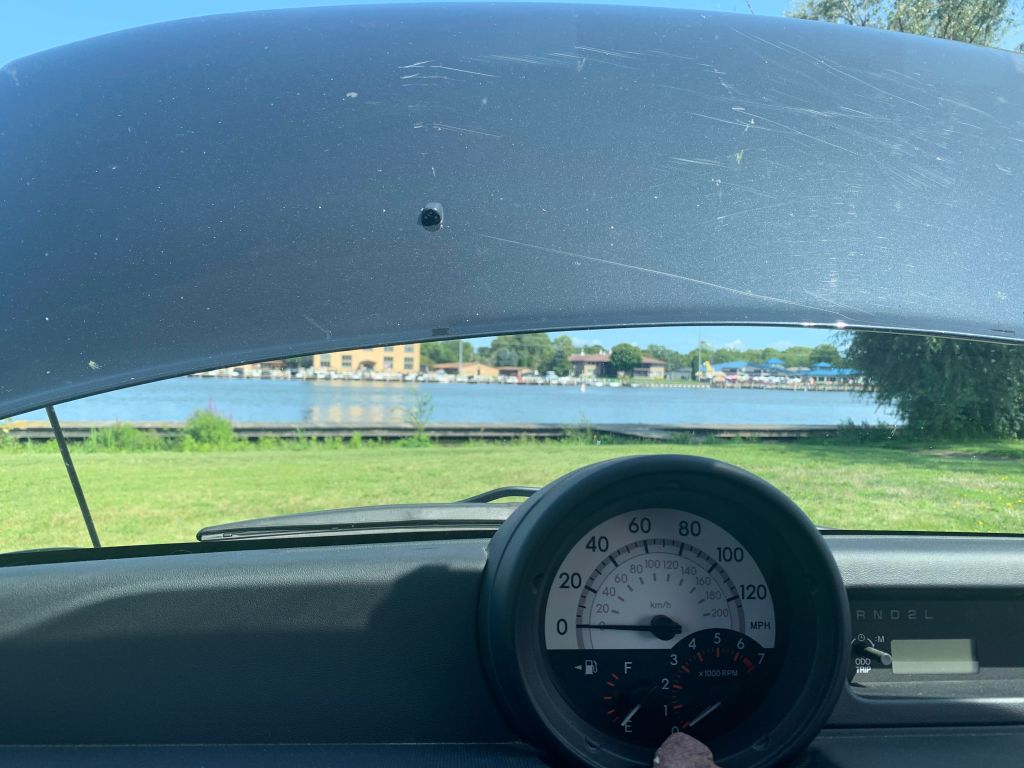
I thought a lot about presence during our epic drive home yesterday. The entire trip was an exercise in being-in-the-now. Of necessity we drove very slow, windows down with the heater on high. We stopped every hour, opened the hood, and let the engine cool down. We checked the coolant. And then, when certain that we could attempt the next stretch, we got back on the road.

I can’t report that it was stress-free but I can with all honesty say we made the best of it. We appreciated and enjoyed our stops. We discovered some new places. There was no rush or need to keep up with traffic. We kept to the right lane and let the-world-in-a-hurry pass us by.

We had friends on the road a few hours behind us; a safety net. They tracked and celebrated our progress.

When we rolled into our driveway, 20 had dinner in the crock pot and wine ready to pour. We laughed and told stories of the day.

We are unbelievably fortunate in friendship and support. All problems disappear in the presence of good friends. The pivot point is not a place. It’s a relationship.

We had an adventure with no problems. I’m certain that, even if the Scion hadn’t made it, we still would have had an adventure with no problems – because we decided to be present with and handle any experience that came our way. We decided to rest in the support of our friends.

It’s a decision, one we ought to make every single day.

read Kerri’s blogpost about THE ROAD

like. share. comment. support. subscribe…thank you.

Stroll With Alexander [David’s blog on DR Thursday]

20 knew we needed a get-away. He suggested a stroll through Milwaukee’s Third Ward. Knowing it was our favorite, he offered to treat us to a bowl of gumbo and a glass of wine at The Public Market. It was a successful temptation. We chose a beautiful day and drove into the city.

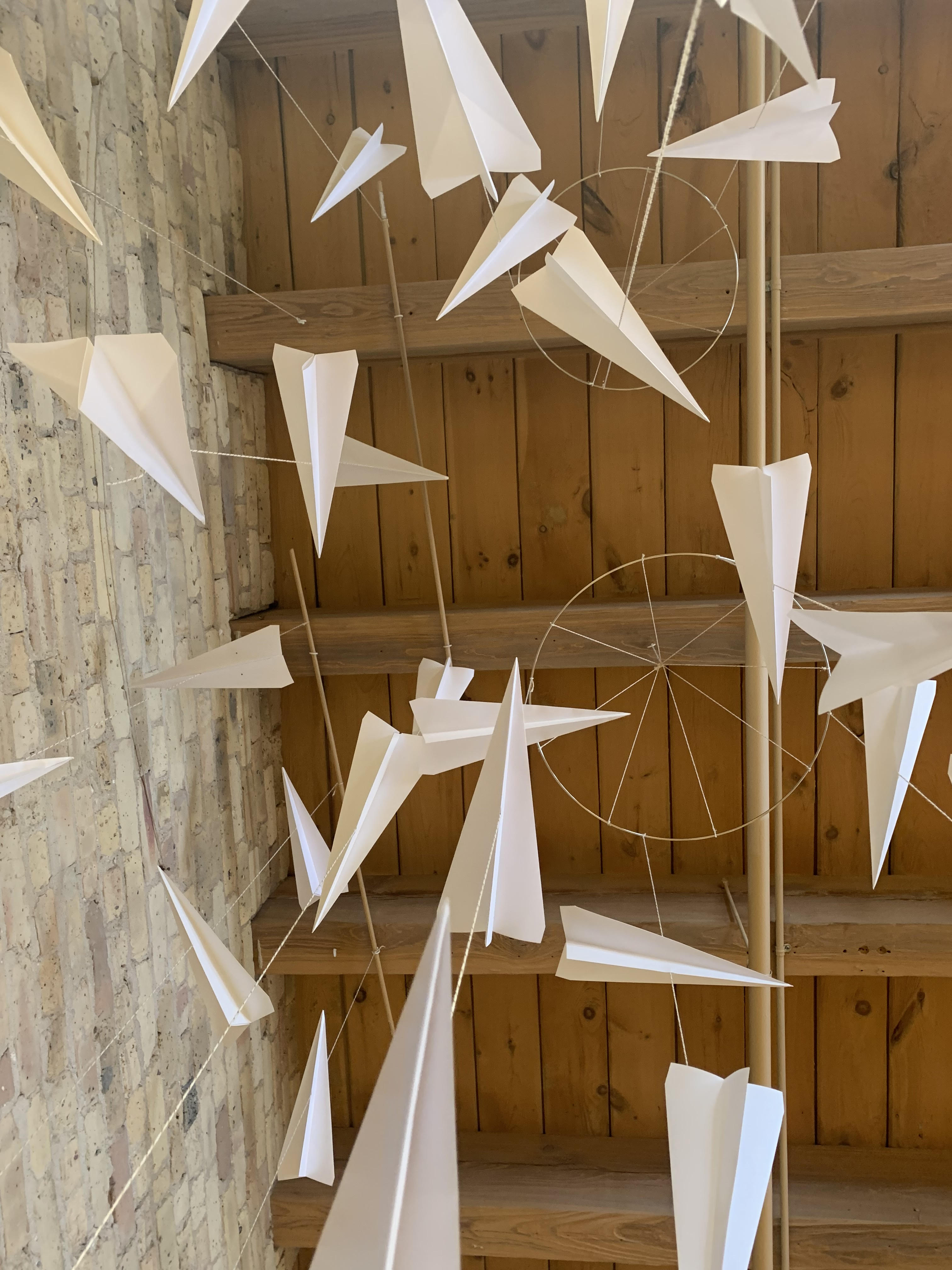
Among the many gifts that day as we strolled in and out of shops was the very present spirit of Alexander Calder. Almost every shop we entered featured a mobile or some variation of sculpture suspended from the ceiling. Paper planes, vibrant lemons in tidy lines like a Sunny-Roman-legion on parade, colorful shapes and orbs delicately balanced and dancing in the air, casting shadows. All paying homage to the art work of Calder. My bet is that few of the shopkeepers knew the origin, the ancestry of their twirling displays.

Calder’s mobiles were radical when he made them. He changed our understanding of sculpture and opened a new world of possibilities. Nearly 50 years after his death, his innovation is commonplace. Incorporation into the norm is the hallmark of profound innovation. Computers are ubiquitous but when they first hit the scene they were revolutionary. Electric light, the telephone, automobiles, televisions, cameras, elevators, air conditioning…They change us. They change our expectation.

So, too, the work of artists. The Impressionists shocked and appalled their contemporaries when they initially showed their paintings. They did not know that they were Impressionists. They were reacting to the latest innovation-of-their-day known as the camera – a device that could easily record reality, important events, make portraits of royals… the job of painters – so they either had to explore new avenues of painting or become irrelevant. To our eyes, 150 years later, their work is anything but progressive or shocking. It is everywhere.

Artist not only change what we see, they change how we see. They challenge us to see what we do not yet see.

A-I is currently stirring our dust and is already being incorporated into the daily grind. The pace of change compresses the distance between the moment of profundity and incorporation into the everyday. The realities of the pace-of-change are, like the camera, changing the nature of what it means to make art.

It’s good to remind ourselves that it hasn’t always been this way. What’s twirling over my head is clever and is the ripple of a revolution. It’s why I loved my stroll with Alexander Calder through the Third Ward. 20 didn’t know it, but he gave me so much more than a getaway, a bowl of gumbo and a glass of wine.

a page from an old sketchbook

visit my gallery site

read Kerri’s blog about MOBILES

support. like. share. subscribe. comment…thank you.

Small Ripples [David’s blog on Merely A Thought Monday]

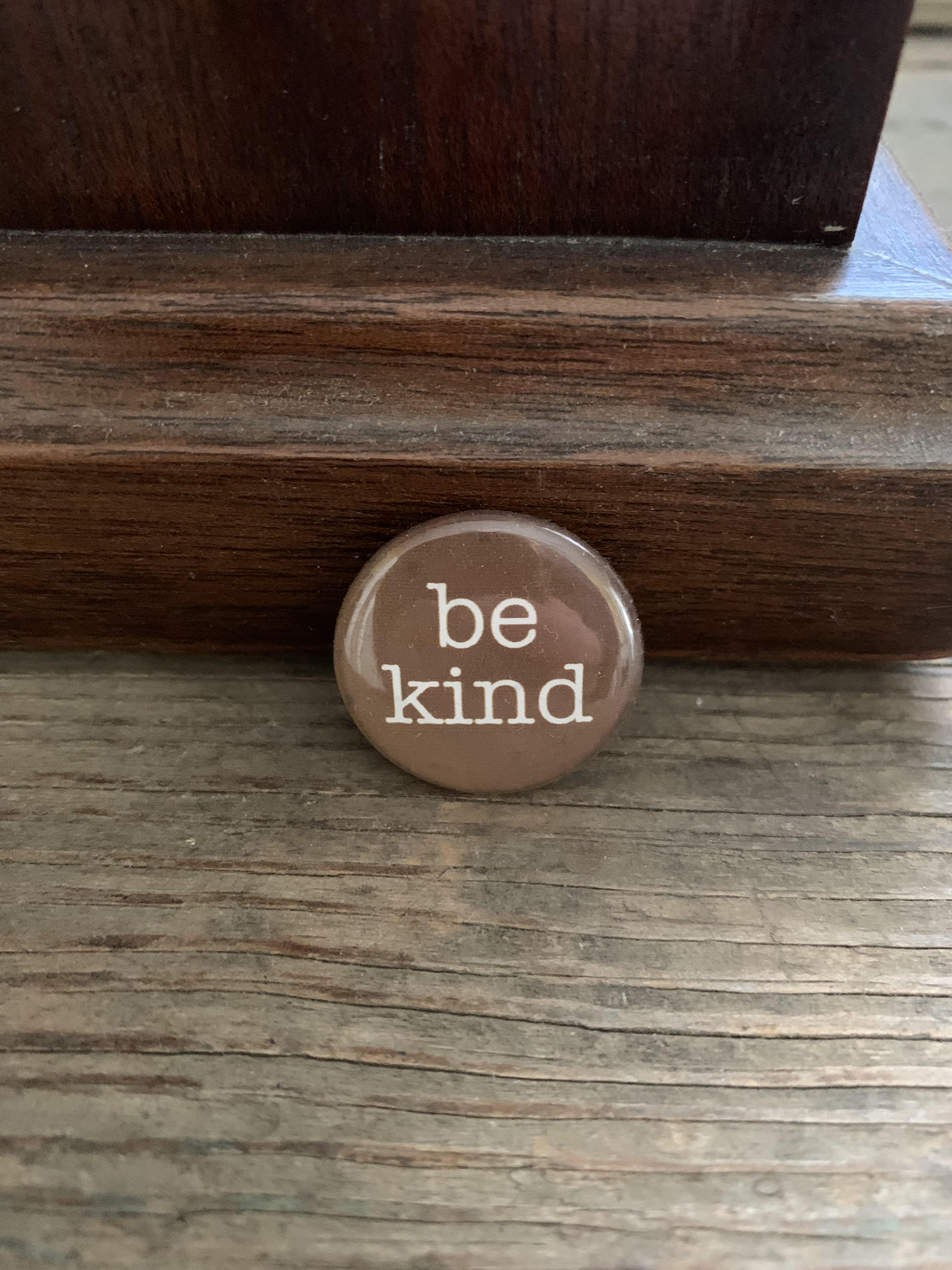
We made them for a Wednesday evening film, part of a series, when we were running a performing arts center. The film was Wonder. The message was kindness. We chose that film because the local arts community had a history of being particularly unkind to each other.

Theirs was an age-old challenge: the tension between the old and the new. The conservative impulse colliding with the necessity of progress. There were territories claimed. Feelings maimed. Status games abounded. As newcomers to the community and managers of the newest facility, we were the rope in the tacit tug-of-war. We experienced both ends of the spectrum: incredible kindness. Breathtaking mean-spiritedness.

None of it was personal.

Art is never supposed to be competitive. Great art creates generous audiences for everyone. COVID ended our time there but in our brief window, we acted as peacemakers. We heard the complaints. We helped vent the pressure. We found avenues to collaboration. We drew clear boundaries. We tried hard to be impeccable to our word: say what we mean and mean what we say. Averting confusion in a community versed in double-speak.

The buttons were available beyond the screening to anyone who wanted them. It felt yummy and subversive to show a film about kindness, about looking beyond superficial appearances to find the rich beauty in others.

I’d forgotten about the buttons. So much has happened in our lives since our time at the performing arts center that I’d almost forgotten about our varied experiences and the lessons we learned there. The buttons still exist on our site. We put them up after Kerri designed them, and although everything else has dropped out of our store, the buttons remain. An epicenter, perhaps. And, thank goodness. Recently a school was organizing a Be Kind Week. They found our buttons and, in some small way, it feels extraordinarily satisfying that our buttons, borne of our desire to break through walls of discord, are now supporting their kindness initiative.

Small ripples. Simple intentions.

read Kerri’s blogpost about BE KIND

Be Kind Buttons

like. share. support. subscribe. comment

Open The Tiny Measure [David’s blog on KS Friday]

My first question: when did UFO (unidentified flying object) become UAP (unidentified anomalous phenomenon)? I know I am late to the party on this one. Like you, I’ve been reading the UAP headlines for a few years and, each time, ask myself the same question: Why the moniker change?

I did a little research this morning and came upon this phrase from Bill Nelson at NASA: “We want to shift the conversation about UAP’s from sentimentalism to science.” Apparently, George Lucas and Steven Spielberg have our space-alien-sentimentalism dialed to an all-time high. Human imagination runs amok with unidentified flying objects and not so much with unidentified anomalous phenomenon.

Language matters. Since our reference point is…us…a flying object, like an airplane or a spaceship implies a pilot, a “being” at the controls. An anomalous phenomenon? It’s another way of saying unusual occurrence and what, exactly, is an occurrence? If it’s unusually amorphous, there is nothing to hang your hat on. The only thing to do is call a scientist or artist since the imagination needs a few parameters to light its fire.

There was another sad-ancient-yet-contemporary-cautionary-tale that popped up in my reading: “NASA recently appointed a director for UFO research, but is not divulging the identity to protect them from the kind of threats and harassment faced by the panel members during the study.” Science and art are -and always have been – dangerous business. Galileo spent his last years on earth under house arrest for publishing his science; it contradicted the firmly-held belief of the day. He was forced to recant his findings or face the fate of heretics.

Belief does not appreciate being contradicted, especially when there is evidence involved – or as is true in the current example – no evidence at all. Belief has a wonky relationship with evidence. We are witness to that all-too-human phenomenon in our times, just as was Galileo. Protecting poll workers and UAP scientists from the violence of those who are unshakable in their faith and/or “news” source (their reference point).

We do not need science (or maybe we do) to see our absurdity.

We have the capacity to exercise our imaginations in this vast universe of possibilities. We have the ability to question if we desire to use it. We have the gift of unbridled curiosity and need not go off the rails into rootless belief if we allow that, “There are more things in heaven and earth than are dreamt of in [our] philosophy”. We can be afraid of ideas, run from progress, or threaten the artists and scientists that force us to open our smallish belief and tiny measure of “normal”. Growth is always preceded by an uncomfortable step into the unknown. A challenge to what we think we “know”.

And then, after the upset, we need to find language to describe the new world that we discover there.

Time Together/This Part of the Journey © 1997 & 2000 Kerri Sherwood

Kerri’s albums are available on iTunes and streaming on Pandora and iHeart Radio

read Kerri’s blogpost about UFO and UAP

like. share. support. subscribe. comment. thank you.

Wish For It [David’s blog on KS Friday]

“The world is changed by your example, not by your opinion.” ~ Paulo Coelho

And so we tie up another year according to the latest iteration of the Roman calendar. As is customary on the waning days of the year, we look back and review where we’ve been, who we’ve lost, and attempt to measure our progress toward any number of goal posts. We affix an adjective or two to the passing year; “It was a good year.” Or, “It was a bad year.” A rough year. A surprising year. It’s the time of experience-reduction and encapsulation. It’s the time of renewal as we step over the imaginary line with an imaginary clean slate.

We wish each other a happy new year. I’ve been wondering what the world would look like if the wish had some teeth. What would we do on the first day of the new year – and every day after – if it was more than a passing wish; if it was our imperative to make certain that each person in our community, in our lives, would have a happy year. Happiness as a shared responsibility. How might that change our choices? How might that fulfill the ubiquitous ideal to “lead by example”? To live by example.

I know. Another pie-in-the-sky post. But I would offer this thought from my personal year-in-review: I am surrounded by people who have made my well-being their personal concern. And, I haven’t the first idea how to reciprocate in a meaningful way except to pay it forward in any way possible. To live my life according to their example.

So, was it a hard year? Yes. Oh, god, yes. Was it an extraordinary year? Yes. Unbelievable. Am I moving forward with a clean slate? A fresh beginning? No. Not a chance. The baggage is coming with me.

Except there will be this: when I throw my confetti into the air and toot a horn of celebration, wearing my funny hat, I will step across the line in full knowledge and with a full heart, a new imperative beyond the sing-song wish of a Happy New Year. I will have an example to follow that completely transforms the once-yearly-ritual-wish into a daily-lived-action.

It’s not pie-in-the-sky, after all. It’s about time we create what we always wish for.

grateful/as it is © 2004 kerri sherwood

Kerri’s albums are available on iTunes and streaming on Pandora and iHeart Radio

read Kerri’s blogpost about THE WISH

share it. like it. support it. comment on it. we appreciate it.

buymeacoffee is a digital gratitude, an online tip-jar, that sails through time and space to support the continued creation and blather of the artists who consider pie-in-the-sky possible.

Invite The Bacon [David’s blog on Merely A Thought Monday]

Of course, the problem with leaving well enough alone is that the phrase only pops up when things are not well enough. When change is on the horizon, when a hidden truth is about to breach the crusty surface, when the globe spins and a new insight dawns, it is a sure bet that the keepers of the conservative will bellow, “Leave well enough alone!”

Call it creative tension. The space between progress and conservation is a taut rubber band. Both poles serving a necessary purpose, neither is trustworthy when absent the other pole. So, phrases like, “Leave well enough alone” are signal flags, signs that the tension on the band is high and the snap forward is inevitable. Pulling back always signals an impending forward step. Always.

I’m particularly fond of this image. A tomato slice demanding inaction. And won’t this crabby tomato be surprised in a day or two to see the icky green results of inactivity! Better to invite the bacon, lettuce and toasty bread to the plate, a bit of salt and pepper, and get on with the business of yummy sustenance. Progress by any other name.

read Kerri’s blogpost about LEAVE WELL ENOUGH ALONE

like. share. support. comment. resist. leap. stand very still. all are appreciated.

buymeacoffee is a progressive impulse meeting a conservative over-reaction causing deep distress that can only be cured by an action in the direction of intention to make a better world for the tomatoes that envision it.

Sun Dry [on DR Thursday]

“…people find what they are looking for. If you’re looking for beauty, you’ll find beauty. If you’re looking for conspiracies, you’ll find conspiracies. It’s all a matter of setting your mental channel.” ~ Roger von Oech, A Whack On The Side Of The Head

Our time on Washington Island was multi-layered. Half of the people on the island saw us as invaders. The other half saw us as welcome progress. We were hired to manage the performing arts center which, out of the chute, served as a divisive symbol for the local community. We were the first “non-islanders” to manage the TPAC. Division upon division. And, although we were the focal point of the contention, none of it had to do with us, not really. Our status as invader or progress originated in the eye of the beholder.

Because the actual job was a festival of landmines, I especially appreciated the simplicity – and sanctuary -of our little house, a home provided to us for the summer-on-island-months. Our refuge sat on the shore of Lake Michigan. It was as peaceful as the job was contentious.

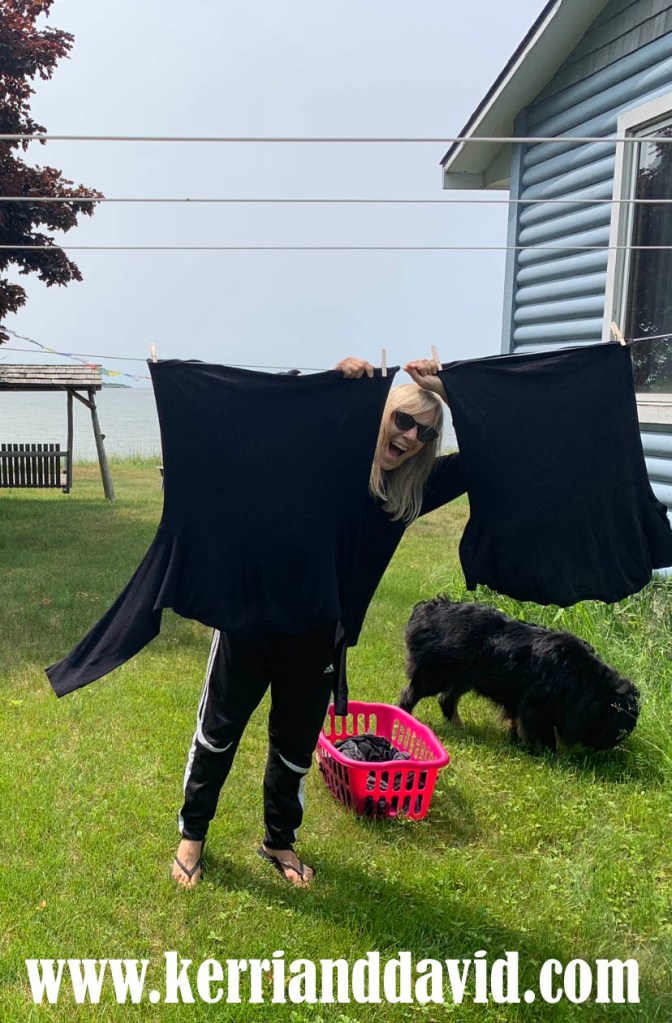
My favorite symbolic act at the little house was hanging the clothes to dry. When we arrived the clothesline was in disrepair. We re-strung the poles with new line purchased at the local hardware store. We quickly grew accustomed to carrying the wet clothes outside. We learned that the wind off the lake sometimes required strategy to what-is-pinned-in-front-of-what. Double clothespins on sheets and shirts was always a good idea. Mostly, I appreciated how the clothesline slowed our pace. It brought us into the sun and in relationship with the wind. The real stuff.

It helped set our mental channel. Hands on, tactile, slow-paced, generous, the power and presence of the lake filled us with awe. So, to our work, we brought awe. Literally. We were in awe of these people that cared so much for their community. Like most communities, they had more than one idea of how to protect it. Progress or conservation.

We understood that these two paths-to-the-same-goal need not be oppositional.

We learned that our job was to build bridges where they had fallen. We understood that, in this divided community, we had to pay attention to what-is-pinned-in-front-of-what. We learned that double pins on big ideas was sometimes a good idea because ideas often generated big wind. Listening was the best idea of all. We understood that if we brought our awe to both sides of the coin, we might one day build a single bridge that could not be burned.

We learned that there was no rushing the process, just as there is no way to rush the clothes drying on the line.

a day at the beach, mixed media, 38x52IN © 2017

my site. yes. as yet incomplete. a testament of continued indecision of my purpose and intention.

read Kerri’s blogpost about the CLOTHESLINE

like. share. comment. support. many thanks for all.

Watch Your Fingers [on DR Thursday]

After several weeks with its face to the wall, I turned the painting around to see it with fresh eyes. “OMG!” I thought. “This needs some serious work!” It’s too tight in some places, not finished in others, and it’s missing an all important element. The florals are rock hard and the dog – part of the original composition – is nowhere to be found. What was I thinking!

I’m a bit too famous for painting over paintings. It’s a habit that evokes finger-wagging from friends. Kerri has been known to fling herself between me and a painting that I put on the easel-chopping-block. “I hate it!” I cry.

“Touch it and I’ll break your fingers,” she quietly threatens. I like my fingers so I relent.

Actually, she’s provided me with the perfect response to gallery-goers when they ask the ubiquitous question, “How do you know when a painting is done?”

In the past I’d say something amorphous like, “It’s not something you know; it’s something you feel.” Intuition. Gut feeling. Artistic argle-bargle.

Now, my perfect reply is definitive and goes like this: “Oh, it’s easy! I know it’s complete when my wife threatens to break my fingers.” She might look like a delicate columbine-flower but watch out.

It’s a conversation stopper but the real fun comes when I add, “She’ll break the fingers of anyone who doesn’t appreciate my work.”

I turn and walk away as they debate asking the obvious next question: Is she here?

read Kerri’s blogpost about COLUMBINE FLOWERS

The offending painting. It needs work and Kerri has yet to threaten my fingers.

My site-placeholder.

“like” my argle-bargle. or share it. or comment (but watch your fingers!). or buyusacoffee.com. all are great ways to support our work.

train through trees – in this state of development © 2023 david robinson

Look In [on Not So Flawed Wednesday]

“I want to stand as close to the edge as I can without going over. Out on the edge you can see all kinds of things you can’t see from the center.” ~Kurt Vonnegut

Yesterday I applied for a job that is all about narratives told from the edges of society. I’m not sure why it surprised me to find such a cool-to-me job; our community seems addicted to shattering so there are plenty of small edges to be found. Small edges are fallacious and serve a myriad of false centers. Our survival will depend upon whether or not we can awaken from the shatter-narrative and make the decision to direct our broken focus toward a common center. No small feat.

It is the role of the shaman, the explorer, the artist, the researcher to stand on the edge and report back to the community what is seen and unseen. The voice from the edge is rarely welcome since the report is capable of popping delusions or pulling the sheep’s clothing from the wolf. Page one of the autocrats’ handbook instructs the elimination of artists and educators. Making an enemy of the eyes-that-see, demonizing educators and thinkers – the people who recognize pattern and metaphor. The game of Us-and-Them necessitates silencing the voices capable of calling out the wolf. Autocrats require blind sheep that follow without question.

Some famous edge sitters: Galileo. Cesar Chavez. Rosa Parks. Nelson Mandela. Susan B. Anthony. Albert Einstein. Frederick Douglass, a former slave and leader of the abolitionist movement, wrote extensively about what we call Critical Race Theory; it was clear in his view from the edge. It’s not a new theory. It’s an old pattern with a new name. I think he might denounce his Republican party affiliation were he alive today; they would certainly silence his voice. He would be fired were he a professor in Florida today. As would Martin Luther King, another famous voice from the edge.

Voices of reason are often voices from the edges. Voices of the future are always voices from the edges. Galileo was silenced for suggesting that the earth circled the sun and not the other way around. Over time, the voices from the edge, when authentic, always make the center better, the community stronger. Susan B. Anthony spent her life on the edge, lobbying the center, to secure for women the right to vote.

Progress. Growth. They are rarely inspired from the tight grip at the center. Silence the edges and the community atrophies. Stop the movement and the body dies. That page was left out of the autocrats’ handbook for obvious reasons.

read Kerri’s blogpost about EDGES