Scratches On The Wall [David’s blog on Two Artists Tuesday]

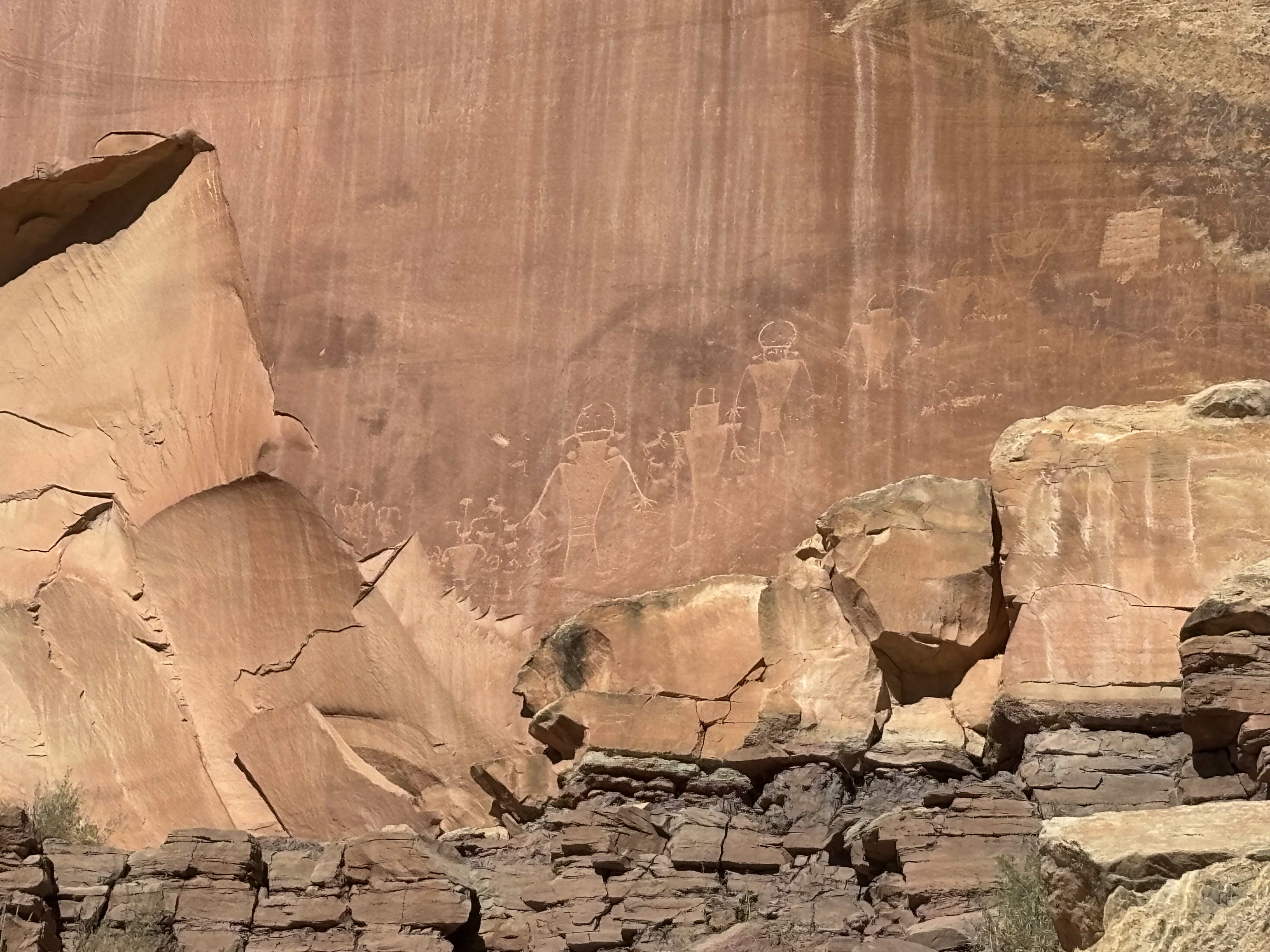
Scratches on the wall. Petroglyphs, the only evidence that remains of a people who once lived in these canyons, who lived by the river we’ve named Fremont. We do not know if they had a name for the river. We do not know if they had a name for themselves. We call them the Fremont, after the river. A location name.

The Fremont River is named for an American explorer, John Charles Fremont, so the people who scratched pictures into the rock over 1,000 years ago also carry his name. As is the nature of history, we locate them from our point of view. We build an identity-structure and civilization-story about them based upon our story of them. We’ve placed them in our narrative timeline, 1 – 1300 CE. We have no idea how they thought of or marked their time.

We have no idea what became of them. They disappeared into time. We have no idea what the petroglyphs mean or why they scratched them into the canyon walls. We wonder at the semiotics, the inner symbolic life that produced such strange (to us) images that remain on the red rock walls.

This morning, through my COVID aches and chills, I watched the news. I would like to say that I am mystified by the civilization-story currently being spun and supported by half of my nation but I am not. I would like to say that the hatred and fear-mongering of the red hat tribe is as much a mystery to me as the way of the Fremont, but it is not. The concurrent xenophobia and wild-eyed-creation of an internal enemy (anyone not in a red hat) has roots that are all too easy to see. It’s a fascist popcorn trail, a page from Hitler’s handbook. The language is identical. The images, scratched into the red-fox-walls of our time are all too easy to interpret. A frightened and misinformed populace is easily manipulated. Fooled.

What is a mystery to me is the inner symbolic life of my nation’s conservatives that seem so ready to trade our sacred democracy for a populist authoritarian. What scratches on the walls of their minds are so easily storied into hatred. What has so hardened their hearts that they embrace with cheers the repulsive bile spewed by their candidate? It is as incomprehensible to me as the petroglyphs of the Fremont.

All societies disappear into time. Ours, relative to the Fremont, is still in its infancy. We can only hope that an explorer in some distant future finds our petroglyphs – and although a mystery to them, we will have known that we transcended the authoritarian threat and overcame the fox-fear-fantasy, manufactured hatred and dark lies. And, over the next thousand years, our scratches on the wall tell the tale of how we matured to fulfill the promise of our sacred ideals. Out of many, one.

read Kerri’s blogpost about PETROGLYPHS
like. share. support. comment. subscribe…thank you.

Carry The Impression [David’s blog on DR Thursday]

Leigh is an authority on rock art, the pictographs and petroglyphs found in caves and on rock walls around the world. People, for whatever reason, leaving a mark. Leaving their mark. Ritual? Aesthetic? I relished conversations with him as I peppered him with questions, speculating about their reasons.

Brad once said – that when he passes someday – he wants a plaque on a bench so that people will know that he was here. Future bench sitters will read the plaque and wonder who he was and why his name is on the bench.

Recently 20 brought to our house several drawings, conte crayon on newsprint. They are figure studies Duke, his father, did years ago when working with a model. They are gorgeous and free, the drawings of a master. Most are signed. I sign my paintings, too. I want people to know that they are mine, that I created them. Looking at the drawings, now that Duke is gone, I was taken by the power of the marks on the page, his signature, reaching across time to tell me, “This was my work. I was there.”

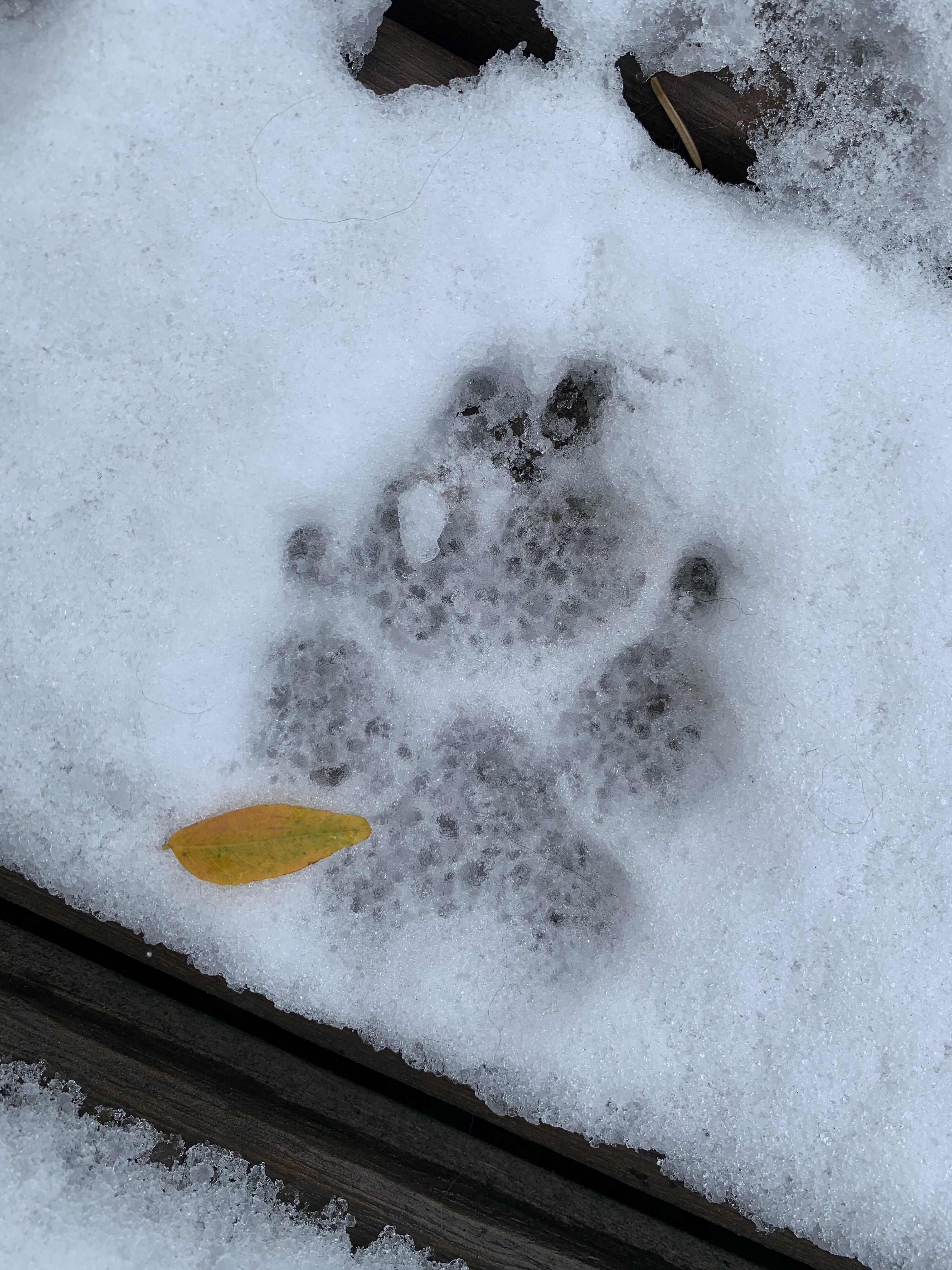
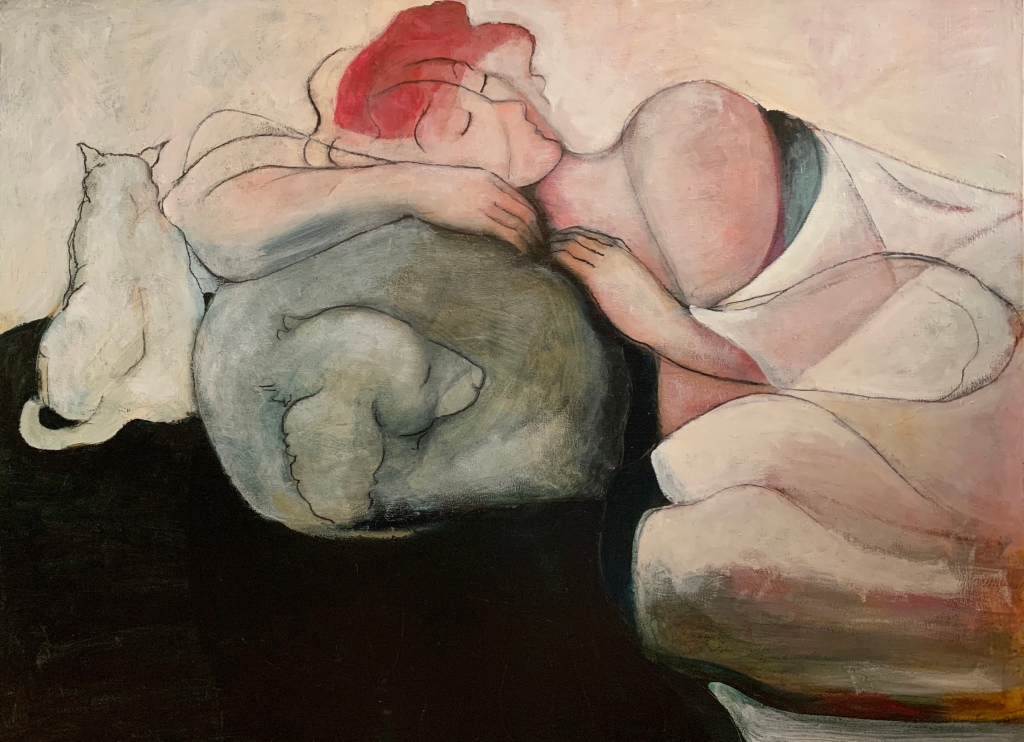
When BabyCat passed the vet made an impression of his paw for us. A keepsake. A reminder. I doubt BabyCat cared at all but we did. It helps us stay connected. It prompts us to tell stories.

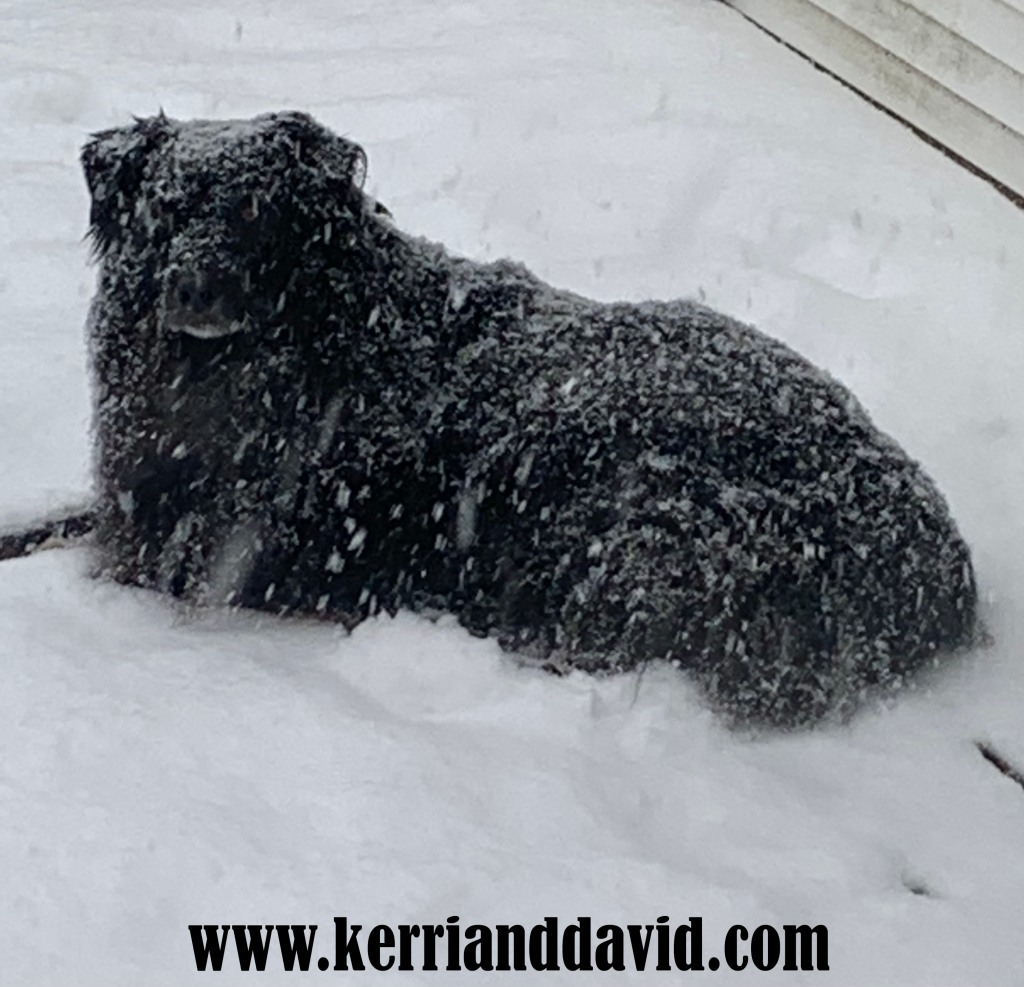
Dogga’s beard is as grey as mine. He sometimes groans when he stands. He snores at night and we smile, knowingly. A few weeks ago, for a day or two, he was in pain, limping for unknown reasons. Although I knew it was not serious, an achy joint or pulled muscle, I was terrified at the depth and scope of what I was feeling. Love is like that. He stepped through the snow and left a print. I stared at it, taken by it, like Duke’s signature or a petroglyph scratched into stone. I watched him prance his circle-of-patrol and was utterly grateful for my terror, for the depth and scope of what I was feeling.

Love is like that. A bottomless impression he has left in me that I will carry to the end of my days.

read Kerri’s blogpost about DOGGA PRINT

support. like. share. comment. many thanks.

Ask The Same Questions [on DR Thursday]

Their call is ancient and beautiful. I imagine their unique voice reaches back to the pterodactyl. Sandhill cranes. We live on their migration path. Each spring they stop for a rest, passing through, heading north. The Des Plaines river, surrounded by abundant farm fields, provide ample road snacks and safe places for respite.

Last fall, during the southern migration, a crane couple took up residence in a cornfield we pass en route to our trail. They stayed so long that they became a fixture. We expected to see them. Statuesque, always together, I wondered if they were as excited to see us as we were of seeing them. “There they are!” the cranes point to our little black toaster car. “Those two are always together,” they observe. “I wonder where they are headed?”

We make the same observations and ask the same questions of them.

When we first saw their tracks in the snow it felt like a gift, like seeing two hawks circling or several deer peeking from the willows. Their prints were huge, almost too big to be real. They were so distinct that they reminded me of something Andy Goldsworthy might create. Patterns in the snow. Marks mysteriously etched across the landscape.

Were it stone instead of snow, white quartzite, these amazing marks would be petroglyphs. Abraded to leave us a message, a symbol whose meaning was lost in time but inspire speculation none-the-less. “Where did they come from,” we ask, knowing there is no answer but we have to ask anyway.

Our footprints cross theirs on the path. Brad does a masterful crane-walk-imitation. We laugh as man becomes bird, eyes intense. The original theatrical impulse. I look back at the our prints crossing the crane’s and marvel at the image. This startling canvas will certainly melt. Another reminder of Andy Goldsworthy. The power of impermanence, like a sacred sand painting, a spirit captured for a brief moment, witnessed, evoking power, and then disappearing into sun and wind and time.

Canopy, 48x48IN, acrylic

read Kerri’s blogpost about CRANES

Canopy © 2008 David Robinson

Make A Mark [on DR Thursday]

see an owl with frame copy

k.dot & d.dot see an owl, mixed media, 24 x 48IN

Every once in a while I paint a chronicle piece, capturing an event from something that happened in our lives. Early in our relationship, sitting in Adirondack chairs in the front yard,  sipping wine, listening  to music, we broke into a spontaneous fit of dancing.  Dancing In The Front Yard was the first of the chronicle paintings.

Picasso said that painting was just another way of keeping a diary. I suppose that makes all of my work or any artist’s work a chronicle. A record. Jackson Pollock’s ‘action paintings’ are considered a record of the artist’s movement, a visual register of the painter’s dance.

I knew a man whose passion in life was rock art. Petroglyphs and pictographs. Human-made markings on stone. He traveled the world to the caves or cliffs – sites – where these ‘records’ are found. We had many conversations about the “why” of it – why people so long ago scratched images in rocks, ground minerals to make pigment and painted walls deep in a dark cave. Ritual or roadmap? Worship or whimsy? Both/and?

A diary? A register? A reaching? A marker? Maybe it is simple: humans make marks. And then give the marks meaning. Or, perhaps more to the point, we make marks and believe the marks give us meaning.

Kerri and I saw an owl in the pine tree in our backyard. It was thrilling. We thought it was a good omen, a gift. We slipped into the house to get the binoculars, careful not to move too fast to scare it away. Later, standing before a blank canvas, all I could think about was the thrill of seeing the owl.


read Kerri’s blog post about K.DOT & D.DOT SEE AN OWL


drc website header copy


chicago river website box copy


k.dot & d.dot see an owl ©️ 2015 david robinson