Gurgle On! [on DR Thursday]

I’m certain the first time I tried to walk I was not successful. A few stumble-steps and a return to the floor. My first attempts at speaking the English language did not receive a passing grade. As I recall (and I don’t recall), I made some gurgling sounds into which the adults surrounding me projected meaning. I’m certain they cheered and encouraged me to gurgle-on.

Learning is not a terribly difficult thing to do when 1) there’s a reason to do it, and 2) judgment, including words like “success” or “failure” are absent from the experience. Thank goodness my first art teacher treated me like an infant and, rather than critique my mess, she encouraged me to gurgle-on. Consequently, I associate my artistic impulses with fun and exploration instead of the thousand shades of rignt-and-wrong that most people are subjected to.

Recently Skip wrote and asked, “What’s the second rule?” Suspend your judgment and learn.

We just bought a mandoline. It slices and dices and chops and cuts. “The first thing we’re going to make is potato chips!” Kerri proclaimed. And, then, her brow furrowed. “What if we do it wrong?”

“We’ll learn something and make another batch.” Trial and error. Both “trial” and “error” are essential ingredients in the learning process and, since all of life is a learning process, you’d think someday we’d learn to value the “error” portion of the experience. We do ourselves a great disservice placing so much emphasis on passing the test and having the “right” answer. The essential ingredients of trial and error can’t breathe in brains fogged by so much right-and-wrong-ness.

Our first batch, like our first baby step, was a stumble. But more delicious. We stood over the pan eating our result and discussed second steps. What should we do differently next time? Less heat or more? Thinner slices or thicker? This is all I know. I love to learn, especially when food is involved and judgment is not.

read Kerri’s blogpost about POTATO CHIPS!

flawed cartoon © 2016 david robinson

Go To The Mountains [on DR Thursday]

For Mike, it was the ocean that called. For me, it was the mountains. When Columbus passed, more than a service, more than any gathering, I needed a walk in the mountains. I needed the quiet of aspen, the smell of pine. A moment in time, time that keeps moving through the monumental and the everyday. The trees and stream were here before I was born and they will be here after I am gone. I went to the mountains for perspective.

I am working with brilliant people. We are developing something that we hope will help people. Our conversations are genuine. Our intentions are pure. And, yet, how easily do we get lost in the minutiae. How often do we spin out into abstraction. Right now I have a unique perspective on life. I am in no hurry to get anywhere. I easily let go of my end of the rope in any potential tug-of-war. Will what we create actually help others? That is like asking, “Will they like my painting?” That is not for me to decide. Mine is to paint it. All I know is that our conversations are genuine. Our intentions are pure. None of the rest really matters.

I’ve decided to put two paintings into a local show. I’ve only shown and sold online since moving to Wisconsin eight years ago. I was tired. Before I moved, I had paintings in galleries or office spaces or bars or restaurants every single day for over a decade. I was moving or mailing paintings all of the time (and my paintings are mostly large). Once, I took 15 paintings, loaded on a cart, on the light rail. I arranged for a truck that did not show up and I had to deliver the paintings that day, within a specified time-window. I wheeled 15 large paintings down the street, onto an elevator and maneuvered them onto the train. The train-police came to make sure I meant no harm. We had a nice chat and I showed them my work. We laughed heartily at my delivery method. I wheeled them off the train and through a neighborhood to the gallery. “I’ll never do that again,” I said to the train-police when I wheeled my empty cart back onto the light rail. It all seemed so necessary, important.

A specified time-window. We only have so much time. The clock is ticking. The funds may run out. Will we get there in time? Will our/my work matter? Is the message clear? What is the message? What am I willing to do and not do?

And, so, I went to the mountains for perspective.

read Kerri’s blog post about PERSPECTIVE

Chasing Bubbles © 2019 David Robinson

Embrace Orbisculate [on Merely A Thought Monday]

A family is trying to get ‘orbisculate‘ into the dictionary to honor their dad who died of Covid-19

Compromise. Accuse. Jaded. Dishearten. Tranquil. Swagger. Mimic. These are just a few of the over 1,700 words that William Shakespeare invented or adapted. Making up words, playing with sounds and meanings and clever twists of usage was appreciated in his lifetime. Audiences went to hear plays like we go to hear concerts. The sound of the word was more important than the visual on the stage.

During Shakespeare’s lifetime, Robert Cawdrey toyed with a thing that would someday be called The Dictionary though it wasn’t something Will had to consider. Spelling was phonetic. Teachers did not think to circle his words with red pencil. That bit of standardization was still a few centuries away. Spend time within the unedited-for-our-eyes First Folio and you’ll find yourself sounding out words just as the poet did. Tasting the sounds. Shaping meaning in your mouth en route to making meaning in the world.

Language is fluid. Each year new words come into being and others drop from sight. For instance, our word “google” is a “creative spelling of the word googol, which implies an unfathomable number. It was coined in the 1930’s. Our version is in the dictionary as a verb: to search for information. And, you’ve probably already heard that it’s also a company that facilitates the search for information. Which came first, the verb or the company? Some words, over time, come to mean the opposite of what they originally meant. The archaic meaning of the word “egregious” is “remarkably good.” From remarkably good to outstandingly bad is quite a journey!

Definitions are discoveries and agreements made according to how we use the tasty sounds we call “words.” Each word comes into being from necessity.

Orbisculate is a tasty word that William Shakespeare might have created and enjoyed. But, he didn’t. Neil Krieger did. It is a word for juice squirting in your eye. Neil died of COVID and, to honor this good man and his good life, his family is attempting to get Neil’s good word into common parlance and, ultimately, to the dictionary. They are appealing to poets and pedestrians alike to embrace their necessity and use Neil’s word. If you visit their site, check out their 50 Goals. Never was a single word so lovingly brought into the lexicon. Help them if you will. Will would have. He’d have used orbisculate in one of his comedies. Or many of his comedies.

I have a sneaking suspicion, if they are successful in their quest, that, over time, orbisculate will come to have another meaning: an act of familial love.

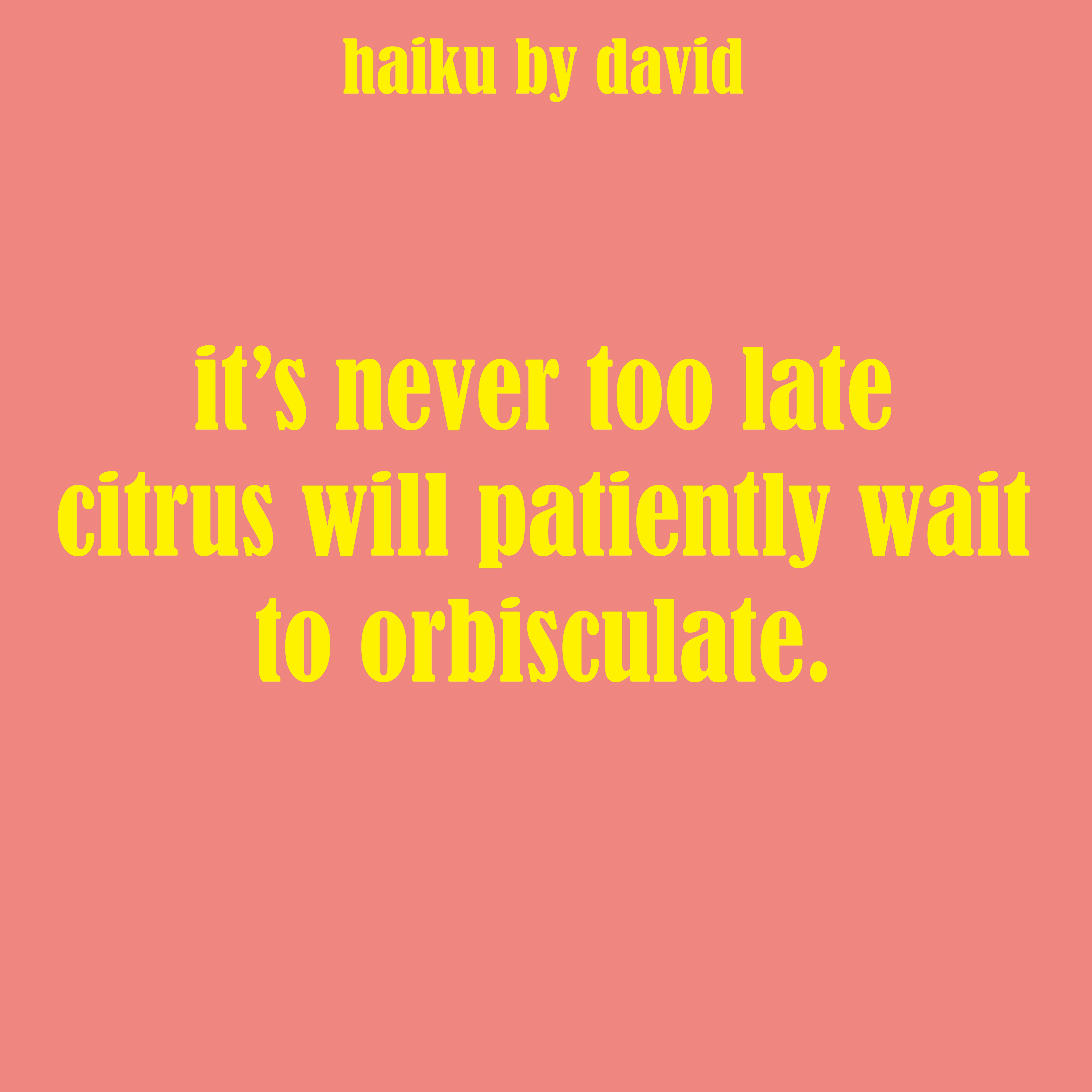
The Orbisculate haiku challenge! Here’s mine:

Now, it’s your turn. Make sure you let the family know.

read Kerri’s blog post about ORBISCULATE