Open The Tiny Measure [David’s blog on KS Friday]

My first question: when did UFO (unidentified flying object) become UAP (unidentified anomalous phenomenon)? I know I am late to the party on this one. Like you, I’ve been reading the UAP headlines for a few years and, each time, ask myself the same question: Why the moniker change?

I did a little research this morning and came upon this phrase from Bill Nelson at NASA: “We want to shift the conversation about UAP’s from sentimentalism to science.” Apparently, George Lucas and Steven Spielberg have our space-alien-sentimentalism dialed to an all-time high. Human imagination runs amok with unidentified flying objects and not so much with unidentified anomalous phenomenon.

Language matters. Since our reference point is…us…a flying object, like an airplane or a spaceship implies a pilot, a “being” at the controls. An anomalous phenomenon? It’s another way of saying unusual occurrence and what, exactly, is an occurrence? If it’s unusually amorphous, there is nothing to hang your hat on. The only thing to do is call a scientist or artist since the imagination needs a few parameters to light its fire.

There was another sad-ancient-yet-contemporary-cautionary-tale that popped up in my reading: “NASA recently appointed a director for UFO research, but is not divulging the identity to protect them from the kind of threats and harassment faced by the panel members during the study.” Science and art are -and always have been – dangerous business. Galileo spent his last years on earth under house arrest for publishing his science; it contradicted the firmly-held belief of the day. He was forced to recant his findings or face the fate of heretics.

Belief does not appreciate being contradicted, especially when there is evidence involved – or as is true in the current example – no evidence at all. Belief has a wonky relationship with evidence. We are witness to that all-too-human phenomenon in our times, just as was Galileo. Protecting poll workers and UAP scientists from the violence of those who are unshakable in their faith and/or “news” source (their reference point).

We do not need science (or maybe we do) to see our absurdity.

We have the capacity to exercise our imaginations in this vast universe of possibilities. We have the ability to question if we desire to use it. We have the gift of unbridled curiosity and need not go off the rails into rootless belief if we allow that, “There are more things in heaven and earth than are dreamt of in [our] philosophy”. We can be afraid of ideas, run from progress, or threaten the artists and scientists that force us to open our smallish belief and tiny measure of “normal”. Growth is always preceded by an uncomfortable step into the unknown. A challenge to what we think we “know”.

And then, after the upset, we need to find language to describe the new world that we discover there.

Time Together/This Part of the Journey © 1997 & 2000 Kerri Sherwood

Kerri’s albums are available on iTunes and streaming on Pandora and iHeart Radio

read Kerri’s blogpost about UFO and UAP
like. share. support. subscribe. comment. thank you.

Clear Your Mind [David’s blog on Merely A Thought Monday]

There’s nothing like a walk in a garden to clear your mind. It was the end of the week – or was it the beginning? In any case, our brains were overloaded. We sought a garden.

So the story goes, Adam and Eve lost their spot in the garden. They ate from the tree of knowledge and started to think about things. They became self-aware, a by-product of apple-eating, they had to tell stories of where they’d come from. They had to tell aspirational stories of where they wanted to go. They made rules. Look back. Imagine forward. Neither direction is true in the absolute sense of the word. Memory and imagination are not fixed. They are fluid, changing, like a stream.

Listening to our stories it’s easy to conclude that this good earth couldn’t possibly manage without us. As global weirding progresses, it’s likely that we’ll learn the opposite of our control-story is the case: we can’t possibly manage without the good earth. We may have to adapt our narrative! We may have to consider that the garden and its many inhabitants didn’t really need names; we invented knowledge-management to suit our purposes. We might need to recognize that we invented all forms of management to suit our narrative.

We like to tell stories of being in control, of being at the top of the pyramid. We especially like narratives placing us at the center of the universe – and the micro level variety: being the chosen ones. Believing that it all spins around us is, well, comforting. Or hubris. Or both.

Of course, our story is pocked with kill-joys like Galileo. Though, to be fair, even though his telescope proved beyond a shadow of a doubt that humanity is NOT at the center, it’s had very little impact on our dedication to being all important. Above it all. We are a tenacious bunch when our story of primacy is threatened.

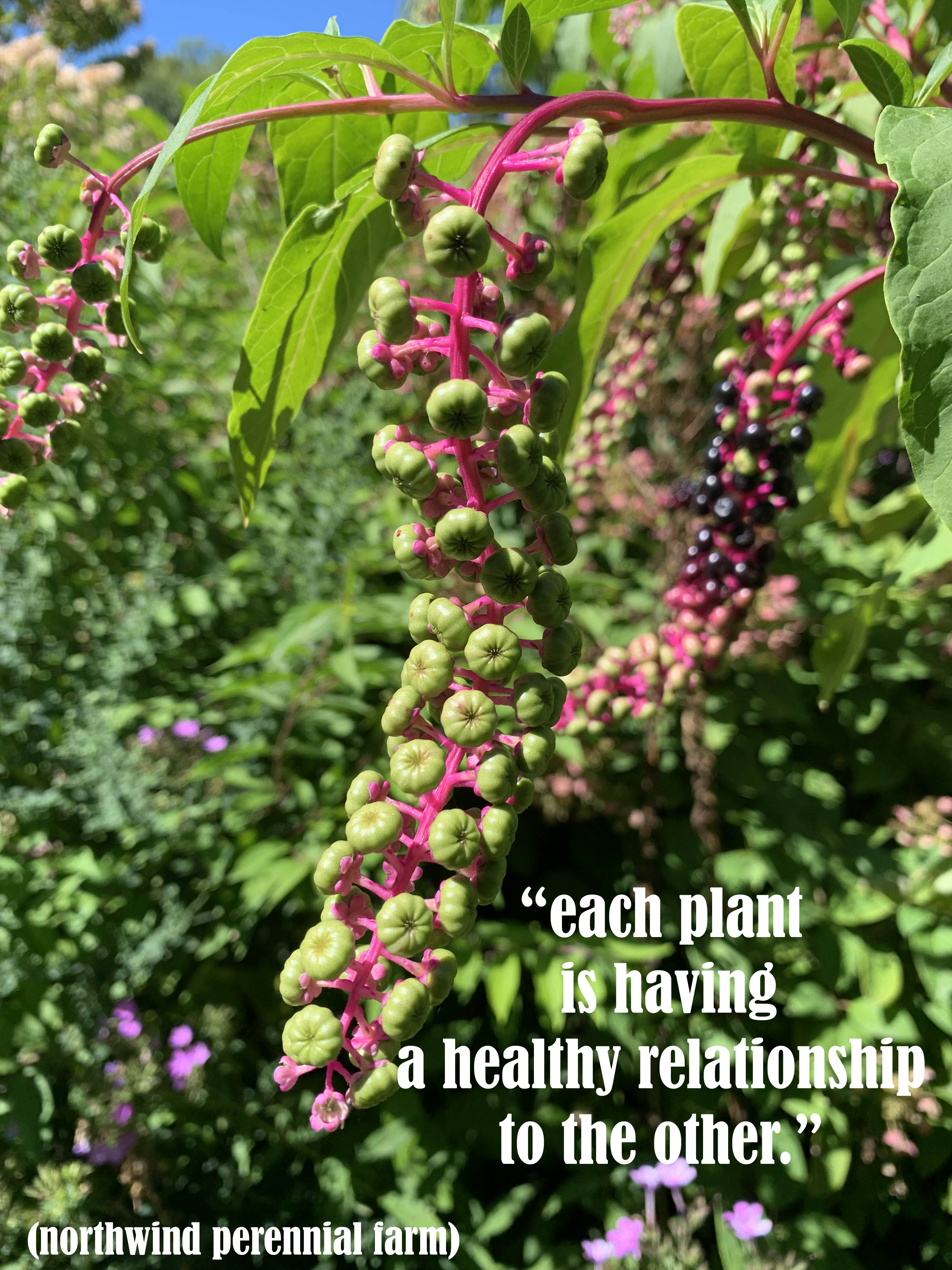
I was especially moved by the sign in the garden and wondered what it would take for us to turn the tables and imagine ourselves as part of the spinning universe rather than above-it-all. There are plenty of examples to draw from, humans in symbiotic relationship with their garden. Listening rather than instructing. Spinning with.

I think that is why, when our brains are overloaded, we head to the garden. A return to our senses. We breathe. We listen. We feel. We clear our minds and, even for a moment, re-enter a naturally healthy relationship.

read Kerri’s blogpost about HEALTHY RELATIONSHIPS

like. share. support. comment. thank you.

Look In [on Not So Flawed Wednesday]

“I want to stand as close to the edge as I can without going over. Out on the edge you can see all kinds of things you can’t see from the center.” ~Kurt Vonnegut

Yesterday I applied for a job that is all about narratives told from the edges of society. I’m not sure why it surprised me to find such a cool-to-me job; our community seems addicted to shattering so there are plenty of small edges to be found. Small edges are fallacious and serve a myriad of false centers. Our survival will depend upon whether or not we can awaken from the shatter-narrative and make the decision to direct our broken focus toward a common center. No small feat.

It is the role of the shaman, the explorer, the artist, the researcher to stand on the edge and report back to the community what is seen and unseen. The voice from the edge is rarely welcome since the report is capable of popping delusions or pulling the sheep’s clothing from the wolf. Page one of the autocrats’ handbook instructs the elimination of artists and educators. Making an enemy of the eyes-that-see, demonizing educators and thinkers – the people who recognize pattern and metaphor. The game of Us-and-Them necessitates silencing the voices capable of calling out the wolf. Autocrats require blind sheep that follow without question.

Some famous edge sitters: Galileo. Cesar Chavez. Rosa Parks. Nelson Mandela. Susan B. Anthony. Albert Einstein. Frederick Douglass, a former slave and leader of the abolitionist movement, wrote extensively about what we call Critical Race Theory; it was clear in his view from the edge. It’s not a new theory. It’s an old pattern with a new name. I think he might denounce his Republican party affiliation were he alive today; they would certainly silence his voice. He would be fired were he a professor in Florida today. As would Martin Luther King, another famous voice from the edge.

Voices of reason are often voices from the edges. Voices of the future are always voices from the edges. Galileo was silenced for suggesting that the earth circled the sun and not the other way around. Over time, the voices from the edge, when authentic, always make the center better, the community stronger. Susan B. Anthony spent her life on the edge, lobbying the center, to secure for women the right to vote.

Progress. Growth. They are rarely inspired from the tight grip at the center. Silence the edges and the community atrophies. Stop the movement and the body dies. That page was left out of the autocrats’ handbook for obvious reasons.

read Kerri’s blogpost about EDGES

Embrace Wabi-Sabi [on Not So Flawed Wednesday]

“I love this photo,” she said, “because the flower isn’t perfect.” Wabi-sabi. Appreciation and acceptance of impermanence and the absence of perfection. The full embrace of ‘what is’ rather than some imagined belief or ideal.

I read that the church leaders refused to look through Galileo’s telescope because their book already explained to them how the universe worked. I don’t know if this account is true or not but I’m given to believe it. I see the same story playing out in all shapes and sizes of blind-belief systems today. The wily Fox has millions refusing to look through the telescope in favor of an abstract and angry conviction.

Imperfection. Appreciation of nature and its forces. Look up. Open eyes. Open mind. Open heart. Direct experience that has the power to challenge the staunch and rigidly held opinions. Modesty.

Wabi-sabi. I love this photo.

read Kerri’s blog post about THE WHITE BLOSSOM

Step Out Of Line [on Merely A Thought Monday]

“…the fountain of creative work is an intelligent questioning of the rules.” ~Alan Watts, Tao: The Watercourse Way

“If someone tells you they know, they most certainly do not.” It’s not a direct quote from Quinn but it’s close enough. Art school almost snuffed the art in me; there were so many rules and nary a hint of curiosity allowed in the studio. I fled into the theatre after a single year for fear of losing my heart to a book of rules. My theatre professors were explorers of nature. Their refreshing mantra was, “Well, let’s find out!”

What if…? What happens if…?

Nature is boundless expression. Boundless expression is human nature, too, until it is taught otherwise. Boys don’t cry. Be a good girl. Sit in your desk. Follow the rules. There’s a right way. My way or the highway…So much effort to force nature – your nature, your curiosity, to stand on a line.

Einstein revolutionized our world because he dared to posit that Newton had it upside-down. Thank goodness, as Alan Watts observed, “The scientist and the mystic both make experiments in which what has been written is subordinate to the observation of what is.” In other words, they look beyond established belief, expectation and entrenched norms into what is.

What is? Curiosity. A desire to know what’s over that hill. No child begins their life-walk by desiring to color within the lines. Lines are a learned thing. The word “wild” was invented by people whose ancestors emerged from the woods and who have forgotten that they, too, are part of nature – so have become afraid of stepping into the woods. What might they – we – find there?

“It’s not an idea problem,” David Burkus wrote in the HBR, “It’s a recognition problem.” Stepping beyond the known – a great definition of curiosity – is too often seen as an aberration or an assault upon authority. Nip it in the bud. Forcing flow into a fixed state invariably causes idea-blindness and the imperative to think-outside-of-the-box. Innovations are too often smothered in the crib by “What we know,” or “We don’t do it that way.” Coloring in the lines, once ingrained, is a life-long-book-to-follow.

I wish I had a nickel for every time I’ve been invited into an organization or hired by a client to help them “see what they cannot see,” and then subtly or not-so-subtly, been rebuked for opening their eyes to what is in plain sight…or the availability of alternative paths. “We want a vital arts program but we only want art that entertains,” said the school board after the student play asked a serious question of their audience. “…the scholastic theologians would not look through Galileo’s telescope because they considered that they already knew, from Scripture, the order of the heavens.” (Alan Watts)

Think outside the box – as long as you stay within the model or the expectation or the rules. So many models. So many lines. So in love with the struggle and afraid of the simple, natural joy of curiosity. Bend your will to the line. See what you are supposed to see and look no further. What, exactly, are we trying to control?

read Kerri’s blog post about CURIOSITY