The Composition of a Life [David’s blog on Two Artists Tuesday]

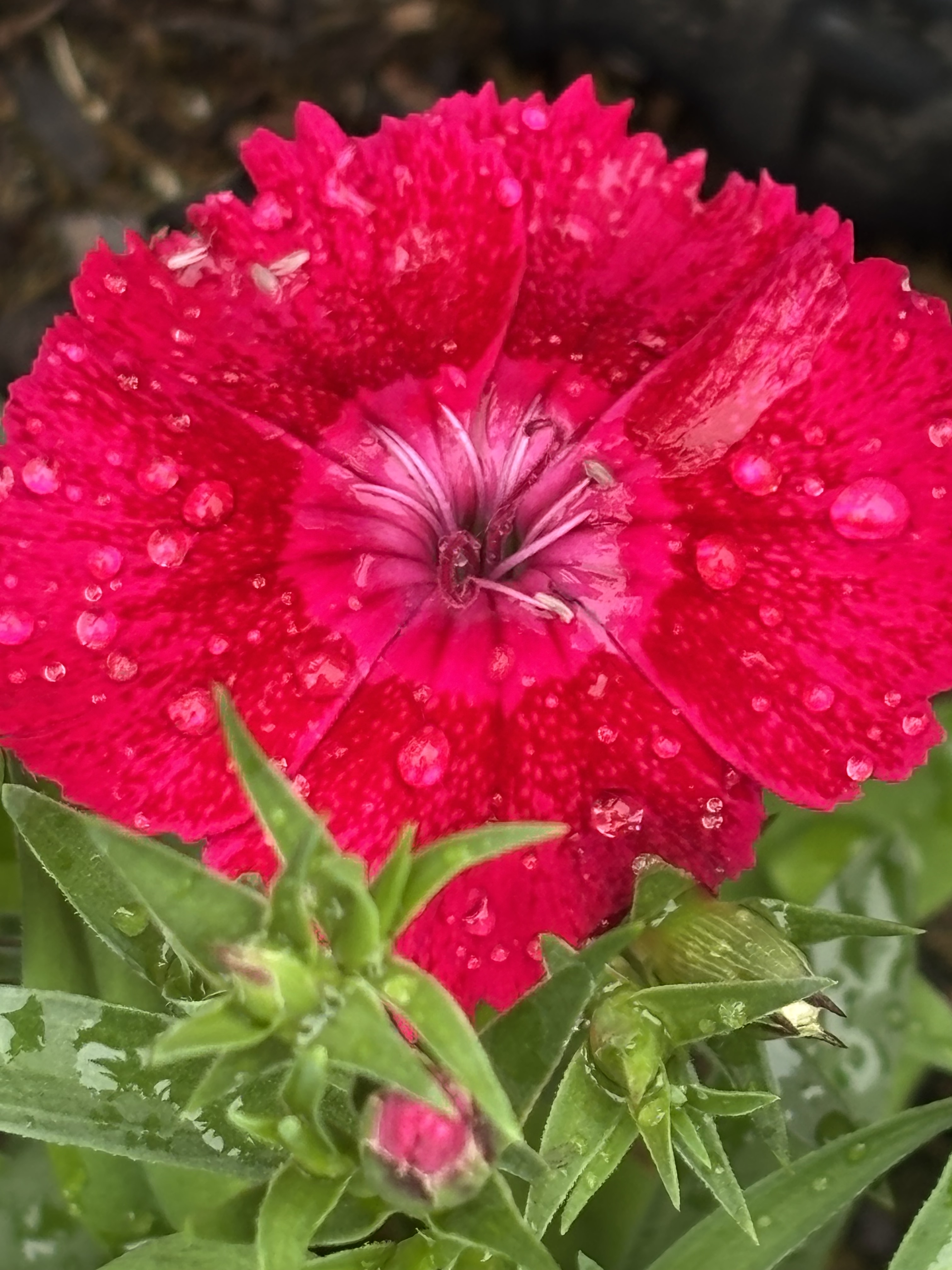
I cut the post I wrote for today. The image of this Dianthus flower is too beautiful for the thoughts I paired with it. The color of this flower kills me. The composition of this photograph would make Georgia O’Keeffe smile.

I reminded myself to not miss the beauty-of-the-moment in the middle of the national horror story we currently experience.

Chris has been on a quest for 15 years to develop a play based on Viktor Frankel’s book, Man’s Search For Meaning. A few days ago he took another step forward. He’s knocking on the door of his dream. Viktor Frankel was a Holocaust survivor and the book is based on his experiences in the camp. He makes a distinction that is relevant for us today: we have the choice to either seek meaning from our experiences or to bring meaning to our experiences. Our chances of survival are better if we bring rather than seek meaning – especially in a time, like ours, when amorality and cruelty have the reins of power. It’s hard to find meaning in the wasteland.

It’s the reason I cut my post. I was seeking meaning from the rapid collapse of our democracy rather than bringing a greater meaning to this moment-in-time.

We put the air conditioner in the window because our old Dogga suffers in the heat. Last night he was laying in his now-usual-spot directly in front of the fan blowing cold air. I sat next to him and rubbed his ears. I cannot describe the enormity of what I felt in that moment. It was more necessary, more important than anything rolling across our screens.

As I write this a bird – a house finch – is scratching at the window just behind where I am sitting. It is literally six inches from my head. I can see into its eyes. And it is looking into mine.

The color of this Dianthus kills me.

I cannot stop the national slide into autocracy. I can control where I choose to place my focus and there’s so much around me that would be a shame to miss. It’s the composition of a life that would make Georgia O’Keeffe – and Viktor Frankel – nod with silent approval.

read Kerri’s blogpost about DIANTHUS

likesharesupportsubscribethankyou.

All But One [David’s blog on Two Artists Tuesday]

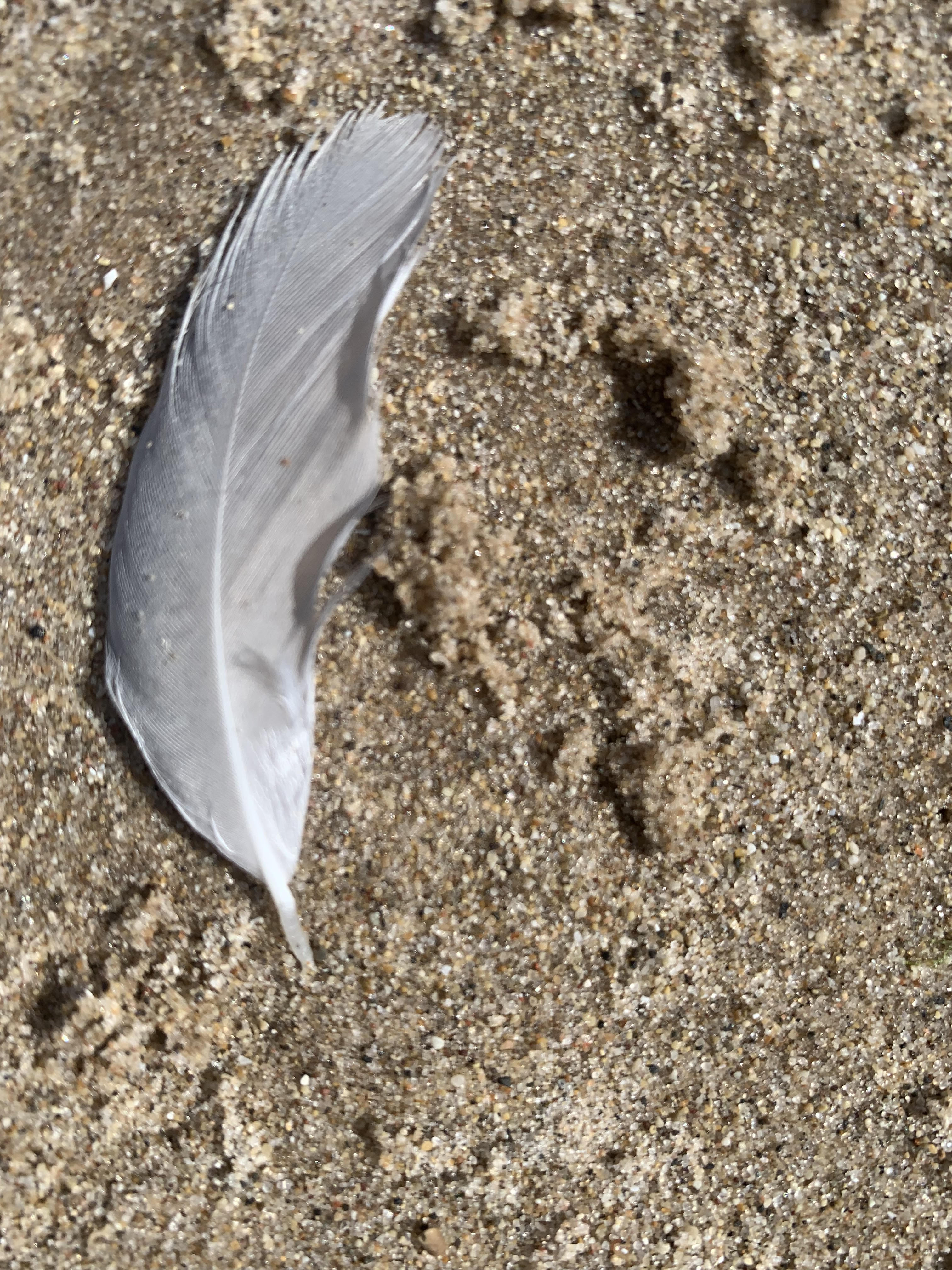
Is it about the subject, the seagull feather, or the overall composition? It’s a more relevant question than you might imagine.

Of note: another word for ‘composition’ is ‘constitution’. Framework. Anatomy.

Begin here: the Supreme Court just ruled on a question of presidential immunity. Was their ruling about the subject (presidential immunity) or the constitution (the framework that fundamentally defines our national identity)?

Hint: In school we learned to speak The Pledge of Allegiance. “…with liberty and justice for all.” With this ruling, with hands over hearts, the words spoken daily by children and adults alike must now be, “…with liberty and justice for all, but one.

In taking up the question of presidential immunity -a puzzling choice on their part at the outset since the answer to the question of immunity is already deeply imbedded in something sacred that every American school child recites by rote at the beginning of each school day – the Supremes altered the composition of our picture. The very constitution of our democracy. All, but one.

In his weekly newsletter, artist Nicholas Wilton writes that we must see our work as telling our story. With this ruling, the work of the Supremes, on our behalf, set course for a much different story. A fundamentally different composition.

When was the last time that you read and considered the power and import of the Preamble to The Constitution? “We the People of the United States, in Order to form a more perfect Union, establish Justice, insure domestic Tranquility, provide for the common defence, promote the general Welfare, and secure the Blessings of Liberty to ourselves and our Posterity, do ordain and establish this Constitution for the United States of America.”

We the People (the composition). All, but one (the subject). The Supremes reversed the subject and the composition: All but one is now the composition. Where does that leave we the people? It’s a more relevant question than you might imagine.

Hold your nose and say it with me: I pledge allegiance to the Flag of the United States of America, and to the Republic for which it stands, one Nation under God, indivisible, with liberty and justice for all but one?

read Kerri’s blog on Two Artists Tuesday

like. support. share. subscribe. comment…thank you.

See The Third [David’s blog on DR Thursday]

Rules of composition are really a study of human perception. It’s not the work of art that’s being examined, it’s the human being. Why do we consistently – universally – respond positively to visual compositions that follow the rule of thirds? Divide a composition into thirds, either vertically or horizontally, and then place focal areas of the “scene” at the meeting points of the lines. A professor in art and design school teaches the rule as a basic tenet, not because it was a concept that was invented but because someone, somewhere in time, noticed that people generally like their paintings, photographs, murals, quilts, architecture… when the focal point lands on one of the thirds. It was a discovery about the nature of people. Human nature.

Even the most abstract painters adhere to the rule of thirds. There is structure beneath seeming chaos.

There is something about humans and the number 3. The structure of a joke has three parts – the set-up, the detail, and the punchline. Most religions sport a trinity: father, son, and holy ghost. Brahma, Vishnu and Shiva. Buckminster Fuller’s Geodesic Dome is a festival of three. Pay attention and the rule of thirds pops up in everything from brain science to marketing messages. Triangulate and even the most lost hiker will be found.

When I first met Kerri I was disconcerted. Her compositional eye is infinitely better than mine. How could this musician come into my studio, snap a photo of my work-in-progress, and show me that her cropped version of my composition was infinitely better? What the heck? Her crops were never radical; simple adjustments merely. After I recognized how natural yet specific her eye sees the thirds – while I am clumsy in my seeing – in a fit of re-composing, I almost took a saw and scissors to my paintings. It was so obvious. Now, I ask her early and often to come into the studio and tell me what she sees (Imagine my horror when she stands silently for several moments and finally utters, “Well…”).

On the trail she stops often to “take a picture.” I play a game with myself. I look at where she aims her camera and then I predict where the focal point will land. Which third will claim the prize? I am almost never right but always delighted by what she shows me. “Lookit!” she says, smiling. A perfect third. Naturally.

prayer, 9″ x 24″ acrylic on hardboard

read Kerri’s blogpost about LACE AND SNOW

like. support. share. comment. many thanks

buymeacoffee is not a third. It is something else.

Gaze Inside [David’s blog on Two Artists Tuesday]

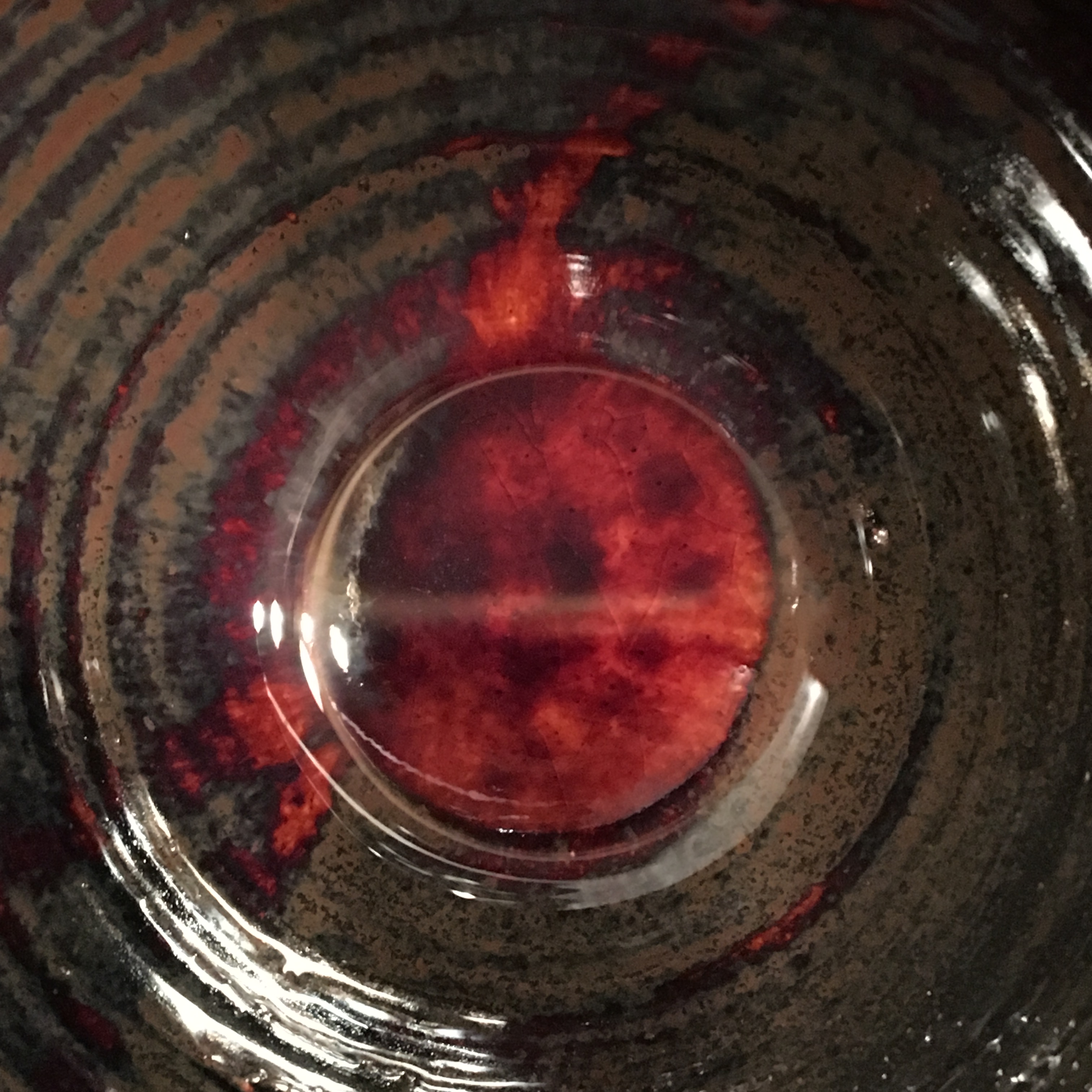
I suppose most people would first notice the beautiful glaze and transfer pattern on the outside of the cups. We were caught by the beautiful color, the glaze on the inside at the very bottom. Gorgeous. Simple.

The cups were a wedding present from Kerri’s good friend and long-time collaborator, Heidi. Together, they toured the country. Heidi telling the story of her breast cancer journey. Kerri performing her compositions written for the cause of cancer research and celebration of life. I was not in the picture when they were doing their good work but I can hear in their stories the potency, the absolute epicenter of the power of art, their art: inspiring, encouraging, healing, up-lifting spirits.

It is the same spirit that Rachel Stevens, the potter of the cups, imbued in her work. It’s why we were immediately captivated. The free flow of her artistry lifted our spirits. A perfect talisman for our union, a reminder of my favorite day of life – our wedding.

We brought out the cups for our wine. I love the delicate weight and textures, the feel when I hold them in my hand. Before pouring, I gazed again at the inside color and had a minor revelation, the kind that will simmer over the next few months:

I’m sitting in a quiet space with my artistry. The imperative to create remains as strong as it has ever been, but it is the time to journey into the root. Early in my life I created for myself, for the pure pleasure of the presence it provided. The gift of solitude. Another kind of union. Later, the root required a reaching out, a branching relationship with others, to light the dark path, ask the unanswered question, explore the uncharted territory. Yet another kind of union. The cycle is coming back around; I am returning to the pure pleasure of creating. The root. Now, there can be – there is – no other reason.

Simple. Gorgeous.

read Kerri’s blogpost about THE CUPS

like. share. comment. support. thank you.

buymeacoffee is a beautiful glaze at the bottom of a delicate pottery cup that, when you hold it, makes you feel good to be alive.

Work Forward And Back [David’s blog on DR Thursday]

Writing the first draft of a play, I’ve just entered the “swimming upstream” step in the process. I’m working my way from back-to-front to make sure all the story dots connect. It’s detail work. It requires looking close-in. I used to hate this part of the process because I’d get lost. I’d forget what I was doing and prematurely rework sections. Painters ruin paintings when working too small too soon. Writers are subject to the same peril. Now, I adore this step. Life is funny.

A few years ago I realized that my change in process-love, my capacity to work in detail without getting lost, came when I stopped trying to race to the end. Now, I am in no hurry to finish. I want a full relationship with my story as it reveals itself to me. It is a child, holding my hand, guiding me to the wonders of the playground.

Working forward. Working backward. Stepping in and then stepping away, like the tides. Big brush washes first, attending to the overall composition. Structure. And then detail. It’s much like building a house. Foundations and then finishes.

I have learned from watching Kerri to use my camera to see detail. To step in and look. Seeing-as-a-relationship. To pay attention to the dew on the small pine, the reason it glistens. And then to step in further. The platitude: a single drop of dew contains an entire world. Beyond the platitude: step in and it’s possible to fall into another world. To experience the surprise available in the enormity of the minute. And bring back to the big, big world of hurry-here-hurry-there the astonishment that is found there.

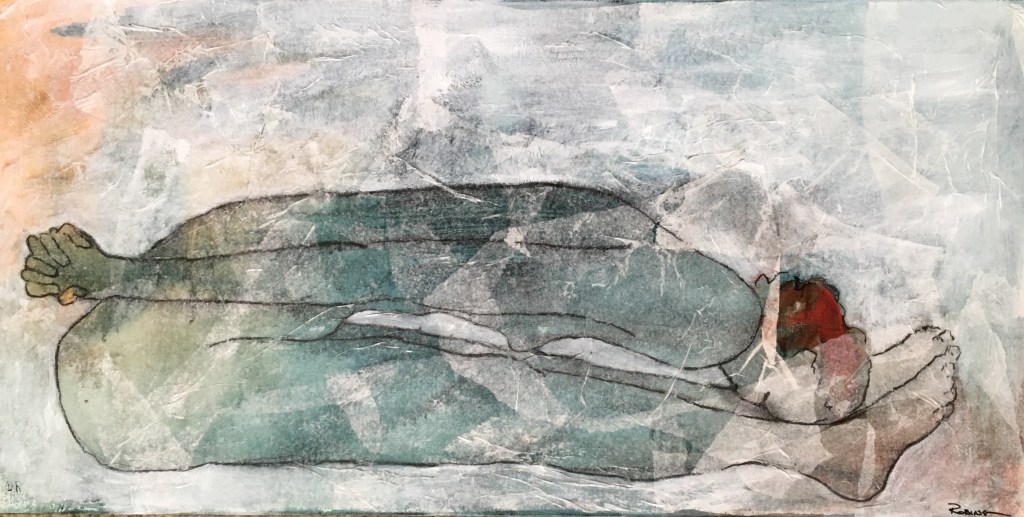
Forward Back, 18 x 36IN, mixed media on canvas

read Kerri’s blogpost about DEW

like. share. support. comment. thank you.

buymeacoffee is a dew drop in a sea of possibilities, a tiny window into the realities of another reality.

Voluntarily Contemplate [David’s blog on DR Thursday]

It’s tempting to say that the snow is white. A second look, a better look, will prove otherwise. Purples and cool blues with some muted green and pink thrown in for good measure. A subtle festival of color. In general the light on the trail painted the snow – not surprisingly – ice blue, so the burnt orange in the leaf made for an eye-popping compliment. Some abstract expressionist might use this bit of natural composition for inspiration. Helen Frankenthaler or Joan Mitchell. Monumental paintings with the power to force contemplation. Well…to force voluntary contemplation.

Forced contemplation! A great phrase, to be sure, and another name for “problem solving.” Take a moment and look around during this busy holiday season: everyone you see elbowing their way through the crowd will be deep in forced contemplation. Rushing to the next. Making a list and checking it twice.

I’m a few pages into my fourth reading of Zen and The Art of Motorcycle Maintenance. It fell off the shelf and hit me so I took that as a sign that it was time for a revisit of Robert Pirsig’s novel. The subtitle is An Inquiry Into Values. I’ve learned that the books I read are forms of voluntary contemplation. What has value? What does not? And why? I regularly ask myself a question that comes from the title of another favorite-book-of-the-past: How Then Shall We Live. Wayne Muller’s voluntary contemplation on meaning, purpose, and grace. Given what I know – that I shall die – how then shall I live this day of my life?

There are very few answers to the question but there are values that, like a marble sculpture, take shape and emerge over time. The single value that consistently dominates my voluntary contemplation: walk through this day slow enough to see that the snow is not white. Rather, experience the full celebration of color and live inside – rather than rush through – the perfection of this composition.

meditation, 48×48, mixed media on canvas

read Kerri’s blogpost about SNOW AND LEAF

like. share. support. comment. a few ways to let us know that you are out there.

buymeacoffee is a slow walk of appreciation through a world that holds more magic than any single mind can conceive.

Triangulate [David’s blog on KS Friday]

It had to fall just right. What are the odds? When it snapped from the trunk, it fell into a perfect three-point cradle? Three points of contact.

Three-points-of-contact is the rule for safe climbing. It’s a shorthand phrase, like “turn-around-don’t drown,” the mantra meant to pop into your noggin at the moment you think it’s a good idea to drive through a flooded section of road. Three points of contact make it harder to fall.

A few years ago I collected conceptual models defined by three elements. Look around and you’ll find them everywhere, from brain processing to filmmaking, it seems that the three-points-of-contact rule provides stable footing for complex models of meaning making. Father-son-and-holy ghost. Brahma-Vishnu-Shiva.

Every story has a beginning, middle and an end. Though, no one tells us that the end is a new beginning in search of an unknown middle en route to an end. I’m currently working on a story and realized that I often tell myself to “triangulate.” Two plot points are a line, the third gives the story shape, depth, and movement.

The best visual compositions work on a model of thirds. Drawing a face is best learned by a rule of three. Many Renaissance paintings are built on a compositional triangle. Perspective works with three points even when we call it two-point-perspective.

Take heart. If you are lost, your rescuers will certainly triangulate to find your location.

As you walk through the day today, notice the patterns of three that are swirling all around you. Red light, yellow light, green. Like a limb falling from the sky, you might discover yourself cradled.

holding on/letting go on the album right now © 2010 kerri sherwood

Kerri’s albums are available on iTunes and streaming on Pandora and iHeart Radio

read Kerri’s blogpost about THE LIMB

like. share. support. comment. many thanks for reading what we write.

buy-me-a-coffee is an donation “tip jar” where you may support the artists whose work you value

Sip It [on Merely A Thought Monday]

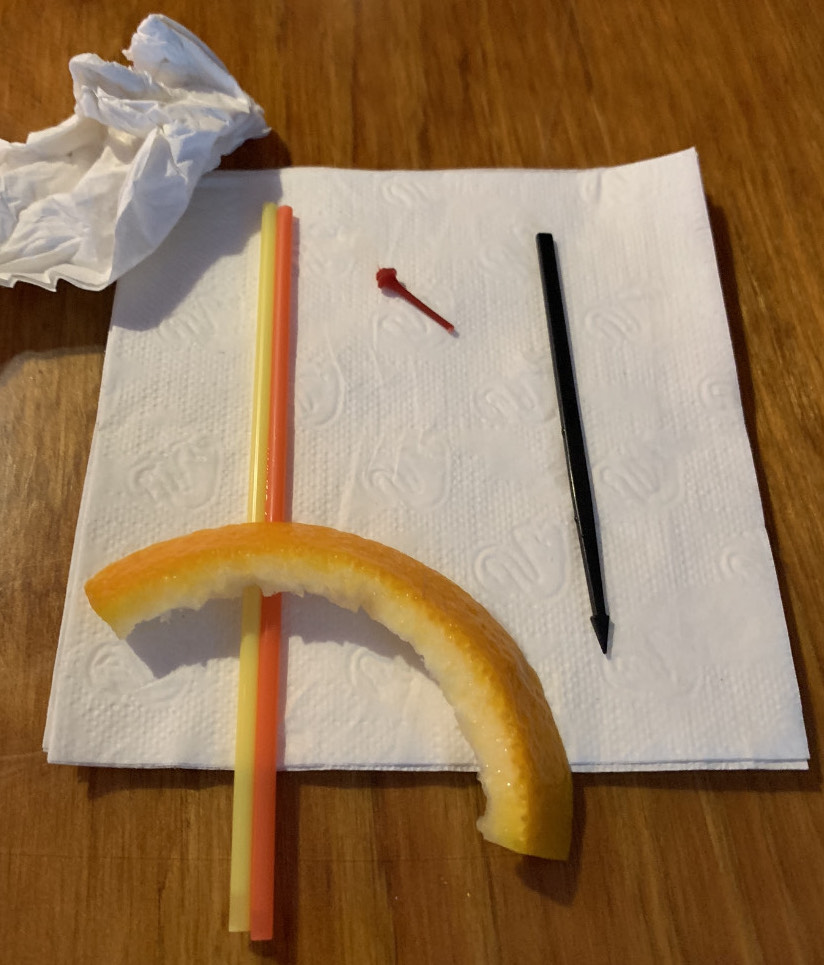
There are deep, meaningful layers to this story-image. The first is an answer to the all-important-question, “How do we entertain ourselves at a bar?” We make fun contemporary art, of course! Or, we make fun of contemporary art. I’m not sure since the line of distinction is blurred in real life so it is more blurred at the bar, where life isn’t really real and escapism is to be expected.

Have I confused you? It’s simple really. Limit your palette to two bar napkins, two sipping straws, and the fruit remnants from a brandy old-fashioned. Arrange a composition. Snap a photo for posterity. Ask yourself and others, “What does it mean?” And, when you find yourself concocting answers to the great amusement of your friends, you might recognize that the actual art-of-the-moment is the performance of the improvisational play entitled What Does It Mean?

You’ll conclude – if you are honest – that it – your art work – has no inherent meaning – and all supposéd meaning is projected onto the image. It can mean many things or nothing at all. Just like life outside of the bar [that sneaky escapism always loops back to the real stuff!] The composition might simply be appreciated for its clever arrangement and varied texture. It might conjure up fond memories of old-fashioned’s past.

Here’s what it means to me: I could not be considered a local Wisconsinite until I had a palette of experiences, like eating cheese curds or attending a fish boil. On the tippy top of the list was to enjoy a brandy old-fashioned. More, to know whether I preferred my drink sweet or sour. This composition, the scattered remains of the drink-of-the-state, reminded me of the day I ascended to the top of the list and sipped my first ritual old-fashioned. I would anoint this piece with the worthy title BELONGING AT LAST.

read Kerri’s blogpost about POST OLD-FASHIONED

278 weeks and counting of daily posts. Like it. Share it. Tip it. Tell us to stop or keep going.

Make It Visible [on Two Artists Tuesday]

“I believe that the very process of looking can make a thing beautiful.” ~ David Hockney

Sometimes I look at a blank canvas and see a composition. My job is to follow the image. To make it visible.

Sometimes I have an idea and I bring it to the canvas. My job is to explore the idea. To make it visible.

It’s a chicken-and-the-egg conundrum. What comes first? When I look at the peony do I see beauty or do I bring beauty to what I see? Is beauty a decision?

“Good-God!” I hear Kerri’s inner monologue-commentary on my too-ponderous questions. “Get out of your head! Smell the peonies!”

I wish I could. What happens when it’s not a peony that I see but my neighbor? Or someone whose worship is strange to me? Or someone with a different opinion?

Sometimes I look at a blank canvas. Sometimes I have an idea that I bring to it. Sometimes my job is to follow the image. Sometimes my job is to explore the idea.

The tricky part of language is that the biases are unseen. For instance, in English, the emphasis falls on the noun: me. Canvas. It implies the two are separate. Distinct. It obscures the relationship between. Connectivity is relegated to the basement, a lower status or obscured to the point of nonexistence. It fosters a philosophical orientation of…”it happens to me.”

Connectivity, once seen, once understood, requires us to recognize our responsibility for what we see. Our participation in the dance of creating what we see. In what we bring to “it”. What, exactly, do we wish to make visible?

read Kerri’s blogpost about the PEONY

Celebrate The Symphony [on Two Artists Tuesday]

The return of the frogs. No, it’s not the title of a b-grade-horror film. It’s one of our favorite rites of spring. Their chorus is deafening, a sound celebration of the season’s cycle into renewal. We look forward to and celebrate the day of their return.

A short month ago we walked across a snowy field, still a bit in shock at the scrape-clearing of the tall grasses and brush. Broken bits of stick and root poked through the snow. The picture of devastation. In just a few short weeks, the field became a bog – evidently the perfect performance hall for the musician-frogs signaling life’s return with their playing.

They’ve always played in this spot along the trail but this year their symphony is made particularly poignant by the seeming wreckage of their environment. This year, to our ears, they perform a rousing song of perseverance. A composition of resilience.

They’ve also awakened a question in us. We ask it every year but this time it is made more mysterious because the bog is exposed. We can see everything except the frogs. The air is alive with sound while the water is still. We’ve stood, awash in the noisy vibration, yet can see nary a ripple in the surface.

How is it possible to shake the limbs of trees with joyous sound without disturbing the fen? The musicians are invisible.

There can only be one explanation: They are magic, these frogs in their spring renewal, popple-free playing while stirring our hearts and imaginations.

read Kerri’s blogpost about FROG BOG