Scratches On The Wall [David’s blog on Two Artists Tuesday]

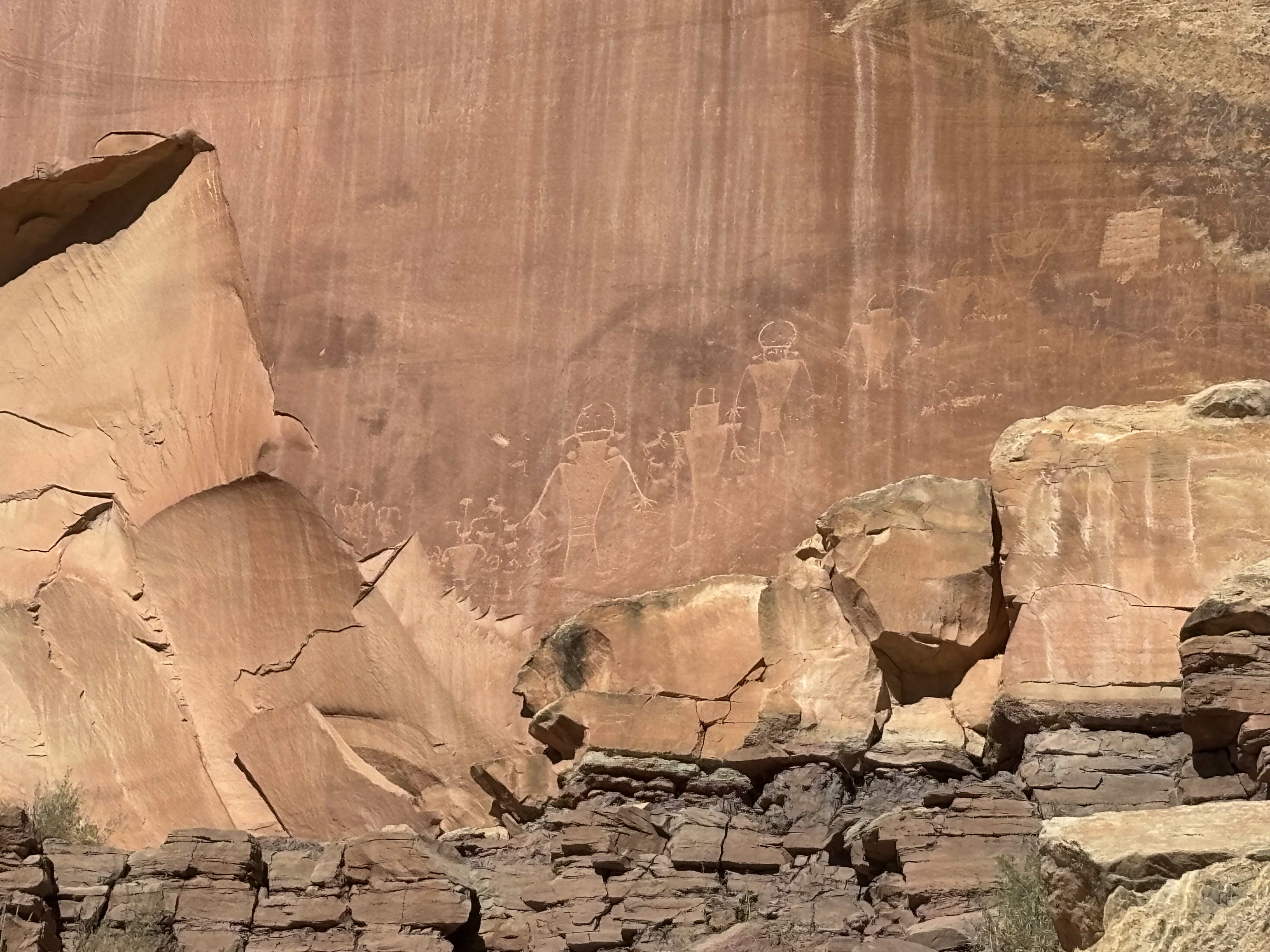
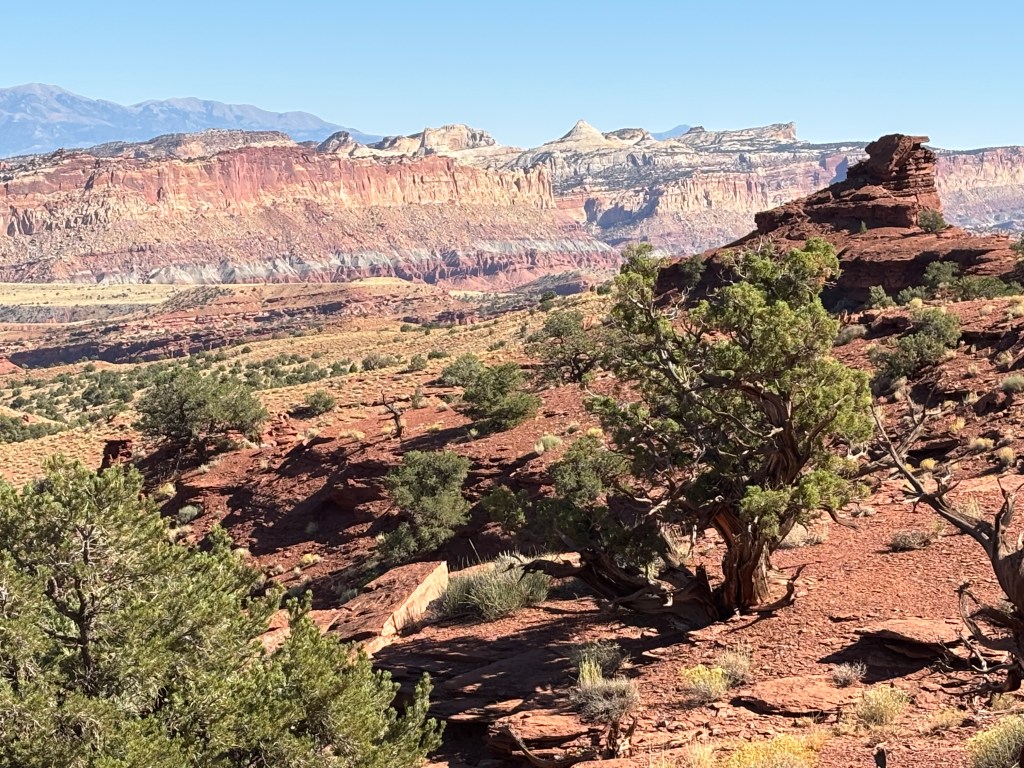
Scratches on the wall. Petroglyphs, the only evidence that remains of a people who once lived in these canyons, who lived by the river we’ve named Fremont. We do not know if they had a name for the river. We do not know if they had a name for themselves. We call them the Fremont, after the river. A location name.

The Fremont River is named for an American explorer, John Charles Fremont, so the people who scratched pictures into the rock over 1,000 years ago also carry his name. As is the nature of history, we locate them from our point of view. We build an identity-structure and civilization-story about them based upon our story of them. We’ve placed them in our narrative timeline, 1 – 1300 CE. We have no idea how they thought of or marked their time.

We have no idea what became of them. They disappeared into time. We have no idea what the petroglyphs mean or why they scratched them into the canyon walls. We wonder at the semiotics, the inner symbolic life that produced such strange (to us) images that remain on the red rock walls.

This morning, through my COVID aches and chills, I watched the news. I would like to say that I am mystified by the civilization-story currently being spun and supported by half of my nation but I am not. I would like to say that the hatred and fear-mongering of the red hat tribe is as much a mystery to me as the way of the Fremont, but it is not. The concurrent xenophobia and wild-eyed-creation of an internal enemy (anyone not in a red hat) has roots that are all too easy to see. It’s a fascist popcorn trail, a page from Hitler’s handbook. The language is identical. The images, scratched into the red-fox-walls of our time are all too easy to interpret. A frightened and misinformed populace is easily manipulated. Fooled.

What is a mystery to me is the inner symbolic life of my nation’s conservatives that seem so ready to trade our sacred democracy for a populist authoritarian. What scratches on the walls of their minds are so easily storied into hatred. What has so hardened their hearts that they embrace with cheers the repulsive bile spewed by their candidate? It is as incomprehensible to me as the petroglyphs of the Fremont.

All societies disappear into time. Ours, relative to the Fremont, is still in its infancy. We can only hope that an explorer in some distant future finds our petroglyphs – and although a mystery to them, we will have known that we transcended the authoritarian threat and overcame the fox-fear-fantasy, manufactured hatred and dark lies. And, over the next thousand years, our scratches on the wall tell the tale of how we matured to fulfill the promise of our sacred ideals. Out of many, one.

read Kerri’s blogpost about PETROGLYPHS
like. share. support. comment. subscribe…thank you.

The Greatest Weapon [David’s blog on Merely A Thought Monday]

The timing was uncanny. While on a slow walk in the park, deep in a conversation about our discouragement – no, our despair – for loved ones sucked down and seemingly lost in the dark, angry MAGA hole, we passed a group of girls engaged in an emphatic conversation and overheard the phrase, “I don’t know you like that!”

The phrase came like a slap. Kerri took out her phone to capture the slap in her notes. “That’s exactly it,” she said. “That’s precisely what is so troubling. It’s what I want to say: I don’t know you like that.”

I am lately haunted by the words of H.G. Wells: “Civilization is in a race between education and catastrophe. Let us learn the truth and spread it as far and wide as our circumstances allow. For the truth is the greatest weapon we have.”

There is a reason that the template outlined in Project 2025 includes the elimination of the Department of Education. There is a reason that governors in red states are (and have been) waging a war on education. Educated people ask questions. Educated people check the veracity of statements hurled their way. They take time to check facts and sources of information. In a democracy, an educated populace would never sign on with an autocrat exploiting their anger. They’d ask questions of their anger -and so would be impervious to exploitation. An educated populace would demand ideas from their leaders, respectful debate, reasonable compromise, adherence to the Constitution. They’d demand the same of themselves. An educated populace would see through the ugly name-calling and victim-squeals of a would-be dictator. An educated populace would pay no heed to the cries of “fake news” because they’d have learned to check it out for themselves. They’d hold news organizations to a higher standard. They’d care enough to question and verify information before jumping onto a hate-train. In fact (hear those two words) they would not so easily jump onto any train other than the truth-train because they were dedicated to living-in-facts that transcend bubble-gossip and tribal tittle-tattle.

This morning I had an HGTV revelation about our current political choice. It’s my latest metaphor illuminating the dangerous nonsense running around our nation in a red hat. I’ve learned in my HGTV viewing that demo-day feels good, takes very little time, very little thought, and requires only a sledgehammer. Anyone can do it. Destruction is easy. On the other hand, building the house is hard. It takes ideas, time, thought, planning, cooperation, collaboration, flexibility, knowledge, well-researched choices, skills, process and patience. Wisdom. All are the results of education.

Destruction is not complicated. It asks no questions, requires no learning. Destruction is the center of the red hat campaign.

Creating something beautiful and long-lasting is hard. It takes skill, the capacity to question and learn from mistakes. It takes a plan, forward thinking, and complex considerations, not fantasies sought in the rearview mirror of some imagined sitcom past. And it is never done. Building a better house is the center of the blue team’s campaign.

The red hat and company certainly espouse a plan, Project 2025, but an educated person would only need to ask the authors of the plan a pair of questions before rejecting it outright: 1) Why would you tear down the shining-city-on-the-hill and replace it with a dark prison? 2) Why are you trying to hide your plan from voters?

People I love, those caught in the undertow of the red swirl, empty of fact but full of shared-victim-anger, gulping and then spewing mouthfuls of toxic-fox-swill, waving their flags, raging with a dedicated ignor-ance…I don’t know them like that. I wonder how they came to know themselves like that.

Let us learn the truth and spread it as far and wide as our circumstances allow. For the truth is the greatest weapon we have.”

Let us learn about truth: Truth is not what we hear or see in the stream. It is not something verified by people passing memes around our social bubbles or validated because we share the same opinion and invest in the same misinformation sources that cater to our opinions. Truth is what we find when we question what we hear. It is verified by exiting our bubbles and questioning what we think we know, examining the foundation of our likemindedness. Truth is learned when we fact-check our own opinions and especially challenge our rigidly held beliefs. Rigidity is a red flag, a marker that something false is hiding.

I have learned to remember this: an opinion shared with great passion or rage is still just that – an opinion. Any strong belief held without question or reflection is, in fact, weak and makes us easily exploited, easily led. Lemmings. Fools. Learning the truth requires constant effort and personal responsibility – especially in our age of easy misinformation. In learning truth, our greatest weapon, there is never a need to fill the communal cup with fear-mongering. Truth dispels fear. It dissipates gossip, and, because it demands personal responsibility, affords no room for blame.

Truth is a common center. Education, the art of questioning and discernment, is the compass that gets us there.

read Kerri’s blogpost about I DON’T KNOW YOU LIKE THAT

like. share. comment. subscribe. support…thank you.

Knead And Listen [on Two Artists Tuesday]

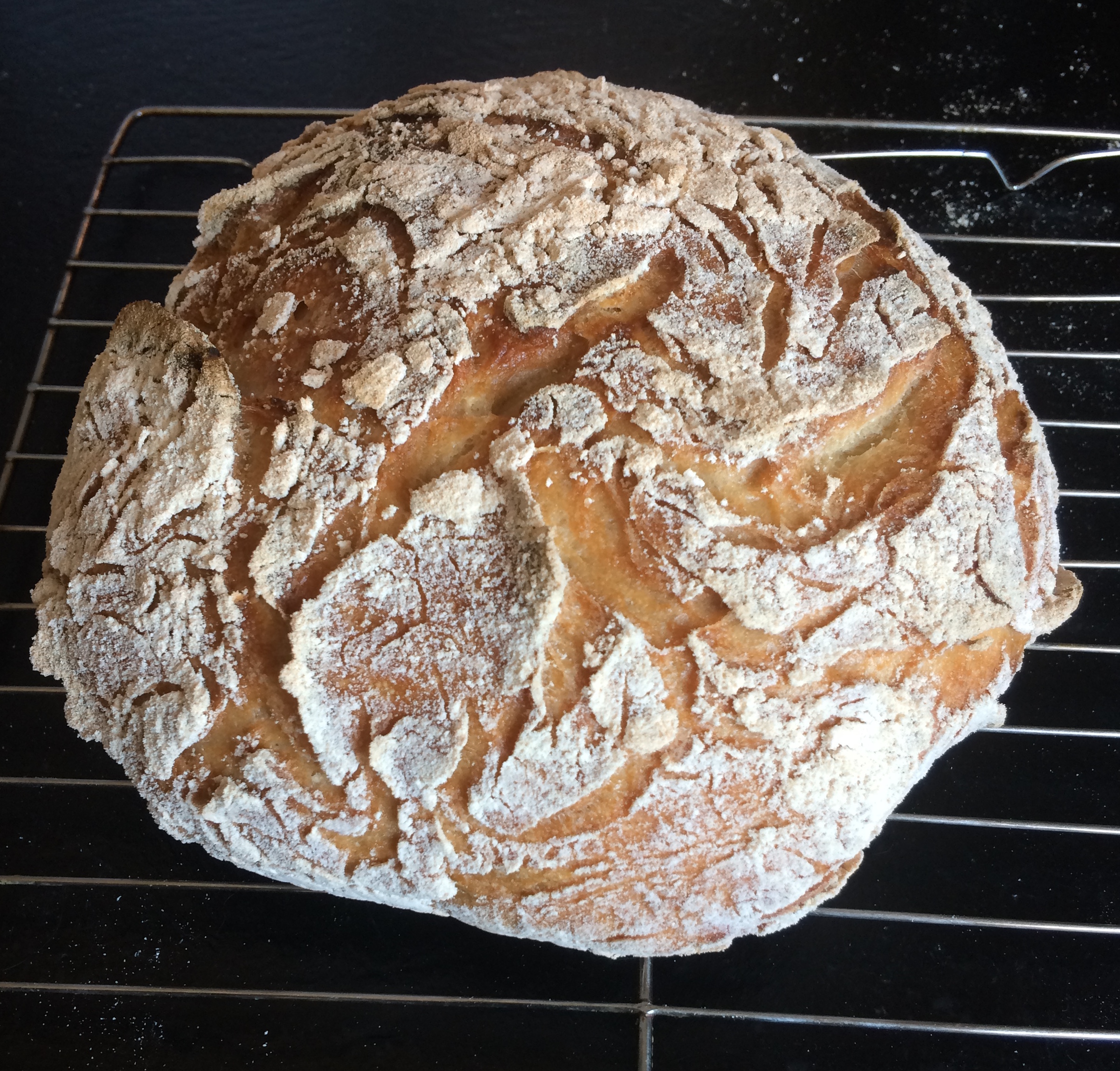
rustic bread copy

I am now among the legion of people that turned to baking bread during the pandemic-stay-at-home era. This loaf is gluten free, made with rice flour, since Kerri is allergic to gluten.

In truth, I’ve wanted to bake bread since I knew Brad the baker in California. He was a genuine hippie, a believer in peace and simple living. “Bread is a living thing,” he once said as I watched in fascination his kneading of the dough. You can tell a true master craftsman at work by watching their hands. They feel something in the dough or the wood that the rest of us do not.

My loaf was not made by a master. Not even by an apprentice.

Bill sent a photo of his first loaf and I asked for the recipe. It came as screen shots and I scribbled them into a recipe on notebook paper. Easy steps to follow but I knew from watching Brad that I would not find in my recipe any easy guidance on how to feel the life in the dough. That would come with time. Maybe. If I was lucky and diligent and practiced listening through my hands.

I’m not surprised people are turning to bread during this time of pandemic uncertainty. It is essential. The making of bread, the cultivation of wheat, made civilization, as we know it, possible. It is, therefore, a central symbol in many belief systems. Separate the chaff from the wheat. A time for harvest. This is my body. Eat.

Brad told me that the dough kneads you as much as you knead the dough. It’s a simple relationship between living things and requires complete focus. Mutual respect. Attention must be proffered.

Perhaps that is why we turn to bread in times like these. Simple relationships of attention and mutual respect are increasingly rare. Bread reminds us of what is possible, what is healthy. It reminds us of the patience that is required if we are to find our way to harvest. It reminds us of the necessity of knowing what is chaff and what is wheat, or remembering that there is a direct relationship between what is planted and what is grown.


read Kerri’s blog post about BREAD


ely website box copy