Beyond Words [David’s blog on Not So Flawed Wednesday]

Sometimes the obvious is hard to write about. A heart path. A heart on the path. My mind jumped to the easiest association: a heart path is a metaphor for a spiritual life. Despite the countless tomes written across cultures and through the ages, including the current river of memes flowing across our screens, a spiritual life is impossible to wrap in words. Yet we have a long and complex history of trying.

I have friends who are Buddhist, friends who are Christian, friends who are Jewish, friends who are Muslim. I’ve spent time with Hindu priests and I’ve been introduced to the Tao. As they say, many paths, one destination. Heart paths, all. It is worth remembering that no single path is better or worse than any other. As Joseph Campbell suggested, religions are vehicles. A ride share.

A spiritual path need not require a deity or a book of rules. As Kerri says, “If it’s not about kindness it’s not about anything.” Kindness is an expression of the heart. Kind-heartedness. Warm-heartedness. Tender-heartedness. A heart path invokes this quality: selflessness. Deities and rulebooks can be twisted, human-made as they are, to serve un-kind, selfish intentions. Stoke divisions. Division is the opposite of a heart path. Kindness is an expression of unity.

A heart is a good symbol for the path because we all have one – every single one of us. Skin color, cultural orientation, systems of belief, sexual identity…do not alter the simple fact: we have hearts in common. Many hearts (plural) reaching for the single shared heart. One heart (singular).

Transcendent.

read Kerri’s blogpost about HEART ON THE PATH

like. comment. support. share. subscribe. many thanks.

Chase A Ghost [David’s blog on Merely A Thought Monday]

The question came in through our site from a man who was instrumental in Kerri’s decision to record her compositions. A voice from her past asking a good question.

There are many surface answers to his question. In our case, all would be applicable: to give voice to our thoughts, to build a community, to call attention to our work…This morning, as I ponder his question, I think the purpose of a blog, my blog, might be to chase ghosts.

I began blogging utterly convinced that I had very little of value to say. I’d never considered myself to be a writer. It was a challenge I set for myself. Actually, I had one thing to say and decided I would, every day, attempt to write about it until I ran out of gas. I calculated that the tank would run dry in less than seven days. I was chasing the elusive ghost known as voice. My voice.

The interesting thing about ghost-chasing is that it makes you pay attention to everything. Ghosts can come at you in an instant from any direction and disappear just as quickly. Sometimes you can’t see them at all but feel intensely their icy presence. That was the first thing I learned in my voice-ghost-pursuit: I was paying careful attention, inside and out. It was not intense, not a strain or a struggle. I didn’t have to try. It was natural.

Not surprisingly, paying attention gave me more and more to write about, more to reflect upon. More to offer. “Have you seen this? Do you understand it?”

Chasing ghosts is a great question stimulator. Ghosts are curious and require all manner of suspension of disbelief so they are also terrific curiosity-energizers. Among the first line of questioning is about your self: your perceptions, your beliefs, your ideas of who you are and who you are not. It’s nearly impossible to write about others without exposing your self. Voice chasing leads to an astounding realization: the self/other boundary is permeable. We come to know ourselves relative to how well we know others. We only know our voice because someone out-there is listening and, hopefully, giving voice in return. Contrast principle.

Our basement is unusual in that it has box-after-box of unsold CD’s – the hard evidence of the music industry making a quick pivot to streaming services. The stacks of my unsold paintings take up an entire room. Our filing cabinets are filled with ideas and manuscripts and songs-not-yet-recorded. There are folios of cartoons that didn’t quite make it to syndication, folios of ink gestures, watercolors, and sketches. Another kind of ghost: the work of years past. When we met and married, we began blogging together, originally to try and call attention to the voice-of-work-past-but-not-yet-sold. That ghost, a very sad ghost, quickly left us; the joy of writing together each day overcame the initial intention.

The joy of writing together. We no longer chase the ghost of voice. It was here all along (of course). Now-a-days, we pursue a much simpler spirit: the gift of paying attention, the pure surprise of what shows up when we dive into and write about our daily prompt. “You go first,” I say, since she is wiggling with excitement to read what she just wrote.

read Kerri’s blog about WHAT IS A BLOG?

like. share. support. comment (give voice). we thank you for any and all.

buymeacoffee is lending your voice in support of our voice so we can lend our voice to your voice. It’s a circle.

Babble [David’s blog on KS Friday]

This could be a Jackson Pollack splash painting or an x-ray of arteries, veins and capillaries. A winter sun attempting to reach through the cover of clouds and trees.

If I believe the forecast, as hard as it tries, the winter sun will not reach us today.

I’m paying attention to language a bit more than usual. Looking up through the veins and arteries of the tree, I ask myself: What could it be? What could be? What is “it”? I shiver and am reminded of a quote I used in my book. It is appropriate for our times:

“One must be leery of words because words turn into cages.” ~ Viola Spolin

Language Matters. A double entendre. One of my favorite. It’s right up there with my favorite double entendre title of a book: The End of Education. Classic Neil Postman.

The question is, in our day-and-age, amidst the torrent of words and the easy belief-systems that words construct, how to stay out of the cage?

It’s a question with roots back to The Tower of Babel. A human race united by a single language builds a tower that reaches into the heavens. It is a threat to Yahweh. To protect his status, he confounds their speech and scatters them around the world. Language is the barrier against unity.

A bramble of branches to a Pollock painting to the inner working of life-blood to a weather report and landing at last in the Tower. An epic journey in just a few words, reaching through metaphor and pattern.

Language can be a cage. It can also set us free. Language Matters. A double entendre.

Nurture Me/Released From the Heart © 1995 Kerri Sherwood

Kerri’s albums are available on iTunes and streaming on Pandora and iHeart Radio

read Kerri’s blogpost about WINTER SUN

like. support. share. comment. all words that describe actions that we appreciate.

buymeacoffee is. nothing more. nothing less.

Appreciate The Moment [on Not So Flawed Wednesday]

Monumental moments in a life sometimes seem so small at the time. They pass as incidental but, in retrospect, are profound.

In his recent visit, Bruce and I reminisced about my inability and horror of singing. In the majority of my life, I couldn’t find a pitch if it was sitting on my shoulder. Kerri jumped into the conversation telling Bruce that I’d found my voice. Well, to be honest, she helped me find my voice. A patient teacher who simply taught me how to hear. Bruce’s mouth dropped open when I told him that I sang at my grandfather’s funeral. “It was terrifying,” I said.

“But you did it,” Kerri added.

When I met her, as I’ve previously recounted, I told Kerri that, “I don’t sing and I don’t pray.” And, then came the ukulele band. On the day I flew in for my third visit, Kerri picked me up from O’Hare and we rushed back to make the first rehearsal of her new group, the ukulele band. We met in the gardens of the Kemper Center, Lake Michigan humming by our side. She handed me a black uke. She taught the group to tune. We learned a chord or two. And picked and sang our way through a few easy songs. I dare anyone to avoid singing when they are in a group of silly colored ukuleles. It was my first of many lessons. I was having so much fun strumming, that I forgot that I was singing.

Such a simple moment. The beginning of challenging a faulty life-story. A self-imposed limit. Kerri was wise enough to know that I needed to begin with fun. Laughter is a great maker of courage. The first step.

Eight years ago. At the time it seemed so incidental. Following this amazing musician through her day. Playing along. Carrying her books. And, all along, it was her gentle way of saying, “Let’s challenge that obstacle. There’s a way around it and all you have to do is have fun and learn again to listen.”

read Kerri’s blog post about UKULELES

Touch The Arc

A painting I did twenty years ago of my dad.

Years ago I started a portrait of my dad (we call him Columbus) emerging from – or returning to – a cornfield. At the time it seemed an odd painting, something more elemental than intellectual. Something I had to paint though I didn’t really know why. I thought I’d left portrait painting far behind. Columbus is from a very small town in Iowa so the necessity of the cornfield made some small sense. He yearned to live in the town of his birth and although life took him other places he maintained a deep heart-root to Monticello. For Columbus, Monticello, Iowa was and always will be home.

After laying it out, after applying the under painting, the portrait felt complete – or I felt complete. So, I stopped. I have carried it with me all of these years.

These days, dementia has its slippery tentacles around Columbus. He is a mighty combatant in this tug of war, a war that he cannot win, and feeling his strength waning, his single wish was to one last time visit Monticello. So, this past week, Kerri, my mother, and I – as Kerri likes to say – followed Columbus’ heart around Monticello.

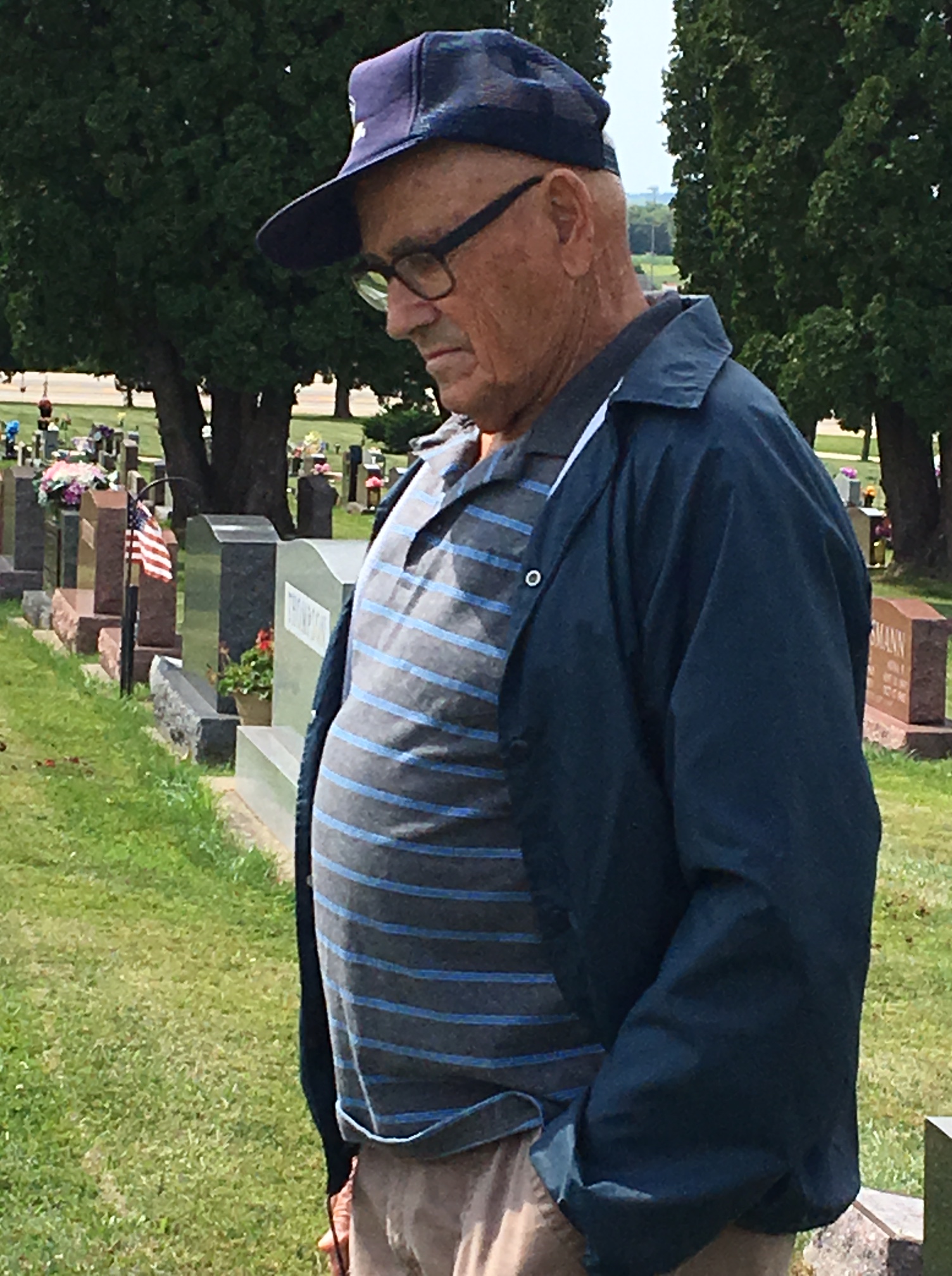
His heart took him three places. The first was to the cemetery. It is the place he will finally rest with his brother, parents, grandparents, aunts and uncles and friends. He wanted to wander. We followed him as he touched stones and told stories – stories he told to us but for himself: a friend who died too young in a car crash, a kind scoutmaster and mentor, an old girlfriend, a high school pal who flew an airplane and their adventures landing in cornfields. We followed, listening, renewed to the deeper truth that the stories we tell of others, the stories of shared time and experiences, both comic and tragic, when combined, scribe the arc of our own lives. Columbus needed to go to the end place to scribe his arc, to touch the depth and arc of his experiences.

The second place was the house that his grandpa Charlie built. It was the place of his childhood, the place of his greatest freedom, the place where all his stories begin and, now I know, where they return. This house is the cornfield. It is, for Columbus, the font of family and the source of his ideals. It is the symbol of his pride. This small house, with no electricity or running water, no indoor plumbing, this house that was pieced together with found material, smacked together with a handsaw and a hammer, an evolution, this house is Columbus’ holy ground. It still stands, just barely. And although now a storage shed for someone, it holds riches beyond words or measure. Columbus needed to stand in the source of his belief.

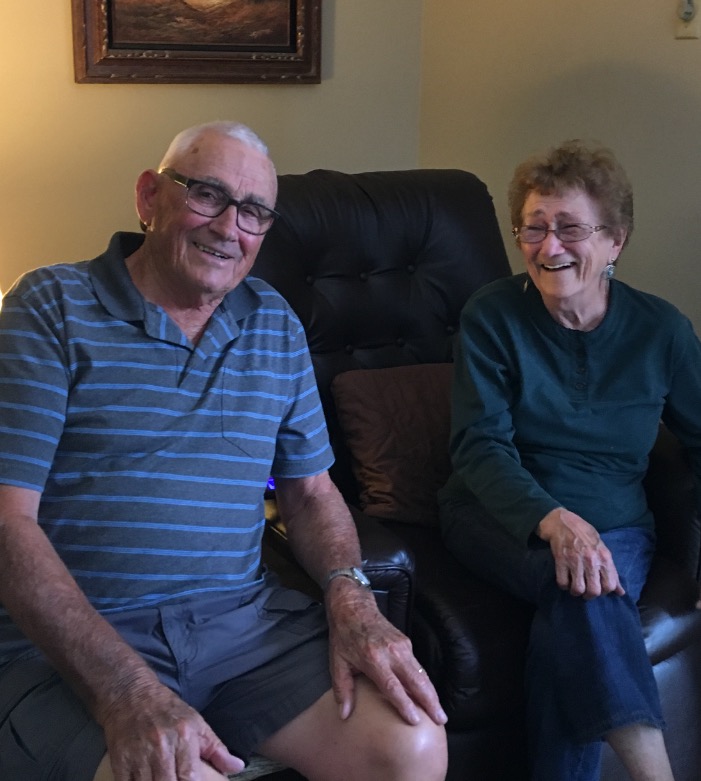
Finally, we followed his heart to visit his aunt JoAnne. She is only two years his senior but his aunt never-the-less. She is the last living person to know him through the entire passage of his life. She is his connective tissue, the one capable of affirming that it all happened, that the house and the people in it were exactly as he remembers, that this life, although only a minute long, is bottomless in the love that they share. They are the burning point of family, the front line. When we left her, Columbus and JoAnne hugged and cried, saying to each other but not for a moment believing it, “I’ll see you again.”

Stories told at the end place. Stories told from the beginning place. Stories told that connect the places. Columbus counts himself a lucky man. He knows with absolute certainty the trinity of places that hold his life/story. Sitting on the porch he (once again) taught me that stories – lives – are like a river and the flow transcends a single life. He just taught me that the story, a good life, like the painting, is never really complete.