Wine Shadow [David’s blog on DR Thursday]

And with no warning, Cat Stevens was suddenly holding a concert in my head: Oh, I’m being followed by a wine-shadow, wine-shadow, wine-shadow. A leapin’ and hoppin’ on a wine-shadow, wine-shadow, wine-shadow…

Carl Jung wrote that “Everyone carries a shadow,…” I suspect Carl chose his verb carefully. Rather than being followed by it, everyone carries their shadow. The absolute weight of weightlessness. The next part of his thought goes like this: “…and the less it is embodied in the individual’s conscious life, the blacker and denser it is.” The moral of his story: get to know your shadow.

I had a long talk with a high priest in Bali. He explained that, according to their belief, they see no need to run from the dark as we do. They strive to make peace with the dark. Keep in mind that their construct is not built upon the hard rock of heaven-or-hell. For them, there is dark energy and light energy. The two dance and balance each other. They are necessary to each other. Our work, he suggested, is to walk between them, hold them both as meaningful and sacred. Getting to know the shadow is about having a relationship with the light.

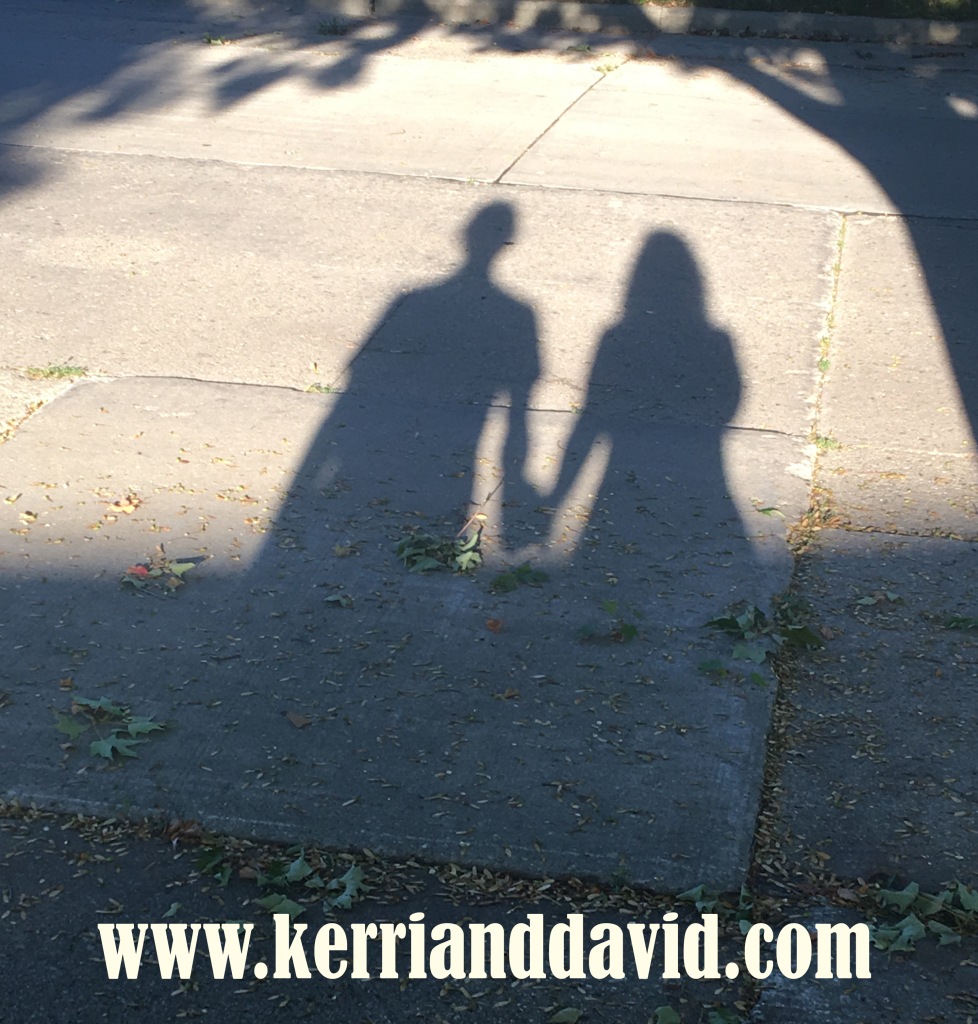
“Don’t sit down!” she said, jumping up, camera in hand.

“What? What?” I asked looking around. She rarely jumps up like that. Only in the presence of bees.

She pointed enthusiastically at my chair. “Shadow! Shadow!” she whispered, as if her voice would scare the shadow away. She focused her camera on the weighty-weightless.

“It’s beautiful,” I whispered, just in case she was right. I’ve ruined a shot or two in the past by using my outdoor voice. I didn’t want to get “the look” if I caused the shadow to flee before she could snap the picture.

It was during her photoshoot that Cat Stevens popped in. And Carl Jung, not wanting to be out-sung, offered his quote.

“I look forward to getting to know this shadow,” I said.

“What?” she whispered, aiming and re-aiming.

“Never mind,” I smiled.

Did it take long to find me?
I asked the faithful light
Oh, did it take long to find me?
And are you gonna stay the night?
” [Moonshadow, Cat Stevens]

read Kerri’s blogpost about WINE SHADOW
share. like. subscribe. comment. support. thank you.

Lean Into It [David’s blog on DR Thursday]

And what did the oracle say? Did she give you insight? Wise counsel? Did she offer a prophesy? Divination? Are you on your way? Do you know where you are going?

This song has been playing through my mind all morning: “Mama pajama rolled outta bed, she ran to the police station…” Simon and Garfunkel. Down by the School Yard. I think it’s in my head because, for many days, it was rolling through Kerri’s head. Transference. The difference is that when she sings the song it sounds like it is supposed to. Queen of Corona.

Before Simon and Garfunkel moved in, I was awash in The House at Pooh Corner. Kenny Loggins and John Messina. “I’ve wandered much further today than I should and I can’t seem to find my way back to the woods…” I hadn’t thought of this song for years and, this time, Kerri wasn’t a source of song-transfer. Where do these things come from?

A friend wrote last night. Like me, he is a wanderer. He thinks it might be time to find a place to settle. Settle, not settle down. I get that. I looked for my home for years and, as it turns out, it had to find me. A person, not a place. She’s filled with music. “And I’m on my way, I don’t know where I’m goin’ – takin’ my time, but I don’t know where…” I hope he finds his place, his person. I hope he is filled with light.

Impressions on a page. The Balinese taught me it is all a shadow on a screen. The moment I put a name on it, I cleave it in two. Subject and object. Mind and matter. Future and past. The only real place is in between the definitions and it cannot be fully grasped. Just lived. Johannes said, with our words, we make images, projections, and, if the image is good, we lean into it. Reaching for the impression.

“Count all the bees in the hive. Chase all the clouds from the sky…”

Prayer of Opposites, 4’x4′, acrylic on hardboard

read Kerri’s blogpost about FOG AND TREE

comment. like. share. support. many thanks!

buymeacoffee is a shadow on a screen, a simple story to tell.

Share Through Your Eyes [David’s blog on Not So Flawed Wednesday]

We slept on the living room floor last night. Our chugga-chugga air conditioner doesn’t reach our bedroom at the back of the house. Record breaking heat drove us to improvisation. “We’re camping!” we exclaimed, spreading blankets on the throw-rug, Dogga jumping with enthusiasm into our bed-making-attempts, ruffling our efforts.

In the morning, we could barely move. “My shoulder is killing me!” I whined.

“My hips are burning,” she frowned.

We laughed and together howled, “OUCH!” I creaked to the kitchen to make coffee.

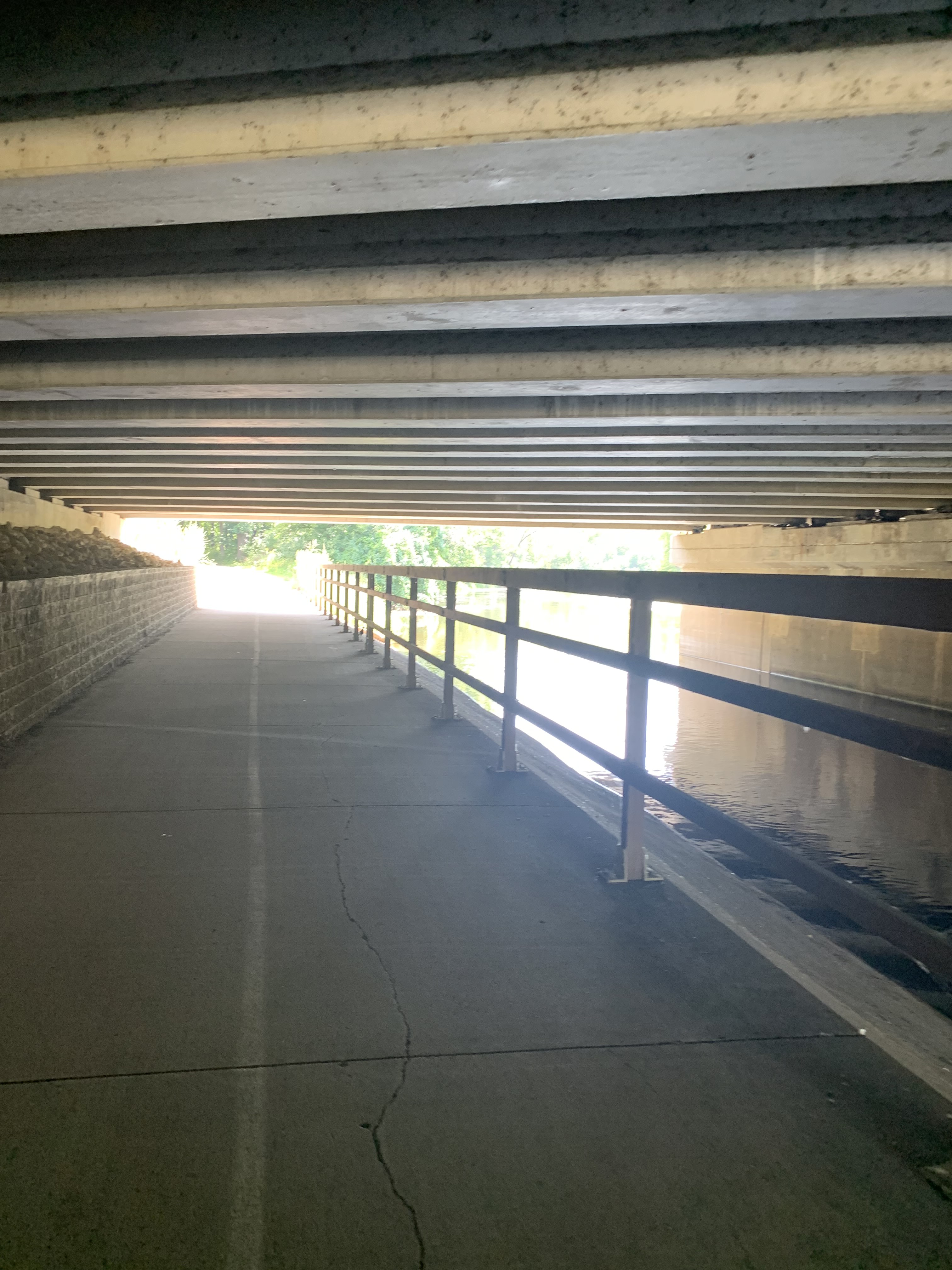
While waiting for the coffee to brew I thought of the underpass. On Saturday we explored a new part of the river trail that ran beneath several busy roads, including the interstate highway. As we left the heat of the sun and entered the cool of the underpass, Kerri asked, “Do you think people sleep under here?”

“Yes, I do.”

Standing at the coffeemaker I was awash with thankfulness. I slept on the floor by choice. Our dog woke us this morning nuzzling our faces. Our ancient air conditioner kept us cool through a brutally hot night. We laughed at our aches and pain.

It’s funny the way thoughts tumble and connect with memory, constellating into well-worn images or plowing new conceptual pathways. Udayana University, Bali. One of my graduate school peers had just completed a presentation on homelessness in the United States. The Udayana faculty was horrified. “But you are the richest country on earth,” a wide-eyed Balinese professor stuttered. “How can you let a member of your community go without a home?” To him, it was the height of shame for a community not to care for their own. It was, in fact, inconceivable. This moment was central to my memory: I saw in his eyes the high esteem he held for us fall into the dark basement. He was suddenly very proud to be Balinese. His community might not have financial resources but they had a form of wealth that made paupers of his American guests.

“It’s the contrast principle”, 20 says. Oppositions illuminate. Cultural differences clarify. What we normalize we cease seeing. I’ve stepped over people sleeping in the street. In Seattle, I routinely rode my bike on paths under a freeway lined with tents and shopping-cart-possessions. In Bali, a man stopped his work in the fields and walked with me because it was rude to let a guest walk alone. We did not speak because we did not share a common language. When I reached my destination, we nodded and shared through our eyes that most universal of gratitudes: genuine appreciation for the companionship of the other; an authentic wish for the well-being of all.

read Kerri’s blogpost about THE UNDERPASS

like. share. support. comment. thank you

Drive The Backroads [on saturday morning smack-dab.]

I thought I’d always be a city rat. I love museums and galleries and concerts. And then, something happened. Now, the pull is to quiet places. Space. I still love my art museums but I no longer need to live next door.

We drive the backroads as often as possible. We are much more interested in enjoying the ride than we are in “getting there.” Surrounded as we are, by Chicago to the south and Milwaukee to the north, our meandering down the backroads is often speedier than the aggressive congested freeways. We’ve become the turtle in the race with rabbit.

Last Friday, after work, we drove the backroads to The Chicago Botanical Gardens. It was a gorgeous evening. We held hands and Bali-walked the paths through the Japanese Gardens. Walking with no desire to arrive.

read Kerri’s blog post on this saturday morning smack-dab.

smack-dab. © 2022 kerrianddavid.com

See Down The Pike [on Flawed Wednesday]

“Age and stage,” 20 says, to explain the behavior of people. Age and stage.

I pulled up Shakespeare’s Seven Ages of Man soliloquy. Jaques from As You Like It. “All the world’s a stage…” We perform the role of ourselves in this drama of life. In a funny coincidence, I’m spending some time inside Pirandello’s play, Six Characters In Search of An Author. David is updating the script and preparing for a production. I’m fortunate enough to play witness to his journey. ‘All the world’s a stage’ meets ‘who will tell our story?’

In the final lap of his career, Tom was an assistant superintendent at a school district. He’d shake is head and say, “Parents forget that they were once children and expect their kids to do things that they themselves could not do as children.” Each age grows blind to the previous stage. We forget the great learning-power of making a mistake.

My favorite of Tiago Forte’s 10 Principles of a Second Brain is to make it easier for your future self. It’s a great idea and I wish the bevy of my past selves had been kind enough to consider me at this age and stage. When I turn and look at the rough wake of my passage I know that, with some better choices, I might have scribed a more direct path. Or not. My past selves caution me to fully appreciate the messes and the mistakes that they made. My life is better today because of the rampant foolishness of those former-me’s.

The Balinese believe that we come back every seventh generation. They are an ancestor returned. As such, they are less likely to foul their nest believing they will themselves be the future inhabitants of the nest. Looking down the long-road, they see themselves dealing with the world they currently create. And so cooperation, sustainability, and peace are much higher on their priority list than guns and every-man-for-himself. To care for another is to care for their future self. They find a society like ours, that allows anyone in the community to be homeless, to be broken. Diseased. Or simply adolescent.

I can’t help but think they are mature while we are mewling toddlers. Considering the impact of your actions seven generations into the future is surely a sign of maturity. Thinking of others, understanding betterment as a shared responsibility, is an adult perspective. Currently, we allow our children to be slaughtered and protect the gun that killed them. Surely there’s some growing-up to be done.

I wish I had a penny for every recent conversation I’ve heard that began with the phrase, “I don’t understand what’s going on in this nation.” 20’s voice pops into my head, “Age and stage,” he says in my mind. “Age and stage.” Let us hope that there’s some maturity coming down the pike, that we survive this stick-your-finger-in-the-socket stage.

Perhaps we will someday look back and appreciate the mess, the rampant foolishness, the mishmash we are making.

read Kerri’s blogpost about AGE AND STAGE

Read A Tiny Note [on Two Artists Tuesday]

I was still in shock. It was late, beyond midnight. The roosters were watching for the sunrise. The ritual I’d witnessed that night blew the metaphoric wheels off my car. Wave after wave of knife-wielding priests ran at the Rangda, a priest chosen for the evening to wear the mask, to enter the trance and become the demon. The priests stabbed the Rangda but to no avail. The blades bent. They were repelled. Eventually, all entered the trance and turned the knives on themselves, taking the energy, the protection of the Rangda, into their bodies. Into the community. No one was injured. Peace was made with the Rangda. Balance was affirmed.

I held one of the knives after the ritual was complete. It was not a stage prop. I could not have bent the blade on my chest without doing injury to myself.

Budi explained it all to me. I had so many questions. In his culture, the dark forces are not to be resisted or banished. There is no hell separate from heaven. Evil and good are not compartmentalized. There are energies, some dark and some light. There is no need to make peace with the light. The necessity is to face and make peace with the dark. Balance is created, an intentional relationship with a dynamic whole. It’s a dance of responsibility, a balance of dark and light. The middle way.

Balance.

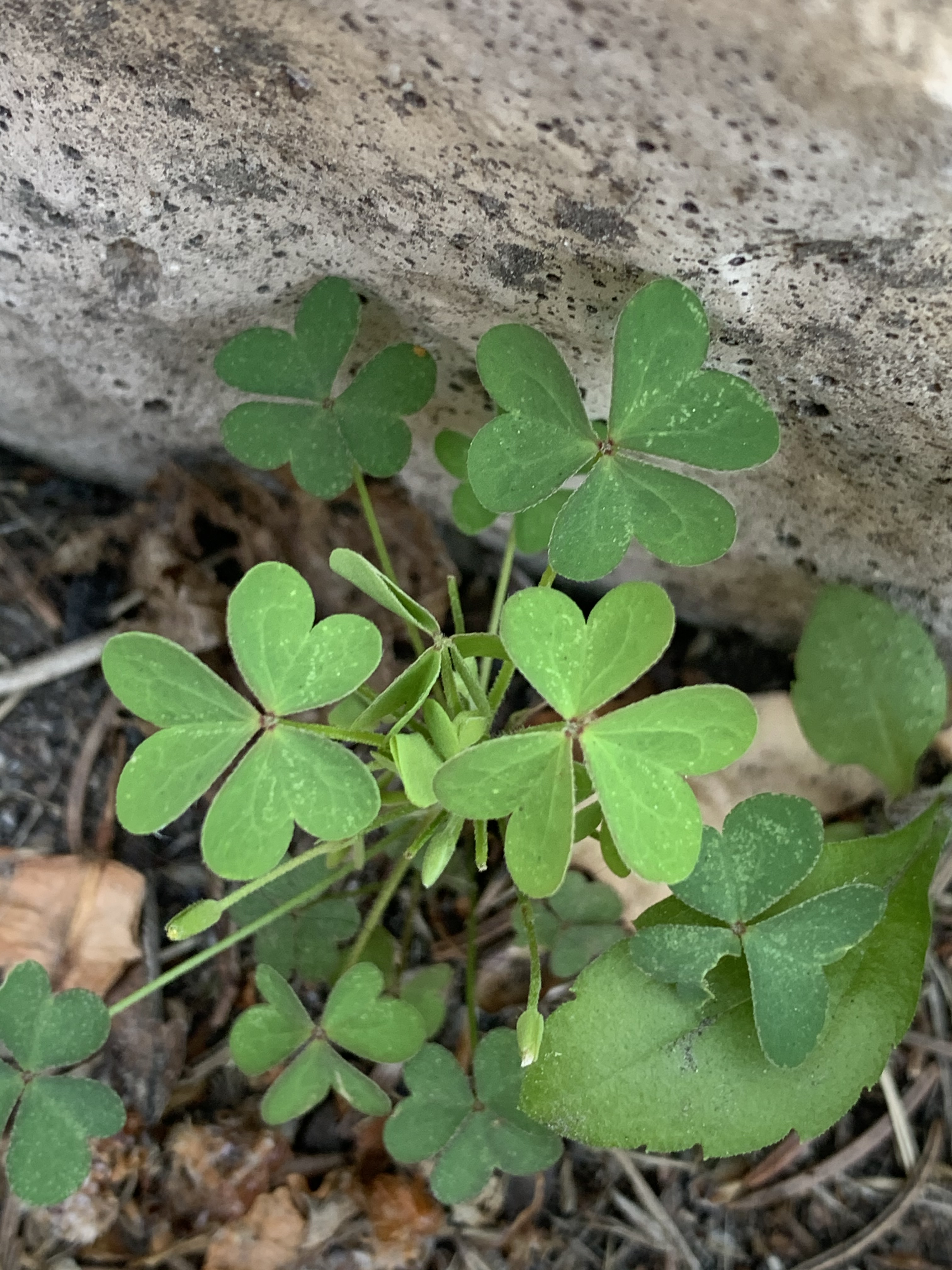
I loved this photo when Kerri showed it to me. Clover. You can’t tell but it is tiny. It is bursting from beneath the stone that serves as the step onto our deck. It made we wonder if the fairy people were close at hand. They serve, in the western tradition, a similar role to the Rangda in Bali. Nature spirits. It was most important to keep in the good graces with the Fairies. Honor their places. Respect and maintain the balance. According to tradition, they went into hiding, they left because we assaulted their spaces; we came to value the path of resources, mining, deforestation, fracking, damming…over the path of balance.

This tiny breath of clover. I sat on the stone last night. The air was cool after a humid and hot day. DogDog was doing his rounds. I had not thought of the Rangda in years. A tiny community on a tiny island. The “mayor” of the town introduced the ritual to us as their art. “We have so little to offer you,” he said in his broken English, “but we bring you our most prized offering, our art.”

Art. A prized offering. The dance of energies, an intentional relationship with the dynamic whole. An ongoing ritual of balance. It was the first time I witnessed a community that had yet to exorcise its art from the sacred. It bent knives. It restored balance. It belonged and gave deep meaning to every member of the community.

Tiny. Like the Fairies or the community on the island. A simple respect for what is good for the whole. Balance is expressed in the tiny things, the choices of where to walk, what to say. What helps in the long run. What does not. What gives meaning and cohesion to a community. What does not.

Budi would caution us with COVID and guns and a globe that is weirding and warming, “Rangda is ignored,” he’d say.

“Yes,” I’d reply, “the fairies have gone into hiding.”

But, all is not lost. They left a tiny note at our back door. Balance, it reads, is a relationship, an intentional act. It is an ongoing ritual, a tiny sacred thing.

read Kerri’s blog post about CLOVER

Cast A Shadow [on DR Thursday]

“The soul has no limits.” ~ Heraclitus

It was a hot summer night, humid and sticky, and the community was gathered in the outer ring of the temple. The Wayang Kulit master, shadow puppet master, was performing a play. Part ritual, part entertainment, the Balinese have not yet banished their arts from their worship. Laughter is welcome in the temple. Although the puppets are beautiful, ornate, the audience can only see the shadows they cast on the screen. It is a metaphor for life: in consciousness, we see only the shadows. We are the shadows. Our life-stories are illusion.

We walked in silence. Watching our shadows on the snow I thought of that hot night in Bali, of my astonishment of the skill of the master, manipulating all of the puppets, voicing all of the parts, a lamp of hot oil burning on his head – the light source to create the shadows. If that were not enough, he conducted the orchestra, seated behind him, by tapping the ground with a piece of wood wedged between his toes. He was a priest. A storyteller, not a preacher. Words and laughter swirl in the outer ring. As you progress to the inner ring, the most sacred place, language falls away, no words are spoken. No words are necessary. Kerri and I, while we walk, often occupy the inner ring. We hold hands. We listen to the sounds in the forest. We cast shadows.

Sometimes I feel far away from that hot summer night. Sometimes I sit right next to it. Our walks bring me closer to it.

It was a revelation to me to sit with people that experience no division between what is sacred and what is not. They do not worship on the weekend and then leave their holy place. To the people watching the shadow puppets, it is all sacred. It is all temple, even themselves. They know themselves as sacred. It is all holy, even to the forks and spoons in their drawer.

The separation they experience in this life – as individuals – is the shadow. Separation is the illusion. Fears and foibles are without lasting substance. The puppet master plays his rowdy tale to remind the people seated on the ground in the temple, that the truth of their existence is beyond the projection on the screen of their minds. Forms are fluid, not fixed. Souls have no limits.

read Kerri’s blog post about SHADOWS

Look Into Their Eyes [on Merely A Thought Monday]

I joke that my experience of moving to Wisconsin was akin to a brake-less semi-truck hitting a runaway truck ramp. I plowed into the sand and pieces of me flew off in all directions. My work, my artistry, my orientation to life. Also lost in the rapid deceleration were my defense mechanisms, my armor, my “status” and “role” as I understood it. Full stop. Bumpers, bolts and bits of me strewn all over the place. It seemed that I was no longer useful.

I recently read a story about African porters, after days of hurrying to keep up with the team of explorers racing to get through the jungle, the porters refused to go another step. They simply sat down. The exasperated explorers appealed to the porters to no avail. “We have been moving so fast, ” the porters said, “we must now wait for our souls to catch up to our bodies.”

I have learned that, amid my wreckage, I am like the porters. Although my abrupt stop was largely unconscious, my soul needed some time to catch up. Wonderment takes time. Depth of experience (otherwise known as relationship) requires a good bit of standing still.

It’s a lesson I have learned more than once. During my time in Bali, if I wanted to walk with Budi, I had to slow way down. It’s actually possible to walk-in-presence rather than walk-in-purpose. In slow walking I learned I could breathe. My mind slowed. Direct experience (also known as relationship) and imagination filled-to-the-brim my new found space.

In our world, so addicted to speed and achievement and possessing and lists and “getting there,” we flatten our experiences to the mechanical. In nuts-and-bolts there is very little meaning to be found. Worse, there is no inter-connectivity. There is no experience of togetherness in an expectation of quotas and cubicles.

When I was consulting with organizations, the most profound experience I could provide my clients was simply to have them stand and face each other. No words. Presence is utterly terrifying to people who are dedicated to never being present. Once through the terror, however, there is no better balm to the horrors of a “business-is-business” wound.

Flat world phrases like “bottom line,” “human resources,” and “business-is-business” are ultimately the language of abdication of responsibility. It is the language of separation. It is the language of cowardice. As we know, it is possible to do all manner of violence on people and the planet when they are reduced to a “resource” or considered an obstacle to business.

We can forgive ourselves anything when we refuse to stand still and look each other in the eye.

The eyes are, after all, the window to the soul.

Stand still. facing another human being, and you will at first pull up the drawbridge and man the parapets. Guards will rush to the towers. But, after a few moments of eye-to-eye-looking, the castle falls apart. The pieces come down. It’s like laying in a hammock on a dark starry night, gazing into the Milky Way. You will either clap your hands and laugh with wonder or you will weep with the profound recognition of belonging.

read Kerri’s blog post about TRAVELING TOGETHER

Walk With Me [on Not So Flawed Wednesday]

life is grace sleep copy

Lately, I’m dreaming of walking the Pacific Crest Trail. It is an escape fantasy. I want to unplug from this angry culture and its toxic division. I want to walk until it hurts. I want to listen to the wind. I want to think-no-thoughts.

I’m kinesthetic. Walking is a better form of meditation for me than sitting. I get quiet when I walk. Chris once told me that I should lead pilgrimages. At the time it made me laugh since I was certain I could probably guide the walk but had very little to offer seekers other than this bit of counsel: shhhhhhhhhhhh. Listen.

I grew up in Colorado and camped often. Say the word, “sacred” to me and I immediately hear the sound of wind rustling through the tops of pine trees. Once, walking a trail in the mountains, it began to gently snow. The forest stilled. It was so quiet I thought for a brief moment that I’d grown deaf. The wind. The quiet. I heard myself catch my breath. Sacred.

At the beginning of this pandemic time, we’d wake in the morning and, sometime during coffee, we’d remember. “Oh, right,” Kerri would say, “we’re living in a sci-fi movie.” The night had forgiven the previous day’s stresses.

One day in Bali, walking down a long road, I felt unsettled. A young man came from the fields and joined me. At first I was perturbed because I wanted to be alone but soon I found his company reassuring.  I asked where he was going and he said, “With you. I walk with you.”

I was confused and asked “Why?”

He was confused by my question. “You are a guest here,” he said in his broken English. “To let you walk alone…is not nice.”

I thought of this young Balinese man, my one-day companion, as I drifted off to sleep last night. The gentle courtesy of his act. His deeply felt obligation of presence. His work-of-the-day was less important, less vital, than showing spontaneous kindness to a stranger. Would I need my escape fantasy, my epic walk, if the people in my country were as generous, as respectful of each other, as he was to me?

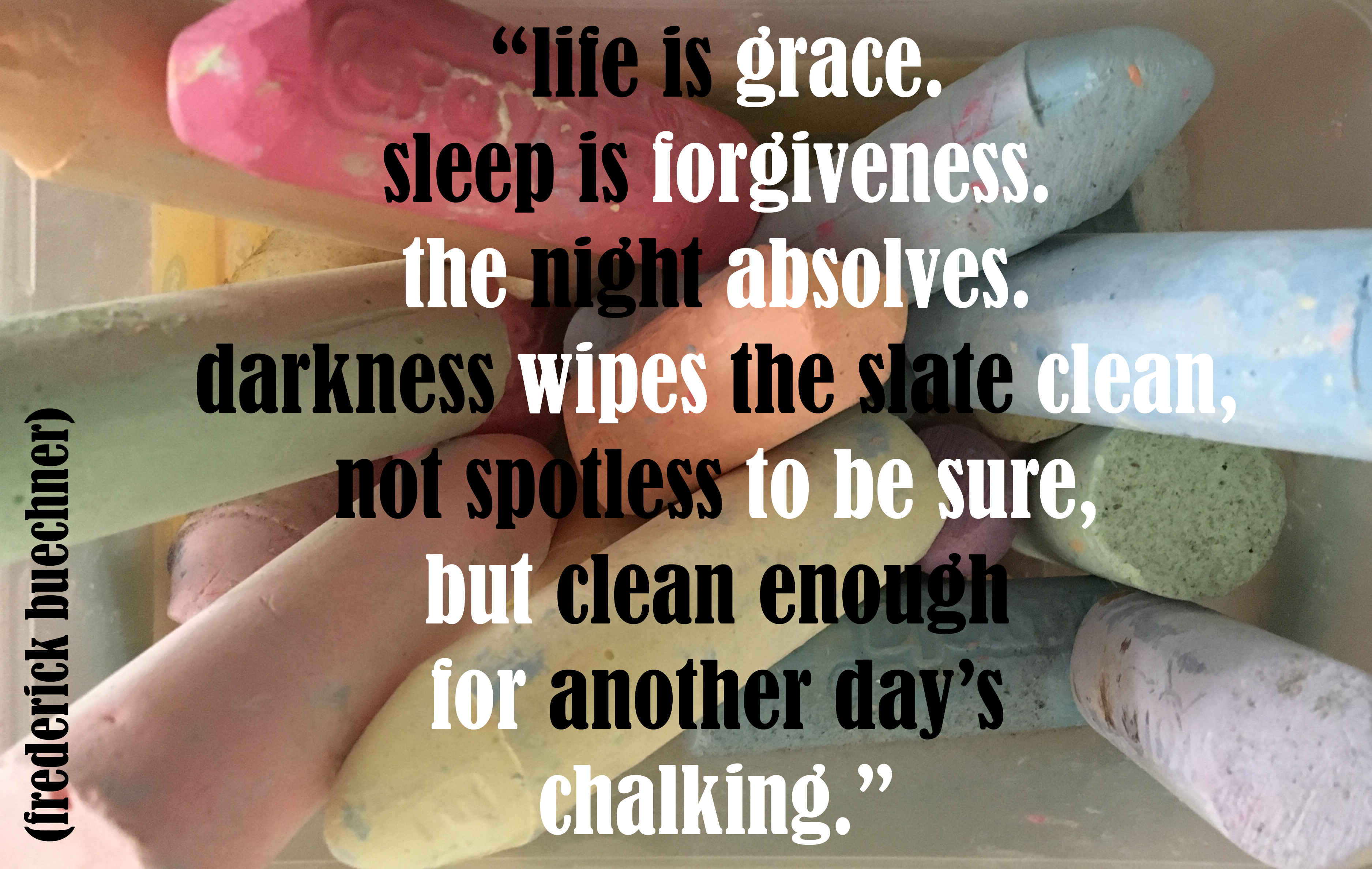
“Life is grace. Sleep is forgiveness. The night absolves. Darkness wipes the slate clean, not spotless to be sure, but clean enough for another day’s chalking.” ~ Frederick Buechner


read Kerri’s blog post about ANOTHER DAY’S CHALKING


boardwalk shadow feet website copy


held in grace: rest now ©️ 2016 david robinson

Look In, Look Out [on DR Thursday]

InPrayer copy

yoga series: in prayer, mixed media, 67 x 64 IN

Going through my stacks I’m struck by how many of my paintings are about meditation or prayer. Most of my work is inward looking.

When I was a kid I was fascinated with drawing eyes. I spent hours and hours drawing eyes because I wanted to know what was behind them, inside, going on beneath what was visible. It should not be a surprise to me when looking at the mountain of canvas and paper in my studio that most is populated with images of inward looking. I’m still working on what’s behind those eyes, it seems.

Once, in Bali, Budi told me that the high priests were in prayer all of the time. Their whole lives were dedicated to constant prayer. Seeing how I was struck by his comment he added that all people are in prayer all of the time, they just don’t know it. “Thought is prayer,” he said. “The high priests know it so they guide their thought and pray for peace. Most people spend their life praying about their troubles.”


read Kerri’s thoughts on IN PRAYER


tpacwebsitebox copy


yoga series: in prayer ©️ 2014 david robinson