Light The Dark [on DR Thursday]

Strong contrast between light and dark: chiaroscuro. Renaissance painters loved it. The word ‘chiaroscuro’ literally means light-dark.

Today is Stephen’s memorial service. It is across the country or I would be there. I confess, I am haunted by Stephen’s death. When Mike wrote to tell me of Stephen’s passing, he told me that he was at peace when he died.

I’m not sure why his passing has hit me so hard. The last time I saw Stephen was 1998. He was following MM like a puppy. They were working on a set construction project. That’s what I remember. He was 14 years old, so, in my mind, he is frozen at 14. He was one of a pack of brothers that formed a solid core of Dimension’s Theatre Project, a theatre program that I spent more than a decade resurrecting and nurturing into artistic vitality. Stephen and his brothers were present in its heyday. For me, it was an artistic and learning laboratory, a place of spirited artistic creation. I loved every minute of it.

Of the brothers, I knew Stephen the least. I worked most directly with his older brother, Greg. I prided myself that Dimensions was a safe space. Artists, especially young artists, are vulnerable. They need to know that they can make strong offers, take chances, find their edges, without shame. That means living in and creating a culture of mutual support. The person selling the tickets mattered just as much as the actor on the stage. Every member of the community was directly responsible for the health and well-being of every other member. It is the philosophy I inherited. It is the philosophy I carried forward.

Mike took the reins of Dimensions when I left. He carried on the tradition, made it his own, Changing Faces Theater Company. Mike knew the artist that Stephen would become. The musician. The designer. The man who cared for the health and well-being of others, artistic and otherwise. Mike knew the dark and the light of Stephen’s short walk on the earth.

Usually, when I am confused or need to sort out my heart, I take a break and visit the pond. Magic, the frog, lives there. He’s a good hider but every few days comes out for a visit. After Mike’s news, confused at the depth of my confusion, I went to the pond and hung out for a few minutes with Magic. Dogga was running circles, making my visit safe from marauding squirrels. The sun was down.

“Look at this picture!” Kerri smiled. She’d caught Magic in chiaroscuro, made more dimensional and full in light-dark.

“It’s beautiful,” I said, looking at the photograph.

Light-dark. The Renaissance masters loved it. I smiled this morning when I read Stephen’s obituary. It began with a quote, something he must have often said. His words brought to me what I couldn’t find at the pond. Peace for Stephen. “Proper lighting can change the world.”

read Kerri’s blog post about MAGIC

surrender now ©️ 2016 david robinson

Meet The Saw [on Merely A Thought Monday]

As the magician saws the woman in half, he tells her that, “Magic is not an exact science.” It is among my favorite Flawed Cartoons.

“There’s nothing sadder than a forty year old production assistant,” she said, sipping her drink, looking across the room at a man she clearly thought was a loser. I was living in Los Angeles and was at a party with movers-and-shakers. The gathering also included a few of the people who carried the cables, loaded the trucks, moved the electrics – the lowest rung on the ladder. The runners. I swallowed hard. At the moment she said it, I was thinking the exact opposite. There is nothing more interesting than a forty year old production assistant. I wanted to be standing with the very man she considered a loser. He’d have stories to tell. Experiences to share. The movers-and-shakers bored me. Dulled by their dedication to security, thoroughly protected from the unknown or surprising experiences, they sneered at the people who’d actually lived. I found my way across the room and spent the rest of the evening sitting in the kitchen talking with a man who traveled the world.

Were I at the party today, she would look across the room at me and whisper, “Sad.”

Life is like magic. It is not an exact science. Ideals collapse. Dreams implode. Yet, the luckiest people I know are the few who have stepped out of their seats and volunteered to climb on to the stage. They’ve taken chances. Built wood buses or put their lifeblood into starting a theatre company or went boarding instead of dying in a cubicle. They’ve stepped beyond traditions and expectation. They’ve been cut in half, opened, challenged, surprised, disappointed, scared, triumphant, awed. They’ve learned. They’ve questioned their beliefs and perceptions. They’ve made titanic mistakes. They’ve stared down their demons. They’ve opted for curiosity rather than being right. They stepped off the edge. They followed, “What if…”

There’s no shortage of people who watch life from the safety of their seats. As Tom used to say, “They paint with a limited palette.” There are those lucky few who, if you see them at the party, most likely the people serving drinks, who’ve been cut in two and know from scary experience that there’s nothing more numbing or illusory than certainty. Follow them into the kitchen and ask about their lives. You’ll be amazed at the full spectrum of colors you find in them.

read Kerri’s blog post about SAWED IN HALF

flawed cartoon ©️ 2016 david robinson

Root And Fly [on KS Friday]

“Inspiration does exist but it must find you working.” ~ Pablo Picasso

At some point I realized that all of the good guidance I have received, all of the masters that I have admired, made statements about Roots & Wings.

“A writer writes. A painter paints.” ~ Tom McKenzie

“You must write 10 bad pages to arrive at one good page.” ~ John Guare

“Live on the plateau (in the present moment).” ~ George Leonard

“Cultivate your serendipity.” ~ Tom Quinn

I remember Jim E. teaching actors not to push their voices to be heard but, first and foremost, to root down into the earth.

After years of practice I am approaching the lesson that Saul taught his tai chi students: stay on the root and the energy will move you. He also taught me, on a brilliant Saturday morning when I was trying to bend the world to my will, to look beyond my opponent into the field of opportunity. It is two ways of saying the same thing. Root. And the wings will appear. Root, and possibility will find you.

Work at the easel, and inspiration will arise.

all of Kerri’s albums are available on iTunes or streaming on Pandora

read Kerri’s gorgeous blog post on ROOTS AND WINGS

give me roots, give them wings/released from the heart ©️ 1995 kerri sherwood

Look Again [on DR Thursday]

I’m not sure when I started using floral shapes and imagery in my paintings. There was Sam The Poet and Eve, trees as symbol.

Sam The Poet, acrylic, 48 x 48IN
Eve, acrylic on hardboard, 48 x 48IN

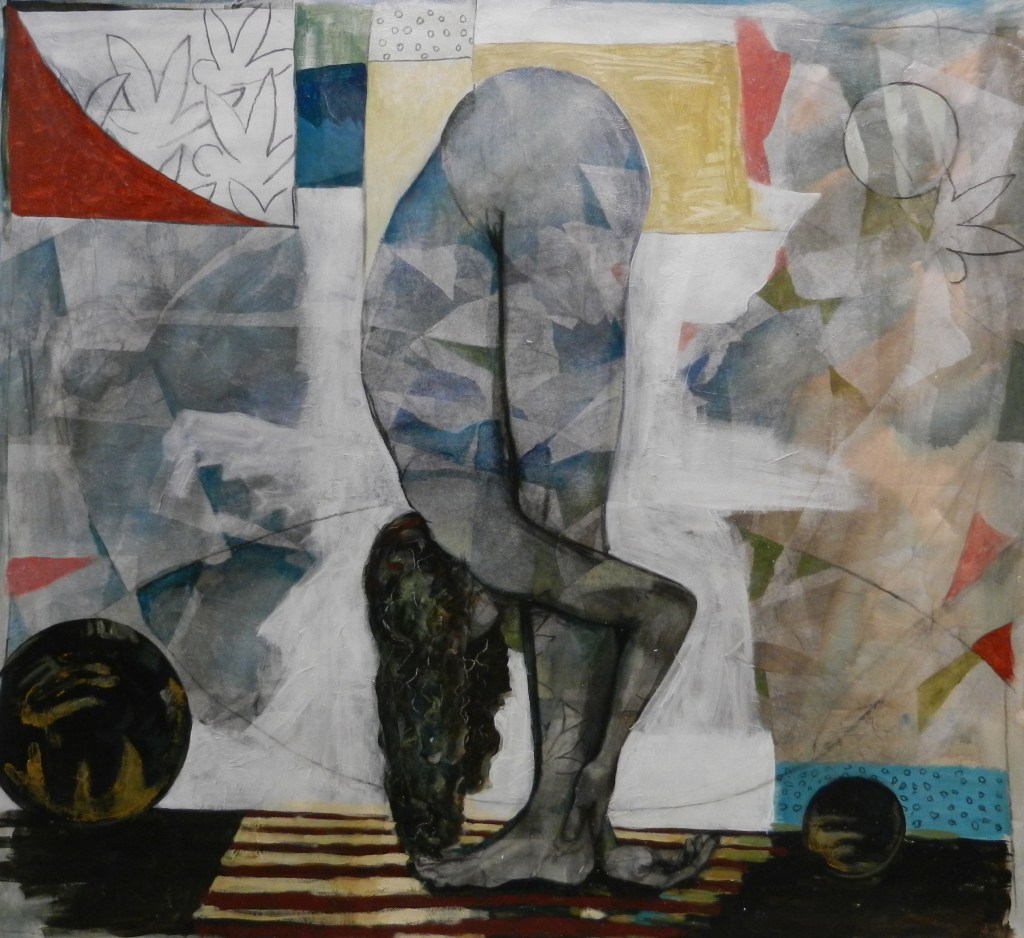
I know my sketchbooks began filling up with flower shapes and symbolic landscapes. Petals appeared throughout my Yoga Series. Leaf and flower shapes found their way into the bodies as well as the surrounding spaces.

Joy, mixed media, 50 x 56IN

I played with tissue paper over color as a ground for the images. When Tony recently visited my studio, he said my paintings were sculptural, visually commanding. I wrote his words on a scrap of paper since artists are mostly terrible at describing their work. He is an artist so he knows that the proper answer to the question, “Tell me about your work?” is “Go look at it and then you tell me about my work.” He didn’t ask the question; he went straight to the looking.

Tango With Me, mixed media, 39 x 52IN

We walked down a path at sunset. Kerri saw the sunflowers and I knew a photo op had arrived. “You should use this as your Thursday post,” she said, showing me her photo, “because your paintings always have flowers in them.”

Well, good enough, then. Sunflowers, shape and symbol, will find their way into the next painting, I’m sure of it.

read Kerri’s blog post about SUNFLOWERS

copyrights for all paintings in this post, 2010 – 2021, david robinson

Be Indeterminate [on Two Artists Tuesday]

Through the good graces of our tomato plants, I’ve learned a few new concepts this summer. Determinate and indeterminate. Bush and vine. Determinate tomato plants (bushes) are bred to stop growing. Indeterminate tomato plants (vines) will grow indefinitely or until the weather conditions “are no longer favorable.”

Our plants are indeterminate. Each morning, Kerri visits our planting bench and checks her tomatoes. 20 taught her a few simple tending-rules and now, each morning, there are more and more little indeterminate miracles moving backward along the color spectrum, finally arriving at a brilliant red.

Life is indeterminate.

My new tomato-terms come just in time. My current project has me revisiting my past life as a teacher and facilitator. If I apply my new terminology to people I can’t help but think it is the lucky few who survive so much dedicated energy to stop the learning-mind in the name of education. The natural output of a system designed on manufacturing principles is to truncate the questioning mind by patterning the notion that there is a predetermined answer. It becomes a game of finding the answer that teacher wants – a closed loop – instead of an incitement of curiosity. Children are excellent game players and translate the gaming pattern into their now-dulled-adulthood.

There is a cycle apparent in all genuine learning processes. It begins with discontent. Curiosity is a movement born from some form of discontent. It leads to questioning. Questioning always leads to disturbance (the interruption of the known). And, just like that, out of the disturbance something new is seen, call it a breakthrough, call it an insight, call it new learning…Many classrooms – certainly the systems – are designed and organized to keep disturbances to a minimum. The mantra is ‘control’ rather than ‘inspire curiosity.’ Business has the same dedication.

We’re taught that disturbance is the sign of something wrong rather than the crusty earth breaking to reveal new verdant life.

Discontent leads to questioning, leads to disturbance, which leads to breakthrough. And, an insight will always lead to discontent. It’s a story cycle, where yearning meets obstacle. Learning is by definition uncomfortable and at its best when it is uncontrollable.

Last week I attended a meeting. My two companions and I brought our homework back to the team. One was content. The other two of us were filled with discontent. The leader of the session, at first, was angry. He did not get the result he’d anticipated from his exercise. “So, you two are telling me this process was worthless!” he raged. We’d spent our week questioning instead of answering. Discontent. Questioning.

“No! It was great!” we chimed in chorus. “Look at all the good information we uncovered!” It was a mess. Big disturbance. We cycled through our misalignment a few times, wrangling over perception and usefulness. More rage. And then…an insight. The breakthrough. All of the rage, all of the appeasing, began to flow in a single direction. A possibility took shape. A target materialized that was much better than the prescribed pursuit. Energy filled our zoom-osphere. Laughter. Excitement.

Learning. Indeterminate. Open questions. Hot pursuits.

I am drawn to and surrounded by the dedicated indeterminates; those who refuse to stop learning: David, Mike, Horatio, MM, Bruce, 20, Judy, and yes, Kerri…I am a very fortunate man to be surrounded by so many tomatoes moving their way backward along the color spectrum, not afraid to walk through their discontent toward bigger and bigger questions.

read Kerri’s blog post about TOMATOES

Make Life Better [on Merely A Thought Monday]

Lately, the universe has pitched me headlong into a master class on efficiency. Maximum productivity with minimum wasted effort. A useful concept in certain arenas and an intensely destructive concept in others. For a person who’s spent his life in a study of curiosity, art, and the creative, it’s an unexpected study at this stage of the game. It is sometimes uncomfortable but I consider it an opportunity for balance. Artists rarely meditate on efficiencies. We’re more of a discovery clan and efficiency is generally the enemy of discovery. No one ever sailed to the edge of the world with efficiency-on-their-lips.

Once, I made the argument to a school board that daydreaming was highly productive. It seems a no-brainer to me that exercising the imagination should be highly valued in a learning environment. Einstein’s Theory of Relativity came to him in a dream about cows. It is not an accident that many insights and revelations come in the shower or while driving or peeling a carrot. Newton’s apple did not fall on his head while he was exercising maximum productivity. The mind, to be efficient, needs space to breathe, fields to roam. It is the most elegant of paradoxes but mostly lost on worshipers at the altar of efficiency. In the modern business world, efficiency is all about time since time is billable. You know the mantra: time is money. Do more with less. Somehow, we’ve turned that nonsense into a virtue, a thing to be desired. A reason to squeeze.

There’s another, more admirable side to efficiency-seekers. How to make work less arduous. Grease the wheels and remove the friction. Relieve the burden. Not faster but easier. Ann used to say, “Find a need and fill it.” She’d look at people toiling and ask, “How can I ease their struggle?” Beaky was that way, too.

Near our home there is a stretch of shoreline with an ineffective seawall. It was built with stones and debris that become projectiles when hit by forceful waves. The locals know to avoid that stretch during a storm. It’s deadly. After the storm, it has become our ritual to walk the path to see the destruction. It’s always impressive. How far can a wave throw a heavy stone? The answer: farther than you think. Mother Nature yawns when we think we can control her. The seawall has become my metaphor for human hubris but also masterful inefficiency. It would cost money to build a proper wall. So, instead, after each storm, crews collect the rocks and pile them back on the shore, readying them to be hurled by the next storm.

We saw a double-rainbow and turned toward the shore. Kerri never misses an opportunity to capture a little miracle or a slice of beauty. We parked in front of the seawall-of-inefficiency and I laughed out loud. A budding Banksy sprayed a message on the rubble: love. The secret message-maker could not have found a more appropriate word: Love. Can you imagine anything more inefficient and, at the same time, more potent? Love moves mountains but is not billable. It transcends time. What better reason to do anything? Well, perhaps reason has nothing to do with it and never has. Reason has the worshipers-of-the-efficient perpetually re-stacking stones.

It’s easy to be seduced but let’s face it, life reduced to billable hours is not life at all. On the other hand, there is nothing more inspiring, nothing more curiosity-invoking than asking, “How can I make life better for everyone?”

Love on a rubble pile. What could be better? On second thought, what could possibly be more efficient?

read Kerri’s blog post about LOVE ON A ROCK

Let’s Get On With It [on Not So Flawed Wednesday]

It was a national campaign of the US Department of Homeland Security. If you see something, say something. The enemy is here. It is us. We pulled it from an episode of Grace & Frankie. Old folks have hair that grows in places it ought naught. Frankie plucks a hair from Grace’s chin. “How long has that been there?” Grace exclaims. “Frankie, if you see something, say something!”

Yesterday, I had a collision of experiences at the courthouse during my jury pool swim. First, I read an article in The Atlantic, by Tom Nichols, Afghanistan Is Your Fault. He wrote, “The soldiers who served overseas in those first years of major operations soon felt forgotten. ‘“America’s not at war” was a common refrain among the troops. “We’re at war. America’s at the mall.”’

He continued, “A serious people—the kind of people we once were—would have made serious choices, long before this current debacle was upon them. They would today be trying to learn something from nearly 2,500 dead service members and many more wounded. They would be grimly assessing risk and preparing both overseas and at home for the reality of a terrorist nation making its way back onto the international map.

Instead, we’re bickering about masks. We’re holding super-spreader events. We’re complaining and finger-pointing about who ruined our fall plans.

Next, I was among the many chosen for voir dire (the jury selection process). I was in the last group selected so the odds of my serving on the jury were slim. I sat in the courtroom and watched an amazing moment unfold. The judge said something that all Americans should hear. It aligned perfectly with Tom Nichols’ thoughts. A potential juror, a young man, claimed serving on a one-day trial would create hardship. He’d miss a day of work. The judge questioned him to get more context and then sat back, considered for a moment, and said this:

“Democracy is hard work. When I was young, there were three things that we had to do: pay taxes, honor the draft if called, and serve on a jury if called. All of those things create hardship. Taxes aren’t easy. The draft changed the lives of thousands of young people. Serving on a jury interrupts life. It creates hardship. Giving of yourself to the common good means serving something greater than yourself. It is an interruption. Today, there are only two of those things because there is no draft. My point is, giving of yourself to make this gorgeous system work is not easy. It is hard work. It creates hardship to ensure that our system, the oldest democracy in the world, thrives and survives for the next generation.”

America is at the mall. Meanwhile, democracy is hard work.

For a serious people, there is a center to our commons and, keeping it alive, takes a bit of self-reflection and sacrifice. Giving of yourself to the common good means serving something greater than yourself.

Divided we fall. It is a cliche’ but could not be more relevant.

The enemy is here. It is us. Bickering about the lesser while the greater slips from our fingers. “If you see something, say something” is predicated on an assumption: we are in service to something greater than ourselves. We are on the same team with a common, shared interest.

The judge sat back in his chair after his lecture and asked the young man, “Are you less capable of handling hardship than anyone else in this room?”

“No, sir,” the young man sat back in his chair, resigned.

“Good!” the judge exclaimed. “Now, let’s get on with it.”

read Kerri’s blog post about SEE SOMETHING, SAY SOMETHING

Refresh [on Two Artists Tuesday]

It’s been true since we met. People stop us in airports and on the street, they give us thumbs up or take a faux paparazzi-photograph. They tell us that we are cute or “lookin’ good!” Once, a shopkeeper came out of his store to tell us that we made him smile. When we walk the neighborhood, we are often met with people who tell us that we make their day. It always takes us by surprise and it always makes us smile.

What are people seeing? We are older and link arms when we walk. We hold hands. Our clothes are unintentionally the same. Black on blue jeans. We walk slowly. We talk to each other. We stroll; a walk without a destination. We don’t know what inspires the comments but always appreciate them.

Kerri always coos when she sees a horse. In our imaginary life, she has horses, a donkey, and an old truck. We were walking on the trail in our flip flops (that always gets a raised eyebrow or two) when the cowboy came around the bend. “A horse!” Kerri whispered, and squeezed my arm. The cowboy sat up in his saddle, nodded as he rode passed, then said, “You look like you like each other.”

“We do.” I replied.

Perhaps it is that simple. We like each other.

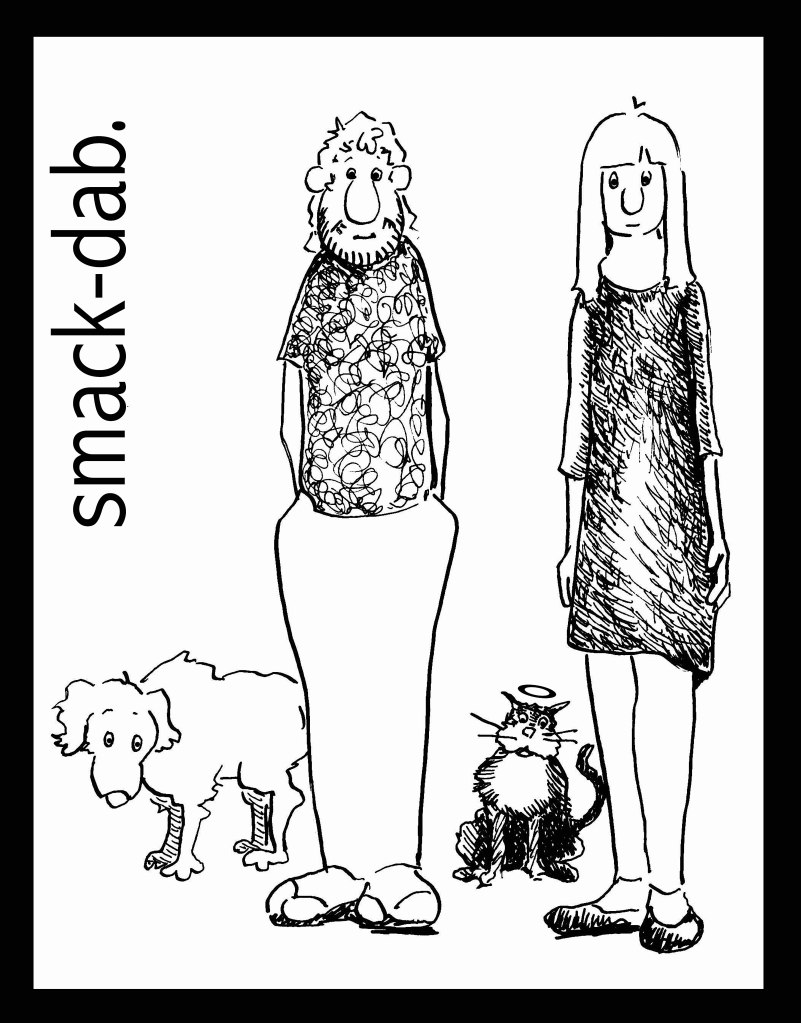
We’re fortunate. Our work allows us to be together all day. Every day. That would, I’m sure, be the end of most relationships. We like it. When I need feedback on a painting, she is my best wise-eyes. “What do you see?” I ask. We read our posts to each other before we publish. We edit together. We cook together. We create together. Our list of joint projects is growing. Lately, our once-weekly-cartoon about…well…us, Smack-dab., is giving us tremendous energy. It is fun. We poke fun at ourselves. We capture the ridiculous and the poignant. We pay attention to the marvels of simple relationship.

Picasso said that, “Love is the greatest refreshment in life.” He also said that, “Art is the elimination of the unnecessary.” Those thoughts, placed side-by-side, I believe, holds the reason a cowboy sat up in his saddle and a shopkeeper ran into the street. We are refreshed. We practice the elimination of the unnecessary – on canvas, at the piano, and in life.

We didn’t try to make 24/7 togetherness. There was no rule or expectation. It’s what we wanted. It’s what we want.

I am on jury duty this week and was at the courthouse most of the day. When she came to fetch me I got in the car and we said at the same time, “That was weird!”

“Tell me everything!” she said.

“No. You first! What did you and Dogga do?” Our conversation took us deep into the night. There’s so much life and so little time. Perhaps that’s it. We know this day is precious and fleeting and act accordingly. It must show.

read Kerri’s blog post about YOU MUST LIKE EACH OTHER

See The Spaces [on DR Thursday]

The space around and between. Shapes that share edges. Emptiness that provides definition. In art it is called negative space. Not-the-object. In art classes, students draw the negative spaces in order to see or to learn a new way of seeing. Try it. See the holes and the space around the leaves as primary. It’s not as easy as it sounds.

Some folks use the term “air space” because they get snagged on the word “negative.” It’s a term of opposition when set next to “positive.” Yet, just as there is an electric field that flows between negative and positive ions, electrons and protons, there is a field that flows between negative and positive space. Yin and Yang. A dynamic polarity. A creative field of movement and energy. The air space is alive because of the perceived opposition. The positive space is not visible without the negative.

When I was a consultant, I used the phrase “the space between” to imply relationship. There are people. There is the space between people. Relationship is invisible but it defines the people. Relationship illuminates the otherwise unknowable individual. They are impossible to separate. In a community obsessed with nouns, bottom lines, test scores and individual rights, the verbs and the relationships often go unnoticed and unappreciated. As if the negative space didn’t matter. The space between is where the movement lives and the problems are solved. It is where new seeing is possible. It is created and creative. The word “community” lives in the space between.

Try it. Take a day and focus on the space between. See relationship as primary. You may experience a whole new way of seeing.

20 sent this image,a memorial. It makes the point.

read Kerri’s blog post about NEGATIVE SPACE

iconic ©️ 2010 david robinson

Pull The Weed [on KS Friday]

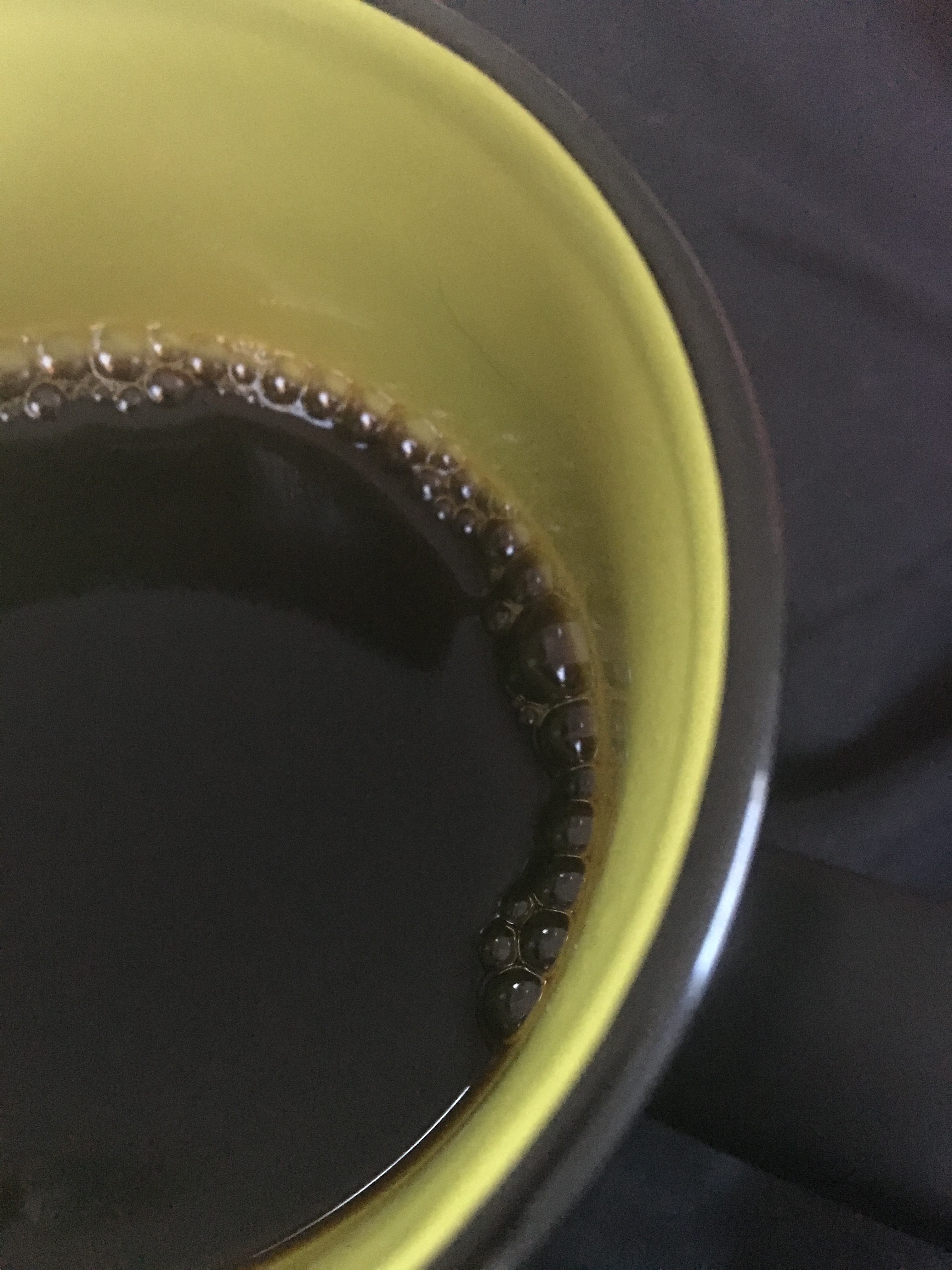
One of my favorite simple pleasures each day is watching Kerri go out in the early morning and tend to her tomatoes. The world is quiet. The coffee is brewing. Dogga makes sure the yard is clear of marauding squirrels so the path to tomatoes is safe. An extraordinary ordinary moment. A tender ritual. A wonderful world.

Put down your clever and pick up your ordinary. It is one of my favorite “rules” of improvisational theatre. It is also a good credo to live by. Trying to be clever will take you out of the game every time. It is as true in all aspects of life as it is in art. The beautiful little secret: power, presence, flow…these live in the province of the ordinary.

When I was learning to scuba dive,Terry tried to teach me one central concept: get neutral. After several dives, fighting for control, trying “to do it right,” burning through my oxygen with my dedicated stress, I simply relaxed. I found the neutral that he advised. It was as if I joined the current. The colors sharpened. Time seemed to slow. My breathing definitely slowed. What was a struggle only a few moments before was suddenly easy. I’d picked up my ordinary. I got out of my way.

I delight watching children draw. They are free in their ordinary, not a shred of clever to be found. They lose that. We lose that, trying to be…something other than what we are. How many of us shudder in the notion that we are inauthentic? How many of us invest in the notion of low “self-esteem?” The circle of ordinary comes back around though it is cloaked in words like “self love” or “acceptance” or “wholeness.” Get neutral. Put down your clever.

Ordinary, not clever. It is a discovery that ought to stick early in life but generally lands much later. There’s very little distance between the child that freely colors and the adult that one day remembers that nothing is broken, nothing needs fixing. It is ordinary to color with abandon. The riches are in tending the tomatoes. “Clever” is merely a weed that needs pulling. In the ordinary, a wonderful world is waiting.

PULLING WEEDS on Kerri’s album RIGHT NOW is available on ITunes or streaming on Pandora

read Kerri’s blog post on TOMATOES

pulling weeds/right now ©️ 2010 kerri sherwood