Embrace The Paradox

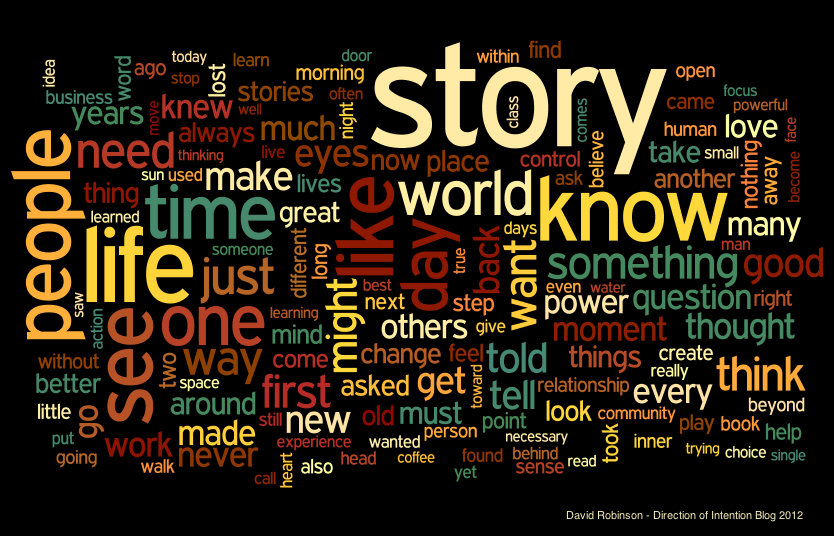
Mark Seely's gift to me: A Wordle of my blog

Mark Seely’s gift to me: A Wordle of my blog!

This is a landmark post: number 1000. When I started blogging I told Horatio that I feared I only had enough thought for 10 posts. He said, “If you can write 10, you can write 1000.” I wrinkled my brow in disbelief but it turns out that Horatio was right. With every step comes a new perspective. Kerri has a phrase I love: take down one tree at a time. In other words, if you can’t see where you are going, take the step that you can see; many single steps translate into miles of walking just as one post at a time can become 3 years of small thought-shares all in a row. What is a lifetime but a long series of days?

I’m writing this from a dining room table. All around me, covering the walls, are long strips of newsprint with a gathering storm of many colored post-it notes. The notes contain phrases, actions, like “Burn Your Trash,” or “Both Feet In, “ or “ Leave the Yuck Behind,” or, as you’ve already guessed, “Take Down One Tree At A Time.” They are story prompts. They are insight and idea prompts. Each prompt is associated with one of Kerri’s music compositions (she has 15 albums to date, with material enough for 3 more). They are building blocks for concert/storytelling evenings or keynote speech/performances. From the more than 60 post-it note prompts (and growing) we can combine any 9 to configure an audience-specific performance. The possibilities are endless. The viable themes are both unique and universal. Our umbrella title is Back To Center. We have a series of workshops to compliment the performances. The workshops illuminate the extraordinary moments and liberate the boundless capabilities of we mortals, we ordinary human beings. The big box is appropriately a prompt: Be A Ray!

Kerri and I are bringing our work together in a new form: Be A Ray!

Kerri and I are bringing our work together in a new form: Be A Ray!

As it turns out, I am a man of my time after all. The notion of a series of discreet component thoughts assembled to create a universal conception is taking over all of my processes – writing, painting, coaching, facilitating. It is the “many small steps making one large journey” philosophy of creation. It has taken over our world. It is contemporary: note the thought behind an App store or an Army of One. It is natural; cells do it. In the blog world it goes by the name of a “plug-in.” Build your own burger: design your car from the available components. It is the illusion of individuality in the midst of a constraint of choices. There is no arrival, just continuing process of expansive and interchanging capability. It is the Kahn Academy. Work at the pace that is appropriate to you. It is yoga: begin where you are, not where others are. It is what the old world of government process (ridiculously obscure tax codes), health care, education…the usual bureaucratic suspects and old school businesses do not understand. The world of rolling process has ascended; products and outcomes are obsolete before they hit the shelves. Story is more accurate than data (data is, after all, a type of story).

Nimble thinking requires nimble processes. Expansive living requires expansive thinking. Cathedrals are built one block at a time but the secret story of a cathedral is that it is never finished. It is always under construction, always changing, updating, repairing and modernizing. That’s the point of a sacred path. Stability, your sacred home, in this modern age is now found in motion, in a pure engagement with a moment. This is what we mean when we say, Be A Ray! Get into motion and focus your intention. Safety is never found in stasis.

Yesterday I wrote that a good life is marked by the capacity to stand solidly in the constancy of discovery. It is a paradox. Another prompt on the wall, one of my favorites, reads, “Embrace The Paradox.” Yes.

Go here to get my latest book, The Seer: The Mind of the Entrepreneur, Artist, Visionary, title_pageSeeker, Learner, Leader, Creator…You.

Or, go here for hard copies.


Spin A Web

from the Yoga series by David Robinson

from the Yoga series by David Robinson

Quinn’s study smelled of cigarettes and books. There was always a red felt tip pen and a yellow pad for note taking or for his latest composition. Quinn didn’t type and I doubt that he ever touched a computer. He had to feel the pen move across the paper. He was a sports writer though, in truth, he was more a poet philosopher. For Quinn, sports were a path to illumination. He filled his articles with haiku, analogies to chaos theory, Michael Murphy, and George Leonard.

One day while sitting in his study, talking about athletic achievement and success, he said, “You have to cultivate your serendipity.” What a terrific phrase! Serendipity is one of those paradoxical words that imply both coincidence and destiny. So, according to Quinn’s coupling of “cultivate” with “serendipity,” we must either promote coincidences or encourage destiny. Or both.

I responded, “So, in other words, the harder you work, the luckier you get.”

“It’s more than that,” he said. “It’s much more than that. Of course you have to do your work. But you also have to share your work. You have to show up, be visible, ask lots of questions, and seek the masters in your field. You have to show what you don’t know. In fact, you have to operate from what you don’t know. There’s always a better way to make a shot or shoot a basket. To cultivate your serendipity is to never stop learning, never stop improving, never assume that you’ve got it.” He paused and then said, “What you don’t know can be an obstacle or it can be connective tissue.”

Quinn watched me take it in. I knew we were talking about more than athletic achievement. He was trying to help me. At the time, I was an accomplished introvert and was wrestling mightily with sharing my work. I had no problem painting the paintings but telling galleries about my work seemed an utter impossibility. Sharing meant I would have to talk to people. It meant I’d have to say, “This is my work and it is good work.” It meant claiming my gift beyond the thoughts and opinions of others. Quinn was teeming with blarney and always seemed at ease in a crowd though I knew even then that we shared a similar demon. He doubted his gift. He recognized my struggle because it was his struggle.

After a moment he lit a cigarette, blew the smoke and continued, “It’s like spinning a web – and the silk, the connectivity, is spun from seeking what you have yet to learn. The more you share your gift, the more you ask others what they see, the more people know about your gift, the higher the odds that a path to success will open. You have to spin the web.” I nodded my head, taking it in. I remember being daunted by what he was telling me. He leaned back in his chair, his eyes filled with mirth, and said, “Success is really about letting yourself learn; always learn.”

I nodded and stared at the floor. He took a drag on his cigarette and as he blew the smoke he added, “No one does this alone.”

Go here to get my latest book, The Seer: The Mind of the Entrepreneur, Artist, Visionary, title_pageSeeker, Learner, Leader, Creator…You.

Go here for hard copies

Let’s Dance

from my cartoon series, FLUB

from my cartoon series, FLUB

[This is a response to my dear friend who believes he will someday be worthy to call himself “artist.”]:

There is a trap that every artist must negotiate: the mistaken notion that “artist” is something you achieve. “Artist” is something that you are (and every child is an artist, wouldn’t you agree?). Art is an exploration of life. Some of the greatest artists in history had no training and no experience. They, like you, enjoy playing with various colors and never followed a textbook or a guideline because art doesn’t happen in textbooks and the only guideline that ultimately matters is in the heart of each individual artist. Art is an exploration. It is a relationship with the mystery.  It is not a prescription. There isn’t A WAY to do it. There is your way. And my way.

Art is an engagement with something intangible and if it is life giving to you, that is all that matters. It gives you life and you bring it to life and that dance of giving and bringing life is the work of the artist. The viewer will never see what you see because they do not have your eyes or your life experience or your heart. They will see what they see and interpret it according to their life-filters. Some people will love your work, some will hate it, most will be indifferent – and that has nothing to do with you. You can’t (nor should you) determine what they see. A painting or photograph is like a doorway: the viewer can step through or not. They can choose to engage or not to engage and you have no power over what they  do or see or feel or think. And, it is vital that you understand that because the notion that you can control what they think is the very thing that leads you to believe that you must pass some credibility test to be deemed and artist. When a viewer engages with a work of art they cease to be a viewer and themselves become an artist. Engagement with art is never passive; it is creative. They enter their own dance of creation. They become creators. Yours is to offer the doorway, not to push people through it.

In truth, the shadow side for the artist in trying to control what other people think is that they give away the essential thing: what they think. Why assign to other people the responsibility for your identity as “artist.” If they like your work then you are an artist? If they hate your work then you are not? You can either serve your heart (art) or please other people but you cannot do both.

I’ve coached a legion of people who set up great studio space for themselves and then never go into it. People are great at creating separation from what they want. They can get close to it (set up the studio) but fear stepping into it (picking up the paint brush) because the act of making art is the act of releasing control. It is to offer without condition. It can be a scary thing to give voice to what you see. It is vulnerable to show your heart to the world. It is only scary until you own it and get out of the trap of valuing other people’s point of view over your own.

Another form of separation is to say, “I will be an artist when I sell my work.” Selling your work does not make you an artist. Making art is what makes you an artist. Acceptance does not make you an artist. Making art is what makes you an artist. 10,000 hours in the studio will make you better and better (meaning freer and freer to express) but it will not make you an artist. You are an artist in the first hour and an artist in the 10,000th hour because you are exploring your relationship with life. You might have better mastery of the tools in the 10,000th hour but “master of tool” and “artist” are two distinctly different things. The  artist uses the tool, the tool does not define the artist.

You have the courage to go to your studio and get lost in an exploration of life through image and color. You lose all sense of time because your relationship with the mystery is pure. And, in the end of the day, who cares if anyone sees you as an “artist;” who cares if you see yourself as an “artist.” All that matters is that you enter that sacred studio place and open yourself to the mystery and say, “Let’s dance.”

Go here to get my latest book, The Seer: The Mind of the Entrepreneur, Artist, Visionary, title_pageSeeker, Learner, Leader, Creator…You.

Or, go here for hard copies and Kindle (Amazon)

Take The Time

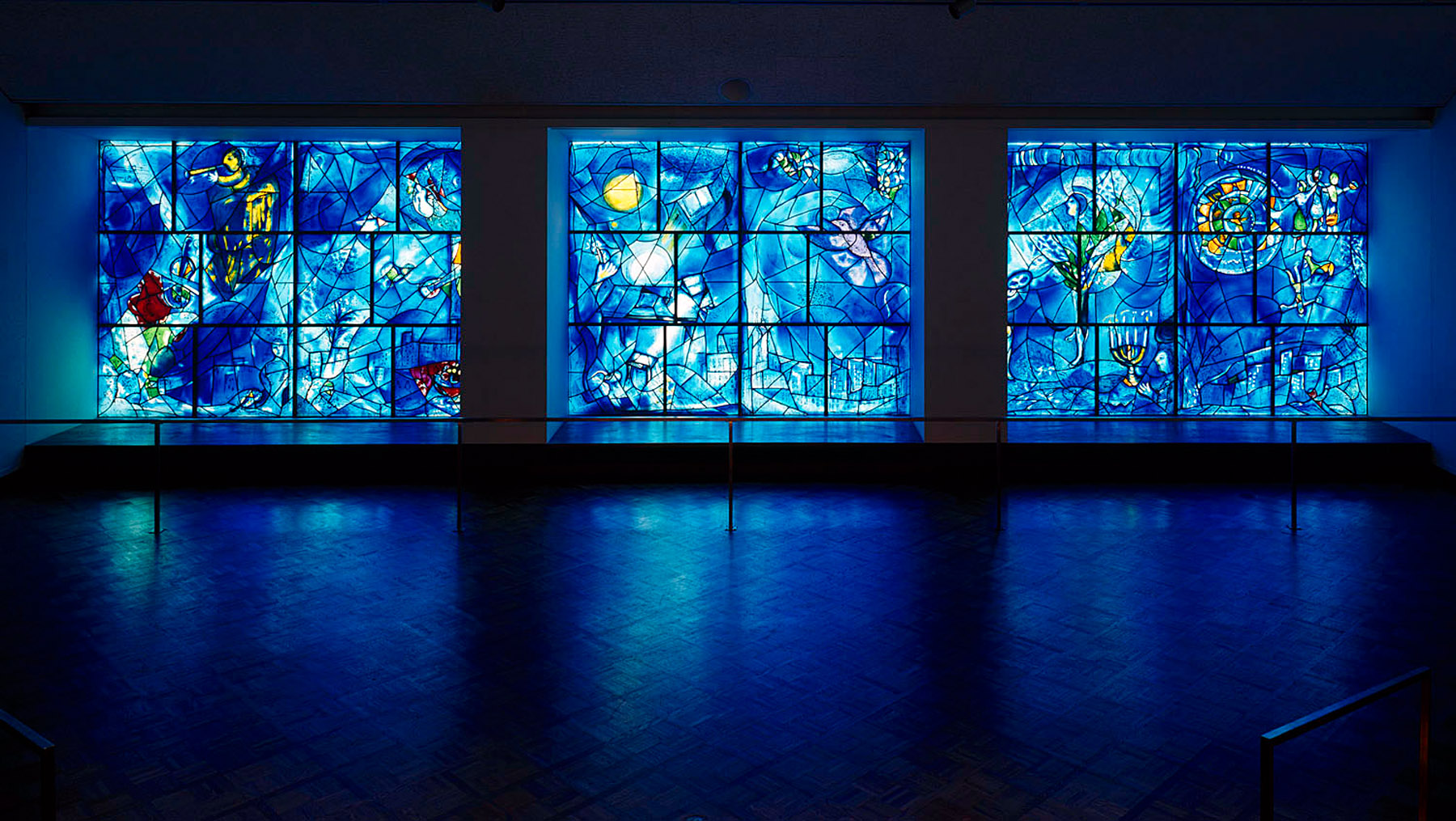
Marc Chagall  'America Windows'

Marc Chagall ‘America Windows’

I finally saw Marc Chagall’s ‘America Window.’ It’s at the Art Institute of Chicago and has long been on my must-experience list. It’s a long list! Unlike most bucket lists, my list cannot be contained in a bucket and I have no illusion that I will experience everything on the list before I die. It’s not possible to experience everything on my list in a single lifetime. I keep my list to remind myself that my life is both finite and that this life holds more miracles than any single life-bucket can contain. Finite lifespan nests within the infinite awe.

The Window provided me with an extraordinary perspective flip. When first approaching it I thought, “How spare!” It was breathtaking in color but seemed narratively sparse, like a Mark Rothko instead of a Marc Chagall. And then I stepped closer and the story of the Window began to emerge. An entire world opened for me. The longer I looked the more I saw. The more I saw the more I wanted to look. It was as if I was at first hypnotized and then drawn into the world of the Window. When I finally decided to leave, I walked several paces away and turned back for one more look. The world that had at first seemed spare was now too full to comprehend. I was seeing beyond my thinking.

What a great metaphor for the process of stepping into presence! It’s a process of moving from the conceptual to an experience. Our thinking, our relationship with language, requires us to generalize and a generality is always an abstraction. It is made up. For instance, right now, looking out my window, I see many “trees” and, in truth, I’m not seeing them at all. I’m seeing the abstract concept “tree” that I attach to many, many unique forms. I’m seeing what I expect to see. If I take the time to go outside and touch, smell and feel them, I see that each “tree” is vastly different than all the others. No two forms are ever the same. They are vastly different than my expectation. It is not until we take the time to move beyond our words that we regain our capacity to see.

Chagall, like all great artists, knew this. He knew that people need help seeing and that seeing is vastly different than looking. Vital life, dare I say the rich meaning of life, is available when we learn to see beyond our abstractions. Vital life (the infinite) dances in front of us all of the time. It is the role of the artist to help us move beyond our expectation and engage with the dance. The Window reminded me that sometimes we need only take the time to open our eyes and see.

Go here to get my latest book, The Seer: The Mind of the Entrepreneur, Artist, Visionary, title_pageSeeker, Learner, Leader, Creator…You.

For hard copies, go here

Learn To Laugh

Comedy is about other people’s pain. Wiley Coyote going off the cliff one more time is funny. The guy slipping on the banana peel is hysterical as long as you are not that guy. Humor is mostly a status drop for someone.

I’ve been writing and drawing a cartoon called FL!P for almost half a year now so I’m inadvertently making a study of what’s funny and what is not. Recently some acquaintances that know me from my coaching life took me to task because my comic strip seemed out of character. “It’s mean,” they said. “Yes.” I said. That is precisely why it is funny.

The strip is aimed at entrepreneurs and there is a need for a bit of levity in a world so steeped in self-interest and confusing agendas. In many traditions around the world the trickster is an integral part of worship. We are not meant to take our gods so seriously. The reverence is always found in the relationship and the realization that the godhead is in all of us. It is our flaws that take us closer to the creative. Worship is a relationship and a full relationship includes laughter, joy, play, as well as inner quiet and awe. Tricksters break rules and pull the blanket off of societies inequities. Tricksters help us see what we pretend not to see. The Emperor would still be strutting around naked if the trickster boy hadn’t spoken a truth that the rest of the village denied. Truth comes easier with laughter. I can tell you that there is much public prancing in the world of accelerators and incubators but very little real apparel. Humor is necessary in a landscape so rife with pretending.

Artists are often of necessity the tricksters of their culture. It is the artists’ job to open eyes to what is there (versus what we think is there). It is the artists’ job to bring the communal attention into the present, to slap-stop the puffed up importance of things that do not matter so that the things of real importance can be seen. With a 24 hour news cycle and a congress ruled by corporate dollars it is hard for us to sort out what is valuable and what is not. The narrative in the commons rarely reaches the level of significance. It is no wonder that many people confess to getting their news from John Stewart and Stephen Colbert (both heroes of mine).

The greatest lessons of my life did not come gently and I am all the more grateful for the force behind the learning. My lessons came with status drops and like Wiley Coyote I have gone more than once over the cliff with an anvil close behind. Comedy is mean. Learning requires falling down. Stepping into the unknown is potent because of the myriad of things to trip over. If you can’t laugh at the bungle you’ll miss the lesson.

897. Join me in inspiring truly powerful people. Each day I will add a new thought, story or idea to support your quest and mine.

For a humorous look at the wonderful world of innovation and new ventures, check out my new comic strip Fl!p and the gang at Fl!p Comics.

Swing

856. Join me in inspiring truly powerful people. Each day I will add a new thought, story or idea to support your quest and mine.

Sometimes I think the most amazing piece of art I create is the studio floor. While working on paintings my brushes dribble and spatter, charcoal is ground underfoot into a fine dust and swirled into the gesso drizzle. I rarely look down at the unintentional artwork that emerges under my feet but when I do I am awestruck. It is lively, spontaneous, child like, and free. My underfoot artwork is not labored, over-thought, or heavy with a too serious intention. It is emergent, ongoing and completely without limitation.

My underfoot artwork is vital because I am not in the way.

A few nights ago I confessed that the muse possessed me and I stapled a new canvas to the wall. In a fury of gesso madness, I coated the canvas so that it might stretch and ready itself to reveal its secrets. Today I put on a second coat of gesso and also managed to cover myself with more gesso than actually made it onto the canvas. This has always been true of me: it is nearly impossible for me to put paint on anything without getting equal amounts on myself. Roger used to say that I only needed to walk within ten feet of a can of paint in order to wear half of it. Too true! During the process of painting I am never aware of my personal transformation into canvas. It is only after the fact that I discover the spatter pattern on my shirt and pants and shoes. And, today, while following the spatter trail to my feet (no shoes where involved today), my eyes went to the floor! It was glorious.

Picasso famously said, “Every child is an artist. The problem is how to remain an artist once we grow up.” When we grow up we put down our big brushes, our spontaneity, our spirit of play and pick up our little inner critic, a need to impress others with our little brilliance, and the notion that “artist” is something you do. Adults forget that artistry is essentially curiosity in relationship with a moment. “Artist” is not a role, it is a way of being. What happens when you smear the paint simple to feel the smear, tear the paper for the sound, use vibrant orange to paint the broccoli tree against a purple streak that might be an indication of sky – or deep joy made manifest with the swipe of a brush. Every child knows that joy is purple today and another color tomorrow.

My underfoot artwork, now showing on the studio floor gallery, is the work of the inner child, the real artist. All of the critics say his work is vibrant, free, and alive. The artist is not concerned with the critics’ interpretation because he was distracted by the sun, left his brush unattended on the table, and went outside to swing. All the world is his studio and swinging is, after all, real work of the serious artist.

Share A Meal With Jakorda

803. Join me in inspiring truly powerful people. Each day I will add a new thought, story or idea to support your quest and mine.

Jakorda Rai sat behind me. His hands on either side of my head, he read my energy just as he’d read the other students who previously sat before him. Unlike the other students he did not progress to the second phase of diagnosis. Instead, he simply tapped me on my right shoulder and through a translator told me that nothing physically ailed me. My challenge was to open my story. As if to emphasize his diagnosis he tapped me again on the right shoulder and repeated his instruction. Open your story.

Later I would return to his house compound and participate in a ritual. He initiated me into his family temple. I became one of his family line. Only now am I understanding the import of that gesture, the gift that he gave me. The high priests brought me in to his temple and then Jakorda Rai sent me back into the world to open my story. Before I left his house compound he invited me to come back back. Through the translator he said, “Someday come back and share a meal with me.” I thought I’d be back within a few years. More than a decade has passed.

What does it mean to have an open story?

Artists – and by artists I mean all people who are conscious of their actions and choices – flourish when the emphasis in life is moved from “answer seeking” and placed on “question engagement” – the capacity to explore and engage, to sit solidly in uncertainty: that is the environment (and I think it is an internal environment) necessary for humans to flourish and fulfill their creative impulse.

I’ve posted these words before and decided to post them again. My dear friend Sam asked me to describe under what conditions an artist flourishes and this is what I wrote in response:

It is perhaps too simple but this is what I know and experience: the artist in me becomes present (it is all about presence; artistry is not something you do as much as something you are) – there is no past or future, just what is before me (and in me) in that moment and we are not separate: the poem or the painting or the story and I are one fluid thing. The world (my seeing) moves from nouns to verbs, from object focused to process focused. When I am present the environment, my seeing of my environment, comes “alive;” the colors are more intense, the sounds and textures of my space richer and clearer. I guess, in my artist self, there ceases to be a separation between me and my environment, I am not moving through a day, I am in the day. All concepts of “time” disappear. I am the creator, the creating, and the created.

This is what it means to have an open story. And now that I know, now that I am an open story, I remember that I am long over due to share a meal with Jakorda Rai.

Bring It

768. Join me in inspiring truly powerful people. Each day I will add a new thought, story or idea to support your quest and mine.

This afternoon I taught a Business of Theatre class at Cornish College for the Arts. The students were seniors in the final weeks of their degree programs. Their assignment was to make project pitches as if we, the class, were granters or investors. My job was to support them to get better at doing project pitches. Through the several pitches, two themes emerged that became the focus of our conversation.

The first theme: rather than pitch their ideas as great, almost all the students justified or somehow diminished their idea. They defended it prior to an attack.They were unconsciously seeking reinforcement or approval of their idea. Or, to be clear, they sought approval as if I was the keeper of worth for their idea. Had I said, “What a stupid idea,” they might have agreed with me. The need for my approval trumped their personal point of view. My approval was more important than their idea.

Theme number two is related to theme number one: they entered the relationship assuming that the granter (me) had all of the power. As pitch makers they cast themselves in an unbalanced, powerless position. They came as supplicants. They assumed that the grant maker held the golden key to open the door to their project/dream. In this play (a pitch is a play) they cast themselves as impotent.

Both themes were unconscious. Both were based on assumptions of lack.

Every artist, if they are to thrive, must reorient at some point in the arc of their career. They must leave behind orientating according to what they might get from the world and reorient according to what they bring to the world.

Grant makers, foundations, investors and auditors have no power over an artist – unless, of course, the artist is oriented in the relationship according to what they might get from the relationship. At best, a granter can support a route. They might open a pathway to fulfilling an idea. There are hundreds of routes. There is one dreamer. The responsibility for manifesting the dream is the dreamers not the granters.

No one need apologize for his or her dream. No one need justify why it is important. It is a dream. It is an idea. It is a desire. No one else need approve; the approval belongs to the dreamer.

The students and I discussed the power of bringing the dream to the world. We played with the perspective shift that happens when artists own the responsibility for their dreams and refuse to define their role as impotent. Bring the dream. Stop seeking your worth in the responses of others. Bring it. The granter will fund it or not and that should have no impact on whether the dream is pursued or not. Bring your best game. Bring it everyday. If you have a dream, create it. There are many routes. Explore them all and in each case pitch your best game.

Open The Door

748. Join me in inspiring truly powerful people. Each day I will add a new thought, story or idea to support your quest and mine.

“The artist vocation is to send light into the human heart.” George Sand

The first of the Four Noble Truths of Buddhism is that all of life is suffering. In this context the predicament of the artist is no different than that of a plumber or a president though I’ve yet to find a plumber who considers suffering necessary to his or her vocation. With artists (in the USA) suffering is central to the narrative. It is an expectation and seems to be a prerequisite. Why do artists think they need to suffer or believe that suffering unlocks the door to their artistry? It doesn’t.

Here are some conditions central to unlocking the door to artistry: curiosity, experimentation, exploration, discovery, passion, investigation, play, “What if…?”

We do not easily walk into our shadows. One of the roles of artist is to go where others choose not to go. A walk into the shadow may be uncomfortable but it is equally as liberating. An artist is supposed to see what others cannot and sometimes that is painful. An artist often acts as a bridge between worlds of perception, living on the edge of the village, translating the signs. As the god of transitions and boundaries, Hermes was of this ilk. He was also the protector of poets. Sometimes it is the role of the artist to travel into the netherworlds to retrieve a truth or a lost soul. Orpheus descended into the underworld to reclaim Eurydice. He did not trust so he lost what he most desired. His artistry was a gift of the gods. His suffering was from distrust of the gods’ gift.

At times artistry may be solitary or scary but it is always transforming. Always. An artist rarely “fits” the social norms but continually serves the health and growth of the community. Artists are transformational.

The coaching work I do with artists (myself included) often requires a stroll into this misguided ideal or expectation of suffering. What are the underlying assumptions that make suffering or madness an erroneous precondition for artistry? This is what I know: suffering is what happens when we ignore our innate artistry or smother our essential creative spark. Suffering is not a prerequisite to anything. Suffering is a sign that the artistic door is closed.

Find Your Voice

722. Join me in inspiring truly powerful people. Each day I will add a new thought, story or idea to support your quest and mine.

Yesterday I worked with teachers and students in an art cadre. We explored what it means to make art.

I am resistant to write, “We made art” because it implies that the “art” was a product, a thing separate from the process. It implies that the “doing” was incidental and the outcome was the thing called “art.” That notion is upside down. The art is not the outcome. The art is the process yet we have no language to correctly express it. What happened in our art cadre was essential. The students and teachers recognized that a great product requires a great process; the process is the essential.

We focused entirely on process because I know that students and teachers alike are all the time squeezed into demonstrating outcomes. They are forced to let go the primary in service to the secondary. Art teachers are generally under siege and always have to prove their value to school districts because school districts see “art” as an incidental. Consequently, art is often taught as a product and therefore not art. It is misunderstood as something non-essential.

There is an entire industry known as “self-help” dedicated to a single, simple impulse: the full expression of the self: how to give full voice to perceptions and ideas without impediment. In other words, how do we get out of our own way? This is a question of process and reachable through “art” when art is understood. Businesses invest fortunes to “brainstorm” new ideas, to see patterns and give form to new conceptions. Perception is the province of “art.” I hear whining from the glass towers of commerce: “Why aren’t schools producing self-directed, critical thinking workers?” Answer: dedicating the focus to outcomes and answer regurgitation (in other words, beat the art out of people) will always produce a hiring pool of anesthetized answer regurgitators. We get what we produce. Self-expression and critical thinking are sister skills. Quash one and we quell the other. Art would seem to be an essential skill for business.

One of the saddest moments of the day came after the cadre. Two teachers stayed to talk. They told me that they knew what they are doing to kids (yes…doing TO kids) is wrong. They are required to produce products. They believe that they have no voice in the matter. They told me that they agreed with everything we explored but must serve the product expectations of their district. I didn’t ask the question I wanted to ask. There seemed no point. I wandered when they would wake up and recognize that supporting a system that they knew to be harming kids was also taking a toll on their health and lives. Voice is not something other people give you. It is something that you have to agree to give away. Voicelessness is a terrible thing to exchange in order to follow a rule, especially if you do not believe in the premise of the rule.