Wash Your Spirit [on Two Artists Tuesday]

“Keep close to Nature’s heart…and break clear away, once in a while, climb a mountain or spend a week in the woods. Wash your spirit clean.” ~ John Muir

I did not know how badly my spirit needed a good washing until we were hiking the Ditch Trail. The aspen trees were just beyond their autumn peak so the mountainside popped with islands of orange and vibrant yellow. The only noise was the breeze murmuring through the trees, quaking the leaves. I literally felt the world of angry people drop away. I breathed deeply the air, the sun warmed me to the bone. The cleansing commenced. Silence of the mind.

Jim once told me that people go to the seashore to experience the eternal. The tides were coming and going long before your birth and will come and go long after you are gone. It puts everything into perspective.

The mountains are like that, too. They are perspective-givers. This week Horatio told me “This life is short so we better get out there and do what we want to do.” The mountains are in constant motion but our lifespans are too short to see the waves rising and falling. On our last day in Colorado, while climbing above timberline, I realized (again) that in my short life I have been less and less concerned with what I want to do and more and more interested in how I want to be. Standing at the edge of Lower Lost Man Lake with Kerri and Kirsten, a bitter wind watering my eyes, I wanted nothing more. The spirit washing continued.

Driving back to Wisconsin, we mused that our re-entry into the world of people would be difficult. It was nice to be out of the fighting and the lying and the aggression. It made me wonder how the mountains perceive us. Such a small creature steeped in a full-blown-delusion-story of having dominion over all things. “Hubris,” the mountain blinks and we are gone.

In the midst of our incessant search for value and meaning and achievement and worth and dominance, our bitter fight over whose story we will tell, the mountain issues an invitation. Come. Walk awhile. Exit the chatter and stand in this moment. What else do you seek?

read Kerri’s blog post about THE MOUNTAINS

Approach The Edge [on Two Artists Tuesday]

It was nearing sunset when we saw the signs for The Royal Gorge Bridge and decided to jump off the road and investigate. We knew the bridge would be closed but thought it might be a nice break to get out of the truck and walk along the canyon rim as the sun went down.

It was a great idea with this single caveat (and minor confession): I. AM. AFRAID. OF. HEIGHTS. Canyon rims are not the most comfortable places for someone like me, especially in waning light.

I grew up in Colorado and visited The Royal Gorge Bridge as a child. I remember stepping onto the world’s highest suspension bridge, grabbing my mother’s hand, and running. I’m sure my poor mother became kite-like as I raced us to the other side. I have no memory of how we got back across the bridge. I’m certain I was not teleported so I must have crawled on my belly or passed-out and been carried. I survived, that’s about as much as I can say of my previous Gorge experience.

We parked the truck in a picnic area and walked a trail to the rim. Kerri ran to the edge and began snapping pictures. I entered a full-blown existential crisis. High edges feel to me like they are alive; they are a force that pulls me toward them. I have to grab trees or wrap my arms around rocks to resist the force. Worst of all, when I see other people approach the edge, I feel the force pulling them, too. In me, it amplifies the yank toward the abyss.

While Kerri cooed and danced on the rim snapping brilliant photographs, I grimaced and writhed, bound myself to a tree and resisted the siren call of the void. I couldn’t help but think of Alex Honnold scrambling up the face of El Capitan without a rope. “Expand your comfort zone!” I chanted to myself as I watched Kerri, a famous stubber-of-her-toes, zip to-and-fro along the rocky ledge with nary a thought of falling over.

The sun dipped beneath the horizon. It was dark and time to go. Have I yet expressed how darkness compounds the pull of the rim? Edges that can’t be seen are yawning maws that view me as a tasty snack. I had to release my grip on the tree, turn my back to the dark hungry mouth, and pretend not to sprint for the safety of the truck.

That was amazing!” Kerri exclaimed as we hiked back up the trail. “I can’t wait to show you all the pictures!” She was invigorated.

Exhausted, I nodded my head. “Yes.” I stammered, happy to be alive. “That was truly amazing.”

read Kerri’s gorgeous blog post about TINY/VAST

Love The Bells [on Two Artists Tuesday]

A haiku from the road:

Maroon Bells and masks,

Autumn in Colorado,

The hills are on fire.

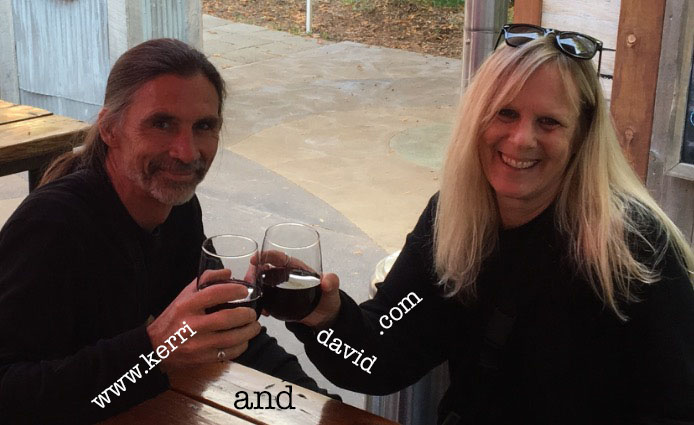
In 140 weeks of blogging together (5 days a week) this is the first prompt-image that we’ve posted of ourselves. It seemed fitting as we pause, visit family too long unseen, celebrate our anniversary, and ponder next steps.

read Kerri’s Two Artists Haiku

Define ALL [on Two Artists Tuesday]

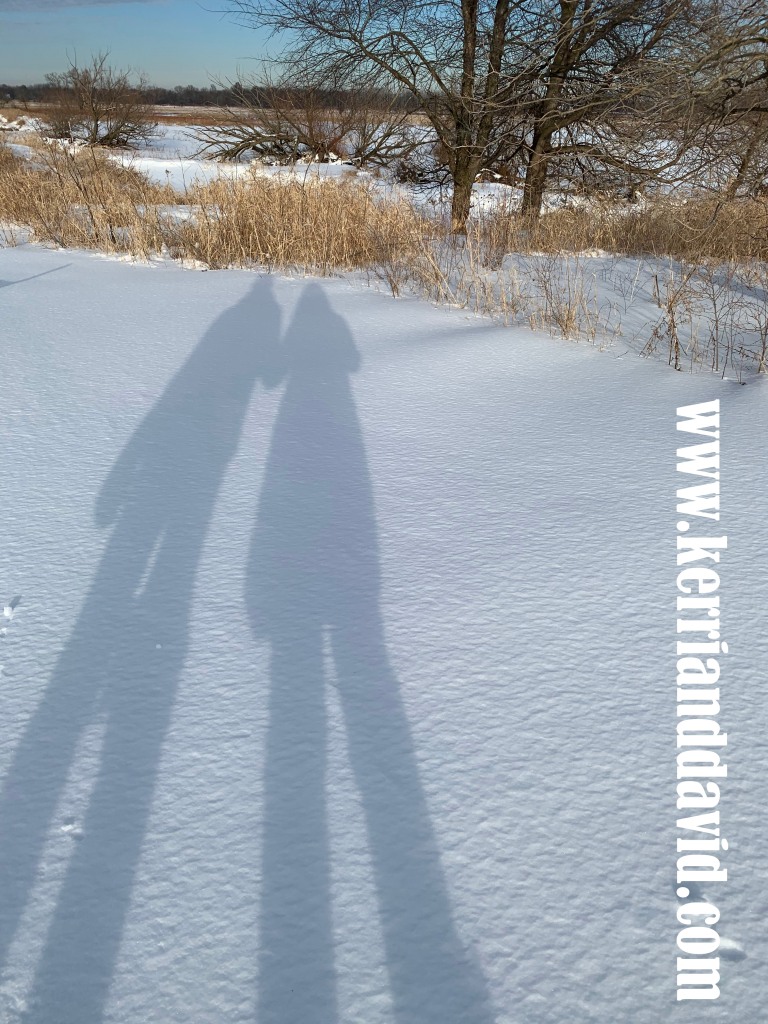
Kerri named this photo “peace shadow.” It brought to my mind a project begun by a group of artists in 2009, The Peace Shadow Project. They make and collect shadows all over the world. When the atomic bombs were dropped on Hiroshima and Nagasaki, the force of light released by the bombs burned shadows of people into the walls. As a way to enter a conversation about nuclear weapons and advocate for a nuclear weapons free world, the artists “burned” shadows of survivors – with strong light on photo paper – and displayed them all over the cities. Then, they asked people all over the world to send their shadows.

It’s what I love about artists. They (we) believe that art can transform consciousness. And so, a shadow might make us think of what we do, why we do it, how we do it. Pipe-dreamers all!

It made me ponder what art project I might offer these once-united-states. What might make us think? What could transform our consciousness so that we might occupy a single story, join together in a bigger identity?

I believe that all the many forces at play that ail us can be boiled down into a single word. ALL. We wrote this word in our documents of inception. “All men are created equal.” We have, since the beginning, wrestled with this word, ALL. Who does it include? Who does it exclude? BLM is the latest challenge to the word ALL.

The men that wrote the word ALL into our documents of inception meant white-land-holding-males. They believed that they were chosen, that their destiny was manifest, granted by god. By definition, when you believe yourself to be chosen, the word ALL becomes complex at best. It only applies with caveats.

Does ALL apply equally to women? What about black Americans? LGBTQ people? What about new immigrants? What about people who worship Allah? Or Shiva?

My art project would be the ALL project. I’m not sure what shadow might be burned or face might be photographed – what might be the art of the ALL project. I know that it would be intended to transform consciousness – to confront the forces of ugly exclusion. It would be meant to open doors not only of acceptance, but of belonging.

read Kerri’s blog post about PEACE SHADOW

Take A Peek [on Two Artists Tuesday]

We have two frogs in our pond this summer. Their names are Epic and Tiny. This is a photograph of Epic. He’s in his safe place. When Kerri took this picture she said, “This is how I feel most of the time.”

Each day, in writing this blog, I face a dilemma. I named my blog The Direction of Intention because I desire my writing and artistry (and life) to be conscious steps toward positive creation rather than pushing against and complaining about what I don’t want. Lately, that is a tight rope to walk. I no longer feel it is possible to peek out from my safe place because I doubt in these-once-united-states that there is a safe place. Lately, each day, it seems that pushing back, peeking from my rock and croaking, “Open your eyes,” IS taking conscious steps toward the creation of a healthy spirit, nation-body and world.

I’ve long been a believer that the deep imbalances in our system, like systemic racism, cannot change by focusing on the word “racism.” The change we seek, the safety we desire, will only come when we address this completely broken and ugly system that is composed upon layers of inequity. BLM is a pressure valve. It is an opportunity to look with clear and honest eyes at the favoritism designed into our system.

At the epicenter of our dysfunction is an apparatus that pretends to be a democracy but, in fact, throws its weight behind minority rule. For instance, if the popular vote of citizens actually elected the president, Ronald Reagan would have been the last Republican to occupy the White House [George W. Bush won the popular vote in his second term but initially gained the presidency after losing the popular vote to Al Gore]. Or, consider this: even though, since 1920, more Americans are urban dwellers, the electoral system throws its weight to rural (more conservative) voters. The electoral college ensures democracy will not prevail. It goes on and on. If you want a hysterical look at the hysterical gerrymandering of the American system, visit John Oliver here.

Why would a system that purports to be a democracy knowingly allow and continually enable unfair political advantage to a minority elite? Why would a political party work so hard to gerrymander electoral maps, prevent black and brown voters from voting, whip up with no evidence the notion that, if they lose, the election will be rigged? The advantage is blatantly apparent in our tax codes, in how we fund schools and fill prisons, an on and on and on.

The gap between who we are and who we pretend to be is vast.

The game is rigged. A thriving democracy is impossible when one team, the conservative elite, do not believe in nor support democratic processes. Winning at all cost, regardless of the cost, is a tool from the fascist toolbox. it is the opposite of the democratic ideal. What we are experiencing is not an accident. It is not a mistake. It is a design. A thriving democracy is impossible when the system is designed to be undemocratic [when you are done laughing with John Oliver, weep at Umberto Eco’s list of 14 common features of fascism].

In other news, upheaval makes systems change, real change, possible. Peeking out from my rock I can only hope that we-the-people, in this turbulent time, have both the will to show up at the polls AND the courage, resolve, and clarity to stick with it until we align our words with our actions, until we pull down the institutions that keep inequity and minority-rule the name of the game – until we expect our system and our elected leaders to actually believe in democracy.

It’s epic.

read Kerri’s blog post about EPIC

Become An Experiment [on Two Artists Tuesday]

Because we walk the streets of our neighborhood almost everyday we’ve inadvertently made a study of holiday decoration practices. “It’s too soon for Halloween!” we declare. “Look at that wreath! The colors are all wrong!” We are snotty decoration critics.

Among Kerri’s greatest holiday-decoration-pet-peeves is over-extended-Christmas decorations. “Don’t they know that Christmas is over!” she raves at the colored lights adorning the eaves. “Why do they still have a tree! It’s February! Santa is gone!” she howls to (almost) no one listening. We laugh at our mock-decoration-disdain. “We’re regular killjoys!”

This year we’ve had to check our derision. We’ve somehow joined the ranks of the eternally decorated. “Look at those people,” Kerri says of our house as we pull into the driveway, “don’t they know that they should take down their lights!”

It’s hard to know exactly how it started. A fall. Two broken wrists. The year began with disruption. One day we realized that the happy lights festooning the garland on the front rail had been burning for months. In an effort to evade our obvious hypocrisy, we agreed it was no longer a decoration but had become an experiment. How long will the happy lights last if we keep them plugged in 24/7? We took bets as hard proof just in case our neighbors looked at us with decoration-scorn.

“They’re still going,” we said throughout the spring, looking up and down the street to see if anyone was listening. “Who would have thought our experiment would last this long!” I’d loudly declare. Amazement set in sometime in July. “I’m going to write a letter to the company,” Kerri said. “They should know that their lights are really good!”

In the eighth month of our experiment, coming home after dark, we saw that half the strand was burned out. The next night the strand was completely dark. We stood on our front stoop and applauded the hardy happy lights before ceremonially taking them down.

“I suspect that the snotty couple that judges everyone’s decorations will be relieved,” I said. “The holiday is finally over.”

“I think they’ll miss them,” Kerri opined. “They made our house happy and, especially this year, who doesn’t need a happy house in their neighborhood.”

read Kerri’s blog post about HAPPY LIGHTS

Touch Nature [on Two Artists Tuesday]

“One touch of nature makes the whole world kin.” ― John Muir

Since we’ve exhausted every mountain climbing documentary ever made, we now end our days walking an epic trail. We’ve done some serious time on the Appalachian Trail, The Pacific Crest Trail, The Continental Divide Trail and, lately, our imaginary feet have, through the magic of hiker movies, walked every inch of the John Muir Trail.

In addition to our actual walks everyday, our end of evening film walks serve as our escape. It’s how we cope. Because my pals routinely tell me that they, like us, are exhausted or anxious or chronically unfocused, I’ve started the practice of asking them how they mentally get away amid the age of pandemic, social unrest, natural disaster, and pathological lie. My question is always met with a look (or sound) of surprise. Some read. Some play music. Some exercise. Some unplug from news and technology. All seek some time out-of-doors.

Mental get-a-way.

Hands in the dirt, feet on the path. The changing sky, getting caught in the rain or facing the sun, the smell of falling leaves or pine, those damn mosquitoes, cicada chorus, a hawk visitation…perspective givers, all.

Much of the madness chasing us through our days is nothing more than the horror story we unleash in our minds. Human beings are wildly creative and for proof look no further than the fear tales daily yammering through your thought. Amidst the presence of an actual pandemic, the imagination can let loose a full gallery of monsters.

We have legitimate monsters running rampant in our world. We also have imaginary monsters running roughshod in our brains. Sometimes it’s hard to distinguish between the two. Fortunately, there is a test that helps differentiate between them: the legitimate monsters, as a people (as human beings) we will always turn toward and face. The pandemic. Climate change. Injustice. The imaginary monsters we either run from or work hard to magnify. Ignore or amplify. Why is it that human beings argue so ardently for their fears?

The folks that deny the legitimate monsters have confused the legitimate monsters with the illusory. They believe the yuck that runs around in their minds is real. In order to validate the inner yuck requires an all out suppression of the actual threats like viruses, a warming globe, systemic racism. Conversely, dealing with the real challenges leaves no space for fantasy monsters like deep states and wild-hairy-democrats-drinking blood in under ground tunnels. That’s my theory.

A walk in the woods famously clears the mind of made-up-monsters. All of our devices and politics and power games seem silly when standing among the redwoods or on a beach with infinity breaking like waves and rushing the sand to meet your toes. There’s nothing like The Milky Way to make all those inner monsters seem trivial.

There’s nothing like cresting a mountain to affirm that we are – if nothing else – united in our smallness and passing lifetimes. It is only in our minds that we are possibly bigger than the mountain or more important than the seas.

read Kerri’s blog post about NATURE TRAIL

Give Light [on Two Artists Tuesday]

“What is to give light must endure burning.” ~ Viktor Frankel

We walked downtown a few days after the fires. We decided it was time to go see for ourselves what had happened in our town only a few blocks from our home. In truth, the sound of speeches ringing through the neighborhood drew us. We were already walking when we first heard them. We couldn’t understand what they were saying or where exactly they were coming from so we followed the sound. The amplified voices and cheering bounced off the buildings and sometimes seemed to be coming from all directions.

We followed the echo to the street that runs by the civic center. From a distance we could see the crowd. ACLU observers wearing blue vests roamed the area. There was a first aid center. Tables were manned to distribute water to the crowd. When we saw the burned out car lot Kerri took out her camera and began taking pictures. “Why did they burn this?” she asked. Yes. Why?

It is uniquely human to ask why. To need an explanation. We attempt to record and document. To gather evidence. All in the pursuit of sense-making. To find meaning. And, if no meaning is easily found, no readily graspable answer to “Why?” is available, it is among our greatest human powers to make it.

To make meaning. To find meaning.

Viktor Frankel, a survivor of Nazi concentration camps, asked “Why did some people survive and some not? He looked for an attribute that favored survival in such extreme, random and deadly conditions. He concluded that, after sheer luck, survival in the camps favored people who made meaning from their circumstance. The people who sought meaning from their circumstance soon lost hope. He wrote, “Everything can be taken from a man but one thing: the last of the human freedoms—to choose one’s attitude in any given set of circumstances, to choose one’s own way.”

On the hood of one of the burned out cars someone had stenciled this appeal: Let’s Be Better Humans. What might it take for us to be better humans?

When I was in elementary school great pains were taken to teach me how to be a good human and function in a civilized society. Wait for my turn. Open the door for someone with their hands full. Help where you can. Listen to others. Raise my hand before speaking. All of these simple lessons shared one thing in common, a specific organizing principle: consider others. Be considerate to others. Good humans are mindful and cooperative.

All of these simple lessons ran contrary to the rules I was taught about succeeding in the world: it’s dog-eat-dog. It’s a fierce competition. Do whatever it takes. In other words, it’s every man and woman for themselves. It’s just business.

So, like all of us, I’ve wrestled with the national schizophrenia: I can either be a good human and consider others or I can succeed. Not both. Said another way: in order to succeed I have to abandon my goodness.

As is the case with most either/or framing, it is a false choice. Money need not be absent of morality. Success can be the blossom of compassion.

It is important as we stand at this national crossroad, this opportunity for reckoning with our past, that we look at this polarity, that we step into the gaps between all of the false choices, black and white. Our troubles will not go away until we attempt to live our rhetoric, until we unpin white success from black subjugation. Equality of opportunity, equal justice, equal (fill in the blank) has not been afforded all members of our community. To be better humans we need to challenge our either/or false choices and instead walk toward a center that includes a full spectrum of color, choices and opportunities for all.

If we can find our center, if we can challenge our rhetoric, we just might find our path to being better humans living in healthy inclusive society. In the end, we may even come to the same conclusion as did Viktor Frankel: “I grasped the meaning of the greatest secret that human poetry and human thought and belief have to impart: The salvation of man is through love and in love.”

read Kerri’s blog post about BE BETTER HUMANS

See The Pattern [on Two Artists Tuesday]

guarding the sidewalk copy

“The United States, virtually a demilitarized nation on the eve of the Second World War, never stood down in the wake of victory. To this day, American troops are deployed in 150 countries. Since the 1970s, China has not once gone to war; the U.S. has not spent a day at peace. President Jimmy Carter recently noted that in its 242-year history, America has enjoyed only 16 years of peace, making it, as he wrote, “the most warlike nation in the history of the world.”’ ~ Wade Davis, The Unraveling of America

The most remarkable thing about these toy soldiers on a dish, is that a child did not place them in the garden. The adults did. People regularly place statues in their gardens, a Buddha or the Virgin Mary or gnomes or fairies. They are statements of value. They are statements of identity. Little guardians with powers no bigger than their guns.

In the words of Captain Obvious, the United States is rife with contradictions. In our sacred founding documents we wrote that “All men are created equal,” while simultaneously legislating that black men (and women) were less than human. It’s the crevasse we fall into again and again, our metaphoric original sin. The people currently protesting on the streets across this land simply want the rhetoric of the nation to align with the actions of the nation. Nothing more. Nothing less.

Today in Kenosha we await the unwelcome arrival of the commander-in-chief, a leader whose has only one note to pluck: division. The white nationalists are taking to the streets, waving their flags and chanting, “Four more years.”  For a nation comprised of immigrants from all over the planet, the world’s greatest crossroads, it seems more-than-absurd that anyone in this nation could or would revel in xenophobia. It’s astounding that the leader of a nation so rich in diversity would throw gasoline on the fires of racism. Contradiction upon contradiction. It’s farcical.

Or, perhaps it’s not contradiction at all. As Shakespeare wrote, “The truth will out.”

It shouldn’t be surprising that “the most warlike nation in the history of the world” is habitually at war with itself. The battle lines are as clear as the vast difference in the photographs comparing the Republican and Democrat members of the 116th Congress Members-Elect [scroll the article to see the photographs]. Ours is a war of identity and the dividing line runs along the color line. More Captain Obvious, I know [my apologies].

We do not have a problem, we have a pattern. And, to change our pattern of division and internal war, we need only take an honest look at the story we tell ourselves. The story we continue to tell ourselves about ourselves. We need to take a good honest look at who fits into the definition of “ourselves.” Right now we have two working definitions. And, that is our pattern. A pattern of conflicting definitions (inclusion vs. exclusion) works for some but is misery for most. Division by design.

Taking an honest look at ourselves is easily said. Even Captain Obvious is rolling his eyes!

The truth will out. It’s in our gardens. It’s in our statues. It’s in our streets. It’s on the images of brutality we capture on our iPhones. It’s in our tax codes and how we fund our schools and the children killed by guns while at school. It’s in our COVID-19 morbidity data and the populations of our prisons. The truth will out again and again and again until we decide to look at it with honesty, until we learn that our words matter, until we resolve to tell a different story, a story that lines up with our professed ideals. Until we decide that perpetual war is not a pattern that leads to social harmony and peace.

And, it’s a choice. Nothing more, Nothing less. Obviously.


read Kerri’s blog post about TOYS IN THE GARDEN


please vote website box copy


See It [on Two Artists Tuesday]

IMG_3933 copy

Systems do what systems are designed to do. For instance, this seawall is a simple system designed to protect one element (land) from the other (water). Left unchecked they come together and change occurs. This wall is a system built to prevent significant changes to the coastline.

Our system, relative to black and white Americans, as stated in the colonial records and enacted through legislation, was designed to keep the two groups from uniting. Division by design.

The law [the Virginia Slave Codes of 1705] was devised to establish a greater level of control over the rising African slave population of Virginia. It also served to socially segregate white colonists from black slaves making them disparate groups hindering their ability to unite. A unity of the commoners was a perceived fear of the Virginia aristocracy which had to be addressed, and who wished to prevent a repeat of events such asBacon’s Rebellion, occurring 29 years prior.” [Wikipedia, An act concerning Servants & Slaves]

A unity of commoners is to be feared. To that end, African Americans were determined through legislation to be less-than-human, three-fifths to be exact. No other group in our history have been institutionalized, bills debated and passed into colonial law, as sub-human.  When we see signs that read “Black Lives Matter” it speaks to a systemic definition, a system that to this day is doing what it was designed to do. African Americans simply want their two-fifths recognized and returned.

To match the denigration of black Americans, poor (non-land-owning) whites were given a promotion, new rights and status. “Many of the European-descended poor whites began to identify themselves, if not directly with the rich whites, certainly with being white. And here you get the emergence of this idea of a white race as a way to distinguish themselves from those dark-skinned people who they associate with perpetual slavery.” [Facing History & Ourselves]

The system only works if pushing the black head down is the mechanism that elevates the white head. The police are merely servants of the system. To redefine the police, through funding changes or otherwise, will not address the root of the pattern. The system will reinvent itself in another form because that is what systems do.

America has a pronoun problem. As I write this I am sitting in my smoke-filled house in Kenosha, Wisconsin. Downtown is burning in reaction to Jacob Blake’s shooting. A quick scroll through the Kenosha Facebook page and I read again and again this question, “What do they want?” THEY. Not a hint of WE to be found. The system is working perfectly to prevent the unity of commoners.

Yesterday, I wrote to my pal David that nothing has changed. I was in Los Angeles in 1991 during the Rodney King riots. I watched Los Angeles burn. Today I am watching the destruction of downtown Kenosha. To understand the violence of the response you need look no further than the violence present in the two videos. In a routine traffic stop, Rodney King was pulled from his car and beaten nearly to death. Jacob Blake, an unarmed black man, was shot seven times in the back. In a situation where no club was necessary, a black man was brutally beaten. In a situation where no gun was necessary, a black man was shot seven time in the back. Is the burning of the city more or less repugnant and out-of-proportion than the violence that incited the flames?

My point: The violence is already present. It is the seawall erected through law to prevent the two groups, black and white, from coming together. Slavery was violent. Jim Crow was violent. This latest iteration is, not surprisingly, violent. It’s how the system maintains itself. The form changes but they system remains constant. The violence prevents the unity of commoners.

Finally, consider this: “With the COVID crisis, 40 million Americans lost their jobs, and 3.3 million businesses shut down, including 41 percent of all black-owned enterprises. Black Americans, who significantly outnumber whites in federal prisons despite being but 13 percent of the population, are suffering shockingly high rates of morbidity and mortality, dying at nearly three times the rate of white Americans. The cardinal rule of American social policy — don’t let any ethnic group get below the blacks, or allow anyone to suffer more indignities — rang true even in a pandemic, as if the virus was taking its cues from American history.” [Wade Davis, The Unraveling Of America, RollingStone Magazine, 8.6.2020]

So, if you are one of the legion asking this question, “How can this be happening?” I suggest you ponder this: how could it not be happening. It’s by design.

If you are one of the many wondering what can be done, begin by paying attention to how YOU are participating in the design. And then, perhaps, all us can begin the difficult search to find a path to WE.


read Kerri’s blog post about the SEAWALL


? website box copy