Cut A New Path

ComfortNow

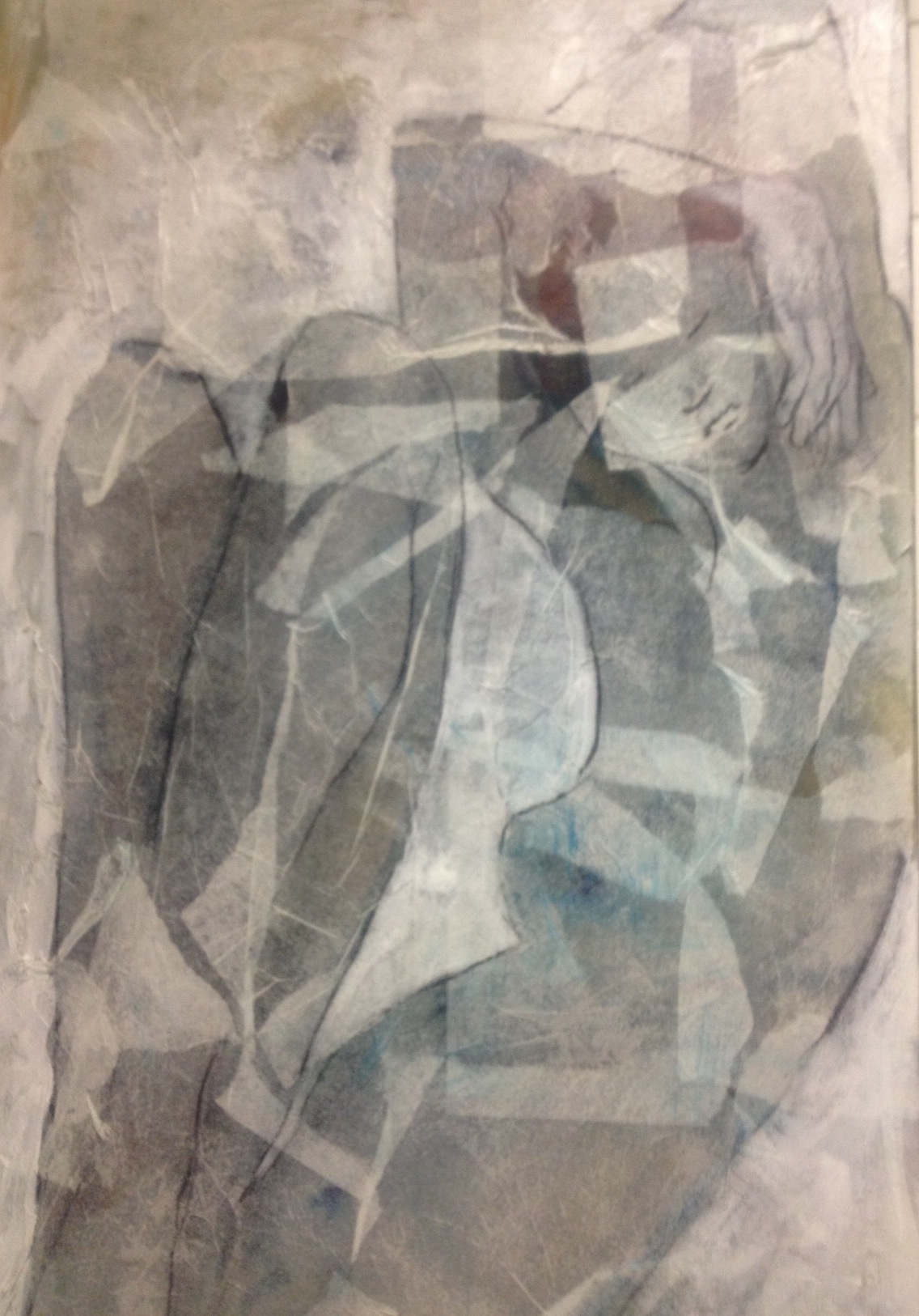
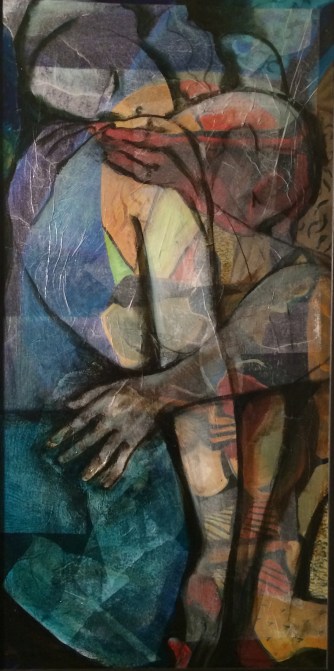
The latest in my Held In Grace series. This is Comfort Now

It seems to me that most of our days on this earth are spent moving through patterns, conscious or unconscious. These patterns are the rituals of our lives. Some of the rituals are easy to see. For instance, what is the sequence of actions you perform before going to bed each night? What about your ritual of rising each day? The care and feeding of Tripper Dog-Dog-Dog and Babycat are central to my rising and retreating rituals each day. We move through the same actions every morning and evening and I delight in the warmth of the ritual.

Some of the rituals are not so easy to see. Researchers tell us that most of the thoughts we think every day are the same thoughts we had yesterday. We mostly think in patterns (it makes sense once you recognize that language is constructed of category and pattern). We talk to ourselves, cutting paths through the forest of our minds and, once we’ve established a trail, we like to stay on it. Easy is often unconscious. There’s nothing wrong with staying on the easy trail if the path you’ve cut, your repetitious thought-ritual, is self-loving. The rub: ritual paths of self-loathing and self-limitation are also easy, well-worn paths and that makes them both unconscious and hard to leave.

Cutting a new path through the mind forest begins with recognizing that new paths are always available. They just aren’t easy to establish. They require new practices. They require surrender and the first bit of surrender necessary for cutting a new path is the ritual giving-over of needing-to-know-anything; new paths, by definition are unknown.

New paths are not comfortable precisely because they require attention, consciousness.

My teachers taught me that all stories worth telling are stories of transformation. The main character or characters will know something at the end of the story that they did not know at the beginning and the new knowledge will be hard-won. That’s what makes the story worth engaging. Hamlet is a much different character in Act 5 than he was in Act 1. His peace was difficult to come by. He had to learn to surrender. To cut a new path he had to make a practice of peace.

The same ideal applies to the stories we live off the stage.


Heed The Call

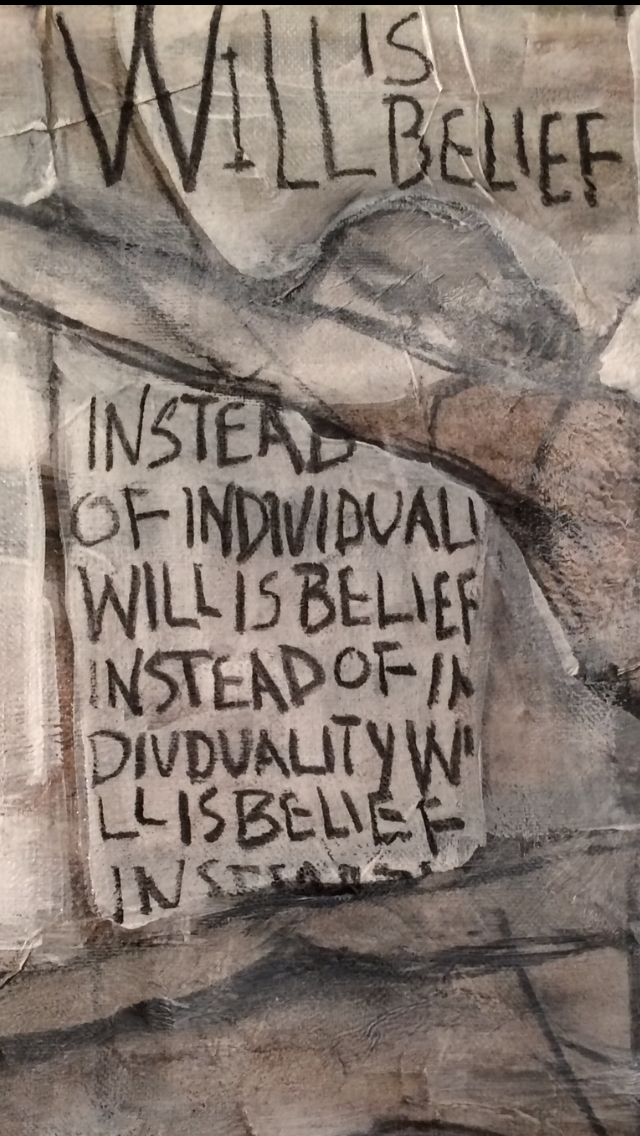
A detail from my painting, Will Is Belief

A detail from my painting, Will Is Belief

“It’s hard to explain to people,” said Chris. “I’m answering a calling. I know in my bones that I’m doing with my life exactly what I’m supposed to be doing. There is nothing else that gives me life. There is only this that I can give my life to. I don’t have a choice and that makes no sense to my family and friends.”

Chris is an artist, a brilliant actor. He acts because he needs to act and that is impossible to understand to those who’ve never had a soul-deep calling. It makes no sense to those witnessing the hardship his life path requires. His family and friends want him to have a better life. They want him to have a big home and two cars. They want him to have a back yard and a barbecue. What they can’t grasp is that Chris, like all artists with a calling, is acting from a selfless imperative. They aren’t doing it for themselves. They are not indulging an ego-need. They are, as Chris said, “creating to translate experiences for others.” Artists are meaning makers in a world that often makes no sense.

It is simple. Artists serve the force of unity in a world dedicated to the forces of division. And, that makes no sense.

Pastor Tom has a calling. He left a big salary career for the meager salary of a pastor because he could no longer ignore the inner voice demanding that he answer his call. It need not make sense because Pastor Tom can say that he answered God’s call. Chris’ calling is coming from the same source though, in our world, the connective tissue of his claim is not as easy to grasp.

Many people can draw, write, dance, act, sculpt, trumpet, and paint. A very few actually need to do it. They can do nothing else. Just as many people are capable of sermonizing and leading a church, it is the rare person who has to do it, who can do nothing else. Chris would wither if he did, as his elders suggest, leave his crazy pursuit and get a real job that pays real money and provides real stability. They do not know what Chris knows: stability has nothing to do with money or jobs that make sense.

Sense-making is a matter of the head. Chris is a servant of the heart.

There is a very powerful Hungarian film, called White God (though if you are a dog lover as I am you should probably steer clear). It is film about violence and suppression begetting nothing but more violence and suppression. It makes sense. In the final scene of the movie, when faced with a tide of horrific violence, a young girl pulls her trumpet from her backpack and begins to play. The beauty of her playing stops the unstoppable. It breaks the cycle of violence. It makes no sense: beauty has the power to extinguish violence.

Beauty has the capacity to unify a world dedicated to division and violence. This is what Chris’ call is all about. This is what he knows in his bones. It is the reason he gets on the stage for meager pay. It is the reason he spends his days going to endless auditions and producing plays on subway platforms and other places where few will ever stop and take notice. It is the reason a big backyard and sensible job make no sense. He is a servant to the power of beauty, the wonders of art, the necessity of illuminating unity amidst the madness of division. With this calling, all other paths are closed. They simply make no sense.

Go Slow

Our feet at Montauk

Our feet not rushing at Montauk


Years ago Quinn gave me a book by George Leonard called Mastery. I revisit it from time to time when I feel, as I do now, that I know nothing. In truth, the older I get, the more experiences I have, the more certain I become that I know nothing at all. If George Leonard was still living I imagine he would approve of my not knowing. “Finally, we are getting somewhere!” he might declare.

Here’s a bit from the book’s introduction:

“The many comments and inquiries that I continue to receive have convinced me more than ever that the quick-fix, fast-temporary-relief, bottom-line mentality doesn’t work in the long run, and is eventually destructive to the individual and the society. If there is any sure route to success and fulfillment in life, it is to be found in the long-term, essentially goalless process of mastery.”

Although in the quarter of a century since Mastery was published the pace of life has, if anything, shifted into hyper-drive, the truth of George Leonard’s assertion remains constant. Fulfillment is found in the long-term. It is found in the goalless processes like friendship or love or a walk in the woods. Fulfillment is a relationship and not an achievement. Learning is a relationship and not an achievement. Spirituality is a relationship and not an achievement. Artistry is a relationship and not an achievement.

All the things we think we know, the things we argue for or against, the righteous territories we claim, the belief flags we plant in the sand, the battle lines we draw, the hills we die on, the idea-wars we wage,.., make muddy the life crackling right before our eyes. After all, what do we really know?

On Sunday I witnessed a baptism. The next day I attended a funeral. These two back-to-back rituals left me with a question: What’s the rush?

I have absolutely no idea.

Be Clumsy

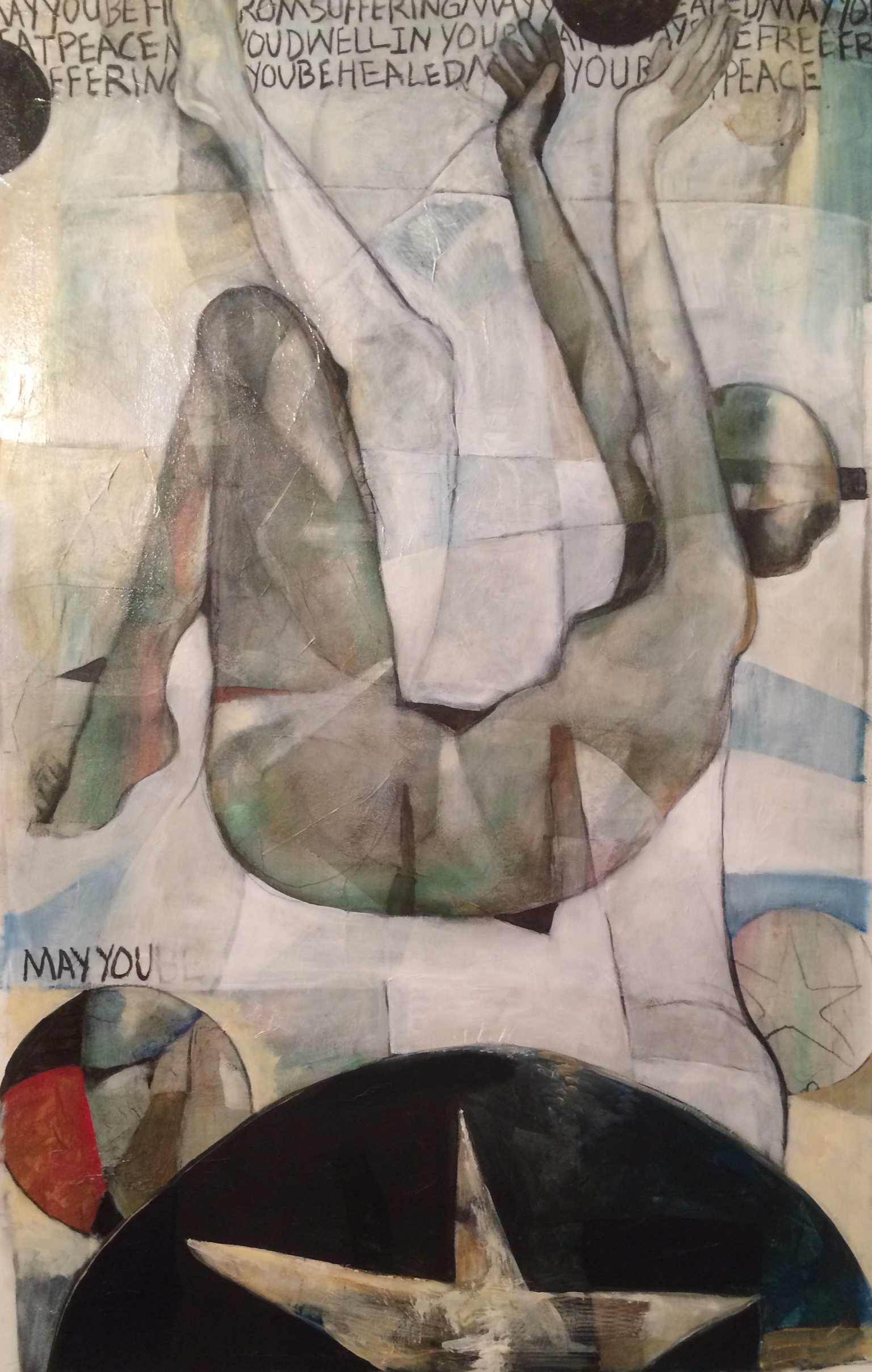
a detail of my painting, May You Be.

a detail of my painting, May You Be.

Clumsy (klum’ ze) adj. 1. lacking dexterity, grace or skill; awkward. 2. ungracefully shaped or made; unwieldy. 3. awkwardly or unskillfully said or done, ill-contrived.

“We don’t allow ourselves to be clumsy,” Kerri said. “Life is clumsy.”

Many years ago I read a commentary that suggested we moderns have a harder time of feeling good about ourselves than people of ages past. The argument went something like this: we have an impossibly high standard to meet and it is mostly illusory. For instance, our predecessors compared themselves and their successes against a relatively small village populace. We are swimming in pool that stretches around the earth. The athletes in our ancestral villages ran against their neighbors, the artists created for a specific purpose that served a tangible need in their community. Our young runners know to the hundreth-of-a-second what greatness requires. They run against the world. Our artists rarely know outside of their own inner imperative why they are creating. With no outer limit they spend a great deal of time wondering if their work has any impact or greater significance. With no outer limit it has no defined audience or community. Stephen, a gifted and prolific artist, used to ask, “Why don’t people recognize the value of art?”

The argument is largely a question of access. Our predecessors had limited and very abstract access to the news of the day, to the happenings beyond their region. We have a 24-hour global news cycle that comes to us on multiple devices that are designed to grab and keep our attention. It is not passive. On our multiple devices we are bombarded with images and messages of what we should look and feel like. Yet, almost all of the images populating our personal measuring stick are constructed. They are manipulated, retouched, powdered and Photoshopped. Legs are stretched. Wrinkles are removed. Sunsets are filtered. We measure ourselves against illusions.

Thus, intermediaries are everywhere. Interpreters abound. I rarely go into a gallery without a curator telling me why the work on the walls is important. The news of the day makes us the rope in a tug-of-war of interpretation.

Art, like life, like deep spirituality, requires direct engagement. It is made rich in the rough draft and the mistake. The broken road is interesting, vital. Learning is a process that takes time. It is messy. It is clumsy. It is not straight, paved, and has no road signs. And, it cannot be walked alone.

There is no forgiveness (of self or other) on the path of perfection; forgiveness is in short supply when the standard is both impossible to attain and an illusion. On the clumsy path, on the messy and muddy road, lives grace, generosity of spirit and deep forgiveness.

Clumsy (klum’ ze) adj. 1. Human

May You Be

May You Be


Put Down The Hammer

photo-3[continued from BE WE]

The woman behind the counter at Starbucks, someone I’d never seen before, leaned forward, and chirped, “David! I loved your wedding!” She laughed at the look of confusion that must have crossed my face and added, “No, you don’t know me.” One of our invited guests brought her as a date. “Best wedding ever!” she exclaimed as Kerri joined us. Because the day is a blur, Kerri and I enjoy hearing people’s accounts of our wedding day and she enthusiastically told us of her experiences. It was nice. It was personal.

We took our coffee to a table and joined some friends. After a few moments, the woman behind the counter came to our table. She brought some samples, some health supplements and cosmetic products, “I only do this Starbucks job for the health insurance,” she said, “This is really my business,” she said, sliding the tiny packages in front of Kerri. “You never know who might be interested,” she chirped and blushed before making an exit. It was awkward. It felt awful. We went from personal to prospect in one inelegant step.

There is an old saying that came to mind: When the only tool you have in your box is a hammer, everything looks like a nail.

Many years ago, in a time of great financial desperation, I worked with some financial folks who recruited me to sell their stuff. I learned their processes, got my licenses in record time, and for a few horrid months, tried to sell their wares. I hated it. The work was highly profitable but the cost was highly destructive. Everyone looked like a prospect. To every social encounter, every friendship, every casual meeting, I brought an agenda. For a few months I looked through a lens that made every person, every circumstance, a commodity-opportunity. It reduced life (my life) to an ugly basic. It was toxic. Anna taught me the very appropriate word for what I felt: vampiring. It was a great lesson. It made me pay attention to the intention I bring to my life.

It’s what the woman at Starbucks felt, too. She was desperate. She, like a former version of me, sold the greater need to satisfy the lesser. Vampires are insatiable and stuck in an untenable lifeless-lens: everyone looks like a food source. Desperation is like that. It is easy when desperate to sacrifice friendships for prospecting. No one likes to be a food source.

As I perused this years bountiful crop of ugly images of Americans fighting and crushing each other for cheap toys and electronics, the annual product-stampede/people-crush-and-fist-fight on Black Friday (formerly known as Thanksgiving), I couldn’t help but think about the Starbucks lady. Desperation wears many masks but always makes others look less-than-human. Communities thrive when they feed each other and die when they feed on each other. This is not a mystery.

Commodity is supposed to service community, not the other way around. Vampiring is the only visible path when community loses itself to commodity; it inadvertently tosses away its many tools and leaves itself with only a hammer. It’s a question of order as much as a question of values. There is nothing wrong with commodity when the order of value is respected. Without a WE there can only be a very confused, desperate, and lonely I. It should not come as a surprise that desperate and lonely people do desperate and lonely things.

This is the season of the return of the light. We need do nothing more to create the miracle than put down the hammer and look at others as if they are more than nails.

[to be continued]

Be We.

a detail of And Now.

a detail of And Now.

“We need to create this together,” I said. We were discussing a project, a collaboration. 20 whipped out his phone and began searching frantically for something.

“What are you doing?” I laughed.

“Ah,” he said, “Here it is.” He smiled and read to me a definition of the word, ‘we.’ “You and I,” he read, “I and another.” He chuckled, adding, “Oh, I’m not sure I like that word.”

We. It’s a little big word.

At dinner the other night, Brad asked, “Now that you are married does your relationship feel any different?” Kerri and I both smiled. Yes. There is something bigger than ‘you and me.’ It’s hard to explain the change except to say that there is now a ‘we,’ a relationship that takes precedence over any single individual concern.

I was married many years ago and now know why things didn’t work out. We’d established our relationship on the sandy foundation of a bargain: I’ll help you if you help me. Bargains like that do not sound so bad until trouble comes. Bargains are predicated on what you get from the relationship. Marriages, I’ve learned, are built upon what you bring to the relationship. In a bargain there is no ‘we.’

Yesterday Skip and I talked about art (among many other things). It’s been my experience that art happens in the ‘WE’ space. Actors have to bring their gifts in service to the play. In fact, they cannot fulfill their gifts unless they are in service to something bigger than themselves. A self-serving actor essentially locks the audience out of the play; WE is not possible when an actor is oriented to what he or she can get from the experience. Magic happens when an actor is oriented according to what they bring to the experience. It’s the tragic misconception of art in these United States: art is not about self-expression; art, when properly understood, is the creation of WE.

another detail of And Now

another detail of And Now

A few weeks ago we watched a movie, Always, and this line (not a direct quote) jumped out and smacked me on the head: to gain your freedom you first must give it away. Gifts are not fulfilled unless they are given. People are not fulfilled until they give themselves to WE.

[to be continued]

Create A Purpose

photo-2In the sixteenth hour of our drive to the mountains, to keep us awake, Kerri and I began a rousing game of This-or-That. “Frosted Flakes or Lucky Charms?” Frosted Flakes all the way; those little marshmallow things get wonky in the milk. It’s amazing what you learn about yourself and others when the world of infinite possibilities is reduced to two choices. The game soon escalated to the impossible with pairings like “Coffee or Chocolate?” Real life penetrates the game when the only possible answers are, “It depends!” or “Both!”

Since our drive to the mountains I’ve been paying attention to how often people unwittingly play the This-or-That game, pretending that there are only two choices and, further, pretending that the choices are distinct and knowable. Democrat or Republican? Communities collapse when they forget that the important stuff is unanswerable. The important stuff is a moving target and requires conversation, debate, and comes along with multiple points of view. Two sizes do not fit all bodies.

I’ve also been playing my own inner game of This-or-That, purposefully choosing impossible pairings. Order or Chaos? It seems like a no-brainer until you dive in a bit deeper.

My favorite version so far is the Purpose-of-Life category. I picked a most lofty purpose: Illumination – and matched it with the utter absence of purpose. And, of course, I came to, “It depends!” or “Both!” I sprang my line of reasoning on Kerri (she thought we were going to talk about what to make for breakfast. She’s grown quite used to my surprise topics so she rolled her eyes, sipped coffee, and listened, knowing that no breakfast choice would be possible until after I unpacked my game).

No matter which spiritual tradition I read, the final point seems to be presence (living fully – aware of your moments). And in practice, presence becomes possible when thought is either transcended (meditation) or focused (prayer). Meditation and prayer are both purpose-full. Thought needs transcending and/or focus because it is mostly a babbling brook of nonsense or, better, a brook of babbling nonsense. It’s a lot of made up stuff that often takes the form of a game called This-or-That (I win/I lose, I’m right/I’m wrong, Us/Them). The game, as is true of all forms of interpretation, gets in the way of direct experience. It interrupts presence.

Detach from the babble. Meditate. Or recognize that it’s all made up and focus what’s made up. Pray. In either case presence comes through the recognition that it is all made up. The hitch: every notion of purpose, then, is also made up. There isn’t one. But, having a purpose is required to come to the recognition that there is no purpose. It’s a loop. It’s all creativity. It’s all imagination.

Spectrums and polarities are often cycles in disguise. They are both/and. They are yin and yang (not Yin or Yang). Illumination or Purposelessness? It depends. Both. Order needs chaos just as much as chaos needs order. The question is, what do we want to create? Why, a purpose, of course! So, let’s see what’s needed and decide to address it.

“My imagined purpose is breakfast,” Kerri sighed at the end of my rambling dissertation. “Pancakes or an egg scramble?”


Change Your Focus

a watercolor from 2003, House On Fire

a watercolor from 2003, House On Fire

Life can change in an instant. There are collective moments. There are personal moments. For years, my dad kept articles about the conspiracy theories swirling around the Kennedy assassination. It was the moment that marked the end of things as he knew it. Life would never be the same. For many years I shared his fascination because my first memory is an image from John F. Kennedy’s funeral which we watched on black and white television: a soldier leading a horse with empty boots reversed in the stirrups. I suspect that the image was potent for me because it was potent for the adults caring for me as they watched the funeral of the president.

Many years later, on a beautiful September morning in 2001, I sat in front of another television set and watched the Twin Towers fall. I thought, “Life will never be the same.”

With the recent anniversary of that day, on another beautiful September morning, Kerri and I read aloud to each other a book, 102 MINUTES: The Untold Story of the Fight To Survive Inside the Twin Towers. I was surprised by my reaction to the book. It felt a return to the place where we got lost. Like my dad, I missed the innocence that vanished in a single day (doesn’t each generation experience this loss? I imagine my grandfather yearned for a world before the atom bomb).

Throughout the reading, two potent and related metaphors would not let me go. First, a two-part metaphor for what I believe ails our nation. With a hyper focus on profitability, many long standing high rise safety precautions were minimized in the Towers. Less escape stairs meant more rentable space. Structural fire prevention measures are costly so they were either written out of the code or ignored. No one believed these twin Titanics could fail and when they did, the greatly reduced escape routes were either severed by the planes that hit them or were inadequate to accommodate the evacuation of the buildings. Additionally, communication between the police and fire departments was broken – they had the capacity but lacked the will. They did not use their updated systems because they were fighting over who would be in control. Their polarization crippled them on the day that they most needed to communicate.

So, the metaphor. One of the themes of my life (and, therefore, this blog) is the importance and necessity of a conscious placement of focus. Where you focus matters. Focus is a creative act. Our hyper focus on profitability took down the world’s economy in 2008. We’ve deregulated our financial institutions, removing all the safety precautions so that we might, as my pals in the financials services once told me, “Print money from nothing.” And the structure weakens. The wealth of the nation is in the hands of a shrinking few even though, as I learned in Economics 101, a healthy capitalist system is built upon a healthy middle class. No one believes this Titanic can sink. Communication between those who are supposed to be looking out for our safety, The House, The Congress, etc., are famously polarized. They have the capacity but lack the will and do not exercise their communication in the fight over who will be in control. In the meantime, we need them to communicate; waiting until the Tower falls will be too late to start. Our focus is on the wrong stuff.

 A sketch working out some details for House On Fire

A sketch working out some details for House On Fire

Which, brings me to metaphor number 2. This is the metaphor that cures us. The other story of those 102 Minutes is a story of kindness. People reaching for other people. When the disaster struck, the gap between custodian and CEO disappeared. The social divisions were irrelevant. People helped people simply because they needed it. They recognized that they were living a common story, a shared story, not the story of division that predominated a single moment before the planes struck the buildings. Everything changed in a moment. Or, perhaps everything became clear. People died to help other people. Their focus changed.


Laugh More

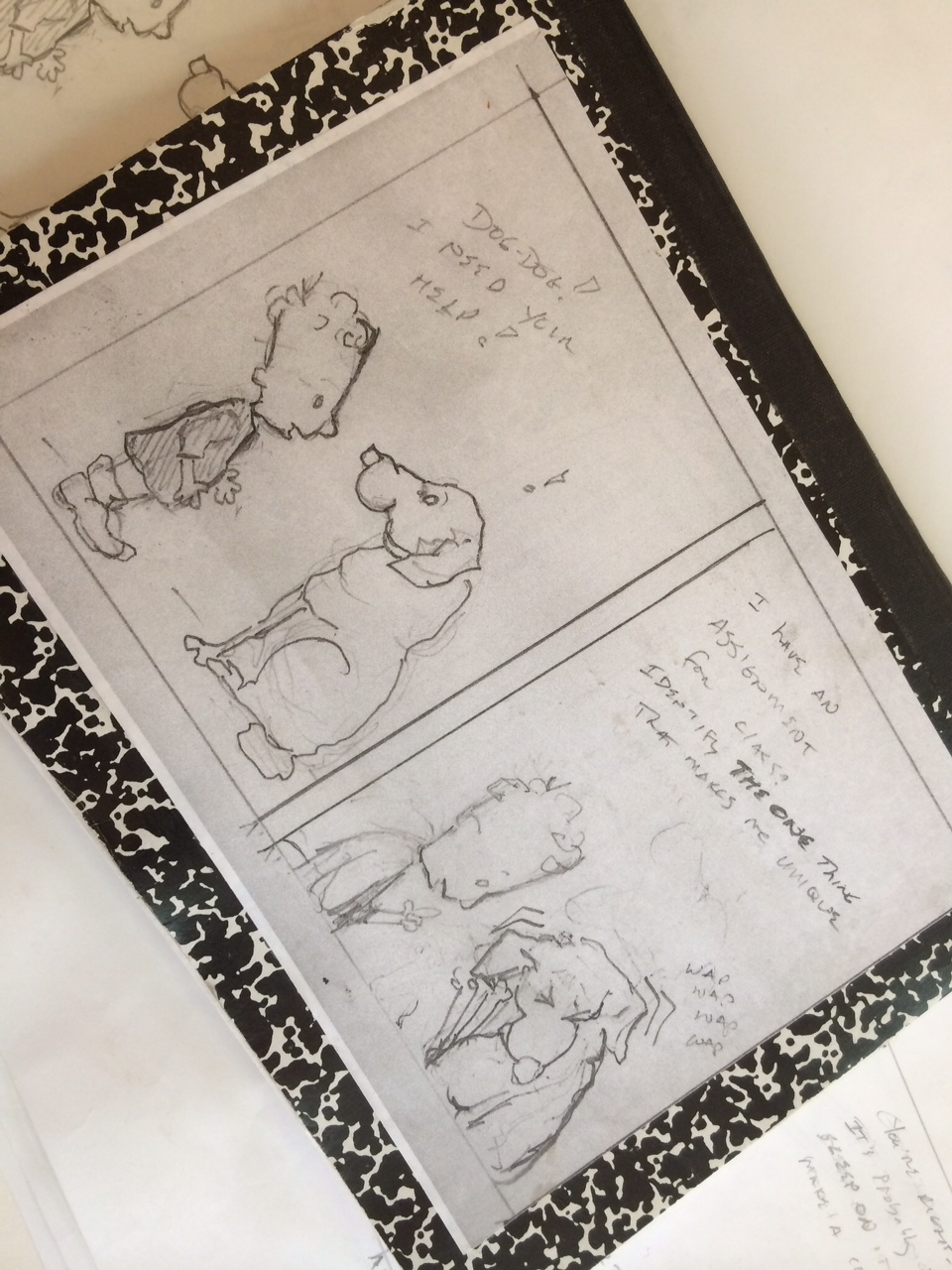
my idea book for our coming-soon cartoon, Chicken Marsala

my idea book for our coming-soon cartoon, Chicken Marsala

There is laughter coming from the next room. Across the way, a woman bursts into tears and a man with a ponytail leads her away from a group. They whisper. He tries to calm her. He makes her laugh. She wipes her eyes and they walk back to the group and all act as if nothing had happened. And, maybe nothing did happen. I am too far away to know the circumstances of her tears. I know the circumstances of her laughter.

Today it rained. I sat at my drafting table and worked on a cartoon strip. Tripper Dog-Dog-Dog sat at my feet. For the first time in over two years I streamed NPR and listened to the day’s news and some other stories. There was a story of a hunger strike in Chicago over the closure of a school. There was a story on public figures and apologies. There was an age-old story of the division in congress. I felt the same way listening to the news as I just felt watching the woman in tears. I am too far away to know the circumstances. I am too far away to know with certainty the truth of any of it. I’ve developed a healthy distrust of news reports. All I know with certainty is that truth is relative, truth is a point of view. I inked my drawings and listened as I might listen to a book-on-tape.

There is more laughter. It is coming from a meeting. I find comfort knowing that a committee in charge of anything can laugh. I hope that they are laughing at themselves.

Ann once told me that they key to success was to find a need and fill it. This world seems to have no shortage of needs. It does seem to have a shortage of laughter.

Recently, David shared with me his thoughts of Plato’s analogy of the cave. Perception as projection. It’s all shadows. Once I watched a Balinese shadow puppet master perform. The performances always take place in the outer ring of the temple and are meant to remind people that what they see in this life is a shadow, a projection merely. One of the messages: we are too far away to know Truth. Another message: our projections are worthy of our laughter and not much else. The puppet master had us rolling on the ground. His characters were mostly tricksters, stooges, and in their over-serious pursuits they were hysterical in their folly. Another message, perhaps the most important: the quickest route to the divine, to the connective tissue, is through laughter.


Answer The Question With A Question

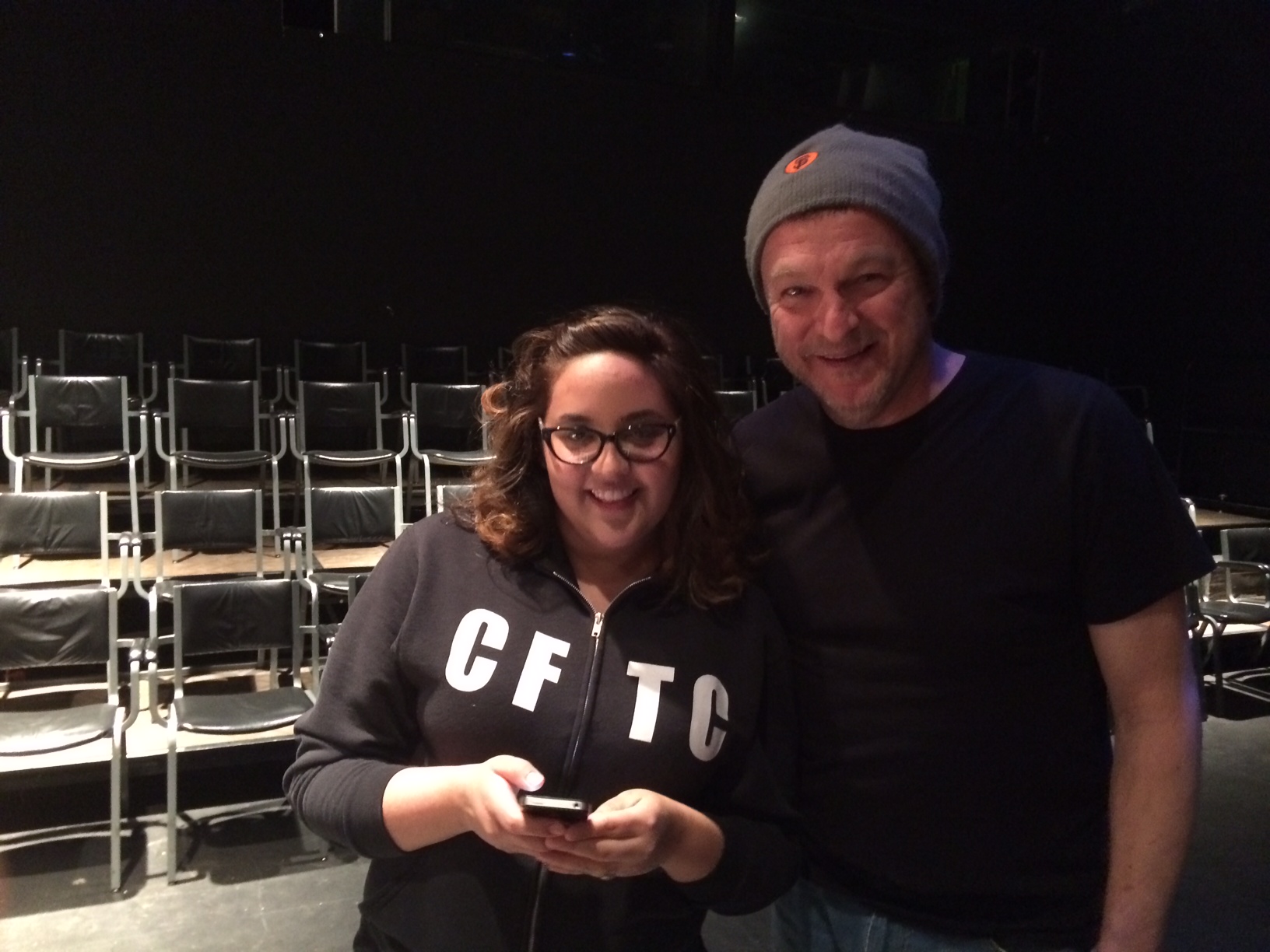
carrying on the tradition (and my heroes): mike and sabrina bartram

carrying on the tradition (and my heroes): mike and sabrina bartram at Changing Faces Theatre Company

Many years ago at the start of my career I bumbled into running a summer theatre company. It would become one of the great gifts of my life. At the time I decided that it would be my laboratory. I’d be able to experiment with directing processes and actor training techniques. What I didn’t realize until much later was that I would also be running an experiment in business and, more importantly, how to create a community mindset of support and empowerment (and, therefore, achievement). I was free to succeed because I gave myself permission to focus on the quality of the process instead of worrying about hard and abstract words like ‘achievement.’ My bottom line was the inner growth of everyone in the company, the inner growth of the community that we served.

When the company was up and running, when it was mature, company members swept the parking lot because they knew it would make the play better (improving the audience experience always impacts the performance). The people running the box office prided themselves on their kind service and efficiency because they knew that it would make the play better. The actors understood that they were in service to the play and not themselves. In fact, everyone in the company was in service to something bigger than themselves. That was the culture of the company. When pushed to articulate the success of what we created together, I’d say, “We’re focusing on the important stuff.”

Yesterday with great intention I sent that phrase (focus on the important stuff) out into the e-stratosphere. I lobbed it in association with the company that Kerri and I are in the process of creating to see what would come back at me. Like the summer theatre company, this new venture is our laboratory. What came back was the question, “What’s the important stuff?”

Sometimes the only way to answer a question is with another question. Take a look around your world. Take a moment to look at the difference between what you say and what you do. What do you see? What do you want to see? Big power comes to people when, like my company members (students) of so long ago, they realize that their “seeing” isn’t passive. The greatest single power any human being has is to choose where they place their focus. The greatest single revelation any human being has is to recognize that what they see impacts everyone around them. No one does this walk alone.

the very first painting in the Yoga series. It was an experiment, a walk of discovery. It's also about being alone

the very first painting in the Yoga series. It was an experiment, a walk of discovery. It’s also about being alone.

It’s easy to place a focus on an obstacle. It’s very easy to fix a gaze on the problems. It’s easy because, left alone, believing we are alone, that’s where most people default. Place yourself in a community that knows there is something bigger, something more important to see and serve, and the field of possibilities becomes easy. My company members of so long ago didn’t know what they couldn’t do so they did everything they imagined. That was only possible because they imagined it together. So, answering a question with a question, to you, what’s the important stuff?