Give Yourself Some Advice (2)

Finishing a painting is really about having a conversation with yourself. This one is talking!

Finishing a painting is really about having a conversation with yourself. This one is talking!

[continued from Give Yourself Some Advice]

Here’s the next bit of an email Horatio sent to me with his Advice To Myself. He wrote it following a question from a reporter about advice he’d give to emerging filmmakers. I am particularly fond of this section as many of my teachers, mentors, and guides are now passing away and I am revisiting what is mine to add to this “ancient conversation.” Here is the next section of Horatio’s advice to himself (for the full text, visit his blog at www.fidalgofilms.com):

Respect the boundaries of others; do not seek to control anyone else. You can only control your own choices.

Learn and honor with absolute integrity your own boundaries so that others may not try to control you or your work. Unfortunately, this is usually only learned through a certain amount of trial and error. 

Learning to trust is an art, and absolutely necessary. Learn to trust yourself first. Learn to trust others.

Always respect the tradition of your work, its ancient human conversation.

Connect to tradition, to all your teachers and your teachers’ teachers. Give yourself to it so that it can give to you and to your work. Honor it with rigor and doubt, with hours and hours of study and practice.

Then let your teachers go, follow the path that you understand as truth. You will know it when you see it. It will be your part of the ancient conversation. Likely, you will find that parts of one or two of your teachers have become part of you.

If you do not let your teachers go, your part of the ancient conversation will not be yours, but rather what you think other people want you to add to the conversation. That is not from you and only clogs up the conversation.

[to be continued]

Horatio asks great questions: What is the tradition that you carry forward? I follow the line of Tom and Marcia McKenzie, who learned from DeMarcus Brown, who learned from Eva Le Gallienne, who learned from…. What teachers/teaching do you need to let go?

Go here to get my latest book, The Seer: The Mind of the Entrepreneur, Artist, Visionary, title_pageSeeker, Learner, Leader, Creator…You.

Or, go here for hard copies (Amazon)


Give Yourself Some Advice

Horatio as a young man

Horatio as a young man

A few days ago I received an email from Horatio. He is an amazing filmmaker and gifted visual artist. We’ve wiled hours and days away talking about art and acting. He’s a treasure. His email was advice that he wrote to himself, the artist (what a great idea!) and with his permission, over the next three days, I will share it in segments. If you are impatient and want to read ahead, visit his blog or take a gander at his work at www.fidalgofilms.com. Here’s his email with the first portion of his Advice To Myself:

The evening after screening The Bath at Taos Shortz Film Festival in March, 2014, a very adept interviewer with the wonderful name Tamara Stackpoole (straight from Downton Abbey or Jane Austen?) asked if I had any advice to emerging filmmakers. My answer, as I recall:

“Let your teachers go. Just tell your own truth. Learn the craft – setup and payoff, three-act structure, and so on – and learn it well. But then let it go and tell your own truth, your vision. You’ll know it when you see it.”

When I woke the next morning, I realized that I had a lot more to say, and that it amounted to advice to myself. It follows:

You only can control yourself, which means your choices. You cannot control anything else.

Choose ethically, you will regret anything else.

The foundation of ethics is to respect others. Treat others as you wish to be treated. Be humble. Pride is the foundation of all the deadly sins, according to Dante and his mentor Virgil.

Your work is the essential ingredient of your life, an expression of your choices, your ethics. 

Connection to others is the essential mechanism of ethics.

A reciprocal connection of human to human (parent/child, student/teacher, artist/audience, friend/friend, or lover/lover) is the basic means to give yourself to others and to receive from them, to further yourself and others.

You will always be learning and practicing that kind of connection. You will never be finished. 

[to be continued]

Prompted by Horatio’s inspiration, I’ve started writing my version of Advice To Myself. It’s a great exercise and amounts to yanking the blankets on what matters to you. It begs the question: what will be your legacy? What might you write to yourself?

Go here to get my latest book, The Seer: The Mind of the Entrepreneur, Artist, Visionary, title_pageSeeker, Learner, Leader, Creator…You.

Or, go here for hard copies.

Be A Team

can you see the team boosting the child? I have many of these and will soon begin intentionally pursuing this form

can you see the team boosting the child? I have many of these and will soon begin intentionally pursuing this form

Many years ago Judy gave me a book by African writer Malidoma Some. He wrote that, in the village where he grew up, there were no locks on the doors. In fact, there were no doors. The people of the community respected the possessions and privacy of others. Locks were not necessary. The community cared for the health of its members so its members cared for the health of the community. From his point of view, a society that needs locks on the doors is a sick society. Locks are sign of communal breakdown.

I’ve been thinking much about sickness and the need for locks as I prepare to do a workshop for organizations about effective teams. I’ve done too many of these workshops not to recognize that the need to build teams is a sure sign of an unhealthy community. In Malidoma Some’s community, people were aware of and acted from a consideration of the health of the whole. Loyalty begets loyalty. “Acting for the good of the whole” is a great working definition for a team. It’s all you need to know to nurture great teams: make sure everyone in the organization, from the top to the bottom, is caring for the health of all the members. Make sure the choices are made for the good of the whole.

An organization that needs to team build is like a society that needs locks: most organizational systems support a philosophy of “every man and woman for themselves” while the executive suite needs cooperation and compliance to get the job done. No amount of team building can transcend compensation for individual merit. Once, a CEO asked me, “How do I get them to do what I want them to do?”

The short answer: you don’t.

A healthy team, just like a healthy community, requires no leveraging to act. It requires no policing. A team is a not a “thing.” A team is a relationship and just like a sports team or a theatre troupe, everyone needs to feel safe to really bring their game. They have to know the team cares for them as much as they care for the team. Many years ago, while sitting in a jury pool, the judge asked us, “Why do people resent being called to serve?” A lovely older woman raised her hand and replied, “The government offices are inaccessible and unhelpful when I need information or support. Why should I be happy to serve a system that wants nothing to do with me until it needs my money or someone to sit on a jury.” The rest of the jury pool applauded. When loyalty is a two-way street, teams form naturally. When loyalty is a given, people quite naturally offer their service to something greater than themselves.

There are a few other elementary things necessary for the relationship known as, “team,” like a common story (a common center) and a clear intention, but they are not possible when the metaphoric doors need locks. “Team” is something we are, not something we build or do.

Go here to get my latest book, The Seer: The Mind of the Entrepreneur, Artist, Visionary, title_pageSeeker, Learner, Leader, Creator…You.

Or, go here for hard copies.


Embrace The Paradox

Mark Seely's gift to me: A Wordle of my blog

Mark Seely’s gift to me: A Wordle of my blog!

This is a landmark post: number 1000. When I started blogging I told Horatio that I feared I only had enough thought for 10 posts. He said, “If you can write 10, you can write 1000.” I wrinkled my brow in disbelief but it turns out that Horatio was right. With every step comes a new perspective. Kerri has a phrase I love: take down one tree at a time. In other words, if you can’t see where you are going, take the step that you can see; many single steps translate into miles of walking just as one post at a time can become 3 years of small thought-shares all in a row. What is a lifetime but a long series of days?

I’m writing this from a dining room table. All around me, covering the walls, are long strips of newsprint with a gathering storm of many colored post-it notes. The notes contain phrases, actions, like “Burn Your Trash,” or “Both Feet In, “ or “ Leave the Yuck Behind,” or, as you’ve already guessed, “Take Down One Tree At A Time.” They are story prompts. They are insight and idea prompts. Each prompt is associated with one of Kerri’s music compositions (she has 15 albums to date, with material enough for 3 more). They are building blocks for concert/storytelling evenings or keynote speech/performances. From the more than 60 post-it note prompts (and growing) we can combine any 9 to configure an audience-specific performance. The possibilities are endless. The viable themes are both unique and universal. Our umbrella title is Back To Center. We have a series of workshops to compliment the performances. The workshops illuminate the extraordinary moments and liberate the boundless capabilities of we mortals, we ordinary human beings. The big box is appropriately a prompt: Be A Ray!

Kerri and I are bringing our work together in a new form: Be A Ray!

Kerri and I are bringing our work together in a new form: Be A Ray!

As it turns out, I am a man of my time after all. The notion of a series of discreet component thoughts assembled to create a universal conception is taking over all of my processes – writing, painting, coaching, facilitating. It is the “many small steps making one large journey” philosophy of creation. It has taken over our world. It is contemporary: note the thought behind an App store or an Army of One. It is natural; cells do it. In the blog world it goes by the name of a “plug-in.” Build your own burger: design your car from the available components. It is the illusion of individuality in the midst of a constraint of choices. There is no arrival, just continuing process of expansive and interchanging capability. It is the Kahn Academy. Work at the pace that is appropriate to you. It is yoga: begin where you are, not where others are. It is what the old world of government process (ridiculously obscure tax codes), health care, education…the usual bureaucratic suspects and old school businesses do not understand. The world of rolling process has ascended; products and outcomes are obsolete before they hit the shelves. Story is more accurate than data (data is, after all, a type of story).

Nimble thinking requires nimble processes. Expansive living requires expansive thinking. Cathedrals are built one block at a time but the secret story of a cathedral is that it is never finished. It is always under construction, always changing, updating, repairing and modernizing. That’s the point of a sacred path. Stability, your sacred home, in this modern age is now found in motion, in a pure engagement with a moment. This is what we mean when we say, Be A Ray! Get into motion and focus your intention. Safety is never found in stasis.

Yesterday I wrote that a good life is marked by the capacity to stand solidly in the constancy of discovery. It is a paradox. Another prompt on the wall, one of my favorites, reads, “Embrace The Paradox.” Yes.

Go here to get my latest book, The Seer: The Mind of the Entrepreneur, Artist, Visionary, title_pageSeeker, Learner, Leader, Creator…You.

Or, go here for hard copies.


Step Into The Dot

Kerri and I are bringing our work together in a new form: Be A Ray! More on this tomorrow

Kerri and I are bringing our work together in a new form: Be A Ray! More on this tomorrow

Raquel and I had an extraordinary conversation yesterday. We always have extraordinary conversations that serve to shake loose the penny in my mind that needs to drop. Yesterday’s penny was about the question of a universe by design versus a universe of utter chaos.

So much of this past year seems by design. There have been too many serendipities, too many perfect circumstances, too many uncanny seeming coincidences. Last year I told her I was in a fast moving river racing toward my destiny. I could feel it. I can feel it. Raquel asked if perhaps that has always been true and that I was simply seeing it now.

My response to her question surprised me. I told her that all of my life I’ve had one foot in each universe. When the tides seemed against me or things were uncomfortable, then I was convinced that I was a bobber in a chaotic ocean. When I had one of the mystic/profound experiences that have become the hallmark of my life, when the tides seemed to go my way, I found it convenient to believe in a universe of a perfect design. I told Raquel that this year I’ve finally understood that I can’t have it both ways. I am either a bobber in a vast ocean or I’m here by design. Or, more to the point, I understand that the chaos I experience is my response to the design. Both feet are in one idea. The universe-by-design (a universe of participation and co-creation) must be true in the uncomfortable moments as well as the profound. It has to be true in the ordinary as well as the extraordinary. There is only one tide. It is a game to pretend otherwise.

In the past few years, the theme of my growth has been to finally see where I have been living with one foot in and one foot out – and to at last put both feet in. If you are driving to work waiting for retirement, you are one foot in. If you have a backdoor plan in your relationship, you are one foot in. If you are seeking proof of your faith, you are one foot in. You’d be amazed at what becomes visible, what you see, when you cease dividing your intention, splitting your presence, and stand with both feet in. Kerri and I call this, “stepping into the dot.”

[to be continued]

Go here to get my latest book, The Seer: The Mind of the Entrepreneur, Artist, Visionary, title_pageSeeker, Learner, Leader, Creator…You.

Or, go here for hard copies

Face The Sun

Lake Michigan frozen

Lake Michigan frozen

Standing on the sea wall, the sun on our faces, the frozen Lake Michigan looked like a vast field of broken glass, shards akimbo, glistening in the morning light. The shards popped and crackled, moaned and snapped; it was the first warm day in months. The birds frolicked. It was a small taste of spring, a gift before winter’s return tomorrow. I closed my eyes, faced the sun, and drank it in.

Kerri and I had just walked across the harbor. We watched the ice fishermen drill holes in the ice. The bit dropped more than two feet before breaking through. The fishermen assured us that the ice was very thick. “I’ve lived my whole life here and never seen the ice this deep,” the man said, sipping his coffee and looking at the lines he’d dropped in the water. We stepped out onto the ice, making a pact to rescue the other – and walked across the harbor.

The sea wall is on the far side of the harbor and usually requires a boat to reach. It is constructed of enormous boulders, some still encased in ice and looking like something the artist Christo might have created. On our water walk to the sea wall we snapped photographs, splashed in newly formed puddles, and left footprints in the snowy spots.  We laughed. We waltzed around an old fishing hole. We looked at each other and said over and over, “I can’t believe it!”

On the wall, listening to the ice chorus, my eyes closed and soaking up the sun, I photo-1remembered a conversation that I had years ago with Father Lauren when I was a student at The College of Santa Fe. We had great conversations because he knew I was not a believer in his faith. In many ways we saw the world from diametrically opposed points of view but rather than wrestle with winning the other to our perspective, we asked questions to try and understand. Father Lauren saw the earth as corrupt. I saw (and see) it as magnificent. We were talking about reincarnation and he’d just asked, “What kind of god would punish people by bringing them back to this place?” I responded with a phrase I’d recently heard in a lecture Joseph Campbell delivered about the gnostic gospels, “The kingdom of heaven is on earth and men just do not see it.”

Father Lauren closed his eyes and tried to spin his paradigm around. He asked, “So, we are already in heaven and simply need to open our eyes to the beauty of it all?”

“Yes,” I said. “That’s what I believe.”

He smiled, “I just can’t believe it.”

Standing on the sea wall, Kerri took my hand. The ice sang. She whispered, “I just can’t believe it.”  I wanted to reach back in time and tell Father Lauren, “Yes. That’s the thing! When you open your eyes and see heaven on earth, what you see is impossible to believe.” Heaven has nothing to do with belief and everything to do with what you choose to see.

“Me, too,” I whispered, the sun on my face. “It is unbelievable.”

Go here to get my latest book, The Seer: The Mind of the Entrepreneur, Artist, Visionary, title_pageSeeker, Learner, Leader, Creator…You.

Go here for hard copies (Amazon)

Hear Your Words

[continued from EAT WELL]

Craig originally wrote a post about the boxes people construct around themselves and the alternative choice of creating a stage.  After his post he challenge me to enter the fray and muck about with boxes and stage and I’ve been pleasantly surprised at how much I have to say – I’ve followed the thread for a few days and will probably keep following it for a few more. It’s a rich exploration!

Yesterday I mentioned that I had the opportunity to work with Skip’s Human Centered Design class at the Illinois Institute of Technology in Chicago. I tossed the group into several exercises and experiences designed to help them understand how people story themselves. Specifically, we took a look at language as the building block of perception. We captured on video portions of my time with the students so rather than write about it, here’s clip from the day. [Note: the real riches start about 2:30 minutes in but I thought the students questions might be of use to set the stage so I left it in the cut. They’d just completed an exercise of misnaming things]. Let me know if you find some juicy bits about the boxes we build around ourselves and our attempts to “step outside of the box.”

[to be continued]

Go here to get my latest book, The Seer: The Mind of the Entrepreneur, Artist, Visionary, title_pageSeeker, Learner, Leader, Creator…You.

Go here for hard copies (it’s Amazon…)

Look Beyond The Box

one of my paintings (untitled) from the Yoga series

one of my paintings (untitled) from the Yoga series

[continued from SEE THE BOX]

Craig’s question is bigger than a single post can accommodate. He’s both reflecting and asking several questions about the boxes people construct around themselves, about building personal “stages” and what becomes visible to us when we open ourselves to life without editor or inhibition. He’s asking deep river questions about the assumptions we make when we look at others through the lens of our own experience. He asked about what I see from my stage and when did I know to create my stage. And, here’s the kicker question, “When was the last time you stepped up and saw something you didn’t know was there?”

I want to start with the last question first because I believe it colors all of the other questions. At this point in my life, there isn’t a day that passes that I don’t see something surprising or new. I know that sounds like a superficial dodge until you consider that it wasn’t always the case. Like everyone else, I was schooled in a long series of mistaken notions: 1) that people need to know where they are going before they go there, 2) people need to know what they are doing before they do it, 3) knowing is something that happens in the head, and 4) that truth is singular and knowable; believers in right/wrong paradigms are especially fond of this point.

It took a few years (okay, decades) to realize that “knowing” is a process and not an arrival platform and, therefore, no body knows. People build boxes around themselves because they think they must know what is unknowable. People build boxes around themselves because they think they must look a certain way or think what others want them to think. People build boxes around themselves in an attempt to control what they can never control. No one really knows where they are going (well, everyone knows where they are going but dying is an existential question – a topic for another post). No one knows what tomorrow will bring. As Marshall McLuhan wrote, people step into the future with their eyes in the rearview mirror. We make sense of today through yesterday’s eyes so we can only “know” what happened, not what will happen. The day before September 11, 2001 people walked into airports to greet their friends and relatives at the gate. And then, the very next day, like millions of people, I sat in front of a television and watched a plane fly into the World Trade Center. That day I understood that what I thought I knew was basically useless.

Each of us has, at one time or another, had a personal September 11th. People learn. They grow. They have experiences and then make meaning of their experiences. People change. Life is a moving target. At one point in my life I started my own school within a school. It was experiential and filled with filmmaking and theatre and performance art. At the beginning of that era of my life I thought I would run that school until I the day I died. Three years later, I was done with my exploration in education and I surrendered my cushy tenured position and ran for the air of uncertainty. People story themselves according to inner imperatives through lenses of past experiences. The idea that we are primarily rational and reasonable is…not rational or reasonable.

At some point, when you cease thinking you know stuff, your eyes open. You see beyond what you think. Everything is surprising beyond the dull-wit of thinking. Thinking (a language-based activity) will always be an abstraction. Put a word on something and you delude yourself into thinking that you “know” what it is. This is especially heinous when applied to other people. People build boxes around themselves because of the words placed on them or the words they place on themselves.

Mostly, people build stages for the exact same reason. Saying, “I’m not going to be influenced by others; I’m going to act independent of others” is also a delusion constructed from notions of “knowing” or trying to determine how others will see you. Most stages are constructed from the desire to control. Sometimes the biggest box looks like a stage.

When you no longer need to know anything, you see surprising things everywhere you look.

[to be continued]

Go here to get my latest book, The Seer: The Mind of the Entrepreneur, Artist, Visionary, title_pageSeeker, Learner, Leader, Creator…You.

Go here for hard copies (it’s Amazon, don’t be afraid;-)


Take The One Action

a work in progress. I'll call it "Salutation"

a work in progress. I’ll call it “Salutation”

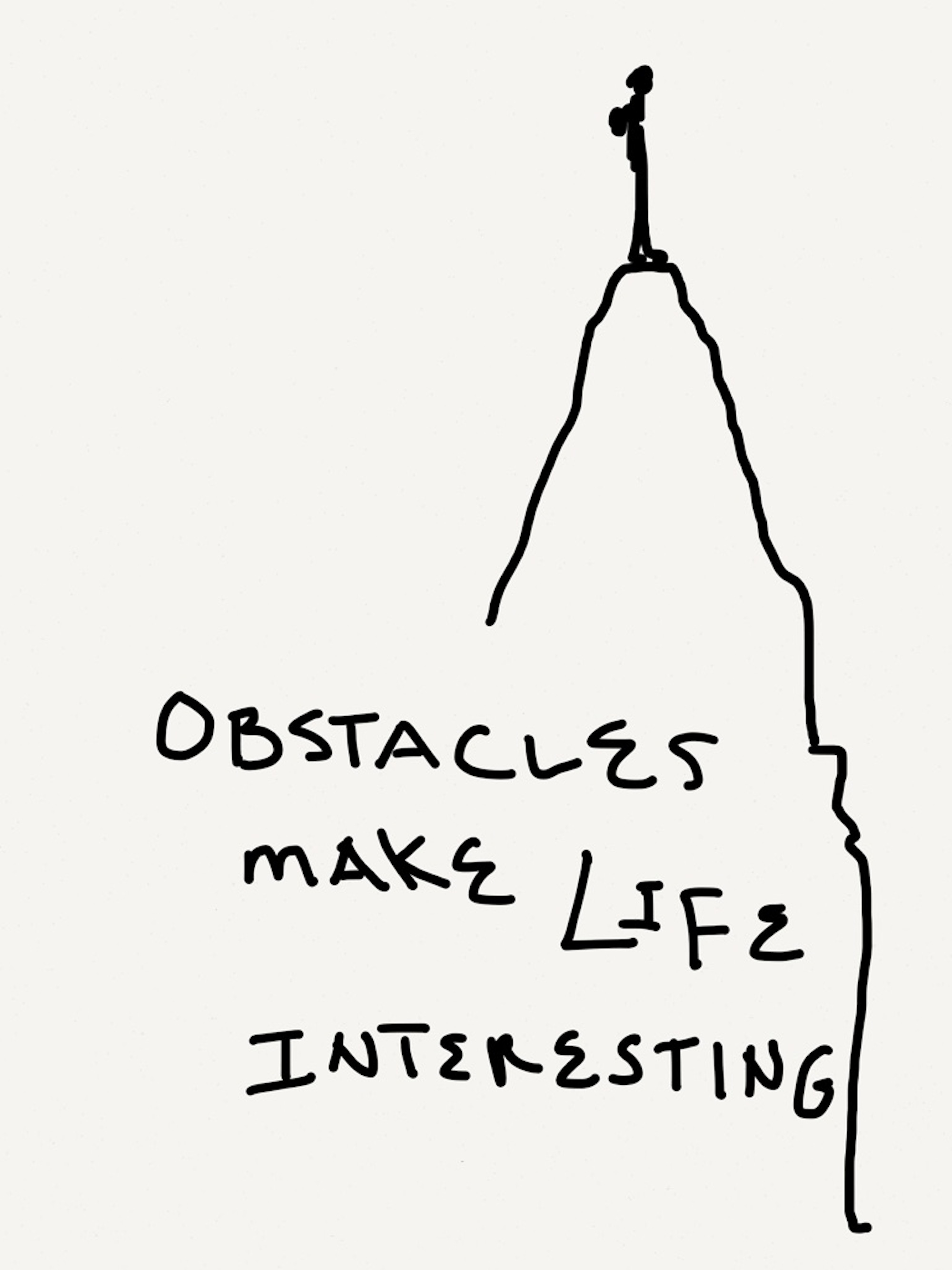
It is true that, at the end of the day, we are our own best obstacle. Nothing is better at blocking meaningful action toward a dream than our personal story of doubt and fear. It comes in many forms, like, “Who am I to think that…,” or “If I only had some time I’d…,” or “If I only knew how to start, I’d….”

Lately, I’m fascinated with a specific form of the best-personal-obstacle canon: why do we take any action EXCEPT the one action that matters. For instance, I hear often statements like this: “I want to be a writer, but….” Anything following the statement of desire is a self-generated obstacle. There’s not enough time. No one will like what I write. Fill in the blank. The single action that matters is to write. Sit down and write. That is how one becomes a writer. And, if the writing happens everyday, one will become a better and better writer. Anything else is a well-placed, self-generated obstacle.

The question is, “Why do we need our obstacles?” What does placing a boulder in the road do for us? There is an obvious answer: it keeps us from the scary prospect of fulfilling our dreams. Fulfilling a dream requires showing up and expressing a personal truth. Personal truth is, well, personal, and will always meet resistance because there are billions of personal truths walking around out there.

The refusal to take the single-action-that-matters applies to the everyday. How many times have you swam in a pool of overwhelm rather than pick up the phone and make the call that you know you need to make? Once, when I ran a theatre company, I knew I needed to fire an employee but I didn’t want to do it. She was a nice person. She wasn’t doing her job. We had countless meetings discussing why she wasn’t taking the one single action that mattered (doing her job). And, so, I didn’t take the one single action that mattered (letting her go). When I finally mustered the courage to fire her, she thanked me. She wanted to do something else with her life but didn’t have the courage. When I fired her, I pushed her out of the nest. I became the circumstance that pushed her into the one action that mattered.

I think that’s the point of not taking the one action that will actually matter. We allow circumstance to decide for us. We delay until the bill collector comes or until the boss fires us or until we are sitting in a rocking chair telling the story of why we never had time to write. If only….

Go here to get my latest book, The Seer: The Mind of the Entrepreneur, Artist, Visionary, title_pageSeeker, Learner, Leader, Creator…You.

Go here for hard copies

Stand With Hope

Untitled Narrative by David Robinson

Untitled Narrative by David Robinson

Here’s my gorgeous quote of the day. It came from Barney during a conference call with Skip. We were talking about yesterday’s striking quote, “lost is the new normal.” Barney reflected that being lost (not knowing) is a beginning. He said, “It necessitates that we stand in the presence of hope.”

Isn’t that elegant! Do you remember the last time you stood in uncertainty and whispered quietly to yourself, “I do not know what to do?”  Did you recognize the moment as a beginning? Why is “not knowing” what to do so frightful? What assumption set requires us at all times to know? Knowing what to do is, at best, an illusion.

“Not knowing” is the beginning of learning. Learning has nothing to do with knowing. Learning has to do with exploration. Life has nothing to do with knowing. Life has everything to do with experience and engagement. Every educator, mentor, guide, and leader should listen to Barney’s thought.

What if we understood that being lost was nothing more than a beginning and the gift of “not knowing” was that, for a moment, we might stand silently in the warm presence of hope? What if we understood the role of student to be a long walk in the presence of hope? Can you imagine who we might be as a society (and as individuals) if we understood the need to test for the presence of hope before we ran tests for knowing stuff?

Go here to get my latest book, The Seer: The Mind of the Entrepreneur, Artist, Visionary, title_pageSeeker, Learner, Leader, Creator…You.

Go here for hard copies of The Seer