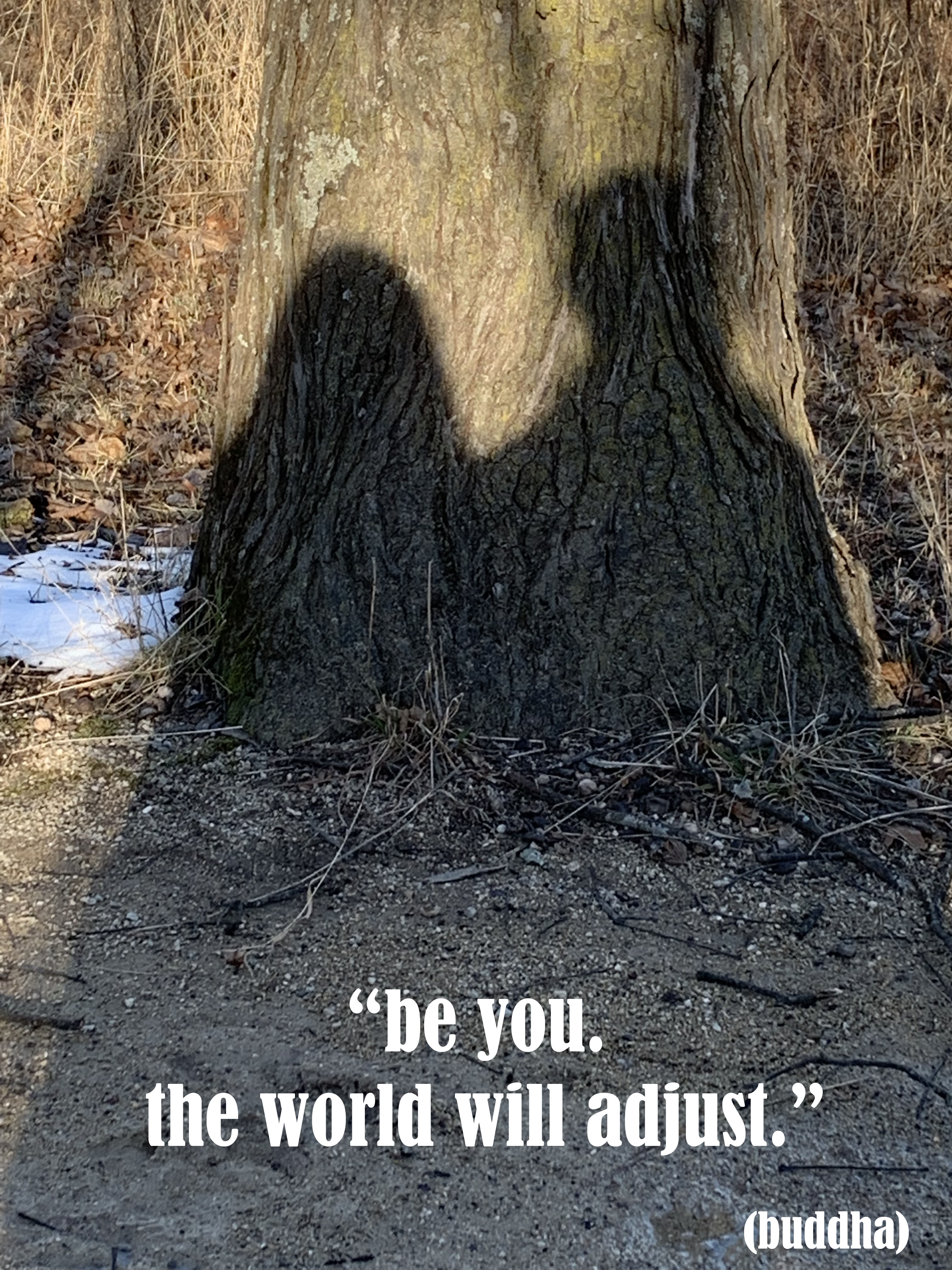
Read The Shadow [on Not So Flawed Wednesday]

Kerri said, “Look at that shadow! It makes me think of the collar Ruth Bader Ginsburg wore with her robe!”

Ruth’s collar was not my first thought. I went straight for Spirograph. The colorful spiral drawings made possible by the magic of plastic rings and wheels.

I suppose most people would have their moment of shadow association and move on to other topics but not us. Our association led to another association: what might Ruth Bader Ginsburg’s collar and a Spirograph have in common?

The artistry of mathematics. Action scribed from a center of integrity.

The Notorious RBG once said, “I am optimistic in the long run. A great man once said that the true symbol of the United States is not the bald eagle, it’s the pendulum, and when the pendulum swings too far in one direction, it will go back.”

The colorful line scribes an arc all the way to the edge of the ring and then, in perfect pattern form, scribes an arc across the board to the other side. And again. And again. Until a beautiful pattern, a brilliant complex roulette is formed. A single line that, at its inception looked random or out of control, running to the extremes, weaves – in the long run – a unified, inclusive, connected design.

Optimism in the long run. The symbol in a collar. The certainty of tides. The balance point found in all polarities. So much hope! A visit from RBG and a memory of a childhood toy. And, all of this from a single shadow cast on a dresser on an early spring morning.

read Kerri’ blogpost about SHADOWS
Drop The Leaf [on Two Artists Tuesday]

I’ve spent hours of my life in figure drawing classes. There’s nothing more beautiful or complex than the human body. There’s nothing more sacred. When I was very young, I drew people – both naked and clothed, both male and female – from photos in The National Geographic magazines. I drew figures and bits of bodies from plaster casts – both plaster-naked and plaster-clothed. I drew figures from those weird artist wooden mannequins, never clothed, sex-neutral, gender unknown.

A friend just sent a story from The Washington Post. A principal in Florida was forced to resign after sixth grade art students were shown a picture of Michelangelo’s David. Had my eye-roll been any more pronounced my eyeballs would have popped out of my head and rolled across the floor. This principal’s forced resignation: a fig leaf by another name.

It’s true, The David was strapped with a fig leaf by outraged clergy shortly after it was displayed in public in 1504. Humanity has grown-up a bit since then, or so we might have hoped. It’s true: history repeats itself though you’d think with all the bodies sunning on Florida beaches, with the ubiquitous sex in movies, on television, and used to sell everything from automobiles to vacation destinations, that the un-leafed David might be understood as high art rather than an affront to any pretend moral authority.

Don’t look up if you visit the Sistine Chapel; Adam has yet to eat from the tree of knowledge and is naked, naked, naked. Touched by god. It is, after all, a painting of the day he was “born.”

The Greeks-of-yore, those whacky inventors of democracy and critical thinking, understood the body to be virtuous. Michelangelo was drawing from that deep pool of tradition and wisdom rather than the shallow frog pond of pretend-pious-purity. David, a biblical figure, stands naked before the giant Goliath. Virtue with a slingshot. Sacred and beautiful.

It takes a modern-day-Florida to turn virtue to vice while elevating vice as virtue. The cure for their fake-moral-fig-leaf is simple: attend a few figuring drawing classes. Drop the leaf. Or, go to the beach and open their eyes.

read Kerri’s blogpost on LEAF IMPRESSIONS

Lean Into The Questions [on Merely A Thought Monday]

A theme that surfaces in my conversations with Rebecca is how unsafe people feel – especially women – to ask questions. At work. At school. Asking a question is too often misunderstood as a challenge to authority. It’s dangerous. Smile. Be silent.

I suppose authority has always been thin-skinned though the idealist in me wants to believe that we’re all in this together. I know without doubt – as we all know – that the way forward is through the field of questions. The best answers open doors to better and better questions. Anyone afraid to be questioned and insisting that their answers are absolute – full stop – should inspire dread.

After eight years on the job, Kerri was handed a contract with the mandate to sign it. She asked a few questions. The description in the contract didn’t align with the reality of the job she was performing or the previous agreements made with her supervisors. Authority did not respond well to her questions. The ensuing assault was incessant. Bullying. Dangerous. For awhile she tried to comply with the only advice offered her: smile sweetly. I wondered, if a man was being similarly pummeled, would he be offered the same advice? When Kerri finally stopped smiling and stood solidly with her questions, she was branded “belligerent” and “uncooperative.”

I doubt a man would be similarly pummeled. To this day, I wonder at all the men and women in the community who watched the pummeling and said nothing. As witnesses to the danger in asking a question, they held-their-tongues. I suppose they learned their lesson. Ask no questions. See no evil. Hear no evil. Look away. Speak no truth.

And, while they weren’t looking, their community fractured and fell apart. All were diminished. Thugs count on division; it’s their secret sauce for establishing control. They engender silence. It’s how they maintain their authority.

And, isn’t that the true danger. We don’t want to bring the the wrath of the gorilla upon ourselves so we “get on board” or “toe the party line.” Smile sweetly. Pretend the bully isn’t beating the woman into submission. Make the assault her fault. She brought it on herself.

Kerri’s experience is a microcosm. The bullies have the microphone. World-wide, authoritarianism is on the rise.

If ever there was a time to lean into the questions, it is now. If ever there was a time to ask aloud, “What are we doing?” and “Why are we doing it?”, it is now. Together, asking questions capable of leading to answers that open doors to better and better questions. We have no shortage of persecutors beating down questioners while screaming that they have all the answers and their answers are absolute.

Perhaps the questions we need to ask together are simple: Is this who we are? Is this who we want to be?

read Kerri’s blogpost about SMILING

Look In [on Not So Flawed Wednesday]

“I want to stand as close to the edge as I can without going over. Out on the edge you can see all kinds of things you can’t see from the center.” ~Kurt Vonnegut

Yesterday I applied for a job that is all about narratives told from the edges of society. I’m not sure why it surprised me to find such a cool-to-me job; our community seems addicted to shattering so there are plenty of small edges to be found. Small edges are fallacious and serve a myriad of false centers. Our survival will depend upon whether or not we can awaken from the shatter-narrative and make the decision to direct our broken focus toward a common center. No small feat.

It is the role of the shaman, the explorer, the artist, the researcher to stand on the edge and report back to the community what is seen and unseen. The voice from the edge is rarely welcome since the report is capable of popping delusions or pulling the sheep’s clothing from the wolf. Page one of the autocrats’ handbook instructs the elimination of artists and educators. Making an enemy of the eyes-that-see, demonizing educators and thinkers – the people who recognize pattern and metaphor. The game of Us-and-Them necessitates silencing the voices capable of calling out the wolf. Autocrats require blind sheep that follow without question.

Some famous edge sitters: Galileo. Cesar Chavez. Rosa Parks. Nelson Mandela. Susan B. Anthony. Albert Einstein. Frederick Douglass, a former slave and leader of the abolitionist movement, wrote extensively about what we call Critical Race Theory; it was clear in his view from the edge. It’s not a new theory. It’s an old pattern with a new name. I think he might denounce his Republican party affiliation were he alive today; they would certainly silence his voice. He would be fired were he a professor in Florida today. As would Martin Luther King, another famous voice from the edge.

Voices of reason are often voices from the edges. Voices of the future are always voices from the edges. Galileo was silenced for suggesting that the earth circled the sun and not the other way around. Over time, the voices from the edge, when authentic, always make the center better, the community stronger. Susan B. Anthony spent her life on the edge, lobbying the center, to secure for women the right to vote.

Progress. Growth. They are rarely inspired from the tight grip at the center. Silence the edges and the community atrophies. Stop the movement and the body dies. That page was left out of the autocrats’ handbook for obvious reasons.

read Kerri’s blogpost about EDGES

React [on Two Artist’s Tuesday]

The answer is herbicide. That blue coloring sprayed on stumps and shards of stumps along our path is meant to prevent the invasive species from sending up new shoots. Eliminating the invasive species so the native plants might someday make a comeback is the point. It only looks like total plant decimation with performance-art-blue dotting the eradicated forest. It is, in actuality, rejuvenation.

We met a couple walking the path. They were bird watchers and thrilled about the rejuvenation project. They explained how the work would allow the river to return to its natural course. The invasive plants were choking the waterway. With the removal of the invasive plants, the wildlife, like the plants, might have a renaissance. They assured us we’d see the difference when spring returned.

When I lived in the pacific northwest, there was deep concern about the salmon. Damming the rivers interrupted the natural cycle of the salmon’s return to spawn and the entire ecosystem was suffering because of it. Salmon are considered a “keystone” species; without the keystone, the ecosystem falls apart.

As we walked our loop I wondered how the invasive plants were introduced and how long had it taken for the invaders to choke the native plants? What prompted the preserve to act now?

Most likely, the invasive plants were introduced unknowingly by people. We cultivate land. We “utilize” nature as a resource. We study. We explore. We develop. We trade. We migrate. We are a force of nature. We walk well tended paths constructed for our ease and enjoyment. Sometimes conscious and sometimes unconscious of our impact.

I had a great conversation with a forest ranger about the re-introduction of wolves into Yellowstone. The thought of “managing” nature has always struck me as paradoxical. We eradicated the wolves and then felt the impact. We re-introduced the wolves to try and correct the mistake before the ecosystem collapsed, and set off another chain reaction of unintended consequences that required further intervention. It’s like prescribing a drug to manage the side effects of a medication.

As we walked I wondered if the concept of natural balance is just too hard for us to grok. We generally don’t realize that interdependence applies to us, too. We believe we are nature’s managers rather than part of the chain. That prevents us from seeing ourselves as invasive, responsible, reactive.

We manage. And sometimes that looks like forest-performance-art-devastation with accents of green-shade-blue.

read Kerri’s blogpost about HERBICIDE

Check The Resale [on KS Friday]

“Although Rothko lived modestly for much of his life, the resale value of his paintings grew tremendously in the decades following his suicide.”

The premise of this sentence made my jammies bunch-up. This wiki entry might have been written about Van Gogh. “Lived modestly” is a euphemism for “poor.” My favorite stereotype: the poor artist.

William Blake also lived modestly; he’d be shocked at the “resale value” of his work now. Nothing brings valuation to an artist’s work like the sudden end of the supply. Blake’s life came to a natural conclusion, so at least there’s that.

How do we know something has value? Resale, of course. Commodity. Soul reduced to a bottom line.

.003 percent of the nation’s budget goes to the National Endowment for the Arts. Valuation. If you desire to truly understand the phrase, “lived modestly,” visit your local not-for-profit arts organization. They’ll heap sincere gratitude upon you if you donate a ream of paper.

As an exercise in understanding soul, ask an actor or painter or dancer or composer the most obvious question: why do you do it?

Their answer will have nothing to do with resale value or commodity. Keep in mind, that doesn’t mean that they don’t want to be paid. Imagine Van Gogh’s answer. Or Mark Rothko’s. Emily Dickinson’s. Wouldn’t you love to know what they knew, see what they saw? Attempting to stand in their shoes, to see what they saw, is the reason that their resale value is so high. They connect us to something greater than commodity.

A caution: the next time you ask yourself, “What’s it all about?” be careful to direct your question to your inner Mary Oliver rather than your inner Elon Musk. They serve remarkably different gods.

My favorite quote of late: “And while a hundred civilizations have prospered (sometimes for centuries) without computers or windmills or even the wheel, none have survived a few generations without art.” David Bayles & Ted Orland, Art & Fear

.003%. That equates to an amount far less than Jeff Bezos’ tax bill. As a percentage, that’s much more than Kerri gets paid for a single spin of one of her pieces on your favorite streaming service (.000079 of a cent). Spotify, Pandora, and the rest are making out like bandits while the independent artists continue to “live modestly.”

What’s the real value of a nation that so desperately undervalues its art? I guess we’ll just have to wait for the postmortem resale.

Kerri’s albums are available on iTunes and streaming on Pandora

read Kerri’s blogpost about ROTHKO

every breath/as it is © 2004 kerri sherwood

Ask A Simple Question [on DR Thursday]

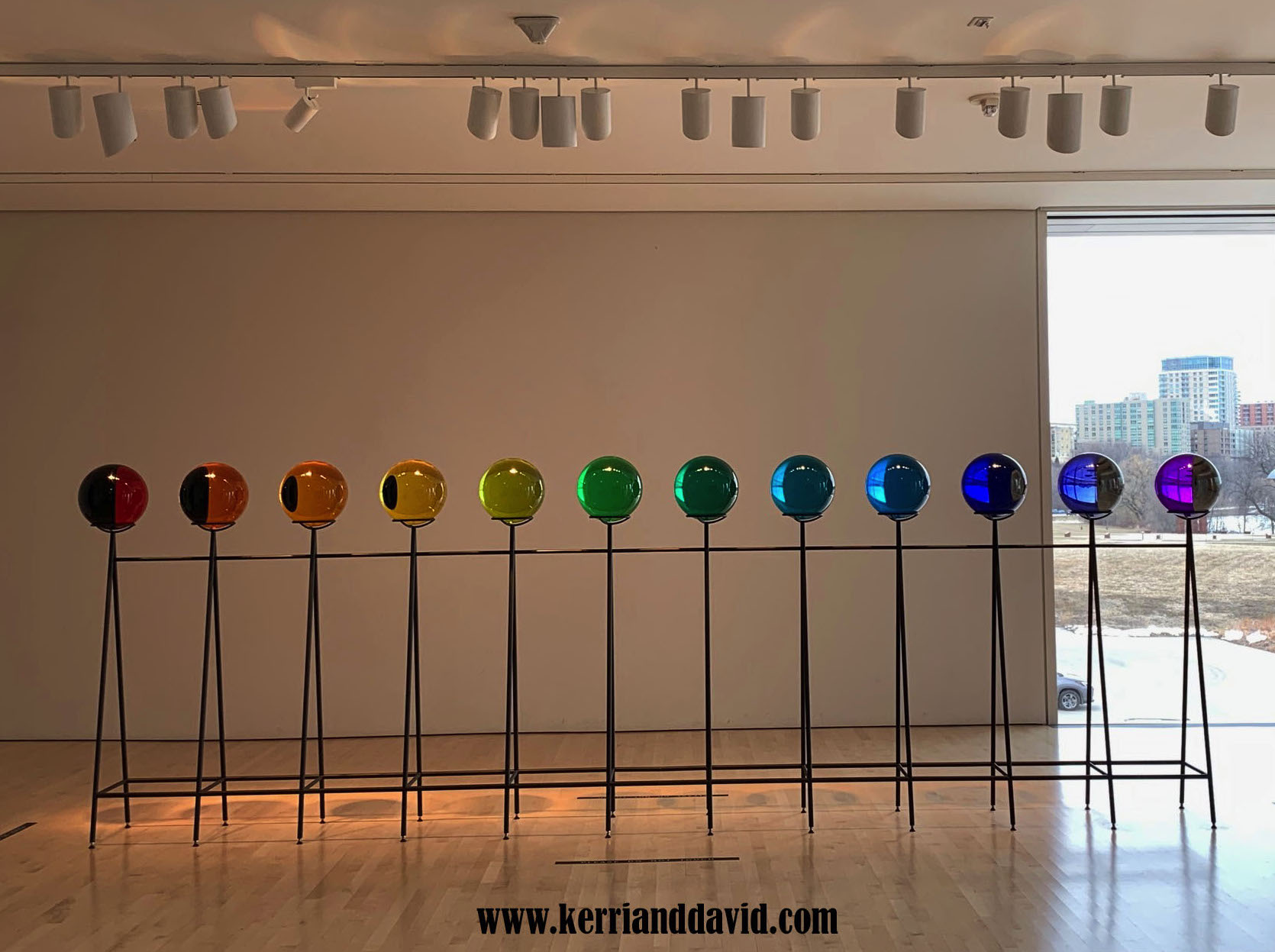
It’s existential. What you see changes depending upon where you stand. That’s true when engaging any piece of sculpture. It’s true when engaging anything in life. Point-of-view is fluid and relational. This sculptural reminder is Olafur Eliasson’s Rainbow Bridge.

In another era of my life facilitating diversity and inclusion workshops, the same surprisingly simple concept was usually a revelation to people. What you call “normal” is merely a point-of-view. Most importantly, it’s not everyone’s point-of-view. Your “normal” is unique to you, not universal. Most hopeful: it’s not fixed in stone. It’s changeable. Relational. Capable of growth. A mature point-of-view recognizes that it need not, it cannot, be the center of the universe. A mature point-of-view necessarily asks an all important question: “What do you see?”

It’s not only possible to look at the same sculpture and see a myriad of differences, it’s necessary. It’s human. Sharing what we see is how we, together, create community. A common center is created by a circle of differing points of view. A common experience is borne of sharing disparate points-of-view of the same event. A common center is made functional when everyone in the circle is capable of asking with sincerity a simple question: What do you see? It is made vibrant when everyone in the circle expects the answers to be different than their answer.

Art is one way of responding to the simple question.

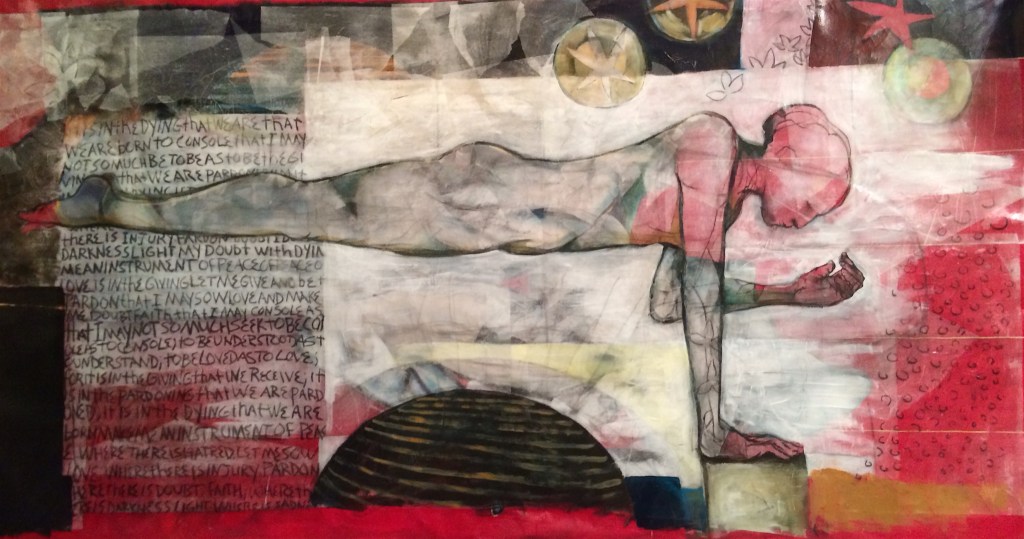
Instrument of Peace, 48x91IN, mixed media

read Kerri’s blogpost about RAINBOW BRIDGE

instrument of peace © 2017 david robinson

Trace The Line [on Merely A Thought Monday]

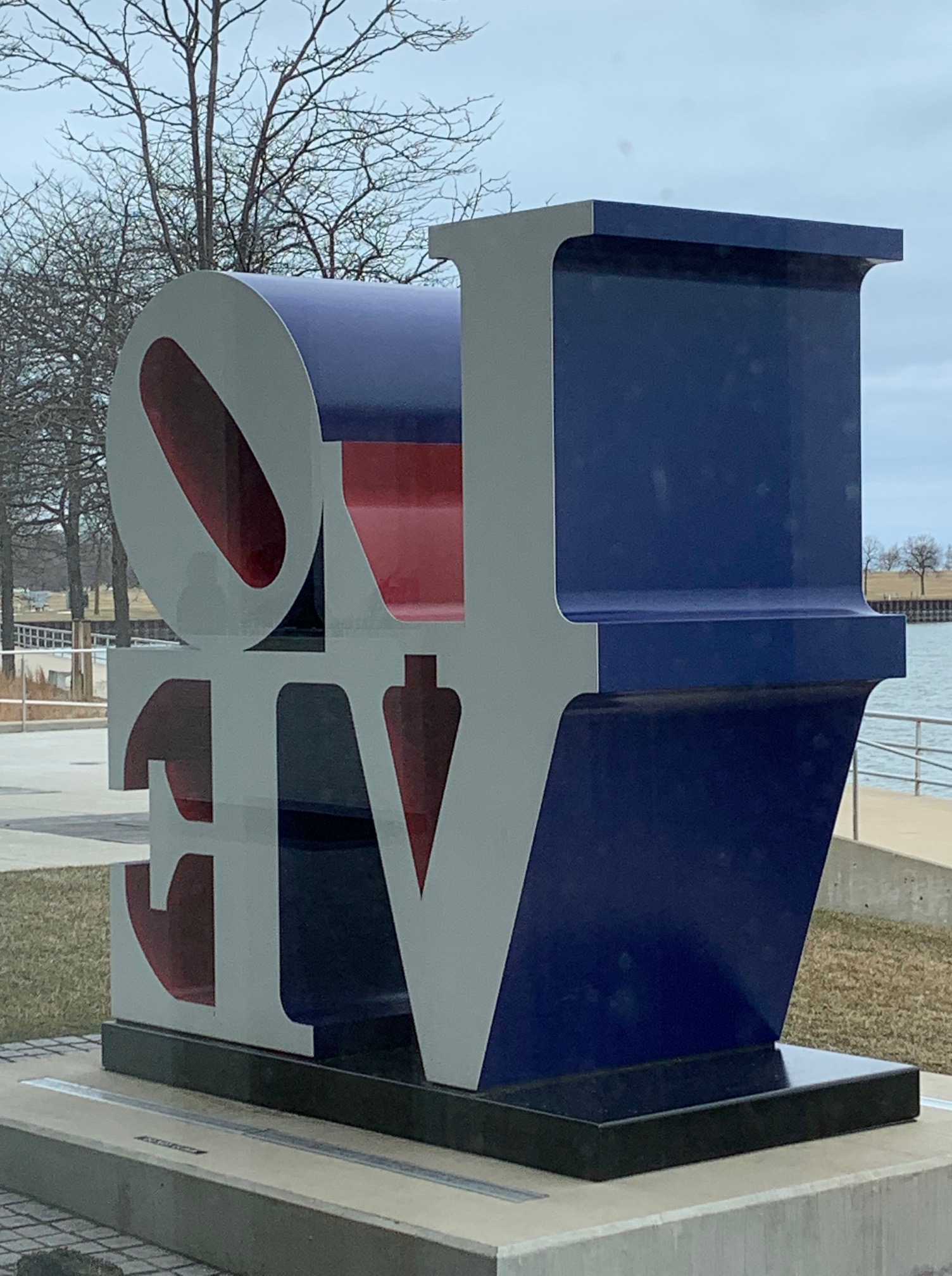
Love has a lineage. Without Piet Mondrian there would be no Ellsworth Kelly. Without Ellsworth Kelly there would be no Robert Indiana. For that matter, without Georges Seurat or Henri Matisse there would be no Piet Mondrian. Without the invention of the camera and the science of optics there would be no Georges Seurat. Of course, I’m referring to Robert Indiana’s sculpture, Love. We are rarely aware of how many lives influence our thoughts and give shape to our passing moments.

Love, the non-sculpted variety, follows the same principle in every life. It has a lineage. Chose any moment – any emotion – and follow the thread. An amazing web of interconnectivity emerges that stretches beyond…beyond. Sometimes I stop on a trail and wonder how I came to be walking through the woods in Wisconsin holding this woman’s hand. A tumble of choices. An immensity of influences and circumstances that quickly become impossible to comprehend. It’s no wonder destiny is such an attractive notion! Phew!

Four simple letters. Stacked symbols designed into another symbol. An aspiration? A graphic design? History placed Love in the box called Pop Art, thereby giving it a location-in-time. A starting point. A relative nod to lineage.

Standing in the museum, gazing out the window at Love, Dale Chihuly’s color explosion to my right, Kerri taking a photograph of the sculpture over the shoulder of a biker seated at a cafe table, the guard lost in his thoughts, a school tour echoing in the next gallery, a mural behind me that I’ve not yet taken in though it’s tapping me on the shoulder…meaning being made and shared and expressed all around me! How is it possible that we ever think we originate on our own? How is it possible that we ever think we walk this path alone?

read Kerri’s blogpost about LOVE

Open The Binder [on Merely A Thought Monday]

He was referred to me because he was failing. His English teacher told me that he was impossible, that he rarely came to class and he “just wasn’t interested in writing.” At the time I was working at the “alternative school” running an independent study program. My job was “to catch the students that were falling through the cracks” or “to retrieve the students who’d already fallen.” To this day, the language kills me.

We talked. We laughed. The assignments I gave him were about fun and breathing space. After three sessions, when he trusted me not to judge him, he came to our appointment with a thick black binder. It was very old. The seams were ripping. It was a sacred object. He tapped his fingers on the cover, still deciding whether or not to share it with me. He wriggled in his chair, vulnerable.

I will always remember the moment he asked, “Can I show you something?” I felt honored. It is what I always feel when an artist comes out of hiding and shares their work with me.

He gingerly opened the binder. It was literally bursting with stories that he’d written and alive with illustrations that he’d drawn. This young man was ditching English class so he could hide in the football stadium and write stories.

I asked him to read to me. As he read, he made marks on the page. “What are you doing?” I asked.

“Making changes.”

After a few sessions I asked questions about the characters. He shared his illustrations. One day, he came to our session with a new story complete with sketches that we placed in sequence across the floor. As he read, we stepped to the next drawing. And the next. He made more marks on his pages. He made notes on his sketches.

One day I asked if I could read one of his stories to him. As he listened to me read, he began to coach my reading. “Whoa! Did I write that?” he said, grabbing the pages from my hand. And then he asked, “How can I write that in a better way?”

“I don’t know,” I smiled. “What does it mean to be better?”

read Kerri’s blogpost about BE YOU

Ask A Useful Question [on Merely A Thought Monday]

“Answers are reassuring, but when you’re really on to something useful, it will probably take the form of a question.” ~ David Bayles & Ted Orland, Art & Fear

We read in the morning news about the exodus of teachers from the classroom. One paragraph in the story made me choke on my coffee. “In addition to having to deal with low pay, high student-to-teacher ratios, poor working conditions, post-pandemic learning loss, school shootings and social or emotional issues with students, teachers across the nation are also grappling with culture wars over what they can and cannot teach in the classroom.” (Rene Marsh, CNN, February 3)

If you’re like me, that short paragraph inspires a host of useful questions. To cite a “spurious”quote attributed to Thomas Jefferson, “An educated citizenry is a vital requisite for our survival as a free people.” One of my useful questions: why are we so fearful of an educated citizenry? The collapse of our public schools and teaching as a valued profession is not an accident. It takes a dedicated effort to undermine something so completely.

An educated citizenry asks good questions of its leaders. An educated citizenry would not be so easily duped by entertainment-posing-as-news. An educated citizenry would not fear its history or its future.

When we rounded the corner in the Milwaukee airport and saw the meditation room, it was like a magnet. It pulled me inside. An intentional place of peace! A quiet space for reflection. How rare in a place dedicated to hustle and bustle.

I was struck by the quote from the Talmud and carried it with me for days. To create peace, to experience peace, truth and justice must be not only be valued by the community, they must be lived by the community. Truth must be shared. Removing books from classrooms, gagging teachers from teaching the fullness of our history, does not change our history a whit. It does, however, soil our future, perpetuate the race to the bottom, and intentionally obfuscates truth. It creates discord by ignoring injustice.

As the Talmud quote instructs, in such a world, where truth is not valued, there can be no justice and, in the absence of justice, there is no capacity for peace.

Sustaining ourselves, surviving as a free people. Teachers are the stewards of our core values; theirs is a sacred obligation. And, the teachers are walking out of the schools. Here’s a useful question: Who could blame them?

read Kerri’s blogpost about THE MEDITATION ROOM