Honor Difference [on DR Thursday]

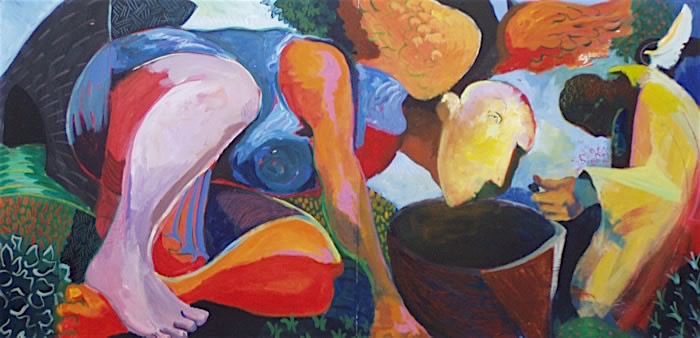
A Double Haiku:

Honor Difference.

A mural in Milwaukee.

Heart of the ideal.

Infinite palette,

Many hands, many painters,

Eyes that choose to see.

Read Kerri’s blog post about Honoring Difference

helping hands ©️ 2012 david robinson

Stand In The Narrow Place [on Merely A Thought Monday]

“Western civilization has been a 2,000 year long exercise in robbing people of the present. People are now learning the joys that hide in the narrow place of the hour glass, the eternal moment.” ~ George Leonard, Mastery

The observation has become something of a yearly ritual. Every 9/11, I hear or participate in this conversation: one day, people got out of bed, drank their coffee, brushed their teeth and went to work or boarded an airplane. And then, they never came home.

We are fairly smothered in sentiments about appreciating life, seizing-the-day, living in the present moment, take nothing for granted… “You never know.”

Quinn gave me his copy of Mastery. As was his practice, he underlined significant passages in red pen – and the book was a festival of underlined passages. For years I kept the book on my desk or beside my bed. I’d flip it open and read the red sections. They served as a daily meditation. They gave my busy mind something generative and hopeful to occupy.

George Leonard called presence, “the plateau.” Eckhart Tolle calls it “the now.” In one of the gospels NOT included in the bible, Jesus is reported to have said, “The kingdom of heaven is on earth but men do not see it.” The Way of the Buddha leads to the present moment.

What do we see if we stop thinking long enough to experience the present moment?

2996 people died in the terrorist attacks on 9/11. These people could do nothing about what happened to them on that day. They brushed their teeth. They left for work or got on an airplane.

“You never know.”

This year, there was a new river-of-thought that ran through the annual ritual observation: the daily COVID death toll last week in these un-united states was above 1,000 a day. On January 7th, 2021, 4,147 people died of COVID. In the divided-united states, more than 660,000 people have died of COVID. World-wide 4,550,000 people have perished.

It’s impossible not to look at the numbers and wonder why-and-how we became our own terrorists.

In the past year, with the availability of a vaccine, with the proven effectiveness of masking and social distancing, these people, had they united with the help of their friends and neighbors, had choices. They – we – could have done everything to save their lives. We did not. We divided. 1000 yesterday. 1000 today. 1000 tomorrow. And growing.

Sometimes we know.

Appreciating life is – and always will be, at the narrow place of the hour glass – a community affair. In presence, on the plateau, the line between me and you blurs. It is the reason why all of those firefighters and first-responders ran into the towers that day. My life cannot be precious if I cannot see that yours is also precious. Why – on earth – on any given day – would I not do everything possible – anything possible – to protect your life? Why would you not do the same for me?

read Kerri’s blog post about BLESSINGS ABOVE GROUND

Offer The Chair [on Flawed Wednesday]

“Indeed, the effect of the forum is all the more powerful if it is made clear to the audience that if they don’t change the world, no one will change it for them.” ~ Augusto Boal, Games For Actors And Non-Actors

Many of my pals in the theatre turned their noses up at me when I began doing work in corporations. They thought I was yet another theatre artist doing improvisation-games with the terminally neck-tied. I was not. My work was more in the tradition of Augusto Boal than Keith Johnstone. Some of the best plays I’ve ever facilitated, some of the most profound pieces of theatre I’ve directed and witnessed, happened in board rooms, classrooms or conference spaces. Here’s how I know: the actors and audience were one-and-the-same. Their play was personal. When they left “the theatre” they did not leave the nice story behind and end the evening with a cocktail. They were disrupted. They had seen something that could no longer be ignored or deflected. The hard work was about to begin.

People yearn. People entrench. People plant their flags and claim the most ridiculous territory. I’ve seen teachers come to blows over an overhead projector. I’ve seen lawyers undermine colleagues to gain dominion over a swiveling chair. And, the chair or the projector are never really the issue. The issue is usually an abstraction. Pecking order. Boundaries. Alliances. People have killed each other over a pair of shoes. It’s not the shoes but the status the shoes represent. Abstraction and illusion.

People are generally unconscious about the reasons beneath their passions. I’ve met a score of dedicated meditation practitioners who meditate to control their thoughts rather than realize them. Once I led a group of teachers through the ritual they enact each morning before the arrival of their students. The question was, “What are you preparing to do in your day?” Their answer was unnerving and revolutionary: they were preparing to control the kids. Teaching and learning were secondary.

We are witness to a country-wide communal piece of theatre, an unconscious play. The issue is not the mask. The issue has never been the mask. The issue is, I suppose, people feeling out of control, imposed upon. Fearful. They are, with their bare faces, making a stand. Drawing a line in the sand. That “no one can tell me what to do” might as well be “I am losing control over my life.”

And, as is always the case, as with the office chair and the overhead projector, refusing to don the mask does not really address the real issue, it merely deflects it. The energy and action is focused on non-sense. And when non-sense rules the day, the action taken actually brings about the thing-most-feared. Loss of control. The pandemic continues, the children are being taken, the economy suffers, the community fractures. It’s a lengthy list.

The lesson in the office chair wars and the overhead projector games is always the same. No one wins. Everyone loses in a toxic tug-of-war. The chair might be yours today but it will be theirs tomorrow. The game only ends when one of the players offers the chair to the other or the projector becomes a reason to share. The same will be true of the mask wars. People will die, the pandemic will continue until the mask becomes a generosity. Then, low-and-behold, the virus will abate and real control over our destiny will be within our grasp.

I hope that, like the lawyers or teachers who were brave enough to walk into the real story, to stand face-to-face with a dysfunction, that we meet our story and ask, “Why would so many sacrifice so much over a little piece of cloth?” An overhead projector. A pair of shoes. A chair that swivels…

read Kerri’s blog post about MASKS

Read The Walk [on Two Artists Tuesday]

Between the morning rehearsal and the evening wedding, we had several hours without commitments so we did the thing we most like to do. We walked. It was a gorgeous September day. We were in Milwaukee’s Third Ward, a miracle of reclaimed and converted warehouses, shops and condos that line the waterway. We followed the Riverwalk, Kerri snapping photographs, ambling our way to Lake Michigan.

It’s odd in this age of pandemic, to be in a city on a beautiful weekend day. The rules of engagement are different. The rules of enjoyment are different. Be out in the day but avoid the crowds. There was an art fair, a crush of people, so, as artists, normally pulled toward art gatherings, we walked the other way. In years past we would have waded in to the fray, talked to the artists, enjoyed people enjoying art.

Instead, we found a bounty of art on our walk. The shadows playing on the walls. The flowers. The finials. The sculpture. Everywhere we looked we found riches of intentional design. People dedicated to creating beautiful spaces had a field day re-imagining what had once been an industrial wasteland on the water.

Chiseled into the the boards upon which we walked was a narrative history of the city. We stepped on top of important dates of the Civil War. We walked across innovations, breweries arising in a city of beer, World Wars and the changes they wrought. Sports victories. We walked across the story of a previous pandemic, a hundred years ago. A few thin boards, markers of a tragic toll.

For a moment I stood and watched the kayaks paddling, the pontoon boats cruising the channel, the diners seated beneath umbrellas, the strollers, like us enjoying the day with no destination calling. Full moments in lifetimes that someday might be told in a few thin boards of narrative highlights.

I wondered how many people, how much dedicated action, it took to make this moment beautiful and possible. The architects. The artists. The artisans. The craftsmen and women. The laborers. The florists, The gardeners. The shopkeepers. The waiters. The chefs. The suppliers. The mail carriers,…Dreamers all, stretching back through time. Interconnected and interdependent in ways that only few recognize.

That’s the challenge, isn’t it? Were I to chisel the story of our pandemic in a boardwalk, or create a sculpture meant to capture our moment in narrative time, my theme would be interconnection and interdependence unnoticed. Unmasked. A myopic madness, a messy delusion of every-man-for-himself, a sure-fire way to perpetuate a pandemic or warm a globe.

There is, of course, no evidence for life thriving in a vacuum. On the other hand, there’s plenty of evidence, apparent on a stroll in a city on a beautiful sunny September day, killing some time before a wedding, that it takes all of us, every last life, to thrive. An artist needs an audience. A developer needs a supplier. A doctor needs a patient who wants to be healthy. Who wants to do more than survive. Thriving is, after all, a group sport. A careful reading of the boards tells a very specific tale: no one does this walk alone.

read Kerri’s blog post about OUR WALK

Light The Dark [on DR Thursday]

Strong contrast between light and dark: chiaroscuro. Renaissance painters loved it. The word ‘chiaroscuro’ literally means light-dark.

Today is Stephen’s memorial service. It is across the country or I would be there. I confess, I am haunted by Stephen’s death. When Mike wrote to tell me of Stephen’s passing, he told me that he was at peace when he died.

I’m not sure why his passing has hit me so hard. The last time I saw Stephen was 1998. He was following MM like a puppy. They were working on a set construction project. That’s what I remember. He was 14 years old, so, in my mind, he is frozen at 14. He was one of a pack of brothers that formed a solid core of Dimension’s Theatre Project, a theatre program that I spent more than a decade resurrecting and nurturing into artistic vitality. Stephen and his brothers were present in its heyday. For me, it was an artistic and learning laboratory, a place of spirited artistic creation. I loved every minute of it.

Of the brothers, I knew Stephen the least. I worked most directly with his older brother, Greg. I prided myself that Dimensions was a safe space. Artists, especially young artists, are vulnerable. They need to know that they can make strong offers, take chances, find their edges, without shame. That means living in and creating a culture of mutual support. The person selling the tickets mattered just as much as the actor on the stage. Every member of the community was directly responsible for the health and well-being of every other member. It is the philosophy I inherited. It is the philosophy I carried forward.

Mike took the reins of Dimensions when I left. He carried on the tradition, made it his own, Changing Faces Theater Company. Mike knew the artist that Stephen would become. The musician. The designer. The man who cared for the health and well-being of others, artistic and otherwise. Mike knew the dark and the light of Stephen’s short walk on the earth.

Usually, when I am confused or need to sort out my heart, I take a break and visit the pond. Magic, the frog, lives there. He’s a good hider but every few days comes out for a visit. After Mike’s news, confused at the depth of my confusion, I went to the pond and hung out for a few minutes with Magic. Dogga was running circles, making my visit safe from marauding squirrels. The sun was down.

“Look at this picture!” Kerri smiled. She’d caught Magic in chiaroscuro, made more dimensional and full in light-dark.

“It’s beautiful,” I said, looking at the photograph.

Light-dark. The Renaissance masters loved it. I smiled this morning when I read Stephen’s obituary. It began with a quote, something he must have often said. His words brought to me what I couldn’t find at the pond. Peace for Stephen. “Proper lighting can change the world.”

read Kerri’s blog post about MAGIC

surrender now ©️ 2016 david robinson

Walk As WaWo [on Two Artists Tuesday]

It was past 3am when Kerri asked me if I wanted to “watch a trail.” We were wide awake. The air was hot and still. We’d recently stumbled upon The Wander Women: Kristy, Annette, and Lynn, woman our age, walking the PCT. They’re doing a flip flop, having started their hike in the middle of the 2600 mile trail and walking to Canada, then, they’ll return to the center point and walk the distance to Mexico. We watched the installment, posted this week, as they reached the Canadian border.

Still wide awake, we went to their channel and listened as they answered questions about their hike of the Appalachian Trail. They are sirens of the possible, guides of give-it-a-try. They are not hikers who pound out miles to reach a goal. As Kristy said, “We want to enjoy every single moment.” Their yoga is a matter-of-fact-presence. They plan and improvise; both/and.

We’ve listened to more than one Q&A with the Wander Women. In an answer to their follower’s questions about living full time in an RV and life on the trail, Annette responded, “Home is where we put up our tent. You carry home inside yourself.” It was the answer of someone who’d transcended their stuff. It was the response of someone who’d internalized her security.

We couldn’t plug our windows with air conditioners this summer. We had too much of isolation last year. We needed to hear the birdsong and feel the summer air. We knew that would bring uncomfortable days, humid and hot nights. We have always walked our neighborhood and the local trails, but our decision to feel-the-summer pulled us more out-of-doors than usual. We extended the sanctuary of our sunroom out onto the deck. We placed torches along the patio and fixed the lights around the pond.

Each evening, after our work is done, we sit outside in our ever-expanding sanctuary. We listen to the cicadas. The cardinals and the chipmunks vie for a place at the bird feeder. Sitting at our table I had a mini-revelation about why I was so enjoying The Wander Women and following the few couples also out on the trail and posting weekly updates. They talk about the community of support that they find in the trail. It is often unexpected and yet ubiquitous. Both/and. They offer a staunch counter narrative to the horror we hear in the news, the contention and division. There are people dedicated to helping them and they, in turn, are dedicated to helping others. “You can do this!” they say to anyone listening. “We’ll help you do this,” their followers echo back to them. They broadcast friendship, kindness and support.

It is a breath of fresh air, a sparkling optimism for the best in humanity. It rises on the trail. Generosity that cultivates generosity. Hope that is grounded in the experience of the unprotected, the heat and cold and bugs and rain and challenge of being-what-they-are-doing. Shared experience. Sanctuary. Here. Everywhere.

read Kerri’s blog post about SANCTUARY

Consider It [on Not So Flawed Wednesday]

“Innumerable confusions and a feeling of despair invariably emerge in periods of great technological and cultural transition.” ~ Marshall McLuhan

At the first theatre company I artistic directed, we cut silk screens and pulled ink to make our posters. They were crude but we didn’t know it at the time because that was the most advanced process available. At the time they looked cool and we were proud of them. They took some effort.

I remember the day a student came into my office and showed me how we could design our posters on the computer. His designs were gorgeous, easily adjusted, took almost no time, and came back from the printer quicker than I could cut a good screen. We felt like our status bumped up a notch. We looked professional, and, what we’d been so proud of only a year before, now looked primitive.

My first website cost an extraordinary amount of money. It took weeks of working with a designer. Changes were costly so were made rarely. Now, Kerri and I design, redesign and make changes to our site every week. A few years ago we set up a site for a theatre company, complete with ticket service, database and newsletter capacity all in one easy-to-use app. It cost them almost nothing and any fool could adjust and make changes to it.

People who only a few short years ago considered themselves voiceless can now say any old thing they want to an audience no less than world-wide. Patti once asked a conference attendee, “If you had a voice, what would you say?” If I could go back in time I’d beg her to retract that question.

We live in a time of high anxiety. There are few substantial anchors to moor our reality. I’m about to make the ultimate old guy statement: I remember when…a few limited news channels actually attempted to broadcast the news. They had a limited window of time to tell the news so they made their information count. We now have hundreds of information and misinformation sources that can rattle at us 24/7 and from multiple devices. The challenge is not editing-down-to what-matters, it is filling too much time with loads of spin that mostly has limited substance.

Information spreading – for me, too – has become easy-peasy. I can lob an opinion as easily and as readily as the next person. But, as Marshall McLuhan said – and I whole-heartily concur, “I don’t necessarily agree with everything I say.” In other words, (don’t tell Kerri) I am sometime reactive. Sometimes, I think I know more than I do. Sometimes, I make mistakes. Slowing down seems to be the only cure. Thinking things through. Researching before spouting. Breathe and breathe again. Consider what matters. Really matters.

I’ve walked a complete circle in my life. Now, in all it’s shiny capacity, within the amazing miracles of technology, I find much of what people say and do and assert with this glorious ability – to be crude. Without thought. It’s too easy so it doesn’t much matter. The stream will quickly carry away even the most offensive opinions and endlessly wash in some more. I wonder how considerate people might become if their easy voices were less easily shared? If saying something actually took some time and effort – let’s say, as much time as it took to design, transfer and cut a silkscreen – what might they say? If it was less easy to “like” or “dislike.” If one slip would send the thought back to the arduous start? Maybe we’d be more considerate because we’d take the time to consider what we were expressing – to think about what we were saying and why we were saying it.

I suspect most of our “whys” would get our knuckles rapped by grandmothers who held decorum and polite communication as a high virtue. Saying stuff so-as-to-belong-or-pile-on…or to hear ourselves talk, certainly wouldn’t spare the rod.

That whole thought stream came from taking a walk, looking down, and finding a rock smiling back at me. Someone took some time. Chose a rock. They chose what to paint and had a grandma-approved-reason-why. And, they did a good job of it. “Ahhhhh,” Kerri said, smiling back at the rock. “How considerate,” I added to her awe.

read Kerri’s blog post about ROCKS THAT SMILE


Be Indeterminate [on Two Artists Tuesday]

Through the good graces of our tomato plants, I’ve learned a few new concepts this summer. Determinate and indeterminate. Bush and vine. Determinate tomato plants (bushes) are bred to stop growing. Indeterminate tomato plants (vines) will grow indefinitely or until the weather conditions “are no longer favorable.”

Our plants are indeterminate. Each morning, Kerri visits our planting bench and checks her tomatoes. 20 taught her a few simple tending-rules and now, each morning, there are more and more little indeterminate miracles moving backward along the color spectrum, finally arriving at a brilliant red.

Life is indeterminate.

My new tomato-terms come just in time. My current project has me revisiting my past life as a teacher and facilitator. If I apply my new terminology to people I can’t help but think it is the lucky few who survive so much dedicated energy to stop the learning-mind in the name of education. The natural output of a system designed on manufacturing principles is to truncate the questioning mind by patterning the notion that there is a predetermined answer. It becomes a game of finding the answer that teacher wants – a closed loop – instead of an incitement of curiosity. Children are excellent game players and translate the gaming pattern into their now-dulled-adulthood.

There is a cycle apparent in all genuine learning processes. It begins with discontent. Curiosity is a movement born from some form of discontent. It leads to questioning. Questioning always leads to disturbance (the interruption of the known). And, just like that, out of the disturbance something new is seen, call it a breakthrough, call it an insight, call it new learning…Many classrooms – certainly the systems – are designed and organized to keep disturbances to a minimum. The mantra is ‘control’ rather than ‘inspire curiosity.’ Business has the same dedication.

We’re taught that disturbance is the sign of something wrong rather than the crusty earth breaking to reveal new verdant life.

Discontent leads to questioning, leads to disturbance, which leads to breakthrough. And, an insight will always lead to discontent. It’s a story cycle, where yearning meets obstacle. Learning is by definition uncomfortable and at its best when it is uncontrollable.

Last week I attended a meeting. My two companions and I brought our homework back to the team. One was content. The other two of us were filled with discontent. The leader of the session, at first, was angry. He did not get the result he’d anticipated from his exercise. “So, you two are telling me this process was worthless!” he raged. We’d spent our week questioning instead of answering. Discontent. Questioning.

“No! It was great!” we chimed in chorus. “Look at all the good information we uncovered!” It was a mess. Big disturbance. We cycled through our misalignment a few times, wrangling over perception and usefulness. More rage. And then…an insight. The breakthrough. All of the rage, all of the appeasing, began to flow in a single direction. A possibility took shape. A target materialized that was much better than the prescribed pursuit. Energy filled our zoom-osphere. Laughter. Excitement.

Learning. Indeterminate. Open questions. Hot pursuits.

I am drawn to and surrounded by the dedicated indeterminates; those who refuse to stop learning: David, Mike, Horatio, MM, Bruce, 20, Judy, and yes, Kerri…I am a very fortunate man to be surrounded by so many tomatoes moving their way backward along the color spectrum, not afraid to walk through their discontent toward bigger and bigger questions.

read Kerri’s blog post about TOMATOES

Make Life Better [on Merely A Thought Monday]

Lately, the universe has pitched me headlong into a master class on efficiency. Maximum productivity with minimum wasted effort. A useful concept in certain arenas and an intensely destructive concept in others. For a person who’s spent his life in a study of curiosity, art, and the creative, it’s an unexpected study at this stage of the game. It is sometimes uncomfortable but I consider it an opportunity for balance. Artists rarely meditate on efficiencies. We’re more of a discovery clan and efficiency is generally the enemy of discovery. No one ever sailed to the edge of the world with efficiency-on-their-lips.

Once, I made the argument to a school board that daydreaming was highly productive. It seems a no-brainer to me that exercising the imagination should be highly valued in a learning environment. Einstein’s Theory of Relativity came to him in a dream about cows. It is not an accident that many insights and revelations come in the shower or while driving or peeling a carrot. Newton’s apple did not fall on his head while he was exercising maximum productivity. The mind, to be efficient, needs space to breathe, fields to roam. It is the most elegant of paradoxes but mostly lost on worshipers at the altar of efficiency. In the modern business world, efficiency is all about time since time is billable. You know the mantra: time is money. Do more with less. Somehow, we’ve turned that nonsense into a virtue, a thing to be desired. A reason to squeeze.

There’s another, more admirable side to efficiency-seekers. How to make work less arduous. Grease the wheels and remove the friction. Relieve the burden. Not faster but easier. Ann used to say, “Find a need and fill it.” She’d look at people toiling and ask, “How can I ease their struggle?” Beaky was that way, too.

Near our home there is a stretch of shoreline with an ineffective seawall. It was built with stones and debris that become projectiles when hit by forceful waves. The locals know to avoid that stretch during a storm. It’s deadly. After the storm, it has become our ritual to walk the path to see the destruction. It’s always impressive. How far can a wave throw a heavy stone? The answer: farther than you think. Mother Nature yawns when we think we can control her. The seawall has become my metaphor for human hubris but also masterful inefficiency. It would cost money to build a proper wall. So, instead, after each storm, crews collect the rocks and pile them back on the shore, readying them to be hurled by the next storm.

We saw a double-rainbow and turned toward the shore. Kerri never misses an opportunity to capture a little miracle or a slice of beauty. We parked in front of the seawall-of-inefficiency and I laughed out loud. A budding Banksy sprayed a message on the rubble: love. The secret message-maker could not have found a more appropriate word: Love. Can you imagine anything more inefficient and, at the same time, more potent? Love moves mountains but is not billable. It transcends time. What better reason to do anything? Well, perhaps reason has nothing to do with it and never has. Reason has the worshipers-of-the-efficient perpetually re-stacking stones.

It’s easy to be seduced but let’s face it, life reduced to billable hours is not life at all. On the other hand, there is nothing more inspiring, nothing more curiosity-invoking than asking, “How can I make life better for everyone?”

Love on a rubble pile. What could be better? On second thought, what could possibly be more efficient?

read Kerri’s blog post about LOVE ON A ROCK

Be The Rain [on KS Friday]

Simple elegance. Courteous goodwill. Thoughtfulness. Consideration. Do honor. Ennoble. Look up the word “grace” and these are the phrases and synonyms that you will find.

John Updike wrote that “Rain is grace; rain is the sky descending to the earth; without rain, there would be no life.” California is on fire. So is Greece and Turkey. Siberia. Reservoirs are shrinking. So many are looking to the sky awaiting its descent to the earth. Awaiting simple grace.

When I lived in Seattle I delighted on a hot summer day of running through the International Fountain. I was not alone. Children and adults alike squealed as they played in the dancing jets of water. It was a joy to go to the fountain, sit in the spray and watch people play, rest, and rejuvenate with and in the water.

We are following couples as they through-hike the Pacific Crest Trail and the Continental Divide Trail. They plan their days according to their water sources. There are water-less stretches that are made do-able only because a trail-angel maintains a cache of water for the hikers.

Trail-angels, people who, for no other reason than having the satisfaction of helping ease the journey of others, give me hope. They bring respite, perhaps because someone in their past did it for them and it mattered. They make difficult passages do-able. Sometimes they provide a ride into town. They look for opportunities to help. They are the rain when rain is nowhere to be found.

Isn’t that grace? Rain meeting earth? Angel meeting a need, providing water so a thirsty traveler might drink and continue walking?

Grace on the album Right Now

Kerri’s albums are available on iTunes and streaming on Pandora

read Kerri’s blog post about WATER

grace/right now ©️ 2010 kerri sherwood