Live Inside The Altar [on Merely A Thought Monday]

Dear reader, you have done me a great service. You’ve connected my past to my present.

I’m not sure why but, initially, I numbered rather than named my blogposts. My 623rd blog post was about a practice I’d all but forgotten. Building an altar of gratitude.

Someone out there read #623 so it popped up in my analytic. “This is old!” I thought, staring at the screen. A numbered post! Another era. “I wonder what I was writing about?”

2012. Thanksgiving. Among the darkest days of my life and yet, on that day, I was deeply, profoundly grateful. Life had chased me to a cliff. There was nothing to do but leap. I remember like it was yesterday wandering the streets of Seattle placing notes of gratitude in the cracks of walls, at bus stops, at coffee shops. I felt as if I was invoking. I wanted a better world. If I wanted it, I needed to offer betterment to the world. It was a prayer. A weaving. It was the last time I built my “altar of gratitude.”

A year later I lived in an entirely different world. Everything went to ashes.

2022. Kerri and I are walking our trail. We’re giggling because we just planted a painted rock in the elbow of a tree. “Do you think someone will find it?” her inner 5 year old asks, too wiggly with excitement to stand still. I expect her to skip in circles of enthusiasm.

“Yes,” I laugh. “Someone, someday, will find it.”

As I reread #623 I realized that, in rising from the ashes, I was no longer building my altar on a single day in a single season. I was no longer invoking gratitude. I was no longer hoping for a world that might someday come into being.

I am creating it. Not on a single day or special occasion. I’m practicing gratitude every day. I’m living gratitude every day. Painting rocks, making dinner, watching sunsets, buying groceries, writing blogposts.

Because you sent #623 back to me, a marker in time, I’ve realized I’m living inside my altar. All the world….

read Kerri’s blogpost about EXPLORE

Live Like. Reach For. [on Merely A Thought Monday]

These messages are everywhere! Marketing tags, song and book titles, posters and billboards. memes. A sentiment also found in poetry, plays, and religious texts. Live like…

Live like you were dying (title of a studio album by Tim McGraw)

Live like a monk (title of a book by Daniele Cybulskie)

Live like there’s no tomorrow (A ubiquitous quote and set up for follow-up sentiments like, “Tomorrow may never come!”)

Live like.

Live. No guarantees. Dance like no one is watching. Be here now. If I was the rain.

It’s the message human beings like to deliver to other human beings. Don’t waste your one precious life. Realize it. Consider the lilies.

So the story goes, the Buddha was asked, “What’s the biggest mistake we make in life,” His reply: “The biggest mistake is to think you have time.”

It’s as if we were trying to wake each other up. Or, wake up to each other. It’s as if we need to say, “Don’t miss it!” It’s as if we are asking, “Will you help me see it?”

These days there’s plenty of fear-mongering spinning around the word “woke.” I wonder at this collision of universal message and partisan agenda. After all, what is the opposite of “woke”? Why would anyone want to walk through life dulled or asleep? Why would anyone want to walk through life with their eyes closed, uneducated, filled with answers but empty of questions? Why would anyone want you to close your eyes and mind and heart to the fullness of life?

An amazing thing happens when near death kisses open the eyes: all the perceived divisions drop away. People throw themselves on bombs to save other people, people give up their seat on the life boat and, in those moments, skin color, sexual orientation, or politics matter not at all. In Highland Park, while the bullets were flying, decisions made in helping others to safety and the promise of one-more-day-of-life had nothing to do with division.

In the real moments, the awake moments, people reach for other people.

Perhaps that is why we are appealing to each other in beer commercials and bibles, lyrics and legislation, to wake up.

read Kerri’s blogpost about LIVE LIKE

Be Different [on Merely A Thought Monday]

Inadvertently, 20 did me a great favor. On the day Kerri and I married, he carried a concealed camera and captured conversations and special moments of our ceremony. In his footage is a short exchange he had with my dad. My dad said of me, “He’s his own man.”

To that point in my life I’d wondered what he thought of me, my winding career path, my free-form seeming-feral existence. “He’s his own man,” brought me peace.

Once, during a conference that we led, Alan told me I should dress differently. “People would have more respect for you,” he said. Once, trying to fit in, I wore a suit to a facilitation and Rich told me I should dump the suit and dress as myself. I’ve awarded him the blue ribbon for best advice.

In my consulting life I wore clogs. I hated shoes with strings. The first thing I did at every job was kick off my clogs. You’d be surprised how invested people in power suits are in their footwear. You’d be heartened how human they become when they unlace and kick off their shoes. It’s like removing a mask.

People hire me because I am different. Because I see differently. My difference is my gift, the epicenter of what I bring to the world – and that is true of all people.

In a culture that prides itself on its individualism, it’s always been amusing to me how invested we are to “fit in.” Shopping at the right store, wearing the right clothes, we gush about our wild nature while synching tight the corporate tie. To “dress for success” means to fit a prescription, to NOT stand out. Business casual. The real real. All houses must look the same. Revealing behavior betrays the swaggering rhetoric.

Our individualism is at best a thin veneer. In truth, we fear difference. I dare the court of Supremes to uphold a coach’s right to pray before the big game on the 50 yard line if he’s Sikh. Or Muslim. Or Hindu. Or Buddhist. My son is gay. He lives a constant, never-ending battle to defend his difference. Why?

“But the truth is, I am different,” I said to Kerri who was red-faced with anger at the email from the concrete sub-contractor. He turned down the job to replace our bit of sidewalk, broken out during the waterline repair. Among his reasons, “…and he seems a little different.” He was referring to me.

“I’ve dealt with that my whole life,” I said as she furiously typed a reply. “It’s not a big deal. I’m an artist.”

“It is a big deal,” she snarled, typing harder, faster.

Listening to her ferocious key-pounding, I had a sweet wave of appreciation for her. In a lifetime of “different”, it is a rare and precious moment that someone vigorously defends your difference. Rather than hammer you into creased dockers, lace-up shoes or the right haircut, a furious defender was unfamiliar. She, too, is different and knows the bruise of the shame-hammer. I suspect we’ve all experienced its sting.

In my head, I heard my dad say, “He’s his own man.” Peace. I am what I am and the people who love me wouldn’t have me any other way. That makes a difference. All the difference.

This I know: it’s nice – so nice – not to be alone in my difference.

read Kerri’s blogpost about DIFFERENCE

Live The Words [on Merely A Thought Monday]

We awake each morning to birdsong. I imagine the birds’ song raises the spirit of the sun. Or, the birds sing because the sun raises their spirits. Both are good stories.

When I was in college I had a professor who seemed a bit radical. Now I recognize that he was not radical. He was a scientist and his data was prophetic. He was sounding an alarm for his students, knowing that his students could not yet hear him. He was the first person to introduce me to the notion of climate change. At the time, the world was still smarting from the oil crisis of the 1970’s. One day in class he said, ‘If you think the oil wars are bad, just wait until the water wars.” I heard his voice this morning while looking at photographs of Lake Mead and the river Po. Dwindling water meets rising population. Panic is in the air. In the meantime, Australia is drowning. Desperation is on the rise.

I like to imagine the birds raising the sun while the sun raises the song in the birds. It’s a story of interconnectivity. It’s to understand the question, ‘what causes what?’ – as a two way street. You impact your environment and your environment impacts you. Or, better stated, you and your environment are not separate events. (“The love you take is equal to the love you make.” ~ The Beatles)

Though he never used the word, “interconnectivity” was the construct my seeming-radical professor was asking us to consider. He understood that his students were products of a long tradition of disconnection. A dedicated delusion of dominance over nature ruled our construct and he was attempting to puncture that absurdity bubble. Pour toxins into your river and your water will poison you. Pour carbon into your air and your air will eventually pour carbon into you.

The same applies to governance and society in general. What we pour into it is what we will experience as it. H wrote that, “Politics is simply the exercise of being a good neighbor for the sake of the neighborhood.” Interconnectivity. For the sake of the neighborhood. Demonize your neighbor and they will, in turn, demonize you. Refuse to listen to your neighbors and they will refuse to listen to you. Pour guns into your community and your community will inevitably aim its guns at you. Lie to gain power and the lie will gain power over you.

Pour support, service, acceptance, consideration…into your community and it will respond in kind. “Do unto others as you would have them do unto you,” is not so complicated a concept when seen through the lens of interconnectivity. Kindness begets kindness. Acceptance begets acceptance. Honesty begets honesty. Intend it. Practice it.

These are easy words to say. Living the words is quite another story. Unless you happen to be a bird, singing the sun awake as the sun pours its rejuvenating warmth over your song.

read Kerri’s blogpost about THIS DAY AND AGE

Blink Open Your Eyes [on Merely A Thought Monday]

In an interview, Thomas Friedman called what we now face in this nation a “slow erosion.” Societies do not collapse all at once. They slow boil, frog in a pot.

Timothy Snyder said, ‘Ideas matter.” After all, ideas become action. Ideals matter, too. Democracy is an idea. It is not a given. Those who erode its foundation must believe it is inevitable, otherwise they would think twice before perpetuating The Big Lie, brazenly participating in sedition. Make no mistake, justifying an assault on the succession principle is to turn against the fundamental idea. Democracy is nothing more or less than a succession principle. Ideas matter.

Slow erosion. Slow boil.

Watching the news, reading the streams, there’s not much more that can be said after the court’s assault on a woman’s right to choose what happens with her body. Equality is an ideal. It is not a given. We not only have to choose it, we have to choose it again and again and again. Equality is a kind of power structure. It is the rhetorical central idea of our society.

And, so, we work on and on to make our central ideal more than rhetoric. We fought a war over inequality. We actively chose our central ideal with equal rights amendments. Early in our history, we chose it when we extended the vote beyond white male land owners. We chose it again when we prevented government from dictating what a woman could and could not do with her body. Equal rights.

Equality scares those who stand atop the hierarchy, who believe their privilege is their power. Ask Ginni Thomas what drives her sedition? Ask her husband Clarence why, now that the nation has rendered women second-class citizens, we now must revisit the rules of contraception and same-sex marriage? Ask Mitch McConnell about his life-long mission to pack the courts. What, exactly, might they be afraid of? Why are they working so hard to undermine rather than further democratic ideals? Why are they choosing to restrict equal rights while pushing forward autocratic candidates with authoritarian ideals?

My grandfather told me it was wiser to listen to a person’s actions and not their words.

Ideas, ideals – like equality – are powerful and made visible in chosen actions. Tom used to say that you can see the power of an idea by “the size of the tide that rises against it.” Right now there is a mighty tide rising against the democratic ideal of equality and the core principle of succession. It’s not a given. We are seeing what happens when the guardians of the principle turn against it. Slow erosion. Robbed nest.

The good news is that Tom’s phrase works both ways: you know the power of an idea by the size of the tide that rises to defend the idea.

Timothy Snyder also said that we have recently been a nation of sleepwalkers. Democracy is not inevitable. It is a choice made again and again and again. We create it on a daily basis through our choices and actions – or we lose it. Perhaps this latest assault on the ideal will wake us up? Perhaps we might blink open our eyes and realize that, as the stewards of the democratic ideal, we’d best start choosing to walk toward it rather than allow this minority, that so fears the power of equality, to continue their assault on the right to choose.

read Kerri’s blog post about ROBBING ROBIN’S EGGS

Experience It [on Merely A Thought Monday]

Dogga was fast asleep just outside the back door. The early morning air was cool and the sun was shining on the deck. He found the perfect spot for a re-pouch.

I was concerned because his usual morning habit is to raise a ruckus and run in circles. His silence brought me to the back door. I was so surprised to find him sleeping that I was at first concerned but the morning was so still, so unusually quiet, that I, too, felt overcome by the peace of it all. I watched him sleep. I wanted to lay down in the sun and cool air and enjoy the rare moment.

Kirsten was here for the weekend. She and Dogga have a special bond. He was laying at her feet; sleepy eyes bobbing. I told her that Dogga was just beginning to have some old-dog behaviors. More naps. Sometimes he allows the squirrels to run across the yard without a chase. He’ll be nine years old soon.

There’s a phrase that’s recently popped up several times in my reading. The purpose of life is to experience life. I thought about that on Saturday night. Kerri was inside prepping for dinner and Kirsten was upstairs. I sat on the back deck to watch the waning light. Dogga came and rested his head on my shoulder.

There are moments that you want the world to stop, moments that you want to rest in, drink deeply and savor, yet you know they are special because they are passing. That particular combination of loves will never again coalesce in just this way. A snowflake .

The purpose of life is to experience life. In all of its snowflake forms. Fully. Deeply.

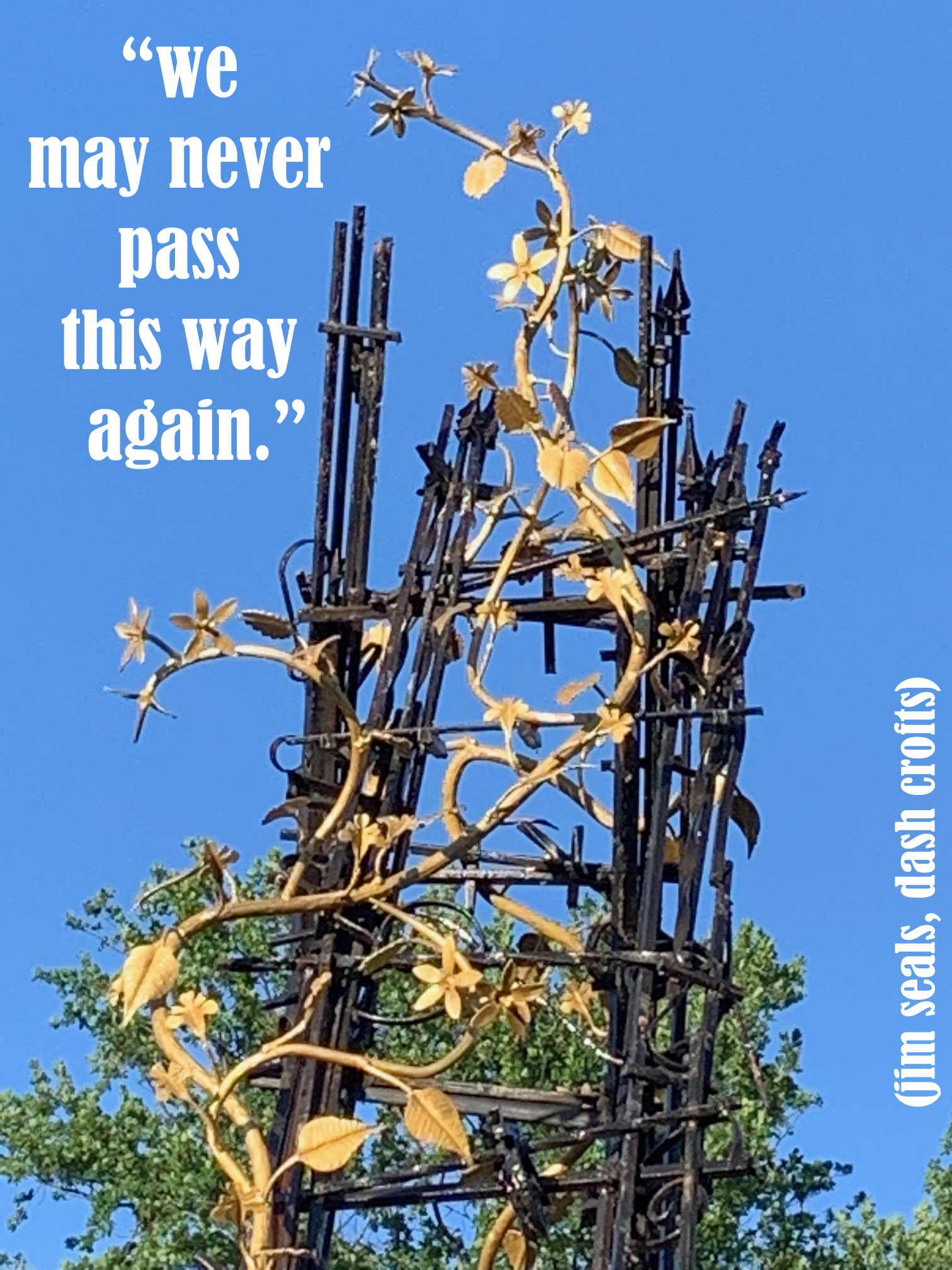
[Jim Seals passed this week. His passing has Kerri singing We May Never Pass This Way Again]

read Kerri’s blog post about WE MAY NEVER…

Unearth Your Modtro [on Merely A Thought Monday]

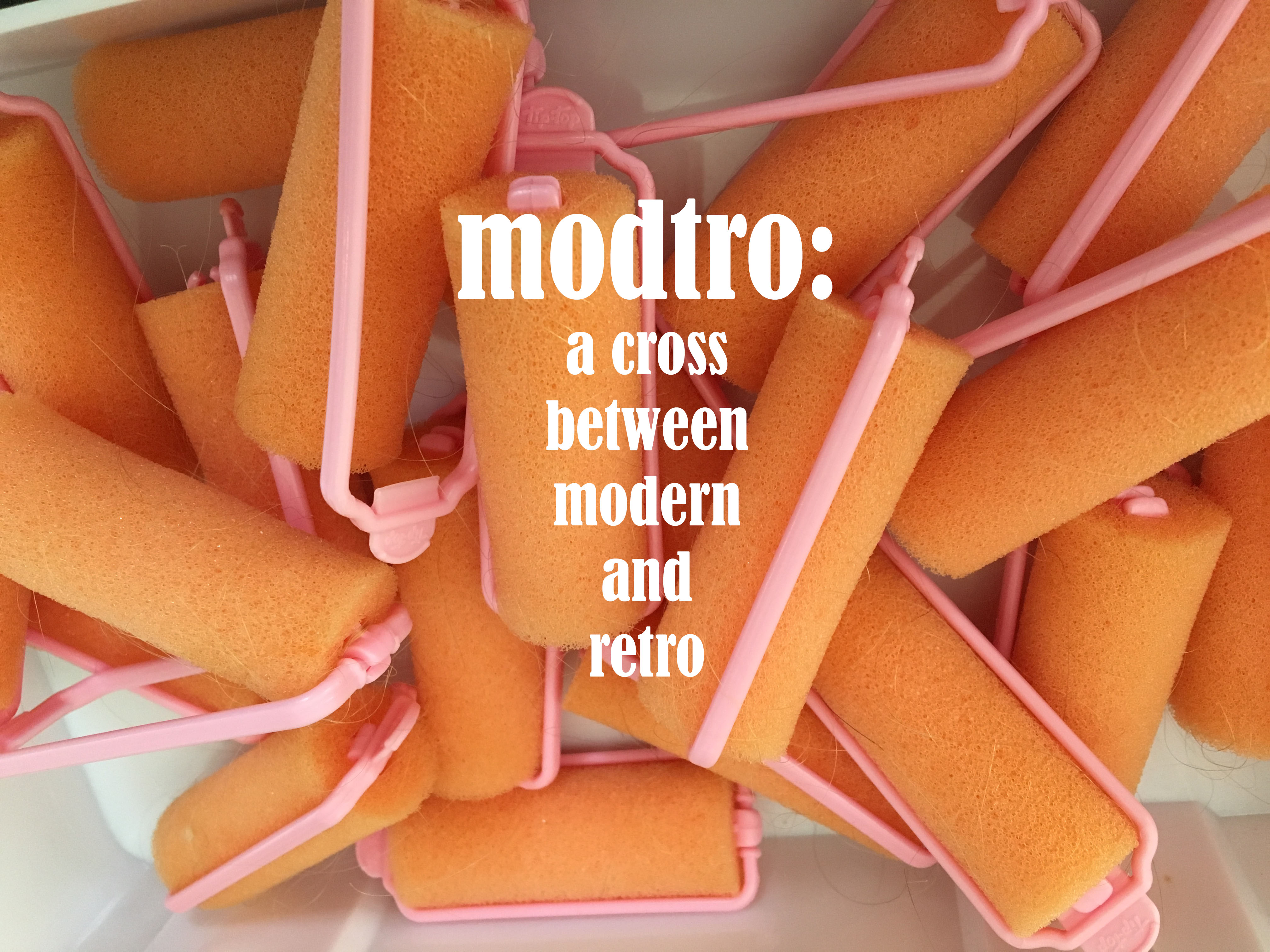
Our latest late-night binge is Bad Hikers. An adorable young couple hiking the John Muir Trail. Never have two people hiked the JMT in such modtro style. Goth meets urban chic. They are at home in their style, comfortable in their bodies, so they are both unaffected and affected at the same time. Glimmers of Mad Max on the JMT. I love it. Their spirit inspires us.

William Blake is another in the canon of artists unrecognized during his lifetime but now considered a creative titan, one of the great artists of the Romantic era. His contemporaries thought he was crazy because he was not like them. He stood out and no amount of hammering would make him fit the mold.

In the dance between the conservative and the creative impulses, the conservative will always claim the safe ground, plant their flag in “normal.” Tradition. “We’ve always done it this way.” The creative will swim to the margins, climb to the tops of the mountains where they can see more clearly. “What’s over the next horizon?” All people are a mix of both impulses, conservative and creative. We dance between the poles.

One of the first lessons I learned in art school is that, in the western tradition, every era reacts against the previous standard (I laughed when it occurred to me that our tradition is to react against our tradition – no wonder we are always at war with ourselves!) Realists rise in response to the Romantics. Impressionism reacts to Realism. And on and on. The other side of that equation is that the artists are generally tuned into societal and technological advances. Picasso’s cubism and Einstein’s theory of relativity hit the world within a few months of each other. Reactivity holds hands with innovation.

And so it goes with clothes, too. To dress as is expected. To dress as a statement. To dress as is comfortable. To find your style. To define yourself within your era. Clothes are how we publicly locate ourselves relative to the two poles. “This is me!” We shop at the same stores, we buy the same brands, all to express our individuality relative to the expectation-of-the-day. Sometimes you find your style and sometimes it finds you. And, mostly, your style changes as you do. Tie-dye puts on a suit and tie.

And so, this long and winding road brings me to a caution: do not, when you unearth the box of sponge curlers in your basement, exclaim as I did, “Oh my god! Who on earth ever used these things! Why do we have these in our house?” My laughter fizzled the moment I realized that the obvious answer was standing right next to me.

read Kerri’s blogpost about SPONGE CURLERS

Stand Still [on Merely A Thought Monday]

“The understanding of what you actually are is far more important than the pursuit of what you should be.” ~ Krishnamurti, Think On These Things

I wrinkled my brow the first time I heard Kerri say it: “We don’t change. We just become more of who we already are.” I didn’t like it. I wanted to pop the notion with pithy ideas of transformation. Something made me hold my tongue. “Consider it,” I said to myself.

Now, a full decade into the latest phase of my life-long-onion-peel, I see the wisdom in her words. The layers of protection, the suits of armor, the wall of respect, the race from shame, the measuring sticks and self-inflicted-social-expectations stripping away. Trying-to-be falls to the floor like a robe. The story-husks and fear-shells and false skins, false faces, false labels and roles and masks falling to the forest floor.

And, there you are. Just as you are. Naked and vulnerable and oh, so passingly human. Standing still. No ghosts to chase. No monsters chasing you.

And, there you are.

No distance between you and what you desire to create or experience. Finger painting. A child with a crayon and an empty wall for scribbles.

Kerri looks for hearts. She finds rocks shaped like hearts and leaves, heart-impressions in walls and heart-shaped clouds. Each one is a first-and-only and evokes delight. Last week on the trail, it occurred to me that she finds them everywhere, not because she looks for them, but because she expects to see them.

Seeing old friends. There you are.

read Kerri’s blog post about the HEART LEAF

Fail At The Box [on Merely A Thought Monday]

Among Don Miguel Ruiz’s Four Agreements is this gem: do the best that you can.

Through the lens of the Occident, those folks on earth oriented to the idea that their nature is bad and needs taming, the Agreement is a statement of self-forgiveness. Do the best that you can. It’s a good bit of advice when everything on earth seems to come with a measuring stick.

Don Miguel is Toltec so his Four Agreements are rooted in an entirely different understanding of nature. To do the best that you can has little to do with performance or achievement. There’s no judge sitting on the high bench scrutinizing goodness or badness. There’s no book with black marks next to your name. This Agreement is about setting an intention. The other Agreements are about speaking with impeccability, making no assumptions, taking nothing personally. In other words, it’s never about you; you can’t possibly know the reasons why; your words matter. So, do the best that you can.

Circumstances are uncontrollable. Sometimes people are mean. Sometimes the tornado comes through and blows your house away. It’s not personal. You probably can’t do anything to change the tornado and even less to change other people. So, change yourself. Or, better, be yourself. Attend to your story and free yourself from the illusion of living under grand judgment or any of a number of other control fantasies. Do the best that you can.

Lately, I’m pondering the too-tight-image-boxes we squeeze into and try, but can never quite, fulfill. The impossible image; a too tight expectation. The Pleaser. The One Who Knows What Is Right. The Peacekeeper. The Strong One. A step away from the box-expectation, the-role-I-think-I-must-fulfill, is a giant leap into happiness. Inside the box it is virtually impossible to do the best that you can. Boxes are alive with assumptions (what I must do, who I must be); buzzing hives of judgment, and, when in a box, speaking truth is frowned upon, so editing and/or silence rules the day. Just try doing your best when living in a too tight box!

Fear and anger fill boxes. That is, after all, the purpose of the box, the fruit of the impossible mission.

Here’s my advice to myself: fail at the box. Cut it up and put it into the recycle bin. Then, free of the too-tight judgments, it’s possible to set mistake-free intentions. Life as finger painting: do the best that you can.

read Kerri’s blogpost about SOME DAYS

Re-Connect [on Merely A Thought Monday]

The latest addition to my “Terms in this Unknown Land” document is TL;DR. Too-Long-Didn’t-Read. I laughed aloud when I heard this new acronym in a meeting. If there is a sign of our times, an identifying marker of our era, it is this: TL;DR.

We communicate through text and emoji. Chat. Twitter is a thing because it mandates brevity. Scrolling the news app is a study in cramming the full story into a brief headline. Marketers have mastered the 5 second ad. Businesses are liberal in their use of “narrative” and “story” but have no time to actually hear one. A short synopsis will have to do. Get to the point.

As a member of my culture I find that I scan more than I read. If I can find it on Youtube, I’d rather watch it than read about it. When I began writing blogposts ten years ago, the “rule” was 800 words or less. The rule has adjusted with our attention spans and now the target is between 400 and 600 words. Often, when I receive links to articles, they come complete with an estimate of how many minutes are required to read them. Yesterday, I read advice from a marketing guru that suggested we restrict paragraphs to two sentences or less; more than two sentences is a red flag: too much information. Less than two sentences is…a sentence.

So much information is coming at us all the time, we have no time or thought-space to take it all in. I wonder if we can discern relevance from dreck. A quick look at our leaders leaves me with a resounding “No!” Relevance is lost in the dreck and, since they represent us, they are us, our information inundation has rendered our attention spans tiny and blunted our acuity. We are awash in information while wisdom has gone missing.

Each week I attend meetings; the central concern is explicitly or implicitly about helping people connect. It reminds me of the conversations I heard in graduate school: while living in a city of a million people, the concern was about how to create community. So many people. So little community.

I ponder these things every day. With our ubiquitous technology, we couldn’t be more connected. Through social media, I know what people had for dinner or what cute thing the kids said. I receive advertising that confirms my devices are listening to me. Yesterday, for-the-hell-of-it, I said, “Machu Picchu.” Today I am awash in travel ads for Peru.

We are connected. Connection to everything is connection to nothing. Relevance is hard to discern in a tsunami of information masking as connectivity.

Relationships – real relationships – take time. Values cannot be communicated in a text. They must be demonstrated and deeply rooted in lived narrative. Stories that carry relevance cannot be well-told in synopsis. Opinions are so easy to tweet. Dreck is easy to fling. It is not the capacity to share that we lose in the crush. It is not connection. It’s the capacity to be present. With presence comes the capacity to listen. Presence is not in a hurry to be some other place.

Rich connectivity requires more than quick consumption of information. Sharing, real sharing, the kind beyond pressing a “send” button, is a two-way street between people who have the time to invest in each other. Once, it was called relationship.

TM;CL. Too much. Can’t listen.

read Kerri’s blogpost about TL;DR