Set It Free [on DR Thursday]

Horatio told me that, according to the happiness index, the good folks in Iceland sit atop the happiness-mountain. One reason, he explained, is that they’ve removed failure from their national equation. They cheer the effort, not the outcome.

Removing failure from the equation is the main ingredient for fun and success in all arenas, especially the arts. It is impossible to learn color theory without making some extraordinary messes. Ask a dancer how many times they tried and fell before they made that astounding leap look easy. Throw many pots and, over time, mastery will come – and mastery is nothing more than the understanding that there is no such thing as failure. It is the feel and touch of a long relationship with clay that can only come from not being afraid to throw it, to see what happens if…

Sometimes, no matter how hard I struggle with it or adjust it, a painting just isn’t working. Usually it doesn’t work because I’ve forgotten the rule about failure-removal. My brush is too timid. My brain is in the way. And yet, sometimes, in the middle of a painting that isn’t working, there is a small piece, the actual inspiration for the painting, that isn’t stilted, that remains alive and free of my fear. It’s easy to see. It captivates my eye, a warm island in the middle of a frozen sea. Every so often, rather than paint over the whole thing, I’ll lift the island, cut it out, set it free from it’s too-labored surroundings.

“Brutal,” Kerri said. “I liked that painting.”

“I’ll do another,” I replied. And maybe, I thought, another and another and another. Who knows, learning to cheer the effort takes some not-so-serious practice. It’s the only road back to the freedom of finger painting and the joy of playing in the sand.

Beautiful K.Dot, 12 x 9IN, mixed media

read Kerri’s blog post about CUT OUT

beautiful k.dot ©️ 2021 david robinson

Laugh At Yourself [on DR Thursday]

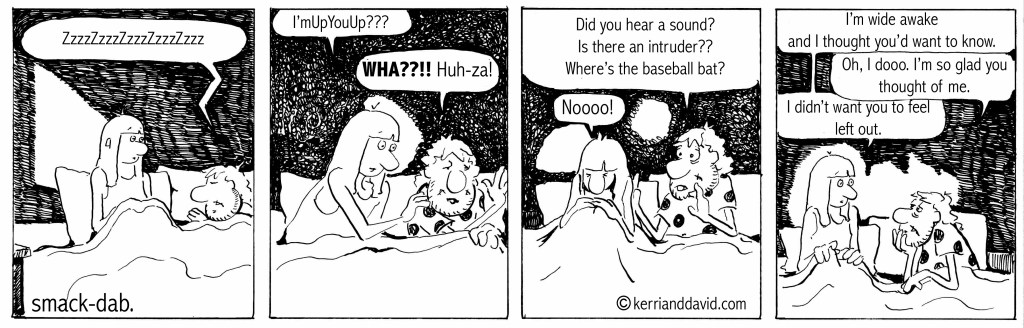
Had you come across our website during the era of The Roadtrip, a play that Kerri and I wrote from the several-months-email-conversation we had before we first met face-to-face, you’d have read this phrase: smack-dab in the middle of middle age…a true story of quiet hope and the arrival of life’s second chances.

Smack-dab. In the middle of middle age. We met. We married. We walk the neighborhood arm-in-arm. We write these blog posts each day. She brings her wise-eyes into my studio and I tell her what her music makes me feel and think.

For an intense year or so, we tried-like-crazy to syndicate a cartoon strip called Chicken Marsala, the imaginary child of two people who met smack-dab in the middle of middle age. In the course of writing and drawing Chicken, we also pitched a single-panel cartoon, Flawed, and another called At The Door. Chicken Marsala had several iterations because the syndicate liked it…almost. They asked for improvements though never specified what those improvements might be – in the writing? The art work? In this age of too much information, no answer ever came back to us.

In the face of unspecified and uncertain improvements, this ONE thing is certain: we generated a mountain of material in the hunt for the elusive improvement. Oh, and this, too: we laughed heartily at ourselves. The mountain of material was about us. We were poking fun at the things we do and say each day.

This morning I found Kerri furiously working at her computer guffawing. She’d pulled up the old Chicken file. There was an iteration of the strip that was pre-Chicken, the middle-aged couple prior to the appearance of their imaginary son. We sat this morning and laughed again at ourselves. These things actually happen and how joyful is it to chronicle yourself in-and-as a cartoon?

I suspect we are going back to the drawing board. This time, we’ll not hide behind our imaginary son. This time, we’ll pull the blankets on the source. Smack-dab. In the middle of middle age. Two artists met and got married. What could be a better set-up for ridiculousness?

read Kerri’s blog post introducing SMACK-DAB

*don’t believe a word she writes, she guffaws all of the time.

smack-dab ©️ 2021 david robinson & kerri sherwood

Appreciate The Marks [on DR Thursday]

Life leaves marks. When I look in the mirror these days, I see my grandfather staring back at me. Or, to be more accurate, I see aspects of both of them, all akimbo in a variation that I now recognize as “me.” The topography of DNA, crafted by my unique life, now sketched into my mask.

Quinn left marks in me. So did Tom. And Doug. And Kathy. I could go on. The list of amazing humans who had a hand in shaping my perception, molding my thinking, in informing my walk through this world, is lengthy. They are my fortune, the gold in my pocket. Their marks serve as my credo, define my intentions. Their marks have become the scale upon which I weigh value and importance. Laughter, according to their marks, carries enormous weight.

As we carried boxes out of the house, I couldn’t help but notice marks on the walls, scuffs on the floor. Each marked a memory. When the movers lifted the couch, its impression in the carpet was deep. It had sat in the same spot for years. In its absence, the entire space reeled. Soon it would find a new equilibrium as another family sculpted the now empty space. They will, no doubt, remove the carpet. The impression is too deep, the placement and accompanying memories are not theirs. Erasure is the necessary first act of new inhabitants. Eliminate the marks. Paint. Sand. Demo. And freshen. Clean the palette.

Leigh is an authority on rock art. Cave painting. The marks left by humans. Prophesy and map. Ritual and graffiti. Not all cultures are obsessed with leaving marks. Many try not to. My relationship to my marks, my paintings, changed the day I helped carry Duke’s brilliant paintings out of his basement. He’d passed and now the question was, “What do we do with all of his paintings?” I knew, someday, someone would ask the same question of my paintings. Carrying his paintings up the stairs and stacking them in the truck, I became less invested in the notion that my paintings, my marks, need matter. They no longer need to transcend me. They are immediate, fulfilling for me and perhaps me alone. That is enough. Bits of ego easily fall off when the perspective of age comes calling, when the marks are undeniable.

Marks fade. Life is what is happening now. A cliche’ that could not be more relevant. The couch, seemingly so permanent, will someday be hauled out. The marks will remain for a while. Only a while. And new life will move in and fill the old space, as it should.

read Kerri’s beautiful blog post on IMPRESSIONS

Touch The Walls [on DR Thursday]

A Haiku

I wander the house

touching boyhood memories.

Stories pour from walls.

read Kerri’s DR Thursday Haiku

Catch His Hand [on DR Thursday]

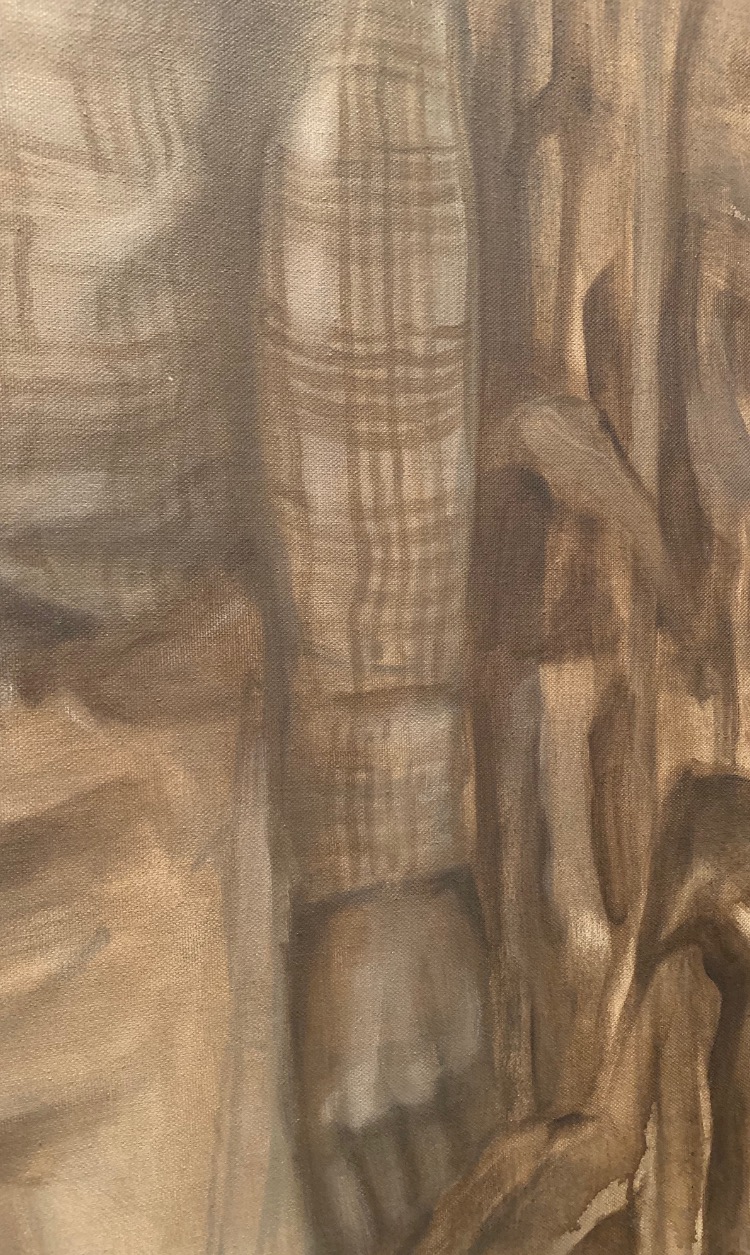
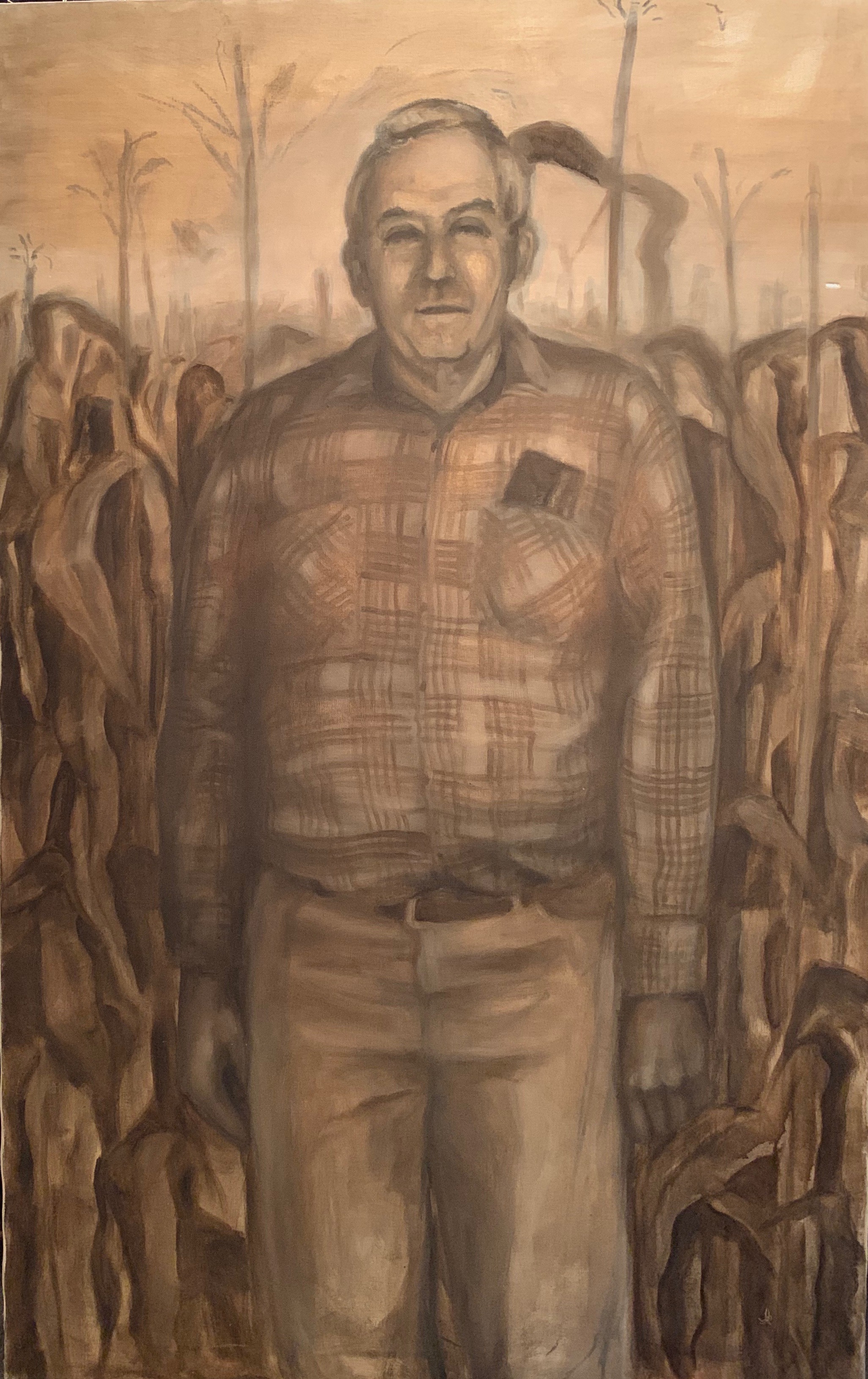
Many years ago, somewhere in the middle of the 1990’s, I painted a portrait of my dad. It is monochromatic and a fairly quick study. In the painting, he is either emerging or returning to the corn. Or both. I can’t remember why I painted him in the corn except that he was born in Iowa and wished his entire adult life to return to the small town where he grew up. Perhaps this is a painting about yearning. Perhaps it is a painting about returning home.

It occurred to me, when I found it while re-stacking paintings after the great studio flood, that I painted this when he was roughly the age I am now. For a fleeting moment I wanted to paint a monochrome self-portrait simply so I might place it across the room. We’d have a staring contest that reached beyond both of our lives.

I chucked the idea for many reasons but mostly because I had no idea what “field” I might emerge from or into? My symbolic return home would be…what? I am not connected to a single place, a tiny town in Iowa or, like Tom Mck, a ranch in California. I have been a wanderer.

I’ve always loved hands. They are, in many ways, more expressive than faces. They are not as guarded and rarely put on airs. My dad was a working man and has working man hands. He was proud of the work he did. It was hard and broke his body but he loved it. It was out of doors under the open sky. He started his career as a teacher and, although he never confessed as much, I think he hated teaching. The classroom was suffocating. He needed to get his hands in the dirt, feel the sun on his face. Even after he retired, as he aged, he sat on the porch in the mornings, he worked his garden or clipped his grass or cleaned his gutters; anything to be outside.

I had a dream many years ago that has stayed with me. My dad and I were free-falling through time. As we fell, he reached out his hand. I stretched out my arm, tried to grasp his hand, but in falling, we were just out of reach. In the dream I stared intently at his hand as I tried to extend my arm, tried to grasp his hand. I knew, if I was successful, if we could catch his hand, it might not stop our fall, but we, neither of us, would fall alone.

read Kerri’s blog post about COLUMBUS HANDS

Dance In Timelessness [on DR Thursday]

“We cannot struggle to be present. We can only discover that we are present.” ~ Declan Donnellan

The struggle to reach across the divide and grasp hands with the one that you love. It is a universal story. Yearning requires an obstacle to ignite the story.

I painted this for Kerri when we were attempting to bridge the divide. I lived in Washington. She lived in Wisconsin. During a visit, sitting in Adirondack chairs in her front yard, sipping wine and listening to music, we discovered that we were present. We danced in timelessness.

Obstacles become surmountable when love is on the other side of the abyss. We moved mountains and then dealt with the consequences.

It’s a rule that an artist should never tell an audience what a painting means, should never rob a viewer of their response, interpretation, and story of a painting. Sometimes it’s alright to break a rule. I painted this painting for Kerri. It’s about reaching for love across the divide, discovering the present, and the promise of dancing our way through the obstacles.

read Kerri’s blog post about DANCING IN THE FRONT YARD

dancing in the front yard ©️ 2013 david robinson

Add Another Layer [on DR Thursday]

Were you to meet my easel in a dark alley it would, no doubt, frighten you. It’s big. Substantial. Rough. Weathered from hard life. Knobby, bent and encrusted.

I see it with different eyes. It is one of my most sacred possessions. It was given to me, a gift of celebration, following the opening of my very first solo show. Prior to its arrival in my life I propped my canvas on chairs or tables, I leaned them against walls, kneeling to paint. My easel allowed me to stand.

Caked in charcoal and layer upon layer of paint, artifacts of the hundreds of paintings that it has held for me, I find it beautiful. It has traveled with me through many states and life stages. Its main support is bent. It creaks when I adjust the angle or drop the arm. It occurred to me this morning, as I rebuild my studio following the great flood, that I also creak when my angles adjust, when my arms drop. We’ve aged together.

In a life with very few constants, my easel has served as my single steadfast companion through every move, every triumph, every tragedy. It has stood with me when I was artistically productive and a barren wasteland. It’s listened to me rant, ramble, and recite. It’s been witness to my laughter and my fears. It has been the silent sentinel during my mini-deaths and slow rebirths.

This morning, as I carried my easel back into the studio, I realized how out-of-order my world has felt. If my studio is in disarray, as it has been since the flood, I am also in disarray. Returning my easel to its proper spot in the studio I felt a flood of relief. All of my pieces are nearly put back together again. My trusty companion, my reliable easel and I will soon stand together, paint will spatter, charcoal and matte medium will crust another coating onto our already layered archaeology.

Art hollers. Possibility beckons.

read Kerri’s blog post about the EASEL

Finish The Race [on DR Thursday]

We are nearing the anniversary of SHAYNE. As heart projects go, high atop the list of projects that mattered, sits SHAYNE.

One night, Kerri’s mom, Beaky, called in tears. Nearing the end of her life, she wondered what she’d achieved. A brilliant woman born in the early part of the 20th century, many roads open to a man were utterly inaccessible to her. She wondered, as Kerri said, “What comes after the comma behind her name.”

Decades earlier, Beaky had written manuscripts for three children’s books based on the family’s dog, Shayne. She’d submitted them without success to a publisher. Kerri searched the earth and found the manuscripts. In a matter of days, we illustrated and published the first in the series. We constructed a website, set up and publicized an author’s reading. Over 70 people came, complete with the press and photographers, to hear Beatrice Arnson read and sign her new children’s book. Her first sale was in The Netherlands so I teased her that she was an international author.

Beaky passed away 18 days after the event. The word, “author” followed the comma after her name. She saw the cover art for the second and third books in the series but never saw them published. In fact, we published the second book posthumously but have yet to publish the third. It’s been too hard.

And, each year, on the anniversary of the book signing, we revisit publishing the third book. We simply need to a take a week, lay it out (the illustrations are complete), and publish it. The anniversary we approach is not only about the publication of the first book. It is the closure, the lingering necessity, of publishing the final book and complete the race that we started more than 6 years ago.

Resolution. Conclusion. Completion. More than just words. A symbolic mountain that is very difficult to climb.

The books are more than just books. The illustrations are more than just drawings and paint. They are a dream come true. A gift from daughter-to-mother and mother-to-daughter; the best kind of love-loop. They are a word that follows the comma after a name.

read Kerri’s blog post about SHAYNE

Try [on DR Thursday]

The operative word in this Chicken Nugget is “try.”

To try is a verb, an action. It’s also a noun but the synonyms used in either variation are mostly the same: attempt, endeavor, make an effort.

Try. It’s such a small word but its impact is unfathomable. It is the defining line between intolerance and empathy. Empathy begins with trying to see what others see. Intolerance begins with refusing to try to see what others see.

Try. It is the epicenter of advise that every parent offers to their children. Take a crack at it. Why not put it out there. Give it your best shot. You can’t win if you don’t run the race. You’ll never know unless you try.

A verb. An action. Try. A noun. A way of being.

Try is the foundation stone of curiosity. Wanting to know, wanting to experience what is “just over there.” To see not only what others see, but why they see it.

I sometimes try to see the unbridled enthusiasm that Dogga sees in each and every moment. I try to see the world of unlimited possibilities that Dawson sees every time he touches a crayon or paint brush. I do not delude myself. My eyes are not so pure. But I try.

Imagine what we might do in this world if we only gave it a try.

read Kerri’s blog post about TRY

Prepare For The Jump [on DR Thursday]

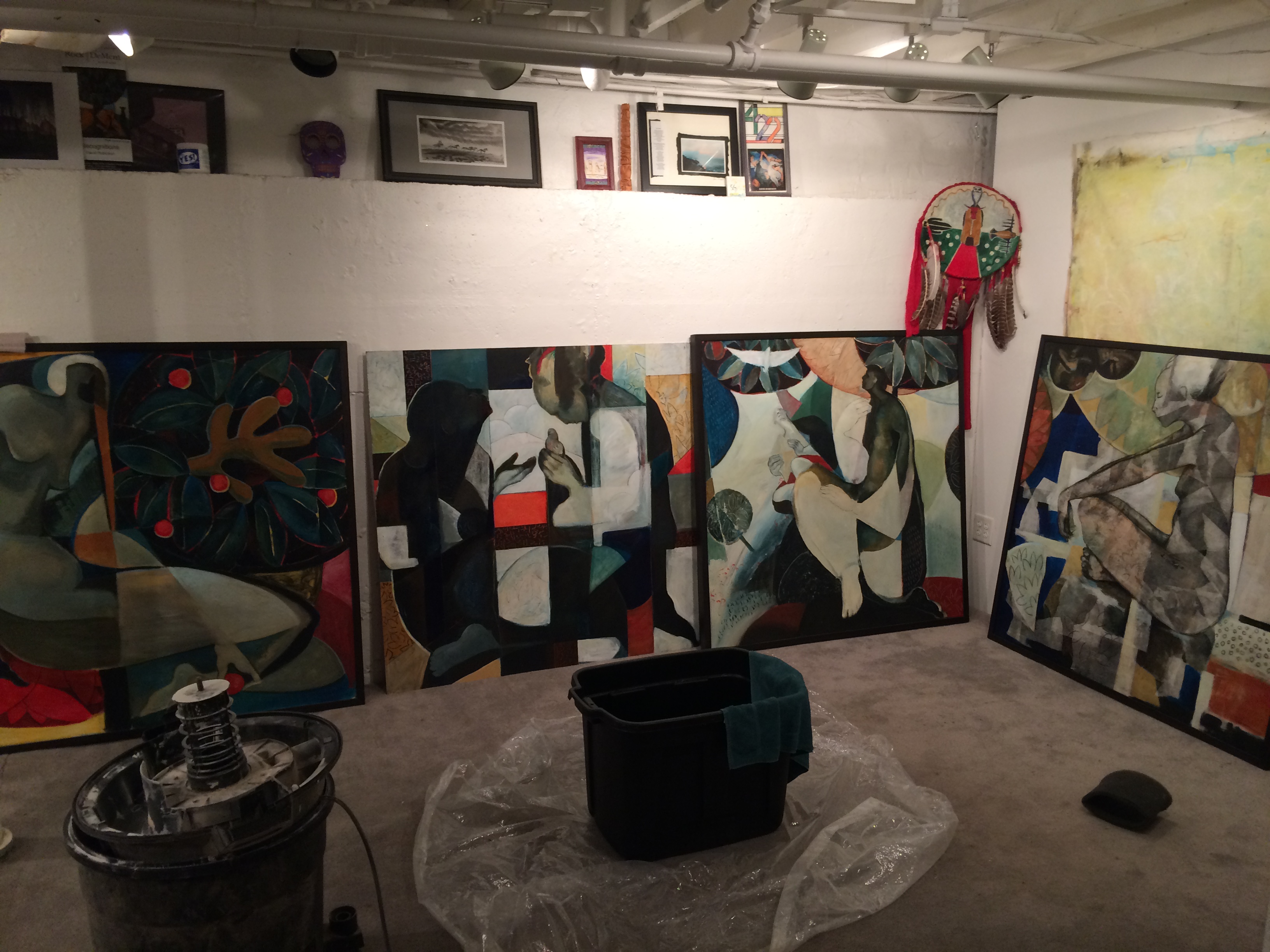
On the upside, an in-studio-waterfall, after the shop-vac-a-go-go, the sodden-carpet-padding-removal, the baking-soda-ballet, amidst the-we-are-still-hunting-for-the-proper-gasket-to-stop-all-leaks-quest, an opportunity arises. It’s been awhile since I sat with my life’s work. It’s been awhile since I made time to stare at my paintings, each and every single one.

I confess that this year has been rife with artistic mourning. I have barely picked up a brush. I have sat in my studio like a visitor at a wake. I feel the emptiness as a loss and have asked myself the fear-question again and again, “Where did it go?”

One of my favorite books is Art & Fear. Recently, I flipped it open and read, “Your reach as a viewer is vastly greater than your reach as a maker. The art you experience may have originated a thousand miles away or a thousand years ago, but the art you can make is irrevocably bound to the times and places of your life. Limited by the very ground on which you stand.”

A second flip brought me to this passage about change: “Yet it’s demonstrably true that all of us do (from time to time) experience such conceptual jumps, and while ours may not affect the orbits of the planets, they markedly affect the way we engage with the world around us.”

The times of our life. The world, for us, stopped when Kerri broke her wrists. She was in casts when the pandemic washed over all of us. Our jobs disappeared. Our community fragmented. Our city burned with civil unrest, a young militia-boy murdered two people a few blocks from our home. My father took rapid steps toward the abyss. Kerri took a second fall, tore ligaments in an already injured wrist. Our BabyCat left us. We talk about 2019 as if it was decades ago. “Doesn’t it seem like years since we…”

I know this death I feel will find its springtime. There was a “me” before this time. There will be another “me” after. Sitting on the stairs, looking at my paintings, I know for the first time in a-year-that-feels-like-a-century, that a conceptual jump is bubbling. I remember the man who painted these paintings. I look forward to meeting the man who will one day pick up his brushes and dance with the muse again.

In the meantime, I sit with my paintings. I stand in the ground of my times. I will find the right gasket so water no longer rains into my studio. I will prepare for my jump by putting all of my pieces back together again.

read Kerri’s blog post about THE WATER STUDIO REVIEW