Celebrate The Symphony [on Two Artists Tuesday]

The return of the frogs. No, it’s not the title of a b-grade-horror film. It’s one of our favorite rites of spring. Their chorus is deafening, a sound celebration of the season’s cycle into renewal. We look forward to and celebrate the day of their return.

A short month ago we walked across a snowy field, still a bit in shock at the scrape-clearing of the tall grasses and brush. Broken bits of stick and root poked through the snow. The picture of devastation. In just a few short weeks, the field became a bog – evidently the perfect performance hall for the musician-frogs signaling life’s return with their playing.

They’ve always played in this spot along the trail but this year their symphony is made particularly poignant by the seeming wreckage of their environment. This year, to our ears, they perform a rousing song of perseverance. A composition of resilience.

They’ve also awakened a question in us. We ask it every year but this time it is made more mysterious because the bog is exposed. We can see everything except the frogs. The air is alive with sound while the water is still. We’ve stood, awash in the noisy vibration, yet can see nary a ripple in the surface.

How is it possible to shake the limbs of trees with joyous sound without disturbing the fen? The musicians are invisible.

There can only be one explanation: They are magic, these frogs in their spring renewal, popple-free playing while stirring our hearts and imaginations.

read Kerri’s blogpost about FROG BOG

Sing Red! [on Not So Flawed Wednesday]

We were awake much of the night so we ate bananas and talked. Our conversation rambled over miles and covered acres of territory. In the wee-hours, Kerri explained to me the compositional elements of a symphony, the placement of a solo in a piece, and the foundational support offered by the other instruments. In other words, it takes a village to raise a solo.

There’s a famous story of Leonardo Da Vinci, paintbrush in hand, staring all day at his mural-in-progress. Finally, after hours of staring, he approached the wall and added to his composition a single brushstroke. If you are a painter you understand that the story is not about the single brushstroke but where it was placed. Color lives or dies relative to other color. Leonardo spent his day assessing relationships.

We are new gardeners. It may seem silly to expert growers, those who’ve been around the farm a time or two, that through the fall, we jumped out of bed every morning, ran to the kitchen, to see our cherry tomatoes. When we pulled the plants at the frost, the vines were laden with green tomatoes. Not to worry, Kerri told me; put the little green orbs together in a sack (ours landed in Tupperware and never left because we delighted in watching them) and they will make the journey to red. They’d help each other to ripen. And so it was. Each day the palette changed until, one day, the entire tomato choir sang red. I am filled with wonder.

It is a cliche’ that every great journey begins with a single step. A single step and lots of encouragement. A single step and a team of support. Explorers need financing. Too often we place the accent on the single player and ignore the symphony. We get a big kick out of the crowds of individuals standing in line to stand atop of Mt. Everest, thrusting their hands like Rocky Balboa in the very-thin-air, playing conquerer of the mountain, forgetting that a Sherpa carried their gear, set up their tent, cooked their food, set their ropes, tended their wounds, warmed their tea, hauled away their waste and sometimes carried their bodies back down when they couldn’t make the round trip.

No one walks this walk alone. Individualism is like Leonardo’s brushstroke: it only works if it furthers community, when it makes life better for all. How’s that for a paradox!

We are tomatoes, all. Green and small by ourselves. But when brought together in our little Tupperware crossroads, red, red, red, red, red!

read Kerri’s blog post about TOMATOES!

Reach Back [on DR Thursday]

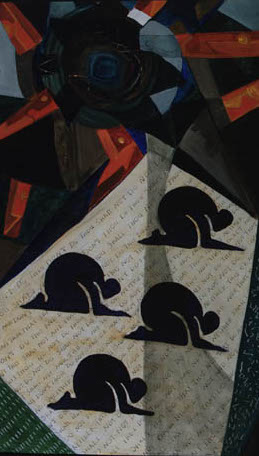
prometheus resurrection morsel copy

Artists are constantly reaching backward and forward through time. They daily pay visits to the work of the masters. They periodically revisit their own past creations. Their work sends ripples of inspiration and opportunity far into the future.

When Beethoven was young he wrote a ballet called The Creatures of Prometheus. It calls for a legion of dancers and is way too big for most contemporary ballet companies to attempt. Contemporary symphonies, on the other hand, desire to play the music because Beethoven, for the rest of his life, reached back into his ballet, mining for musical phrases, developing some of the phrases into his most famous work.

How to play the music from a ballet written in 1801 as a symphonic piece in 2009?

Yaacov Bergman, the visionary and laughter-filled director of the Portland Chamber Orchestra had an idea. Why not tell the story of the ballet. A storytelling would provide the connective tissue, weaving the music together into a cohesive symphonic performance. Because Beethoven wrote a ballet, 207 years later, I had the great good fortune to write and perform the story of The Creatures of Prometheus with the PCO.

And, since we were crossing time boundaries, why not cross a few artistic genres, too.  Yaki hired artist Liz Gil-Neilson to paint and produce a visual storytelling that was projected during the performance. Music, storytelling, contemporary visual art. Ripples, ripples, everywhere.

But, that was not enough. Since I am also a visual artist, Yaki asked that I translate my story into a visual statement. So, I painted three large canvases (Creation, Garden, Resurrection), one for each movement of the symphony, that hung with Liz’s original images during run of the symphony at the George Broderick Gallery in Portland.

Reaching forward. Reaching back. Today, more than a decade after our collaboration, I mine my experiences and paintings for inspiration. As new collaborations arise, as I stand at the base of a new series of seemingly impossible tasks, I’m fortunate to have my Creatures of Prometheus to remind me of the possibilities. They nudge me forward.  Like Beethoven, I reach back into my past work to find a path forward.

It makes me smile to know that in 1801 Beethoven, with a quill pen and ink, scribbled notes at his desk and those scribbles turned into dances and symphonies that inspired stories and paintings and a wacky multi-media collaboration (a phrase that did not exist during his lifetime). And more: a morsel image digitally altered for a blog post written on a computer keyboard. Pen and ink are hard to come by. Reaching backward. Reaching forward.


read Kerri’s blog post about Prometheus morsel


arches shadows k&d website box copy


prometheus resurrection ©️ 2008 david robinson

Imagine Peace [on KS Friday]

peace song box copy

When I first met Kerri I was still pitching ideas to Yaki, a conductor/artistic director of  symphonies. We’d created a few projects together. Yaki is a visionary, one of my favorite past-collaborators. He knows that symphonies, like all performing art forms, must reinvent themselves to attract the next generation audiences. Our projects were rooted in both new and traditional compositions. They were multimedia story-tellings, explorations of arts crossing disciplines.

So much of Kerri’s work lends itself to a symphony. Listen to the strings in PEACE! There is a cello line that  breaks my heart every time I hear it. I sent PEACE to Yaki with two statements and a question: Listen. Imagine the possibilities. What could we do?

It was a different time then, or, perhaps, it is a different time now. Have we ever needed peace more than now? And so, on KS Friday, I send you this PEACE with the same two questions I asked Yaki but with a much greater imperative: Listen. Imagine the possibilities. What could we do?


PEACE on the album AS IT IS available on iTunes & CDBaby


read Kerri’s blog post on PEACE


www.kerrianddavid.com


peace/as it is ©️ 2004 kerri sherwood