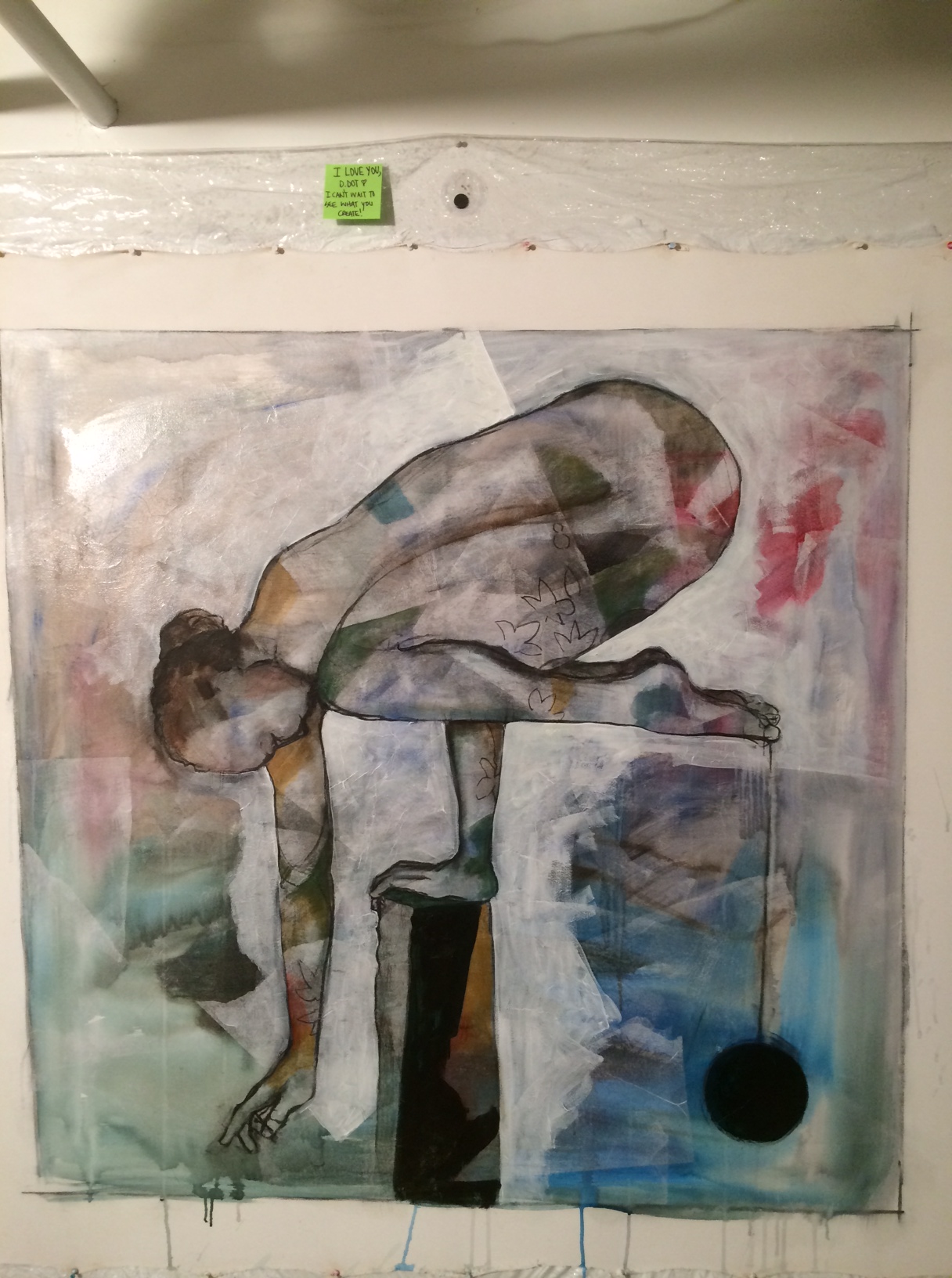
Be An Instrument Of Peace

I asked Kerri which of my recent paintings most accurately represented me as an artist. I was building a new website and wanted my home page to highlight a single painting. Without hesitation, she said, “The one titled, He’s A Stubborn Pain In The Ass.” I’d have protested but I knew my protests would be drowned out by her gales of laughter.

When she could breathe again, she said, “Use ‘An Instrument Of Peace.’ It’s the painting that best defines you as an artist. It’s what you bring.”

I am always excited to enter the studio to work because, for me, it is a place of peace. It is THE place of peace. And, as such, it is the place of clarity. When painting, my mind is silent. Peace is a quiet place. It is dynamic, immediate.

It’s a paradox that I enjoy. Peace is more practical than paradise. It lives beyond the turmoil of story and ideals and points of view and resistance. It lives beyond thinking and striving in any form. It is methodical-miraculous.

Horatio and I have often talked of entering the studio and disappearing into work, of becoming present. In other words, we stop ‘becoming’ entirely and simply ‘be.’ The epicenter of the paradox: creating in the absence of striving. It sounds like an ideal, doesn’t it? It sings like an impossible hippie aspiration or a Bob Dylan lyric. The Buddhists have a shorthand phrase for this practical peace: chop wood, carry water. In other words, it is not found in what you do. It is enlivened by how you are within what you do.

Krishnamurti wrote that if you want peace in the world you first must be peaceful. The phrase, Be Peaceful, is appropriately redundant: you will be peaceful if at first you learn to BE.

The trick, as someone once taught me, is to make all the world my studio. After all, it is not the place, not the studio. It is me. I can’t think of anything I’d rather bring to the world than to create as an instrument of peace, to –maybe- be an instrument of peace.

The new website: davidrobinsoncreative.com


Appreciate It

#5

#5 in the process shots

Spring came fast. At this time last week there was a four-foot drift of snow on the back patio; it was Tripper Dog-Dog-Dog’s favorite plaything, leaping in and out of the snow monster. Today, a mere seven days later, the monster is gone, the back yard is snow free. Dog-Dog has already found a new favorite game: plucking leaves floating in the pond and then racing the circumference of the yard as if the newly plucked leaf was valuable treasure.

John’s dad passed yesterday. His passing was both sudden and not a surprise. His dad was an artist, a brilliant painter, and the celebration of his life will include much of his life’s work. “That’s what he would have wanted,” John said. After the call with John, Kerri looked at me and said, “There’s no time to waste.” Life happens so fast.


#6

#6

I went down to the studio and worked (yes, Skip, these are the next two process shots and the sketch;-). While I worked I listened to Kerri’s album, This Part Of The Journey. She came down to see how the painting was progressing and heard her music. She asked me to listen to a moment, a swelling of the strings, and told me of the day she and her producer mixed the track. It is a moment of music that can break your heart or make you yearn for home. “This is a piece I wrote for Wayne,” she said. Wayne was her brother; cancer took him many years ago. We listened in silence, appreciating the fullness of the moment, appreciating the power of her music, appreciating the painting that was emerging; appreciating life happening.

photo-4

from the sketchbook.


Make A Pie

Taking  a walk with K.Dot and Dog-Dog

Taking a walk with K.Dot and Dog-Dog

Stay with me. This post is not nearly as curmudgeonly as it might first appear.

Many years ago I was directing a play in Santa Fe. It was the week before Halloween and I went into a coffee house. I was taken aback to find the place decked out for Christmas. Since then I’ve kept a running count of the first day in the fall that I see Christmas appear in the shops. As you might have guessed, it is earlier and earlier every year. This year’s arrival date: October 3rd.

I laughed out loud this Thanksgiving season when I heard an advertiser shout that, this year, Black Friday begins on the Monday before Thanksgiving. The whole week is black! Mark my words, next year Black Friday will begin on the Friday before Black Friday. Soon, the month of November will be decked in black while also decking the halls.

As has become our national custom, the midterm elections began the day after the last Presidential campaign and the new Presidential campaign began the day after the midterms. Are we never out of an election cycle (a rhetorical question)? It is the only example I can cite in which politics is running ahead of the rest of the advertisers.

I’ve not had a television for a few years so I’m a bit behind the wheels of progress. This morning, as we made pies, we turned on the Thanksgiving Day parade and I was wide-eyed with wonder that the entire affair is now a not-so-veiled advertisement for products, television shows, and musicals on Broadway. Along with each float came a cut-away commercial for the sponsoring company (I learned how to bake a lot of new desserts and was prompted more than once to rush out and get the ingredients NOW). Even the shots of Al-in-the-crowd were interviews, not with the crowd, but with celebrities; I heard when their show airs, and learned what their character might eat on this holiday and be grateful for if they were not imaginary. I was also prompted to text the network and tell them what I might be grateful for so that I might feel a sense of participation.

Take a step back. There is so much noise. There are so many competitors for our attention. I read that our attention spans are shrinking and how could they not shrink (or flee into hiding) under such an unceasing assault. Apparently with a shorter attention span it takes longer and longer to get our attention. I can’t help but think it is all stuffing and no bird.

Each year I work with people actively seeking for meaning or purpose. They tell me that something is missing in their lives. The pattern is to purchase-for-fulfillment but commerce makes for a lousy core and inevitably shows its true colors as a temporary numbing agent or distraction. And that’s the point. Seekers cease seeking when they learn where to place their attention. They step out of the noise cycle. Instead of navigating the noise they simply turn it off and take a walk or a nap. Instead of texting the network they look at their loved ones and say, “Let’s make a pie.”

title_pageGo here to buy hard copies (and Kindle) of my latest book: The Seer: The Mind of the Entrepreneur, Artist, Visionary, Innovator, Seeker, Learner, Leader, Creator,…You.

Intend And Forget

I have many titles for this painting and have used it a few times for posts. It is ultimately about intention and inner guidance.

I have many titles for this painting and have used it more than a few times for posts. It popped up for me again today. It is ultimately about intention and inner guidance.

I just finished writing this post and realized that, in many ways, this is the continuation of yesterday’s thought: clear the mental static and the channel to full expression opens. So, here is part two of my meditation on inner static:

John and I were having a conversation about the passage of time. He told me that he’d recently found some old lists that he’d written of life goals and intentions. The interesting thing about discovering the lists was 1) that he’d forgotten writing them and, 2) that he’d achieved most of what he’d written. He said, “The form of what I created was different than what I’d originally imagined but I was surprised to see that I’d actually created what I intended.” It was as if he had to write the intention in order to activate it. Forgetting the intention was necessary to give it space to manifest and grow. Write and forget.

When I was first training as an actor, late in every rehearsal process, my teachers consistently advised that we let go of everything we’d rehearsed and just show up. “You’ve done your work,” they’d say. “Now, let it go and trust.” Many years later when I was directing plays and teaching actors I gave the same advice. “Let go and trust. You’ve done your work. All that remains is to be present.” From the teacher/director seat, the moment of letting go is palpable; you can literally see and feel the phase in the process when an actor needs to let go of their work to come alive. They need to get out of their own way. They need to get out of their head and give all of their focus to the relationships on the stage. The work moves from the head to the body. It is this last step that transforms their study to a living pursuit. Forgetting the work creates spaciousness and allows the art to happen. Art is always about relationship and great art happens when the relationship is clear and expansive enough for all comers.

One of the most profound lessons I gained from my time in Bali concerned this dynamic connection between setting an intention and letting it go. While I was on the island my internal monologue disappeared; one day I realized that I was completely quiet. Thought was a choice and not a plague or chattering background noise. Silence was simple when no story was necessary, when no interpretation was needed. In the middle of that silence I could set an intention (“This is what I want to do/find today”) and then forget it. Before the day was over I would have found what I intended. The steps came to me; I did not have to seek the steps. Sometimes the intention was simple and sometimes seemed complex but that didn’t matter. If I clearly stated what I wanted and returned to silence the necessary coincidence always found me. I felt as if I could see the pieces on the game board moving on my behalf. There was no internal noise to compromise my intention so there was no external discord confusing my choices. I was conscious of my connection.

Alan calls this co-creating. Work with the energy and cease trying to force things to happen. John told me of his lists and I wondered how many people have had the same experience. We make lists, we try to make the list happen, life gets in the way and we forget. And, in the moment of forgetting, we relax our grip on how we think things need to happen. We forget the form and inadvertently open to possibility. In the forgetting we create the steps necessary for fulfillment: spaciousness, trust, and quiet participation.

Go here to get my latest book, The Seer: The Mind of the Entrepreneur, Artist, Visionary, title_pageSeeker, Learner, Leader, Creator…You.

Go here for hard copies.

Allow The Silence

698. Join me in inspiring truly powerful people. Each day I will add a new thought, story or idea to support your quest and mine.

“After silence, that which comes nearest to expressing the inexpressible is music.” Aldous Huxley

There are few things more satisfying to me than closing the studio door, picking up a large brush, turning the up the volume on the music, and giving over to the forces that want to find expression through me. The night before my latest trip, without really meaning to do it, I turned from my computer, saw the canvas stapled on the wall, and the next thing I knew several hours had passed, the music was rattling the windows, and both the canvas and I were covered in paint (it’s why I stopped buying new clothes…). It had been too long since I gave myself over to the call.

I used to draw everyday. It was my practice, my imperative. In recent years I’ve moved on to other practices. I write. I facilitate. I walk. I find the quiet. And then, like a starving man who stumbles into a feast, I disappear without warning into a painting gluttony. It is a different kind of quiet, ferocious, vibrant, and necessary. There is no thought; my body takes over and the painting comes through: silence in the center of a hurricane of movement and sound. When finally I step away from the canvas and come back into my body, I discover an image in front of me. It is less correct to say, “I did that,” and more correct to ask, “What just happened?” I’ve spent hours of my life standing in front of paintings that I just painted, thinking, “Whoa. Look at that!”

Once, many years ago, Jim looked through all of my recent work and asked, “What is the significance of the three balls in your paintings?” I had no idea what he was talking about so he pulled out of the rack ten paintings, lined them up, and showed me that each had three balls as if some unseen figure was juggling them. I was gob-smacked. I studied the paintings for a few minutes and said, “Whoa. Look at that!” Jim laughed.

The silence is not empty; it is full. It is rich and vibrant. The silence is what happens when we get out of our own way, open to the forces, and let them come through. Words like “art” or “transformation” or “perspective” or any other word can’t contain all the meaning that becomes available when we learn to step out of the way and allow the silence.