Diversity Defines Us [David’s blog on Two Artists Tuesday]

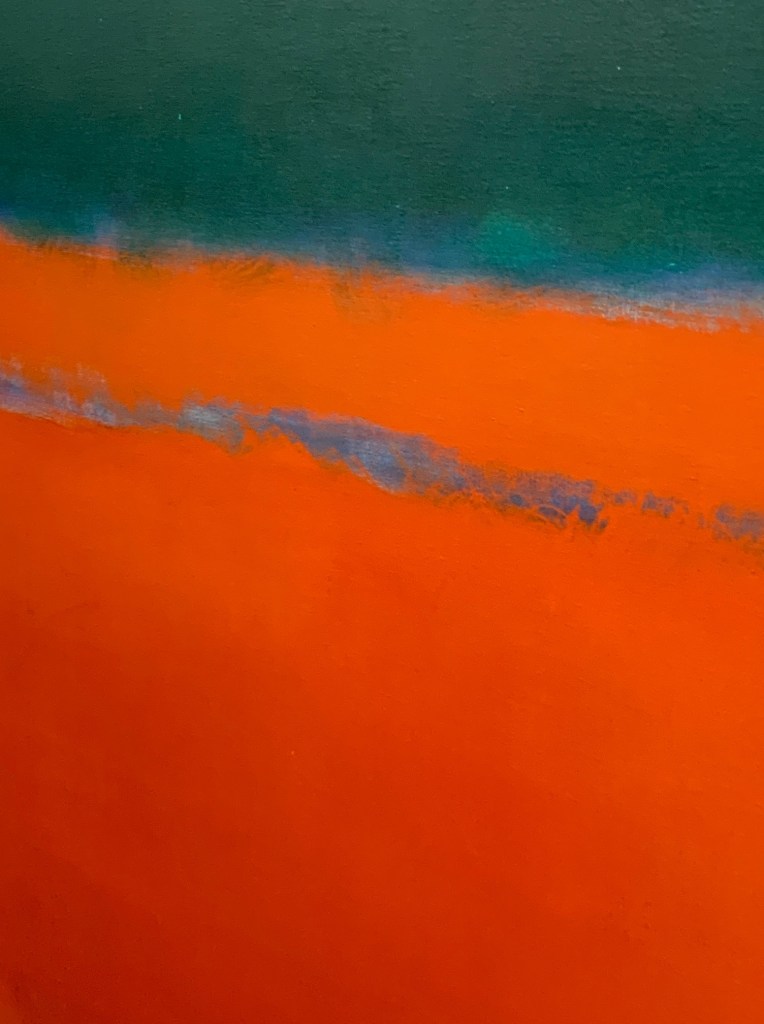
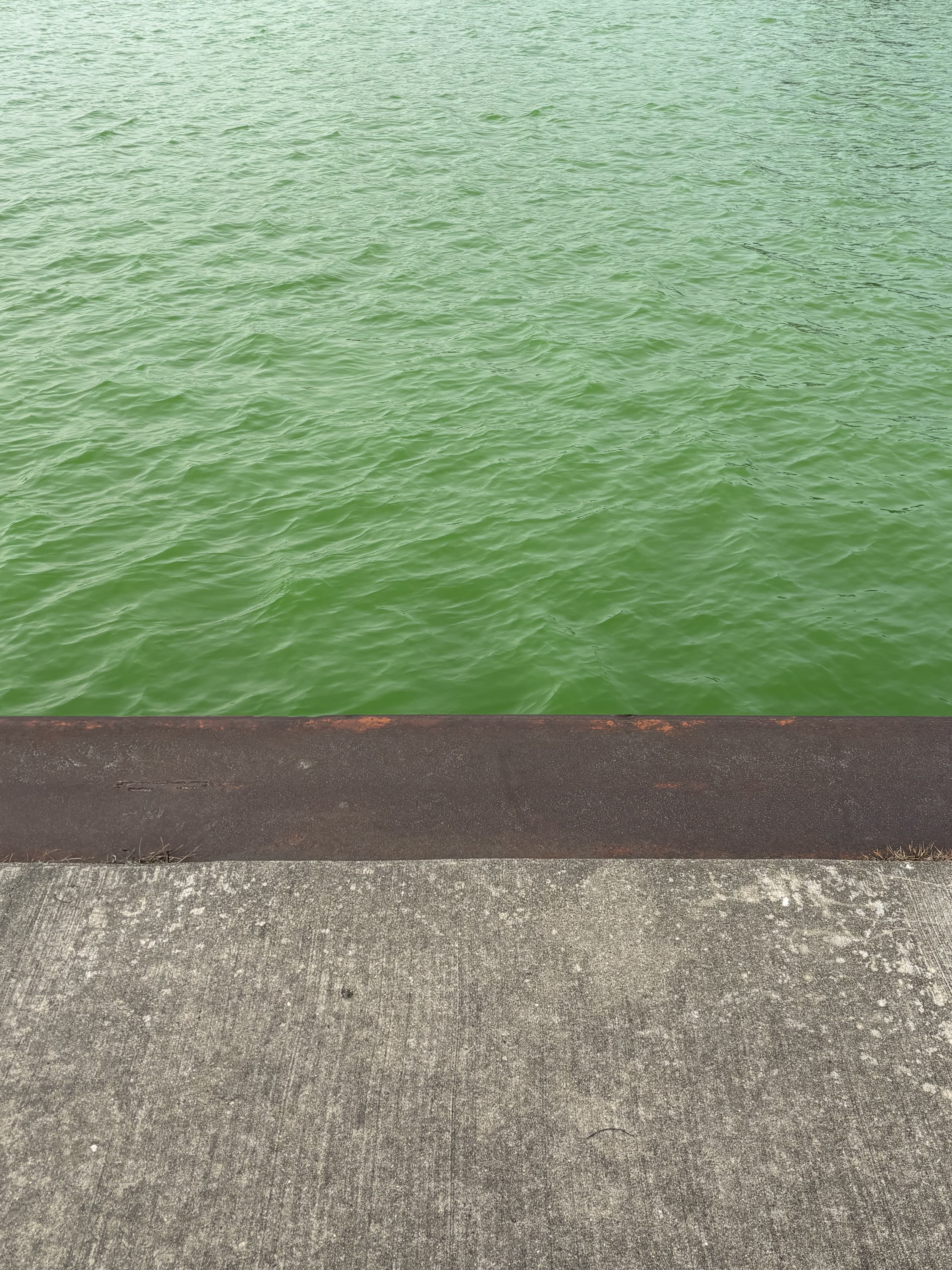
We called this photograph the “Irish Rothko”. Mark Rothko was one of the great American painters of the 20th century. His paintings are in museums all over the country and around the world. It’s important in our times to recognize that he was born in Latvia. The great American painter was an immigrant.

We heard the channel to the marina was dyed green for St. Patrick’s Day so we bundled up and scurried to take advantage of a clear photo opportunity. While Kerri snapped pictures I pondered the potato famine. The marina was dyed green on this day in 2025 in the USA because 180 years ago over 2 million Irish people fled starvation to find hope in a new land. Immigrants. St. Patricks’s Day is a celebration of the promise of The United States. I’m fairly certain that the vast majority of people all over the nation drinking green beer, sporting shamrock pins and wearing Leprechaun hats were not themselves Irish. Americans of Italian, German, Scandinavian, Japanese, Chinese, Mexican, Nigerian, Egyptian, Indian, Turkish, Indonesian…descent, hoisted frosty green beverages. Americans, all.

We are a diverse people. Our diversity is what defines us. We regularly celebrate each other and our diversity whether we realize it our not. We are a strong weave from many origins, many races, many religions. We are weakened when we pretend that one fiber is better than another.

I suppose it’s possible to attempt to scrub any mention of DEI. It does not change the reality of the nation. It does not alter the driving imperative of the nation: amidst such a diverse populace to forge an equal, conscious and considerate society. We’ve managed to make buildings wheelchair accessible, begin addressing the disparity of pay for women, with civil rights laws we walk into the hot fire of inequality…all aspects of diversity, equity and inclusion. People with disabilities should not have barriers to workplaces. Women should not be paid less than men for equal work. People of color should not be excluded from opportunities because of the color of their skin. Gay men and women should have the same rights as heterosexual men and women.

Striving for equality makes us strong. It is the necessary ongoing conversation of our nation.Forced inequality makes us immoral, corrosive, and weak. Trying to end the conversation is spineless.

The work of equality takes courage and perseverance. As we are seeing, it is possible to issue an executive order to end the efforts of a diverse nation to forge an equitable society, it’s possible to brand those efforts as “illegal”. It is, however, impossible to stop it. Unity fashioned from rich diversity is the center of our national ideal and is the basic reality of our society. After all, it is the nation’s motto: E pluribus unum. Out of many, one.

It’s definitely possible to suppress people. It is possible to bully and terrorize people. It is possible to legislate a delusion. It is possible to manufacture enemies. It is possible to pretend that the people at the top of the hierarchy are somehow being victimized and blame efforts at equality as the culprit. All of that is possible. It does not change the self-deception, the corruption and lies necessary to do it.

It is the height of cowardice to scrub white the identity of this diverse nation – as this administration is attempting to do. And, if not cowardice, it is pure malfeasance. To obtain the goal of white supremacy the despot-wanna-be must make our democracy disappear – as this administration is attempting to do. The demonization of DEI is the epicenter of their ruse: Those poor old rich white guys have been so completely abused by laws protecting equality for all. Those sad despairing right-wing Christians who cannot display their nativities on government property have suffered tremendous religious persecution. Apparently, the separation of church and state should apply to everyone but them! It’s discrimination of the first order! And DEI is to blame! (It would be laughable, really, if it were not now so dangerous).

In nature, diversity is strength. In the USA, as in nature, our diversity is our strength.

Mono-cultures are vulnerable and readily eliminated. The Irish potato famine is an example of what happens when a people rely too heavily on a single crop. When it fails – as a mono-culture inevitably does – many, many people die.

We have never been a mono-culture. We will never be one. Pretending to be a white-male-mono-culture will echo nature and lead to culture collapse. No amount of legislating lies or embellishing white-victim-fantasies can – or will – change it.

read Kerri’s blogpost about IRISH ROTHKO

likesharecommentsupportsubscribe…thankyou

A Different Understanding [David’s blog on Not So Flawed Wednesday]

Sometimes color stops me in my tracks. The color of a sunset. The color of a canyon. The color of a flower. This hot coral coneflower stopped all engines.

David Hockney is a colorist. Henri Matisse. Judy Chicago. Piet Mondrian. Sonia Delaunay. There are so many painters whose use of bold color, like the coneflower, stops me in my tracks. Ellsworth Kelly. Mark Rothko.

With my love of color you’d think I’d be a colorist painter. Although I’ve had my moments, mostly I sort to earth tones. The neutrals. Once, a viewer of my painting, Unfettered, asked “Were you going for stone?” I wrinkled my nose and let the question hang unanswered.

Many years ago I mimicked David Hockney’s colors. I pushed myself to live in vibrancy. I loved the exploration but was rarely comfortable living in so much visual enthusiasm. I am too much the introvert to comfortably scream from my canvases.

I just washed over my latest painting, County Rainy Day. Kerri was appalled but I’d veered off course and hit color saturation too soon. I needed to reset. I generally work things out in process – instead of doing studies – so wiping off or washing over a canvas is not unusual. Like Kerri, John K used to chastise me, too, saying “Do versions or variations!” Versions and variations are expensive and I’ve rarely had abundant resources in my life. Every action has a history.

Recently Andrew Wyeth has once again caught my fancy. I’d never suggest that he is not a master of color – he is – but his paintings tend toward the neutrals. He captures something deeper, his visual language is as much that of a poet as a painter. A different understanding of color.

I imagine that, like me, on his daily walk, the color of a coneflower or the shape of a leaf stopped him in his tracks. And, one way or another, that startling moment of appreciation found its way into his heart and onto his canvases.

reset: County Rainy Day (detail)

read Kerri’s blogpost about SALMON CONEFLOWER

like. share. subscribe. comment. support…thank you.

Walk The Path [David’s blog on DR Thursday]

It’s been awhile. I’ve fallen into an art book, Ancestral Modern: Australian Aboriginal Art. I bought this book after attending the exhibit at the Seattle Art Museum. It was – and still is – one of my favorite exhibits, reaching me on many levels. I went back again and again so I might spend quality time with a few of the paintings.

The paintings of the Aboriginal artists are mythologies, though not as we think of mythologies. They are more than dusty stories. Explanatory. They are active guides on a life path. Were I Aboriginal I’d “read” them. I’d know the stories so each piece would speak personally to me. The paintings would escort me along my life-path. Mythology as my story.

This is what amazed me most: many of the pieces were as abstract as a Rothko or Frankenthaler. Vibrant lines and color. They shimmered. Dreaming. Living foundational narrative carried in energetic swirls and dots of paint.

In my experience it is not uncommon in a gallery or museum to come across someone puzzling over a painting by a master artist and hear them say, “I don’t get it.” The abstraction is a closed door. “I could do that,” I heard a man huff while staring intently at a Jackson Pollock painting. The door is not closed between the Aboriginal artist and his or her community. The mythology has not broken down. The artist is not exclusively serving an individual expression, rather, they are maintaining an ancient connection, drawing from and carrying forward the deep well of communal story. “Meet Blue-Tongued Lizard Man…” Artists paying homage. Artists serving their role as keepers of the flame.

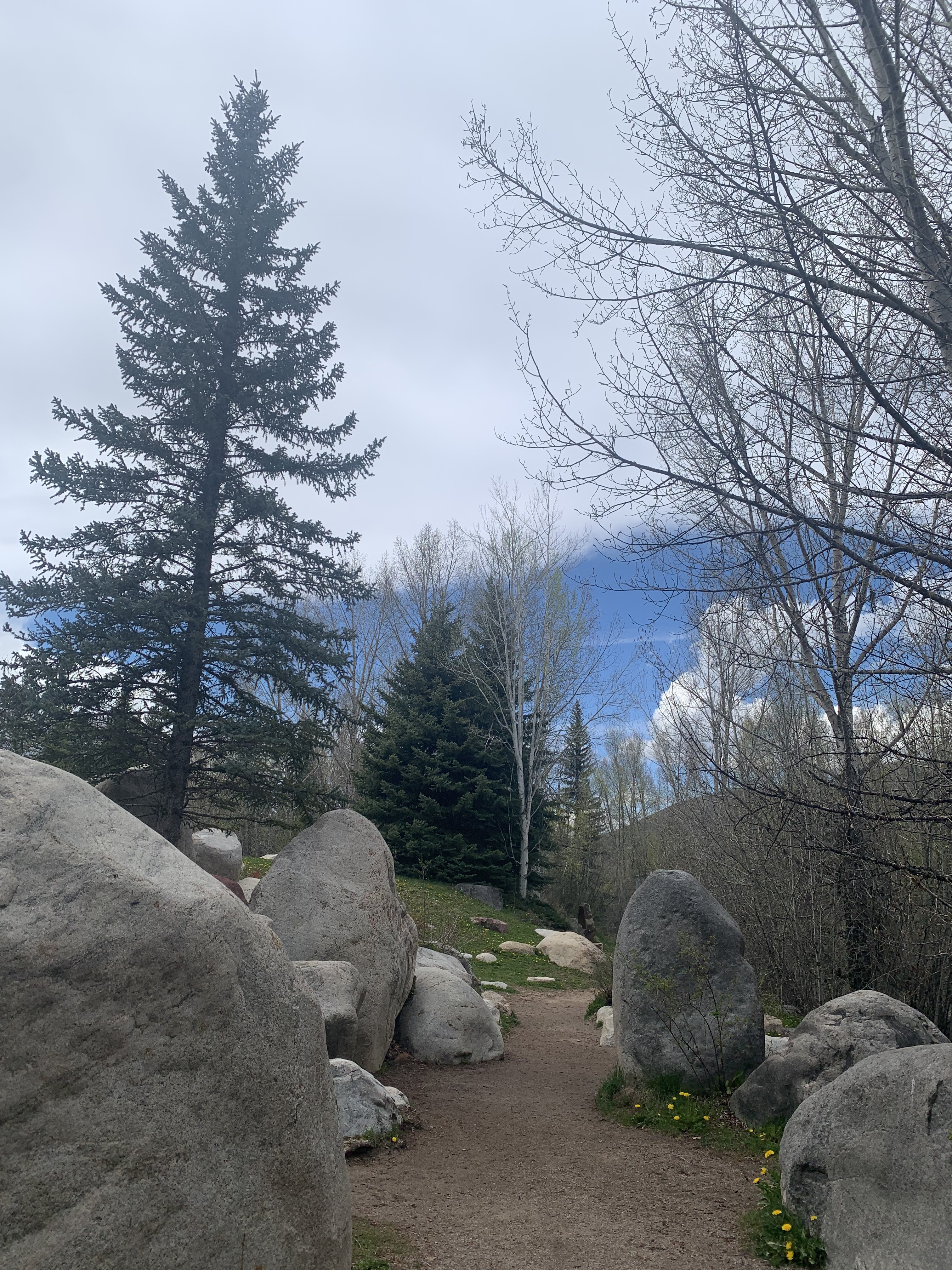
Kerri and I talked of our artistry as we walked the paths of the John Denver Sanctuary. He was a guide-star for her and continues to influence her work. Simple lines. Music that does not rely on acrobatics or embellishment. It was poignant that we had the sanctuary to ourselves. Sometimes it is nearly impossible to know whether or not our work-in-the-world reaches anyone or serves any real value beyond satisfying our imperative to create it. And sometimes, like that day walking the path through the sanctuary, the clouds rolling over the mountain, the Roaring Fork River singing at our side, the ancestry is clear. “This is where I come from,” she said. “This is where I belong”.

read Kerri’s blogpost about THE PATH

like. support. share. comment. subscribe. thank you.

Edge Of Time [David’s blog on KS Friday]

It was here for a moment. The snow on the wall. The tall grasses bowing beneath the weight. Today the grass is standing. Time moves on. Circumstances flow and change.

Yesterday we sat at a counter in the Public Market and ate gumbo. Kerri and the server, a young woman, talked about the oddities of aging. It was Kerri’s 65th birthday so the topic was vital and current. Both women laughed at how out-of-sync they feel relative to the number of their spins around the sun. “What is this supposed to feel like?” they asked in unison. The old man sitting next to us almost spit out his salmon.

We arrived at the art museum an hour before closing. She said, for her birthday, she wanted to visit her boys: Richard Diebenkorn. Ellsworth Kelly, and Mark Rothko. We sat in front of the Rothko for several minutes and I swear, like a good wine, the painting opened. The longer we sat with it the more it beckoned. The richer the color became. “I wish there was a bench in front of Richard,” she said. She loves her other boys but Diebenkorn is her favorite.

On our way out we stopped by the enormous Anselm Kiefer painting, Midgard. The mythical serpent doing battle at the end of the world. It’s a metaphor in darkness: cycles of renewal amidst constant destruction. A crucible. I always visit Anselm as he is a favorite of my friend David. I sent him a photo of the painting and realized that it has been almost eight years since I have seen him.

Catching a glimpse of my image in the window and not fully recognizing the man that looked back, I said, “This time thing is crazy.” She squeezed my hand.

“Tell me about it,” she said. And then asked, “So, what’s the next part of our adventure?”

Boundaries/Right Now © 2010 Kerri Sherwood

Kerri’s albums are available in iTunes and streaming on Pandora and iHeart Radio

read Kerri’s blogpost about SNOW

comment. share. like. support. subscribe. thank you!

Check The Resale [on KS Friday]

“Although Rothko lived modestly for much of his life, the resale value of his paintings grew tremendously in the decades following his suicide.”

The premise of this sentence made my jammies bunch-up. This wiki entry might have been written about Van Gogh. “Lived modestly” is a euphemism for “poor.” My favorite stereotype: the poor artist.

William Blake also lived modestly; he’d be shocked at the “resale value” of his work now. Nothing brings valuation to an artist’s work like the sudden end of the supply. Blake’s life came to a natural conclusion, so at least there’s that.

How do we know something has value? Resale, of course. Commodity. Soul reduced to a bottom line.

.003 percent of the nation’s budget goes to the National Endowment for the Arts. Valuation. If you desire to truly understand the phrase, “lived modestly,” visit your local not-for-profit arts organization. They’ll heap sincere gratitude upon you if you donate a ream of paper.

As an exercise in understanding soul, ask an actor or painter or dancer or composer the most obvious question: why do you do it?

Their answer will have nothing to do with resale value or commodity. Keep in mind, that doesn’t mean that they don’t want to be paid. Imagine Van Gogh’s answer. Or Mark Rothko’s. Emily Dickinson’s. Wouldn’t you love to know what they knew, see what they saw? Attempting to stand in their shoes, to see what they saw, is the reason that their resale value is so high. They connect us to something greater than commodity.

A caution: the next time you ask yourself, “What’s it all about?” be careful to direct your question to your inner Mary Oliver rather than your inner Elon Musk. They serve remarkably different gods.

My favorite quote of late: “And while a hundred civilizations have prospered (sometimes for centuries) without computers or windmills or even the wheel, none have survived a few generations without art.” David Bayles & Ted Orland, Art & Fear

.003%. That equates to an amount far less than Jeff Bezos’ tax bill. As a percentage, that’s much more than Kerri gets paid for a single spin of one of her pieces on your favorite streaming service (.000079 of a cent). Spotify, Pandora, and the rest are making out like bandits while the independent artists continue to “live modestly.”

What’s the real value of a nation that so desperately undervalues its art? I guess we’ll just have to wait for the postmortem resale.

Kerri’s albums are available on iTunes and streaming on Pandora

read Kerri’s blogpost about ROTHKO

every breath/as it is © 2004 kerri sherwood

Choose The Lesser Chaos [on DR Thursday]

“If I choose abstraction over reality, it is because I consider it the lesser chaos.” ~ Robert Brault

And what isn’t an abstraction? Dealing with ideas rather than events? Not-the-thing-but-is referential-to-the thing?

Every word in every language is an abstraction. Every thought that zips through every brain is an abstraction. Not the thing but referential to it. The word “chair” is not a chair.

I caught myself in a sticky net. Not once, several times. I’ve tried again and again to paint “abstractions” only to whine, ‘I can’t abstract!” [insert laugh track]. A painting of something is, by definition, not the something. Picasso had a heyday playing with people’s minds around this idea, this abstraction.

After an unexplainable medical event, my doctor shrugged and said, “Sometimes there is no explanation. People like to rationalize things. They think if they can explain it, they can control it.”

Explain Pollock or Rothko. Diebenkorn’s Ocean Park series. Ellsworth Kelly.

And who wouldn’t rather spend time pondering the sense of Richard Serra than anything we read in the news?

read Kerri’s blog post about ABSTRACTION

earth interrupted © 2012 david robinson

See Simply [on DR Thursday]

autumn hillside pair copy

Kerri’s morsel choice often surprises me but none more than this week. She took a close up photo of my painting We Watch The Setting Sun, flipped it over, made two copies, left one untouched and manipulated the other. “I want to use both!” she announced with THAT look in her eyes. “It reminds me of a hillside in the fall.”

I write this often, perhaps too often, but it matters: through the morsels I am discovering simplicity.  In her Autumn Hillside set I see the freedom of my brushstrokes. I see the collision of thick paint and thin washes. I see simple color that, in its movement, serves as a suggestion. Less is more. Nothing else is needed. I understand Mark Rothko. I appreciate Ad Reinhardt.  I am seeing their work through new eyes.

New eyes. Could there be a greater gift for an artist, for someone who has worked his entire life at ‘seeing?’

“Don’t you love it?” Kerri asked of the morsels. I smiled. Yes. I love it.


FALL50%OFFSALE copyseptember 1 – 16


read Kerri’s blog post about AUTUMN HILLSIDE


www.kerrianddavid.com

facebook logo copy 2

autumn hillside/autumn hillside night ©️ 2018 david robinson & kerri sherwood