Find The Riches

an illustration from Beaky's book, SHAYNE.

one of my illustrations from Beaky’s book, SHAYNE.

During my call with Jim I told him that my projects this year have been the most satisfying of my life. Certainly they have been the most important. And, they have also been, as I laughingly used the term, “negatively lucrative.” He didn’t yet know of Beaky’s books, of her website, of her book signing, so I sent him a few of my favorite photos from the event. Later, he sent me this text:

It is wonderful to be able to eat and pay the bills but there are for a fact things money can never buy. That famous authors obvious joy being one.

Isn’t that the truth? What price could we possibly place on joy? What price would we pay for true love? What price do we place on personal truth? What is the price tag on fulfillment?

I suspect that the great disease of our time – something future history professors and archaeologists will investigate – is that we’ve managed to place a value on our values; morality has somehow enmeshed with money, the purpose of education has somehow become the achievement of a bigger paycheck. In this never-ending political season, count the number of times and ways our candidates tell us that we must weigh our interests against our values.

What is the price of a value? What is the purpose of a value if it has a price?

All my life I’ve been told by people who love me, that, as an artist, I need to make a distinction between the work I do for food and the work I do for love. Most artists, myself included, feel their work is a kind of call. It is an imperative, a necessity. It is food. It is love. Most artists, myself included, do their work-for-love whether they are paid for it or not. They have to. I have to. It is a call. It is nourishment. There is no way in a culture that has placed a value on its values to recognize the real value of food-for-the-soul and food-from-the soul (the purpose of artists in a culture); a market cannot make sense of soul nourishment. This line of distinction, work-for-food or work-for-love, is at best a wonky value statement. It is a line that only makes sense to a people versed and rehearsed in trading their soul-requirements for a better retirement.

what is the price of joy?

what is the price of joy?

Last night I finished reading aloud to Kerri Tuesdays With Morrie. Jim’s text and Morrie’s messages are in beautiful alignment: there are, for a fact, things that money can never buy. And, those things are where the riches of this life can be found.

Step Back

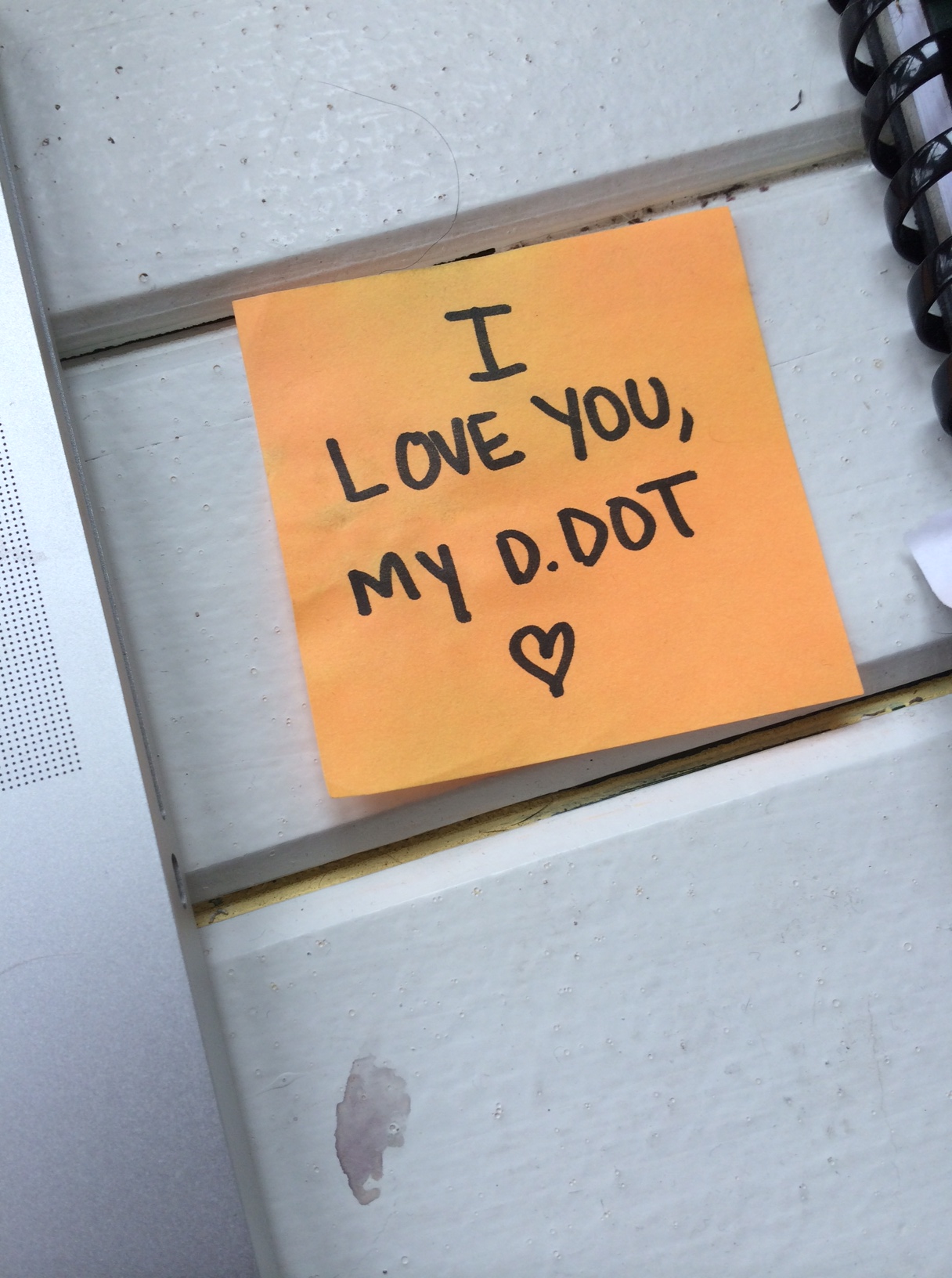
On the desk there is a wire and wood sculpture of a crow, a flour sifter stuffed with colored pencils, a little tiny picnic basket containing the sisu phone, a plant from Jen, a hanging jar holding rocks and crystals, stacks of paper and notebooks – each representing a project that is in motion, pens and pencils galore, three pink post-it notes with “right,” “left,” and “a gift from me to 2 U! Pass it on!” written on them. There is also a weathered orange post-it note by the computer with this much treasured-phrase: “I Love You, My D.Dot.” If I had to surrender all of my worldly possessions except for one, I would choose to keep the orange post-it note.photo

On Friday afternoon we will help John hang a memorial art show of his father’s paintings. It is how his dad wanted his life to be celebrated. As I was in the studio painting this morning I thought that, someday, someone might do the same for me. I wondered who might think to celebrate my life with a show of my paintings. Who might read some of what I have written? And, what if all that matters in this world can be expressed on a single orange post-it note? What if it is not the paintings or the books or plays – the things I produced? What if all that really matters is if I paid attention and loved mightily during the time allotted me? What more do I need than to have lived a life that warranted an orange post-it note?

Last night we had a band rehearsal in the sanctuary. I stepped away from Kerri, Jim, and John (the real musicians) and walked to the back of the sanctuary so I could listen to the song. It was gorgeous and they were unaware of how gorgeous it was – of how gorgeous they were. They were simply working. I was captured by the moment. I literally ached with how full and rich was the moment. I simply could not believe the depth of my good fortune. Kerri sang, Jim and John played, and I cried with the power of it all.

The moment was ordinary for them, extraordinary for me – and isn’t that always the way? The extraordinary is always waiting in the ordinary, in the post-it note, in the rehearsal, in the person passing you on the street, in the hard choice, making a meal, the sigh of the Dog-Dog in the middle of the night? Isn’t this very notion – opening the extraordinary hiding in the ordinary – the reason we live and make art? Isn’t the real practice of the artist simply a matter of stepping back so we might see it – and then share what we see?

Recognize The Gift

Kerri with her mom, Beaky

Kerri with her mom, Beaky

Late night thoughts from the ER.

Earlier in the day Beaky told me that she had no special talents and I protested! She is one of the best storytellers I’ve ever known. She’s a natural. She can’t help herself. Sit with Beaky and you’ll hear some great stories. Beaky is like the rest of us: she doesn’t recognize her greatest gift because she thinks it is ordinary. She overlooks her gift because she thinks everyone can do what she does easily. That is the way with gifts: it is in the ordinary that we ultimately recognize our extraordinary-ness.

Beaky fell and we spent the night with her in the emergency room. As we sat by her bed, waiting for the pain medication to kick in, she said, “Did I ever tell you about the time…?” We heard stories about stags leaping over the car and the late-in-life marriage of her brother.

Another gift, related to her gift of story or, perhaps, an extension of her story-gift: people smile when they hang out with Beaky, even under extreme circumstances. For instance, writhing in pain, she looked into the eyes of a nurse and said, “I wish I had some of what you have! You have such a lovely smile.” And a new story begins; the nurse moved into the hall to tell the night staff about the kind woman in room 28.

After a sleepless night, Kerri and I sat in the hospital café and talked about the lessons of life, the lessons in generosity of spirit, the instruction in Grace and the rich stories we are receiving. From this seat, not much else seems important.

title_pageGo here to buy hard copies (and Kindle) of my latest book: The Seer: The Mind of the Entrepreneur, Artist, Visionary, Innovator, Seeker, Learner, Leader, Creator,…You.

Johnny crop copySupport the Kickstarter campaign for my play, The Lost Boy

Greet The Day

photo-1Behind Beaky’s house is a retention pond. There is an alligator that occasionally breaks the surface and when it does I say, “Looking for poodles…” Kerri punches my arm and smiles.

The house is nearly empty; Beaky moved into assisted living almost 2 years ago and slowly her possessions have been packed or passed on to family members. It has been a quiet attrition, a gradual acknowledgment of the step into the next phase of life.

We stay in the house when we visit. We sip our coffee, sit in camping chairs, and watch the waters of the pond change with the progress of the morning sun. A cormorant comes each morning. It stands at the pond’s edge, spreads it’s wings, and drinks the sun. “It’s as if it is opening its heart to greet the new day,” Kerri says.

She tells me that the cormorant comes to the exact spot where, a year ago, her family gathered to spread her father’s ashes. A single cormorant came that day, too. In the middle of the rite, the bird landed, stepped into the setting sun, and spread it’s wings. Her father loved the pond. It was as if the spirit of her father came as the cormorant. It opened its heart. It greeted the sunset.

The news with Beaky is not good. I watched Beaky’s face as Kerri wheeled her from the doctor’s office. Beaky is no longer living, as she says, “indefinitely.” Her path is now definite (as I suppose all of our paths are truly definite even though we rarely consider it so). She looked relieved. She looked easy and quiet. Beaky said, “I’ve lived a good life! I’m ready.”

Now, as is true with abundant life, there is metaphor upon metaphor. There is the house. There is the alligator breaking the surface. There is the cormorant spreading its wings. There are cycles of life, passing moments, possessions never really possessed. There are stories made and stories lost. There is a family with an open heart, watching the progress of the sun, ready to greet the day.

title_pageGo here to buy hard copies (and Kindle) of my latest book: The Seer: The Mind of the Entrepreneur, Artist, Visionary, Innovator, Seeker, Learner, Leader, Creator,…You.

Or, go here for all digital forms of The Seer


OR! Go here for fine art prints of my paintings

I call this painting, "Canopy"

I call this painting, “Canopy”


Love The Game

Dog-Dog-Dog in the joy of the pursuit

Dog-Dog-Dog in the joy of the pursuit

Tripper Dog-Dog-Dog likes to chase bumblebees. He snaps at them in an attempt to catch them. He never catches them but that does not deter his endless attempts or the glee of his pursuit. He loves the chase. He loves it.

Tripper Dog-Dog-Dog also loves to be chased. He only requires something to carry, something to claim that makes the chase necessary. Any stick will do. I walk to the center of the yard, pick up the most available stick, he takes it from my hand and races away. My job is to give chase (as I pursue the Dog-Dog, I say again and again, “Give me my stick!” as if the stick was mine. Such is the power and grace of the human imagination!) Wild-eyed and joyful, he races around the yard at Mach speed, a bumblebee to my snapping dog. I never catch him but that does not deter the glee of my pursuit.

Dog-Dog is teaching me the secret to a joyful life. It is simple: love the chase. It is the glee of the pursuit. As James Carse wrote in Finite and Infinite Games, the point of the game is not to win but to continue the play. The point is to become a better and better player. In an infinite game, winning is not an outcome, it is a way of being. The point is to love playing.

I am grateful that Tripper Dog-Dog-Dog leaps for bees that are nearly impossible to catch. I am grateful that Tripper Dog-Dog-Dog runs from me even though he knows I will never catch him. When I am too tired to continue the chase, he drops the stick and circles back to where I stand huffing and puffing, ready to give him a few pets. His entire body wags with delight. His eyes shine with the thrill of the game and I laugh at his unbridled enthusiasm. He teaches me without using a single word. When I’ve caught my breath, I’ve learned to say, “Hey! Where’s my stick!” Picking any twig from the ground, he snatches it from my hand and we are off and running.

title_pageGo here to buy hard copies (and Kindle) of my latest book: The Seer: The Mind of the Entrepreneur, Artist, Visionary, Innovator, Seeker, Learner, Leader, Creator,…You.

Yoga.ForwardFoldGo here for Fine Art prints of my paintings

See It. Feel It.

I call this painting "Sleepers"

I call this painting “Sleepers”

Tom spoke of small actions, the gift of peanut butter to a food kitchen for the poor. He asked, “Will it change the world?” and answered his own question, “I don’t know. In some small way, bringing a bit of hope to anther person, or providing food for a day, maybe it will.” Tom has been meditating on the many ways we enact love but perhaps do not see. He has been wondering if small acts of generosity serve as small acts love. Are not these small acts of generosity capable of changing the world.

For the past year, since moving from Seattle and leaving my work with entrepreneurs, I’ve been pondering this impulse toward change and the ubiquitous desire to change the world. I learned last year that, in business start-ups, the intention to change people is the great sign of folly. Changing people is impossible. If the central intention of the new business is to change people, don’t invest. It’s good rule of thumb.

People pray for a world without violence, a world free of disease and poverty. People read the paper and wonder what has become of the world. Someone recently said to me, “It’s overwhelming. What can I do?”

Tom’s meditation has brought him to this: it is not the doing that ultimately matters. It is quality of the being that matters. If your doing changes your being, you have changed the world. If some small act of generosity or compassion opens you, it changes the world. In the year prior to my move, I walked across the city of Seattle twice each day. I made it a game to count the small acts of kindness I saw each day during my crossing. There were always too many to count. People opening doors for others, making space in line, helping someone who dropped their packages, blocking traffic for an elderly person to cross the street. My walks were steeped in otherwise small invisible generosities.

The mistake we make when desiring change in the world is to think of change as a bottom line, change as an outcome or end result. Change as a forced march or dose of castor oil. Changing the world is not an arrival platform. It is within every act of kindness. It is every generous thought. It is fluid, on going, never ending.

One thing I learned from my walk with entrepreneurs is that every single start-up came about because someone saw a way to make life easier for others. What makes an idea good is how effectively it helps others. And so, in pursuing their idea, in every small action, they change themselves. They play in the field of possibilities. In changing themselves, they cannot help but change the world.

Will a donation of a jar of peanut butter to a food bank change the world? Perhaps. If it feels good. If it changes you. Small acts do not exist in isolation. To change the world you need only change yourself. People do not exist in isolation. The river flows. Each act impacts others in small ways and large.

title_pageGo here for my latest book, The Seer

Go here for fine art prints of my paintingsYoga.ForwardFold

Feel The Ripple

Baby Cat settles in

Baby Cat settles in

“The fabric of creation ripples when people love each other,” the leader prayed. I opened my ipad to capture the phrase. I liked the image of creation as a dynamic living fabric, a weave responsive to the heart.

Yesterday, Jim said with gratitude and love in his eyes, “Life can change in an instant.” His wife was in a brutal head-on collision a few days ago. She survived and will eventually recover. “The crash was 900 feet from our driveway,” he said, adding, “You never know.”

You never know.

Tripper Dog-Dog-Dog jumped onto the bed. He brought his bone and settled at our feet. We were having the first cup of coffee of the day and talking about things to come. Baby Cat leaped up to the window sill and settled in.

Creation ripples.

title_pageGo here for my latest book, The Seer

Or, go here for fine art prints of my paintings

Eve, by David Robinson

Eve, by David Robinson

Carry Your Story

I call this painting, "Canopy"

I call this painting, “Canopy”

Since writing my post yesterday I’ve been rolling around in my mind the image from this quote from Deepak Chopra’s book, Life After Death: “Every former self you have left behind is a ghost. Your body is no longer the body of a child. Your thoughts, desires, fears, and hopes have changed. It would be terrible to walk around with all your dead selves holding on.”

All day I’ve been looking at people as if they are walking around with all of their dead selves hanging on. And, technically, we are. We define our present moment through the eyes of the past. I suppose the number of ghosts we carry depends upon the definition we carry about ourselves.

Definitions are stories. Thoughts, desires, fears and hopes are contained in the form of a story. Any thought you have is actually a form of storytelling. When we worry if this will happen or that, we are telling a story. When we tell our friends about being stuck in a traffic jam, we are telling a story. When we say, “This is who I am,” we are telling a story. When we say, “That is who they are,” we are telling a story. In a week, my family will gather to memorialize my grandfather; we will tell his story.

I’ve found in many parables and myths that an inner monologue (the story you tell yourself) acts like a fog. It obscures the present. For instance, in the Sisyphus tale, Sisyphus goes to the underworld and watches the souls of the newly departed cross the river Styx. Each soul thinks it is alone even though they are with many others; they cannot see the others through the curtain of their ego story. To enter the great “I am” they must first stop telling a story of separation.

Stories obscure.

We carry our stories forward. That is a legacy. Carrying a story forward is how we connect to our ancestry. Jean Houston once used an image that I like: we are the burning point of the ancestral line. We carry the story-torch forward. Like the Olympic flame our fire was ignited by a spark that stretches back eons. And through us, this flame will reach far into the future. We burn now. This story-torch, the family story, is the root story. It illuminates us.

Stories enlighten.

In both cases, obscuring and illuminating, stories can be heavy to carry. Or, they can be light. It may not be so terrible to walk around with your dead selves holding on if your dead selves tell a story love and connection, a story of hope and aspiration, a story of yearning and possibility. If illumination is the act of transcending your story, a step toward illumination certainly includes a story of love, and usefulness, and a deep appreciation of the ordinary moments that we story to fill our extraordinary days.

title_pageGo here for my latest book


Give As Love

The stack of paintings sitting in my basement waiting for me to show them.

The stack of paintings sitting in my basement waiting for me to show them.

Sitting in the choir loft this morning I was at first disappointed that the stained glass window was silent. I was so full of questions – and have lately been so full of questions – and have come to look forward to hanging out in the loft, conversing with the window, while Kerri plays a service.

When I bring my questions the window always has something to say. The window offers a better set of questions or a startling reflection or a slap of insight. The window’s responses always come in the form of a message of return (return to heart, return to forgiveness, etc.). If I get quiet and ask my question, out of the peace, a conversation always ensues. Today, from my quiet, I asked my question about artistry, about my artistry, and I was met with an unusual silence. I wrinkled my brow. I wondered if my conversation with the window had come to an end or if perhaps my question was out of the scope of topics for a stained glass window.

There was a visiting pastor, an elder who’d been preaching for over 50 years. I sat up and paid attention when he began his sermon this way:

“Artists have a special gift. They help others see in a new way….”

His message was about love. Love, he told us, takes many forms and the form that love takes depends upon the unique gifts of the lover: a symphony is a gift of love, a painting is a gift of love. A plumber fixing a broken water main late into the evening is a gift of love. “What is your gift? he asked. Do you recognize it as love?

A few years ago, on New Year’s Eve, I visited a tarot woman at a bookstore in Denver. During our session she asked me a question that felt like a cold slap in the face. “You know god’s voice,” she said. “Why do you not use it?” I mumbled a lame excuse that dribbled into silence. “Why do you not use it?” she asked again.

Sitting across the table from the tarot woman, I knew without doubt that I have, my whole life, been a great servant to other people’s artistry but a lousy servant to my own. In my life I’ve been the midwife to many people’s gifts while mine have remained mostly unrealized.

The window whispered, “A painting is a gift of love. So is a play. So is a book. These are your forms of love. Your gift is a gift of love. Love is god’s voice and you know god’s voice.”

“I do know it,” I said, timid to admit it. “Don’t we all?” I asked the window.

“Access is open to all. Few actually listen,” the window replied. “Few know how to listen. Most fear their gift and plug their ears.”

To offer my gift without inhibition is how I best express love to the world? That was old and new for me at the same time. I asked the window, “How many artists need to hear that message? How many people need to hear that message?”

“You are deflecting. You deflect your gift by serving other people’s purposes before your own. These questions you ask are the wrong questions,” said the window. “Yes, of course, all people need to hear the message. But, is it your purpose to deliver the message or is it your purpose to fulfill your gift? Helping others hear their message is not yours to do. Yours is to fulfill your gift and, in that way, help others to see their gift in a new way. You need do nothing but give your gift. They will see or not without your intervention. Love by giving your gift. It is simple. Give your gift, give your love, without reservation or doubt.”

“Love can be how you listen to a friend in need,” the pastor said. Love is not about the rules or the restrictions. Even when you try to alienate love, it will always find its way back to you. It will find its way back through you.

“You know god’s voice,” the window continued. “And you know it. Return to the truth; return to your truth. The question, ‘Why do you not use it,’ no longer matters. It, too, is a deflection. Asking ‘why’ merely delays the giving. Use it. Give it. Give as love.”

Go here to get my latest book, The Seer: The Mind of the Entrepreneur, Artist, Visionary, title_pageSeeker, Learner, Leader, Creator…You.

Or, go here for hard copies.

Love Yourself Better

this one is from the archives. I painted this 10 years ago.

this one is from the archives. I painted this 10 years ago.

He said, “The current goal is to love myself better.” And then he added, “Not so much a goal but something that needs teaching from our own mind.” His statement begs a great question, an ages old question: Can the mind teach itself? Really, the question is can the mind see itself clearly enough to teach itself?  Or, the question within the question: Can the mind teach itself to love itself? I scribbled the questions in my notebook and beneath them I wrote, “Is love teachable? Is love reachable through the mind, especially self-love?

We’d been chatting for a while and had covered a lot of territory, from Monte Blanc pens to typewriters to soap use around the world, clean water, the difference between good and bad scotch, the shapes of the 50 states and how they might influence personal identity and we’d somehow wandered into the epicenter: self-love.

His statement nailed the universal dilemma perfectly. It was a declaration of separation. The self watching and wanting more for the self. The separation is in the language: to love myself better. I don’t know anyone who hasn’t made this statement. Which part of the self will better love the other part of the self? Which part of the mind will teach the other to love?

It is where myth meets the everyday. Every human being who has walked the earth has wrangled with separation and the yearning for self-love (re-connection to self, unity). The human journey is a walk from separation (birth, if you want to take it literally) to reunification (death). The story lives in mythologies the world round. If we were still willing to read our mythologies (religions) metaphorically, we’d see it. For instance, being expelled from the Garden of Eden for eating from the tree of knowledge is the story the ancients told of the experience of separation. The inevitable bite of apple from the tree of knowledge brought duality consciousness: male/female, us/them, mine/yours, haves/have-nots, me/you. Separation. The rest of the story, not often told, is how, through out the rest of our lives, we seek the Garden where there lives a second tree: the tree of everlasting life (unity). We journey from knowledge (separation) to everlasting life (reconnection). The death need not be literal. To die to the self is necessary to experience the SELF.

Here’s the great paradox: loving another person is an act of self-love. The path to self-love is found when we serve something bigger than our selves. Think about it: the movement is always from separation to joining, from isolation to connectivity. The obvious question is, “Connectivity to what?”

Self-love is not found when the mind teaches the mind but when the mind gets out of the way of the heart. The love is always there. Love is never missing. Self-love reveals itself when the definition of self grows beyond our own skin. According to our latest neurological science, we experience ourselves as separate because we dull ourselves to our fundamental connectedness to others. In other words, we cultivate a story of isolation and then set about the real work of our lives: to see beyond what we think.

And then he said, “You know what else I just realized?”

“What’s that?” I asked.

“I just landed myself in a blog post.”

Yep.

Go here to get my latest book, The Seer: The Mind of the Entrepreneur, Artist, Visionary, title_pageSeeker, Learner, Leader, Creator…You.

Or, go here for hard copies.