Call Her Anguish [on DR Thursday]

morsel copy

It was a long night. We’ve spent the last few evenings listening to a police scanner and watching live-stream reporting of the violence in our streets. We sit on our back deck and follow the swirl of helicopters, listen to the explosions, the angry voices in the street. We have a “go” bag packed by the door. We sleep with one eye open.

The Jekyll-and-Hyde pattern of our national protests has come to roost in our city, the epicenter a few blocks from our home. Peaceful protests by day; violent destruction by night. And, each night it gets worse. Each day I scan the heart-sickening savage call-and-response of an ugly divided citizenry, a crumbling society incapable of civil discourse.

I am haunted by an article written by Wade Davis. I’ve reread it a dozen times. I will read it a dozen more. Each day new quotes arise. After watching an armed militia strut up and down the boulevards of Kenosha under the pretense/delusion of protecting the city, stand cock-guard over a dry cleaning shop, and ultimately, one young militia member [too young to drink a beer in Wisconsin but not too young to sport an automatic weapon] murdered two and maimed one of the unarmed citizens they proclaimed to protect. Alice’s wonderland makes more sense than America’s implosion. This young man was not a citizen of our town or of our state. He brought his big gun across state lines to feed his white nationalist fantasy and ended the evening a murderer who will spend the days of his life in prison. What did he imagine might happen? Waste upon waste. These are the quotes from the article that today bobbed to the top:

“The measure of wealth in a civilized nation is not the currency accumulated by the lucky few, but rather the strength and resonance of social relations and the bonds of reciprocity that connect all people in common purpose.”

“The American cult of the individual denies not just community but the very idea of society. No one owes anything to anyone. All must be prepared to fight for everything: education, shelter, food, medical care. What every prosperous and successful democracy deems to be fundamental rights — universal health care, equal access to quality public education, a social safety net for the weak, elderly, and infirmed — America dismisses as socialist indulgences, as if so many signs of weakness.”

By his measure, we are a very poor nation indeed. Violent to the core because we eschew shared responsibility, shun a common center and refuse to deal with our issues.

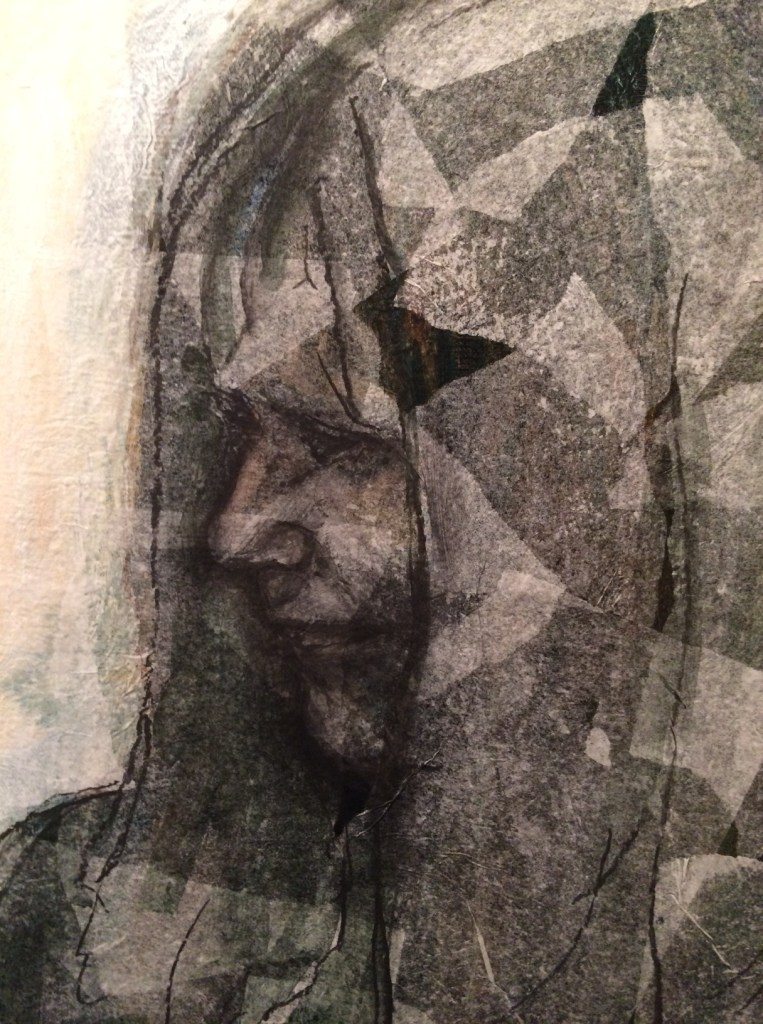
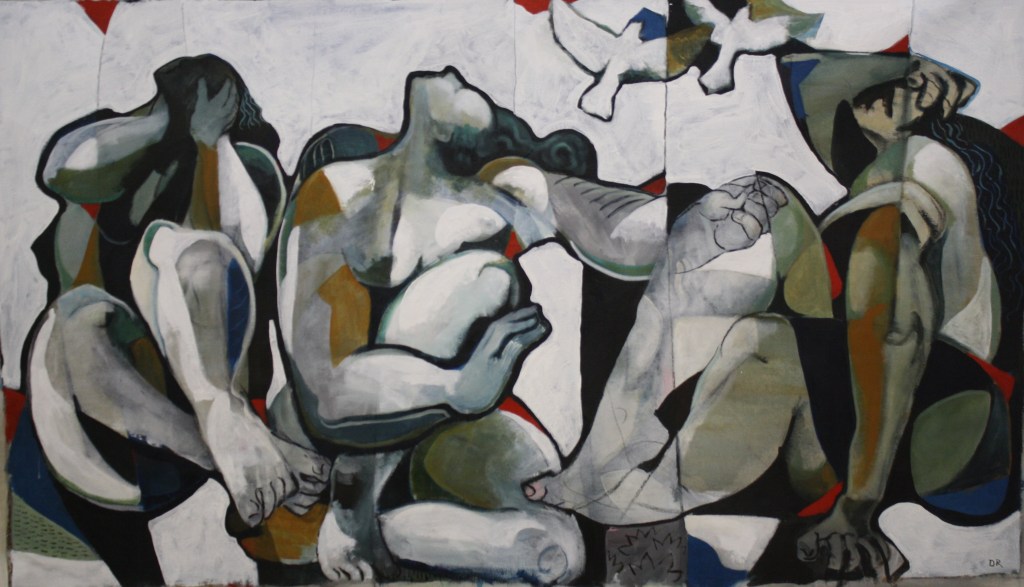
I asked Kerri to choose a piece for the Melange today. I was surprised because she selected a snippet from my painting, Three Graces. She’s not fond of this painting. Traditionally the Graces represent Muses: Brightness, Joyfulness, Bloom. Beauty, Charm, Creativity. It’s ironic.

Were I to name this fragment, this lonely Muse culled from her sisters, I think I’d call her Anguish. What else?


read Kerri’s blog post about ANGUISH


Three Graces


stick people website box copy


three graces ©️ 2012 david robinson

Step Into The Dark Wood [on Not So Flawed Wednesday]

dense copy

Midway through one of our favorite hikes, the trail cuts through a section of dense tall reeds. I feel as though I could run and jump at the wall of tightly knit green and it would reject me outright. No entrance. I always imagine there must be a magic door, a secret phrase that will unlock passage to the wonders awaiting on “the other side.” Narnia will open if I know which reed to press.

In stories, the dense woods and murky places are to be avoided. They are where the monsters lurk, the bandits hide, where witches offer poison apples to little children. The community cautions against going there but the protagonist, usually to save the community, must enter that place, the place where no one is supposed to go.

The light must turn and see the shadow. Great power is always found there. Wholeness is never experienced by standing safely in the light but is brought back into the light from the dark side of the moon.

Jonah must go into the belly of the whale. The young wife must seek the Crescent Moon Bear. Luke Skywalker has to enter the dark cave on Dagobah. Adventures are not adventurous without a step into the scary unknown. Growth and new knowledge is not accessible from a safe seat on the couch. What we find in the dense wood or dark cave is often upsetting and unsettling. Revelation creates movement. That’s the function of the shadow. The ring of power is dark and dangerous and must be thrown into the volcano if middle earth is to survive. Who will take it?

Stories are there to help us both understand and navigate our personal and communal journey through this life. They help us know what to do when we have no idea what to do.  They help us know that the answers are not easy and usually arise after a step off the lighted path. They will come after a good bit of struggle, mess and misstep. The answers are rarely at first welcome because they challenge our smallness and will inevitably crack our safe denial.

Today, sitting in our city on fire, another night of protests looming, scary rumors running rampant, I can only hope that we – as a nation – listen to the great stories, that we step with shaky legs into our dark woods and face our dragon once and for all. The great stories assure us that what we find will not be easy or welcome. It guarantees that we will make messes and mistakes. But, it reassures us that our vulnerability and willingness to go through the dark passage will one day make us strong.

It will certainly transform us. I find that intensely hopeful.


read Kerri’s blog post about DENSE


moon website box copy


See It [on Two Artists Tuesday]

IMG_3933 copy

Systems do what systems are designed to do. For instance, this seawall is a simple system designed to protect one element (land) from the other (water). Left unchecked they come together and change occurs. This wall is a system built to prevent significant changes to the coastline.

Our system, relative to black and white Americans, as stated in the colonial records and enacted through legislation, was designed to keep the two groups from uniting. Division by design.

The law [the Virginia Slave Codes of 1705] was devised to establish a greater level of control over the rising African slave population of Virginia. It also served to socially segregate white colonists from black slaves making them disparate groups hindering their ability to unite. A unity of the commoners was a perceived fear of the Virginia aristocracy which had to be addressed, and who wished to prevent a repeat of events such asBacon’s Rebellion, occurring 29 years prior.” [Wikipedia, An act concerning Servants & Slaves]

A unity of commoners is to be feared. To that end, African Americans were determined through legislation to be less-than-human, three-fifths to be exact. No other group in our history have been institutionalized, bills debated and passed into colonial law, as sub-human.  When we see signs that read “Black Lives Matter” it speaks to a systemic definition, a system that to this day is doing what it was designed to do. African Americans simply want their two-fifths recognized and returned.

To match the denigration of black Americans, poor (non-land-owning) whites were given a promotion, new rights and status. “Many of the European-descended poor whites began to identify themselves, if not directly with the rich whites, certainly with being white. And here you get the emergence of this idea of a white race as a way to distinguish themselves from those dark-skinned people who they associate with perpetual slavery.” [Facing History & Ourselves]

The system only works if pushing the black head down is the mechanism that elevates the white head. The police are merely servants of the system. To redefine the police, through funding changes or otherwise, will not address the root of the pattern. The system will reinvent itself in another form because that is what systems do.

America has a pronoun problem. As I write this I am sitting in my smoke-filled house in Kenosha, Wisconsin. Downtown is burning in reaction to Jacob Blake’s shooting. A quick scroll through the Kenosha Facebook page and I read again and again this question, “What do they want?” THEY. Not a hint of WE to be found. The system is working perfectly to prevent the unity of commoners.

Yesterday, I wrote to my pal David that nothing has changed. I was in Los Angeles in 1991 during the Rodney King riots. I watched Los Angeles burn. Today I am watching the destruction of downtown Kenosha. To understand the violence of the response you need look no further than the violence present in the two videos. In a routine traffic stop, Rodney King was pulled from his car and beaten nearly to death. Jacob Blake, an unarmed black man, was shot seven times in the back. In a situation where no club was necessary, a black man was brutally beaten. In a situation where no gun was necessary, a black man was shot seven time in the back. Is the burning of the city more or less repugnant and out-of-proportion than the violence that incited the flames?

My point: The violence is already present. It is the seawall erected through law to prevent the two groups, black and white, from coming together. Slavery was violent. Jim Crow was violent. This latest iteration is, not surprisingly, violent. It’s how the system maintains itself. The form changes but they system remains constant. The violence prevents the unity of commoners.

Finally, consider this: “With the COVID crisis, 40 million Americans lost their jobs, and 3.3 million businesses shut down, including 41 percent of all black-owned enterprises. Black Americans, who significantly outnumber whites in federal prisons despite being but 13 percent of the population, are suffering shockingly high rates of morbidity and mortality, dying at nearly three times the rate of white Americans. The cardinal rule of American social policy — don’t let any ethnic group get below the blacks, or allow anyone to suffer more indignities — rang true even in a pandemic, as if the virus was taking its cues from American history.” [Wade Davis, The Unraveling Of America, RollingStone Magazine, 8.6.2020]

So, if you are one of the legion asking this question, “How can this be happening?” I suggest you ponder this: how could it not be happening. It’s by design.

If you are one of the many wondering what can be done, begin by paying attention to how YOU are participating in the design. And then, perhaps, all us can begin the difficult search to find a path to WE.


read Kerri’s blog post about the SEAWALL


? website box copy


Read The River [on Merely A Thought Monday]

an old river copy

The great gift of writing this blog is that I now have ten years of recorded ramblings and ruminations. I have an almanac of my thought patterns, a rolling document of what really matters most to me. I  periodically revisit what I wrote five or ten years ago. My visits to the past never fail to surprise me.

I’m chewing on the same stuff. I’m rolling around the same ideas. You’d be shocked – as I am – at how many times I’ve had the same revelation, thinking it was the first time. Yet, since my writing serves as a map to my revelation cycle, I can also see how the man having the old-revelation-anew is not the same man. I have the old revelation through new eyes. Perhaps that is why I have these revelations again and again. Discovery as rediscovery. New perspective makes the old revelation vital again.

As I’ve written before, I feel as if I am living the Parcival story. When I was young I failed in The Grail Castle.  I didn’t speak my truth. Rather, I did as I was taught, practiced my good social training, and withheld my voice as a proper knight should. Should. I started writing my blog when I was wearing armor, riding around the kingdom attempting to slay dragons and fight ogres to make up for the wasteland I’d created. I won my battles but lost my war – just as the story prescribed.

Now, I read about my battles sitting in the forest, having dropped my armor. Having mourned my defeat. Having lost my way. Having passed through the frustration and fear and anger that comes with lost-ness. Having relaxed into chopping wood and carrying water. Having the same old revelation again and again.

The story, this life story that we live, is a story of letting go, of paring down. Dropping the “shoulds.” Simplifying to the point that recognizing who we are is of much greater import than who we should be. Inhabiting the present moment is most often the abolition of “should.”

One of the greatest lessons I taught but failed to grock is, “suspend your judgments and learn.” ‘Should’ is a judgment by another name. A self-judgment. Armor. Mechanisms that separate. What story do I tell that separates me from this moment? What story do I tell that separates me from delighting in my self just as I am – and not as what I think I should be? What limits do I impose on my story and why?

Life, I’m learning, is one long lesson about the illusion of separation. We spend the first half of our days creating distance and the second half closing the gap-of-our-own-creation.

So, this morning I sit with my blog. I read the chronicle, this old river, and laugh at what I’ve apparently always known but refused to learn. The old story comes with a consistent bit of wise and useful advice: let go. No one but you tells the old story. No one but you misses seeing the Grail Castle that, as the hermit-in-the-woods giggles when it appears a second time to Parcival, “Boy, it’s been there all along.”


read Kerri’s blog post about AN OLD RIVER


turkey on the roof website box copy


Question It [on KS Friday]

bridge box copy

Mist covers the mountain and the mountain disappears.

I just learned a new term: astroturfing: “…the practice of masking the sponsors of a message or organization to make it appear as though it originates from and is supported by grassroots participants. It is a practice intended to give the statements or organizations credibility by withholding information about the source’s financial connection.” ~wikipedia

This morning I stumbled onto this term because someone we love has swallowed the bait and jumped enthusiastically into a conspiracy sink hole. It took us less than 30 seconds to research the organization and discover its connection to Russian bots. It’s a mirage meant to attract the lazy-minded and whip them into malcontents. Pull the curtain and Oz is revealed as nothing more than a 2nd rate magician who understands the power of slight of hand. Look over there.

I feel as though I could and should use this quote every day:

“There is a cult of ignorance in the United States, and there has always been. The strain of anti-intellectualism has been a constant thread winding its way through our political and cultural life, nurtured by the false notion that democracy means that ‘my ignorance is just as good as your knowledge.” ~ Isaac Asimov

The real problem of our nation in these times is a dedication to ignorance. It took us less than 30 seconds to pull the curtain on this cult-sham-of-angry-misinformation meant to influence our elections. Yet, we know that no amount of love or appeal matters. Our loved one is lost. It is the nature of cults to provide absolute answers to the fearful. The cult provides the appearance of comfort and community. “Welcome!” The organizing principle is always Us versus Them with the not-so-subtle doctrine that Us is superior to Them. It is the nature of cults to isolate their members, play on their low self-esteem, steel them against fact or reason or the appeals of loved ones to open their eyes. It is an aspect of cults that the adherents have no idea that they are in a cult.

There’s no use shouting, “Wait! Look! Open your eyes!” We have become the enemy, Them. We are inferior and data and fact are an an assault on the comfort, the easy answer, a threat to new-found absolute superiority. The tub of purple Koolaid has already been distributed and consumed by the faithful.

I remember teaching students to check their sources. It’s become even more important in the age of the internet and social media. Kerri and I hold ourselves to that standard. We check our media. We check the sources of our media checks. It is a simple basic: don’t believe everything you hear. Check it. It is the hard line separating ignorance from knowledge. We cannot have a debate of ideas and ideals without it. We cannot build a bridge to the center, to compromise and collaboration, if astro-turf  manipulation is so easily embraced as a grassroots movement, if dedicated ignorance is comparable to research, study and questioning.

30 seconds. It seems like such a small thing to ask, a simple kick of the tire. Check what your hear. Question what you are being sold. A question is never an assault on belief.

Yet, it seems too much to ask. We watch as the mist descends. The mountain disappears.


Kerri’s albums are available on iTunes


read Kerri’s blog post about BRIDGE


ruler website box copy


bridge/as it is ©️ 2004 kerri sherwood

Bring It [on DR Thursday]

InstrumentofPeace copy 2

This painting, or snippets of this painting, has found its way into more Melange posts than any other. An Instrument of Peace. It’s a big canvas. It’s an even bigger meditation.

The words are a mish-mash of the Prayer of St. Francis which was not at all written by St. Francis. Its author is anonymous. The Franciscan Order notes that the prayer is too “me” focused to be something that Francis would have written. Let me bring love. Let me bring pardon. Let me bring union, truth, faith, hope, light, joy. Let me be an instrument of your peace. Let me bring.

It’s a prayer of intention. Let me not be reactive.

It’s an appeal that speaks directly to our current climate. Let me respond to fiery times and dedicated division from my better nature. Where there is discord, let me bring union.

Ideals and idealists are often written off as being so much pie-in-the-sky. Idealists, like Gandhi or Martin Luther King, understood that union is not an elimination of differing points of view. It is not utopian or singular. It is wildly diverse and collaborative. Compromise is a meeting ground of unlike minds in service to a common cause.

More than once I have walked into a room populated with dedicated diametrically opposed points of view. Wood cutters and tree huggers.  There is always common ground to be found. Trees are a vulnerable livelihood. Trees as vulnerable heritage.  The conversation begins in vulnerability. More than once I left a room populated with people who found a place to begin, a shared middle ground. The most amazing moment happens when everyone in the room realizes that the middle ground was always present, it was there all along. It becomes crystal clear in shared vulnerability.

It’s possible, regardless of dedicated belief, to bring the middle ground. Yes, bring it. Too often we shout across it so it remains invisible. Too often we plant our flags and defend our territory and justify our position before we check a fact; we listen through a lens of righteousness. Bringing middle ground requires nothing more than a desire to leave behind our dedicated reactivity, our stalwart indignation, and enter the conversation with an intention. Let me bring union. Let me be an instrument of peace. Peace is, after all, nothing more or nothing less than an intention.


read Kerri’s blog post about PEACE


seagull in fog website box copy


ddot studio copy


instrument of peace ©️ 2015 david robinson

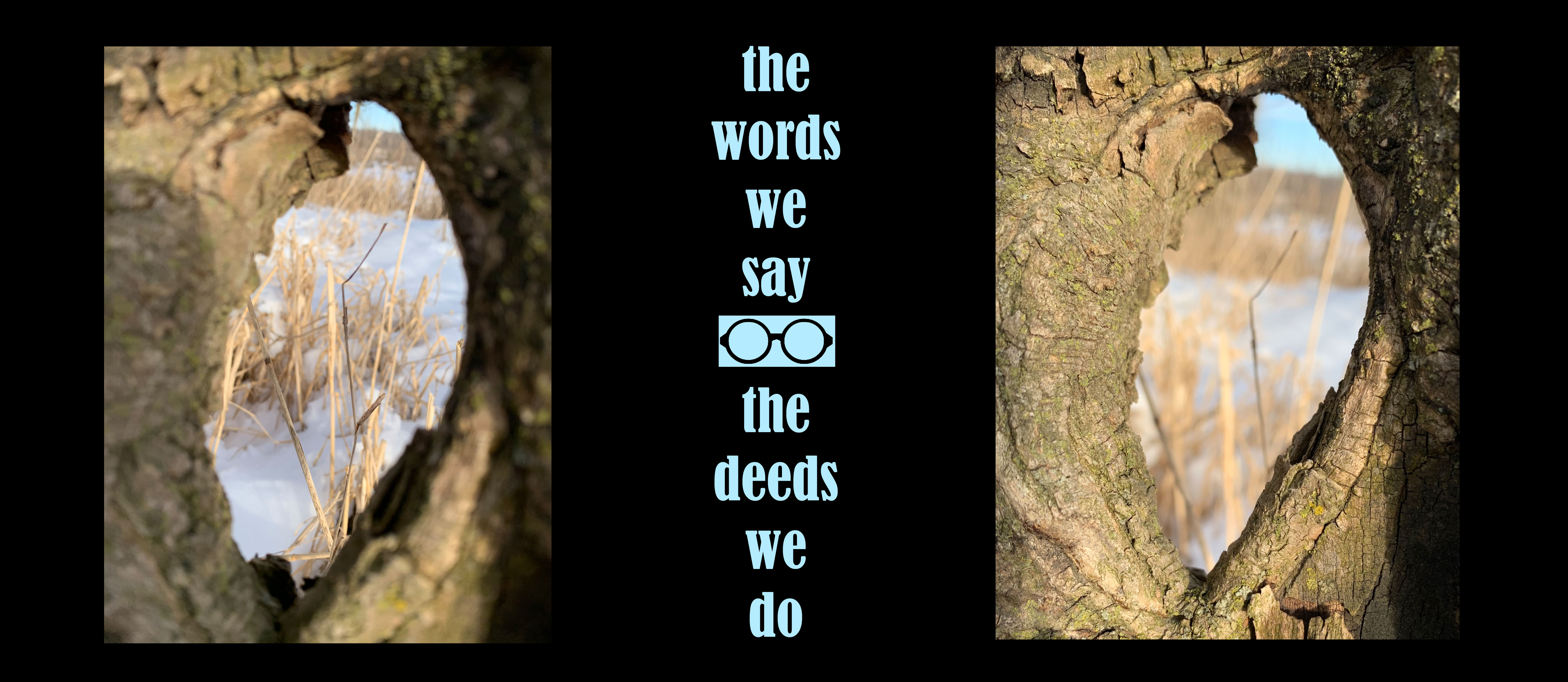
See And Speak [on Not So Flawed Wednesday]

there comes a time when silence copy

We were sitting on a concrete wall, taking a break, when he asked the question. I’ve been asked this very question more times than I care to count and I did what I always do: I took a breath. When you facilitate conversations on diversity and culture change, this question is always lurking somewhere in the room, waiting for a break, a side conversation, so it can be given voice without ramification. Truth often steps forward at the water cooler. It was the question that illuminated for me the real problem with race in America and the mountain we need to move. “Don’t you think black people cause their own problems?” he suggested.

Breathe.

No. I don’t. I believe privilege is blind to itself. And, isn’t this the very conversation we need to have happen in the middle of the room and not at the margins? The mark of institutional racism is that it is utterly invisible to the privileged class.

In the United States we hear a lot these days about tribes and information bubbles as if they were a new phenomenon.  They are not new. Our bubbles, like all bubbled history, is meant to cleanse the narrative to justify the indefensible, to hide the ugly behind a noble mask. Here’s a phrase from our history: The ruling class responded [to Bacon’s Rebellion] by hardening the racial caste of slavery in an attempt to divide the two races from subsequent united uprisings with the passage of The Virginia Slave Codes of 1705.

If you are white in America this might not yet have pierced your bubble. Note these phrases relative to the history you learned in school. It might help to understand the system at play in our current historical attempt to change systemic racism: Ruling class. Harden the racial caste of slavery [yes, a created caste system. The system of slavery was erected and black Americans were legally defined as lesser beings]. Divide the two races [black & white]. The point of the black/white division was and is to prevent subsequent uprisings against the ruling class. Ruling class.  The division we wrestle with was intentional, crafted for a specific purpose, and systematized. It serves the same institutional purpose to this day.

Another tidbit worth gnawing on: According to the Oxford English Dictionary, the first appearance in print of the adjective white in reference to “a white man, a person of a race distinguished by a light complexion” was in 1671. Colonial charters and other official documents written in the 1600s and early 1700s rarely refer to European colonists as white.

If we are learning anything in these days of fox propaganda and pandemic tales it is the power of people to entrench in their narrative despite data, fact, and personal experience that disputes the narrative. Systematize a narrative and it is nearly impossible to challenge. No see, no hear, no speak. Systems, as I learned in school, are living things – not mechanical – and will fight to the death to keep themselves alive. We are currently watching the fight of a systemic challenge.

The question at the water cooler, “Don’t you think black people create their own problems?” was always asked in earnest. It revealed the successful hardening of racial caste, the power of the mechanism preventing the uniting of the races so as to ensure no possible subsequent uprisings. Us. Them. Bubbles. A vicious cycle.

It’s hard to see a mountain when you are sitting on it. We The People. Ruling class. These two phrases are incompatible but co-exist through the successful creation of division. It’s black and white.

We have a long history and have worked very hard not to see what is right before our eyes. The second rule of systems change: if you know where you are going then it is not change but repetition. Rearranging the deck chairs on the Titanic.

The opportunity for change is, once again, upon us. The conversation needs to move to the center of the communal square and we need to muster the courage to step into unknown territory. Silence and denial are not now nor ever have been valid excuses for perpetuating an ugly system. We betray ourselves.

“When you see something that is not right, not fair, not just, you have to speak up. You have to say something. You have to do something.” ~ John Lewis


read Kerri’s blog post about SILENCE


sunrisewebsite copy

Value The Cake [on Two Artists Tuesday]

available copy

When you choose an artist’s path the odds are you will always be looking for work. In the United States it is the rare artist that makes their living through their artistry. Staying afloat requires a layer-cake-strategy: the bottom layer is the job you take to make money (waiting tables). The second layer is the job you take that somehow relates or comes close to the artistry (teaching). The top layer, the holy grail layer, is the art itself. Few artists resent or resist this reality. They are called to it. It’s more a question of who they are than what they choose to do. It’s also true that few artists survive the hardship beyond the age of 30.

In my life I have dug ditches, cleaned chicken coups, delivered bread, unloaded mattresses from semis, waited tables and been licensed as a massage therapist (to name only a few). I’ve been credentialed twice, been an adjunct professor a few times, founded an experiential learning program, been a general manager and managing director of theatre companies, and an artistic director twice. I’ve had a consulting practice, an international coaching practice, run around in the world of entrepreneurs, drawn cartoons and children’s books. I’ve painted all my life. I’ve directed plays and written plays. I have seven book outlines in my files, none of which will make it to a final form. I’ve performed with symphonies, written and told stories at conferences. At this point, I have a very hard time answering the dinner party question, “So, what do you do?”

What do I do? My friends in Seattle used to tell me that I was the most successful unsuccessful person that they knew. Yes. I am an artist.

If I answer the dinner-party-question with the truth, I am an artist, the inevitable follow-up question,”Do you make a living doing that?” used to make me cringe and feel as though I needed to hide or make excuses for my life. Or lie. “Well, I have this layer cake…” Last year my dear friend, Dwight, popped back into my life for an evening. He asked the question and I started the old tap-dance. I thought if I talked long enough I might find credibility in the eyes of my friend. And, then I remembered that the life lesson is not to find credibility in my friend’s eye, but in my own. I stopped the dance and said, “I don’t know what I’m doing.” We laughed.

I do know this: I am an artist. I chose this path and it chose me. Sometimes I make money through my work. Mostly I do not. I’ve tried putting that piece of myself on the shelf in the closet and I failed. I can’t do it. Artistry, for me, is about much more than making paintings or plays. It is not something I do. It is something I am. It’s a path, a way of fully living this life.

I am in the job hunt cycle again. Writing resumes feels akin to answering the dinner-party-question. How can I make you see that I have value when the only value you recognize is monetary? I can’t. How can I make potential employers see value in my rich diverse set of experiences and, therefore, skills, when the bot weeds me out because I am not singular? I can’t. What the HR-world sees as unfocused is, in actuality, a hyper focus. How can I make the HR-world see the rich value of an artist when they only understand the word as an ego-uplift-phrase for hard working sandwich makers? I can’t.

I just read this question: what are the limits you have set for your life? Many years ago I worked with a man. He owned a tent and party supply business. He worked very, very hard. He drank too much. He bought the business on the day he forever stopped playing his trumpet for a living. I asked if he ever missed playing. He looked away and said, “I can’t think about it.”

I think about it everyday. And, luckily for me, I know beyond doubt that my artistry is central, essential. It is who I am, not what I do. It is not a word I’d pair with “sandwich.” It is what calls me beyond limits. It serves as a constant threshold. It stirs me, challenges me, causes me to listen deeply and feel keenly. It requires me to take chances. It asks me to open my eyes and see beyond what I think. Is there value in that?


read Kerri’s blog post about ARTISTS (sandwich and otherwise)


donnieandmarie uke website box copy


Pick Up [on Merely A Thought Monday]

unicorn store 4 copy

I fell into the word “providence” because of a contradiction. Its synonyms are fate, destiny, kismet and predestination. No surprise there. Yet, also mingling among the synonyms list are these words: chance, circumstance, luck, and accident. As if that was not contradiction enough, also on the list is the winner of the most-foreboding-word prize: nemesis. The inescapable agent of your downfall.

What if your destiny is also your nemesis? That Loch Ness monster of words, “curse,” rises to the surface.

I’ve coached many, many people in my life. The majority were attempting to identify their “purpose” or somehow reach beyond an obstacle to fully inhabit “what they were meant to do.” They felt providence was calling and they couldn’t get to the phone. Or, they felt providence was calling and were afraid to answer the phone. Sometimes the dream arrives and the dreamer runs for cover. What if the dream rips off the cover and exposes the truth-of-me? And, why would destiny call if I couldn’t pick up? Is destiny cruel?

Providence or chance? Are we supported in this vast universe or is it all a matter of happenstance? Or, peel the paint from the question and it’s possible it’s not about kismet at all. It’s about the desire to control or at least an explanation that makes sense. Who doesn’t want to feel in control their destiny? Who doesn’t want to believe that they are supported, blessed, guided, or destined? And what happens to that dedicated belief when the hurricane comes or COVID?

And, what if none of that matters? Aesop reminds us that curses might be blessings and vice versa. Perspective reveals both faces so why get wrapped up either way?

What if that hard puritan word, purpose, was softened just a bit by the equal but more-to-the point-phrase: follow your heart. Purpose is a head-word. A true calling or yearning never comes from that head place. A heart calls. Purpose likes to be sought.

Listening to my clients, I wrote these two sentences more times than I can count: The actions we need to take are almost always easy. The story we wrap around the actions make them seem difficult. The steps are simple. The story wrapped around the simplicity is often full of shame, fear, and that most mighty horror-of -horrors: failure. What if I fail? Better not answer that providence phone or dare to dream! Look to the actions. Take one.

Hearts call. That often looks like caring and caring almost always begs for an action. One  simple action. And another.  A step toward a true heart-call promises abundant surprise but never-ever comes with a guarantee.


read Kerri’s blog post about CARING AND FAILURE

I’m baking Kerri a cake with a file baked in it so that she might escape the Facebook jail. In case the FB guards eat the cake (and, therefore, detect the file) before it makes it to my dainty duck, it might be a good idea to subscribe to her blog. Unless I can bust her out, she might be in lock up for sometime to come.


HH waves feet website box copy


Stack It High [on KS Friday]

a shred of hope copy

It’s day 4 of the salmonella blues. We think the offender was the green onion in the tabouli. We made a big batch on Sunday and it was delicious. And then it wasn’t. If it was possible for our world to get even smaller, more constrained, we found the way.

If we wanted to, we would stack the tales of woe one upon the other: pandemic, broken wrists, lost jobs, and today, the top of the woe-stack would be bad onions. We simply do not want to focus on that particular stack. So, instead, we stack our tales of gratitude: we are safe in our home, we have ridiculous amounts of love for our crazy dog and oversized cat, we are healthy (mostly), we have each other, we have incredible family and friends. We live our art. In fact, during the moments we feel sorry for ourselves, all we need do is slide the stacks together for side-by-side comparison. The gratitude stack is a mighty mountain next to the wimpy stack of woe.

This morning, when we felt that we could sit upright, we went into Kerri’s studio. She brought a word to mind and began playing, improvising. My job, as always, was to hit the record-button and stand still. What she played lifted me. I couldn’t help but look out the window, the sun sparkled in the leaves of the tree out front. I was overwhelmed by the feeling that everything was going to be alright. No matter what.

I told her about my feeling and she said, “Oh, that’s good! The word I chose to play was ‘hope.'”

What’s atop the gratitude-stack today? A little shred of hope.


Kerri’s albums are available on iTunes


read Kerri’s blog post about A SHRED OF HOPE

Kerri lingers in Facebook limbo. Everyday I ask with increasing mock-suspicion, “What exactly did you do?” Her indignation resurrects her almost-lost Long Island accent, “Idintdoanything!” she huffs. So, if you desire that I might live another day, consider subscribing to her blog. It will keep me out of trouble and for that I will chuck you on top of the stack of gratitude. The view is excellent up there so give it some thought.


close-up Arches with website box copy


a shred of hope ©️ 2020 kerri sherwood

a day at the beach ©️ 2017 david robinson